1
Theoretical Foundation of Nursing
(Jean Watson Caring-Model)
College of
Health Science
Department of Nursing and Midwifery
Postgraduate Nursing Program
2
Out Line of the Presentation
Objective of the presentation
Background of Jean Watson
Jean Watson Caring model
Meta-paradigm
Application of caring model
Analysis of the model
Strength of caring model
Weakness of caring model
Conclusion of caring model
3
Objective of the presentation
• After completing this model, the students will be able
to:
•Describe the background of jean watson
•Describe jean Watson's caring model
•Describe jean watson Metaparadigm
•Describe the application of caring model
•Know the strengths and weakness of caring models
4
Background of Jean Watson
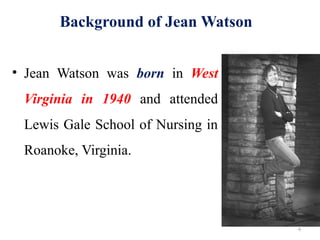
• Jean Watson was born in West
Virginia in 1940 and attended
Lewis Gale School of Nursing in
Roanoke, Virginia.
5
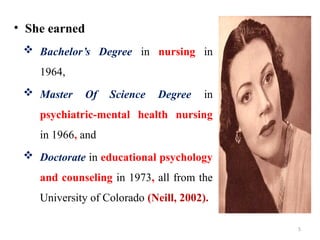
• She earned
 Bachelor’s Degree in nursing in
1964,
 Master Of Science Degree in
psychiatric-mental health nursing
in 1966, and
 Doctorate in educational psychology
and counseling in 1973, all from the
University of Colorado (Neill, 2002).
6
Background conti…
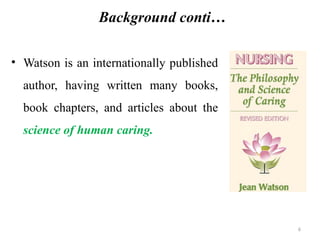
• Watson is an internationally published
author, having written many books,
book chapters, and articles about the
science of human caring.
7
Background conti…
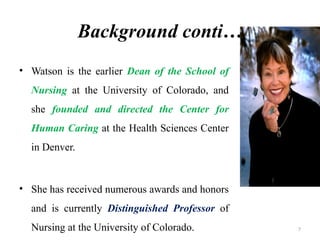
• Watson is the earlier Dean of the School of
Nursing at the University of Colorado, and
she founded and directed the Center for
Human Caring at the Health Sciences Center
in Denver.
• She has received numerous awards and honors
and is currently Distinguished Professor of
Nursing at the University of Colorado.
8
Background conti…
• Dr. Watson developed one of the newest nursing grand
theories, her descriptive theory of caring in 1979
incorporating spiritual dimensions into nursing
practice.
• Dr. Watson modified and broadened her theory of
caring science which was published in 2005.
9
Background conti…
• She contributes two major life changes in a short
time to influencing her more advanced theory of
caring science in nursing; the loss of her left eye in
an accident in 1997 and the loss of her husband of
thirty seven years in 1998.
10
Jean Watson - Caring Model
• The Theory of Human Caring was developed between
1975 and 1979 while she was teaching at the University
of Colorado.
• It emerged from their own views of nursing, combined
and informed by the doctoral studies in educational-
clinical and social psychology.
11
the theory….
• She says nursing is distinct health profession that had
its own unique values, knowledge, and practices, and
its own ethic and mission to society.
• It required unique caring-healing arts and a
framework called “carative factors,”.
12
• The major conceptual elements of the theory
are.
Ten carative factors (evolving toward
“clinical caritas processes”)
Transpersonal caring relationship
Caring moment/caring occasion
Caring-healing modalities
13
Ten Carative Factors
• The original (1979) work was organized around 10
carative factors as a framework for providing a format
and focus for nursing phenomena.
• was to provide a framework for the “core of nursing”.
Watson referred to the “core” as the philosophy,
science and art of caring .
14
Conti…
• This emerging model of transpersonal caring moves
from carative to caritas.
• Caritas comes from the Greek word meaning
to cherish and appreciate,
giving special attention to,
or loving.
15
Conti…
• when we include caring and love in our work and in
our life that we discover and confirm that nursing,
like teaching, is more than just a job; it is also a life-
giving and life-receiving career for a lifetime of
growth and learning.
16
Conti…
• As we enter into the transpersonal caring theory and
philosophy, we simultaneously are challenged to
relocate ourselves in these emerging ideas and to
question for ourselves how the theory speaks to us.
• This requests us into a new relationship with
ourselves and our ideas about life, nursing, and
theory.
17
The 10 Carative Factors are
1. Formation of a humanistic-altruistic system of
values.
2. Instillation of faith-hope.
3. Cultivation of sensitivity to one’s self and to others.
4. Development of a helping-trusting, human caring
relationship.
5. Promotion and acceptance of the expression of
positive and negative feelings
18
Conti…
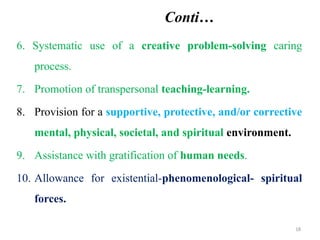
6. Systematic use of a creative problem-solving caring
process.
7. Promotion of transpersonal teaching-learning.
8. Provision for a supportive, protective, and/or corrective
mental, physical, societal, and spiritual environment.
9. Assistance with gratification of human needs.
10. Allowance for existential-phenomenological- spiritual
forces.
19
Transpersonal Caring Relationship
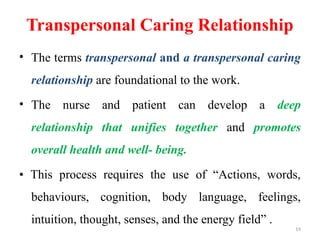
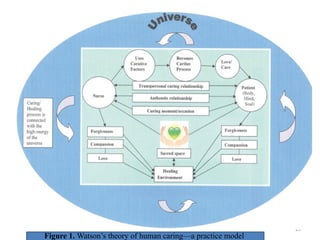
• The terms transpersonal and a transpersonal caring
relationship are foundational to the work.
• The nurse and patient can develop a deep
relationship that unifies together and promotes
overall health and well- being.
• This process requires the use of “Actions, words,
behaviours, cognition, body language, feelings,
intuition, thought, senses, and the energy field” .
20
Conti…
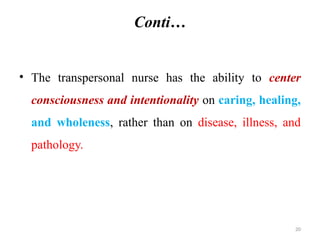
• The transpersonal nurse has the ability to center
consciousness and intentionality on caring, healing,
and wholeness, rather than on disease, illness, and
pathology.
21
Caring Moment/Caring Occasion
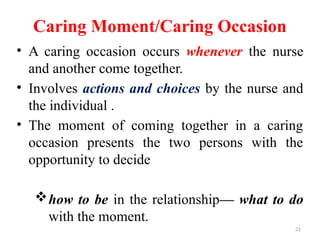
• A caring occasion occurs whenever the nurse
and another come together.
• Involves actions and choices by the nurse and
the individual .
• The moment of coming together in a caring
occasion presents the two persons with the
opportunity to decide
how to be in the relationship— what to do
with the moment.
22
Conti…
• If the caring moment is transpersonal, each
feels a connection with the other at the spirit
level.
23
Caring (Healing) Consciousness
• The dynamic of transpersonal caring (healing) within
a caring moment is manifest in a field of
consciousness.
• The transpersonal dimensions of a caring moment are
affected by the nurse’s consciousness in the caring
moment, which in turn affects the field of the whole.
24
Caring-healing modalities
• are often noninvasive, nondisturbing, natural-human,
energetic environmental field modalities.
• Advanced transpersonal caring modalities draw upon
multiple ways of knowing and being; they encompass
ethical and relational caring,
25
Figure 1. Watson’s theory of human caring—a practice model
26
Meta-paradigm
• Watson defines three of the four met paradigm
concepts in nursing including person or human
being, health, and nursing. They are defined as
follows:
27
• Human being: A person of value to be cared for, understood,
nurtured and respected.
• Health: Unity and harmony of mind, body and soul associated
with congruence between perceived and experienced self.
• Nursing: A science of persons and health-illness experience
that are intervenes by professional, personal, scientific, and
ethical care interactions.
28
Application of Jean Watson’s Theory of
Human Caring
• Transpersonal Caring Theory and the caring
model “can be read, taught, learned about,
studied, researched and even practiced:
29
Practice
• Watson’s theory has been validated in outpatient,
inpatient, and community health clinical settings and
with various populations, including recent applications
with attention to patient care essentials, living on a
ventilator ,and simulating care.
30
Conti…
• Watson and Foster (2003) described an exemplary
application of theory to practice;
• The Attending Nurse Caring Model (ANCM) is a
unique pilot project in a Denver children’s hospital.
• The ANCM is concerned with the nursing care
model.
“It is constructed as a Nursing-Caring Science,
theory-guided, evidence based, collaborative practice
model for applying it to the conduct and oversight of
pain management on a 37-bed, post surgical unit”.
31
Conti…
• Nurses who participate in the project learn
about Watson’s caring theory, carative factors,
caring consciousness, intentionality, and
caring-healing practices.
32
Administration/Leadership
• Watson’s theory calls for administrative practices and
business models to embrace caring, even in a health care
environment.
• It address health care system reform at a deep and
ethical level, and that enable nurses to follow their own
professional practice model.
33
Education
• Watson’s writings focus on educating graduate nursing
students and providing them with ontological, ethical,
and epistemological bases for their practice, along with
research directions.
• Watson’s caring framework has been educated in
numerous baccalaureate nursing curricula.
• In addition, the concepts are used in nursing programs in
Australia, Japan, Brazil, Finland, Saudi Arabia, Sweden,
and the United Kingdom.
34
Research
• Qualitative, naturalistic, and phenomenological
methods are relevant to the study of caring and to the
development of nursing as a human science.
• Watson suggests that a combination of qualitative-
quantitative inquiry may be useful.
• The national and international research that tests,
expands, and evaluates the theory.
• Smith (2004) published a review of 40 research
studies that specifcally used Watson’s theory.
35
Assumption
• Jean Watson's theory of caring is based on
seven main assumptions.
• These assumptions are the foundation for the
theory of caring.
36
These Assumptions are:
1. Caring can be effectively demonstrated and
practiced only interpersonally.
2. Caring consists of carative factors that result in
the satisfaction of certain human needs.
3. Effective caring promotes health and individual
or family growth.
4. Caring responses accept person not only as he or
she is now but as what he or she may become.
37
5. A caring environment is one that offers the
development of potential while allowing the person
to choose the best action for himself or herself at a
given point in time.
6. Caring is more “healthogenic” than is curing.
• A science of caring is complementary to the
science of curing.
• caring and curing need to coexist for the individual
to achieve their maximum health potential.
38
Conti…
7. The practice of caring is central to nursing.
• Caring is at the center of nursing practice.
• Nurses must engage in caring in order to be
effective at improving the health and wellness
of their patients.
39
Analysis
• The theory of caring is
logical in nature,
relatively simple in content,
generalizable and
applicable to most any area of nursing.
• can be used in a variety of health care settings to guide
and improve practice.
• Her theoretical work is supported by numerous
humanists, philosophers, developmentalists and
psychologists
40
Conti…
• Watson's extensive background in philosophy and
psychology played a key role in the development of
her theory of caring.
• She drew parts of her theory from nursing writers like
Nightingale and Rogers and utilized concepts from
her extensive experience in psychology and
philosophy.
41
Conti…
• It follow closest with the Human Interaction Model
because it stresses the importance of human
interactions.
• This model is based on believing that humans are
holistic beings that interact within the situation they
find themselves and that there is constant interaction
between humans and their environment.
42
Strengths and weakness
• The science of caring theory has strengths and
weakness as a theory and as it applies to
nursing practice.
43
Strengths of the theory
• The major components of the science of caring
enhances the nurse-patient interaction and
improve practice for patients.
• It is personal in nature and based on the value
system of the individual.
• Nursing practice becomes personalized while at
the same time less generic and technical in nature.
• The client becomes the focus of care and not the
technology available for treatments.
• Caring science empowers patients to take control
and maintain their health.
44
weaknesses of Watson's theory
The biophysical needs of the patient are given less
importance and the main focus is on the psychosocial
needs of the individual.
The science of philosophy is open to interpretation
which allows many ambiguities that may lead to ha rd
implementation in practice.
The more psychosocial the theory the less practical it
becomes to every day nursing practice.
45
Conclusion of the theory
• Watson’s theory provides a generalized framework for
nurses that can be applied in many different situations
and places.
• As the population ages and the health care system is
more taxed, Watson's theory will remain a key factor for
all nurses to study and apply as they provide care for
their patients.
• Watson's theory can be utilized by advanced practice
nurses in several ways.
46
Conti…
• her theory has been shown to be very useful in
academic programs and educational settings.
• Nurse educators can help empower nursing
students and promote their psychosocial wellness
by utilizing caring science theory.
• Clinical Nurse Leaders can also use
caring science to engage the nurses on their unit
and help promote the developement of trusting
relationships between both nurse leaders and
clinical nurses as well as nurses and their patients.
47
Conti…
• Dr. Watson modified and broadened her theory
of caring science which was published in
2005.
• She contributes two major life changes in a
short time to influencing her more advanced
theory of caring science in nursing.
48
THE END

jean watson - caring model - Copyied.pptx

  • 1.
    1 Theoretical Foundation ofNursing (Jean Watson Caring-Model) College of Health Science Department of Nursing and Midwifery Postgraduate Nursing Program
  • 2.
    2 Out Line ofthe Presentation Objective of the presentation Background of Jean Watson Jean Watson Caring model Meta-paradigm Application of caring model Analysis of the model Strength of caring model Weakness of caring model Conclusion of caring model
  • 3.
    3 Objective of thepresentation • After completing this model, the students will be able to: •Describe the background of jean watson •Describe jean Watson's caring model •Describe jean watson Metaparadigm •Describe the application of caring model •Know the strengths and weakness of caring models
  • 4.
    4 Background of JeanWatson • Jean Watson was born in West Virginia in 1940 and attended Lewis Gale School of Nursing in Roanoke, Virginia.
  • 5.
    5 • She earned Bachelor’s Degree in nursing in 1964,  Master Of Science Degree in psychiatric-mental health nursing in 1966, and  Doctorate in educational psychology and counseling in 1973, all from the University of Colorado (Neill, 2002).
  • 6.
    6 Background conti… • Watsonis an internationally published author, having written many books, book chapters, and articles about the science of human caring.
  • 7.
    7 Background conti… • Watsonis the earlier Dean of the School of Nursing at the University of Colorado, and she founded and directed the Center for Human Caring at the Health Sciences Center in Denver. • She has received numerous awards and honors and is currently Distinguished Professor of Nursing at the University of Colorado.
  • 8.
    8 Background conti… • Dr.Watson developed one of the newest nursing grand theories, her descriptive theory of caring in 1979 incorporating spiritual dimensions into nursing practice. • Dr. Watson modified and broadened her theory of caring science which was published in 2005.
  • 9.
    9 Background conti… • Shecontributes two major life changes in a short time to influencing her more advanced theory of caring science in nursing; the loss of her left eye in an accident in 1997 and the loss of her husband of thirty seven years in 1998.
  • 10.
    10 Jean Watson -Caring Model • The Theory of Human Caring was developed between 1975 and 1979 while she was teaching at the University of Colorado. • It emerged from their own views of nursing, combined and informed by the doctoral studies in educational- clinical and social psychology.
  • 11.
    11 the theory…. • Shesays nursing is distinct health profession that had its own unique values, knowledge, and practices, and its own ethic and mission to society. • It required unique caring-healing arts and a framework called “carative factors,”.
  • 12.
    12 • The majorconceptual elements of the theory are. Ten carative factors (evolving toward “clinical caritas processes”) Transpersonal caring relationship Caring moment/caring occasion Caring-healing modalities
  • 13.
    13 Ten Carative Factors •The original (1979) work was organized around 10 carative factors as a framework for providing a format and focus for nursing phenomena. • was to provide a framework for the “core of nursing”. Watson referred to the “core” as the philosophy, science and art of caring .
  • 14.
    14 Conti… • This emergingmodel of transpersonal caring moves from carative to caritas. • Caritas comes from the Greek word meaning to cherish and appreciate, giving special attention to, or loving.
  • 15.
    15 Conti… • when weinclude caring and love in our work and in our life that we discover and confirm that nursing, like teaching, is more than just a job; it is also a life- giving and life-receiving career for a lifetime of growth and learning.
  • 16.
    16 Conti… • As weenter into the transpersonal caring theory and philosophy, we simultaneously are challenged to relocate ourselves in these emerging ideas and to question for ourselves how the theory speaks to us. • This requests us into a new relationship with ourselves and our ideas about life, nursing, and theory.
  • 17.
    17 The 10 CarativeFactors are 1. Formation of a humanistic-altruistic system of values. 2. Instillation of faith-hope. 3. Cultivation of sensitivity to one’s self and to others. 4. Development of a helping-trusting, human caring relationship. 5. Promotion and acceptance of the expression of positive and negative feelings
  • 18.
    18 Conti… 6. Systematic useof a creative problem-solving caring process. 7. Promotion of transpersonal teaching-learning. 8. Provision for a supportive, protective, and/or corrective mental, physical, societal, and spiritual environment. 9. Assistance with gratification of human needs. 10. Allowance for existential-phenomenological- spiritual forces.
  • 19.
    19 Transpersonal Caring Relationship •The terms transpersonal and a transpersonal caring relationship are foundational to the work. • The nurse and patient can develop a deep relationship that unifies together and promotes overall health and well- being. • This process requires the use of “Actions, words, behaviours, cognition, body language, feelings, intuition, thought, senses, and the energy field” .
  • 20.
    20 Conti… • The transpersonalnurse has the ability to center consciousness and intentionality on caring, healing, and wholeness, rather than on disease, illness, and pathology.
  • 21.
    21 Caring Moment/Caring Occasion •A caring occasion occurs whenever the nurse and another come together. • Involves actions and choices by the nurse and the individual . • The moment of coming together in a caring occasion presents the two persons with the opportunity to decide how to be in the relationship— what to do with the moment.
  • 22.
    22 Conti… • If thecaring moment is transpersonal, each feels a connection with the other at the spirit level.
  • 23.
    23 Caring (Healing) Consciousness •The dynamic of transpersonal caring (healing) within a caring moment is manifest in a field of consciousness. • The transpersonal dimensions of a caring moment are affected by the nurse’s consciousness in the caring moment, which in turn affects the field of the whole.
  • 24.
    24 Caring-healing modalities • areoften noninvasive, nondisturbing, natural-human, energetic environmental field modalities. • Advanced transpersonal caring modalities draw upon multiple ways of knowing and being; they encompass ethical and relational caring,
  • 25.
    25 Figure 1. Watson’stheory of human caring—a practice model
  • 26.
    26 Meta-paradigm • Watson definesthree of the four met paradigm concepts in nursing including person or human being, health, and nursing. They are defined as follows:
  • 27.
    27 • Human being:A person of value to be cared for, understood, nurtured and respected. • Health: Unity and harmony of mind, body and soul associated with congruence between perceived and experienced self. • Nursing: A science of persons and health-illness experience that are intervenes by professional, personal, scientific, and ethical care interactions.
  • 28.
    28 Application of JeanWatson’s Theory of Human Caring • Transpersonal Caring Theory and the caring model “can be read, taught, learned about, studied, researched and even practiced:
  • 29.
    29 Practice • Watson’s theoryhas been validated in outpatient, inpatient, and community health clinical settings and with various populations, including recent applications with attention to patient care essentials, living on a ventilator ,and simulating care.
  • 30.
    30 Conti… • Watson andFoster (2003) described an exemplary application of theory to practice; • The Attending Nurse Caring Model (ANCM) is a unique pilot project in a Denver children’s hospital. • The ANCM is concerned with the nursing care model. “It is constructed as a Nursing-Caring Science, theory-guided, evidence based, collaborative practice model for applying it to the conduct and oversight of pain management on a 37-bed, post surgical unit”.
  • 31.
    31 Conti… • Nurses whoparticipate in the project learn about Watson’s caring theory, carative factors, caring consciousness, intentionality, and caring-healing practices.
  • 32.
    32 Administration/Leadership • Watson’s theorycalls for administrative practices and business models to embrace caring, even in a health care environment. • It address health care system reform at a deep and ethical level, and that enable nurses to follow their own professional practice model.
  • 33.
    33 Education • Watson’s writingsfocus on educating graduate nursing students and providing them with ontological, ethical, and epistemological bases for their practice, along with research directions. • Watson’s caring framework has been educated in numerous baccalaureate nursing curricula. • In addition, the concepts are used in nursing programs in Australia, Japan, Brazil, Finland, Saudi Arabia, Sweden, and the United Kingdom.
  • 34.
    34 Research • Qualitative, naturalistic,and phenomenological methods are relevant to the study of caring and to the development of nursing as a human science. • Watson suggests that a combination of qualitative- quantitative inquiry may be useful. • The national and international research that tests, expands, and evaluates the theory. • Smith (2004) published a review of 40 research studies that specifcally used Watson’s theory.
  • 35.
    35 Assumption • Jean Watson'stheory of caring is based on seven main assumptions. • These assumptions are the foundation for the theory of caring.
  • 36.
    36 These Assumptions are: 1.Caring can be effectively demonstrated and practiced only interpersonally. 2. Caring consists of carative factors that result in the satisfaction of certain human needs. 3. Effective caring promotes health and individual or family growth. 4. Caring responses accept person not only as he or she is now but as what he or she may become.
  • 37.
    37 5. A caringenvironment is one that offers the development of potential while allowing the person to choose the best action for himself or herself at a given point in time. 6. Caring is more “healthogenic” than is curing. • A science of caring is complementary to the science of curing. • caring and curing need to coexist for the individual to achieve their maximum health potential.
  • 38.
    38 Conti… 7. The practiceof caring is central to nursing. • Caring is at the center of nursing practice. • Nurses must engage in caring in order to be effective at improving the health and wellness of their patients.
  • 39.
    39 Analysis • The theoryof caring is logical in nature, relatively simple in content, generalizable and applicable to most any area of nursing. • can be used in a variety of health care settings to guide and improve practice. • Her theoretical work is supported by numerous humanists, philosophers, developmentalists and psychologists
  • 40.
    40 Conti… • Watson's extensivebackground in philosophy and psychology played a key role in the development of her theory of caring. • She drew parts of her theory from nursing writers like Nightingale and Rogers and utilized concepts from her extensive experience in psychology and philosophy.
  • 41.
    41 Conti… • It followclosest with the Human Interaction Model because it stresses the importance of human interactions. • This model is based on believing that humans are holistic beings that interact within the situation they find themselves and that there is constant interaction between humans and their environment.
  • 42.
    42 Strengths and weakness •The science of caring theory has strengths and weakness as a theory and as it applies to nursing practice.
  • 43.
    43 Strengths of thetheory • The major components of the science of caring enhances the nurse-patient interaction and improve practice for patients. • It is personal in nature and based on the value system of the individual. • Nursing practice becomes personalized while at the same time less generic and technical in nature. • The client becomes the focus of care and not the technology available for treatments. • Caring science empowers patients to take control and maintain their health.
  • 44.
    44 weaknesses of Watson'stheory The biophysical needs of the patient are given less importance and the main focus is on the psychosocial needs of the individual. The science of philosophy is open to interpretation which allows many ambiguities that may lead to ha rd implementation in practice. The more psychosocial the theory the less practical it becomes to every day nursing practice.
  • 45.
    45 Conclusion of thetheory • Watson’s theory provides a generalized framework for nurses that can be applied in many different situations and places. • As the population ages and the health care system is more taxed, Watson's theory will remain a key factor for all nurses to study and apply as they provide care for their patients. • Watson's theory can be utilized by advanced practice nurses in several ways.
  • 46.
    46 Conti… • her theoryhas been shown to be very useful in academic programs and educational settings. • Nurse educators can help empower nursing students and promote their psychosocial wellness by utilizing caring science theory. • Clinical Nurse Leaders can also use caring science to engage the nurses on their unit and help promote the developement of trusting relationships between both nurse leaders and clinical nurses as well as nurses and their patients.
  • 47.
    47 Conti… • Dr. Watsonmodified and broadened her theory of caring science which was published in 2005. • She contributes two major life changes in a short time to influencing her more advanced theory of caring science in nursing.
  • 48.

Editor's Notes

  • #7 Heading for=directed
  • #16 Change place=relocate wishes=requist
  • #17 Thinking beyond our selves=altruistic
  • #24 Include,cover=encompass