Group No- 04
Submitted to: Dr. Thamara Amerasekara
Presented by:
A.L.K.Rinsith (5513)
R.G.A.Dilanga (5538)
A.M.Mohamed (5524)
1
2
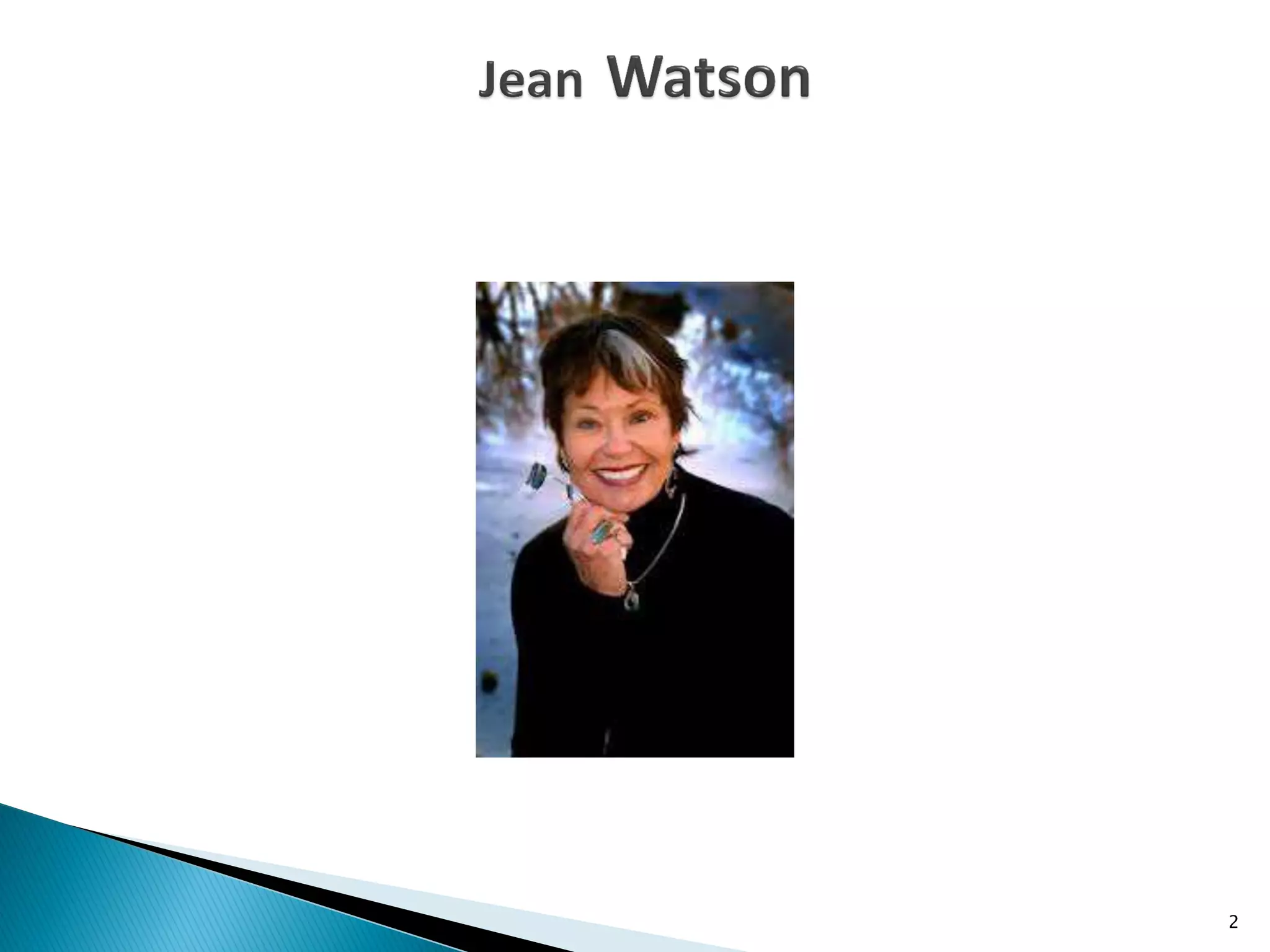
 Margaret Jean Harman Watson, PhD, RN,
AHNBC was born in Southern West Virginia
and grew up in the small town of Welch, West
Virginia.
 1964 – Baccalaureate degree in Nursing
(Boulder Campus)
 1966 – Master’s Degree in Psychiatric-Mental
Health Nursing (Health Sciences Campus)
 1973 – Doctorate in Educational Psychology
and Counseling (Graduate School, Boulder
Campus)
3
 1978 – 1981 – Coordinator and Director of
the nursing PhD program (University of
Colorado School of Nursing)
 1983 – 1990 – Dean (UC School of Nursing
and Associate Director of Nursing Practice
(University Hospital)
 Watson received six honorary doctoral
degrees and three international Honorary
Doctorates.
4
 1993 – She received the National League for
Nursing Martha E. Rogers Award
 1993 – 1996 – served as a member of the
Executive Committee and the Governing Board
and as an officer for the National League for
Nursing
 1995 – 1996 – elected president of National
League for Nursing
 1998 – recognized as a Distinguished Nurse
Scholar by the University
 1999 – assumed the nation’s first Murchison-
Scoville Endowed Chair of Caring Science.
5
 Jean watson has authored 11 books, shared an authoship of six books and
has written countless article in nursing journals.
 Her first book, Nursing: The Philosophy and Science of Caring (1979)
 Her second book, Nursing: Human Science and Human Care – A Theory of
Nursing(1985)
 Her third book, Postmodern Nursing and Beyond (1999)
Collection of 21 instruments used to assess and measure
caring.
 Her fifth and latest book, Caring Science as
Sacred Science (2005)
-.
6
 Watson describe two personal life altering event that
contribute to her writing
 In 1997, she experienced an accidental injury that resulted
in the loss of her left eye.
 soon after in 1998 her husband died.
 Watson states that she is "attempting to integrate these
wound in to my life and work. one of the gift though the
suffering was the privilege of experiencing and receiving
my own theory through the care from my husband and
loving nurse friend and colleagues"
7
1. Caring can be effectively demonstrated and
practiced only interpersonally.
2. Caring consists of carative factors that result
in the satisfaction of certain human needs.
3. Effective caring promotes health and
individual or family growth.
4. Caring responses accept person to choose
the best action for himself or herself at a given point in
time.
8
5. A caring environment allowing the person to choose
the best action for himself or herself at a given point in
time.
6. A science of caring is complementary to the science
of curing.
7. The practice of caring is central to nursing.
9
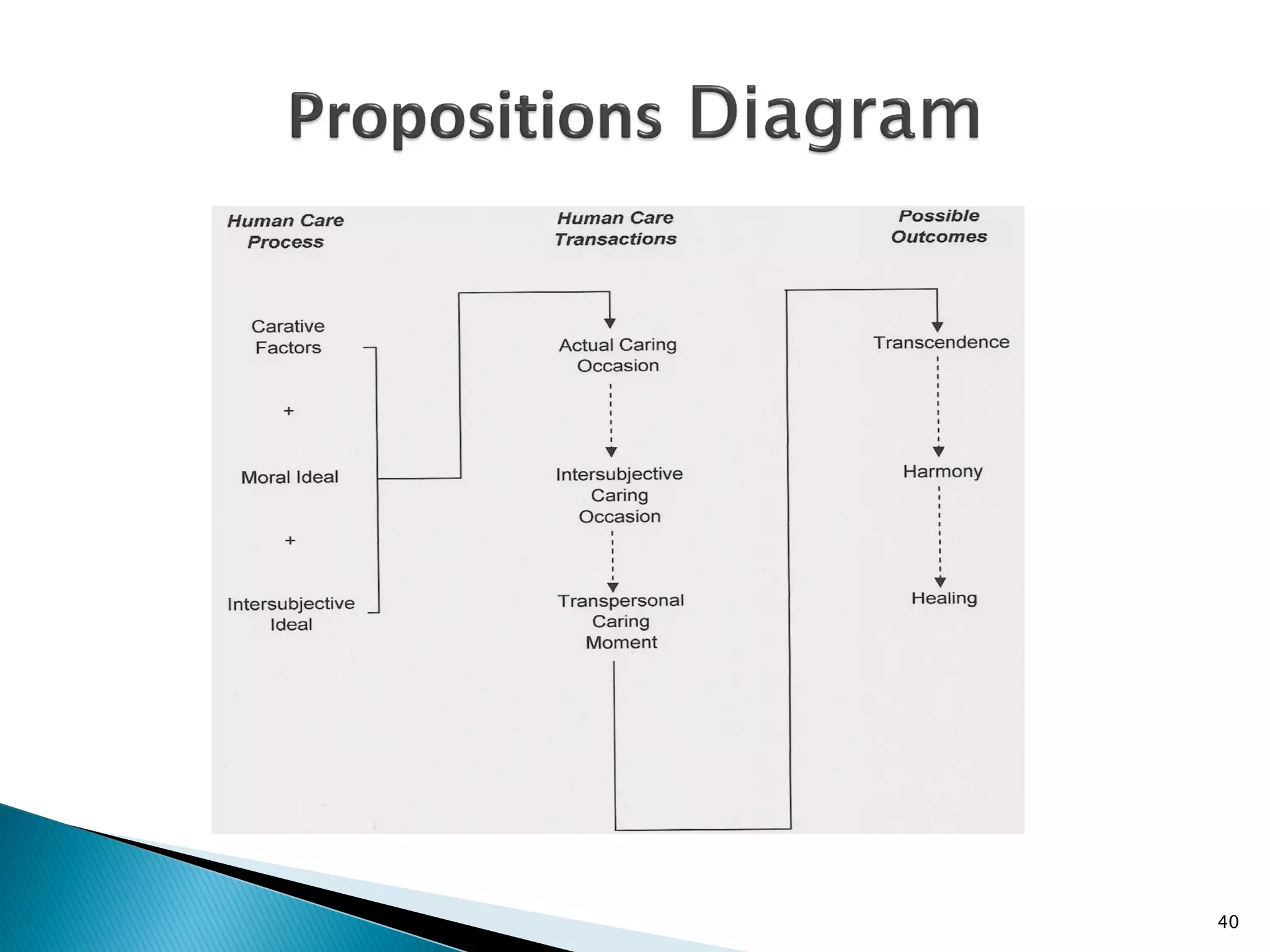
 The ten carative factors (Greek word “caritas” means
to cherish & appreciate, giving special attention to,
loving factors)
 Transpersonal caring relationship
 Caring occasion/caring movement
 Caring and healing model of theory
10
 The original carative factors served as a guide to
what was referred to as the "core of nursing“.
11
1. Formation of a Humanistic-Altruistic System of Values.
- Begins developmentally at an early age with values
shared with the parents.
-Perceived as necessary to the nurse’s own maturation
which then promotes altruistic behaviour towards others.
2. Instillation of Faith-Hope.
- Essential to both the carative and the curative processes.
- When modern science has nothing further to offer the
person, the nurse can continue to use faith-hope to provide
a sense of well-being through beliefs which are meaningful
to the individual.
12
3. Cultivation of sensitivity to Self and to Others.
- Explores the need of the nurse to begin to feel an emotion as it presents
itself.
- Development of one’s own feeling is needed to interact genuinely and
sensitively with others.
4. Establishing a helping-trust relationship.
- Strongest tool is the mode of communication, which establishes rapport and
caring.
- She has defined the characteristics needed to in the helping-trust
relationship. These are:
• Congruence
• Empathy
• Warmth
13
5. The expression of feelings, both positive and negative.
- “Feelings alter thoughts and behaviour, and they need to be
considered and allowed for in a caring relationship”.
-Awareness of the feelings helps to understand the behaviour.
-
6. The systematic use of the scientific problem-solving method for
decision making.
– The scientific problem- solving method is the only method that
allows for control and prediction, and that permits self-correction.
– The science of caring should not be always neutral
and objective.
14
7. Promotion of interpersonal teaching-learning.
- The caring nurse must focus on the learning process as much as
the teaching process.
-Understanding the person’s perception of the situation assist the
nurse to prepare a cognitive plan.
8. Provision for a supportive, protective and /or corrective mental,
physical, socio-cultural and spiritual environment.
- Watson divides these into external and internal variables, which
the nurse manipulates in order to provide support and protection
for the person’s mental and physical well-being.
- The external and internal environments are interdependent.
- Watson suggests that the nurse also must provide comfort,
privacy and safety as a part of this carative factor.
15
9. Assistance with the gratification of human
Needs.
- Watson’s ordering of need similar to that of the
maslow’s.
- She has created a hierarchy which she believes is
relevant to the science of caring in nursing.
- According to her each need is equally important for
quality nursing care and the promotion of optimal health.
16
 10. Allowance for existential-phenomenological
forces.
-Phenomenology is a way of understanding people
from the way things appear to them, from their
frame of reference
-This factor helps the nurse to reconcile and
mediate the incongruity of viewing the person
holistically while at the same time attending to the
Hierarchical ordering of needs
-Thus the nurse assists the person to find the
strength or courage to confront life or death.
17
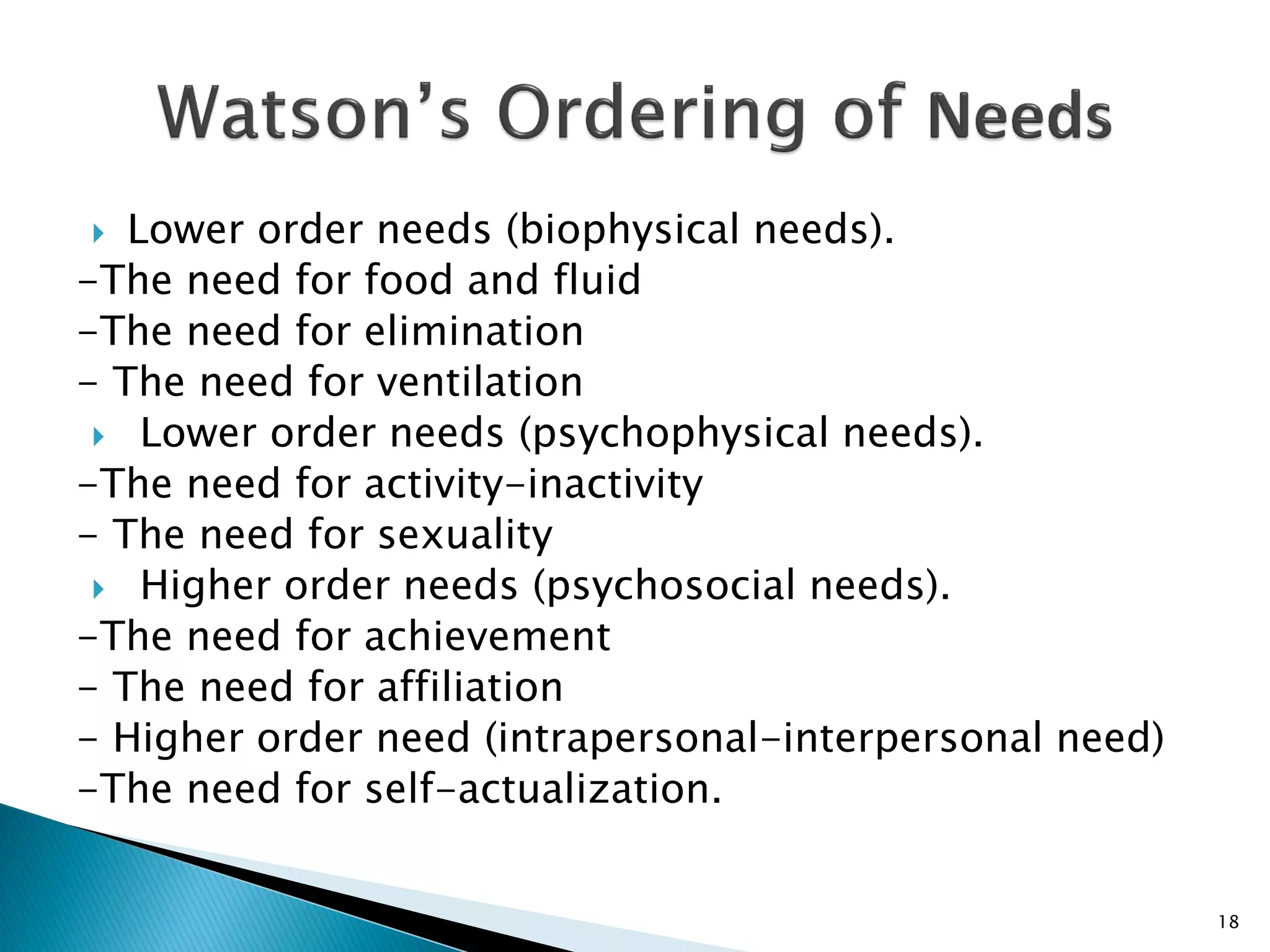
 Lower order needs (biophysical needs).
-The need for food and fluid
-The need for elimination
- The need for ventilation
 Lower order needs (psychophysical needs).
-The need for activity-inactivity
- The need for sexuality
 Higher order needs (psychosocial needs).
-The need for achievement
- The need for affiliation
- Higher order need (intrapersonal-interpersonal need)
-The need for self-actualization.
18
 Occurs during the ‘caring event’, central to watson’s
view of nursing.
 Transpersonal caring seeks to connect the soul
through the processes of caring and healing and being
in authentic relation, in the moment.
 Transpersonal conveys a concern for the inner life
world and subjective meaning of another who is fully
embodied.
19
•1. Moral commitment, intentionality and caritas
consciousness by the nurse protects,
enhances and potentiates human dignity,
wholeness and healing whereby allowing a
person to create or co-create his/her own
meaning for existence, healing ,wholeness and living and
dying.
20
 The nurse’s will and consciousness affirm the
Subjective-spiritual significance of the person while
seeking to sustain caring in the midst of threat and
despair—biological, institutional, or otherwise.
 The nurse seeks to recognize, accurately detect, and
connect with the inner condition of spirit of another
through genuine presenting and being centered in the
caring moment.
21
 The nurse’s ability to connect with another at
This transpersonal spirit- to- spirit level is translated via
movements, gestures, facial expressions, procedures,
information, touch, sound, verbal expressions and other
scientific, technical, aesthetic, and human means of
communication, into nursing human art/acts or
intentional caring-healing modalities.
22
 The caring-healing modalities within the context of
transpersonal caring/caritas consciousness potentiate
harmony, the blocked energy that interferes with the
natural healing processes; thus the nurse helps
another through this process to access the healer
within, in the fullest sense of Nightingale’s view of
nursing.
23
 Personal and professional development and spiritual
growth, and personal spiritual practice assist the nurse
in entering into this deeper level of professional
healing practice.
24
 Other facilitators are personal growth experiences such
as psychotherapy, transpersonal psychology,
meditation, bio-energetics work, and other models for
spiritual awakening.
25
 A caring occasion occurs whenever the nurse and
another come together with their unique life histories
and phenomenal fields in a human-to-human
transaction.
 A caring moment involves an action and choice by
both the nurse and other.
 To decide how to be in the moment, in the
relationship—what to do with and in the moment.
26
It includes the following points,
 The whole caring-healing-loving consciousness
is contained within a single caring moment.
 The one caring and the one being cared for are
interconnected; the caring-healing process is
connected with the other human(s) and with
the higher energy of the universe.
 The caring-healing-loving consciousness of the
nurse is communicated to the one being cared
for.
 Caring-healing-loving consciousness exists
through and transcends time and space and can
be dominant over physical dimensions.
27
 The caring model or theory can also be considered a
central focus for nursing at the disciplinary level.
 Model of caring includes art, science, humanities,
spirituality, and new dimensions of mind body spirit
medicine.
 Nursing evolving openly as central to human
phenomena of nursing practice.
28
 Nurse
 Human being
 Health
 environment
29
 According to watson “ nursing is concerned with
Promoting health, preventing illness, caring for the
Sick and restoring health”.
 It focuses on health promotion and treatment of
Disease. She believes that holistic health care is
Central to the practice of caring in nursing.
 She defines nursing as,
“A human science of persons and human health, illness
Experiences that are mediated by professional, personal,
scientific, esthetic and ethical human transactions”.
30
 Watson uses interchangeably the terms Human being,
person, life personhood and Self. She views the person
as “a unity of mind/body/spirit/nature” and describes
that,
“Personhood is tied to notions that one’s soul
Possess a body that is not confined by objective time and
space..”
31
 Definition of health was derived from the world health
organization as, “the positive state of physical, mental,
and social well-being with the inclusion of three
elements: (1) a high level of overall physical, mental,
and social functioning; (2) a general adaptive-
maintenance level of daily functioning; (3) the absence
of illness (or the presence of efforts that lead to its
absence)”.
32
 Later she defined health as,
“unity and harmony within the mind, body and soul”. It
is associated with the “degree of congruence between
the self as perceived and the self as experienced”.
 Futher watson stated,
“Illness is not necessarily disease; instead it is a subjective
turmoil of disharmony within a person’s inner self or
soul.”
33
 Nurse’s role in the environment as “attending to
supportive, protective, and or corrective mental,
physical, societal, and spiritual environments”.
 later on she had a much broader view of
environment:
“the caring science is not only for sustaining humanity,
but also for sustaining the planet . . . Belonging is to an
infinite universal spirit world of nature and all living
things”.
34
 Jean watson states that “healing spaces can be used to
help others transcend illness, pain, and suffering,”
emphasizing the environment and person connection:
“when the nurse enters the patient’s room, a magnetic
field of expectation is created”.
35
36
 Assist to provide the quality of care
and also provides the soul satisfying care for which many
nurses enter the profession.
 The client is placed in the context of the family, the
community and the culture.
 It places the client as the focus of practice rather than
the technology.
37
 The acuity of illness that leads to hospitalization, the
short length stay , and the increasing complex
technology, such quality of care may be deemed
impossible to give in the hospital.
 While Watson acknowledges the need for biophysical
base to nursing, this area receives little attention in her
writings.
38
 The ten caratiive factors primarily delineate
The psychosocial needs of the person.
 While the carative factors have a sound
Foundation based on other disciplines, they need further
research in nursing to demonstrate their application to
practice.
39
40
 History of jean watson
 life altering event that contribute to her writing
 Conceptual elements
 Carative factors
 Transpersonal relationship
 Major concept of theory
 Strengths
 limitations
41
 Martha raile alligood(2014). Nursing theorist and their
work(8th ed.).USA; Mosby,Elsevier, p.p-79-90.
 Marilyn E.Parker(2005). Nursing theories & nursing
practise(2nd ed). New Delhi;F.A.Davis company, Jaypee
brothers, P.P-295-305.
 www.nurses.info
42
43

Theory of transpersonal caring (jean watson )...

  • 1.
    Group No- 04 Submittedto: Dr. Thamara Amerasekara Presented by: A.L.K.Rinsith (5513) R.G.A.Dilanga (5538) A.M.Mohamed (5524) 1
  • 2.
  • 3.
     Margaret JeanHarman Watson, PhD, RN, AHNBC was born in Southern West Virginia and grew up in the small town of Welch, West Virginia.  1964 – Baccalaureate degree in Nursing (Boulder Campus)  1966 – Master’s Degree in Psychiatric-Mental Health Nursing (Health Sciences Campus)  1973 – Doctorate in Educational Psychology and Counseling (Graduate School, Boulder Campus) 3
  • 4.
     1978 –1981 – Coordinator and Director of the nursing PhD program (University of Colorado School of Nursing)  1983 – 1990 – Dean (UC School of Nursing and Associate Director of Nursing Practice (University Hospital)  Watson received six honorary doctoral degrees and three international Honorary Doctorates. 4
  • 5.
     1993 –She received the National League for Nursing Martha E. Rogers Award  1993 – 1996 – served as a member of the Executive Committee and the Governing Board and as an officer for the National League for Nursing  1995 – 1996 – elected president of National League for Nursing  1998 – recognized as a Distinguished Nurse Scholar by the University  1999 – assumed the nation’s first Murchison- Scoville Endowed Chair of Caring Science. 5
  • 6.
     Jean watsonhas authored 11 books, shared an authoship of six books and has written countless article in nursing journals.  Her first book, Nursing: The Philosophy and Science of Caring (1979)  Her second book, Nursing: Human Science and Human Care – A Theory of Nursing(1985)  Her third book, Postmodern Nursing and Beyond (1999) Collection of 21 instruments used to assess and measure caring.  Her fifth and latest book, Caring Science as Sacred Science (2005) -. 6
  • 7.
     Watson describetwo personal life altering event that contribute to her writing  In 1997, she experienced an accidental injury that resulted in the loss of her left eye.  soon after in 1998 her husband died.  Watson states that she is "attempting to integrate these wound in to my life and work. one of the gift though the suffering was the privilege of experiencing and receiving my own theory through the care from my husband and loving nurse friend and colleagues" 7
  • 8.
    1. Caring canbe effectively demonstrated and practiced only interpersonally. 2. Caring consists of carative factors that result in the satisfaction of certain human needs. 3. Effective caring promotes health and individual or family growth. 4. Caring responses accept person to choose the best action for himself or herself at a given point in time. 8
  • 9.
    5. A caringenvironment allowing the person to choose the best action for himself or herself at a given point in time. 6. A science of caring is complementary to the science of curing. 7. The practice of caring is central to nursing. 9
  • 10.
     The tencarative factors (Greek word “caritas” means to cherish & appreciate, giving special attention to, loving factors)  Transpersonal caring relationship  Caring occasion/caring movement  Caring and healing model of theory 10
  • 11.
     The originalcarative factors served as a guide to what was referred to as the "core of nursing“. 11
  • 12.
    1. Formation ofa Humanistic-Altruistic System of Values. - Begins developmentally at an early age with values shared with the parents. -Perceived as necessary to the nurse’s own maturation which then promotes altruistic behaviour towards others. 2. Instillation of Faith-Hope. - Essential to both the carative and the curative processes. - When modern science has nothing further to offer the person, the nurse can continue to use faith-hope to provide a sense of well-being through beliefs which are meaningful to the individual. 12
  • 13.
    3. Cultivation ofsensitivity to Self and to Others. - Explores the need of the nurse to begin to feel an emotion as it presents itself. - Development of one’s own feeling is needed to interact genuinely and sensitively with others. 4. Establishing a helping-trust relationship. - Strongest tool is the mode of communication, which establishes rapport and caring. - She has defined the characteristics needed to in the helping-trust relationship. These are: • Congruence • Empathy • Warmth 13
  • 14.
    5. The expressionof feelings, both positive and negative. - “Feelings alter thoughts and behaviour, and they need to be considered and allowed for in a caring relationship”. -Awareness of the feelings helps to understand the behaviour. - 6. The systematic use of the scientific problem-solving method for decision making. – The scientific problem- solving method is the only method that allows for control and prediction, and that permits self-correction. – The science of caring should not be always neutral and objective. 14
  • 15.
    7. Promotion ofinterpersonal teaching-learning. - The caring nurse must focus on the learning process as much as the teaching process. -Understanding the person’s perception of the situation assist the nurse to prepare a cognitive plan. 8. Provision for a supportive, protective and /or corrective mental, physical, socio-cultural and spiritual environment. - Watson divides these into external and internal variables, which the nurse manipulates in order to provide support and protection for the person’s mental and physical well-being. - The external and internal environments are interdependent. - Watson suggests that the nurse also must provide comfort, privacy and safety as a part of this carative factor. 15
  • 16.
    9. Assistance withthe gratification of human Needs. - Watson’s ordering of need similar to that of the maslow’s. - She has created a hierarchy which she believes is relevant to the science of caring in nursing. - According to her each need is equally important for quality nursing care and the promotion of optimal health. 16
  • 17.
     10. Allowancefor existential-phenomenological forces. -Phenomenology is a way of understanding people from the way things appear to them, from their frame of reference -This factor helps the nurse to reconcile and mediate the incongruity of viewing the person holistically while at the same time attending to the Hierarchical ordering of needs -Thus the nurse assists the person to find the strength or courage to confront life or death. 17
  • 18.
     Lower orderneeds (biophysical needs). -The need for food and fluid -The need for elimination - The need for ventilation  Lower order needs (psychophysical needs). -The need for activity-inactivity - The need for sexuality  Higher order needs (psychosocial needs). -The need for achievement - The need for affiliation - Higher order need (intrapersonal-interpersonal need) -The need for self-actualization. 18
  • 19.
     Occurs duringthe ‘caring event’, central to watson’s view of nursing.  Transpersonal caring seeks to connect the soul through the processes of caring and healing and being in authentic relation, in the moment.  Transpersonal conveys a concern for the inner life world and subjective meaning of another who is fully embodied. 19
  • 20.
    •1. Moral commitment,intentionality and caritas consciousness by the nurse protects, enhances and potentiates human dignity, wholeness and healing whereby allowing a person to create or co-create his/her own meaning for existence, healing ,wholeness and living and dying. 20
  • 21.
     The nurse’swill and consciousness affirm the Subjective-spiritual significance of the person while seeking to sustain caring in the midst of threat and despair—biological, institutional, or otherwise.  The nurse seeks to recognize, accurately detect, and connect with the inner condition of spirit of another through genuine presenting and being centered in the caring moment. 21
  • 22.
     The nurse’sability to connect with another at This transpersonal spirit- to- spirit level is translated via movements, gestures, facial expressions, procedures, information, touch, sound, verbal expressions and other scientific, technical, aesthetic, and human means of communication, into nursing human art/acts or intentional caring-healing modalities. 22
  • 23.
     The caring-healingmodalities within the context of transpersonal caring/caritas consciousness potentiate harmony, the blocked energy that interferes with the natural healing processes; thus the nurse helps another through this process to access the healer within, in the fullest sense of Nightingale’s view of nursing. 23
  • 24.
     Personal andprofessional development and spiritual growth, and personal spiritual practice assist the nurse in entering into this deeper level of professional healing practice. 24
  • 25.
     Other facilitatorsare personal growth experiences such as psychotherapy, transpersonal psychology, meditation, bio-energetics work, and other models for spiritual awakening. 25
  • 26.
     A caringoccasion occurs whenever the nurse and another come together with their unique life histories and phenomenal fields in a human-to-human transaction.  A caring moment involves an action and choice by both the nurse and other.  To decide how to be in the moment, in the relationship—what to do with and in the moment. 26
  • 27.
    It includes thefollowing points,  The whole caring-healing-loving consciousness is contained within a single caring moment.  The one caring and the one being cared for are interconnected; the caring-healing process is connected with the other human(s) and with the higher energy of the universe.  The caring-healing-loving consciousness of the nurse is communicated to the one being cared for.  Caring-healing-loving consciousness exists through and transcends time and space and can be dominant over physical dimensions. 27
  • 28.
     The caringmodel or theory can also be considered a central focus for nursing at the disciplinary level.  Model of caring includes art, science, humanities, spirituality, and new dimensions of mind body spirit medicine.  Nursing evolving openly as central to human phenomena of nursing practice. 28
  • 29.
     Nurse  Humanbeing  Health  environment 29
  • 30.
     According towatson “ nursing is concerned with Promoting health, preventing illness, caring for the Sick and restoring health”.  It focuses on health promotion and treatment of Disease. She believes that holistic health care is Central to the practice of caring in nursing.  She defines nursing as, “A human science of persons and human health, illness Experiences that are mediated by professional, personal, scientific, esthetic and ethical human transactions”. 30
  • 31.
     Watson usesinterchangeably the terms Human being, person, life personhood and Self. She views the person as “a unity of mind/body/spirit/nature” and describes that, “Personhood is tied to notions that one’s soul Possess a body that is not confined by objective time and space..” 31
  • 32.
     Definition ofhealth was derived from the world health organization as, “the positive state of physical, mental, and social well-being with the inclusion of three elements: (1) a high level of overall physical, mental, and social functioning; (2) a general adaptive- maintenance level of daily functioning; (3) the absence of illness (or the presence of efforts that lead to its absence)”. 32
  • 33.
     Later shedefined health as, “unity and harmony within the mind, body and soul”. It is associated with the “degree of congruence between the self as perceived and the self as experienced”.  Futher watson stated, “Illness is not necessarily disease; instead it is a subjective turmoil of disharmony within a person’s inner self or soul.” 33
  • 34.
     Nurse’s rolein the environment as “attending to supportive, protective, and or corrective mental, physical, societal, and spiritual environments”.  later on she had a much broader view of environment: “the caring science is not only for sustaining humanity, but also for sustaining the planet . . . Belonging is to an infinite universal spirit world of nature and all living things”. 34
  • 35.
     Jean watsonstates that “healing spaces can be used to help others transcend illness, pain, and suffering,” emphasizing the environment and person connection: “when the nurse enters the patient’s room, a magnetic field of expectation is created”. 35
  • 36.
  • 37.
     Assist toprovide the quality of care and also provides the soul satisfying care for which many nurses enter the profession.  The client is placed in the context of the family, the community and the culture.  It places the client as the focus of practice rather than the technology. 37
  • 38.
     The acuityof illness that leads to hospitalization, the short length stay , and the increasing complex technology, such quality of care may be deemed impossible to give in the hospital.  While Watson acknowledges the need for biophysical base to nursing, this area receives little attention in her writings. 38
  • 39.
     The tencaratiive factors primarily delineate The psychosocial needs of the person.  While the carative factors have a sound Foundation based on other disciplines, they need further research in nursing to demonstrate their application to practice. 39
  • 40.
  • 41.
     History ofjean watson  life altering event that contribute to her writing  Conceptual elements  Carative factors  Transpersonal relationship  Major concept of theory  Strengths  limitations 41
  • 42.
     Martha railealligood(2014). Nursing theorist and their work(8th ed.).USA; Mosby,Elsevier, p.p-79-90.  Marilyn E.Parker(2005). Nursing theories & nursing practise(2nd ed). New Delhi;F.A.Davis company, Jaypee brothers, P.P-295-305.  www.nurses.info 42
  • 43.