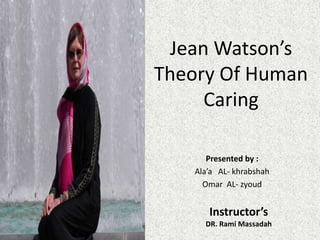
Jean Watson’s
Theory Of Human
Caring
Presented by :
Ala’a AL- khrabshah
Omar AL- zyoud
Instructor’s
DR. Rami Massadah
“We are the light in
institutional
darkness, and in
this model we get
to return to the
light of our
humanity”
(jean Watson, 7/9/2012.)
Outlines
• Introduction
• Theorist Biography (Personal information, Education,
Work background, Accomplishments, Publications ).
• The theory of human caring
• major conceptual elements (10 Caritave factors and
Caritas Process ).
• Major assumptions .
Outlines
• Transpersonal caring relationship.
• Caring occasion/Moment .
• Theoretical assertions and metaparadigm.
• Acceptance by the nursing community
• Application of the theory.
• Critique of the theory .
• Conclusion .
• References.
Objectives :
• By the end of this presentation , you
will be able to :-
1) Obtain an Overview about Watson
background.
2) Identify the multidiscipline resources of the
theory.
3) Identify the major concepts and definitions.
Objectives
4) Recognize the Theory acceptance in Nursing
Community.
5) Examples of practice situations using Watson
theory .
6) Identify the strength and weakness in the
theory.
Introduction
the theory of human caring was a first work to bring
new meaning and dignity to the world of nursing and
patient care, and to the inner subjective life
experiences of self and other. It also served to
provide an ethical foundation for the deeply human
dimensions of nursing.
The theoretical concepts were derived and emerged
from, personal/professional experiences; they were
clinically inducted, empirically grounded and
combined with philosophical, intellectual, and
experiential background.
Theorist’s Background
Full Name: Margaret Jean Harman Watson
Place of Birth: Southern West Virginia
Hometown: Welch, West Virginia
Civil Status: Married to Mr. Douglas.
Children: Jennifer (1963), Julie ( 1967)
Education
1958-61 R.N. Diploma in Nursing
Lewis-Gale School of Nursing
1962-64 B.S. in Nursing
University of Colorado
1964-66 M.S. in Psychiatric Mental-Health
Minor Psychology
University of Colorado
1969-73 Ph.D. in Educational Psychology and
Counseling
University of Colorado
Work Background
*Faculty and administrative position –
University of Colorado
• *Chair and assistant dean of the
undergraduate program .
• *Involved in early planning
and implementation of the nursing
doctorate program in Colorado in 1978
• *Dean of the university of colorado
school of Nursing and associate director .
Continue …
• Nursing Practice at University Hospital from 1983 to
1990.
• A professor of nursing and holds the Endowed Chair
in Caring Science at the University Of Colorado
School Of Nursing.
• Establishing the center for human caring 1980 .
• Founder and member of board of boulder county
hospice.
Theory Of Human Caring
Overview of the theory
Initial attempt to bring meaning
and focus to nursing as an
emerging discipline
and distinct
health profession
Values
Knowledge
Practice
Values
Knowledge
Practice
Process of
Inner healing
Life world of
Experiencing
person
Continue
• This emerging philosophy and theory of
human caring sought to balance the cure
orientation of medicine , giving nursing
it’s unique disciplinary , scientific , and
professional standing
with itself and it’s public .
Major conceptual elements
• Ten carative factors
• Transpersonal caring
relationship
Ten Carative Factors
1) Formation of a humanistic altruistic
system of values.
2) Installation of Faith –Hope.
3)Cultivation of sensitivity to self and
others.
Continue …
4)Development of helping- trust
relationship.
5) Promotion and acceptance of
the expression of positive and
negative feelings
6)Systematic use of a creative
problem-solving caring process .
7) Promotion of transpersonal
teaching-learning.
Continue …
8)Provision for supportive
environment.
9)Assistance with gratification of human
needs.
10)Existential _phenomenological
forces.
Caritas Process
Caritas process intended to offer a more fluid
language for understanding a deeper level of
caritas factors which capture the deeper
dimensions of living processes of human
experiences.
Continue …
• What differs in the clinical
caritas frame-work is that a
decidedly spiritual
dimension and an overt
evacuation of love and
caring are merged for anew
paradigm.
Caritas Processes
Caritas Processes
Carative Factors
1. Practicing Loving-kindness &
Equanimity for self and other.
1. Humanistic –Altruistic Values.
2. Being authentically present
to/enabling/sustaining/honoring
deep belief system and subjective world
of self/other.
2. Instilling/enabling Faith & Hope.
3. Cultivating of one’s own spiritual
practices; deepening selfawareness,
going beyond “ego self”.
3. Cultivation of Sensitivity to one’s self
and other.
4. Developing and sustaining a helping-
trusting, authentic
caring relationship.
4. Development of helping-trusting, human
caring relationship.
5. Being present to, and supportive of, the
expression of
positive and negative feelings as a
connection with deeper
spirit of self and the one-being-cared-for.
5. Promotion and acceptance of expression
of
positive and negative feelings.
6. Creatively using presence of self and
all ways of knowing/
multiple ways of Being/doing as part of
the caring process;
engaging in artistry of caring-healing
practices.
6. Systematic use of scientific
(creative) problem solving
caring process.
7. Engaging in genuine teaching-
learning experiences that
attend to whole person, their meaning;
attempting to stay
within other’s frame of reference.
7. Promotion of transpersonal teaching-
learning.
8. Creating healing environment at all
levels (physical, nonphysical,
subtle environment of energy and
consciousness
whereby wholeness, beauty, comfort,
dignity and peace are
potentiated.
8. Provision for a supportive,
protective, and/or
corrective mental, social, spiritual
environment.
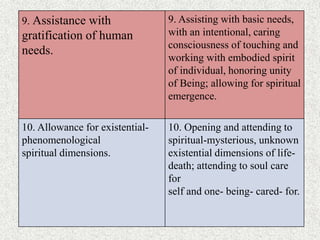
9. Assisting with basic needs,
with an intentional, caring
consciousness of touching and
working with embodied spirit
of individual, honoring unity
of Being; allowing for spiritual
emergence.
9. Assistance with
gratification of human
needs.
10. Opening and attending to
spiritual-mysterious, unknown
existential dimensions of life-
death; attending to soul care
for
self and one- being- cared- for.
10. Allowance for existential-
phenomenological
spiritual dimensions.
Transpersonal caring relationship
Major Assumption
• 1) Caring can be effectively
demonstrated and practiced only
interpersonally.
• 2) Caring consist of 10 carative
factors that result in the satisfaction
of certain human needs.
• 3) Effective caring promotes health
and individual / family growth.
• 4) caring process accept a person not
only as he or she now but as what he
or she will become.
Continue …
5) Caring environment offers the development of
potential while allowing
person to choose the best action
6) Caring is more healthogenic than curing.
7) The practice of caring is central to nursing
Nursing Metaparadigm In
Watson’s Theory
Continue …
• Human ( person )
• Is subjective and unique, not objective, predictable
and calculating.
• Has distinct human needs, which are biophysical,
psychophysical, psychosocial and interpersonal ) are
to be valued, cared for, respected, understood and
assisted.
Continue …
• Is a functioning whole, there is no division among the
mind, body and spirit (George/2002).
• Is directly influenced by their external environment.
Continue …
Health is more than the absence of
illness ,it is an elusive concept
because it has a subjective nature.
(watson1979).
health refers to “ unity and harmony within the mind,
body, soul” and is associated with the “degree of
congruence between the self as perceived and the self
as experienced .
(Watson,1988, p.48)
Continue …
Nursing : is concerned with health promotion ,
restoration and illness prevention .
Caring is a nursing term represent the factors nurses
use to deliver health .
Continue …
• Environment Is crucial to the holistic
healing (mental, physical, social, emotional,
spiritual, developmental, protective, supportive
environments), which is conducive to a
patient’s health and wellbeing.
Continue
• Contains “noise, privacy,
light, access to nature,
color, space and smells that
can have an impact on the
caring-healing process”
(Watson/1999).
Acceptance By Nursing Community
1) Practice :
• Institution that are seeking a holistic
approach to nursing care are
integrating many aspects of Watson's
theoretical commitment to care.
• The Theory is being clinically
validated in variety of settings and
with various populations such as :
- Critical care units ,( NICU) ,pediatric
care unit and gerontological care unit
Continue …
2) Education:
Watson Theory has been active in
curriculum planning at numerous
nursing colleges in USA and
internationally in Australia, Sweden
& UK.
She hope that her theory will help
nurses to develop a meaningful moral
and philosophical base for practice.
Continue ….
3) Research:
• Watson and colleagues are attempting to
research the caring framework and to
arrive at empirical data amenable to
research techniques.
• However , this abstract framework is
difficult to study concretely .
Theory Critique
1)Clarity:
• Watson theory is easily read, uses non technical but
sophisticated language.
• Lengthy phrases , and sentences need to be read more
than once to gain meaning .
• The reader of the theory enhanced to understand
philosophy.
Continue …
2) Simplicity:
 The reader must understanding of a variety of
subjects to understand the theory , it is complex when
considering the existential- phenomenological forces
of her theory and Multidiscipline derivation of her
concept.
Continue …
3) Generality:
• The scope of the framework encompasses all aspect
of health-illness continuum .
• In addition , the theory addresses aspects of
preventing illness and experiencing a peaceful death,
thereby increasing its generality .
• It is about more about being more than doing .
Continue …
4) Empirical Precision:
• She described her theory as descriptive theory
so it is difficult to be studied empirically.
• Her Theory to study the Transpersonal caring
can be classified as Qualitative, Naturalistic or
Phenomenological.
Continue …
5) derivable Consequences :
• Watson theoretical concepts such as:
1- use of self patient- identify needs.
2- the caring process .
3- spiritual sense of being human .
may help nurses and their patients find meaning and
harmony in a period of increasing complexity .
• Watsons rich and varied knowledge of philosophy ,
arts , human science , and traditional science , has
enabled professionals in many disciplines to share
and recognize her work .
*Strengths:
• This theory places client in the context of the family,
the community and the culture.
• It places the client as the focus of practice rather than
the technology.
*Limitations:
• Biophysical needs of the individual
are given less important.
• The ten creative factors primarily delineate the
psychosocial needs of the person.
• Needs further research to apply in practice.
Conclusion
• Caring is the essence of nursing,which
compliments the traditional curative
factors of medicine , giving ( nursing )
its unique disciplinary , scientific, and
professional standing.
• Using Watson’s carative factors will allow the nurse to go
beyond an objective assessment of the patient to develop a
deep personal caring relationship.
• This relationship occurs when the nurse and patient
come together in a transpersonal moment.
• When the spirit of both nurse and patient are present,
outcomes of the transpersonal moment are
transcendence, harmony, and healing.
References …
• Tomey, A. M. and Alligood, M.R. , Nursing theorists and their
work. (6th Ed).
• Parker, M. (2001) Nursing theories and nursing practice (3d
Ed).
• George, B. Julia, M. (2008). Nursing Theories- The Base for
Professional Nursing Practice (4th Ed). Norwalk: Appleton &
Lange Press
• Watson, J. (1985). Nursing: Human science and human care: A
theory of nursing. Norwalk, CT
• Watson, J. (2006). Nursing: Human Science and Human care.
A Theory of Nursing. New
• Chinn, P.L. and Kramer, M.K. (2008) Theory and nursing:
integrated knowledge development. (8th Ed), St. Louis: Mosby.

Lecture_6_Jean_Watson.pptx

  • 1.
    Jean Watson’s Theory OfHuman Caring Presented by : Ala’a AL- khrabshah Omar AL- zyoud Instructor’s DR. Rami Massadah
  • 2.
    “We are thelight in institutional darkness, and in this model we get to return to the light of our humanity” (jean Watson, 7/9/2012.)
  • 3.
    Outlines • Introduction • TheoristBiography (Personal information, Education, Work background, Accomplishments, Publications ). • The theory of human caring • major conceptual elements (10 Caritave factors and Caritas Process ). • Major assumptions .
  • 4.
    Outlines • Transpersonal caringrelationship. • Caring occasion/Moment . • Theoretical assertions and metaparadigm. • Acceptance by the nursing community • Application of the theory. • Critique of the theory . • Conclusion . • References.
  • 5.
    Objectives : • Bythe end of this presentation , you will be able to :- 1) Obtain an Overview about Watson background. 2) Identify the multidiscipline resources of the theory. 3) Identify the major concepts and definitions.
  • 6.
    Objectives 4) Recognize theTheory acceptance in Nursing Community. 5) Examples of practice situations using Watson theory . 6) Identify the strength and weakness in the theory.
  • 7.
    Introduction the theory ofhuman caring was a first work to bring new meaning and dignity to the world of nursing and patient care, and to the inner subjective life experiences of self and other. It also served to provide an ethical foundation for the deeply human dimensions of nursing. The theoretical concepts were derived and emerged from, personal/professional experiences; they were clinically inducted, empirically grounded and combined with philosophical, intellectual, and experiential background.
  • 8.
    Theorist’s Background Full Name:Margaret Jean Harman Watson Place of Birth: Southern West Virginia Hometown: Welch, West Virginia Civil Status: Married to Mr. Douglas. Children: Jennifer (1963), Julie ( 1967)
  • 9.
    Education 1958-61 R.N. Diplomain Nursing Lewis-Gale School of Nursing 1962-64 B.S. in Nursing University of Colorado 1964-66 M.S. in Psychiatric Mental-Health Minor Psychology University of Colorado 1969-73 Ph.D. in Educational Psychology and Counseling University of Colorado
  • 10.
    Work Background *Faculty andadministrative position – University of Colorado • *Chair and assistant dean of the undergraduate program . • *Involved in early planning and implementation of the nursing doctorate program in Colorado in 1978 • *Dean of the university of colorado school of Nursing and associate director .
  • 11.
    Continue … • NursingPractice at University Hospital from 1983 to 1990. • A professor of nursing and holds the Endowed Chair in Caring Science at the University Of Colorado School Of Nursing. • Establishing the center for human caring 1980 . • Founder and member of board of boulder county hospice.
  • 12.
  • 13.
    Overview of thetheory Initial attempt to bring meaning and focus to nursing as an emerging discipline and distinct health profession Values Knowledge Practice
  • 14.
  • 15.
    Continue • This emergingphilosophy and theory of human caring sought to balance the cure orientation of medicine , giving nursing it’s unique disciplinary , scientific , and professional standing with itself and it’s public .
  • 16.
    Major conceptual elements •Ten carative factors • Transpersonal caring relationship
  • 17.
    Ten Carative Factors 1)Formation of a humanistic altruistic system of values. 2) Installation of Faith –Hope. 3)Cultivation of sensitivity to self and others.
  • 18.
    Continue … 4)Development ofhelping- trust relationship. 5) Promotion and acceptance of the expression of positive and negative feelings 6)Systematic use of a creative problem-solving caring process . 7) Promotion of transpersonal teaching-learning.
  • 19.
    Continue … 8)Provision forsupportive environment. 9)Assistance with gratification of human needs. 10)Existential _phenomenological forces.
  • 20.
    Caritas Process Caritas processintended to offer a more fluid language for understanding a deeper level of caritas factors which capture the deeper dimensions of living processes of human experiences.
  • 21.
    Continue … • Whatdiffers in the clinical caritas frame-work is that a decidedly spiritual dimension and an overt evacuation of love and caring are merged for anew paradigm.
  • 22.
    Caritas Processes Caritas Processes CarativeFactors 1. Practicing Loving-kindness & Equanimity for self and other. 1. Humanistic –Altruistic Values. 2. Being authentically present to/enabling/sustaining/honoring deep belief system and subjective world of self/other. 2. Instilling/enabling Faith & Hope. 3. Cultivating of one’s own spiritual practices; deepening selfawareness, going beyond “ego self”. 3. Cultivation of Sensitivity to one’s self and other. 4. Developing and sustaining a helping- trusting, authentic caring relationship. 4. Development of helping-trusting, human caring relationship. 5. Being present to, and supportive of, the expression of positive and negative feelings as a connection with deeper spirit of self and the one-being-cared-for. 5. Promotion and acceptance of expression of positive and negative feelings.
  • 23.
    6. Creatively usingpresence of self and all ways of knowing/ multiple ways of Being/doing as part of the caring process; engaging in artistry of caring-healing practices. 6. Systematic use of scientific (creative) problem solving caring process. 7. Engaging in genuine teaching- learning experiences that attend to whole person, their meaning; attempting to stay within other’s frame of reference. 7. Promotion of transpersonal teaching- learning. 8. Creating healing environment at all levels (physical, nonphysical, subtle environment of energy and consciousness whereby wholeness, beauty, comfort, dignity and peace are potentiated. 8. Provision for a supportive, protective, and/or corrective mental, social, spiritual environment.
  • 24.
    9. Assisting withbasic needs, with an intentional, caring consciousness of touching and working with embodied spirit of individual, honoring unity of Being; allowing for spiritual emergence. 9. Assistance with gratification of human needs. 10. Opening and attending to spiritual-mysterious, unknown existential dimensions of life- death; attending to soul care for self and one- being- cared- for. 10. Allowance for existential- phenomenological spiritual dimensions.
  • 25.
  • 26.
    Major Assumption • 1)Caring can be effectively demonstrated and practiced only interpersonally. • 2) Caring consist of 10 carative factors that result in the satisfaction of certain human needs. • 3) Effective caring promotes health and individual / family growth. • 4) caring process accept a person not only as he or she now but as what he or she will become.
  • 27.
    Continue … 5) Caringenvironment offers the development of potential while allowing person to choose the best action 6) Caring is more healthogenic than curing. 7) The practice of caring is central to nursing
  • 28.
  • 29.
    Continue … • Human( person ) • Is subjective and unique, not objective, predictable and calculating. • Has distinct human needs, which are biophysical, psychophysical, psychosocial and interpersonal ) are to be valued, cared for, respected, understood and assisted.
  • 30.
    Continue … • Isa functioning whole, there is no division among the mind, body and spirit (George/2002). • Is directly influenced by their external environment.
  • 32.
    Continue … Health ismore than the absence of illness ,it is an elusive concept because it has a subjective nature. (watson1979). health refers to “ unity and harmony within the mind, body, soul” and is associated with the “degree of congruence between the self as perceived and the self as experienced . (Watson,1988, p.48)
  • 33.
    Continue … Nursing :is concerned with health promotion , restoration and illness prevention . Caring is a nursing term represent the factors nurses use to deliver health .
  • 34.
    Continue … • EnvironmentIs crucial to the holistic healing (mental, physical, social, emotional, spiritual, developmental, protective, supportive environments), which is conducive to a patient’s health and wellbeing.
  • 35.
    Continue • Contains “noise,privacy, light, access to nature, color, space and smells that can have an impact on the caring-healing process” (Watson/1999).
  • 36.
    Acceptance By NursingCommunity 1) Practice : • Institution that are seeking a holistic approach to nursing care are integrating many aspects of Watson's theoretical commitment to care. • The Theory is being clinically validated in variety of settings and with various populations such as : - Critical care units ,( NICU) ,pediatric care unit and gerontological care unit
  • 37.
    Continue … 2) Education: WatsonTheory has been active in curriculum planning at numerous nursing colleges in USA and internationally in Australia, Sweden & UK. She hope that her theory will help nurses to develop a meaningful moral and philosophical base for practice.
  • 38.
    Continue …. 3) Research: •Watson and colleagues are attempting to research the caring framework and to arrive at empirical data amenable to research techniques. • However , this abstract framework is difficult to study concretely .
  • 39.
    Theory Critique 1)Clarity: • Watsontheory is easily read, uses non technical but sophisticated language. • Lengthy phrases , and sentences need to be read more than once to gain meaning . • The reader of the theory enhanced to understand philosophy.
  • 40.
    Continue … 2) Simplicity: The reader must understanding of a variety of subjects to understand the theory , it is complex when considering the existential- phenomenological forces of her theory and Multidiscipline derivation of her concept.
  • 41.
    Continue … 3) Generality: •The scope of the framework encompasses all aspect of health-illness continuum . • In addition , the theory addresses aspects of preventing illness and experiencing a peaceful death, thereby increasing its generality . • It is about more about being more than doing .
  • 42.
    Continue … 4) EmpiricalPrecision: • She described her theory as descriptive theory so it is difficult to be studied empirically. • Her Theory to study the Transpersonal caring can be classified as Qualitative, Naturalistic or Phenomenological.
  • 43.
    Continue … 5) derivableConsequences : • Watson theoretical concepts such as: 1- use of self patient- identify needs. 2- the caring process . 3- spiritual sense of being human . may help nurses and their patients find meaning and harmony in a period of increasing complexity . • Watsons rich and varied knowledge of philosophy , arts , human science , and traditional science , has enabled professionals in many disciplines to share and recognize her work .
  • 44.
    *Strengths: • This theoryplaces client in the context of the family, the community and the culture. • It places the client as the focus of practice rather than the technology. *Limitations: • Biophysical needs of the individual are given less important. • The ten creative factors primarily delineate the psychosocial needs of the person. • Needs further research to apply in practice.
  • 45.
    Conclusion • Caring isthe essence of nursing,which compliments the traditional curative factors of medicine , giving ( nursing ) its unique disciplinary , scientific, and professional standing. • Using Watson’s carative factors will allow the nurse to go beyond an objective assessment of the patient to develop a deep personal caring relationship. • This relationship occurs when the nurse and patient come together in a transpersonal moment. • When the spirit of both nurse and patient are present, outcomes of the transpersonal moment are transcendence, harmony, and healing.
  • 46.
    References … • Tomey,A. M. and Alligood, M.R. , Nursing theorists and their work. (6th Ed). • Parker, M. (2001) Nursing theories and nursing practice (3d Ed). • George, B. Julia, M. (2008). Nursing Theories- The Base for Professional Nursing Practice (4th Ed). Norwalk: Appleton & Lange Press • Watson, J. (1985). Nursing: Human science and human care: A theory of nursing. Norwalk, CT • Watson, J. (2006). Nursing: Human Science and Human care. A Theory of Nursing. New • Chinn, P.L. and Kramer, M.K. (2008) Theory and nursing: integrated knowledge development. (8th Ed), St. Louis: Mosby.