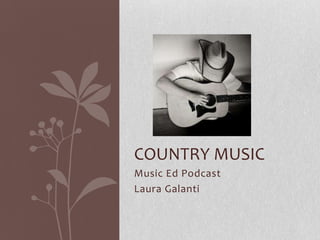
COUNTRY MUSIC
Music Ed Podcast
Laura Galanti
First Generation Country Music
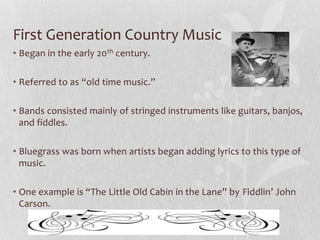
• Began in the early 20 th century.

• Referred to as “old time music.”
• Bands consisted mainly of stringed instruments like guitars, banjos,
and fiddles.
• Bluegrass was born when artists began adding lyrics to this type of
music.

• One example is “The Little Old Cabin in the Lane” by Fiddlin’ John
Carson.
Second Generation Country Music
• Lasted between the 1930s and 40s.

• The Grand Ole Opry began during this time.
• Singing cowboys in western films popularized country music.

• Hillbilly boogie came about. This was one of the first subgenres of
country music to incorporate guitars and drums. An example of this
is “Boogie Woogie” by Johnny Barfield.
• Honky tonk music became popular among men in Oklahoma and
Texas. This particular subgenre is known for its steel guitar sound.
Third Generation Country Music
• Lasted between the 1950s and 60s.
• Hillbilly music and rock and roll were combined to form rockabilly
music.
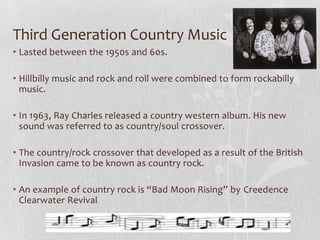
• In 1963, Ray Charles released a country western album. His new
sound was referred to as country/soul crossover.
• The country/rock crossover that developed as a result of the British
Invasion came to be known as country rock.
• An example of country rock is “Bad Moon Rising” by Creedence
Clearwater Revival
Fourth Generation Country Music
• Lasted throughout the 1970s and 80s.

• Outlaw country music was derived from honky tonk music. It is
typically associated with rebel type artists.
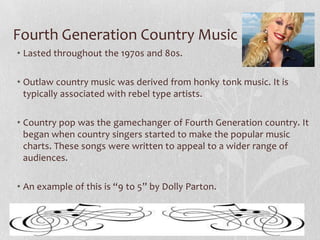
• Country pop was the gamechanger of Fourth Generation country. It
began when country singers started to make the popular music
charts. These songs were written to appeal to a wider range of
audiences.
• An example of this is “9 to 5” by Dolly Parton.
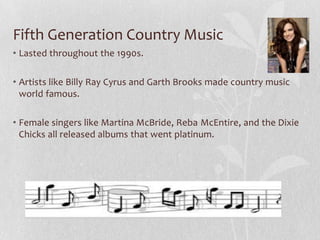
Fifth Generation Country Music
• Lasted throughout the 1990s.

• Artists like Billy Ray Cyrus and Garth Brooks made country music
world famous.
• Female singers like Martina McBride, Reba McEntire, and the Dixie
Chicks all released albums that went platinum.
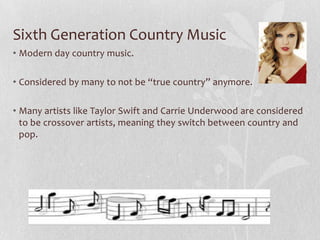
Sixth Generation Country Music
• Modern day country music.

• Considered by many to not be “true country” anymore.
• Many artists like Taylor Swift and Carrie Underwood are considered
to be crossover artists, meaning they switch between country and
pop.

Country Music Powerpoint

  • 1.
    COUNTRY MUSIC Music EdPodcast Laura Galanti
  • 2.
    First Generation CountryMusic • Began in the early 20 th century. • Referred to as “old time music.” • Bands consisted mainly of stringed instruments like guitars, banjos, and fiddles. • Bluegrass was born when artists began adding lyrics to this type of music. • One example is “The Little Old Cabin in the Lane” by Fiddlin’ John Carson.
  • 3.
    Second Generation CountryMusic • Lasted between the 1930s and 40s. • The Grand Ole Opry began during this time. • Singing cowboys in western films popularized country music. • Hillbilly boogie came about. This was one of the first subgenres of country music to incorporate guitars and drums. An example of this is “Boogie Woogie” by Johnny Barfield. • Honky tonk music became popular among men in Oklahoma and Texas. This particular subgenre is known for its steel guitar sound.
  • 4.
    Third Generation CountryMusic • Lasted between the 1950s and 60s. • Hillbilly music and rock and roll were combined to form rockabilly music. • In 1963, Ray Charles released a country western album. His new sound was referred to as country/soul crossover. • The country/rock crossover that developed as a result of the British Invasion came to be known as country rock. • An example of country rock is “Bad Moon Rising” by Creedence Clearwater Revival
  • 5.
    Fourth Generation CountryMusic • Lasted throughout the 1970s and 80s. • Outlaw country music was derived from honky tonk music. It is typically associated with rebel type artists. • Country pop was the gamechanger of Fourth Generation country. It began when country singers started to make the popular music charts. These songs were written to appeal to a wider range of audiences. • An example of this is “9 to 5” by Dolly Parton.
  • 6.
    Fifth Generation CountryMusic • Lasted throughout the 1990s. • Artists like Billy Ray Cyrus and Garth Brooks made country music world famous. • Female singers like Martina McBride, Reba McEntire, and the Dixie Chicks all released albums that went platinum.
  • 7.
    Sixth Generation CountryMusic • Modern day country music. • Considered by many to not be “true country” anymore. • Many artists like Taylor Swift and Carrie Underwood are considered to be crossover artists, meaning they switch between country and pop.