Impact of Wars to
Jazz Development
  {   By: Ezra, Verena, Keyzar, Reydi 10B/F
Table Of Contents
The History/Beginning of Jazz               3-10

Impact of Wars on Jazz Development/Styles   11-12

Influential Jazz Musicians/Composers        13-14

Videos                                      15-16


Bibliography                                 17
History/Beginning of Jazz

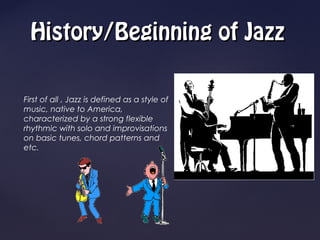
First of all , Jazz is defined as a style of
music, native to America,
characterized by a strong flexible
rhythmic with solo and improvisations
on basic tunes, chord patterns and
etc.
History/Beginning of Jazz
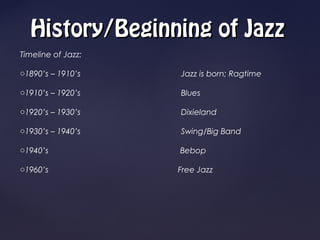
Timeline of Jazz:

o1890’s – 1910’s    Jazz is born; Ragtime

o1910’s – 1920’s    Blues

o1920’s – 1930’s    Dixieland

o1930’s – 1940’s    Swing/Big Band

o1940’s             Bebop

o1960’s             Free Jazz
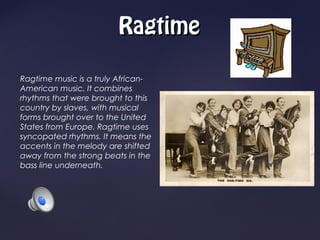
Ragtime

Ragtime music is a truly African-
American music. It combines
rhythms that were brought to this
country by slaves, with musical
forms brought over to the United
States from Europe. Ragtime uses
syncopated rhythms. It means the
accents in the melody are shifted
away from the strong beats in the
bass line underneath.
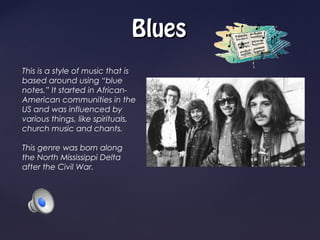
Blues
This is a style of music that is
based around using “blue
notes.” It started in African-
American communities in the
US and was influenced by
various things, like spirituals,
church music and chants.

This genre was born along
the North Mississippi Delta
after the Civil War.
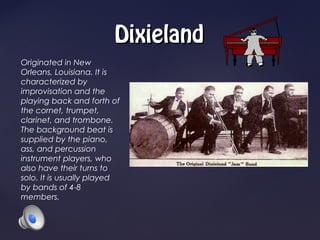
Dixieland
Originated in New
Orleans, Louisiana. It is
characterized by
improvisation and the
playing back and forth of
the cornet, trumpet,
clarinet, and trombone.
The background beat is
supplied by the piano,
ass, and percussion
instrument players, who
also have their turns to
solo. It is usually played
by bands of 4-8
members.
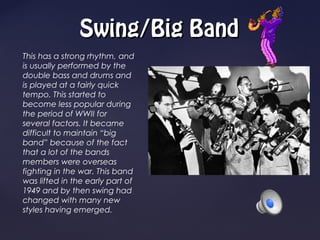
Swing/Big Band
This has a strong rhythm, and
is usually performed by the
double bass and drums and
is played at a fairly quick
tempo. This started to
become less popular during
the period of WWII for
several factors. It became
difficult to maintain “big
band” because of the fact
that a lot of the bands
members were overseas
fighting in the war. This band
was lifted in the early part of
1949 and by then swing had
changed with many new
styles having emerged.
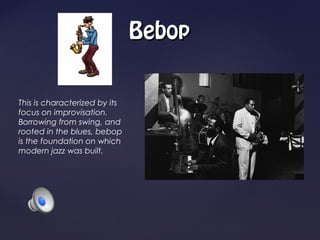
Bebop


This is characterized by its
focus on improvisation.
Borrowing from swing, and
rooted in the blues, bebop
is the foundation on which
modern jazz was built.
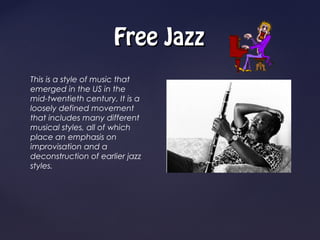
Free Jazz
This is a style of music that
emerged in the US in the
mid-twentieth century. It is a
loosely defined movement
that includes many different
musical styles, all of which
place an emphasis on
improvisation and a
deconstruction of earlier jazz
styles.
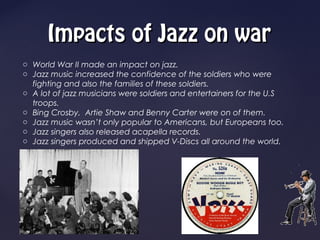
Impacts of Jazz on war
o World War II made an impact on jazz.
o Jazz music increased the confidence of the soldiers who were
  fighting and also the families of these soldiers.
o A lot of jazz musicians were soldiers and entertainers for the U.S
  troops.
o Bing Crosby, Artie Shaw and Benny Carter were on of them.
o Jazz music wasn’t only popular to Americans, but Europeans too.
o Jazz singers also released acapella records.
o Jazz singers produced and shipped V-Discs all around the world.
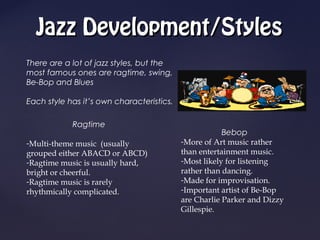
Jazz Development/Styles
There are a lot of jazz styles, but the
most famous ones are ragtime, swing,
Be-Bop and Blues

Each style has it’s own characteristics.

            Ragtime
                                                       Bebop
-Multi-theme music (usually                -More of Art music rather
grouped either ABACD or ABCD)              than entertainment music.
-Ragtime music is usually hard,            -Most likely for listening
bright or cheerful.                        rather than dancing.
-Ragtime music is rarely                   -Made for improvisation.
rhythmically complicated.                  -Important artist of Be-Bop
                                           are Charlie Parker and Dizzy
                                           Gillespie.
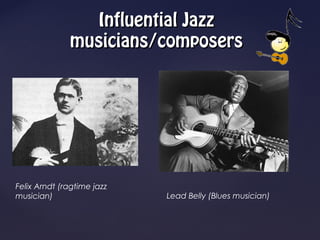
Influential Jazz
              musicians/composers


Felix Arndt (ragtime jazz
musician)                   Lead Belly (Blues musician)
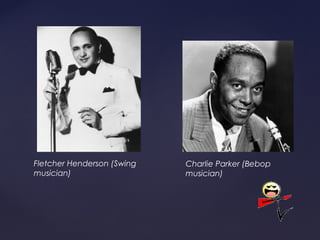
Fletcher Henderson (Swing   Charlie Parker (Bebop
musician)                   musician)
Video Samples


            COUNT BASIE
            Swingin' the Blues,
            1941
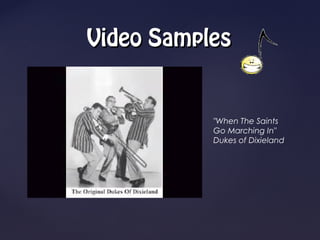
Video Samples


           "When The Saints
           Go Marching In"
           Dukes of Dixieland
Bibliography
1. "Jazz Music and World War II." Jazz Music. N.p., n.d. Web. 30 Jan.
    2013. http://www.angelfire.com/ky3/jazzandww2/
2. "What Is Ragtime?" About.com Jazz. About.com, n.d. Web. 30
    Jan. 2013.
    http://jazz.about.com/od/historyjazztimeline/a/ragtime.htm
"Style Sheets." Bebop. The Thelonious Monk Institute of Jazz, n.d.
    Web. 30 Jan. 2013.
    <http://www.jazzinamerica.org/JazzResources/StyleSheets/10>.
3. "Classics for Kids." Classics for Kids. N.p., n.d. Web. 30 Jan. 2013.
    http://www.classicsforkids.com/shows/jazz.asp
4. "A History of Jazz Music." A History of Jazz Music. N.p., n.d. Web.
    30 Jan. 2013.
http://www.scaruffi.com/history/jazz2.html
5. "All That Jazz History : Swing Era." ThinkQuest. Oracle Foundation,
    n.d. Web. 30 Jan. 2013.
http://library.thinkquest.org/18602/history/swing/swingstart.html

Jazz music ppt

  • 1.
    Impact of Warsto Jazz Development { By: Ezra, Verena, Keyzar, Reydi 10B/F
  • 2.
    Table Of Contents TheHistory/Beginning of Jazz 3-10 Impact of Wars on Jazz Development/Styles 11-12 Influential Jazz Musicians/Composers 13-14 Videos 15-16 Bibliography 17
  • 3.
    History/Beginning of Jazz Firstof all , Jazz is defined as a style of music, native to America, characterized by a strong flexible rhythmic with solo and improvisations on basic tunes, chord patterns and etc.
  • 4.
    History/Beginning of Jazz Timelineof Jazz: o1890’s – 1910’s Jazz is born; Ragtime o1910’s – 1920’s Blues o1920’s – 1930’s Dixieland o1930’s – 1940’s Swing/Big Band o1940’s Bebop o1960’s Free Jazz
  • 5.
    Ragtime Ragtime music isa truly African- American music. It combines rhythms that were brought to this country by slaves, with musical forms brought over to the United States from Europe. Ragtime uses syncopated rhythms. It means the accents in the melody are shifted away from the strong beats in the bass line underneath.
  • 6.
    Blues This is astyle of music that is based around using “blue notes.” It started in African- American communities in the US and was influenced by various things, like spirituals, church music and chants. This genre was born along the North Mississippi Delta after the Civil War.
  • 7.
    Dixieland Originated in New Orleans,Louisiana. It is characterized by improvisation and the playing back and forth of the cornet, trumpet, clarinet, and trombone. The background beat is supplied by the piano, ass, and percussion instrument players, who also have their turns to solo. It is usually played by bands of 4-8 members.
  • 8.
    Swing/Big Band This hasa strong rhythm, and is usually performed by the double bass and drums and is played at a fairly quick tempo. This started to become less popular during the period of WWII for several factors. It became difficult to maintain “big band” because of the fact that a lot of the bands members were overseas fighting in the war. This band was lifted in the early part of 1949 and by then swing had changed with many new styles having emerged.
  • 9.
    Bebop This is characterizedby its focus on improvisation. Borrowing from swing, and rooted in the blues, bebop is the foundation on which modern jazz was built.
  • 10.
    Free Jazz This isa style of music that emerged in the US in the mid-twentieth century. It is a loosely defined movement that includes many different musical styles, all of which place an emphasis on improvisation and a deconstruction of earlier jazz styles.
  • 11.
    Impacts of Jazzon war o World War II made an impact on jazz. o Jazz music increased the confidence of the soldiers who were fighting and also the families of these soldiers. o A lot of jazz musicians were soldiers and entertainers for the U.S troops. o Bing Crosby, Artie Shaw and Benny Carter were on of them. o Jazz music wasn’t only popular to Americans, but Europeans too. o Jazz singers also released acapella records. o Jazz singers produced and shipped V-Discs all around the world.
  • 12.
    Jazz Development/Styles There area lot of jazz styles, but the most famous ones are ragtime, swing, Be-Bop and Blues Each style has it’s own characteristics. Ragtime Bebop -Multi-theme music (usually -More of Art music rather grouped either ABACD or ABCD) than entertainment music. -Ragtime music is usually hard, -Most likely for listening bright or cheerful. rather than dancing. -Ragtime music is rarely -Made for improvisation. rhythmically complicated. -Important artist of Be-Bop are Charlie Parker and Dizzy Gillespie.
  • 13.
    Influential Jazz musicians/composers Felix Arndt (ragtime jazz musician) Lead Belly (Blues musician)
  • 14.
    Fletcher Henderson (Swing Charlie Parker (Bebop musician) musician)
  • 15.
    Video Samples COUNT BASIE Swingin' the Blues, 1941
  • 16.
    Video Samples "When The Saints Go Marching In" Dukes of Dixieland
  • 17.
    Bibliography 1. "Jazz Musicand World War II." Jazz Music. N.p., n.d. Web. 30 Jan. 2013. http://www.angelfire.com/ky3/jazzandww2/ 2. "What Is Ragtime?" About.com Jazz. About.com, n.d. Web. 30 Jan. 2013. http://jazz.about.com/od/historyjazztimeline/a/ragtime.htm "Style Sheets." Bebop. The Thelonious Monk Institute of Jazz, n.d. Web. 30 Jan. 2013. <http://www.jazzinamerica.org/JazzResources/StyleSheets/10>. 3. "Classics for Kids." Classics for Kids. N.p., n.d. Web. 30 Jan. 2013. http://www.classicsforkids.com/shows/jazz.asp 4. "A History of Jazz Music." A History of Jazz Music. N.p., n.d. Web. 30 Jan. 2013. http://www.scaruffi.com/history/jazz2.html 5. "All That Jazz History : Swing Era." ThinkQuest. Oracle Foundation, n.d. Web. 30 Jan. 2013. http://library.thinkquest.org/18602/history/swing/swingstart.html