Blues and Jazz
  Creating an American Artform


                                 S
Delta Blues


S African-Americans in the 1800s sang about the pains of
  slavery, usually without any instruments.

S The first blues music was created along the Mississippi
  Delta. This style is called Delta Blues and sometimes
  Country Blues.

S Blues music travelled up the Mississippi river and became
  popular in big cities like Kansas City, Chicago, and
  Memphis.
Ragtime


S Piano players in the 1890s played the piano in a new exciting
  way to get people moving.

S To do this, they purposely played
  “between the beats” or during the
  backbeat. This type of rhythm is
  called syncopation.

S Scott Joplin is one of the most
  famous ragtime composers of
  all time.
Putting it All Together -
                  Dixieland

S Musicians played “classical” instruments (like the
  trumpet, clarinet, and tuba) to “blues” ideas (blue notes, 12-
  bar blues) with “ragtime” rhythms (syncopation).

S This music first came out of New Orleans but travelled up the
  Mississippi River just like Blues Music.

S Louis Armstrong is the most famous Dixieland musician.
Everyone Loves Jazz!
         From Dixieland to Swing

S The 1920s are called the
  Jazz Age. It was a
  rebellious time when many
  traditions about
  music, dancing, and
  drinking were challenged. It
  ended with the Great
  Depression in 1929.
S Swing music was really
  easy to dance to and
  became the most popular
  music in America during the
  1930s and early 1940s.
The Swing Era


      S Swing bands usually featured a
        soloist. This was usually the
        band leader and the person
        audiences came to see
        S Benny Goodman
        S Count Basie

      S In the 1940s, many bandleaders
        were singers. These bands were
        called “Big Bands”
        S Frank Sinatra
        S Ella Fitzgerald
        S Billie Holiday
Just make something up . . .


S Improvisation is perhaps the most important
  characteristic of Jazz. A song could never be played the
  same way twice.
  S In Classical Music, all the notes are written down.
  S In Jazz Music, the players make up the notes as they go
     along.

S This meant the “players” were most
  important, not the composers.
Turning Jazz into
                             “Art”

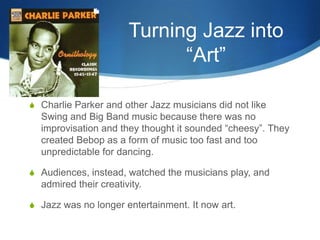
S Charlie Parker and other Jazz musicians did not like
  Swing and Big Band music because there was no
  improvisation and they thought it sounded “cheesy”. They
  created Bebop as a form of music too fast and too
  unpredictable for dancing.

S Audiences, instead, watched the musicians play, and
  admired their creativity.

S Jazz was no longer entertainment. It now art.
What Else Can We Do?

   S As Jazz evolved into
     America’s Art
     Music, musicians
     explored as many
     different musical ideas
     as they could.
     S Some musicians played
       music without a melody.
     S Some musicians made
       music with dissonance.
     S Some musicians
       randomized their
       musical ideas and
Impact of Jazz Music

S Blues and Jazz music still inspire music today.
  S Many popular styles of music, such as Rock and
     Roll, R&B, Funk, or Hip Hop, are direct descendants of
     Blues and Jazz music.

S Outside of music, Jazz has changed America . . .
  S African-Americans were first recognized for their musical
     abilities as Blues and Jazz musicians.
     S   Louis Armstrong, Duke Ellington, and Ella Fitzgerald are among
         the first celebrated African-Americans.
  S Women challenged traditions through dance and as
     bandleaders.
     S   Women gained suffrage (voting rights) in 1920.

Blues and Jazz

  • 1.
    Blues and Jazz Creating an American Artform S
  • 2.
    Delta Blues S African-Americansin the 1800s sang about the pains of slavery, usually without any instruments. S The first blues music was created along the Mississippi Delta. This style is called Delta Blues and sometimes Country Blues. S Blues music travelled up the Mississippi river and became popular in big cities like Kansas City, Chicago, and Memphis.
  • 3.
    Ragtime S Piano playersin the 1890s played the piano in a new exciting way to get people moving. S To do this, they purposely played “between the beats” or during the backbeat. This type of rhythm is called syncopation. S Scott Joplin is one of the most famous ragtime composers of all time.
  • 4.
    Putting it AllTogether - Dixieland S Musicians played “classical” instruments (like the trumpet, clarinet, and tuba) to “blues” ideas (blue notes, 12- bar blues) with “ragtime” rhythms (syncopation). S This music first came out of New Orleans but travelled up the Mississippi River just like Blues Music. S Louis Armstrong is the most famous Dixieland musician.
  • 5.
    Everyone Loves Jazz! From Dixieland to Swing S The 1920s are called the Jazz Age. It was a rebellious time when many traditions about music, dancing, and drinking were challenged. It ended with the Great Depression in 1929. S Swing music was really easy to dance to and became the most popular music in America during the 1930s and early 1940s.
  • 6.
    The Swing Era S Swing bands usually featured a soloist. This was usually the band leader and the person audiences came to see S Benny Goodman S Count Basie S In the 1940s, many bandleaders were singers. These bands were called “Big Bands” S Frank Sinatra S Ella Fitzgerald S Billie Holiday
  • 7.
    Just make somethingup . . . S Improvisation is perhaps the most important characteristic of Jazz. A song could never be played the same way twice. S In Classical Music, all the notes are written down. S In Jazz Music, the players make up the notes as they go along. S This meant the “players” were most important, not the composers.
  • 8.
    Turning Jazz into “Art” S Charlie Parker and other Jazz musicians did not like Swing and Big Band music because there was no improvisation and they thought it sounded “cheesy”. They created Bebop as a form of music too fast and too unpredictable for dancing. S Audiences, instead, watched the musicians play, and admired their creativity. S Jazz was no longer entertainment. It now art.
  • 9.
    What Else CanWe Do? S As Jazz evolved into America’s Art Music, musicians explored as many different musical ideas as they could. S Some musicians played music without a melody. S Some musicians made music with dissonance. S Some musicians randomized their musical ideas and
  • 10.
    Impact of JazzMusic S Blues and Jazz music still inspire music today. S Many popular styles of music, such as Rock and Roll, R&B, Funk, or Hip Hop, are direct descendants of Blues and Jazz music. S Outside of music, Jazz has changed America . . . S African-Americans were first recognized for their musical abilities as Blues and Jazz musicians. S Louis Armstrong, Duke Ellington, and Ella Fitzgerald are among the first celebrated African-Americans. S Women challenged traditions through dance and as bandleaders. S Women gained suffrage (voting rights) in 1920.