JAW CRUSHER GROUP A3
CONTENTS JAW CRUSHER TYPES OF JAW CRUSHERS PRINCIPLE AND WORKING OF JAW CRUSHER EQUIPMENT DIAGRAM INDUSTRIAL APPLICATION AND FEATURES OF JAW CRUSHER PROCEDURE OBSERVATION AND CALCULATION RESULTS AND DISCUSSION LIMITATION REFERENCES
JAW CRUSHER A jaw or toggle crusher consists of a set of vertical jaws, one jaw being fixed and the other being moved back and forth relative to it by a  cam  or  pitman  mechanism. The jaws are farther apart at the top than at the bottom, forming a tapered chute so that the material is crushed progressively smaller and smaller as it travels downward until it is small enough to escape from the bottom opening.
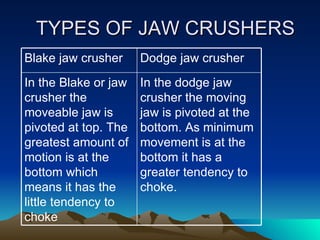
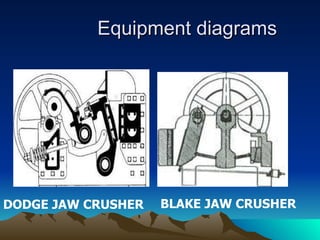
TYPES OF JAW CRUSHERS In the dodge jaw crusher the moving jaw is pivoted at the bottom. As minimum movement is at the bottom it has a greater tendency to choke. In the Blake or jaw crusher the moveable jaw is pivoted at top. The  greatest amount of motion is at the bottom which means it has the little tendency to choke  Dodge jaw crusher  Blake jaw crusher
Equipment diagrams DODGE JAW CRUSHER BLAKE JAW CRUSHER
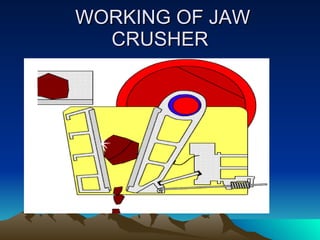
PRINCIPLE OF JAW CRUSHER This jaw crusher uses motor as its power. Through the motor's wheels, the eccentric shaft is driven by the triangle belt and slot wheel to make the movable jaw plate move by a regulated track. Therefore, the materials in the crushing cavity composed of fixed jaw plate, movable jaw plate and side-lee board can be crushed and discharged through the discharging opening.
WORKING OF JAW CRUSHER
INDUSTERIAL APPLICATIONS Jaw Crusher can be used in mining, metallurgical industry, construction, road and railway building, chemistry etc.
FEATURES OF  JAW CRUSHER Simple structure easy maintenance. Stable performance. Even final particles and high crushing ratio.
Procedure  Prepare 5 kg of the size that can pass through 3in hole and retain on a 2 in hole. Note down time (t1) required for 2 revolutions under  unloaded conditions. Also note down energy meter factor. While crushing note down the time(t2) required for 2 revolutions under loaded conditions. when crushing is completed, stop the stopwatch and turn off the crusher. Note down total time required for crushing . Analyze the material using different us astm mesh sieves and weigh out the mass retained on each sieve and in the pan.
OBSERVATION AND CALCULATION
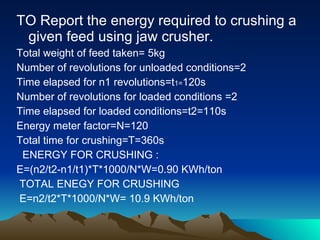
TO Report the energy required to crushing a given feed using jaw crusher. Total weight of feed taken= 5kg Number of revolutions for unloaded conditions=2 Time elapsed for n1 revolutions=t 1= 120s Number of revolutions for loaded conditions =2 Time elapsed for loaded conditions=t2=110s Energy meter factor=N=120 Total time for crushing=T=360s ENERGY FOR CRUSHING : E=(n2/t2-n1/t1)*T*1000/N*W=0.90 KWh/ton  TOTAL ENEGY FOR CRUSHING E=n2/t2*T*1000/N*W= 10.9 KWh/ton
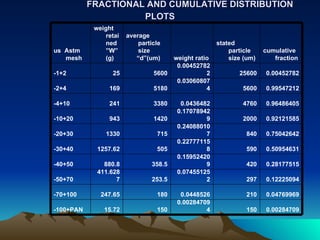
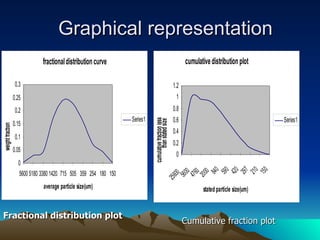
FRACTIONAL AND CUMULATIVE DISTRIBUTION PLOTS 0.00284709 150 0.002847094 150 15.72 -100+PAN 0.04769969 210 0.0448526 180 247.65 -70+100 0.12225094 297 0.074551252 253.5 411.6287 -50+70 0.28177515 420 0.159524209 358.5 880.8 -40+50 0.50954631 590 0.227771158 505 1257.62 -30+40 0.75042642 840 0.240880107 715 1330 -20+30 0.92121585 2000 0.170789429 1420 943 -10+20 0.96486405 4760 0.0436482 3380 241 -4+10 0.99547212 5600 0.030608074 5180 169 -2+4 0.00452782 25600 0.004527822 5600 25 -1+2 cumulative fraction stated particle size (um) weight ratio average particle size “ d”(um) weight retained”W” (g) us  Astm mesh
Graphical representation Fractional distribution plot Cumulative fraction plot
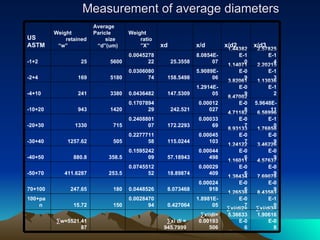
Measurement of average diameters  ∑ xi/di3= 1.90616E-08 ∑ xi/di2= 5.36633E-06 ∑ xi/di= 0.00193506 ∑ xi di = 945.7999 ∑ w=5521.4187 8.43583E-10 1.26538E-07 1.8981E-05 0.427064 0.002847094 150 15.72 100+pan 7.69078E-09 1.38434E-06 0.00024918 8.073468 0.0448526 180 247.65 70+100 4.57637E-09 1.16011E-06 0.00029409 18.89874 0.074551252 253.5 411.6287 -50+70 3.46226E-09 1.24122E-06 0.00044498 57.18943 0.159524209 358.5 880.8 -40+50 1.76858E-09 8.93133E-07 0.00045103 115.0244 0.227771158 505 1257.62 -30+40 6.58996E-10 4.71182E-07 0.0003369 172.2293 0.240880107 715 1330 -20+30 5.9648E-11 8.47002E-08 0.00012027 242.521 0.170789429 1420 943 -10+20 1.13036E-12 3.82061E-09 1.2914E-05 147.5309 0.0436482 3380 241 -4+10 2.20215E-13 1.14071E-09 5.9089E-06 158.5498 0.030608074 5180 169 -2+4 2.57825E-14 1.44382E-10 8.0854E-07 25.3558 0.004527822 5600 25 -1+2 x/d3 x/d2 x/d xd Weight ratio”X” Average Paricle size “ d”(um) Weight retained “ w” US ASTM
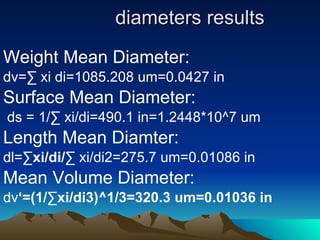
diameters results Weight Mean Diameter: dv= ∑  xi di=1085.208 um=0.0427 in Surface Mean Diameter: ds = 1/ ∑  xi/di=490.1 in=1.2448*10^7 um Length Mean Diamter: dl= ∑xi/di/∑  xi/di2=275.7 um=0.01086 in  Mean Volume Diameter: dv ‘=(1/∑xi/di3)^1/3=320.3 um=0.01036 in
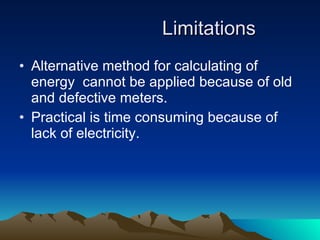
Limitations Alternative method for calculating of energy  cannot be applied because of old and defective meters. Practical is time consuming because of lack of electricity.
Future recommendations I will try to do this practical using different  Materials such as limestone , chalk , clay and others. So my recommendation is that please  provide different types of materials instead of red bricks.
References www.en.wikipedia.org/wiki/Crusher www.shibangchina.com/info/JawCrusher RICHORDSON AND COULSON VOLUME 2
 

Jaw Crusher

  • 1.
  • 2.
    CONTENTS JAW CRUSHERTYPES OF JAW CRUSHERS PRINCIPLE AND WORKING OF JAW CRUSHER EQUIPMENT DIAGRAM INDUSTRIAL APPLICATION AND FEATURES OF JAW CRUSHER PROCEDURE OBSERVATION AND CALCULATION RESULTS AND DISCUSSION LIMITATION REFERENCES
  • 3.
    JAW CRUSHER Ajaw or toggle crusher consists of a set of vertical jaws, one jaw being fixed and the other being moved back and forth relative to it by a cam or pitman mechanism. The jaws are farther apart at the top than at the bottom, forming a tapered chute so that the material is crushed progressively smaller and smaller as it travels downward until it is small enough to escape from the bottom opening.
  • 4.
    TYPES OF JAWCRUSHERS In the dodge jaw crusher the moving jaw is pivoted at the bottom. As minimum movement is at the bottom it has a greater tendency to choke. In the Blake or jaw crusher the moveable jaw is pivoted at top. The greatest amount of motion is at the bottom which means it has the little tendency to choke Dodge jaw crusher Blake jaw crusher
  • 5.
    Equipment diagrams DODGEJAW CRUSHER BLAKE JAW CRUSHER
  • 6.
    PRINCIPLE OF JAWCRUSHER This jaw crusher uses motor as its power. Through the motor's wheels, the eccentric shaft is driven by the triangle belt and slot wheel to make the movable jaw plate move by a regulated track. Therefore, the materials in the crushing cavity composed of fixed jaw plate, movable jaw plate and side-lee board can be crushed and discharged through the discharging opening.
  • 7.
  • 8.
    INDUSTERIAL APPLICATIONS JawCrusher can be used in mining, metallurgical industry, construction, road and railway building, chemistry etc.
  • 9.
    FEATURES OF JAW CRUSHER Simple structure easy maintenance. Stable performance. Even final particles and high crushing ratio.
  • 10.
    Procedure Prepare5 kg of the size that can pass through 3in hole and retain on a 2 in hole. Note down time (t1) required for 2 revolutions under unloaded conditions. Also note down energy meter factor. While crushing note down the time(t2) required for 2 revolutions under loaded conditions. when crushing is completed, stop the stopwatch and turn off the crusher. Note down total time required for crushing . Analyze the material using different us astm mesh sieves and weigh out the mass retained on each sieve and in the pan.
  • 11.
  • 12.
    TO Report theenergy required to crushing a given feed using jaw crusher. Total weight of feed taken= 5kg Number of revolutions for unloaded conditions=2 Time elapsed for n1 revolutions=t 1= 120s Number of revolutions for loaded conditions =2 Time elapsed for loaded conditions=t2=110s Energy meter factor=N=120 Total time for crushing=T=360s ENERGY FOR CRUSHING : E=(n2/t2-n1/t1)*T*1000/N*W=0.90 KWh/ton TOTAL ENEGY FOR CRUSHING E=n2/t2*T*1000/N*W= 10.9 KWh/ton
  • 13.
    FRACTIONAL AND CUMULATIVEDISTRIBUTION PLOTS 0.00284709 150 0.002847094 150 15.72 -100+PAN 0.04769969 210 0.0448526 180 247.65 -70+100 0.12225094 297 0.074551252 253.5 411.6287 -50+70 0.28177515 420 0.159524209 358.5 880.8 -40+50 0.50954631 590 0.227771158 505 1257.62 -30+40 0.75042642 840 0.240880107 715 1330 -20+30 0.92121585 2000 0.170789429 1420 943 -10+20 0.96486405 4760 0.0436482 3380 241 -4+10 0.99547212 5600 0.030608074 5180 169 -2+4 0.00452782 25600 0.004527822 5600 25 -1+2 cumulative fraction stated particle size (um) weight ratio average particle size “ d”(um) weight retained”W” (g) us Astm mesh
  • 14.
    Graphical representation Fractionaldistribution plot Cumulative fraction plot
  • 15.
    Measurement of averagediameters ∑ xi/di3= 1.90616E-08 ∑ xi/di2= 5.36633E-06 ∑ xi/di= 0.00193506 ∑ xi di = 945.7999 ∑ w=5521.4187 8.43583E-10 1.26538E-07 1.8981E-05 0.427064 0.002847094 150 15.72 100+pan 7.69078E-09 1.38434E-06 0.00024918 8.073468 0.0448526 180 247.65 70+100 4.57637E-09 1.16011E-06 0.00029409 18.89874 0.074551252 253.5 411.6287 -50+70 3.46226E-09 1.24122E-06 0.00044498 57.18943 0.159524209 358.5 880.8 -40+50 1.76858E-09 8.93133E-07 0.00045103 115.0244 0.227771158 505 1257.62 -30+40 6.58996E-10 4.71182E-07 0.0003369 172.2293 0.240880107 715 1330 -20+30 5.9648E-11 8.47002E-08 0.00012027 242.521 0.170789429 1420 943 -10+20 1.13036E-12 3.82061E-09 1.2914E-05 147.5309 0.0436482 3380 241 -4+10 2.20215E-13 1.14071E-09 5.9089E-06 158.5498 0.030608074 5180 169 -2+4 2.57825E-14 1.44382E-10 8.0854E-07 25.3558 0.004527822 5600 25 -1+2 x/d3 x/d2 x/d xd Weight ratio”X” Average Paricle size “ d”(um) Weight retained “ w” US ASTM
  • 16.
    diameters results WeightMean Diameter: dv= ∑ xi di=1085.208 um=0.0427 in Surface Mean Diameter: ds = 1/ ∑ xi/di=490.1 in=1.2448*10^7 um Length Mean Diamter: dl= ∑xi/di/∑ xi/di2=275.7 um=0.01086 in Mean Volume Diameter: dv ‘=(1/∑xi/di3)^1/3=320.3 um=0.01036 in
  • 17.
    Limitations Alternative methodfor calculating of energy cannot be applied because of old and defective meters. Practical is time consuming because of lack of electricity.
  • 18.
    Future recommendations Iwill try to do this practical using different Materials such as limestone , chalk , clay and others. So my recommendation is that please provide different types of materials instead of red bricks.
  • 19.
  • 20.