Geography
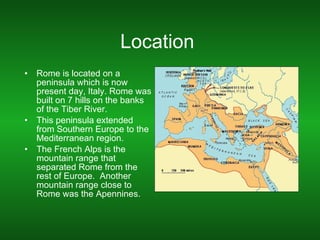
Location  Rome is located on a peninsula which is now present day, Italy. Rome was built on 7 hills on the banks of the Tiber River. This peninsula extended from Southern Europe to the Mediterranean region. The French Alps is the mountain range that separated Rome from the rest of Europe.  Another mountain range close to Rome was the Apennines.
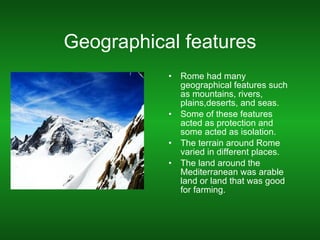
Geographical features Rome had many geographical features such as mountains, rivers, plains,deserts, and seas. Some of these features acted as protection and some acted as isolation. The terrain around Rome varied in different places. The land around the Mediterranean was arable land or land that was good for farming.
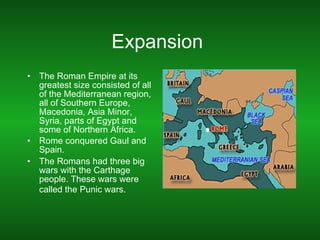
Expansion  The Roman Empire at its greatest size consisted of all of the Mediterranean region, all of Southern Europe, Macedonia, Asia Minor, Syria, parts of Egypt and some of Northern Africa.  Rome conquered Gaul and Spain.  The Romans had three big wars with the Carthage people. These wars were called the Punic wars.
Climate  In the Roman Empire, the climate varied in different places. The climate in the northern part of the empire was cold. The climate in the middle part of the empire was perfect for farming. The climate in the southern part of the empire was hot
Religion
Christianity  Christianity was spread around the empire by a man named Paul.  Paul first traveled to Cypress and Asia Minor. He built churches and made disciples in his travels. Paul traveled to many countries such as Macedonia, Rome, Europe, Persia and Northern Africa.
Judaism  Judaism was a religion that originated in Judea. When Judea was conquered by Rome, the people were offered Roman citizenship. Under the rule of Trajan, there was a Jewish revolt. Trajan was not able to react fast enough, by the time Trajan reacted 200,000 non-Jews were killed.
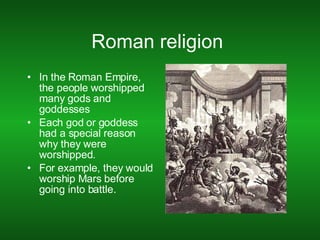
Roman religion  In the Roman Empire, the people worshipped many gods and goddesses  Each god or goddess had a special reason why they were worshipped. For example, they would worship Mars before going into battle.
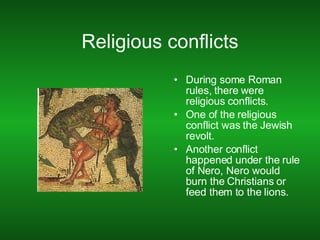
Religious conflicts During some Roman rules, there were religious conflicts. One of the religious conflict was the Jewish revolt. Another conflict happened under the rule of Nero, Nero would burn the Christians or feed them to the lions.
Achievements
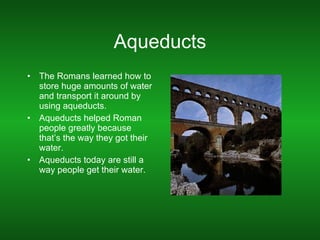
Aqueducts The Romans learned how to store huge amounts of water and transport it around by using aqueducts. Aqueducts helped Roman people greatly because that’s the way they got their water. Aqueducts today are still a way people get their water.
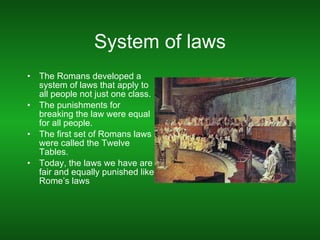
System of laws The Romans developed a system of laws that apply to all people not just one class. The punishments for breaking the law were equal for all people. The first set of Romans laws were called the Twelve Tables. Today, the laws we have are fair and equally punished like Rome’s laws
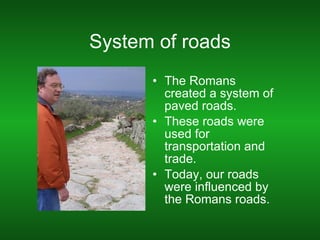
System of roads The Romans created a system of paved roads. These roads were used for transportation and trade. Today, our roads were influenced by the Romans roads.
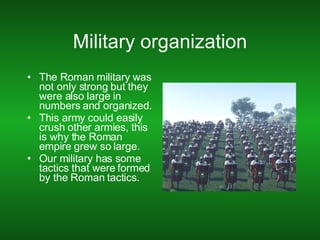
Military organization The Roman military was not only strong but they were also large in numbers and organized. This army could easily crush other armies, this is why the Roman empire grew so large. Our military has some tactics that were formed by the Roman tactics.
Politics
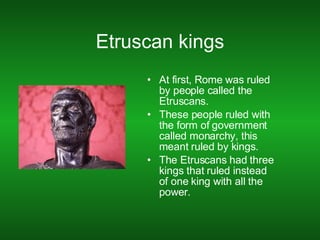
Etruscan kings At first, Rome was ruled by people called the Etruscans. These people ruled with the form of government called monarchy, this meant ruled by kings. The Etruscans had three kings that ruled instead of one king with all the power.
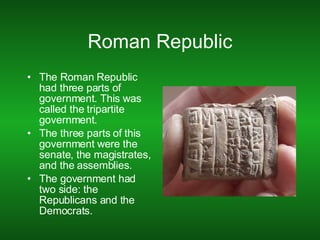
Roman Republic The Roman Republic had three parts of government. This was called the tripartite government. The three parts of this government were the senate, the magistrates, and the assemblies. The government had two side: the Republicans and the Democrats.
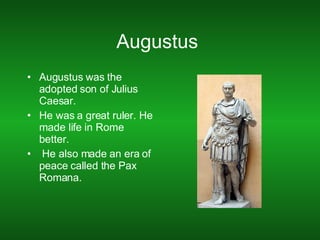
Augustus  Augustus was the adopted son of Julius Caesar. He was a great ruler. He made life in Rome better. He also made an era of peace called the Pax Romana.
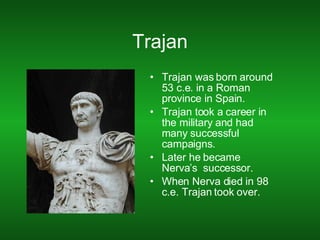
Trajan Trajan was born around 53 c.e. in a Roman province in Spain. Trajan took a career in the military and had many successful campaigns. Later he became Nerva’s  successor.  When Nerva died in 98 c.e. Trajan took over.
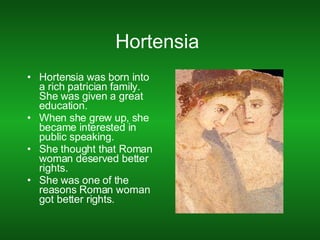
Hortensia  Hortensia was born into a rich patrician family. She was given a great education. When she grew up, she became interested in public speaking. She thought that Roman woman deserved better rights. She was one of the reasons Roman woman got better rights.
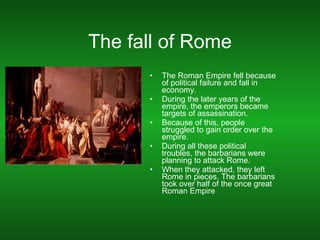
The fall of Rome The Roman Empire fell because of political failure and fall in economy. During the later years of the empire, the emperors became targets of assassination. Because of this, people struggled to gain order over the empire. During all these political troubles, the barbarians were planning to attack Rome. When they attacked, they left Rome in pieces. The barbarians took over half of the once great Roman Empire
Economy
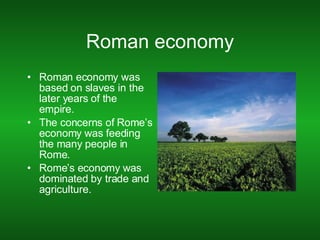
Roman economy Roman economy was based on slaves in the later years of the empire. The concerns of Rome’s economy was feeding the many people in Rome. Rome’s economy was dominated by trade and agriculture.
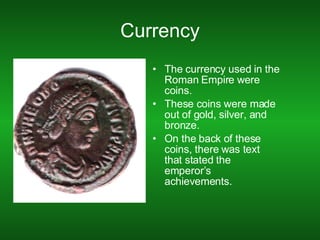
Currency The currency used in the Roman Empire were coins. These coins were made out of gold, silver, and bronze. On the back of these coins, there was text that stated the emperor’s achievements.
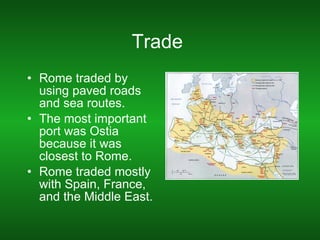
Trade  Rome traded by using paved roads and sea routes. The most important port was Ostia because it was closest to Rome. Rome traded mostly with Spain, France, and the Middle East.
Inflation The Roman economy suffered greatly from inflation.  Inflation was the raising of prices. Once the Romans stopped conquering, the flow of gold decreased. As people kept spending money, the coin became worth less. To make up for this, merchants rose the price of the goods they sold.
Roman social structure
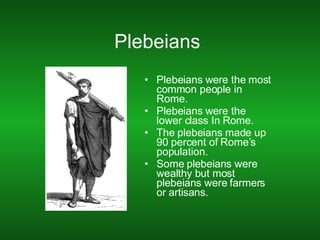
Plebeians  Plebeians were the most common people in Rome. Plebeians were the lower class In Rome. The plebeians made up 90 percent of Rome’s population. Some plebeians were wealthy but most plebeians were farmers or artisans.
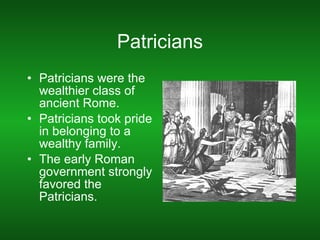
Patricians Patricians were the wealthier class of ancient Rome. Patricians took pride in belonging to a wealthy family. The early Roman government strongly favored the Patricians.
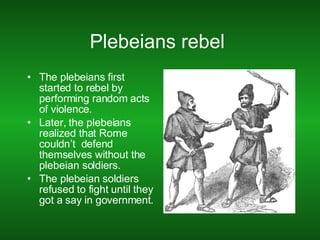
Plebeians rebel  The plebeians first started to rebel by performing random acts of violence. Later, the plebeians realized that Rome couldn’t  defend themselves without the plebeian soldiers. The plebeian soldiers refused to fight until they got a say in government.
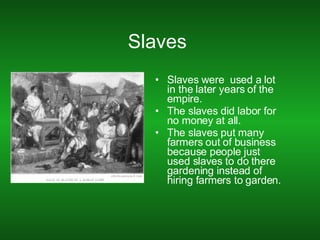
Slaves  Slaves were  used a lot in the later years of the empire. The slaves did labor for no money at all. The slaves put many farmers out of business because people just used slaves to do there gardening instead of hiring farmers to garden.
The most important idea that  I learned about ancient Rome The idea I think is most important was the Roman’s achievements because the inventions in Rome made life better and more comfortable in ancient Rome.  Today, some of our inventions are made from the same concept of the Roman invention, ours are just more modern. Their system of laws were fair and applied to all citizen not just one class.

312

  • 1.
  • 2.
    Location Romeis located on a peninsula which is now present day, Italy. Rome was built on 7 hills on the banks of the Tiber River. This peninsula extended from Southern Europe to the Mediterranean region. The French Alps is the mountain range that separated Rome from the rest of Europe. Another mountain range close to Rome was the Apennines.
  • 3.
    Geographical features Romehad many geographical features such as mountains, rivers, plains,deserts, and seas. Some of these features acted as protection and some acted as isolation. The terrain around Rome varied in different places. The land around the Mediterranean was arable land or land that was good for farming.
  • 4.
    Expansion TheRoman Empire at its greatest size consisted of all of the Mediterranean region, all of Southern Europe, Macedonia, Asia Minor, Syria, parts of Egypt and some of Northern Africa. Rome conquered Gaul and Spain. The Romans had three big wars with the Carthage people. These wars were called the Punic wars.
  • 5.
    Climate Inthe Roman Empire, the climate varied in different places. The climate in the northern part of the empire was cold. The climate in the middle part of the empire was perfect for farming. The climate in the southern part of the empire was hot
  • 6.
  • 7.
    Christianity Christianitywas spread around the empire by a man named Paul. Paul first traveled to Cypress and Asia Minor. He built churches and made disciples in his travels. Paul traveled to many countries such as Macedonia, Rome, Europe, Persia and Northern Africa.
  • 8.
    Judaism Judaismwas a religion that originated in Judea. When Judea was conquered by Rome, the people were offered Roman citizenship. Under the rule of Trajan, there was a Jewish revolt. Trajan was not able to react fast enough, by the time Trajan reacted 200,000 non-Jews were killed.
  • 9.
    Roman religion In the Roman Empire, the people worshipped many gods and goddesses Each god or goddess had a special reason why they were worshipped. For example, they would worship Mars before going into battle.
  • 10.
    Religious conflicts Duringsome Roman rules, there were religious conflicts. One of the religious conflict was the Jewish revolt. Another conflict happened under the rule of Nero, Nero would burn the Christians or feed them to the lions.
  • 11.
  • 12.
    Aqueducts The Romanslearned how to store huge amounts of water and transport it around by using aqueducts. Aqueducts helped Roman people greatly because that’s the way they got their water. Aqueducts today are still a way people get their water.
  • 13.
    System of lawsThe Romans developed a system of laws that apply to all people not just one class. The punishments for breaking the law were equal for all people. The first set of Romans laws were called the Twelve Tables. Today, the laws we have are fair and equally punished like Rome’s laws
  • 14.
    System of roadsThe Romans created a system of paved roads. These roads were used for transportation and trade. Today, our roads were influenced by the Romans roads.
  • 15.
    Military organization TheRoman military was not only strong but they were also large in numbers and organized. This army could easily crush other armies, this is why the Roman empire grew so large. Our military has some tactics that were formed by the Roman tactics.
  • 16.
  • 17.
    Etruscan kings Atfirst, Rome was ruled by people called the Etruscans. These people ruled with the form of government called monarchy, this meant ruled by kings. The Etruscans had three kings that ruled instead of one king with all the power.
  • 18.
    Roman Republic TheRoman Republic had three parts of government. This was called the tripartite government. The three parts of this government were the senate, the magistrates, and the assemblies. The government had two side: the Republicans and the Democrats.
  • 19.
    Augustus Augustuswas the adopted son of Julius Caesar. He was a great ruler. He made life in Rome better. He also made an era of peace called the Pax Romana.
  • 20.
    Trajan Trajan wasborn around 53 c.e. in a Roman province in Spain. Trajan took a career in the military and had many successful campaigns. Later he became Nerva’s successor. When Nerva died in 98 c.e. Trajan took over.
  • 21.
    Hortensia Hortensiawas born into a rich patrician family. She was given a great education. When she grew up, she became interested in public speaking. She thought that Roman woman deserved better rights. She was one of the reasons Roman woman got better rights.
  • 22.
    The fall ofRome The Roman Empire fell because of political failure and fall in economy. During the later years of the empire, the emperors became targets of assassination. Because of this, people struggled to gain order over the empire. During all these political troubles, the barbarians were planning to attack Rome. When they attacked, they left Rome in pieces. The barbarians took over half of the once great Roman Empire
  • 23.
  • 24.
    Roman economy Romaneconomy was based on slaves in the later years of the empire. The concerns of Rome’s economy was feeding the many people in Rome. Rome’s economy was dominated by trade and agriculture.
  • 25.
    Currency The currencyused in the Roman Empire were coins. These coins were made out of gold, silver, and bronze. On the back of these coins, there was text that stated the emperor’s achievements.
  • 26.
    Trade Rometraded by using paved roads and sea routes. The most important port was Ostia because it was closest to Rome. Rome traded mostly with Spain, France, and the Middle East.
  • 27.
    Inflation The Romaneconomy suffered greatly from inflation. Inflation was the raising of prices. Once the Romans stopped conquering, the flow of gold decreased. As people kept spending money, the coin became worth less. To make up for this, merchants rose the price of the goods they sold.
  • 28.
  • 29.
    Plebeians Plebeianswere the most common people in Rome. Plebeians were the lower class In Rome. The plebeians made up 90 percent of Rome’s population. Some plebeians were wealthy but most plebeians were farmers or artisans.
  • 30.
    Patricians Patricians werethe wealthier class of ancient Rome. Patricians took pride in belonging to a wealthy family. The early Roman government strongly favored the Patricians.
  • 31.
    Plebeians rebel The plebeians first started to rebel by performing random acts of violence. Later, the plebeians realized that Rome couldn’t defend themselves without the plebeian soldiers. The plebeian soldiers refused to fight until they got a say in government.
  • 32.
    Slaves Slaveswere used a lot in the later years of the empire. The slaves did labor for no money at all. The slaves put many farmers out of business because people just used slaves to do there gardening instead of hiring farmers to garden.
  • 33.
    The most importantidea that I learned about ancient Rome The idea I think is most important was the Roman’s achievements because the inventions in Rome made life better and more comfortable in ancient Rome. Today, some of our inventions are made from the same concept of the Roman invention, ours are just more modern. Their system of laws were fair and applied to all citizen not just one class.