GROUP 1- GENERAL BIOLOGY
Patrice Lorraine Anoyo
Sandy De Villa
Ciera Magnaye
Keith Cashiell Aguzar
Erickson Aguda
John Hardy Maligaya
Jeanhel John Halup
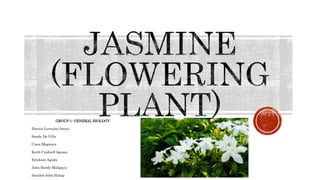
 Jasmine is a genus of shrubs
and vines in the olive family. It
contains around 200 species
native to tropical and warm
temperate regions of Eurasia,
Africa, and Oceania. Jasmines
are widely cultivated for the
characteristic fragrance of their
flowers. The scientific name of
jasmine is Jasminum.
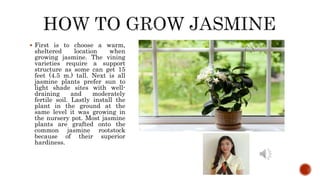
 First is to choose a warm,
sheltered location when
growing jasmine. The vining
varieties require a support
structure as some can get 15
feet (4.5 m.) tall. Next is all
jasmine plants prefer sun to
light shade sites with well-
draining and moderately
fertile soil. Lastly install the
plant in the ground at the
same level it was growing in
the nursery pot. Most jasmine
plants are grafted onto the
common jasmine rootstock
because of their superior
hardiness.
 Jasmine will grow well
in full sun to partial
shaded areas. Summer-
flowering jasmine does
better in a sunny spot,
while other varieties,
such as winter jasmine,
like a more shaded
area. Soils that jasmine
thrive in- Jasmine
needs well-drained but
moist, moderately
fertile sandy loamy soil.
 Jasmine reproduce by
stem layering. It is the
method of vegetative
reproduction used in
jasmine plants. New
plant is propagated by
bending the lowest
branch of the plant into
the ground and covering
it with soil in such a way
that the tip of the branch
would be exposed to the
sunlight.
 Dig a planting hole
and add well-rotted
manure or compost
to the bottom. On
heavy soils, add grit
to aid drainage.
Provide support
using an angled
cane, which should
be pointing in the
direction of wires or
a trellis for later
growth.
 Common jasmine- sometimes called poet's jasmine,
is one of the most fragrant types of jasmine. The
intensely fragrant flowers bloom throughout the
summer and into the fall. Showy jasmine- seems
misnamed because the little 1-inch flowers that
bloom in spring aren't very showy at all. Spanish
Jasmine- also known as royal jasmine, has fragrant
white flowers that are about 1 1/2 inches (4 cm.)
apart. The most common types of jasmine are vines,
but there are some varieties that you can grow as
shrubs or ground covers. Arabian jasmine- is an
evergreen shrub with intensely fragrant flowers.
Italian jasmine- can be grown as a vine or a shrub.
When not attached to a trellis, it forms a dense,
mounded shape as much as 10 feet wide. Winter
Jasmine- is a shrub that grows 4 feet wide and 7
feet tall. The yellow flowers on this deciduous shrub
aren’t fragrant, but it has the advantage of
blooming in late winter. Primrose jasmine- is
seldom grown in the United States. This shrub
produces yellow flowers that are larger than most
varieties—as much as 2 inches in diameter. Asian
Star jasmine- is usually grown as a tough ground
cover. It has small, pale-yellow flowers and large,
dense leaves.

group-1-gen-bio.pptx

  • 1.
    GROUP 1- GENERALBIOLOGY Patrice Lorraine Anoyo Sandy De Villa Ciera Magnaye Keith Cashiell Aguzar Erickson Aguda John Hardy Maligaya Jeanhel John Halup
  • 2.
     Jasmine isa genus of shrubs and vines in the olive family. It contains around 200 species native to tropical and warm temperate regions of Eurasia, Africa, and Oceania. Jasmines are widely cultivated for the characteristic fragrance of their flowers. The scientific name of jasmine is Jasminum.
  • 3.
     First isto choose a warm, sheltered location when growing jasmine. The vining varieties require a support structure as some can get 15 feet (4.5 m.) tall. Next is all jasmine plants prefer sun to light shade sites with well- draining and moderately fertile soil. Lastly install the plant in the ground at the same level it was growing in the nursery pot. Most jasmine plants are grafted onto the common jasmine rootstock because of their superior hardiness.
  • 4.
     Jasmine willgrow well in full sun to partial shaded areas. Summer- flowering jasmine does better in a sunny spot, while other varieties, such as winter jasmine, like a more shaded area. Soils that jasmine thrive in- Jasmine needs well-drained but moist, moderately fertile sandy loamy soil.
  • 5.
     Jasmine reproduceby stem layering. It is the method of vegetative reproduction used in jasmine plants. New plant is propagated by bending the lowest branch of the plant into the ground and covering it with soil in such a way that the tip of the branch would be exposed to the sunlight.
  • 6.
     Dig aplanting hole and add well-rotted manure or compost to the bottom. On heavy soils, add grit to aid drainage. Provide support using an angled cane, which should be pointing in the direction of wires or a trellis for later growth.
  • 7.
     Common jasmine-sometimes called poet's jasmine, is one of the most fragrant types of jasmine. The intensely fragrant flowers bloom throughout the summer and into the fall. Showy jasmine- seems misnamed because the little 1-inch flowers that bloom in spring aren't very showy at all. Spanish Jasmine- also known as royal jasmine, has fragrant white flowers that are about 1 1/2 inches (4 cm.) apart. The most common types of jasmine are vines, but there are some varieties that you can grow as shrubs or ground covers. Arabian jasmine- is an evergreen shrub with intensely fragrant flowers. Italian jasmine- can be grown as a vine or a shrub. When not attached to a trellis, it forms a dense, mounded shape as much as 10 feet wide. Winter Jasmine- is a shrub that grows 4 feet wide and 7 feet tall. The yellow flowers on this deciduous shrub aren’t fragrant, but it has the advantage of blooming in late winter. Primrose jasmine- is seldom grown in the United States. This shrub produces yellow flowers that are larger than most varieties—as much as 2 inches in diameter. Asian Star jasmine- is usually grown as a tough ground cover. It has small, pale-yellow flowers and large, dense leaves.