Korematsu vs. United States 
By: Ronald Barnaby
Talking Points 
• Japanese immigration and US Anti- 
Japanese Sentiment 
• Pearl Harbor and Executive Order 9066 
• Fred Korematsus path to the Supreme Court 
• The verdict and dissent 
• After effects and 1983
Japanese Immigration 
• 1855 – 1919 — Over 300,000 Japanese 
immigrate to the United States. 
• In 1917 many immigration agreements 
reduced the amount of Asian people 
immigrating to the U.S. 
• Japanese immigrants were initially 
successful in establishing productive lives. 
Most of these immigrants were in Hawaii 
and California.
Anti-Japanese Sentiment 
• The success of the Japan born immigrants 
(Issei) in the U.S. lead to a growing national 
anti-Japanese sentiment. 
• Segregation in schools 
• Barred from marrying whites 
• Barred from becoming citizens 
• Barred from owning land 
• The anti-Japanese sentiment would 
continue to escalate until WWII and is a 
principle reason behind Executive Order 
9066.
Pearl Harbor and E.O. 9066 
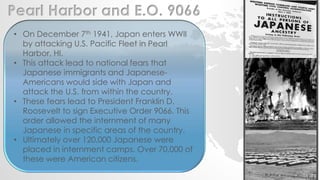
• On December 7th 1941, Japan enters WWII 
by attacking U.S. Pacific Fleet in Pearl 
Harbor, HI. 
• This attack lead to national fears that 
Japanese immigrants and Japanese- 
Americans would side with Japan and 
attack the U.S. from within the country. 
• These fears lead to President Franklin D. 
Roosevelt to sign Executive Order 9066. This 
order allowed the internment of many 
Japanese in specific areas of the country. 
• Ultimately over 120,000 Japanese were 
placed in internment camps. Over 70,000 of 
these were American citizens.
Fred Korematsu vs United States 
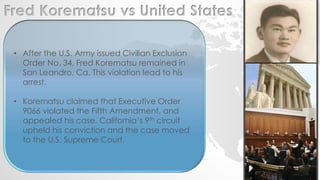
• After the U.S. Army issued Civilian Exclusion 
Order No. 34, Fred Korematsu remained in 
San Leandro, Ca. This violation lead to his 
arrest. 
• Korematsu claimed that Executive Order 
9066 violated the Fifth Amendment, and 
appealed his case. California’s 9th circuit 
upheld his conviction and the case moved 
to the U.S. Supreme Court.
The Verdict & Murphy’s Dissent 
• In 1944 the Supreme Court ruled in a 6-3 
majority to uphold Executive Order 9066, 
thus ruling in favor of The United States. 
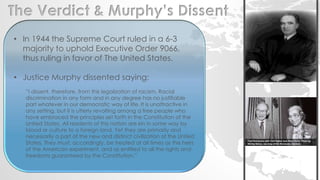
• Justice Murphy dissented saying: 
“I dissent, therefore, from this legalization of racism. Racial 
discrimination in any form and in any degree has no justifiable 
part whatever in our democratic way of life. It is unattractive in 
any setting, but it is utterly revolting among a free people who 
have embraced the principles set forth in the Constitution of the 
United States. All residents of this nation are kin in some way by 
blood or culture to a foreign land. Yet they are primarily and 
necessarily a part of the new and distinct civilization of the United 
States. They must, accordingly, be treated at all times as the heirs 
of the American experiment, and as entitled to all the rights and 
freedoms guaranteed by the Constitution.”
After Effects and 1983 
• The Korematsu trial showed that the 
exclusion order was constitutional and that 
individual rights were outweighed by the 
need to protect from espionage. 
• In 1983 Fred Korematsu’s conviction was 
overturned but the ruling was not. 
• In 2011 Supreme Court Justice Antonin 
Scalia was quoted: 
“the Supreme Court's Korematsu decision upholding 
the internment of Japanese Americans was wrong, 
but it could happen again in war time."
Works Cited 
• http://en.wikipedia.org/wiki/Korematsu_v._United_States 
• http://en.wikipedia.org/wiki/Antonin_Scalia 
• http://korematsuinstitute.org/ 
• http://www.streetlaw.org/en/Page/297/ 
• http://www.archives.gov/research/immigration/enemy-aliens-overview. 
End 
html 
• http://www.law.cornell.edu/supremecourt/text/323/214

Slide share1

  • 1.
    Korematsu vs. UnitedStates By: Ronald Barnaby
  • 2.
    Talking Points •Japanese immigration and US Anti- Japanese Sentiment • Pearl Harbor and Executive Order 9066 • Fred Korematsus path to the Supreme Court • The verdict and dissent • After effects and 1983
  • 3.
    Japanese Immigration •1855 – 1919 — Over 300,000 Japanese immigrate to the United States. • In 1917 many immigration agreements reduced the amount of Asian people immigrating to the U.S. • Japanese immigrants were initially successful in establishing productive lives. Most of these immigrants were in Hawaii and California.
  • 4.
    Anti-Japanese Sentiment •The success of the Japan born immigrants (Issei) in the U.S. lead to a growing national anti-Japanese sentiment. • Segregation in schools • Barred from marrying whites • Barred from becoming citizens • Barred from owning land • The anti-Japanese sentiment would continue to escalate until WWII and is a principle reason behind Executive Order 9066.
  • 5.
    Pearl Harbor andE.O. 9066 • On December 7th 1941, Japan enters WWII by attacking U.S. Pacific Fleet in Pearl Harbor, HI. • This attack lead to national fears that Japanese immigrants and Japanese- Americans would side with Japan and attack the U.S. from within the country. • These fears lead to President Franklin D. Roosevelt to sign Executive Order 9066. This order allowed the internment of many Japanese in specific areas of the country. • Ultimately over 120,000 Japanese were placed in internment camps. Over 70,000 of these were American citizens.
  • 6.
    Fred Korematsu vsUnited States • After the U.S. Army issued Civilian Exclusion Order No. 34, Fred Korematsu remained in San Leandro, Ca. This violation lead to his arrest. • Korematsu claimed that Executive Order 9066 violated the Fifth Amendment, and appealed his case. California’s 9th circuit upheld his conviction and the case moved to the U.S. Supreme Court.
  • 7.
    The Verdict &Murphy’s Dissent • In 1944 the Supreme Court ruled in a 6-3 majority to uphold Executive Order 9066, thus ruling in favor of The United States. • Justice Murphy dissented saying: “I dissent, therefore, from this legalization of racism. Racial discrimination in any form and in any degree has no justifiable part whatever in our democratic way of life. It is unattractive in any setting, but it is utterly revolting among a free people who have embraced the principles set forth in the Constitution of the United States. All residents of this nation are kin in some way by blood or culture to a foreign land. Yet they are primarily and necessarily a part of the new and distinct civilization of the United States. They must, accordingly, be treated at all times as the heirs of the American experiment, and as entitled to all the rights and freedoms guaranteed by the Constitution.”
  • 8.
    After Effects and1983 • The Korematsu trial showed that the exclusion order was constitutional and that individual rights were outweighed by the need to protect from espionage. • In 1983 Fred Korematsu’s conviction was overturned but the ruling was not. • In 2011 Supreme Court Justice Antonin Scalia was quoted: “the Supreme Court's Korematsu decision upholding the internment of Japanese Americans was wrong, but it could happen again in war time."
  • 9.
    Works Cited •http://en.wikipedia.org/wiki/Korematsu_v._United_States • http://en.wikipedia.org/wiki/Antonin_Scalia • http://korematsuinstitute.org/ • http://www.streetlaw.org/en/Page/297/ • http://www.archives.gov/research/immigration/enemy-aliens-overview. End html • http://www.law.cornell.edu/supremecourt/text/323/214