INDIAN INSTITUTE OF FOOD PROCESSING TECHNOLOGY
Ministry of Food Processing Industries, Govt. of India,
Thanjavur
2020
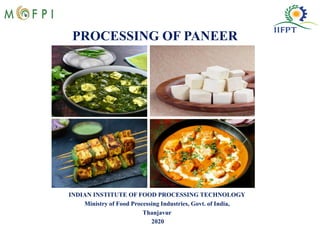
PROCESSING OF PANEER
Introduction
Milk plays a significant role as a source of animal protein in the average
Indian diet which is predominantly vegetarian.
Because of higher ambient temperatures prevailing in Indian sub-continent,
ancient Indians developed more stable products from milk for conservation
of its nutritional goodness.
So the ethnic dairy foods, commonly termed as traditional or Indian
indigenous milk products, were developed over ages utilizing locally
available equipment, utensils and manufacturing procedures.
Traditional Indian Dairy
Products
Production of Milk and traditional dairy products
Total Production in India: 176 Million
Tonnes (2017)
Total percapita availability: 375 g/day
In India only 5-6% of total milk is converted
into western type of products in the organized
sector.
Nearly half of the milk produced in India (50-
55%) is utilized for the manufacture of
traditional milk products and approximately
45.7% is used as fluid milk.
Only about 20% of the total milk produced is
processed by the organized dairy sector.
Conversion of surplus milk into indigenous
milk products in and around production areas
is least expensive and more profitable.
A large proportion of the milk is converted into
indigenous dairy products such as khoa,
chhana, paneer and khoa and chhana based
sweets.
Strengths:
• Traditional dairy products enjoy mass appeal.
• Simple manufacturing technologies which are
well established for small-scale operations.
• Skilled manpower for cottage scale operations
available.
• Lower cost of production and high profit
margins.
• Markets are well established
• Easily available markets for sale
• Utilization of surplus milk.
Strengths:
• Traditional dairy products require low
infrastructure, equipment and operational
overhead costs
• An optimistic demand profile -
consumption likely to grow at an annual
rate more than 20%
• Permit significant value addition,
unparalleled by other dairy products
• Utilization of slightly high acid milk
• Use of low energy
• Approximate for small scale sector
Traditional Indian Dairy Products
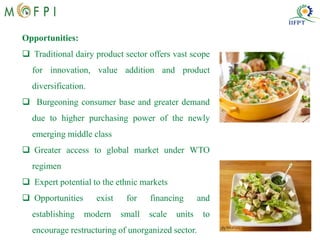
Opportunities:
 Traditional dairy product sector offers vast scope
for innovation, value addition and product
diversification.
 Burgeoning consumer base and greater demand
due to higher purchasing power of the newly
emerging middle class
 Greater access to global market under WTO
regimen
 Expert potential to the ethnic markets
 Opportunities exist for financing and
establishing modern small scale units to
encourage restructuring of unorganized sector.
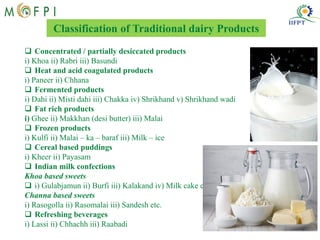
Classification of Traditional dairy Products
 Concentrated / partially desiccated products
i) Khoa ii) Rabri iii) Basundi
 Heat and acid coagulated products
i) Paneer ii) Chhana
 Fermented products
i) Dahi ii) Misti dahi iii) Chakka iv) Shrikhand v) Shrikhand wadi
 Fat rich products
i) Ghee ii) Makkhan (desi butter) iii) Malai
 Frozen products
i) Kulfi ii) Malai – ka – baraf iii) Milk – ice
 Cereal based puddings
i) Kheer ii) Payasam
 Indian milk confections
Khoa based sweets
 i) Gulabjamun ii) Burfi iii) Kalakand iv) Milk cake etc.
Channa based sweets
i) Rasogolla ii) Rasomalai iii) Sandesh etc.
 Refreshing beverages
i) Lassi ii) Chhachh iii) Raabadi
Paneer
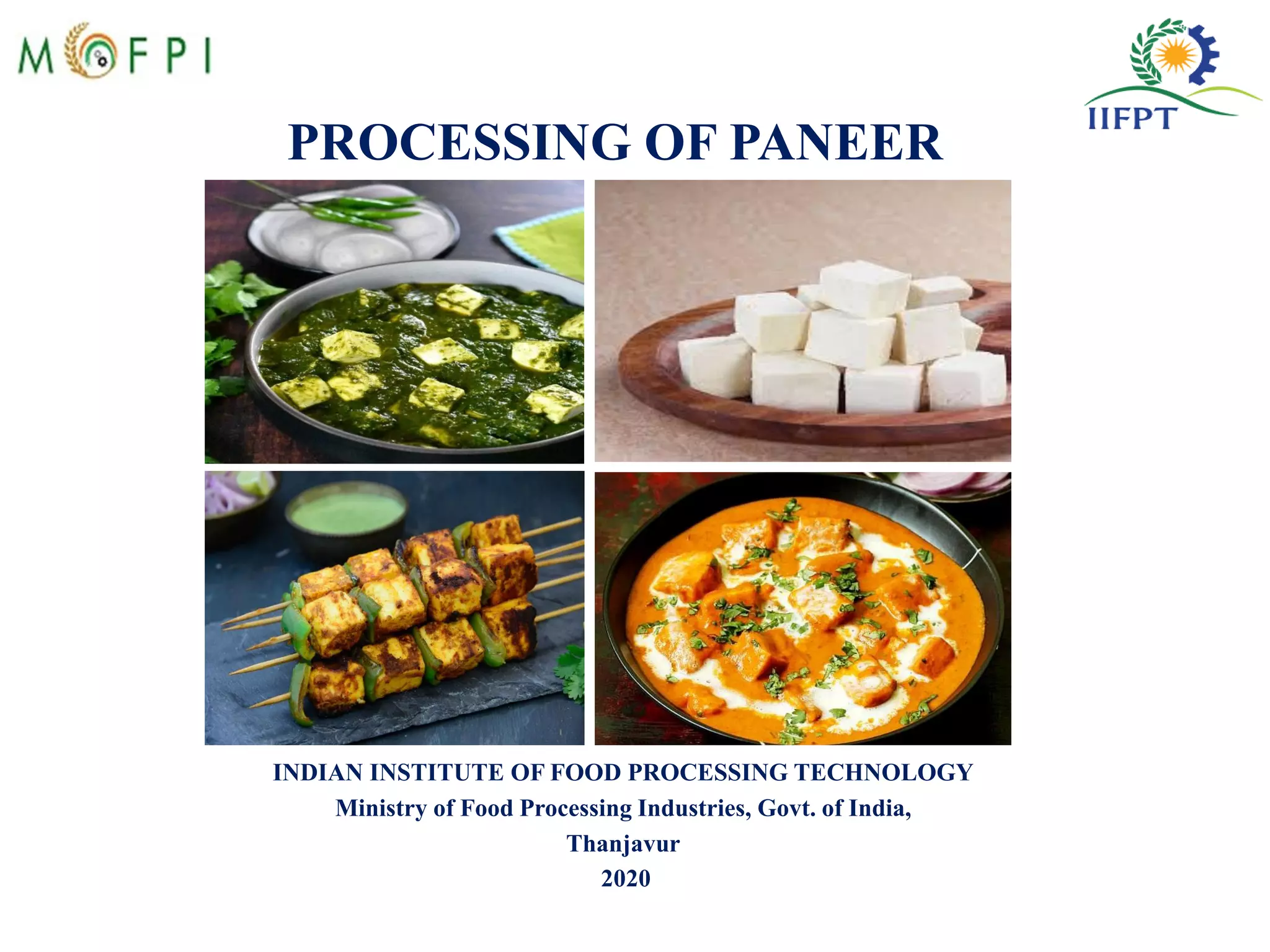
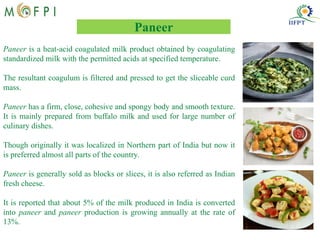
Paneer is a heat-acid coagulated milk product obtained by coagulating
standardized milk with the permitted acids at specified temperature.
The resultant coagulum is filtered and pressed to get the sliceable curd
mass.
Paneer has a firm, close, cohesive and spongy body and smooth texture.
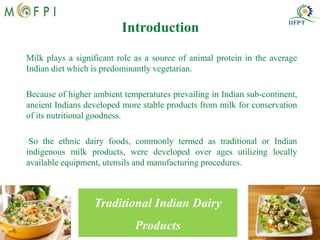
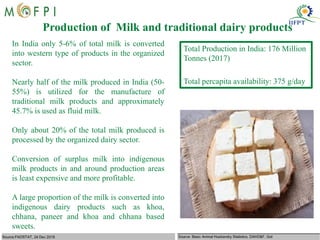
It is mainly prepared from buffalo milk and used for large number of
culinary dishes.
Though originally it was localized in Northern part of India but now it
is preferred almost all parts of the country.
Paneer is generally sold as blocks or slices, it is also referred as Indian
fresh cheese.
It is reported that about 5% of the milk produced in India is converted
into paneer and paneer production is growing annually at the rate of
13%.
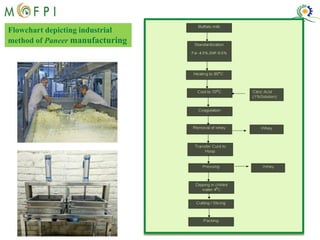
Flowchart depicting industrial
method of Paneer manufacturing
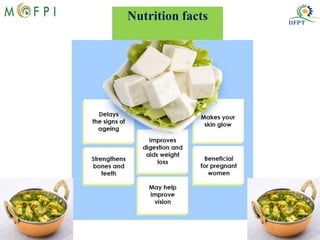
Nutrition facts
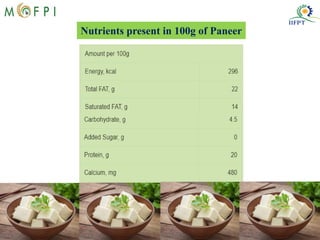
Nutrients present in 100g of Paneer
Factors affecting quality and yield of paneer
 Type of milk - Paneer prepared from buffalo milk possess desirable frying properties, body and
texture as compared to cow milk. The cow milk paneer is soft, weak and fragile and during
cooking it tends to disintegrate. However, cow milk and buffalo milk mixed in equal quantity
yields better product than cow milk. Paneer made from skim milk has chewy and rubbery
texture and hard body.
 Quality of milk - Milk must be fresh and free from off falvour. Growth of psycrotrophic
organisms should be minimized to restrict the off-flavour development. Acidic milk having a
titratable acidity of more than 0.20% lactic acid yields a product of inferior quality.
 Type, Strength and Temperature of Coagulant - Citric acid is generally used as a coagulant.
Lemon or lime juice or vinegar imparts a typical flavour to the product. 1% solution of citric acid
yields good quality of paneer. Sufficient acid is added gently but quickly blended with the milk
(within one min) to reach optimum pH of coagulation. Normally 1.8 to 2.0 kg citric acid is
required for coagulating 1000 L of milk. High acid concentration imparts acidic flavour,
hardness and causes greater solids loss. Whey cultured with Lactobacillus acidophilus at a level
of 2% and incubated overnight at 37°C can be used as a substitute for citric acid. However acidic
whey must be heat treated to destroy these lactic organisms before use to prevent loss of shelf
life of paneer.
 Heat treatment of milk – 90 °C without holding or 82 °C for 5min
 pH of coagulation – 5.2
Paneer
in
Buffalo Milk Vs Cow Milk
Cow milk yields an inferior product in
terms of body and texture. It is criticized to
be too soft, weak and fragile and unsuitable
for frying and cooking.
Buffalo milk contains considerably higher
level of casein and minerals particularly
calcium and phosphorous, which tends to
produce hard and rubbery body while cow
milk produces soft and mellow
characteristics.
By replacing one third of buffalo milk with
cow milk, a good quality paneer can be
made.
Buffalo milk paneer retains higher fat,
protein and ash content and lactose as
compared to cow milk paneer.
By replacing one third of buffalo milk
with cow milk, a good quality paneer can
be made.
To make paneer exclusively from cow
milk, modifications to be made like
Addition of calcium chloride at the rate of
0.08 to 0.1% to milk helps in getting a
compact, sliceable, firm and cohesive
body and closely knit texture.
A higher temperature of coagulation (85°-
90°C) with coagulation of milk at pH 5.20
to 5.25 helps in producing good quality
paneer from cow milk.
However, at this pH of coagulation,
moisture, yield and solids recovery are
less.
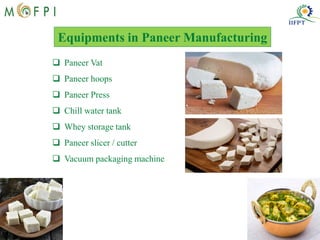
Equipments in Paneer Manufacturing
 Paneer Vat
 Paneer hoops
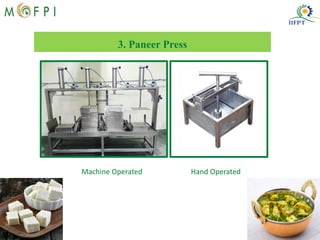
 Paneer Press
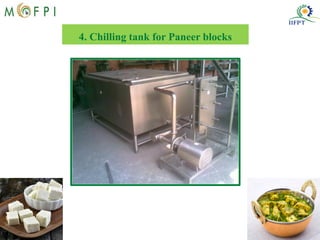
 Chill water tank
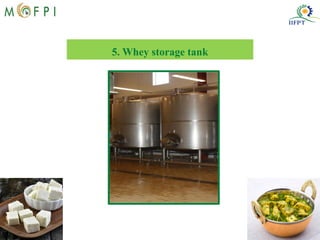
 Whey storage tank
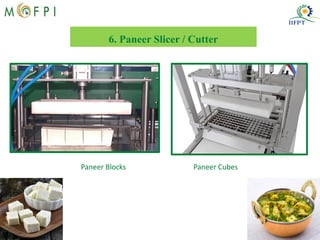
 Paneer slicer / cutter
 Vacuum packaging machine
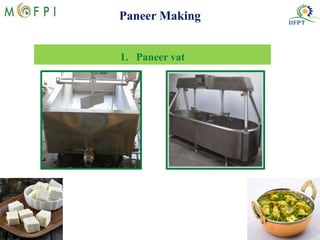
Paneer Making
1. Paneer vat
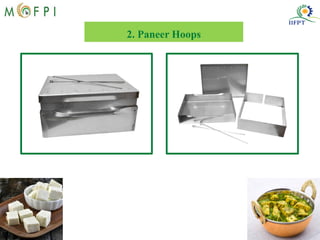
2. Paneer Hoops
3. Paneer Press
Machine Operated Hand Operated
4. Chilling tank for Paneer blocks
5. Whey storage tank
6. Paneer Slicer / Cutter
Paneer Blocks Paneer Cubes
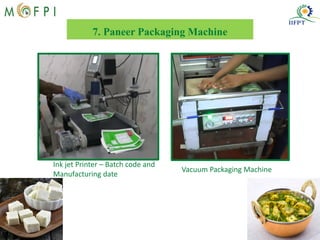
7. Paneer Packaging Machine
Ink jet Printer – Batch code and
Manufacturing date
Vacuum Packaging Machine
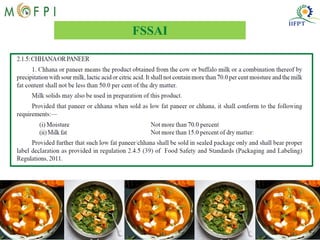
FSSAI
PM FME Scheme
For the details regarding the PM FME scheme, scheme guidelines, various food
processing demonstration videos and DPRs, please visit our weblinks:
https://mofpi.nic.in/pmfme/ and http://www.iifpt.edu.in/ab-pmfme.php
Thank You All!

paneer.pdf

  • 1.
    INDIAN INSTITUTE OFFOOD PROCESSING TECHNOLOGY Ministry of Food Processing Industries, Govt. of India, Thanjavur 2020 PROCESSING OF PANEER
  • 2.
    Introduction Milk plays asignificant role as a source of animal protein in the average Indian diet which is predominantly vegetarian. Because of higher ambient temperatures prevailing in Indian sub-continent, ancient Indians developed more stable products from milk for conservation of its nutritional goodness. So the ethnic dairy foods, commonly termed as traditional or Indian indigenous milk products, were developed over ages utilizing locally available equipment, utensils and manufacturing procedures. Traditional Indian Dairy Products
  • 3.
    Production of Milkand traditional dairy products Total Production in India: 176 Million Tonnes (2017) Total percapita availability: 375 g/day In India only 5-6% of total milk is converted into western type of products in the organized sector. Nearly half of the milk produced in India (50- 55%) is utilized for the manufacture of traditional milk products and approximately 45.7% is used as fluid milk. Only about 20% of the total milk produced is processed by the organized dairy sector. Conversion of surplus milk into indigenous milk products in and around production areas is least expensive and more profitable. A large proportion of the milk is converted into indigenous dairy products such as khoa, chhana, paneer and khoa and chhana based sweets.
  • 4.
    Strengths: • Traditional dairyproducts enjoy mass appeal. • Simple manufacturing technologies which are well established for small-scale operations. • Skilled manpower for cottage scale operations available. • Lower cost of production and high profit margins. • Markets are well established • Easily available markets for sale • Utilization of surplus milk. Strengths: • Traditional dairy products require low infrastructure, equipment and operational overhead costs • An optimistic demand profile - consumption likely to grow at an annual rate more than 20% • Permit significant value addition, unparalleled by other dairy products • Utilization of slightly high acid milk • Use of low energy • Approximate for small scale sector Traditional Indian Dairy Products
  • 5.
    Opportunities:  Traditional dairyproduct sector offers vast scope for innovation, value addition and product diversification.  Burgeoning consumer base and greater demand due to higher purchasing power of the newly emerging middle class  Greater access to global market under WTO regimen  Expert potential to the ethnic markets  Opportunities exist for financing and establishing modern small scale units to encourage restructuring of unorganized sector.
  • 6.
    Classification of Traditionaldairy Products  Concentrated / partially desiccated products i) Khoa ii) Rabri iii) Basundi  Heat and acid coagulated products i) Paneer ii) Chhana  Fermented products i) Dahi ii) Misti dahi iii) Chakka iv) Shrikhand v) Shrikhand wadi  Fat rich products i) Ghee ii) Makkhan (desi butter) iii) Malai  Frozen products i) Kulfi ii) Malai – ka – baraf iii) Milk – ice  Cereal based puddings i) Kheer ii) Payasam  Indian milk confections Khoa based sweets  i) Gulabjamun ii) Burfi iii) Kalakand iv) Milk cake etc. Channa based sweets i) Rasogolla ii) Rasomalai iii) Sandesh etc.  Refreshing beverages i) Lassi ii) Chhachh iii) Raabadi
  • 7.
    Paneer Paneer is aheat-acid coagulated milk product obtained by coagulating standardized milk with the permitted acids at specified temperature. The resultant coagulum is filtered and pressed to get the sliceable curd mass. Paneer has a firm, close, cohesive and spongy body and smooth texture. It is mainly prepared from buffalo milk and used for large number of culinary dishes. Though originally it was localized in Northern part of India but now it is preferred almost all parts of the country. Paneer is generally sold as blocks or slices, it is also referred as Indian fresh cheese. It is reported that about 5% of the milk produced in India is converted into paneer and paneer production is growing annually at the rate of 13%.
  • 8.
  • 9.
  • 10.
    Nutrients present in100g of Paneer
  • 11.
    Factors affecting qualityand yield of paneer  Type of milk - Paneer prepared from buffalo milk possess desirable frying properties, body and texture as compared to cow milk. The cow milk paneer is soft, weak and fragile and during cooking it tends to disintegrate. However, cow milk and buffalo milk mixed in equal quantity yields better product than cow milk. Paneer made from skim milk has chewy and rubbery texture and hard body.  Quality of milk - Milk must be fresh and free from off falvour. Growth of psycrotrophic organisms should be minimized to restrict the off-flavour development. Acidic milk having a titratable acidity of more than 0.20% lactic acid yields a product of inferior quality.  Type, Strength and Temperature of Coagulant - Citric acid is generally used as a coagulant. Lemon or lime juice or vinegar imparts a typical flavour to the product. 1% solution of citric acid yields good quality of paneer. Sufficient acid is added gently but quickly blended with the milk (within one min) to reach optimum pH of coagulation. Normally 1.8 to 2.0 kg citric acid is required for coagulating 1000 L of milk. High acid concentration imparts acidic flavour, hardness and causes greater solids loss. Whey cultured with Lactobacillus acidophilus at a level of 2% and incubated overnight at 37°C can be used as a substitute for citric acid. However acidic whey must be heat treated to destroy these lactic organisms before use to prevent loss of shelf life of paneer.  Heat treatment of milk – 90 °C without holding or 82 °C for 5min  pH of coagulation – 5.2
  • 12.
    Paneer in Buffalo Milk VsCow Milk Cow milk yields an inferior product in terms of body and texture. It is criticized to be too soft, weak and fragile and unsuitable for frying and cooking. Buffalo milk contains considerably higher level of casein and minerals particularly calcium and phosphorous, which tends to produce hard and rubbery body while cow milk produces soft and mellow characteristics. By replacing one third of buffalo milk with cow milk, a good quality paneer can be made. Buffalo milk paneer retains higher fat, protein and ash content and lactose as compared to cow milk paneer. By replacing one third of buffalo milk with cow milk, a good quality paneer can be made. To make paneer exclusively from cow milk, modifications to be made like Addition of calcium chloride at the rate of 0.08 to 0.1% to milk helps in getting a compact, sliceable, firm and cohesive body and closely knit texture. A higher temperature of coagulation (85°- 90°C) with coagulation of milk at pH 5.20 to 5.25 helps in producing good quality paneer from cow milk. However, at this pH of coagulation, moisture, yield and solids recovery are less.
  • 13.
    Equipments in PaneerManufacturing  Paneer Vat  Paneer hoops  Paneer Press  Chill water tank  Whey storage tank  Paneer slicer / cutter  Vacuum packaging machine
  • 14.
  • 15.
  • 16.
    3. Paneer Press MachineOperated Hand Operated
  • 17.
    4. Chilling tankfor Paneer blocks
  • 18.
  • 19.
    6. Paneer Slicer/ Cutter Paneer Blocks Paneer Cubes
  • 20.
    7. Paneer PackagingMachine Ink jet Printer – Batch code and Manufacturing date Vacuum Packaging Machine
  • 21.
  • 22.
    PM FME Scheme Forthe details regarding the PM FME scheme, scheme guidelines, various food processing demonstration videos and DPRs, please visit our weblinks: https://mofpi.nic.in/pmfme/ and http://www.iifpt.edu.in/ab-pmfme.php
  • 23.