Food technology
Fruits and vegetables juice processing
Introduction
• A wide range of drinks can be made using extracted fruit
juice or fruit pulp as the base material. Many are drunk as a
pure juice without the addition of any other ingredients, but
some are diluted with sugar syrup. The types of drink made
from fruit can be separated into
• two basic types;
• - those that are drunk straight after opening
• - those that are used little by little from bottles which are
stored between use.
• The former groups should not require any preservative if they
are processed and packaged properly. However, the latter
group must contain a certain amount of permitted
preservatives to have a long shelf-life after opening.
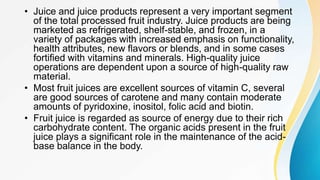
• Juice and juice products represent a very important segment
of the total processed fruit industry. Juice products are being
marketed as refrigerated, shelf-stable, and frozen, in a
variety of packages with increased emphasis on functionality,
health attributes, new flavors or blends, and in some cases
fortified with vitamins and minerals. High-quality juice
operations are dependent upon a source of high-quality raw
material.
• Most fruit juices are excellent sources of vitamin C, several
are good sources of carotene and many contain moderate
amounts of pyridoxine, inositol, folic acid and biotin.
• Fruit juice is regarded as source of energy due to their rich
carbohydrate content. The organic acids present in the fruit
juice plays a significant role in the maintenance of the acid-
base balance in the body.
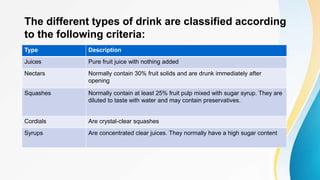
The different types of drink are classified according
to the following criteria:
Type Description
Juices Pure fruit juice with nothing added
Nectars Normally contain 30% fruit solids and are drunk immediately after
opening
Squashes Normally contain at least 25% fruit pulp mixed with sugar syrup. They are
diluted to taste with water and may contain preservatives.
Cordials Are crystal-clear squashes
Syrups Are concentrated clear juices. They normally have a high sugar content
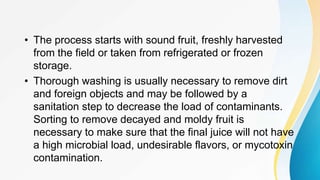
• The process starts with sound fruit, freshly harvested
from the field or taken from refrigerated or frozen
storage.
• Thorough washing is usually necessary to remove dirt
and foreign objects and may be followed by a
sanitation step to decrease the load of contaminants.
Sorting to remove decayed and moldy fruit is
necessary to make sure that the final juice will not have
a high microbial load, undesirable flavors, or mycotoxin
contamination.
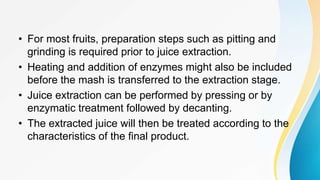
• For most fruits, preparation steps such as pitting and
grinding is required prior to juice extraction.
• Heating and addition of enzymes might also be included
before the mash is transferred to the extraction stage.
• Juice extraction can be performed by pressing or by
enzymatic treatment followed by decanting.
• The extracted juice will then be treated according to the
characteristics of the final product.
• For cloudy juices, further clarification might not be
necessary or may involve a coarse filtration or a
controlled centrifugation to remove large insoluble
particles.
• For clear juices, complete de-pectinization by addition
of enzymes, fine filtration, or high speed centrifugation
is required to achieve visual clarity.
• The next step is usually a heat treatment or equivalent
non-thermal process to achieve a safe and stable juice
and final packaging if single-strength juice is being
produced.
• For a concentrate, the juice is fed to an evaporator to
remove water until the desired concentration level is
obtained.
• Other processes used for water removal include reverse
osmosis and freeze concentration, which are best suited
for heat-sensitive juices.
Method of production
• For all the fruit based beverages, the first stage is the
extraction of juice or pulp from the fruit.
• The following are the key manufacturing stages:
• Selection and preparation of raw material
• Juice extraction
• Filtration (optional)
• Batch preparation
• Pasteurisation
• Filling and bottling.
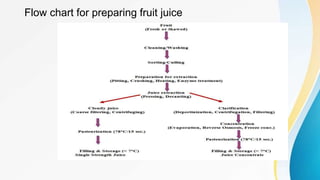
Flow chart for preparing fruit juice
• Preparation of raw material
• Select mature, undamaged fruits. Any fruits that are mouldy
or under-ripe should be sorted and removed. Wash the fruit
in clean water. It may be necessary to chlorinate the water by
adding 1 tablespoon of bleach to 5 litres of water. Peel the
fruit and remove stones or seeds.
• If necessary, chop the fruit into pieces that will fit into the
liquidiser or pulper. Remember that at this stage, you are
exposing the clean flesh of the fruit to the external
environment. Make sure that the utensils are clean.
• Do not leave the cut surfaces exposed to the air for long
periods of time or they may start to turn brown and this will
discolour the juice. The fruit pieces can be placed in water
that
• Juice extraction
• There are several methods to extract juice depending on the
type of fruit you use. For citrus fruits which are naturally juicy,
the best option is to use a hand presser or a revolving citrus
'rose'. Some fruits such as melon and papaya are steamed to
release the juice.
• Apples are pressed and fruits such as mango, guava,
soursop, pineapple, strawberry must be pulped to extract the
juice.
• The fruit pieces are pushed through a perforated metal plate
that crushes and turns them into a pulp. Some fruits can be
pulped in a liquidiser and then filtered to remove the fruit
pieces.
• There is a range of equipment available that varies in size
and in the type of power supply(some are manual while the
larger ones require electricity).
• Filtering
• To make a clear juice, the extracted juice or pulp is
filtered through a muslin cloth or a stainless steel filter.
Some of the larger filter presses have a filter included.
• Although juice is naturally cloudy, some consumers
prefer a clear product. It may be necessary to use
pectic enzymes to break down the pectin and to help
clear the juice.
• Pectic enzymes may be difficult to find and expensive
and therefore should only be used if really necessary
and readily available.
• Batch preparation
• When the juice or pulp has been collected, it is necessary to prepare the
batch according to the chosen recipe. This is very much a matter of
choice and judgement, and must be done carefully to suit local tastes.
Juices are sold either pure or sweetened.
• Fruit squashes would normally contain about 25% fruit material mixed
with a sugar syrup to give a final sugar concentration of about 40%.
Squashes are diluted with water prior to use and, as the bottle is opened,
partly used and then stored, it is necessary to add a preservative (for
example 800ppm sodium benzoate).
• Another popular product is fruit nectar, which is a sweet mixture of fruit
pulp, sugar and water which is consumed on a 'one shot' basis.
Essentially, these consist of a 30% mix of fruit pulp and sugar syrup to
give a final sugar level of about 12-14%.
• All fruits contain sugar, usually around 8-10%. The actual
levels vary from fruit to fruit and with the stage of ripeness of
the fruit. They also vary within the same fruit grown in
different parts of the world.
• The addition of sugar to the fruit pulp to achieve the
recommended levels for preservation must take into account
the amount of sugar already present in the juice. It is
important to achieve the minimum level that will prevent the
growth of bacteria, however, once that level has been
achieved, it is possible to add more if the consumers require
a sweeter product.
• The amount of sugar added in practice is usually decided by
what the purchasers actually want. The Pearson Square is a
useful tool to use to help with batch formulation and to
calculate the amount of sugar to be added for preservation
• Pasteurisation
• All the products mentioned above need to be pasteurised at
80-95°C for 1-10 minutes prior to hot-filling into bottles.
• Care is needed when producing pineapple juice due to a
heat resistant enzyme in the juice. The enzyme damages
skin after prolonged contact and workers should therefore
wear gloves to protect their hands. The juice must be heated
to a higher temperature for a longer time to destroy the
enzyme (eg boiling for 20 minutes).
• It is best to use stainless steel pans to heat fruit juice as the
acidity of the juice can react with aluminium in aluminium
pans during prolonged heating. However, large stainless
steel pans are very expensive and may not be affordable by
the small scale processors.
• Another option is to pasteurise the juices once they
have been bottled. The bottles are placed in a hot
water bath which is heated to 80°C. The bottles are
held in the hot water for the given amount of time until
the contents reach the desired temperature.
• The length of time required in the water bath depends
on the size and volume of the bottles.
• A thermometer should be placed in one of the bottles,
which is used as a test bottle per batch, to monitor the
temperature and to ensure that the correct temperature
has been reached.
• This method of pasteurisation has benefits but also
has problems.
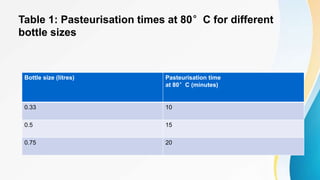
Table 1: Pasteurisation times at 80°C for different
bottle sizes
Bottle size (litres) Pasteurisation time
at 80°C (minutes)
0.33 10
0.5 15
0.75 20
• Filling and bottling
• In all cases, the products should be hot-filled into clean,
sterilised bottles. A stainless steel bucket, drilled to
accept a small outlet tap, is a very effective bottle filler.
The output can be doubled quite simply by fitting a
second tap on the other side of the bucket. This system
has been used to produce 500-600 bottles of fruit juice
per day in the West Indies.
• After filling hot, the bottles are capped and laid on their
sides to cool prior to labelling.
Blended juices
• Sometimes two or more juices are mixed to yield a well-
balanced, rightly flavoured, highly palatable and refreshing
drink. Juices are blended so as to utilize a too sweet fruit
(grape), a bitter fruit (grapefruit), too acidic or tart fruits (sour
lime, sour plum, galgal, sour cherry, etc.), bland and insipid
tasting fruits like pear or apple, and strongly flavoured fruits
(guava and banana). Some of the common commercial blends
of juice are:
• (1) Grape (97%) and lime (3%)
• (2) Grape (50%) and orange (50%}
• (3)Orange (50-75%) and grapefruit (25-50%)
• (4) Apple (97%) and lime (3%)
• (5) Apple (74%) and grapefruit (25%) + 1% sugar
• (6) Apple (50-75%) and pineapple (25-50%) + 1% sugar
• (7) Apple (37%) and plum (62%) + 1% sugar
Significance of Few Important Steps in Fruit Juice
Production
• Straining/Filtration/Clarification
• Extracted fruit juice contains varying amount of suspended solids �
broken fruit tissue, seed, skin & various gums, pectic substances and
proteins in colloidal suspension.
• Coarse particles removed by straining (non-corrodible metallic screens) or
sedimentation.
• If clear juice required (grape, apple, lime juice cordial) complete removal
of all suspensions effected through filtration or clarification with the help of
fining agents and enzymes.
• Fining agents (i) Enzymes (pectolytic, starch liquefying, proteolytic), (ii)
Mechanical finings (Infusorial earth), (iii) Chemical finings (Gelatin,
albumin, casein).
• Apple juice � 0.5-1.5 oz. of tannin and 1.5-6.0 oz. of gelatin per 100 gal.
of juice � fining purpose.
• Disintegration
• Juicing process starts with crushing, a step to break down the
cell tissue. This may be accomplished using various type of
mills viz., hammer mill, grinding disk mill, grating mill, crushers,
stoned fruit mill or even turbo extractors.
• Deaeration
• Pure orange juice which is extremely susceptible to the adverse
action of the residual air, is subjected, immediately after
extraction, to a high vacuum whereby most of the air as well as
other gases are removed.
• Mash enzyme treatment
• This step might not be used for the production of high
quality, single-strength, cloudy and clear
• juices, where the preservation of the fresh flavor is
imperative.
• Depectinization is designed to reduce the viscosity and
slipperiness of the pulp and thus permit the effective
use of decanters and presses with proper press aids as
needed. It is especially useful in processing mature and
stored fruit that results in low juice yield.
• Role of Enzymes in Fruit Juice Extraction
• The use of enzymes in juice industry has contributed in
increasing the yield and production of various types of juices.
The addition of pectinases aims in particular to degrade the
pectic substances, in the cell wall and middle lamella of the
cells of plants, aiming to minimise the impacts of these
compounds on the characteristics of the final product, such as
colour, turbidity and viscosity.
• Enzymes are also able to remove bitterness of citrus juice,
extract pigments, among other applications, and have also had
great interest in the juice industry.
Benefits in the use of enzymes
• Increased juice yield
• Improved efficiency of juice filtration
• Improved juice stability and concentration
• Enhanced juice clarity
• Reduced juice bitterness
Problems encountered during fruit juice
processing
• Some of the problems that may be faced in preparation of fruit juices
are:
• Browning of juice due to action of enzyme Poly phenol oxidase
inherent in fruit (i.e. Apples).
• Foaming of fruit juice that may lead to oxidation of vitmin C and pose
problem during filling of juice in packages.
• Bitterness of juice due to action of enzyme limonin and naringinase
(e.g. in Orange).
• Cloudy juices due to pectinaceous substance (apple juice) or even
bitartrates (i.e. argol precipitation) (i.e. in grape juice).
The use of chemical preservatives in fruit juices and
fruit drinks
• As the name suggests, pure fruit juice is solely the
extracted juice of fruit and should not have any
preservative, or any other ingredients (such as sugar)
added.
• Fruit drinks that are not consumed in one go can have
preservatives added to help prolong the shelf life once
they have been opened.
• There are several chemical preservatives that can be
added to fruit juices. Processors need to check with local
authorities or standards agencies to find the maximum
permitted levels.
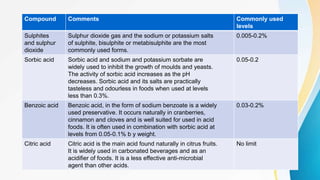
Compound Comments Commonly used
levels
Sulphites
and sulphur
dioxide
Sulphur dioxide gas and the sodium or potassium salts
of sulphite, bisulphite or metabisulphite are the most
commonly used forms.
0.005-0.2%
Sorbic acid Sorbic acid and sodium and potassium sorbate are
widely used to inhibit the growth of moulds and yeasts.
The activity of sorbic acid increases as the pH
decreases. Sorbic acid and its salts are practically
tasteless and odourless in foods when used at levels
less than 0.3%.
0.05-0.2
Benzoic acid Benzoic acid, in the form of sodium benzoate is a widely
used preservative. It occurs naturally in cranberries,
cinnamon and cloves and is well suited for used in acid
foods. It is often used in combination with sorbic acid at
levels from 0.05-0.1% b y weight.
0.03-0.2%
Citric acid Citric acid is the main acid found naturally in citrus fruits.
It is widely used in carbonated beverages and as an
acidifier of foods. It is a less effective anti-microbial
agent than other acids.
No limit

Fruits and vegetables juice processing .pptx

  • 1.
    Food technology Fruits andvegetables juice processing
  • 2.
    Introduction • A widerange of drinks can be made using extracted fruit juice or fruit pulp as the base material. Many are drunk as a pure juice without the addition of any other ingredients, but some are diluted with sugar syrup. The types of drink made from fruit can be separated into • two basic types; • - those that are drunk straight after opening • - those that are used little by little from bottles which are stored between use. • The former groups should not require any preservative if they are processed and packaged properly. However, the latter group must contain a certain amount of permitted preservatives to have a long shelf-life after opening.
  • 3.
    • Juice andjuice products represent a very important segment of the total processed fruit industry. Juice products are being marketed as refrigerated, shelf-stable, and frozen, in a variety of packages with increased emphasis on functionality, health attributes, new flavors or blends, and in some cases fortified with vitamins and minerals. High-quality juice operations are dependent upon a source of high-quality raw material. • Most fruit juices are excellent sources of vitamin C, several are good sources of carotene and many contain moderate amounts of pyridoxine, inositol, folic acid and biotin. • Fruit juice is regarded as source of energy due to their rich carbohydrate content. The organic acids present in the fruit juice plays a significant role in the maintenance of the acid- base balance in the body.
  • 4.
    The different typesof drink are classified according to the following criteria: Type Description Juices Pure fruit juice with nothing added Nectars Normally contain 30% fruit solids and are drunk immediately after opening Squashes Normally contain at least 25% fruit pulp mixed with sugar syrup. They are diluted to taste with water and may contain preservatives. Cordials Are crystal-clear squashes Syrups Are concentrated clear juices. They normally have a high sugar content
  • 5.
    • The processstarts with sound fruit, freshly harvested from the field or taken from refrigerated or frozen storage. • Thorough washing is usually necessary to remove dirt and foreign objects and may be followed by a sanitation step to decrease the load of contaminants. Sorting to remove decayed and moldy fruit is necessary to make sure that the final juice will not have a high microbial load, undesirable flavors, or mycotoxin contamination.
  • 6.
    • For mostfruits, preparation steps such as pitting and grinding is required prior to juice extraction. • Heating and addition of enzymes might also be included before the mash is transferred to the extraction stage. • Juice extraction can be performed by pressing or by enzymatic treatment followed by decanting. • The extracted juice will then be treated according to the characteristics of the final product.
  • 7.
    • For cloudyjuices, further clarification might not be necessary or may involve a coarse filtration or a controlled centrifugation to remove large insoluble particles. • For clear juices, complete de-pectinization by addition of enzymes, fine filtration, or high speed centrifugation is required to achieve visual clarity. • The next step is usually a heat treatment or equivalent non-thermal process to achieve a safe and stable juice and final packaging if single-strength juice is being produced.
  • 8.
    • For aconcentrate, the juice is fed to an evaporator to remove water until the desired concentration level is obtained. • Other processes used for water removal include reverse osmosis and freeze concentration, which are best suited for heat-sensitive juices.
  • 9.
    Method of production •For all the fruit based beverages, the first stage is the extraction of juice or pulp from the fruit. • The following are the key manufacturing stages: • Selection and preparation of raw material • Juice extraction • Filtration (optional) • Batch preparation • Pasteurisation • Filling and bottling.
  • 10.
    Flow chart forpreparing fruit juice
  • 11.
    • Preparation ofraw material • Select mature, undamaged fruits. Any fruits that are mouldy or under-ripe should be sorted and removed. Wash the fruit in clean water. It may be necessary to chlorinate the water by adding 1 tablespoon of bleach to 5 litres of water. Peel the fruit and remove stones or seeds. • If necessary, chop the fruit into pieces that will fit into the liquidiser or pulper. Remember that at this stage, you are exposing the clean flesh of the fruit to the external environment. Make sure that the utensils are clean. • Do not leave the cut surfaces exposed to the air for long periods of time or they may start to turn brown and this will discolour the juice. The fruit pieces can be placed in water that
  • 12.
    • Juice extraction •There are several methods to extract juice depending on the type of fruit you use. For citrus fruits which are naturally juicy, the best option is to use a hand presser or a revolving citrus 'rose'. Some fruits such as melon and papaya are steamed to release the juice. • Apples are pressed and fruits such as mango, guava, soursop, pineapple, strawberry must be pulped to extract the juice. • The fruit pieces are pushed through a perforated metal plate that crushes and turns them into a pulp. Some fruits can be pulped in a liquidiser and then filtered to remove the fruit pieces. • There is a range of equipment available that varies in size and in the type of power supply(some are manual while the larger ones require electricity).
  • 13.
    • Filtering • Tomake a clear juice, the extracted juice or pulp is filtered through a muslin cloth or a stainless steel filter. Some of the larger filter presses have a filter included. • Although juice is naturally cloudy, some consumers prefer a clear product. It may be necessary to use pectic enzymes to break down the pectin and to help clear the juice. • Pectic enzymes may be difficult to find and expensive and therefore should only be used if really necessary and readily available.
  • 14.
    • Batch preparation •When the juice or pulp has been collected, it is necessary to prepare the batch according to the chosen recipe. This is very much a matter of choice and judgement, and must be done carefully to suit local tastes. Juices are sold either pure or sweetened. • Fruit squashes would normally contain about 25% fruit material mixed with a sugar syrup to give a final sugar concentration of about 40%. Squashes are diluted with water prior to use and, as the bottle is opened, partly used and then stored, it is necessary to add a preservative (for example 800ppm sodium benzoate). • Another popular product is fruit nectar, which is a sweet mixture of fruit pulp, sugar and water which is consumed on a 'one shot' basis. Essentially, these consist of a 30% mix of fruit pulp and sugar syrup to give a final sugar level of about 12-14%.
  • 15.
    • All fruitscontain sugar, usually around 8-10%. The actual levels vary from fruit to fruit and with the stage of ripeness of the fruit. They also vary within the same fruit grown in different parts of the world. • The addition of sugar to the fruit pulp to achieve the recommended levels for preservation must take into account the amount of sugar already present in the juice. It is important to achieve the minimum level that will prevent the growth of bacteria, however, once that level has been achieved, it is possible to add more if the consumers require a sweeter product. • The amount of sugar added in practice is usually decided by what the purchasers actually want. The Pearson Square is a useful tool to use to help with batch formulation and to calculate the amount of sugar to be added for preservation
  • 16.
    • Pasteurisation • Allthe products mentioned above need to be pasteurised at 80-95°C for 1-10 minutes prior to hot-filling into bottles. • Care is needed when producing pineapple juice due to a heat resistant enzyme in the juice. The enzyme damages skin after prolonged contact and workers should therefore wear gloves to protect their hands. The juice must be heated to a higher temperature for a longer time to destroy the enzyme (eg boiling for 20 minutes). • It is best to use stainless steel pans to heat fruit juice as the acidity of the juice can react with aluminium in aluminium pans during prolonged heating. However, large stainless steel pans are very expensive and may not be affordable by the small scale processors.
  • 17.
    • Another optionis to pasteurise the juices once they have been bottled. The bottles are placed in a hot water bath which is heated to 80°C. The bottles are held in the hot water for the given amount of time until the contents reach the desired temperature. • The length of time required in the water bath depends on the size and volume of the bottles. • A thermometer should be placed in one of the bottles, which is used as a test bottle per batch, to monitor the temperature and to ensure that the correct temperature has been reached. • This method of pasteurisation has benefits but also has problems.
  • 18.
    Table 1: Pasteurisationtimes at 80°C for different bottle sizes Bottle size (litres) Pasteurisation time at 80°C (minutes) 0.33 10 0.5 15 0.75 20
  • 19.
    • Filling andbottling • In all cases, the products should be hot-filled into clean, sterilised bottles. A stainless steel bucket, drilled to accept a small outlet tap, is a very effective bottle filler. The output can be doubled quite simply by fitting a second tap on the other side of the bucket. This system has been used to produce 500-600 bottles of fruit juice per day in the West Indies. • After filling hot, the bottles are capped and laid on their sides to cool prior to labelling.
  • 20.
    Blended juices • Sometimestwo or more juices are mixed to yield a well- balanced, rightly flavoured, highly palatable and refreshing drink. Juices are blended so as to utilize a too sweet fruit (grape), a bitter fruit (grapefruit), too acidic or tart fruits (sour lime, sour plum, galgal, sour cherry, etc.), bland and insipid tasting fruits like pear or apple, and strongly flavoured fruits (guava and banana). Some of the common commercial blends of juice are: • (1) Grape (97%) and lime (3%) • (2) Grape (50%) and orange (50%} • (3)Orange (50-75%) and grapefruit (25-50%) • (4) Apple (97%) and lime (3%) • (5) Apple (74%) and grapefruit (25%) + 1% sugar • (6) Apple (50-75%) and pineapple (25-50%) + 1% sugar • (7) Apple (37%) and plum (62%) + 1% sugar
  • 21.
    Significance of FewImportant Steps in Fruit Juice Production • Straining/Filtration/Clarification • Extracted fruit juice contains varying amount of suspended solids � broken fruit tissue, seed, skin & various gums, pectic substances and proteins in colloidal suspension. • Coarse particles removed by straining (non-corrodible metallic screens) or sedimentation. • If clear juice required (grape, apple, lime juice cordial) complete removal of all suspensions effected through filtration or clarification with the help of fining agents and enzymes. • Fining agents (i) Enzymes (pectolytic, starch liquefying, proteolytic), (ii) Mechanical finings (Infusorial earth), (iii) Chemical finings (Gelatin, albumin, casein). • Apple juice � 0.5-1.5 oz. of tannin and 1.5-6.0 oz. of gelatin per 100 gal. of juice � fining purpose.
  • 22.
    • Disintegration • Juicingprocess starts with crushing, a step to break down the cell tissue. This may be accomplished using various type of mills viz., hammer mill, grinding disk mill, grating mill, crushers, stoned fruit mill or even turbo extractors. • Deaeration • Pure orange juice which is extremely susceptible to the adverse action of the residual air, is subjected, immediately after extraction, to a high vacuum whereby most of the air as well as other gases are removed.
  • 23.
    • Mash enzymetreatment • This step might not be used for the production of high quality, single-strength, cloudy and clear • juices, where the preservation of the fresh flavor is imperative. • Depectinization is designed to reduce the viscosity and slipperiness of the pulp and thus permit the effective use of decanters and presses with proper press aids as needed. It is especially useful in processing mature and stored fruit that results in low juice yield.
  • 24.
    • Role ofEnzymes in Fruit Juice Extraction • The use of enzymes in juice industry has contributed in increasing the yield and production of various types of juices. The addition of pectinases aims in particular to degrade the pectic substances, in the cell wall and middle lamella of the cells of plants, aiming to minimise the impacts of these compounds on the characteristics of the final product, such as colour, turbidity and viscosity. • Enzymes are also able to remove bitterness of citrus juice, extract pigments, among other applications, and have also had great interest in the juice industry.
  • 25.
    Benefits in theuse of enzymes • Increased juice yield • Improved efficiency of juice filtration • Improved juice stability and concentration • Enhanced juice clarity • Reduced juice bitterness
  • 26.
    Problems encountered duringfruit juice processing • Some of the problems that may be faced in preparation of fruit juices are: • Browning of juice due to action of enzyme Poly phenol oxidase inherent in fruit (i.e. Apples). • Foaming of fruit juice that may lead to oxidation of vitmin C and pose problem during filling of juice in packages. • Bitterness of juice due to action of enzyme limonin and naringinase (e.g. in Orange). • Cloudy juices due to pectinaceous substance (apple juice) or even bitartrates (i.e. argol precipitation) (i.e. in grape juice).
  • 27.
    The use ofchemical preservatives in fruit juices and fruit drinks • As the name suggests, pure fruit juice is solely the extracted juice of fruit and should not have any preservative, or any other ingredients (such as sugar) added. • Fruit drinks that are not consumed in one go can have preservatives added to help prolong the shelf life once they have been opened. • There are several chemical preservatives that can be added to fruit juices. Processors need to check with local authorities or standards agencies to find the maximum permitted levels.
  • 28.
    Compound Comments Commonlyused levels Sulphites and sulphur dioxide Sulphur dioxide gas and the sodium or potassium salts of sulphite, bisulphite or metabisulphite are the most commonly used forms. 0.005-0.2% Sorbic acid Sorbic acid and sodium and potassium sorbate are widely used to inhibit the growth of moulds and yeasts. The activity of sorbic acid increases as the pH decreases. Sorbic acid and its salts are practically tasteless and odourless in foods when used at levels less than 0.3%. 0.05-0.2 Benzoic acid Benzoic acid, in the form of sodium benzoate is a widely used preservative. It occurs naturally in cranberries, cinnamon and cloves and is well suited for used in acid foods. It is often used in combination with sorbic acid at levels from 0.05-0.1% b y weight. 0.03-0.2% Citric acid Citric acid is the main acid found naturally in citrus fruits. It is widely used in carbonated beverages and as an acidifier of foods. It is a less effective anti-microbial agent than other acids. No limit