JAINISM   A RELIGION OF NONVIOLENCE & AUSTERITY Presented By: Kritika Goyal (19061)
ORIGIN: Jainism is a syncretistic religion, which contains many elements similar to  Hinduism  and  Buddhism . The world's almost  4 million  Jains are almost entirely located in India. Founded in 6 th  century B.C. by  Vardhaman Mahavira  who was the 24 th   Tirthankara   or the religious guru of Jains in ancient East India. The name “ jain ” derives from Sanskrit word “ ji ” which means “ to conquer ”. It aims at the victory of jain followers over  body passions  and  senses .
Digambar  and  Shwetambar traditions: The Jain Dharma is divided into two major sects,  Digambar  and  Shwetambar . Digambar  monks do not wear clothes because ‘dig’ means ‘disha’ i.e. the direction and they believe the directions (dishayein) are their clothes . Shwetambar  monks wear white clothes because ‘shwet’ means ‘white’.
Principle " Samyakdarshangyancharitrani Mokshmargasya " is the fundamental principle of Jainism. It means: " True Perception, True/Right Knowledge and True/Right Conduct  " is the path to attain Moksha.
BELIEFS At the heart of right conduct for Jains lie the five great vows:  Nonviolence (Ahimsa)  not to cause harm to any living being. Truthfulness (Satya)  to speak the harmless truth only. Non-stealing (Achaurya/Asteya)  not to take anything not properly given. Chastity (Brahmacharya)  not to indulge in sensual pleasure. Non-possession/Non-attachment (Aparigraha)  complete detachment from people, places, and material things.
PRAYER Namo Arihantanam:  I bow to the arithantas - the ever-perfect spiritual victors Namo Siddhanam:   I bow to the siddhas - the liberated souls Namo Ayariyanam:   I bow to acharyas - the leaders of the jain order Namo Uvajjayanam:   I bow to upadhyayas - the learned preceptors
Eso Panch Namukkaro:  This five-fold salutation Savva Pavappanasano:  Destroys all sins Mangalanam Cha Savvesim:  And amongst all auspicious things Padhamam Havai Mangalam : Is the most auspicious one
JAIN PHILOSOPHY Primarily Jainism assumes that the universe is  without a beginning or an end, being everlasting  and eternal .  The wheel of time incessantly revolves like a pendulum. In the first half circle it revolves  from the descending to the ascending stage where human prosperity, happiness, and life span  increases and in the second half circle it revolves  from the ascending stage to the descending stage where prosperity, happiness, and life span decreases
There exist six fundamental entities in the universe, which are eternal but continuously undergo countless changes. During the changes nothing is lost or destroyed. Everything is recycled into another form.  The six universal substances are: Non Living Substance Kal or Samay Time Non Living Substance Akasa Space Non Living Substance Adharma Medium of Rest Non Living Substance Dharma Medium of Motion Non Living Substance Pudgal Matter Living Substance Jiva Soul or Consciousness
The nine  tattvas  are the single most important subject of Jain philosophy. It deals with the theory of karma, which provides the basis for the path of liberation (moksha).  The Nine Principles  (Tattvas)  are:  Total liberation from karma   Moksha Exhaustion of the accumulated karma   Nirjara Stoppage of the influx of karma   Samvava Sin Papa Virtue Punya Bondage of karma   Bandha Cause of the influx of karma   Asrava Non-living substances   Ajiva Soul or living being (Consciousness)   Jiva
Jains are recommended to pass through four stages during their lifetime: Brahmacharya-ashrama : the life of a student.  Gruhasth-ashrama : family life  Vanaprasth-ashrama : family and social services  Sanyast-ashrama: life as a monk, a period of renunciation.  
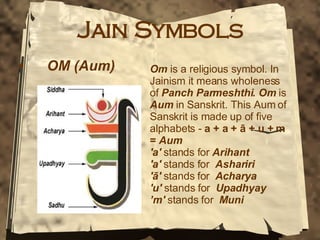
Jain Symbols OM (Aum) Om  is a religious symbol. In Jainism it means wholeness of  Panch Parmeshthi. Om   is  Aum  in Sanskrit. This Aum of Sanskrit is made up of five alphabets -  a + a + ā + u + m =  Aum      'a'  stands for  Arihant 'a'  stands for   Ashariri 'ā'  stands for   Acharya 'u'  stands for   Upadhyay ’m'  stands for   Muni
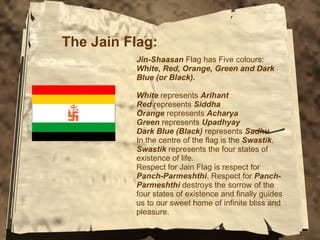
The Jain Flag: Jin-Shaasan  Flag has Five colours:  White, Red, Orange, Green and Dark Blue (or Black).  White  represents  Arihant Red  represents  Siddha Orange  represents  Acharya Green  represents  Upadhyay Dark Blue (Black)  represents  Sadhu In the centre of the flag is the  Swastik .  Swastik  represents the four states of existence of life.  Respect for Jain Flag is respect for  Panch-Parmeshthi . Respect for  Panch-Parmeshthi  destroys the sorrow of the four states of existence and finally guides us to our sweet home of infinite bliss and pleasure.
Thank You ( MicchamiDukkadam   ) For your serious and patient listening

Jainism

  • 1.
    JAINISM A RELIGION OF NONVIOLENCE & AUSTERITY Presented By: Kritika Goyal (19061)
  • 2.
    ORIGIN: Jainism isa syncretistic religion, which contains many elements similar to Hinduism and Buddhism . The world's almost 4 million Jains are almost entirely located in India. Founded in 6 th century B.C. by Vardhaman Mahavira who was the 24 th Tirthankara or the religious guru of Jains in ancient East India. The name “ jain ” derives from Sanskrit word “ ji ” which means “ to conquer ”. It aims at the victory of jain followers over body passions and senses .
  • 3.
    Digambar and Shwetambar traditions: The Jain Dharma is divided into two major sects, Digambar and Shwetambar . Digambar monks do not wear clothes because ‘dig’ means ‘disha’ i.e. the direction and they believe the directions (dishayein) are their clothes . Shwetambar monks wear white clothes because ‘shwet’ means ‘white’.
  • 4.
    Principle " SamyakdarshangyancharitraniMokshmargasya " is the fundamental principle of Jainism. It means: " True Perception, True/Right Knowledge and True/Right Conduct " is the path to attain Moksha.
  • 5.
    BELIEFS At theheart of right conduct for Jains lie the five great vows: Nonviolence (Ahimsa) not to cause harm to any living being. Truthfulness (Satya) to speak the harmless truth only. Non-stealing (Achaurya/Asteya) not to take anything not properly given. Chastity (Brahmacharya) not to indulge in sensual pleasure. Non-possession/Non-attachment (Aparigraha) complete detachment from people, places, and material things.
  • 6.
    PRAYER Namo Arihantanam: I bow to the arithantas - the ever-perfect spiritual victors Namo Siddhanam: I bow to the siddhas - the liberated souls Namo Ayariyanam: I bow to acharyas - the leaders of the jain order Namo Uvajjayanam: I bow to upadhyayas - the learned preceptors
  • 7.
    Eso Panch Namukkaro: This five-fold salutation Savva Pavappanasano: Destroys all sins Mangalanam Cha Savvesim: And amongst all auspicious things Padhamam Havai Mangalam : Is the most auspicious one
  • 8.
    JAIN PHILOSOPHY PrimarilyJainism assumes that the universe is without a beginning or an end, being everlasting and eternal . The wheel of time incessantly revolves like a pendulum. In the first half circle it revolves from the descending to the ascending stage where human prosperity, happiness, and life span increases and in the second half circle it revolves from the ascending stage to the descending stage where prosperity, happiness, and life span decreases
  • 9.
    There exist sixfundamental entities in the universe, which are eternal but continuously undergo countless changes. During the changes nothing is lost or destroyed. Everything is recycled into another form. The six universal substances are: Non Living Substance Kal or Samay Time Non Living Substance Akasa Space Non Living Substance Adharma Medium of Rest Non Living Substance Dharma Medium of Motion Non Living Substance Pudgal Matter Living Substance Jiva Soul or Consciousness
  • 10.
    The nine tattvas are the single most important subject of Jain philosophy. It deals with the theory of karma, which provides the basis for the path of liberation (moksha). The Nine Principles (Tattvas) are: Total liberation from karma Moksha Exhaustion of the accumulated karma Nirjara Stoppage of the influx of karma Samvava Sin Papa Virtue Punya Bondage of karma Bandha Cause of the influx of karma Asrava Non-living substances Ajiva Soul or living being (Consciousness) Jiva
  • 11.
    Jains are recommendedto pass through four stages during their lifetime: Brahmacharya-ashrama : the life of a student. Gruhasth-ashrama : family life Vanaprasth-ashrama : family and social services Sanyast-ashrama: life as a monk, a period of renunciation.  
  • 12.
    Jain Symbols OM(Aum) Om is a religious symbol. In Jainism it means wholeness of Panch Parmeshthi. Om is Aum in Sanskrit. This Aum of Sanskrit is made up of five alphabets - a + a + ā + u + m = Aum    'a' stands for Arihant 'a' stands for  Ashariri 'ā' stands for  Acharya 'u' stands for  Upadhyay ’m' stands for  Muni
  • 13.
    The Jain Flag:Jin-Shaasan Flag has Five colours: White, Red, Orange, Green and Dark Blue (or Black). White represents Arihant Red represents Siddha Orange represents Acharya Green represents Upadhyay Dark Blue (Black) represents Sadhu In the centre of the flag is the Swastik . Swastik represents the four states of existence of life. Respect for Jain Flag is respect for Panch-Parmeshthi . Respect for  Panch-Parmeshthi destroys the sorrow of the four states of existence and finally guides us to our sweet home of infinite bliss and pleasure.
  • 14.
    Thank You (MicchamiDukkadam ) For your serious and patient listening