Social Studies for 8th EGB
Teacher: Mauricio Torres

Teachings of

Buddhism
Buddhism: beginnings
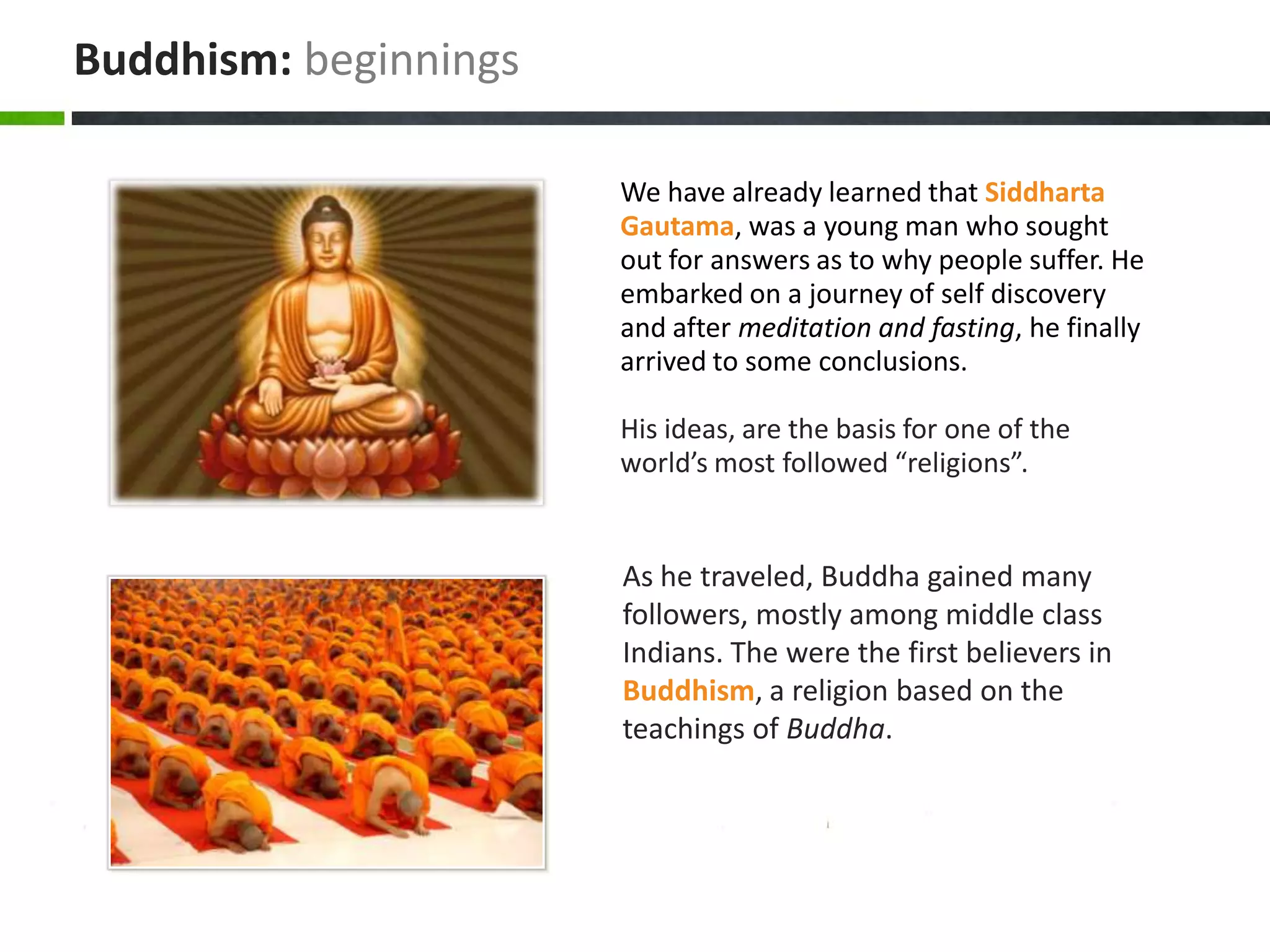
We have already learned that Siddharta
Gautama, was a young man who sought
out for answers as to why people suffer. He
embarked on a journey of self discovery
and after meditation and fasting, he finally
arrived to some conclusions.
His ideas, are the basis for one of the
world’s most followed “religions”.

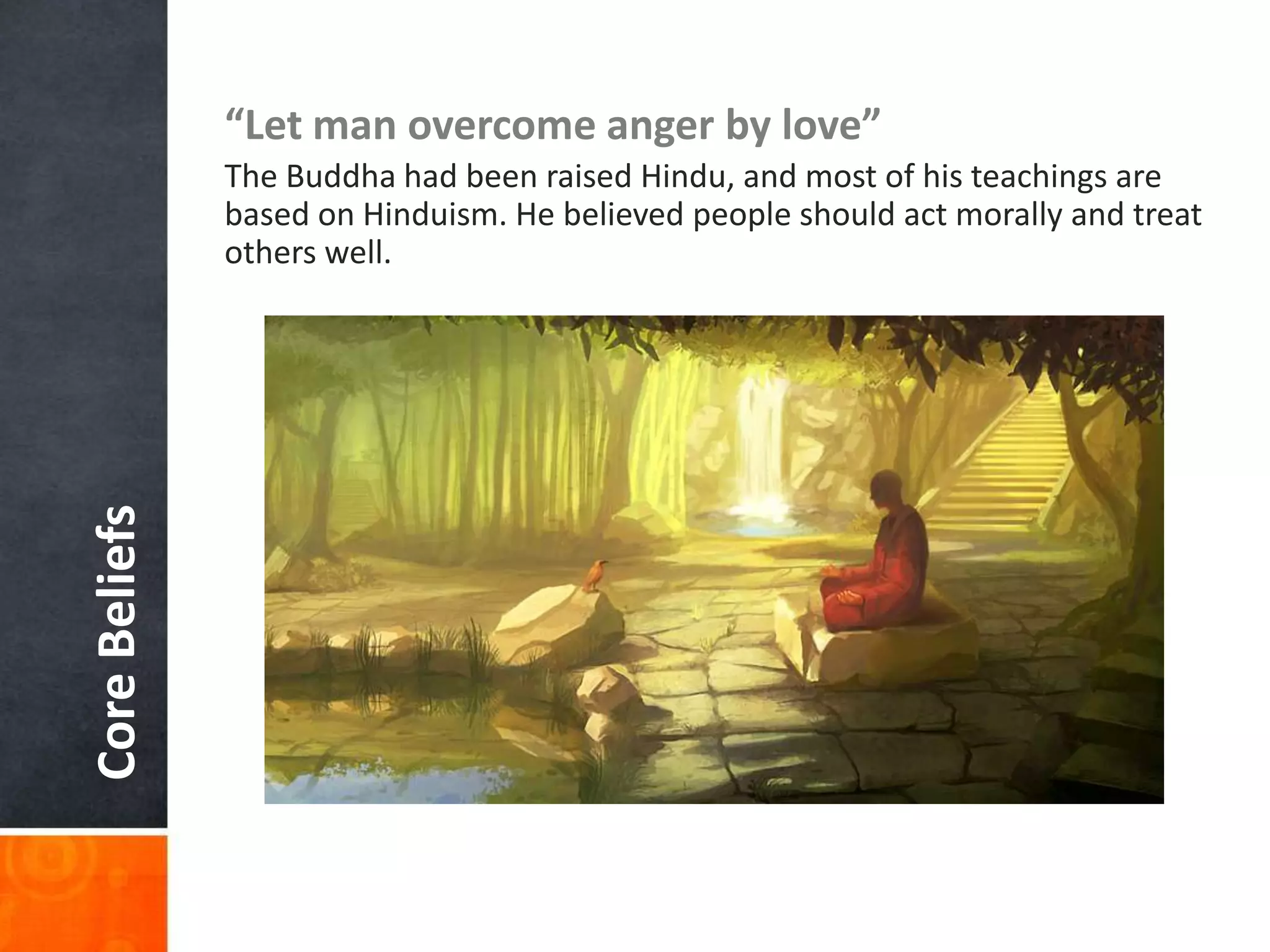
As he traveled, Buddha gained many
followers, mostly among middle class
Indians. The were the first believers in
Buddhism, a religion based on the
teachings of Buddha.
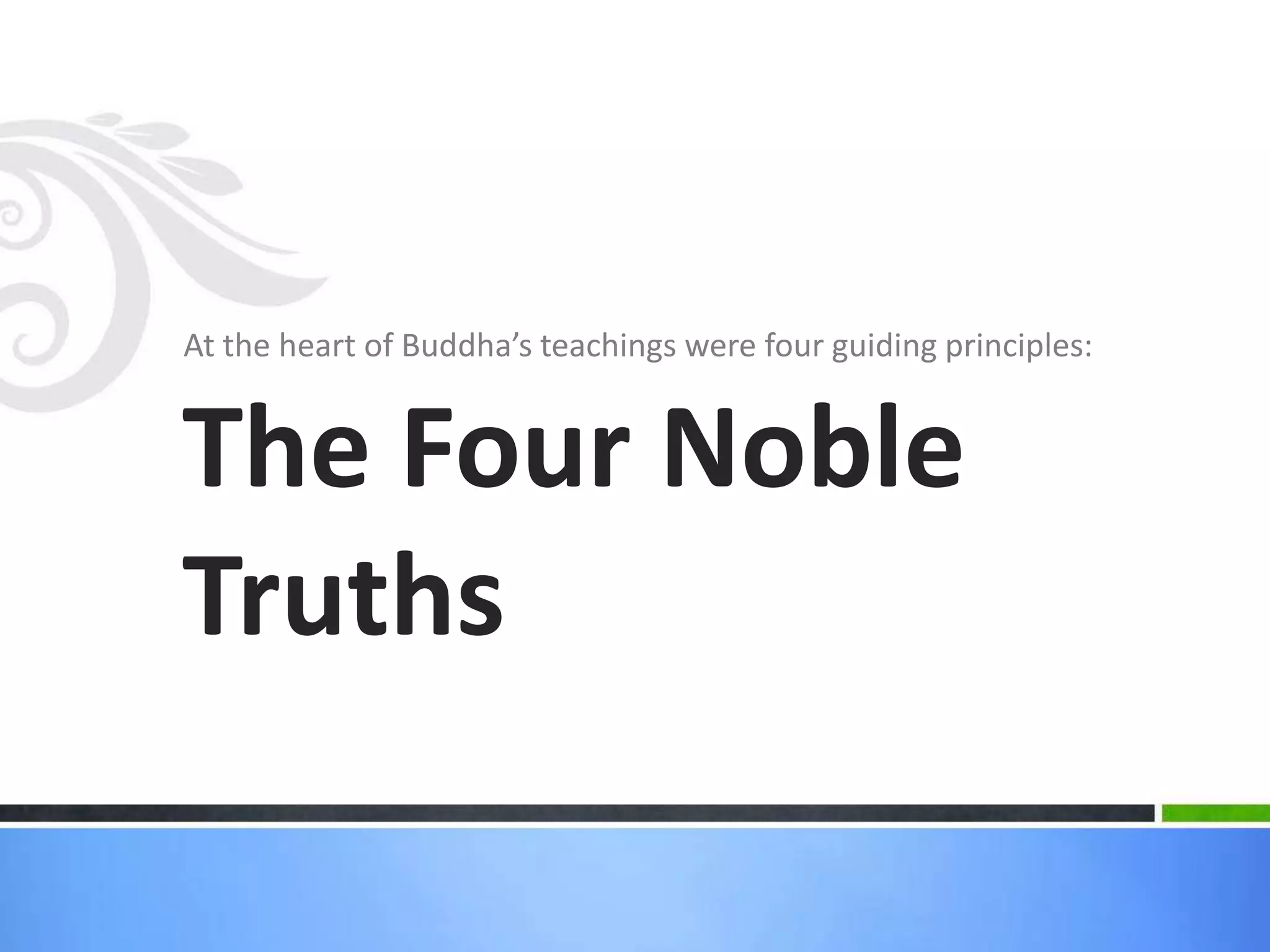
“Let man overcome anger by love”

Core Beliefs

The Buddha had been raised Hindu, and most of his teachings are
based on Hinduism. He believed people should act morally and treat
others well.
At the heart of Buddha’s teachings were four guiding principles:

The Four Noble
Truths
1. Suffering and unhappiness are a part of human
life, no one can escape sorrow.

The Four Noble Truths

Suffering is inevitable, so its worthless to worry about our mishappenings

2. Suffering comes from our desires for pleasure
and material goods.
People cause their own misery because they want things they cannot
have.

3. People can overcome desire and ignorance.
By doing this, they reach nirvana (a state of perfect peace), freeing
the soul from suffering and from need of further reincarnation.

4. People can overcome ignorance and desire by
following an Eightfold Path.
This path will lead to wisdom, enlightenment and salvation.
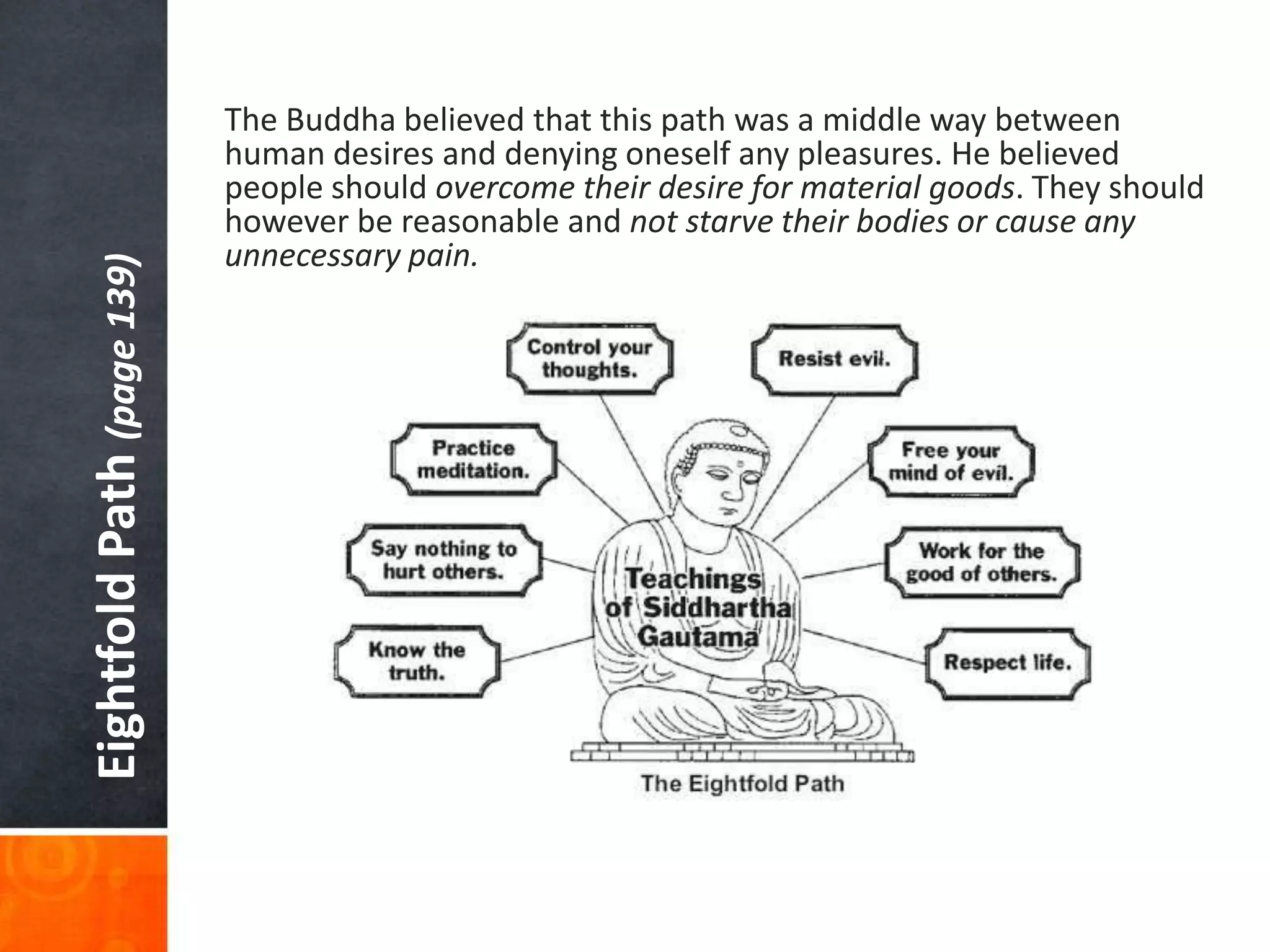
Eightfold Path (page 139)

The Buddha believed that this path was a middle way between
human desires and denying oneself any pleasures. He believed
people should overcome their desire for material goods. They should
however be reasonable and not starve their bodies or cause any
unnecessary pain.
Eightfold Path (page 139)

1.

2.

3.
4.
5.
6.
7.
8.

Right thought
•
Believe in the nature of existence as suffering and the Four
Noble truths.
Right intent
•
Incline towards good and kindness
Right speech
•
Avoid lies and gossip
Right action
•
Don’t steal or harm others
Right livelihood
•
Reject work that hurts others
Right effort
•
Prevent evil and do good
Right mindfulness
•
Control your feelings and thoughts
Right concentration
•
Practice proper meditation
Did Buddha’s teachings

challenge Hindu

ideas or did they support them?
It did both!
Hindu ideas challenged by Buddhism
Buddha’s teaching challenged traditional
Hindu teachings, because he rejected
many ideas in the Vedas such as animal
sacrifice. He told his followers they should
not follow these texts!
He believed Brahmins or their rituals were
necessary for their enlightenment, but
rather each individual’s own
responsibility.
He taught that people who failed to reach
nirvana were the ones who’d fail to
reincarnate, and would do so until they
achieved it.
The Buddha was opposed to the caste
system. He believed no one should be
confined to a certain place or role in
society, and rather those who followed the
Eightfold path properly would reach
nirvana.
Support from the Masses

• His opposition to the caste system won him a
vast support from the masses.
• Many sudras and untouchables liked hearing
that their low social rank would not be a
barrier to enlightenment.
– Unlike Hinduism, Buddhism made them feel that
they had the power to change their lives!
Ask Yourself
• Identify:
• Who was Siddharta Gautama?
• Many of the Buddha’s teachings
reflect the ideas of which other world
religion?
• Describe:
• What did Siddharta endure before
reaching enlightenment?
• Recall:
• What are the Four Noble truths?
• Evaluate:
• What advantage do you think the
Buddha saw in following the “middle
way”?
• How do you think people reacted to
the Buddha’s telling them they did not
have to accept the Brahmin’s
authority?

“Holding on to anger
is like drinking poison
and expecting the
other person to die”.
- Buddha

Teachings of Buddhism

  • 1.
    Social Studies for8th EGB Teacher: Mauricio Torres Teachings of Buddhism
  • 2.
    Buddhism: beginnings We havealready learned that Siddharta Gautama, was a young man who sought out for answers as to why people suffer. He embarked on a journey of self discovery and after meditation and fasting, he finally arrived to some conclusions. His ideas, are the basis for one of the world’s most followed “religions”. As he traveled, Buddha gained many followers, mostly among middle class Indians. The were the first believers in Buddhism, a religion based on the teachings of Buddha.
  • 3.
    “Let man overcomeanger by love” Core Beliefs The Buddha had been raised Hindu, and most of his teachings are based on Hinduism. He believed people should act morally and treat others well.
  • 4.
    At the heartof Buddha’s teachings were four guiding principles: The Four Noble Truths
  • 5.
    1. Suffering andunhappiness are a part of human life, no one can escape sorrow. The Four Noble Truths Suffering is inevitable, so its worthless to worry about our mishappenings 2. Suffering comes from our desires for pleasure and material goods. People cause their own misery because they want things they cannot have. 3. People can overcome desire and ignorance. By doing this, they reach nirvana (a state of perfect peace), freeing the soul from suffering and from need of further reincarnation. 4. People can overcome ignorance and desire by following an Eightfold Path. This path will lead to wisdom, enlightenment and salvation.
  • 6.
    Eightfold Path (page139) The Buddha believed that this path was a middle way between human desires and denying oneself any pleasures. He believed people should overcome their desire for material goods. They should however be reasonable and not starve their bodies or cause any unnecessary pain.
  • 7.
    Eightfold Path (page139) 1. 2. 3. 4. 5. 6. 7. 8. Right thought • Believe in the nature of existence as suffering and the Four Noble truths. Right intent • Incline towards good and kindness Right speech • Avoid lies and gossip Right action • Don’t steal or harm others Right livelihood • Reject work that hurts others Right effort • Prevent evil and do good Right mindfulness • Control your feelings and thoughts Right concentration • Practice proper meditation
  • 8.
    Did Buddha’s teachings challengeHindu ideas or did they support them? It did both!
  • 9.
    Hindu ideas challengedby Buddhism Buddha’s teaching challenged traditional Hindu teachings, because he rejected many ideas in the Vedas such as animal sacrifice. He told his followers they should not follow these texts! He believed Brahmins or their rituals were necessary for their enlightenment, but rather each individual’s own responsibility. He taught that people who failed to reach nirvana were the ones who’d fail to reincarnate, and would do so until they achieved it. The Buddha was opposed to the caste system. He believed no one should be confined to a certain place or role in society, and rather those who followed the Eightfold path properly would reach nirvana.
  • 10.
    Support from theMasses • His opposition to the caste system won him a vast support from the masses. • Many sudras and untouchables liked hearing that their low social rank would not be a barrier to enlightenment. – Unlike Hinduism, Buddhism made them feel that they had the power to change their lives!
  • 11.
    Ask Yourself • Identify: •Who was Siddharta Gautama? • Many of the Buddha’s teachings reflect the ideas of which other world religion? • Describe: • What did Siddharta endure before reaching enlightenment? • Recall: • What are the Four Noble truths? • Evaluate: • What advantage do you think the Buddha saw in following the “middle way”? • How do you think people reacted to the Buddha’s telling them they did not have to accept the Brahmin’s authority? “Holding on to anger is like drinking poison and expecting the other person to die”. - Buddha