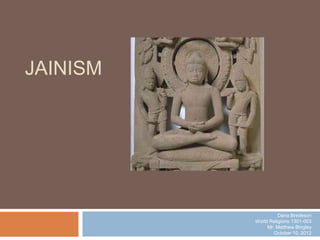
JAINISM


                    Dana Bredeson
          World Religions 1301-003
               Mr. Matthew Bingley
                  October 10, 2012
Origins of Jainism
   Jainism was first developed in northeastern
    India and was created in opposition to the
    Vedic Religion.
   Some people were opposed to the animal
    sacrifices and the strength of the caste system
    and therefore rejected those aspects of the
    Vedic Religion. They also rejected Hindu
    polytheism and ritualism and longed for
    greater religious simplicity.
Origins of Jainism
   Jains believe that there are 24 great people
    that have reached perfection in the present
    cycle of the universe.
   They believe that these people have been role
    models and guides that have shown the way
    to others.
   They call these saints “tirthankaras” which
    means “crossing makers” or “ford finders.”
   The existence of these tirthankaras cannot be
    proven.
Mahavira
   The 24th tirthankara is considered to be the greatest
    of them all. He is known as Mahavira, which means
    “great man” or “hero.”
   Mahavira’s legend strongly resembles that of Buddha.
    Mahavira was born of noble descent and he left home
    at about age 30 to live the life of a wandering holy
    man. During this time, he exhibited harshness toward
    himself and experienced harshness from others.
    Mahavira was extremely cautious as not to cause
    injury to any living thing. He would strain whatever he
    was drinking in order to avoid accidentally swallowing
    an insect and stepped carefully in an effort to avoid
    crushing an ant.
Mahavira
   He experienced great liberation after 12 years
    of meditation, wandering, and extreme
    mortification. He felt completely free of all
    bondage to the ordinary world and fully in
    control of himself. Because of this, Mahavira
    is called a jina, which means “conqueror.”
   It is from this word, jina, that Jainism takes its
    name.
What is Jainism?
   Similar to Hinduism, Jains share a belief in karma
    and reincarnation. However, they see karma as
    having a physical quality and believe that one’s
    level of rebirth is dependent upon one’s state of
    karma at the time of their death.
   Rejecting belief in a Creator, they see the
    universe as natural forces in motion.
   They believe that every person has spiritual
    potential and that they should purify the self, act
    morally, and do good to others.
   Similar to Buddhism, they believe that everything
    is full of life and capable of suffering.
What is Jainism?
   Jains teach that all parts of the universe are composed
    of two types of reality, which are intermixed. These two
    parts are jiva and ajiva. Jiva is spirit, which senses and
    feels. Ajiva is matter which is not alive and has no
    consciousness.
   Jains see life and consciousness in fire, rocks, and
    water and even includes the miniscule life-forms that
    dwell in these things.
   They see humans as containing two opposing parts – a
    material side and a spiritual side. They believe that with
    discipline, humans can overcome the bondage of the
    material world and the body and can liberate their spirits
    through insight, austerity, and kindness.
   The Jain goal is to reach a state of total freedom and to
    live on in the highest realm where Mahavira and other
    tirthankaras dwell.
Jain Ethics and Practices
   Jainism has 5 ethical recommendations. Although
    monks and nuns are expected to adhere to them
    strictly, there is some flexibility in regards to
    laypeople.
     Nonviolence – This is the foundation of Jain ethics
      and they are best known for their extreme measures
      in this regard. Jain laypeople avoid occupations that
      would cause any harm. Some of these occupations
      include hunting, fishing, and even farming because of
      the possibility of injuring insects.
     Nonlying – They believe that lying and exaggeration
      are dangerous because they often cause hurt.
Jain Ethics and Practices
     Nonstealing   – Stealing causes pain to others and
      arises from improper desire
     Chastity – This means complete celibacy for the
      monk or nun but means sexual fidelity to one’s
      spouse for the married individual.
     Nonattachment – For laypeople, this means
      cultivating a spirit of generosity and limiting one’s
      possessions to what is truly necessary.
   In general, Jains practice puja before statues and
    home alters, fast regularly, and often pilgrimage to
    the village where Mahavira died and to great temple
    complexes.
Sources
   Molloy, Michael. "Jainism and Sikhism."
    Experiencing the World's Religions: Tradition,
    Challenge, and Change. Boston: McGraw Hill
    Higher Education, 2010. 190-201. Print.
Discussion
   What similarities does Jainism share with
    some of the religions that we have studied?
    What are some differences?

Jainism

  • 1.
    JAINISM Dana Bredeson World Religions 1301-003 Mr. Matthew Bingley October 10, 2012
  • 2.
    Origins of Jainism  Jainism was first developed in northeastern India and was created in opposition to the Vedic Religion.  Some people were opposed to the animal sacrifices and the strength of the caste system and therefore rejected those aspects of the Vedic Religion. They also rejected Hindu polytheism and ritualism and longed for greater religious simplicity.
  • 3.
    Origins of Jainism  Jains believe that there are 24 great people that have reached perfection in the present cycle of the universe.  They believe that these people have been role models and guides that have shown the way to others.  They call these saints “tirthankaras” which means “crossing makers” or “ford finders.”  The existence of these tirthankaras cannot be proven.
  • 4.
    Mahavira  The 24th tirthankara is considered to be the greatest of them all. He is known as Mahavira, which means “great man” or “hero.”  Mahavira’s legend strongly resembles that of Buddha. Mahavira was born of noble descent and he left home at about age 30 to live the life of a wandering holy man. During this time, he exhibited harshness toward himself and experienced harshness from others.  Mahavira was extremely cautious as not to cause injury to any living thing. He would strain whatever he was drinking in order to avoid accidentally swallowing an insect and stepped carefully in an effort to avoid crushing an ant.
  • 5.
    Mahavira  He experienced great liberation after 12 years of meditation, wandering, and extreme mortification. He felt completely free of all bondage to the ordinary world and fully in control of himself. Because of this, Mahavira is called a jina, which means “conqueror.”  It is from this word, jina, that Jainism takes its name.
  • 6.
    What is Jainism?  Similar to Hinduism, Jains share a belief in karma and reincarnation. However, they see karma as having a physical quality and believe that one’s level of rebirth is dependent upon one’s state of karma at the time of their death.  Rejecting belief in a Creator, they see the universe as natural forces in motion.  They believe that every person has spiritual potential and that they should purify the self, act morally, and do good to others.  Similar to Buddhism, they believe that everything is full of life and capable of suffering.
  • 7.
    What is Jainism?  Jains teach that all parts of the universe are composed of two types of reality, which are intermixed. These two parts are jiva and ajiva. Jiva is spirit, which senses and feels. Ajiva is matter which is not alive and has no consciousness.  Jains see life and consciousness in fire, rocks, and water and even includes the miniscule life-forms that dwell in these things.  They see humans as containing two opposing parts – a material side and a spiritual side. They believe that with discipline, humans can overcome the bondage of the material world and the body and can liberate their spirits through insight, austerity, and kindness.  The Jain goal is to reach a state of total freedom and to live on in the highest realm where Mahavira and other tirthankaras dwell.
  • 8.
    Jain Ethics andPractices  Jainism has 5 ethical recommendations. Although monks and nuns are expected to adhere to them strictly, there is some flexibility in regards to laypeople.  Nonviolence – This is the foundation of Jain ethics and they are best known for their extreme measures in this regard. Jain laypeople avoid occupations that would cause any harm. Some of these occupations include hunting, fishing, and even farming because of the possibility of injuring insects.  Nonlying – They believe that lying and exaggeration are dangerous because they often cause hurt.
  • 9.
    Jain Ethics andPractices  Nonstealing – Stealing causes pain to others and arises from improper desire  Chastity – This means complete celibacy for the monk or nun but means sexual fidelity to one’s spouse for the married individual.  Nonattachment – For laypeople, this means cultivating a spirit of generosity and limiting one’s possessions to what is truly necessary.  In general, Jains practice puja before statues and home alters, fast regularly, and often pilgrimage to the village where Mahavira died and to great temple complexes.
  • 10.
    Sources  Molloy, Michael. "Jainism and Sikhism." Experiencing the World's Religions: Tradition, Challenge, and Change. Boston: McGraw Hill Higher Education, 2010. 190-201. Print.
  • 11.
    Discussion  What similarities does Jainism share with some of the religions that we have studied? What are some differences?