Development & Validation of a
field-based tool for assessing
body proportionalitybody proportionality
A presentation by Jabeen Shah
for the 1st postgraduate research
conference – 12 November 2010
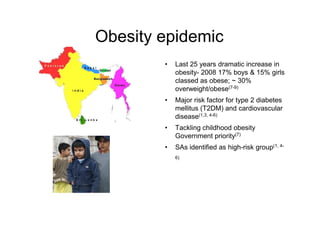
Obesity epidemic
• Last 25 years dramatic increase in
obesity- 2008 17% boys & 15% girls
classed as obese; ~ 30%
overweight/obese(7-9)
• Major risk factor for type 2 diabetes
mellitus (T2DM) and cardiovascular
disease(1,3, 4-6)disease(1,3, 4-6)
• Tackling childhood obesity
Government priority(7)
• SAs identified as high-risk group(1, 4-
6)
Background
•South Asians – genetically
predisposed to central
obesity, insulin resistance &
type 2 diabetes, & CVD.
•The nature vs nurture debate
Background
• Anthropometry measure of
growth predictor of health
• Growth plasticity – ‘The
thrifty phenotype hypothesis’
(Hales & Barker, 2001)
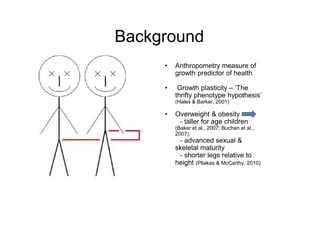
• Overweight & obesity• Overweight & obesity
- taller for age children
(Baker et al., 2007; Buchan et al.,
2007).
- advanced sexual &
skeletal maturity
- shorter legs relative to
height (Pliakas & McCarthy, 2010).
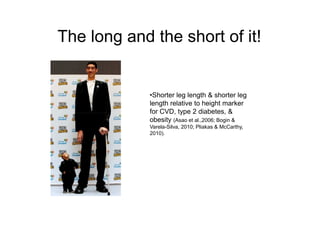
The long and the short of it!
•Shorter leg length & shorter leg
length relative to height marker
for CVD, type 2 diabetes, &for CVD, type 2 diabetes, &
obesity (Asao et al.,2006; Bogin &
Varela-Silva, 2010; Pliakas & McCarthy,
2010).
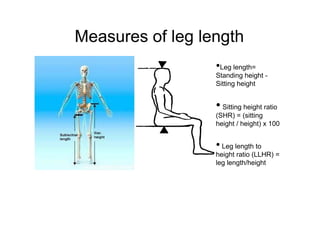
Measures of leg length
•Leg length=
Standing height -
Sitting height
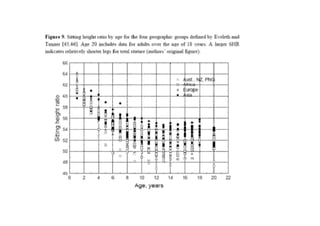
• Sitting height ratio
(SHR) = (sitting(SHR) = (sitting
height / height) x 100
• Leg length to
height ratio (LLHR) =
leg length/height
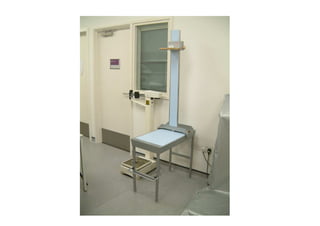
Study aim
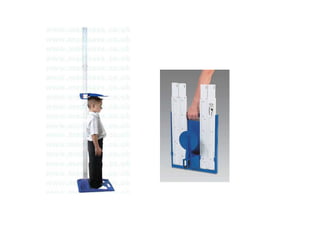
• To develop a valid and reliable sitting
height measure for field use.
• Should be lightweight and portable
• Economical and relatively simple to• Economical and relatively simple to
construct.
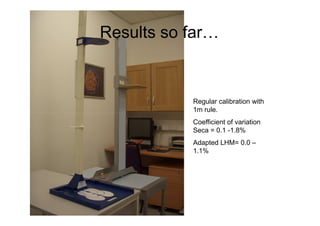
Regular calibration with
1m rule.
Results so far…
1m rule.
Coefficient of variation
Seca = 0.1 -1.8%
Adapted LHM= 0.0 –
1.1%
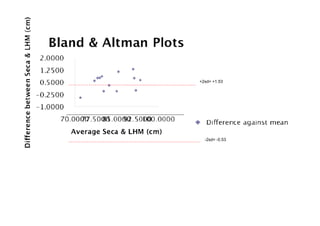
+2sd= +1.53
-2sd= -0.53
Conclusion
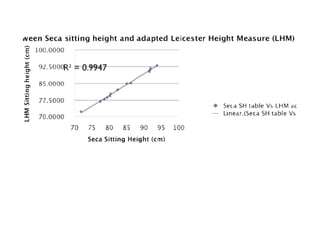
• The results so far suggest that the
adapted measure is a valid and reliable
sitting height measure that is suitable for
field use.field use.

Jabeen shah

  • 1.
    Development & Validationof a field-based tool for assessing body proportionalitybody proportionality A presentation by Jabeen Shah for the 1st postgraduate research conference – 12 November 2010
  • 2.
    Obesity epidemic • Last25 years dramatic increase in obesity- 2008 17% boys & 15% girls classed as obese; ~ 30% overweight/obese(7-9) • Major risk factor for type 2 diabetes mellitus (T2DM) and cardiovascular disease(1,3, 4-6)disease(1,3, 4-6) • Tackling childhood obesity Government priority(7) • SAs identified as high-risk group(1, 4- 6)
  • 3.
    Background •South Asians –genetically predisposed to central obesity, insulin resistance & type 2 diabetes, & CVD. •The nature vs nurture debate
  • 4.
    Background • Anthropometry measureof growth predictor of health • Growth plasticity – ‘The thrifty phenotype hypothesis’ (Hales & Barker, 2001) • Overweight & obesity• Overweight & obesity - taller for age children (Baker et al., 2007; Buchan et al., 2007). - advanced sexual & skeletal maturity - shorter legs relative to height (Pliakas & McCarthy, 2010).
  • 5.
    The long andthe short of it! •Shorter leg length & shorter leg length relative to height marker for CVD, type 2 diabetes, &for CVD, type 2 diabetes, & obesity (Asao et al.,2006; Bogin & Varela-Silva, 2010; Pliakas & McCarthy, 2010).
  • 6.
    Measures of leglength •Leg length= Standing height - Sitting height • Sitting height ratio (SHR) = (sitting(SHR) = (sitting height / height) x 100 • Leg length to height ratio (LLHR) = leg length/height
  • 9.
    Study aim • Todevelop a valid and reliable sitting height measure for field use. • Should be lightweight and portable • Economical and relatively simple to• Economical and relatively simple to construct.
  • 11.
    Regular calibration with 1mrule. Results so far… 1m rule. Coefficient of variation Seca = 0.1 -1.8% Adapted LHM= 0.0 – 1.1%
  • 13.
  • 14.
    Conclusion • The resultsso far suggest that the adapted measure is a valid and reliable sitting height measure that is suitable for field use.field use.