F Syahnaz Mohd Mokhter
POSTGRADUATE RESEARCH
STUDENT CONFERENCE. 2010
-----------------------------------------------------------------------------------------------
friday. 12.11.10
London Metropolitan University . UK
Sir John Cass Department of Art, Media & Design
1
GREEN MAP SYSTEM® –
A Tool for a Sustainable Urban Ecosystem in
Developing Visual Communication Design
Through Cartography and Iconography
2
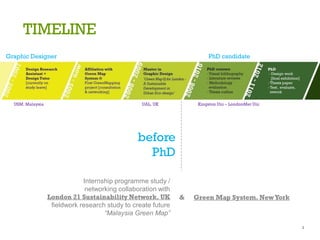
TIMELINE
3
before
PhD
Internship programme study /
networking collaboration with
London 21 Sustainability Network. UK
fieldwork research study to create future
“Malaysia Green Map”
& Green Map System. NewYork
Graphic Designer PhD candidate
USM. Malaysia UAL. UK Kingston Uni – LondonMet Uni
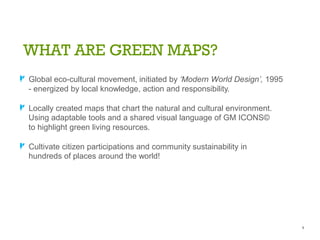
WHAT ARE GREEN MAPS?
A Global eco-cultural movement, initiated by „Modern World Design‟, 1995
- energized by local knowledge, action and responsibility.
A Locally created maps that chart the natural and cultural environment.
Using adaptable tools and a shared visual language of GM ICONS©
to highlight green living resources.
A Cultivate citizen participations and community sustainability in
hundreds of places around the world!
4
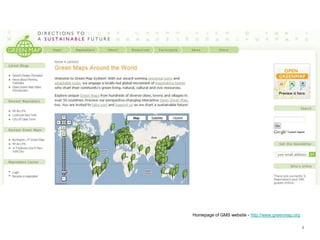
Homepage of GMS website - http://www.greenmap.org
5
www.greenmap.org/greenhouse/en/maps
There are over 550 projects in 50 countries
+ 650 Green Maps published [2009]
6
DESIGN BRIEF
g Develop an eco-friendly Green Map System through cartography
and iconography in reducing the impact of global warming.
g An idea of visual communication design that will engage people
across culture, race, religion and gender by concentrating places
where nature and culture interconnect in local communities.
7
KEY RESEARCH QUESTIONS
Q1 What are the design choices, and the need for updates in design?
How effective are they?
Q2 How to develop existing GMS methodology of open development
[CO-DESIGN] of future icons to be included in the universal symbols
for maps
Q3 Where to research on the places that will be mapped, by using specific
selection criteria to the information that will be included on the map
Q4 How to design a feasibility study and investigate the effectiveness
of the information icons. What is the data to be included on the map?
8
OBJECTIVES
a Stimulate ecological consciousness to the population and to the
public health.
a Create awareness, especially among young generation groups, of the
importance of saving the ‘green areas’ and helping the preservation of
city’s ‘green areas’ in the future.
a Increase awareness, of environmentally sound architecture, design projects,
eco-systematic sites, solar, other renewable energy technologies, etc.
a Historical information about specific places.
a The importance of eco-information, social, political and health resources
[positive and negative aspects].
9
TARGET AUDIENCE
8 People in the London Metropolitan University - campus area
[students, staffs, resident officers, etc]
8 People outside the campus
[general public, nature society, non-profit organizations, school
students, government bodies, higher learning institution, etc]
8 Global: anyone engaged in green mapping
1
0
OPEN GM – Blog, Facebook,Twitter,YouTube,etc.
www.netsquared.org/blog/jedsundwall/think-global-map-social-
interview-wendy-brawer-and-thomas-turnbull-
www.facebook.com/gm_group
www.youtube.com/greenmapsystem
11
OUTLINE PROJECT PLAN
s Digital print promotional items
[publication design of GMS®
creative book art / guidebook]
s New created GMS local Icons©
s CD-ROM
s Final project -
exhibition of design works
www.greenmap.org/universities
12
www.commongroundproject.ca
GM NEW LOCAL ICON-MAKING PROCESS [adapted by F Syahnaz Mokhter]
13
Latest GM Standard Icons Charts Version 3 [2008] –
www.greenmap.org/greenhouse/en/about/iconintro
14
RESULTS
Original Contribution to Knowledge
Community mapping is a graphic learning, development,
and planning tool that connects people to one another and
their home place.
Also intended to inspire and support localization for sustainability,
the worldwide movement is designed for citizens and communities
to engage with and represent the vital interconnections between
the human, natural and built environment.
As The Ecologist (2003:3) stated that, ‘A Green Map gives you back
the city – not in someone else’s sterile view, but as a riotous living
tapestry of human activity’.
15
16
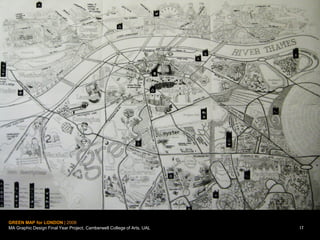
17GREEN MAP for LONDON | 2008
MA Graphic Design Final Year Project, Camberwell College of Arts, UAL 17
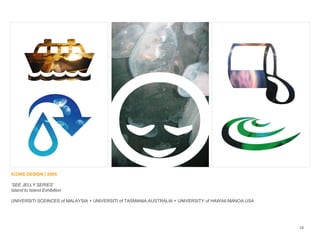
ICONS DESIGN | 2005
„SEE JELLY SERIES‟
Island to Island Exhibition
UNIVERSITI SCEINCES of MALAYSIA + UNIVERSITI of TASMANIA.AUSTRALIA + UNIVERSITY of HAWAII MANOA.USA
18
19
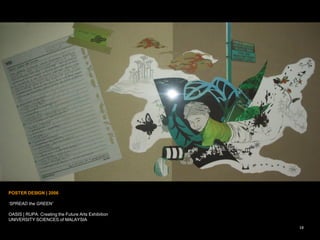
POSTER DESIGN | 2006
Green Map System + OASIS Arts Exhibition. Malaysia
POSTER DESIGN | 2006
„SPREAD the GREEN‟
OASIS | RUPA: Creating the Future Arts Exhibition
UNIVERSITY SCIENCES of MALAYSIA
19
20
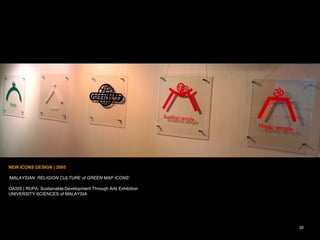
NEW ICONS DESIGN | 2005
„MALAYSIAN RELIGION CULTURE of GREEN MAP ICONS‟
OASIS | RUPA: Sustainable Development Through Arts Exhibition
UNIVERSITY SCIENCES of MALAYSIA
20
21
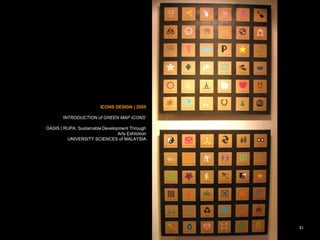
ICONS DESIGN | 2005
„INTRODUCTION of GREEN MAP ICONS‟
OASIS | RUPA: Sustainable Development Through
Arts Exhibition
UNIVERSITY SCIENCES of MALAYSIA
21
REFERENCES
Cross, N. (2006). Designerly Ways of Knowing. London: Springer-Verlag
Fuad-Luke, A. (2010). Design Activism: Beautiful Strangeness for a Sustainable World. London: Earthscan
Fry, T. (2008). Design Futuring: Sustainability, Ethics and New Practice. Oxford: Berg
Gore, A. (2000). Earth in the Balance: Ecology and the Human Spirit. USA: Earthscan Publications Ltd
Lydon, M. (2007). Mapping our Common Ground, A Community and Green Mapping Resource Guide. Canada:
LifeCycles Project Society
Noble, I. (2005) Visual Research: An Introduction to Research Methodologies in Graphic Design. Switzerland: AVA
Publishing SA
Papanek, V. (1992). Design for the Real World – Human ecology and social change, 2nd ed. USA: Academy
Chicago Publishers
Press, M. & Cooper, R. (2003). The Design Experience – The Role of Design & Designers in the 21st Century,
England: Ashgate
Thorpe, A. (2007). The Designer's Atlas of Sustainability. Washington: Island Press
Tufte, E. (1990). Envisioning Information. Connecticut: Graphics Press
Walker, S. (2006). Sustainable by Design: Explorations in Theory and Practice. London: Earthscan
Wood, D. (1992). The Power of Maps. New York: The Guildford Press
____________
Brawer, W. (1997), Green Map System, Available from http://www.greemap.org/html
(Accessed 9 November, 2010)
22
presentation
fadsyaz@yahoo.com
23

Syahnaz mohdmokhter

  • 1.
    F Syahnaz MohdMokhter POSTGRADUATE RESEARCH STUDENT CONFERENCE. 2010 ----------------------------------------------------------------------------------------------- friday. 12.11.10 London Metropolitan University . UK Sir John Cass Department of Art, Media & Design 1
  • 2.
    GREEN MAP SYSTEM®– A Tool for a Sustainable Urban Ecosystem in Developing Visual Communication Design Through Cartography and Iconography 2
  • 3.
    TIMELINE 3 before PhD Internship programme study/ networking collaboration with London 21 Sustainability Network. UK fieldwork research study to create future “Malaysia Green Map” & Green Map System. NewYork Graphic Designer PhD candidate USM. Malaysia UAL. UK Kingston Uni – LondonMet Uni
  • 4.
    WHAT ARE GREENMAPS? A Global eco-cultural movement, initiated by „Modern World Design‟, 1995 - energized by local knowledge, action and responsibility. A Locally created maps that chart the natural and cultural environment. Using adaptable tools and a shared visual language of GM ICONS© to highlight green living resources. A Cultivate citizen participations and community sustainability in hundreds of places around the world! 4
  • 5.
    Homepage of GMSwebsite - http://www.greenmap.org 5
  • 6.
    www.greenmap.org/greenhouse/en/maps There are over550 projects in 50 countries + 650 Green Maps published [2009] 6
  • 7.
    DESIGN BRIEF g Developan eco-friendly Green Map System through cartography and iconography in reducing the impact of global warming. g An idea of visual communication design that will engage people across culture, race, religion and gender by concentrating places where nature and culture interconnect in local communities. 7
  • 8.
    KEY RESEARCH QUESTIONS Q1What are the design choices, and the need for updates in design? How effective are they? Q2 How to develop existing GMS methodology of open development [CO-DESIGN] of future icons to be included in the universal symbols for maps Q3 Where to research on the places that will be mapped, by using specific selection criteria to the information that will be included on the map Q4 How to design a feasibility study and investigate the effectiveness of the information icons. What is the data to be included on the map? 8
  • 9.
    OBJECTIVES a Stimulate ecologicalconsciousness to the population and to the public health. a Create awareness, especially among young generation groups, of the importance of saving the ‘green areas’ and helping the preservation of city’s ‘green areas’ in the future. a Increase awareness, of environmentally sound architecture, design projects, eco-systematic sites, solar, other renewable energy technologies, etc. a Historical information about specific places. a The importance of eco-information, social, political and health resources [positive and negative aspects]. 9
  • 10.
    TARGET AUDIENCE 8 Peoplein the London Metropolitan University - campus area [students, staffs, resident officers, etc] 8 People outside the campus [general public, nature society, non-profit organizations, school students, government bodies, higher learning institution, etc] 8 Global: anyone engaged in green mapping 1 0
  • 11.
    OPEN GM –Blog, Facebook,Twitter,YouTube,etc. www.netsquared.org/blog/jedsundwall/think-global-map-social- interview-wendy-brawer-and-thomas-turnbull- www.facebook.com/gm_group www.youtube.com/greenmapsystem 11
  • 12.
    OUTLINE PROJECT PLAN sDigital print promotional items [publication design of GMS® creative book art / guidebook] s New created GMS local Icons© s CD-ROM s Final project - exhibition of design works www.greenmap.org/universities 12
  • 13.
    www.commongroundproject.ca GM NEW LOCALICON-MAKING PROCESS [adapted by F Syahnaz Mokhter] 13
  • 14.
    Latest GM StandardIcons Charts Version 3 [2008] – www.greenmap.org/greenhouse/en/about/iconintro 14
  • 15.
    RESULTS Original Contribution toKnowledge Community mapping is a graphic learning, development, and planning tool that connects people to one another and their home place. Also intended to inspire and support localization for sustainability, the worldwide movement is designed for citizens and communities to engage with and represent the vital interconnections between the human, natural and built environment. As The Ecologist (2003:3) stated that, ‘A Green Map gives you back the city – not in someone else’s sterile view, but as a riotous living tapestry of human activity’. 15
  • 16.
  • 17.
    17GREEN MAP forLONDON | 2008 MA Graphic Design Final Year Project, Camberwell College of Arts, UAL 17
  • 18.
    ICONS DESIGN |2005 „SEE JELLY SERIES‟ Island to Island Exhibition UNIVERSITI SCEINCES of MALAYSIA + UNIVERSITI of TASMANIA.AUSTRALIA + UNIVERSITY of HAWAII MANOA.USA 18
  • 19.
    19 POSTER DESIGN |2006 Green Map System + OASIS Arts Exhibition. Malaysia POSTER DESIGN | 2006 „SPREAD the GREEN‟ OASIS | RUPA: Creating the Future Arts Exhibition UNIVERSITY SCIENCES of MALAYSIA 19
  • 20.
    20 NEW ICONS DESIGN| 2005 „MALAYSIAN RELIGION CULTURE of GREEN MAP ICONS‟ OASIS | RUPA: Sustainable Development Through Arts Exhibition UNIVERSITY SCIENCES of MALAYSIA 20
  • 21.
    21 ICONS DESIGN |2005 „INTRODUCTION of GREEN MAP ICONS‟ OASIS | RUPA: Sustainable Development Through Arts Exhibition UNIVERSITY SCIENCES of MALAYSIA 21
  • 22.
    REFERENCES Cross, N. (2006).Designerly Ways of Knowing. London: Springer-Verlag Fuad-Luke, A. (2010). Design Activism: Beautiful Strangeness for a Sustainable World. London: Earthscan Fry, T. (2008). Design Futuring: Sustainability, Ethics and New Practice. Oxford: Berg Gore, A. (2000). Earth in the Balance: Ecology and the Human Spirit. USA: Earthscan Publications Ltd Lydon, M. (2007). Mapping our Common Ground, A Community and Green Mapping Resource Guide. Canada: LifeCycles Project Society Noble, I. (2005) Visual Research: An Introduction to Research Methodologies in Graphic Design. Switzerland: AVA Publishing SA Papanek, V. (1992). Design for the Real World – Human ecology and social change, 2nd ed. USA: Academy Chicago Publishers Press, M. & Cooper, R. (2003). The Design Experience – The Role of Design & Designers in the 21st Century, England: Ashgate Thorpe, A. (2007). The Designer's Atlas of Sustainability. Washington: Island Press Tufte, E. (1990). Envisioning Information. Connecticut: Graphics Press Walker, S. (2006). Sustainable by Design: Explorations in Theory and Practice. London: Earthscan Wood, D. (1992). The Power of Maps. New York: The Guildford Press ____________ Brawer, W. (1997), Green Map System, Available from http://www.greemap.org/html (Accessed 9 November, 2010) 22
  • 23.