Learning outcomes
By the end of this session, you will know:
• What anthropometry is
• Why we do anthropometric measurements
• Why it is important to take good quality anthropometric
measurements
• Some steps that we can take to ensure good data quality
• Which measurements we will be taking for NDIS-2021, and what
equipment will be used.
Hands-on Anthropometry – Module 1 – Introduction to Anthropometry
Introduction to
Anthropometry
Anthropometry
Assessment Methods
What is anthropometry?
• Anthropometry is the science of measuring and interpreting the size
and proportions of the human body
• Includes
 Weight
 Length/height
 Circumferences – e.g. mid-upper arm (MUAC), calf, waist
A) Anthropometric
• Definition=it is the measurement of variation of physical dimensions
and gross composition of human body at different level and degree of
nutrition.
• It is used both in community and clinical setup
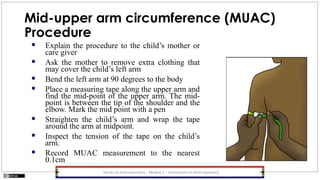
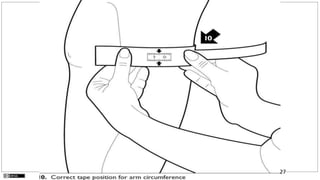
1. Anthropometric Methods
 Anthropometry is the measurement of body height, weight & proportions.
 It is an essential component of clinical examination of infants, children & pregnant women.
 It is used to evaluate both under & over nutrition.
 The measured values reflects the current nutritional status & don’t differentiate between acute & chronic
changes .
Other anthropometric Measurements
 Mid-arm circumference
 Skin fold thickness
 Head circumference
 Head/chest ratio
 Hip/waist ratio
 Z- score of reference population
 percentile in reference distribution

Why do anthropometry?
• In individuals:
 Part of overall assessment of nutrition status – identifying undernutrition and
overnutrition
 Infants and young children: good indication of overall health
• In large-scale nutrition surveys:
 Describe overall population anthropometric status
 Explore relationships between anthropometry and other measured
parameters, e.g. diet
 Compare to previous surveys  monitor trends
Importance of good data quality
• Anthropometry is easy to do, but difficult to do well!
• Poor quality measurements can
 Give an inaccurate picture of the study population’s nutrition status
 Make it difficult to see relationships between anthropometry and other
parameters clearly, and
 Make it difficult to compare our results to other studies.
Ensuring good quality measurements
Equipment-related matters
Equipment must be
• Good quality
• Preferably new
• All the same make and model
• Verified daily
• Set up and used correctly
• Cared for properly
Technique-related matters
Measurements must be
• Taken according to the same
procedures every time
• Taken twice
• Taken by persons who
 are properly trained (i.e. attended the
training specific to this survey), and
 have been assessed to ensure that
they can take the measurements
reliably.
TWO IMPORTANT ASPECTS:
Anthropometric
Measurements in a
Large-scale
Nutrition Survey
The who, what and how
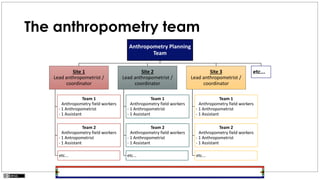
The anthropometry team
Anthropometry Planning
Team
Site 1
Lead anthropometrist /
coordinator
Team 1
Anthropometry field workers
- 1 Anthropometrist
- 1 Assistant
Team 2
Anthropometry field workers
- 1 Antropometrist
- 1 Assistant
etc...
Site 2
Lead anthropometrist /
coordinator
Team 1
Anthropometry field workers
- 1 Anthropometrist
- 1 Assistant
Team 2
Anthropometry field workers
- 1 Anthropometrist
- 1 Assistant
etc...
Site 3
Lead anthropometrist /
coordinator
Team 1
Anthropometry field workers
- 1 Anthropometrist
- 1 Assistant
Team 2
Anthropometry field workers
- 1 Anthropometrist
- 1 Assistant
etc...
etc...
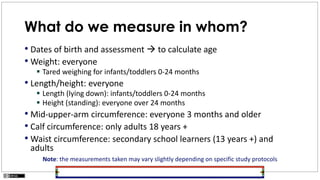
What do we measure in whom?
• Dates of birth and assessment  to calculate age
• Weight: everyone
 Tared weighing for infants/toddlers 0-24 months
• Length/height: everyone
 Length (lying down): infants/toddlers 0-24 months
 Height (standing): everyone over 24 months
• Mid-upper-arm circumference: everyone 3 months and older
• Calf circumference: only adults 18 years +
• Waist circumference: secondary school learners (13 years +) and
adults
Note: the measurements taken may vary slightly depending on specific study protocols
26
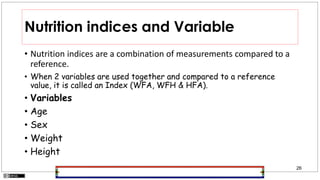
Nutrition indices and Variable
• Nutrition indices are a combination of measurements compared to a
reference.
• When 2 variables are used together and compared to a reference
value, it is called an Index (WFA, WFH & HFA).
• Variables
• Age
• Sex
• Weight
• Height
Anthropometric Indices
• Height and age (HFA) - measures for chronic malnutrition;
measurements which are low height-for-age indicate long-term
malnutrition, i.e. “stunting”.
• Weight and height (WFH) - measures for acute malnutrition;
measurements which are low weight-for-height indicate short-term
malnutrition, i.e. “wasting”.
• Weight and age (WFA) – Combine measure for chronic and acute
malnutrition; measurements which are low for WHA indicate
malnutrition.
14
27
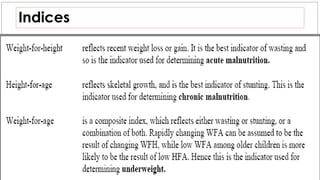
Indices
28
Nutrition indicators
• Nutrition indicators are an interpretation of nutrition indices based on
cutoff points or reference limits
• A nutrition indicator is a tool to measure the clinical phenomena of
malnutrition
• A good indicator is one that detects, as much as possible, those at risk
(sensitivity) without including too many of those not at risk
(specificity).
• The indicators stunting, wasting, overweight and underweight
Anthropometric measurements
include:
1.Weight (including birth weight)
2.Height/length
3.Mid-upper arm circumference
4.Waist circumference
5.Knee height (a proxy for height)
6.Head circumference
7.Calf circumference
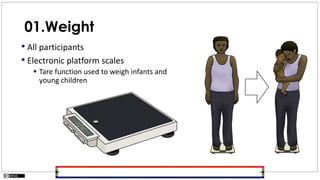
01.Weight
• All participants
• Electronic platform scales
 Tare function used to weigh infants and
young children
Weight measurement procedure
 Place the scale on a flat surface.
 Remove extra clothing from child as much as possible
 Press the Weighing Scale to turn it on
 Ask Mother / Caretaker to stand on the scale without child
 Store weight of the mother by pressing store button
 Pass child to be weighed to the mother on scale
 The scale indicate the child’s weight
 Record child's to the nearest 0.1 gm
19
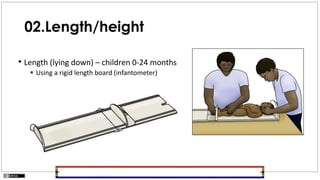
02.Length/height
• Length (lying down) – children 0-24 months
 Using a rigid length board (infantometer)
Length/Height measurement procedure
 For increased accuracy & precision 2 people are needed
 Children aged ≥ 2 years are measured standing up and <2 years are
measured lying down
 If age is difficult to assess then children >87 cm are measured
standing and <87 cm are lying down
 It is important to
 Record child height to the nearest 0.1 cm
 A height stick or tape fixed on a wall/table can also be used to quickly
measure child height/length
21
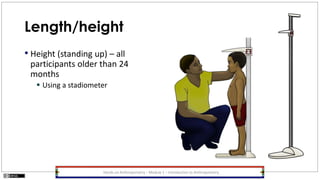
Length/height
• Height (standing up) – all
participants older than 24
months
 Using a stadiometer
Hands-on Anthropometry – Module 1 – Introduction to Anthropometry
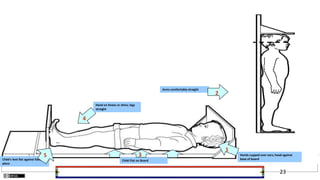
Hands cupped over ears; head against
base of board
1
Child Flat on Board
3
Hand on Knees or shins; legs
straight
4
Child’s feet flat against foot
piece
5
Arms comfortably straight
2
23
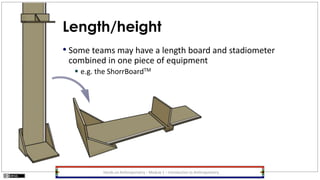
Length/height
• Some teams may have a length board and stadiometer
combined in one piece of equipment
 e.g. the ShorrBoardTM
Hands-on Anthropometry – Module 1 – Introduction to Anthropometry
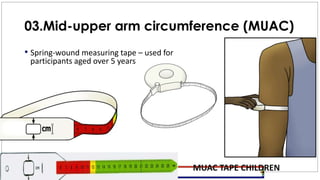
03.Mid-upper arm circumference (MUAC)
• Spring-wound measuring tape – used for
participants aged over 5 years
MUAC TAPE CHILDREN
Mid-upper arm circumference (MUAC)
Procedure
 Explain the procedure to the child’s mother or
care giver
 Ask the mother to remove extra clothing that
may cover the child’s left arm
 Bend the left arm at 90 degrees to the body
 Place a measuring tape along the upper arm and
find the mid-point of the upper arm. The mid-
point is between the tip of the shoulder and the
elbow. Mark the mid point with a pen
 Straighten the child’s arm and wrap the tape
around the arm at midpoint.
 Inspect the tension of the tape on the child’s
arm.
 Record MUAC measurement to the nearest
0.1cm
Hands-on Anthropometry – Module 1 – Introduction to Anthropometry
27
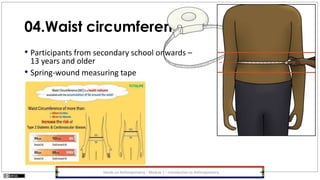
04.Waist circumference
• Participants from secondary school onwards –
13 years and older
• Spring-wound measuring tape
Hands-on Anthropometry – Module 1 – Introduction to Anthropometry
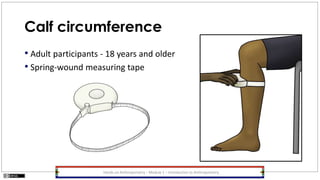
Calf circumference
• Adult participants - 18 years and older
• Spring-wound measuring tape
Hands-on Anthropometry – Module 1 – Introduction to Anthropometry
Thank you
Questions and Discussion

Antrhropometry lec 4th sem HND.pptx

  • 1.
    Learning outcomes By theend of this session, you will know: • What anthropometry is • Why we do anthropometric measurements • Why it is important to take good quality anthropometric measurements • Some steps that we can take to ensure good data quality • Which measurements we will be taking for NDIS-2021, and what equipment will be used. Hands-on Anthropometry – Module 1 – Introduction to Anthropometry
  • 2.
  • 3.
    What is anthropometry? •Anthropometry is the science of measuring and interpreting the size and proportions of the human body • Includes  Weight  Length/height  Circumferences – e.g. mid-upper arm (MUAC), calf, waist
  • 4.
    A) Anthropometric • Definition=itis the measurement of variation of physical dimensions and gross composition of human body at different level and degree of nutrition. • It is used both in community and clinical setup
  • 5.
    1. Anthropometric Methods Anthropometry is the measurement of body height, weight & proportions.  It is an essential component of clinical examination of infants, children & pregnant women.  It is used to evaluate both under & over nutrition.  The measured values reflects the current nutritional status & don’t differentiate between acute & chronic changes . Other anthropometric Measurements  Mid-arm circumference  Skin fold thickness  Head circumference  Head/chest ratio  Hip/waist ratio  Z- score of reference population  percentile in reference distribution 
  • 6.
    Why do anthropometry? •In individuals:  Part of overall assessment of nutrition status – identifying undernutrition and overnutrition  Infants and young children: good indication of overall health • In large-scale nutrition surveys:  Describe overall population anthropometric status  Explore relationships between anthropometry and other measured parameters, e.g. diet  Compare to previous surveys  monitor trends
  • 7.
    Importance of gooddata quality • Anthropometry is easy to do, but difficult to do well! • Poor quality measurements can  Give an inaccurate picture of the study population’s nutrition status  Make it difficult to see relationships between anthropometry and other parameters clearly, and  Make it difficult to compare our results to other studies.
  • 9.
    Ensuring good qualitymeasurements Equipment-related matters Equipment must be • Good quality • Preferably new • All the same make and model • Verified daily • Set up and used correctly • Cared for properly Technique-related matters Measurements must be • Taken according to the same procedures every time • Taken twice • Taken by persons who  are properly trained (i.e. attended the training specific to this survey), and  have been assessed to ensure that they can take the measurements reliably. TWO IMPORTANT ASPECTS:
  • 10.
  • 11.
    The anthropometry team AnthropometryPlanning Team Site 1 Lead anthropometrist / coordinator Team 1 Anthropometry field workers - 1 Anthropometrist - 1 Assistant Team 2 Anthropometry field workers - 1 Antropometrist - 1 Assistant etc... Site 2 Lead anthropometrist / coordinator Team 1 Anthropometry field workers - 1 Anthropometrist - 1 Assistant Team 2 Anthropometry field workers - 1 Anthropometrist - 1 Assistant etc... Site 3 Lead anthropometrist / coordinator Team 1 Anthropometry field workers - 1 Anthropometrist - 1 Assistant Team 2 Anthropometry field workers - 1 Anthropometrist - 1 Assistant etc... etc...
  • 12.
    What do wemeasure in whom? • Dates of birth and assessment  to calculate age • Weight: everyone  Tared weighing for infants/toddlers 0-24 months • Length/height: everyone  Length (lying down): infants/toddlers 0-24 months  Height (standing): everyone over 24 months • Mid-upper-arm circumference: everyone 3 months and older • Calf circumference: only adults 18 years + • Waist circumference: secondary school learners (13 years +) and adults Note: the measurements taken may vary slightly depending on specific study protocols
  • 13.
    26 Nutrition indices andVariable • Nutrition indices are a combination of measurements compared to a reference. • When 2 variables are used together and compared to a reference value, it is called an Index (WFA, WFH & HFA). • Variables • Age • Sex • Weight • Height
  • 14.
    Anthropometric Indices • Heightand age (HFA) - measures for chronic malnutrition; measurements which are low height-for-age indicate long-term malnutrition, i.e. “stunting”. • Weight and height (WFH) - measures for acute malnutrition; measurements which are low weight-for-height indicate short-term malnutrition, i.e. “wasting”. • Weight and age (WFA) – Combine measure for chronic and acute malnutrition; measurements which are low for WHA indicate malnutrition. 14
  • 15.
  • 16.
    28 Nutrition indicators • Nutritionindicators are an interpretation of nutrition indices based on cutoff points or reference limits • A nutrition indicator is a tool to measure the clinical phenomena of malnutrition • A good indicator is one that detects, as much as possible, those at risk (sensitivity) without including too many of those not at risk (specificity). • The indicators stunting, wasting, overweight and underweight
  • 17.
    Anthropometric measurements include: 1.Weight (includingbirth weight) 2.Height/length 3.Mid-upper arm circumference 4.Waist circumference 5.Knee height (a proxy for height) 6.Head circumference 7.Calf circumference
  • 18.
    01.Weight • All participants •Electronic platform scales  Tare function used to weigh infants and young children
  • 19.
    Weight measurement procedure Place the scale on a flat surface.  Remove extra clothing from child as much as possible  Press the Weighing Scale to turn it on  Ask Mother / Caretaker to stand on the scale without child  Store weight of the mother by pressing store button  Pass child to be weighed to the mother on scale  The scale indicate the child’s weight  Record child's to the nearest 0.1 gm 19
  • 20.
    02.Length/height • Length (lyingdown) – children 0-24 months  Using a rigid length board (infantometer)
  • 21.
    Length/Height measurement procedure For increased accuracy & precision 2 people are needed  Children aged ≥ 2 years are measured standing up and <2 years are measured lying down  If age is difficult to assess then children >87 cm are measured standing and <87 cm are lying down  It is important to  Record child height to the nearest 0.1 cm  A height stick or tape fixed on a wall/table can also be used to quickly measure child height/length 21
  • 22.
    Length/height • Height (standingup) – all participants older than 24 months  Using a stadiometer Hands-on Anthropometry – Module 1 – Introduction to Anthropometry
  • 23.
    Hands cupped overears; head against base of board 1 Child Flat on Board 3 Hand on Knees or shins; legs straight 4 Child’s feet flat against foot piece 5 Arms comfortably straight 2 23
  • 24.
    Length/height • Some teamsmay have a length board and stadiometer combined in one piece of equipment  e.g. the ShorrBoardTM Hands-on Anthropometry – Module 1 – Introduction to Anthropometry
  • 25.
    03.Mid-upper arm circumference(MUAC) • Spring-wound measuring tape – used for participants aged over 5 years MUAC TAPE CHILDREN
  • 26.
    Mid-upper arm circumference(MUAC) Procedure  Explain the procedure to the child’s mother or care giver  Ask the mother to remove extra clothing that may cover the child’s left arm  Bend the left arm at 90 degrees to the body  Place a measuring tape along the upper arm and find the mid-point of the upper arm. The mid- point is between the tip of the shoulder and the elbow. Mark the mid point with a pen  Straighten the child’s arm and wrap the tape around the arm at midpoint.  Inspect the tension of the tape on the child’s arm.  Record MUAC measurement to the nearest 0.1cm Hands-on Anthropometry – Module 1 – Introduction to Anthropometry
  • 27.
  • 28.
    04.Waist circumference • Participantsfrom secondary school onwards – 13 years and older • Spring-wound measuring tape Hands-on Anthropometry – Module 1 – Introduction to Anthropometry
  • 29.
    Calf circumference • Adultparticipants - 18 years and older • Spring-wound measuring tape Hands-on Anthropometry – Module 1 – Introduction to Anthropometry
  • 30.

Editor's Notes

  • #4 Module 1.1: What is anthropometry? Anthropometry is a science involving the measurement and interpretation of the size and proportions of the human body – this includes weight, height or length, and various circumferences. This manual focuses on the basic anthropometric measurements that are typically part of nutrition surveys that include infants, children and adults.
  • #7 Module 1.2: Why do we do anthropometry? For individuals of all ages, anthropometric measurements are an important part of assessing nutrition status, helping us to identify undernutrition and overnutrition. In infants and young children, anthropometric measurements also give a good indication of their overall health. In a large-scale, multi-site nutrition survey, anthropometric assessment also allows us to: describe the overall nutrition/anthropometric status of South Africans (for example, how many people are underweight or overweight, and some details of those affected), explore how anthropometric measurements relate to the other things we are measuring (for example, whether people’s weight is related to the types and amounts of food they eat), compare the results to those of previous surveys in South Africa and in other countries, and to determine how the body size and proportions of South Africans are changing over time (for example, we can see whether more people are underweight or overweight now than before).
  • #8  Why are good quality anthropometric measurements important? Anthropometric measurements may seem easy to do, but they are difficult to do well. When doing research, anthropometric measurements must be done with great care to ensure that they are accurate. Inaccurate measurements will affect the outcome of a study by: giving inaccurate information about the anthropometric status of South Africans, making it difficult to tell how anthropometric status relates to food intake, and making it difficult to compare our results to the result of other studies.
  • #9 It’s important to remember that the data collected in a national survey can be used to inform program priorities and decisions to be made by the National Department of Health. Good quality, accurate data will allow the Department of Health to make the best decisions to improve the health of all South Africans
  • #10 Various steps can be taken to ensure that anthropometric measurements are as accurate as possible. Specifically, we can look at equipment-related matters and measurement-related matters: Equipment-related matters: Good quality equipment should be used, preferably purchased new. Ideally, all measurement teams should use the same brand and model of equipment. Equipment should be tested for accuracy daily (a process known as verification). Equipment must be set up and used correctly. Equipment must be properly cared for on a day-to-day basis. Technique-related matters: Measurements must be taken in the same way every time, according to standardised protocols such as those in this manual. Measurements must be taken twice. Anthropometrists (that is, the people taking the measurements) must be properly trained in measurement protocols. After training, anthropometrists must be assessed to ensure that they are able to take the measurements reliably.  
  • #12 Module 1.4: Who does what? Team roles and responsibilities An anthropometry team typically consists of: The anthropometry planning team: responsible for planning anthropometric data collection, compiling manuals and guidelines, and training the lead anthropometrists. One lead anthropometrist (coordinator) per study site: responsible for training all the anthropometry field workers at their sites, conducting standardisation exercises, and monitoring day-to-day data collection. Two anthropometry field workers per team, of which one is trained as an anthropometrist and one as an assistant – they work together to take the anthropometric measurements. The organogram summarises the composition of the anthropometry team. Every member is critical for the quality of the anthropometric measurements.
  • #13 Module 1.5: Which measurements for which participants? The following measurements represent basic anthropometry that may be done in a large-scale nutrition survey: The date of the assessment and the date of birth, which are used to calculate age (this is necessary for us to be able to interpret the anthropometric measurements). Weight – in all participants. Length/height: Length (lying down) – in children 0-24 months. Height (standing up) – in everyone older than 24 months. Mid-upper arm circumference (MUAC) – in everyone aged three months and older. Calf circumference (CC) – in adults 18 years and older, including the elderly. Waist circumference (WC) – in secondary school learners (from age 13 years) and adults 18 years and older, including the elderly.
  • #19 Platform scales are used to weigh all participants: Infants and young children are weighed together with a parent/caregiver, using the tared weighing method. Children over the age of 24 months and adults are weighed standing up. The Seca 874, shown in the picture , is often used in large-scale nutrition surveys.
  • #21 An infantometer (or length board) is used to measure length (lying down) in infants and children up to the age of 24 months.
  • #23 A stadiometer is used to measure standing height in children over the age of 24 months and adults.
  • #25 The length and height meter can also be combined into one piece of equipment, e.g. the ShorrBoardTM, shown in the picture
  • #26 Spring-wound measuring tapes are used to measure MUAC in older children adults.
  • #27 Mid-upper arm circumference (MUAC) tapes for children – shown in the picture – are colour-coded to make it easy to identify children with acute undernutrition.
  • #29 Spring-wound measuring tapes are used to measure waist circumference.
  • #30 Spring-wound measuring tapes are used to measure calf circumference (CC) in adults.