Janet Bowstead
November 2010
1
PHD RESEARCH PROJECT (ESRC-FUNDED)
The research project (2009-2012) will be:
 mapping and analysing the relocation journeys
of women experiencing domestic violence to
services throughout England – 18,812 women
in 2008-09
 53.9% had children with them, 67.4% were of White British
ethnic origin, 8.2% were disabled.
 interviewing a sample of women about their
experiences of relocation and resettlement.
 working creatively with women and domestic
violence services to explore a re-
conceptualisation of women’s journeys
2
USING CONCEPTUAL ‘TOOL BOXES’
“All my books are little tool boxes.  If people
want to open them, to use a particular
sentence, a particular idea, a particular
analysis like a screwdriver or spanner ...
so much the better!”
Foucault, Michel 1995 Dits et ecrits 1954-88 vol. 2 ed. D. Defert and F.
Ewald, Paris: Gallimard. (1995:p720)
3
MICHEL FOUCAULT ON ‘PANOPTICISM’
 “Surveiller et Punir” - “Discipline and Punish”
(Foucault 1991)
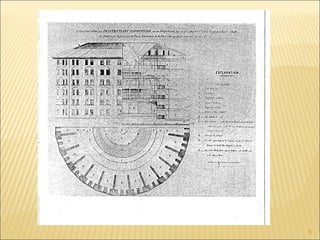
 Jeremy Bentham’s late eighteenth century
‘Panoptican’ prison plan
4
5
6
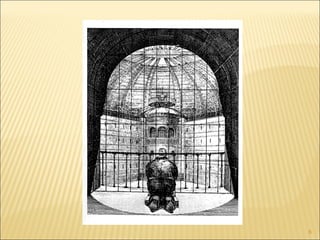
PANOPTICAN
 a structured system whereby “space becomes
specified and functional” enabling the easy and
effective exercise of disciplinary power
 “surveillance is permanent in its effects, even if it
is discontinuous in its action” because inmates
internalise the gaze and regulate their own
conduct
 each individual is isolated, unable to
communicate, an object of hierarchical
observation from the centre; able to be seen but
not to see.
7
8
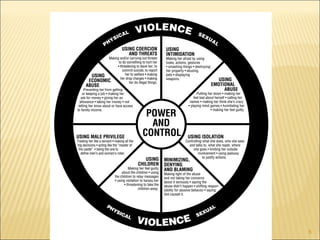
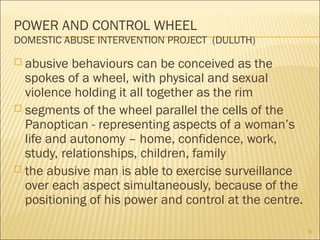
POWER AND CONTROL WHEEL
DOMESTIC ABUSE INTERVENTION PROJECT (DULUTH)
 abusive behaviours can be conceived as the
spokes of a wheel, with physical and sexual
violence holding it all together as the rim
 segments of the wheel parallel the cells of the
Panoptican - representing aspects of a woman’s
life and autonomy – home, confidence, work,
study, relationships, children, family
 the abusive man is able to exercise surveillance
over each aspect simultaneously, because of the
positioning of his power and control at the centre.
9
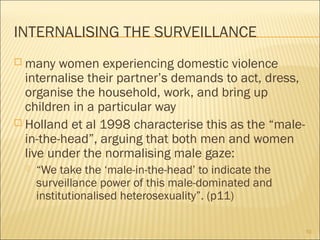
INTERNALISING THE SURVEILLANCE
 many women experiencing domestic violence
internalise their partner’s demands to act, dress,
organise the household, work, and bring up
children in a particular way
 Holland et al 1998 characterise this as the “male-
in-the-head”, arguing that both men and women
live under the normalising male gaze:
 “We take the ‘male-in-the-head’ to indicate the
surveillance power of this male-dominated and
institutionalised heterosexuality”. (p11)
10
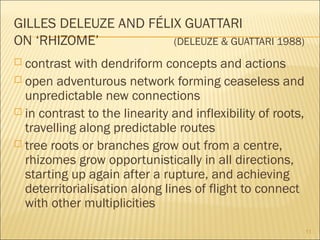
GILLES DELEUZE AND FÉLIX GUATTARI
ON ‘RHIZOME’ (DELEUZE & GUATTARI 1988)
 contrast with dendriform concepts and actions
 open adventurous network forming ceaseless and
unpredictable new connections
 in contrast to the linearity and inflexibility of roots,
travelling along predictable routes
 tree roots or branches grow out from a centre,
rhizomes grow opportunistically in all directions,
starting up again after a rupture, and achieving
deterritorialisation along lines of flight to connect
with other multiplicities
11
RHIZOMIC JOURNEYS – LINES OF FLIGHT
 women’s journeys to flee domestic violence - if
she can travel unpredictably in space, to
unanticipated locations, she is less likely to be
able to be followed
 escaping a regime of disciplinary power – an
abuser who knows her contacts - so power does
not simply weaken as a function of distance
 making new connections, for example by using the
network of women’s refuges, a woman is more
able to escape the operation of power over space
12
MARC AUGÉ ON ‘NON-PLACES’
(AUGÉ 2008)
 “a space which cannot be defined as relational,
historical, or concerned with identity will be a
non-place” (p63)
 he associates non-places with certain ends,
such as transport, commerce and leisure,
rather than a concern with location
 for example holiday-makers may be largely
indifferent as to whether they travel from Gatwick,
Heathrow or Stansted, and therefore airports
become non-places.
13
REFUGES AS NON-PLACES
 a woman fleeing domestic violence may be initially
indifferent as to where she goes for refuge, so long
as it is a place her partner does not know
 she may formally or informally change her identity
 she may sever contacts with friends and family
 she can only disclose her address as a Post Office
Box number
 the building will have the functions of a house, but
barely feels like a place of residence, let alone a
home
14
MAKING PLACES
 refuges can attempt to counteract their
tendency to be non-places and instead
contribute to a sense of belonging and place
through considerations of
 structural positioning – challenging discrimination
 physical space – designing to feel less institutional
 emotional space – bringing women together
collectively for support and to reduce isolation
(Burman & Chantler 2004)
15
USING CONCEPTUAL ‘TOOL BOXES’ FROM OTHER
DISCIPLINES
 Providing insights to analyse women’s
spatial strategies in fleeing domestic
violence.
 sensitising concepts to assist in identifying
patterns and processes within the empirical
data
 contextualising concepts to assist in
analysing these patterns and generalising
from the individual narratives of women’s
journeys
16
 Foucault – on the spatiality of surveillance
 Space as constraint
 useful in understanding what women are overcoming
to leave abusive relationships
 Deleuze and Guattari – on escape along rhizomic
lines of flight
 Space as resource
 useful in understanding the journeys themselves
 Augé – on un-location and non-places
 Space as place
 useful in understanding what needs to be
counteracted to create new homes and belonging
17
REFERENCES
 Augé, M., 2008. Non-places: An Introduction to Supermodernity – 2nd English-
language edition, London and New York: Verso.
 Burman, E. & Chantler, K., 2004. There's No-Place Like Home: emotional
geographies of researching 'race' and refuge provision in Britain. Gender, Place &
Culture, 11(3), 375-397.
 Deleuze, G. & Guattari, F., 1988. Rhizome. In A thousand plateaus. London: Athlone
Press, pp. 3-25.
 Domestic Abuse Intervention Project, Power and Control Wheel. Available at:
http://www.theduluthmodel.org/wheelgallery.php.
 Foucault, M., 1991. Discipline and Punish: The Birth of the Prison (Surveiller et Punir
1975 trans. Alan Sheridan 1977), London: Penguin.
 Foucault, M. 1995 Dits et ecrits 1954-88 vol. 2 ed. D. Defert and F. Ewald, Paris:
Gallimard.
 Holland, J. et al., 1998. The Male in the Head: young people, heterosexuality and
power, London: The Tufnell Press.
18
Janet Bowstead - Research Student
Child and Woman Abuse Studies Unit
London Metropolitan University
e-mail: j.bowstead@londonmet.ac.uk
tel: 020 7133 5014
19

Janet bowstead

  • 1.
  • 2.
    PHD RESEARCH PROJECT(ESRC-FUNDED) The research project (2009-2012) will be:  mapping and analysing the relocation journeys of women experiencing domestic violence to services throughout England – 18,812 women in 2008-09  53.9% had children with them, 67.4% were of White British ethnic origin, 8.2% were disabled.  interviewing a sample of women about their experiences of relocation and resettlement.  working creatively with women and domestic violence services to explore a re- conceptualisation of women’s journeys 2
  • 3.
    USING CONCEPTUAL ‘TOOLBOXES’ “All my books are little tool boxes.  If people want to open them, to use a particular sentence, a particular idea, a particular analysis like a screwdriver or spanner ... so much the better!” Foucault, Michel 1995 Dits et ecrits 1954-88 vol. 2 ed. D. Defert and F. Ewald, Paris: Gallimard. (1995:p720) 3
  • 4.
    MICHEL FOUCAULT ON‘PANOPTICISM’  “Surveiller et Punir” - “Discipline and Punish” (Foucault 1991)  Jeremy Bentham’s late eighteenth century ‘Panoptican’ prison plan 4
  • 5.
  • 6.
  • 7.
    PANOPTICAN  a structuredsystem whereby “space becomes specified and functional” enabling the easy and effective exercise of disciplinary power  “surveillance is permanent in its effects, even if it is discontinuous in its action” because inmates internalise the gaze and regulate their own conduct  each individual is isolated, unable to communicate, an object of hierarchical observation from the centre; able to be seen but not to see. 7
  • 8.
  • 9.
    POWER AND CONTROLWHEEL DOMESTIC ABUSE INTERVENTION PROJECT (DULUTH)  abusive behaviours can be conceived as the spokes of a wheel, with physical and sexual violence holding it all together as the rim  segments of the wheel parallel the cells of the Panoptican - representing aspects of a woman’s life and autonomy – home, confidence, work, study, relationships, children, family  the abusive man is able to exercise surveillance over each aspect simultaneously, because of the positioning of his power and control at the centre. 9
  • 10.
    INTERNALISING THE SURVEILLANCE many women experiencing domestic violence internalise their partner’s demands to act, dress, organise the household, work, and bring up children in a particular way  Holland et al 1998 characterise this as the “male- in-the-head”, arguing that both men and women live under the normalising male gaze:  “We take the ‘male-in-the-head’ to indicate the surveillance power of this male-dominated and institutionalised heterosexuality”. (p11) 10
  • 11.
    GILLES DELEUZE ANDFÉLIX GUATTARI ON ‘RHIZOME’ (DELEUZE & GUATTARI 1988)  contrast with dendriform concepts and actions  open adventurous network forming ceaseless and unpredictable new connections  in contrast to the linearity and inflexibility of roots, travelling along predictable routes  tree roots or branches grow out from a centre, rhizomes grow opportunistically in all directions, starting up again after a rupture, and achieving deterritorialisation along lines of flight to connect with other multiplicities 11
  • 12.
    RHIZOMIC JOURNEYS –LINES OF FLIGHT  women’s journeys to flee domestic violence - if she can travel unpredictably in space, to unanticipated locations, she is less likely to be able to be followed  escaping a regime of disciplinary power – an abuser who knows her contacts - so power does not simply weaken as a function of distance  making new connections, for example by using the network of women’s refuges, a woman is more able to escape the operation of power over space 12
  • 13.
    MARC AUGÉ ON‘NON-PLACES’ (AUGÉ 2008)  “a space which cannot be defined as relational, historical, or concerned with identity will be a non-place” (p63)  he associates non-places with certain ends, such as transport, commerce and leisure, rather than a concern with location  for example holiday-makers may be largely indifferent as to whether they travel from Gatwick, Heathrow or Stansted, and therefore airports become non-places. 13
  • 14.
    REFUGES AS NON-PLACES a woman fleeing domestic violence may be initially indifferent as to where she goes for refuge, so long as it is a place her partner does not know  she may formally or informally change her identity  she may sever contacts with friends and family  she can only disclose her address as a Post Office Box number  the building will have the functions of a house, but barely feels like a place of residence, let alone a home 14
  • 15.
    MAKING PLACES  refugescan attempt to counteract their tendency to be non-places and instead contribute to a sense of belonging and place through considerations of  structural positioning – challenging discrimination  physical space – designing to feel less institutional  emotional space – bringing women together collectively for support and to reduce isolation (Burman & Chantler 2004) 15
  • 16.
    USING CONCEPTUAL ‘TOOLBOXES’ FROM OTHER DISCIPLINES  Providing insights to analyse women’s spatial strategies in fleeing domestic violence.  sensitising concepts to assist in identifying patterns and processes within the empirical data  contextualising concepts to assist in analysing these patterns and generalising from the individual narratives of women’s journeys 16
  • 17.
     Foucault –on the spatiality of surveillance  Space as constraint  useful in understanding what women are overcoming to leave abusive relationships  Deleuze and Guattari – on escape along rhizomic lines of flight  Space as resource  useful in understanding the journeys themselves  Augé – on un-location and non-places  Space as place  useful in understanding what needs to be counteracted to create new homes and belonging 17
  • 18.
    REFERENCES  Augé, M.,2008. Non-places: An Introduction to Supermodernity – 2nd English- language edition, London and New York: Verso.  Burman, E. & Chantler, K., 2004. There's No-Place Like Home: emotional geographies of researching 'race' and refuge provision in Britain. Gender, Place & Culture, 11(3), 375-397.  Deleuze, G. & Guattari, F., 1988. Rhizome. In A thousand plateaus. London: Athlone Press, pp. 3-25.  Domestic Abuse Intervention Project, Power and Control Wheel. Available at: http://www.theduluthmodel.org/wheelgallery.php.  Foucault, M., 1991. Discipline and Punish: The Birth of the Prison (Surveiller et Punir 1975 trans. Alan Sheridan 1977), London: Penguin.  Foucault, M. 1995 Dits et ecrits 1954-88 vol. 2 ed. D. Defert and F. Ewald, Paris: Gallimard.  Holland, J. et al., 1998. The Male in the Head: young people, heterosexuality and power, London: The Tufnell Press. 18
  • 19.
    Janet Bowstead -Research Student Child and Woman Abuse Studies Unit London Metropolitan University e-mail: j.bowstead@londonmet.ac.uk tel: 020 7133 5014 19