• Where does “stuff”, material, or matter
come from to build plants and animals?
• Where does energy come from to build
plants and animals?
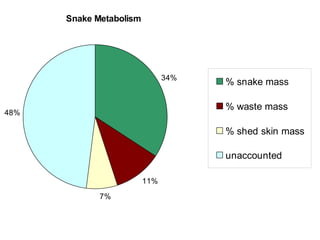
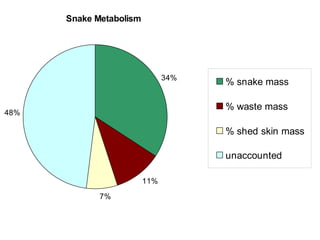
Snake Metabolism
34%
11%
7%
48%
% snake mass
% waste mass
% shed skin mass
unaccounted
• What happens to the food you eat, if you
eat too much?
• What is causing rising obesity rates in
America?
ObesityObesity TrendsTrends Among U.S. AdultsAmong U.S. Adults
Between 1985 and 2010Between 1985 and 2010
Source of the data:
• The data shown in these maps were collected
through CDC’s Behavioral Risk Factor
Surveillance System (BRFSS). Each year,
state health departments use standard
procedures to collect data through a series of
telephone interviews with U.S. adults. Height
and weight data are self-reported.
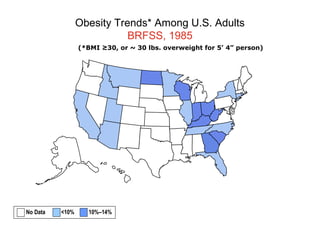
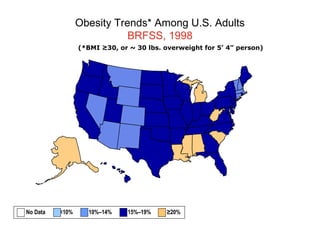
Obesity Trends* Among U.S. Adults
BRFSS, 1985
(*BMI ≥30, or ~ 30 lbs. overweight for 5’ 4” person)
No Data <10% 10%–14%
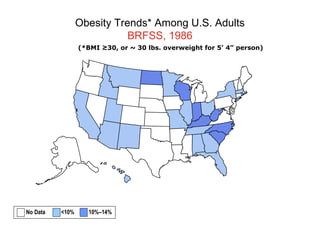
Obesity Trends* Among U.S. Adults
BRFSS, 1986
(*BMI ≥30, or ~ 30 lbs. overweight for 5’ 4” person)
No Data <10% 10%–14%
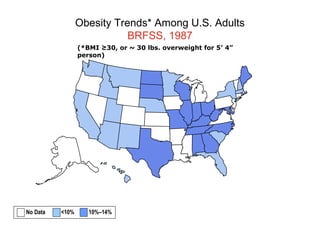
Obesity Trends* Among U.S. Adults
BRFSS, 1987
(*BMI ≥30, or ~ 30 lbs. overweight for 5’ 4”
person)
No Data <10% 10%–14%
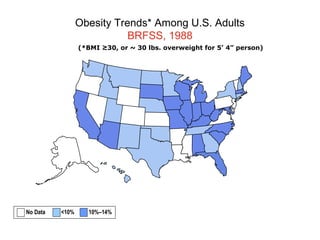
Obesity Trends* Among U.S. Adults
BRFSS, 1988
(*BMI ≥30, or ~ 30 lbs. overweight for 5’ 4” person)
No Data <10% 10%–14%
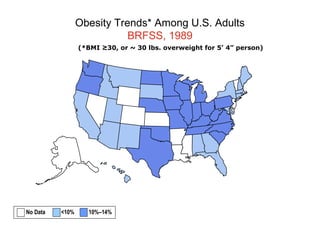
Obesity Trends* Among U.S. Adults
BRFSS, 1989
(*BMI ≥30, or ~ 30 lbs. overweight for 5’ 4” person)
No Data <10% 10%–14%
Obesity Trends* Among U.S. Adults
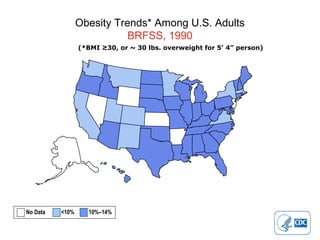
BRFSS, 1990
(*BMI ≥30, or ~ 30 lbs. overweight for 5’ 4” person)
No Data <10% 10%–14%
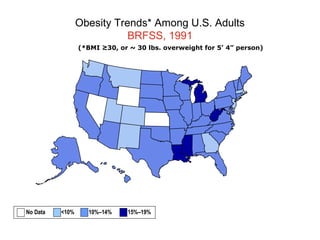
Obesity Trends* Among U.S. Adults
BRFSS, 1991
(*BMI ≥30, or ~ 30 lbs. overweight for 5’ 4” person)
No Data <10% 10%–14% 15%–19%
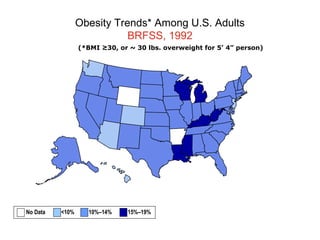
Obesity Trends* Among U.S. Adults
BRFSS, 1992
(*BMI ≥30, or ~ 30 lbs. overweight for 5’ 4” person)
No Data <10% 10%–14% 15%–19%
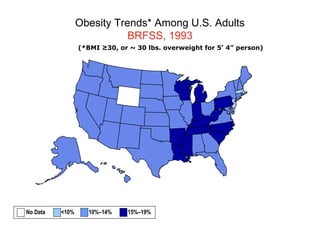
Obesity Trends* Among U.S. Adults
BRFSS, 1993
(*BMI ≥30, or ~ 30 lbs. overweight for 5’ 4” person)
No Data <10% 10%–14% 15%–19%
Obesity Trends* Among U.S. Adults
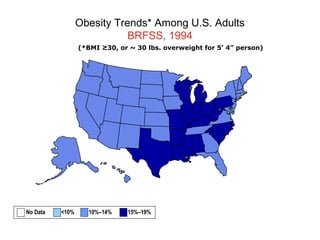
BRFSS, 1994
(*BMI ≥30, or ~ 30 lbs. overweight for 5’ 4” person)
No Data <10% 10%–14% 15%–19%
Obesity Trends* Among U.S. Adults
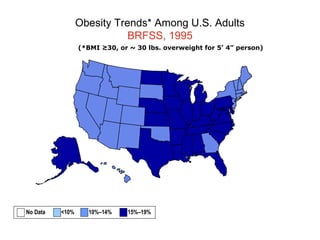
BRFSS, 1995
(*BMI ≥30, or ~ 30 lbs. overweight for 5’ 4” person)
No Data <10% 10%–14% 15%–19%
Obesity Trends* Among U.S. Adults
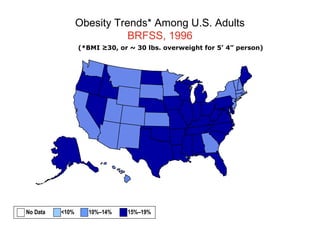
BRFSS, 1996
(*BMI ≥30, or ~ 30 lbs. overweight for 5’ 4” person)
No Data <10% 10%–14% 15%–19%
Obesity Trends* Among U.S. Adults
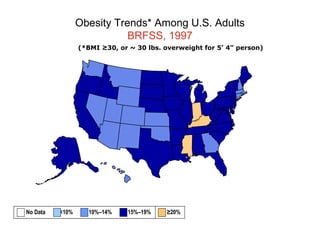
BRFSS, 1997
(*BMI ≥30, or ~ 30 lbs. overweight for 5’ 4” person)
No Data <10% 10%–14% 15%–19% ≥20%
Obesity Trends* Among U.S. Adults
BRFSS, 1998
(*BMI ≥30, or ~ 30 lbs. overweight for 5’ 4” person)
No Data <10% 10%–14% 15%–19% ≥20%
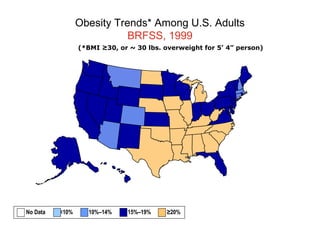
Obesity Trends* Among U.S. Adults
BRFSS, 1999
(*BMI ≥30, or ~ 30 lbs. overweight for 5’ 4” person)
No Data <10% 10%–14% 15%–19% ≥20%
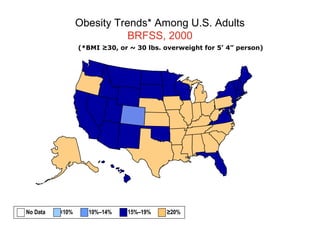
Obesity Trends* Among U.S. Adults
BRFSS, 2000
(*BMI ≥30, or ~ 30 lbs. overweight for 5’ 4” person)
No Data <10% 10%–14% 15%–19% ≥20%
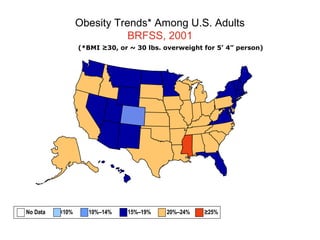
Obesity Trends* Among U.S. Adults
BRFSS, 2001
(*BMI ≥30, or ~ 30 lbs. overweight for 5’ 4” person)
No Data <10% 10%–14% 15%–19% 20%–24% ≥25%
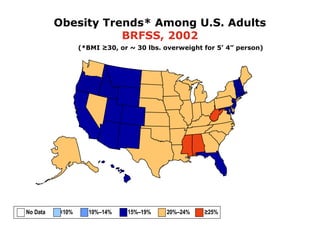
(*BMI ≥30, or ~ 30 lbs. overweight for 5’ 4” person)
Obesity Trends* Among U.S. Adults
BRFSS, 2002
No Data <10% 10%–14% 15%–19% 20%–24% ≥25%
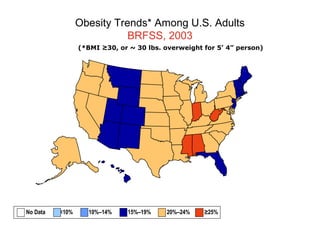
Obesity Trends* Among U.S. Adults
BRFSS, 2003
(*BMI ≥30, or ~ 30 lbs. overweight for 5’ 4” person)
No Data <10% 10%–14% 15%–19% 20%–24% ≥25%
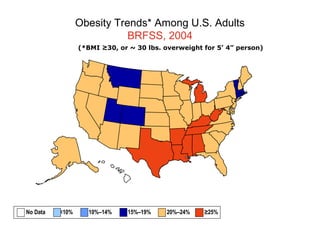
Obesity Trends* Among U.S. Adults
BRFSS, 2004
(*BMI ≥30, or ~ 30 lbs. overweight for 5’ 4” person)
No Data <10% 10%–14% 15%–19% 20%–24% ≥25%
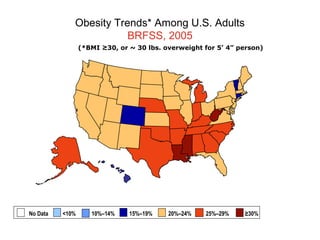
Obesity Trends* Among U.S. Adults
BRFSS, 2005
(*BMI ≥30, or ~ 30 lbs. overweight for 5’ 4” person)
No Data <10% 10%–14% 15%–19% 20%–24% 25%–29% ≥30%
Obesity Trends* Among U.S. Adults
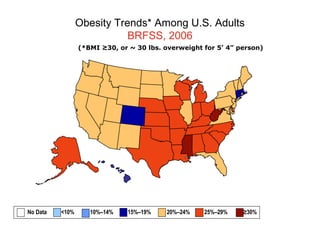
BRFSS, 2006
(*BMI ≥30, or ~ 30 lbs. overweight for 5’ 4” person)
No Data <10% 10%–14% 15%–19% 20%–24% 25%–29% ≥30%
Obesity Trends* Among U.S. Adults
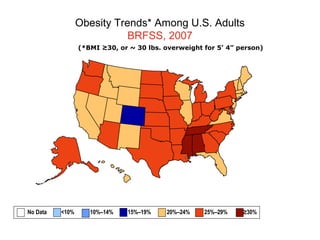
BRFSS, 2007
(*BMI ≥30, or ~ 30 lbs. overweight for 5’ 4” person)
No Data <10% 10%–14% 15%–19% 20%–24% 25%–29% ≥30%
Obesity Trends* Among U.S. Adults
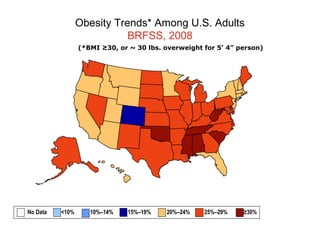
BRFSS, 2008
(*BMI ≥30, or ~ 30 lbs. overweight for 5’ 4” person)
No Data <10% 10%–14% 15%–19% 20%–24% 25%–29% ≥30%
Obesity Trends* Among U.S. Adults
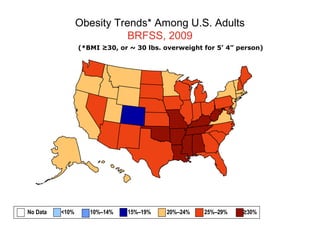
BRFSS, 2009
(*BMI ≥30, or ~ 30 lbs. overweight for 5’ 4” person)
No Data <10% 10%–14% 15%–19% 20%–24% 25%–29% ≥30%
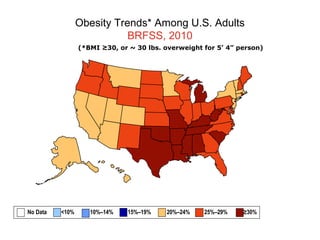
Obesity Trends* Among U.S. Adults
BRFSS, 2010
(*BMI ≥30, or ~ 30 lbs. overweight for 5’ 4” person)
No Data <10% 10%–14% 15%–19% 20%–24% 25%–29% ≥30%
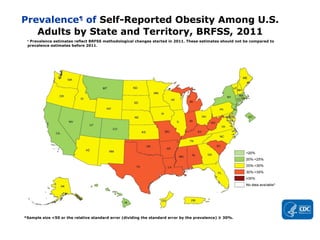
Prevalence
of Self-Reported Obesity Among U.S.
Adults by State and Territory, BRFSS, 2011

Prevalence estimates reflect BRFSS methodological changes started in 2011. These estimates should not be compared to
prevalence estimates before 2011.
*Sample size <50 or the relative standard error (dividing the standard error by the prevalence) ≥ 30%.
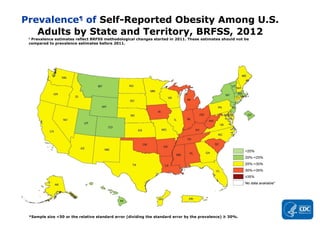
Prevalence
of Self-Reported Obesity Among U.S.
Adults by State and Territory, BRFSS, 2012
Prevalence estimates reflect BRFSS methodological changes started in 2011. These estimates should not be
compared to prevalence estimates before 2011.
*Sample size <50 or the relative standard error (dividing the standard error by the prevalence) ≥ 30%.
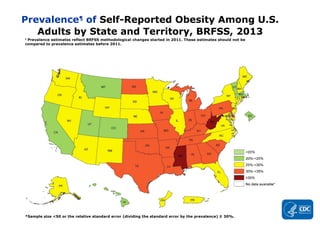
Prevalence
of Self-Reported Obesity Among U.S.
Adults by State and Territory, BRFSS, 2013

Prevalence estimates reflect BRFSS methodological changes started in 2011. These estimates should not be
compared to prevalence estimates before 2011.
*Sample size <50 or the relative standard error (dividing the standard error by the prevalence) ≥ 30%.
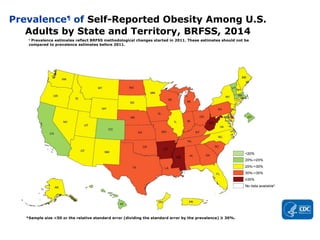
Prevalence
of Self-Reported Obesity Among U.S.
Adults by State and Territory, BRFSS, 2014

Prevalence estimates reflect BRFSS methodological changes started in 2011. These estimates should not be
compared to prevalence estimates before 2011.
*Sample size <50 or the relative standard error (dividing the standard error by the prevalence) ≥ 30%.
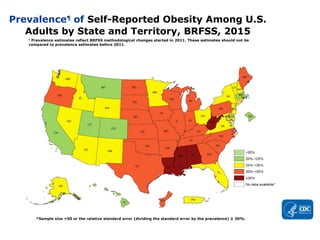
Prevalence
of Self-Reported Obesity Among U.S.
Adults by State and Territory, BRFSS, 2015

Prevalence estimates reflect BRFSS methodological changes started in 2011. These estimates should not be
compared to prevalence estimates before 2011.
*Sample size <50 or the relative standard error (dividing the standard error by the prevalence) ≥ 30%.
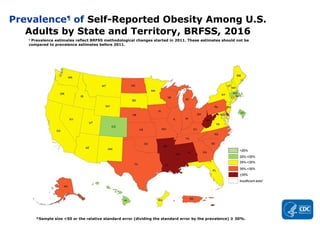
Prevalence
of Self-Reported Obesity Among U.S.
Adults by State and Territory, BRFSS, 2016

Prevalence estimates reflect BRFSS methodological changes started in 2011. These estimates should not be
compared to prevalence estimates before 2011.
*Sample size <50 or the relative standard error (dividing the standard error by the prevalence) ≥ 30%.
What is causing America’s
obesity epidemic?
Issues related to America’s
obesity epidemic
• In New York City, lawmaker’s attempted to ban
sugary soft drinks larger than 16 ounces.
• School districts around the country are opposing
the federal government’s new federal healthy
lunch program, claiming that students will not eat
the “healthy” food.
• Airlines are considering charging higher prices to
overweight passengers.
It takes physical courage to
stand up to enemies. It takes
moral courage to stand up to
friends.
- unknown
How should we combat the
obesity epidemic?
• Do you think government should try to regulate
body weight?
• Should laws prevent businesses from selling
food to obese people?
• Should laws protect obese people from
discrimination?
• Who should pay for medical costs related to
obesity?
• What do you think should be done to decrease
obesity in America?
Understanding metabolism
helps us understand
obesity, medications, and health
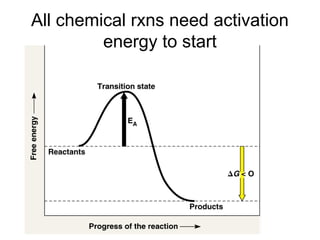
All chemical rxns need activation
energy to start
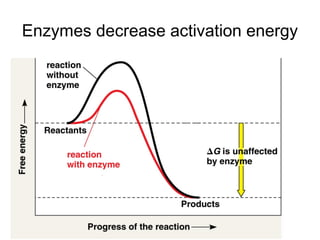
Enzymes decrease activation energy
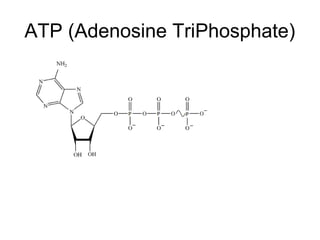
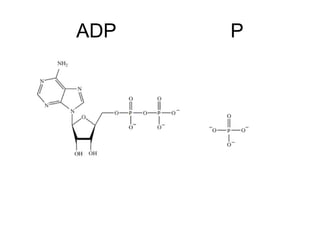
ATP (Adenosine TriPhosphate)
ADP P
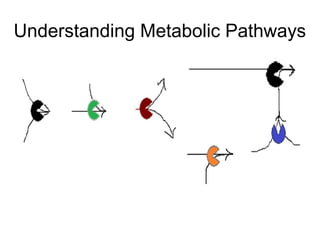
Understanding Metabolic Pathways
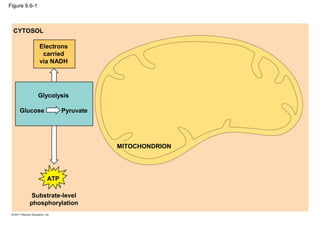
Figure 9.6-1
Electrons
carried
via NADH
Glycolysis
Glucose Pyruvate
CYTOSOL
MITOCHONDRION
ATP
Substrate-level
phosphorylation
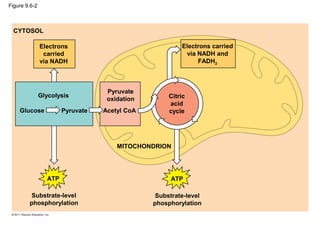
Figure 9.6-2
Electrons
carried
via NADH
Electrons carried
via NADH and
FADH2
Citric
acid
cycle
Pyruvate
oxidation
Acetyl CoA
Glycolysis
Glucose Pyruvate
CYTOSOL
MITOCHONDRION
ATP ATP
Substrate-level
phosphorylation
Substrate-level
phosphorylation
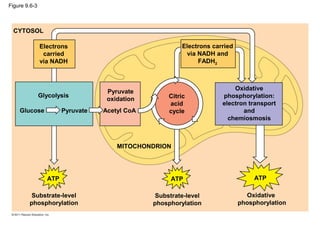
Figure 9.6-3
Electrons
carried
via NADH
Electrons carried
via NADH and
FADH2
Citric
acid
cycle
Pyruvate
oxidation
Acetyl CoA
Glycolysis
Glucose Pyruvate
Oxidative
phosphorylation:
electron transport
and
chemiosmosis
CYTOSOL
MITOCHONDRION
ATP ATP ATP
Substrate-level
phosphorylation
Substrate-level
phosphorylation
Oxidative
phosphorylation
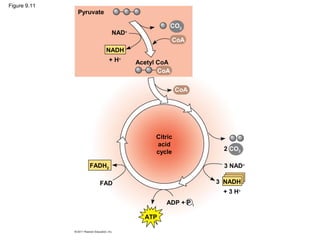
Figure 9.11
Pyruvate
NAD+
NADH
+ H+
Acetyl CoA
CO2
CoA
CoA
CoA
2 CO2
ADP + P i
FADH2
FAD
ATP
3 NADH
3 NAD+
Citric
acid
cycle
+ 3 H+
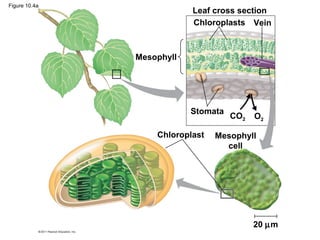
Figure 10.4a
Mesophyll
Leaf cross section
Chloroplasts Vein
Stomata
Chloroplast Mesophyll
cell
CO2 O2
20 µm
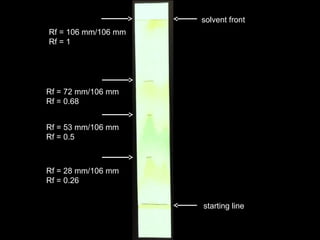
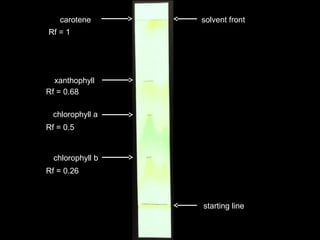
solvent front
starting line
Rf = 106 mm/106 mm
Rf = 1
Rf = 72 mm/106 mm
Rf = 0.68
Rf = 53 mm/106 mm
Rf = 0.5
Rf = 28 mm/106 mm
Rf = 0.26
solvent front
xanthophyll
chlorophyll a
carotene
starting line
chlorophyll b
Rf = 1
Rf = 0.68
Rf = 0.5
Rf = 0.26
Imagination ismoreImagination ismore
important thanimportant than
knowledge.knowledge.
- Albert Einstein- Albert Einstein
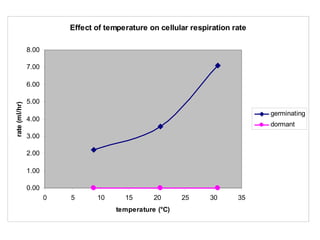
Effect of temperature on cellular respiration rate
0.00
1.00
2.00
3.00
4.00
5.00
6.00
7.00
8.00
0 5 10 15 20 25 30 35
temperature (°C)
rate(ml/hr)
germinating
dormant
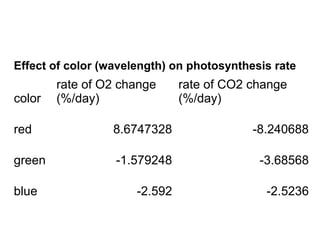
Effect of color (wavelength) on photosynthesis rate
color
rate of O2 change
(%/day)
rate of CO2 change
(%/day)
red 8.6747328 -8.240688
green -1.579248 -3.68568
blue -2.592 -2.5236
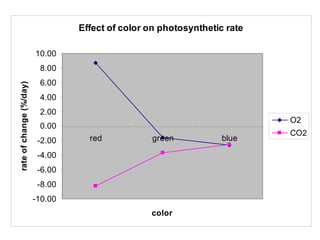
Effect of color on photosynthetic rate
-10.00
-8.00
-6.00
-4.00
-2.00
0.00
2.00
4.00
6.00
8.00
10.00
red green blue
color
rateofchange(%/day)
O2
CO2
Figure 10.6-4
Light
Light
Reactions
Calvin
Cycle
Chloroplast
[CH2O]
(sugar)
ATP
NADPH
NADP+
ADP
+ P i
H2O CO2
O2
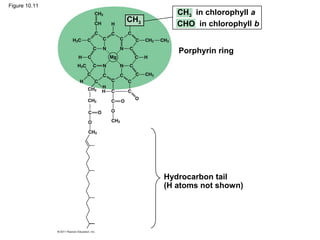
Figure 10.11
Hydrocarbon tail
(H atoms not shown)
Porphyrin ring
CH3
CH3 in chlorophyll a
CHO in chlorophyll b
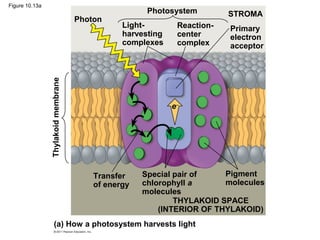
Figure 10.13a
(a) How a photosystem harvests light
Thylakoidmembrane
Photon
Photosystem STROMA
Light-
harvesting
complexes
Reaction-
center
complex
Primary
electron
acceptor
Transfer
of energy
Special pair of
chlorophyll a
molecules
Pigment
molecules
THYLAKOID SPACE
(INTERIOR OF THYLAKOID)
e−
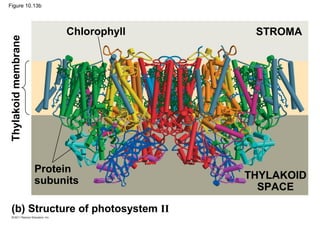
Figure 10.13b
(b) Structure of photosystem II
Thylakoidmembrane
Chlorophyll STROMA
Protein
subunits THYLAKOID
SPACE
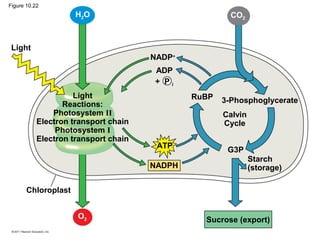
Figure 10.22
Light
Light
Reactions:
Photosystem II
Electron transport chain
Photosystem I
Electron transport chain
NADP+
ADP
+ P i
RuBP
ATP
NADPH
3-Phosphoglycerate
Calvin
Cycle
G3P
Starch
(storage)
Sucrose (export)
Chloroplast
H2O CO2
O2
Snake Metabolism
34%
11%
7%
48%
% snake mass
% waste mass
% shed skin mass
unaccounted
Metabolism

Metabolism

  • 1.
    • Where does“stuff”, material, or matter come from to build plants and animals? • Where does energy come from to build plants and animals?
  • 2.
    Snake Metabolism 34% 11% 7% 48% % snakemass % waste mass % shed skin mass unaccounted
  • 3.
    • What happensto the food you eat, if you eat too much? • What is causing rising obesity rates in America?
  • 4.
    ObesityObesity TrendsTrends AmongU.S. AdultsAmong U.S. Adults Between 1985 and 2010Between 1985 and 2010 Source of the data: • The data shown in these maps were collected through CDC’s Behavioral Risk Factor Surveillance System (BRFSS). Each year, state health departments use standard procedures to collect data through a series of telephone interviews with U.S. adults. Height and weight data are self-reported.
  • 5.
    Obesity Trends* AmongU.S. Adults BRFSS, 1985 (*BMI ≥30, or ~ 30 lbs. overweight for 5’ 4” person) No Data <10% 10%–14%
  • 6.
    Obesity Trends* AmongU.S. Adults BRFSS, 1986 (*BMI ≥30, or ~ 30 lbs. overweight for 5’ 4” person) No Data <10% 10%–14%
  • 7.
    Obesity Trends* AmongU.S. Adults BRFSS, 1987 (*BMI ≥30, or ~ 30 lbs. overweight for 5’ 4” person) No Data <10% 10%–14%
  • 8.
    Obesity Trends* AmongU.S. Adults BRFSS, 1988 (*BMI ≥30, or ~ 30 lbs. overweight for 5’ 4” person) No Data <10% 10%–14%
  • 9.
    Obesity Trends* AmongU.S. Adults BRFSS, 1989 (*BMI ≥30, or ~ 30 lbs. overweight for 5’ 4” person) No Data <10% 10%–14%
  • 10.
    Obesity Trends* AmongU.S. Adults BRFSS, 1990 (*BMI ≥30, or ~ 30 lbs. overweight for 5’ 4” person) No Data <10% 10%–14%
  • 11.
    Obesity Trends* AmongU.S. Adults BRFSS, 1991 (*BMI ≥30, or ~ 30 lbs. overweight for 5’ 4” person) No Data <10% 10%–14% 15%–19%
  • 12.
    Obesity Trends* AmongU.S. Adults BRFSS, 1992 (*BMI ≥30, or ~ 30 lbs. overweight for 5’ 4” person) No Data <10% 10%–14% 15%–19%
  • 13.
    Obesity Trends* AmongU.S. Adults BRFSS, 1993 (*BMI ≥30, or ~ 30 lbs. overweight for 5’ 4” person) No Data <10% 10%–14% 15%–19%
  • 14.
    Obesity Trends* AmongU.S. Adults BRFSS, 1994 (*BMI ≥30, or ~ 30 lbs. overweight for 5’ 4” person) No Data <10% 10%–14% 15%–19%
  • 15.
    Obesity Trends* AmongU.S. Adults BRFSS, 1995 (*BMI ≥30, or ~ 30 lbs. overweight for 5’ 4” person) No Data <10% 10%–14% 15%–19%
  • 16.

    Obesity Trends* AmongU.S. Adults BRFSS, 1996 (*BMI ≥30, or ~ 30 lbs. overweight for 5’ 4” person) No Data <10% 10%–14% 15%–19%
  • 17.
    Obesity Trends* AmongU.S. Adults BRFSS, 1997 (*BMI ≥30, or ~ 30 lbs. overweight for 5’ 4” person) No Data <10% 10%–14% 15%–19% ≥20%
  • 18.
    Obesity Trends* AmongU.S. Adults BRFSS, 1998 (*BMI ≥30, or ~ 30 lbs. overweight for 5’ 4” person) No Data <10% 10%–14% 15%–19% ≥20%
  • 19.
    Obesity Trends* AmongU.S. Adults BRFSS, 1999 (*BMI ≥30, or ~ 30 lbs. overweight for 5’ 4” person) No Data <10% 10%–14% 15%–19% ≥20%
  • 20.
    Obesity Trends* AmongU.S. Adults BRFSS, 2000 (*BMI ≥30, or ~ 30 lbs. overweight for 5’ 4” person) No Data <10% 10%–14% 15%–19% ≥20%
  • 21.
    Obesity Trends* AmongU.S. Adults BRFSS, 2001 (*BMI ≥30, or ~ 30 lbs. overweight for 5’ 4” person) No Data <10% 10%–14% 15%–19% 20%–24% ≥25%
  • 22.
    (*BMI ≥30, or~ 30 lbs. overweight for 5’ 4” person) Obesity Trends* Among U.S. Adults BRFSS, 2002 No Data <10% 10%–14% 15%–19% 20%–24% ≥25%
  • 23.
    Obesity Trends* AmongU.S. Adults BRFSS, 2003 (*BMI ≥30, or ~ 30 lbs. overweight for 5’ 4” person) No Data <10% 10%–14% 15%–19% 20%–24% ≥25%
  • 24.
    Obesity Trends* AmongU.S. Adults BRFSS, 2004 (*BMI ≥30, or ~ 30 lbs. overweight for 5’ 4” person) No Data <10% 10%–14% 15%–19% 20%–24% ≥25%
  • 25.
    Obesity Trends* AmongU.S. Adults BRFSS, 2005 (*BMI ≥30, or ~ 30 lbs. overweight for 5’ 4” person) No Data <10% 10%–14% 15%–19% 20%–24% 25%–29% ≥30%
  • 26.
    Obesity Trends* AmongU.S. Adults BRFSS, 2006 (*BMI ≥30, or ~ 30 lbs. overweight for 5’ 4” person) No Data <10% 10%–14% 15%–19% 20%–24% 25%–29% ≥30%
  • 27.
    Obesity Trends* AmongU.S. Adults BRFSS, 2007 (*BMI ≥30, or ~ 30 lbs. overweight for 5’ 4” person) No Data <10% 10%–14% 15%–19% 20%–24% 25%–29% ≥30%
  • 28.
    Obesity Trends* AmongU.S. Adults BRFSS, 2008 (*BMI ≥30, or ~ 30 lbs. overweight for 5’ 4” person) No Data <10% 10%–14% 15%–19% 20%–24% 25%–29% ≥30%
  • 29.
    Obesity Trends* AmongU.S. Adults BRFSS, 2009 (*BMI ≥30, or ~ 30 lbs. overweight for 5’ 4” person) No Data <10% 10%–14% 15%–19% 20%–24% 25%–29% ≥30%
  • 30.
    Obesity Trends* AmongU.S. Adults BRFSS, 2010 (*BMI ≥30, or ~ 30 lbs. overweight for 5’ 4” person) No Data <10% 10%–14% 15%–19% 20%–24% 25%–29% ≥30%
  • 31.
    Prevalence¶ of Self-Reported ObesityAmong U.S. Adults by State and Territory, BRFSS, 2011 ¶ Prevalence estimates reflect BRFSS methodological changes started in 2011. These estimates should not be compared to prevalence estimates before 2011. *Sample size <50 or the relative standard error (dividing the standard error by the prevalence) ≥ 30%.
  • 32.
    Prevalence¶ of Self-Reported ObesityAmong U.S. Adults by State and Territory, BRFSS, 2012¶ Prevalence estimates reflect BRFSS methodological changes started in 2011. These estimates should not be compared to prevalence estimates before 2011. *Sample size <50 or the relative standard error (dividing the standard error by the prevalence) ≥ 30%.
  • 33.
    Prevalence¶ of Self-Reported ObesityAmong U.S. Adults by State and Territory, BRFSS, 2013 ¶ Prevalence estimates reflect BRFSS methodological changes started in 2011. These estimates should not be compared to prevalence estimates before 2011. *Sample size <50 or the relative standard error (dividing the standard error by the prevalence) ≥ 30%.
  • 34.
    Prevalence¶ of Self-Reported ObesityAmong U.S. Adults by State and Territory, BRFSS, 2014 ¶ Prevalence estimates reflect BRFSS methodological changes started in 2011. These estimates should not be compared to prevalence estimates before 2011. *Sample size <50 or the relative standard error (dividing the standard error by the prevalence) ≥ 30%.
  • 35.
    Prevalence¶ of Self-Reported ObesityAmong U.S. Adults by State and Territory, BRFSS, 2015 ¶ Prevalence estimates reflect BRFSS methodological changes started in 2011. These estimates should not be compared to prevalence estimates before 2011. *Sample size <50 or the relative standard error (dividing the standard error by the prevalence) ≥ 30%.
  • 36.
    Prevalence¶ of Self-Reported ObesityAmong U.S. Adults by State and Territory, BRFSS, 2016 ¶ Prevalence estimates reflect BRFSS methodological changes started in 2011. These estimates should not be compared to prevalence estimates before 2011. *Sample size <50 or the relative standard error (dividing the standard error by the prevalence) ≥ 30%.
  • 38.
    What is causingAmerica’s obesity epidemic?
  • 39.
    Issues related toAmerica’s obesity epidemic • In New York City, lawmaker’s attempted to ban sugary soft drinks larger than 16 ounces. • School districts around the country are opposing the federal government’s new federal healthy lunch program, claiming that students will not eat the “healthy” food. • Airlines are considering charging higher prices to overweight passengers.
  • 40.
    It takes physicalcourage to stand up to enemies. It takes moral courage to stand up to friends. - unknown
  • 41.
    How should wecombat the obesity epidemic? • Do you think government should try to regulate body weight? • Should laws prevent businesses from selling food to obese people? • Should laws protect obese people from discrimination? • Who should pay for medical costs related to obesity? • What do you think should be done to decrease obesity in America?
  • 42.
    Understanding metabolism helps usunderstand obesity, medications, and health
  • 43.
    All chemical rxnsneed activation energy to start
  • 44.
  • 45.
  • 46.
  • 47.
  • 50.
    Figure 9.6-1 Electrons carried via NADH Glycolysis GlucosePyruvate CYTOSOL MITOCHONDRION ATP Substrate-level phosphorylation
  • 51.
    Figure 9.6-2 Electrons carried via NADH Electronscarried via NADH and FADH2 Citric acid cycle Pyruvate oxidation Acetyl CoA Glycolysis Glucose Pyruvate CYTOSOL MITOCHONDRION ATP ATP Substrate-level phosphorylation Substrate-level phosphorylation
  • 52.
    Figure 9.6-3 Electrons carried via NADH Electronscarried via NADH and FADH2 Citric acid cycle Pyruvate oxidation Acetyl CoA Glycolysis Glucose Pyruvate Oxidative phosphorylation: electron transport and chemiosmosis CYTOSOL MITOCHONDRION ATP ATP ATP Substrate-level phosphorylation Substrate-level phosphorylation Oxidative phosphorylation
  • 53.
    Figure 9.11 Pyruvate NAD+ NADH + H+ AcetylCoA CO2 CoA CoA CoA 2 CO2 ADP + P i FADH2 FAD ATP 3 NADH 3 NAD+ Citric acid cycle + 3 H+
  • 57.
    Figure 10.4a Mesophyll Leaf crosssection Chloroplasts Vein Stomata Chloroplast Mesophyll cell CO2 O2 20 µm
  • 59.
    solvent front starting line Rf= 106 mm/106 mm Rf = 1 Rf = 72 mm/106 mm Rf = 0.68 Rf = 53 mm/106 mm Rf = 0.5 Rf = 28 mm/106 mm Rf = 0.26
  • 60.
    solvent front xanthophyll chlorophyll a carotene startingline chlorophyll b Rf = 1 Rf = 0.68 Rf = 0.5 Rf = 0.26
  • 62.
    Imagination ismoreImagination ismore importantthanimportant than knowledge.knowledge. - Albert Einstein- Albert Einstein
  • 63.
    Effect of temperatureon cellular respiration rate 0.00 1.00 2.00 3.00 4.00 5.00 6.00 7.00 8.00 0 5 10 15 20 25 30 35 temperature (°C) rate(ml/hr) germinating dormant
  • 65.
    Effect of color(wavelength) on photosynthesis rate color rate of O2 change (%/day) rate of CO2 change (%/day) red 8.6747328 -8.240688 green -1.579248 -3.68568 blue -2.592 -2.5236
  • 66.
    Effect of coloron photosynthetic rate -10.00 -8.00 -6.00 -4.00 -2.00 0.00 2.00 4.00 6.00 8.00 10.00 red green blue color rateofchange(%/day) O2 CO2
  • 67.
  • 68.
    Figure 10.11 Hydrocarbon tail (Hatoms not shown) Porphyrin ring CH3 CH3 in chlorophyll a CHO in chlorophyll b
  • 69.
    Figure 10.13a (a) Howa photosystem harvests light Thylakoidmembrane Photon Photosystem STROMA Light- harvesting complexes Reaction- center complex Primary electron acceptor Transfer of energy Special pair of chlorophyll a molecules Pigment molecules THYLAKOID SPACE (INTERIOR OF THYLAKOID) e−
  • 70.
    Figure 10.13b (b) Structureof photosystem II Thylakoidmembrane Chlorophyll STROMA Protein subunits THYLAKOID SPACE
  • 71.
    Figure 10.22 Light Light Reactions: Photosystem II Electrontransport chain Photosystem I Electron transport chain NADP+ ADP + P i RuBP ATP NADPH 3-Phosphoglycerate Calvin Cycle G3P Starch (storage) Sucrose (export) Chloroplast H2O CO2 O2
  • 73.
    Snake Metabolism 34% 11% 7% 48% % snakemass % waste mass % shed skin mass unaccounted

Editor's Notes

  • #51 Figure 9.6 An overview of cellular respiration.
  • #52 Figure 9.6 An overview of cellular respiration.
  • #53 Figure 9.6 An overview of cellular respiration.
  • #54 Figure 9.11 An overview of pyruvate oxidation and the citric acid cycle.
  • #58 Figure 10.4 Zooming in on the location of photosynthesis in a plant.
  • #68 Figure 10.6 An overview of photosynthesis: cooperation of the light reactions and the Calvin cycle.
  • #69 Figure 10.11 Structure of chlorophyll molecules in chloroplasts of plants.
  • #70 Figure 10.13 The structure and function of a photosystem.
  • #71 Figure 10.13 The structure and function of a photosystem.
  • #72 Figure 10.22 A review of photosynthesis.