From Training to Technology Transfer:
experiences from an EU perspective
in the Asia and Pacific region
and opportunities/challenges
presented by Cloud Computing
David Fergusson
The problem
We can build technologies and infrastructures.
However without USERS this means nothing.
Only when these tools are used (in this case to
create new science) do they have any meaning.
To do this we have to go out to the communities,
they will not come to us.
NeSC Training, Outreach and
Education
Founded in 2004 based on national and EU grants
(EGEE).
Grown from 2 staff to 13 in 3 years.
Courses in UK, in Europe, elsewhere
China, Korea, Japan, Australia, Africa, South America
TOE projects
EGEE, EGEE II EGEE III
European Grid Institute Design Study
EGI-Inspire
UK National Grid Service
OMII-Europe
NextGrid
ICEAGE
University of Edinburgh, eLearning & MSc
JISC eLearning
JISC eUptake
TOE services
Based around digital library to curate material
Different project views: EGEE, ICEAGE, OMII-EU, NGS
RSS feeds
Multimedia (video/audio/presentations)
Community editable metadata
eLearning services
Online assessment
ePortfolios
T-Infrastructure integration
http://egee.lib.ed.ac.uk/ http://baillie.lib.ed.ac.uk:8080/
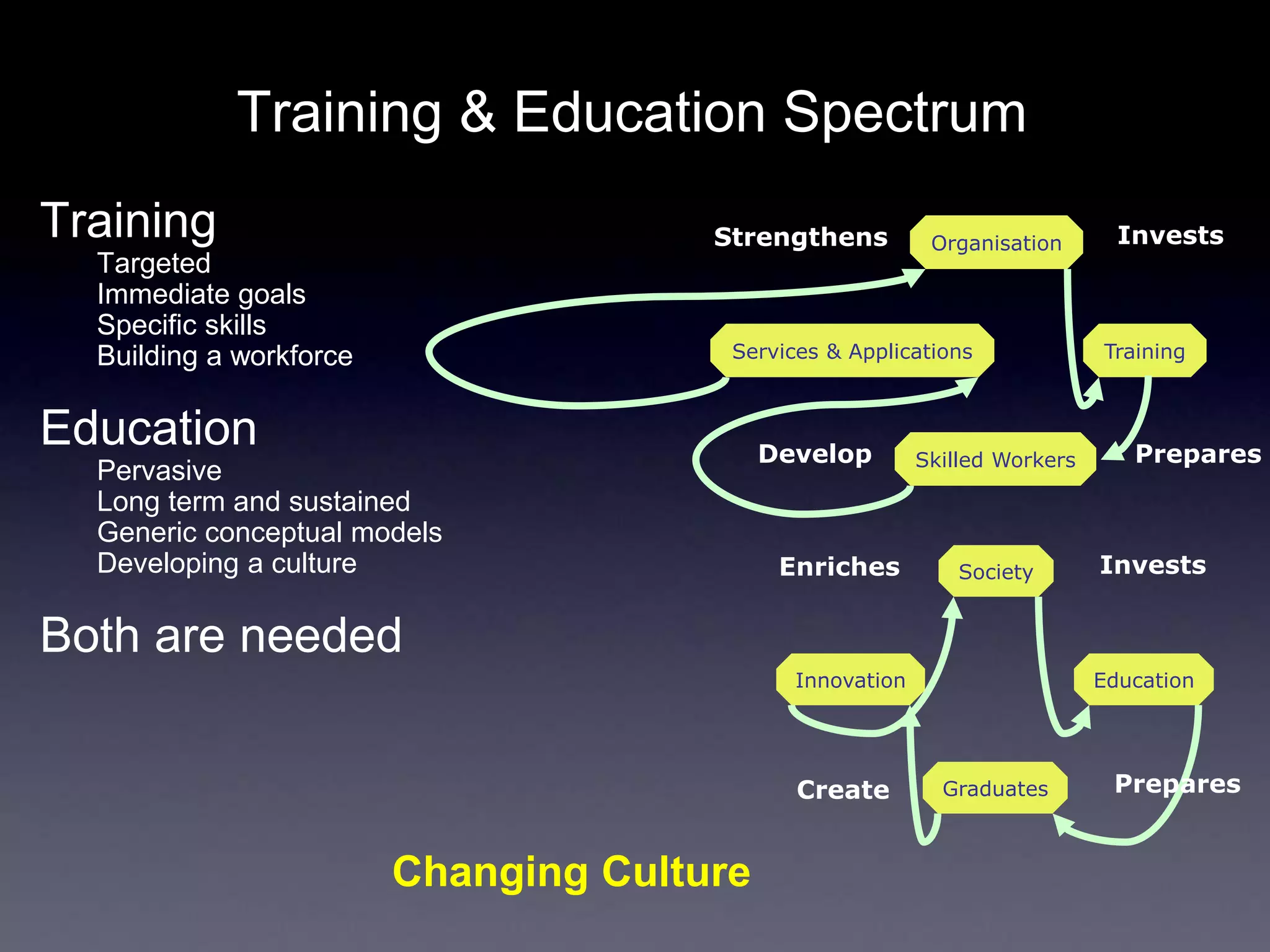
Training & Education Spectrum
Training
Targeted
Immediate goals
Specific skills
Building a workforce
Education
Pervasive
Long term and sustained
Generic conceptual models
Developing a culture
Both are needed
Society
Graduates
EducationInnovation
Invests
PreparesCreate
Enriches
Organisation
Skilled Workers
TrainingServices & Applications
Invests
PreparesDevelop
Strengthens
Changing Culture
EGEE to EGI
Building a sustainable international distributed
infrastructure
8
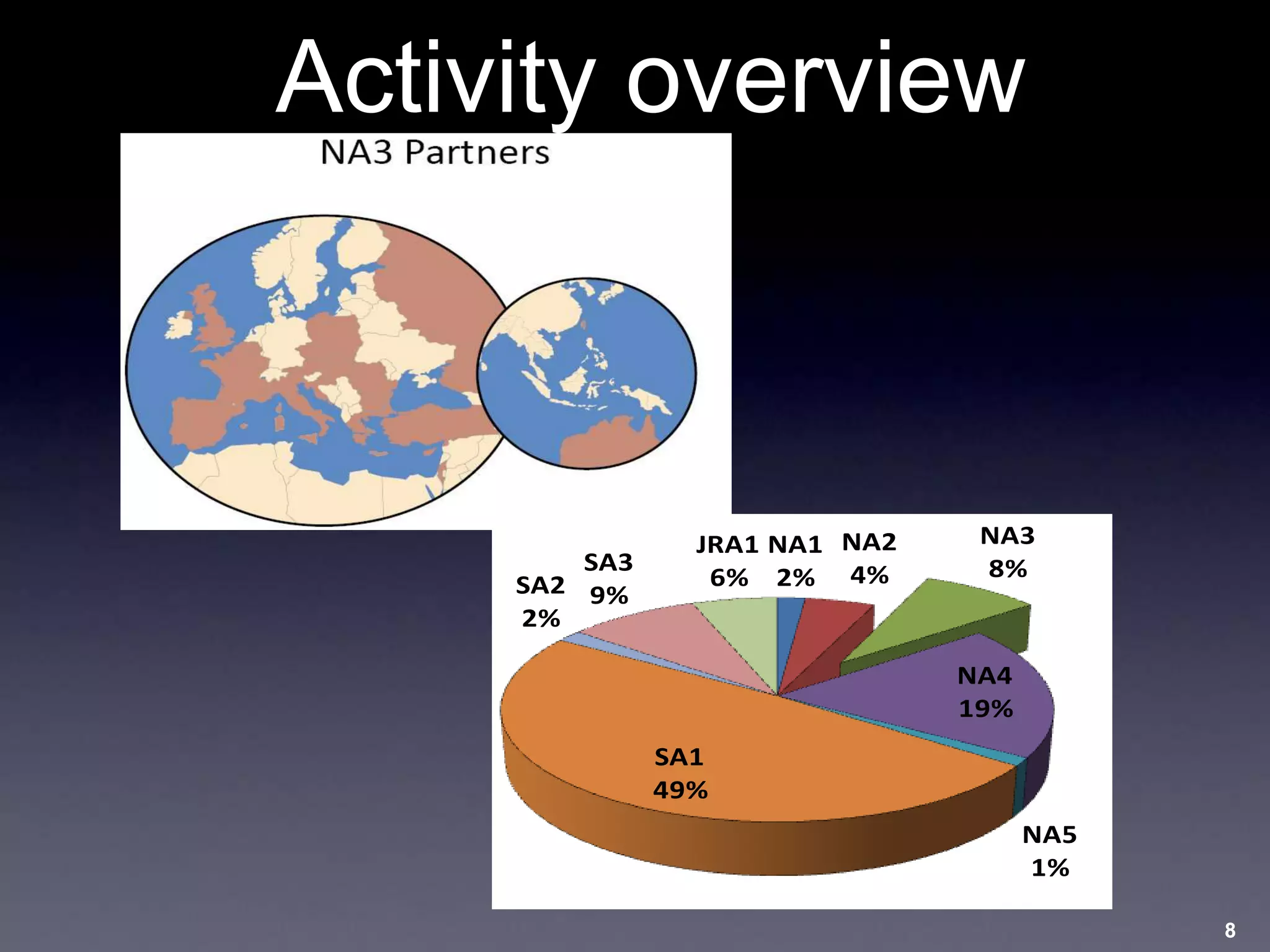
Activity overview
8
NA1
2%
NA2
4%
NA3
8%
NA4
19%
NA5
1%
SA1
49%
SA2
2%
SA3
9%
JRA1
6%
9
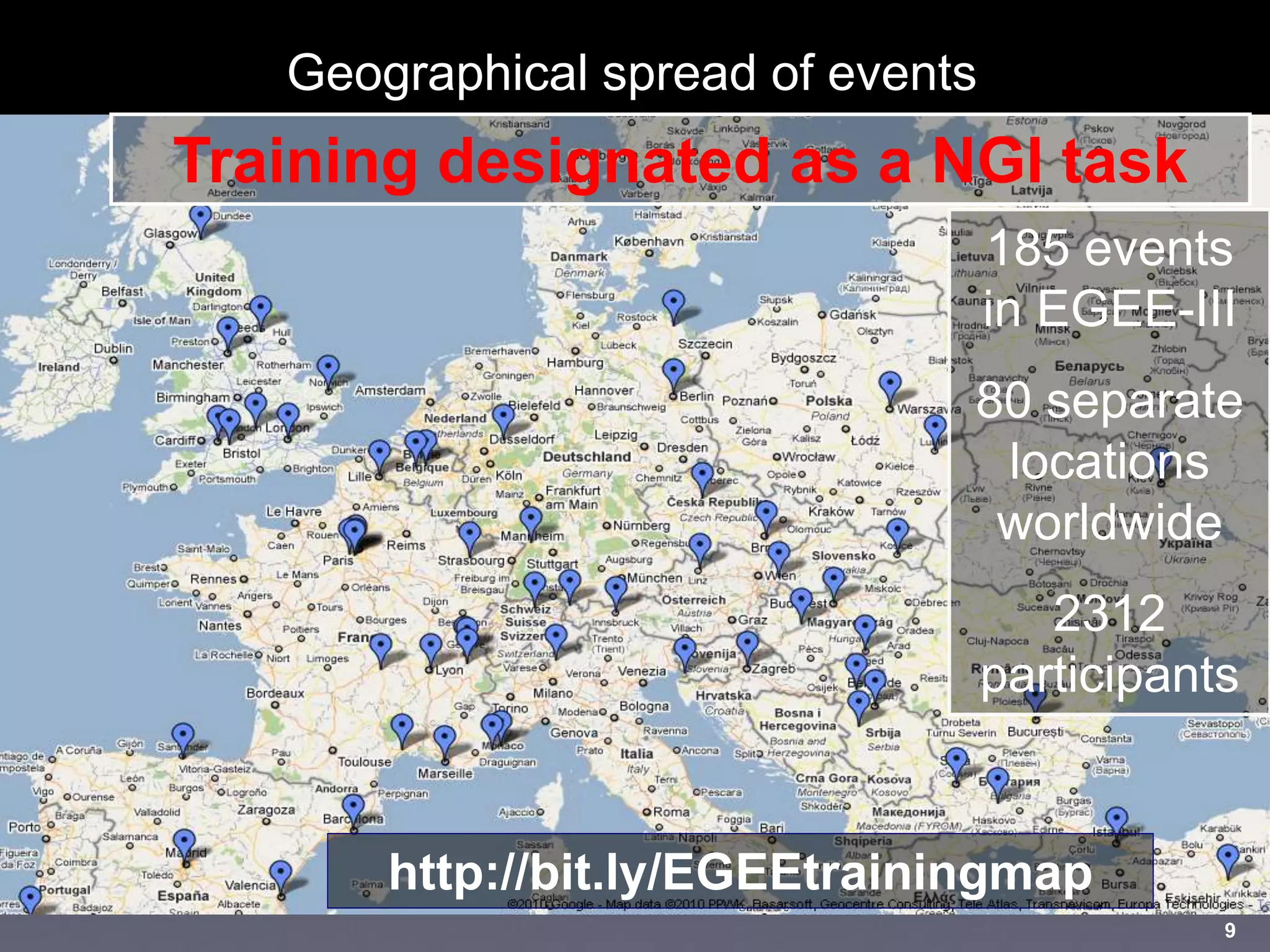
Geographical spread of events
http://bit.ly/EGEEtrainingmap
185 events
in EGEE-III
80 separate
locations
worldwide
2312
participants
Training designated as a NGI task
10
UPDATE Training event locations
2008 - 2010
11
UPDATE Training event data in EGEE-III
<- Event duration
Average course
length 2.5 days
0.0
1.0
2.0
3.0
4.0
5.0
6.0
EvaluationScore(outof6.0)
Date of Event
EGEE-III Year 1 - average evaluation score 5.1 (out of
6, n=65)
0
10
20
30
40
50
60
1 2 3 4 5 6 or more
No.ofEvents
Event Duration (Days)
Duration of training events (n=101)
12
Breakdown by event type
Advanced
3%
Application
developer
14%
Applications
6%
Induction
64%
System
Administrator
8%
Train the Trainer
3%
Workshop (retreat)
2%
13
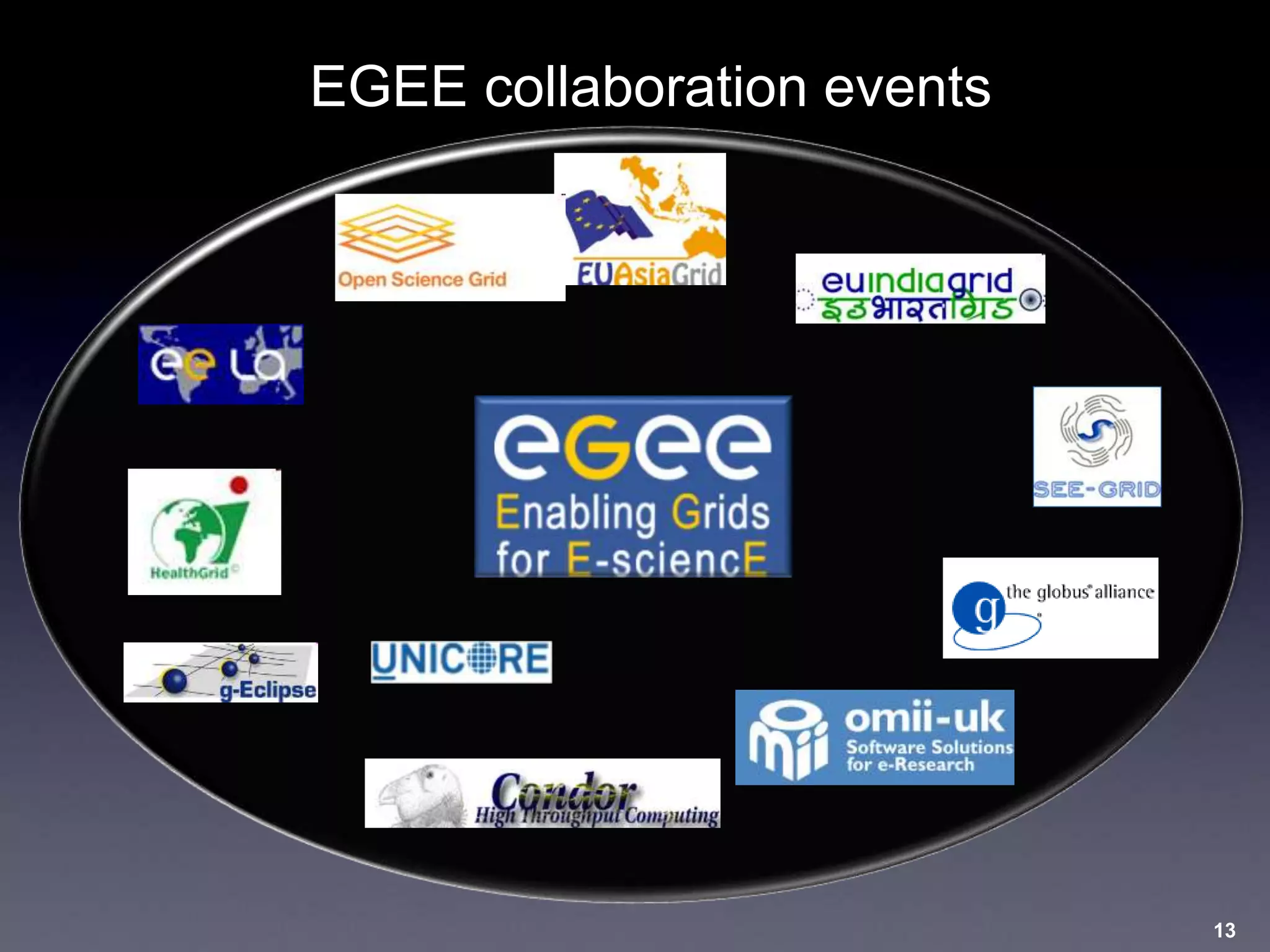
EGEE collaboration events
Services for sustainable training
GILDA VO became part of the production
infrastructure
No difference in infrastructure monitoring &
maintenance between production and t-
infrastructure
NGIs can contribute to training with production
resources
Accreditation of trainers
Training support services in EGI
Digital library
Training event database
Trainer registry
GILDA VO
14
Digital Library
Audio and video in Library
17
Digital library - updates
Improved Search &
Filter
New eLearning
modules
Rebran
ding
Digital Library
• Open to everyone for search, retrieval, linking
http://egee.lib.ed.ac.uk
• Also accessible via web services - by negotiation
• Based on Fedora open source repository and international
standards
• Contains now over 6900 learning resources! (>100 videos)
18
19
GILDA t-Infrastructure
Training Infrastructure for EGEE and other European projects,
providing resources for training events
GILDA is now one VO of the production infrastructure
13 site
~1100
cpu
20
Development of EGEE trainers
• Training the trainers
– Provide partner autonomy
– Experts ensure quality of message
• Trainer Accreditation
– Accreditation process:
 Peer approval
 Details of training experience
– Currently 104 trainers
Location of accredited trainers (Current; increase in Y2)
22
6
2
717
1
3
8
7
16
5
3
1
2
15
2
5
2
1
4
7
1
Taiwan – 8
Australia – 1
Japan - 1
5
3
+2
+3 +2
+5
+16
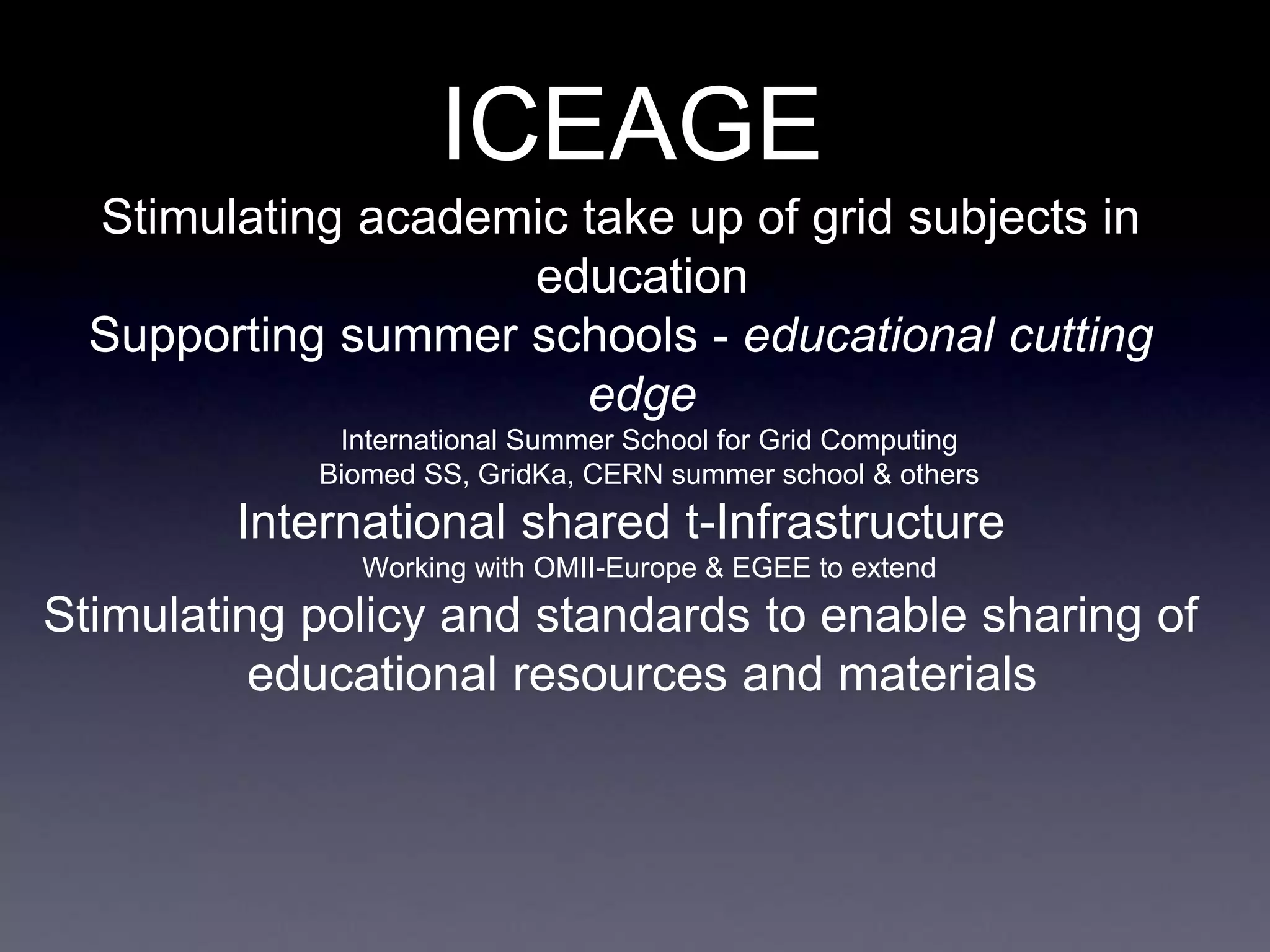
ICEAGE
Stimulating academic take up of grid subjects in
education
Supporting summer schools - educational cutting
edge
International Summer School for Grid Computing
Biomed SS, GridKa, CERN summer school & others
International shared t-Infrastructure
Working with OMII-Europe & EGEE to extend
Stimulating policy and standards to enable sharing of
educational resources and materials
ICEAGE Web site
(www.iceage-eu.org)
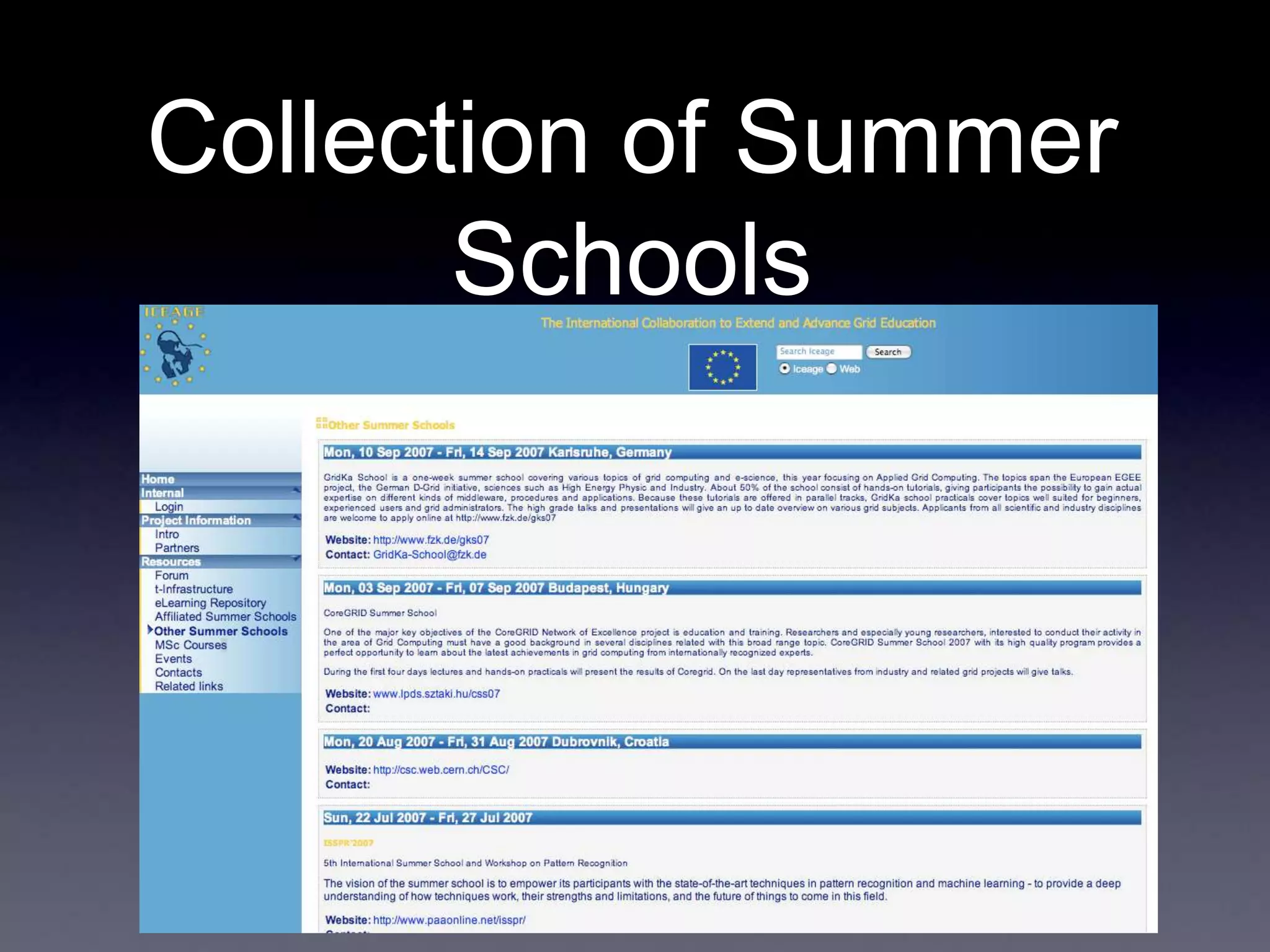
Collection of Masters courses
Collection of Summer
Schools
Policy activity - OGF
OGF E&T Workgroup
Wiki
International Summer School for Grid
Computing
Biomed Grid Summer School
ICEAGE FORUM
E-Infrastructures Reflection Group
e-uptake Project
Rob Procter, David Fergusson Lorna
Hughes, Alex Voss
Overview
WP1
WP2
Sustainability and integration with
other projects
Dissemination
Resourcing status
Extension request
WP1: Fieldwork Phase
I
Aim to develop understanding of academic use
of
e-Infrastructure.
Methodology: desk-based research;
questionnaire, and semi-structured interviews:
50 interviews: 8 respondents per RC (AHRC,
BBSRC, EPSRC, ESRC, MRC, NERC) plus STFC.
Respondents academic users of e-Infrastructure
services selected on basis of desk research and
questionnaire.
Conducted within Community Engagement
Framework of Understanding.
WP1: Fieldwork Phase
I
Respondents asked about their use of e-Infrastructure
services:
Services used and role in research lifecycle
How services facilitated research
How respondents found out about them
Whether training and other kinds of support were available and
made use of
Barriers encountered, if and how they were overcome
Enablers that would improve use of services
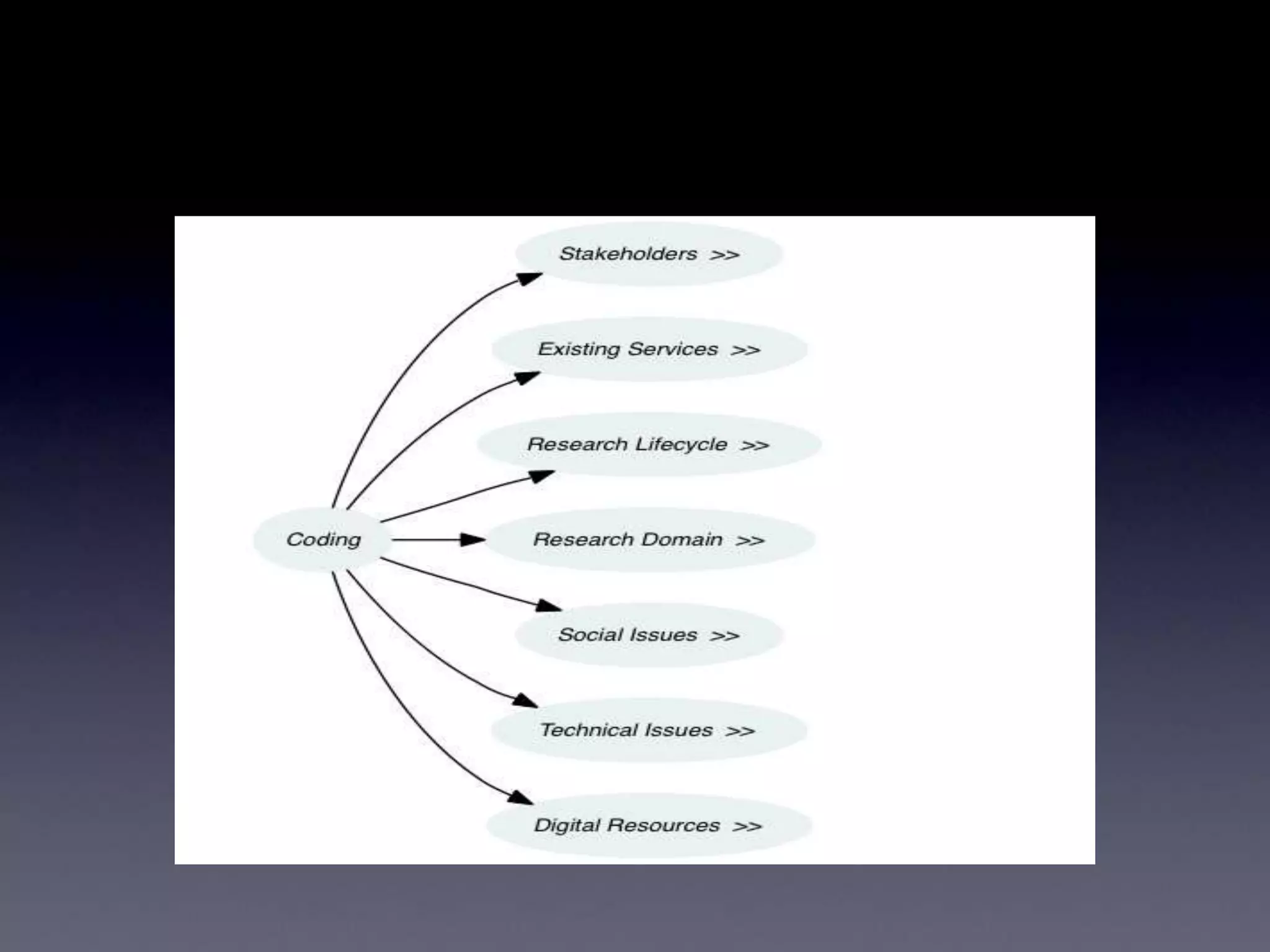
Transcripts systematically coded up using scheme
developed from typology.
WP1: Top Level
Typology
WP1: Data Analysis
Identify barriers, understand their causes and
implications.
Identify enablers, what they achieve and scope.
Evolve the typology.
Identify issues to feed into phase II fieldwork.
Identify candidate interventions for:
WP2
Service ‘intermediaries’, service providers, JISC programme
managers
Feeds into other deliverables:
Current state of adoption
Training recommendations
Other recommendations
Barrier: Lack of
Awareness
Description: There seems to be a lack of systematic introduction to the services
and the training available, which results in a lack of awareness as well as a a
lack of understanding of how services and methods can facilitate research
and what different options exist.
Examples:
[MR02], [EP02], [AH04]
“one barrier is not having heard of these things” [AH03]
Candidate responses:
Boundary spanning
Opportunities for learning about e-Research / e-Infrastructure
Systematic training of young researchers
Typology:
Social Issues / Training, Education and Outreach / Early Engagement & Outreach
Enabler: Boundary
Spanning
Description: Boundary spanning refers to the moving of people
from one discipline to another. It can help transfer ideas,
knowledge and skills across disciplinary boundaries.
Example: As one Arts and Humanities researcher put it: “before
I was at [my current institution], I was at an engineering
department at [other institution] and so I was kind of aware of
a lot of these things that we are talking about – Access Grid,
e-Science.” [AH01]
Barriers addressed:
Lack of awareness of services
Typology
Social Issues / Individual / Career Choices
Training, Education and Outreach
User Requirements
On-going collection of
information
Maintaining form of data set to
allow aggregations
Results
110 attendees completed surveys at the All
Hands Meeting, Oxford e-Research
Conference and EGEE 2008 in
September.
The top five training requirements from
existing categories are:
1. Introduction to e-Science (25)
2. Application development (15)
3. Monitoring (11)
4. Security (9)
5. Semantic grid (7)
UK vs International
Focus
Remain generally very similar.
Differences:
International - Application porting, Monitoring*,
Deployment*, Job Submission
UK - OGSA-DAI, UNICORE, Campus Grid, IPR,
Management issues, Cloud
2008 Training Survey Results:
New Categories
Seven new categories for training have been identified from 2008
Results:
1. Data management (10)
2. Access Grid (6)
3. Interoperation (3)
4. Project management in a distributed environment (3)
5. Campus grid (1)
6. IPR and grid/e-Science (1)
7. Cloud computing (1)
Of these new categories, DATA MANAGEMENT ranks in the top
five across old and new categories (4).
One Stop Shop
Atom/RSS/web services/podcast feeds available
Improving filtering based on:
Community projects’ requirements meeting (filtering
requirements)
Practical experiences with ENGAGE (eg. chunking)
Improved merging of materials and events data
Moving to Digital Library@NeSC as single data source
Improving support for the creation for community specific
clients
NGS will implement new versions of clients
Discussions agreed for OMII - data & presentation
Interventions I
Earlier Social Science/Arts & Humanities event
allowed investigation of new modes of delivery
but poor community engagement at that point
Lead to adjustment of plans using outputs of UK &
International workshops (eUptake and ICEAGE)
Interventions II
More focussed events
joint event with NGS for specific communities
Policy and stakeholder level events (outreach)-
eRoadshows
Greater profile/impact - NGS sponsored UK summer
school
ADSSS
Introductory “text book”
Research in a connected world pamphlet
eRoadshows
Introductory events
Delivered to communities in their
own locations
54
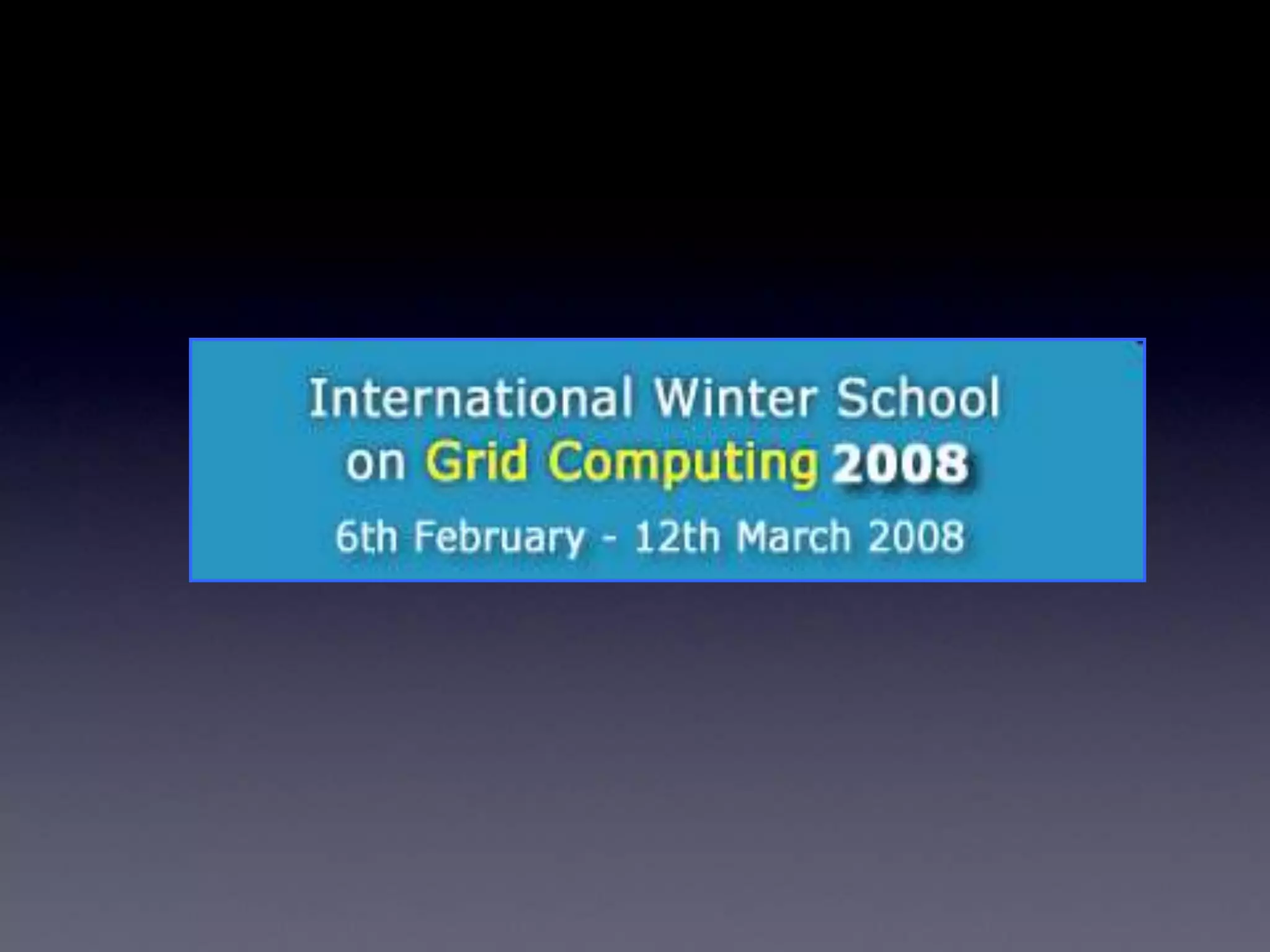
Model for learning - IWSGC eLearning
school
Resources
eLearning event with collaboration between gLite,
Globus, UNICORE, Condor
• 4 technology weeks
• ~17 hours per week
(student average)
• 35 Participants
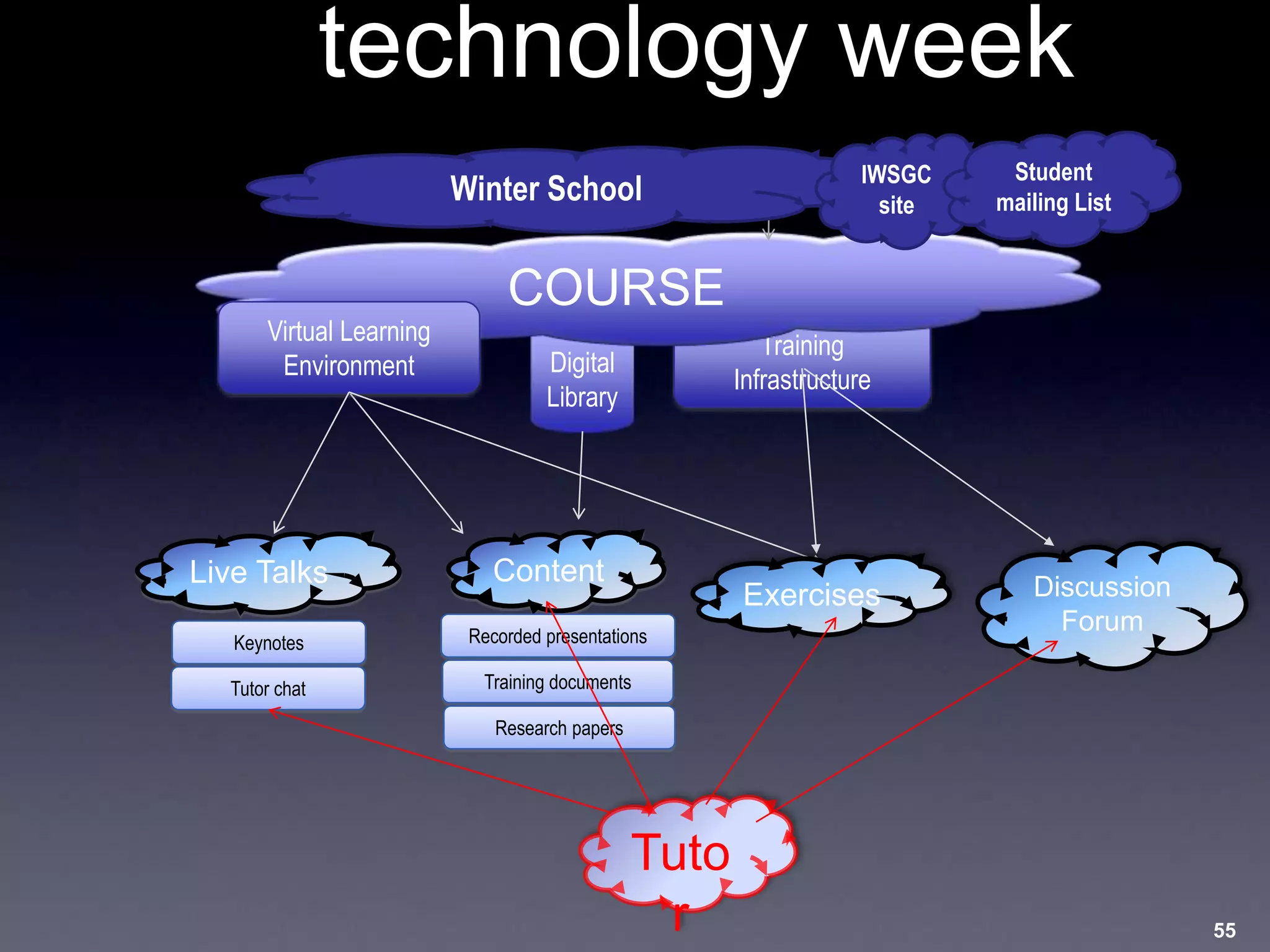
technology week
Training
Infrastructure
Digital
Library
Content
COURSE
Winter School IWSGC
site
Virtual Learning
Environment
Live Talks
Keynotes
Tutor chat
Exercises
Tuto
r 55
Recorded presentations
Training documents
Research papers
Student
mailing List
Discussion
Forum
Objective
To set up an e-Learning version of the
International Summer School in Grid
Computing
Repository Registry t-Infrastructure
Digital
Library
Content
People
Student
Tutor
Assessment
Owner
Marker
Student
COURSE
VLE
NA3 support services were necessary
to complete the winter school
Application
Application form
Admission process
Acceptance
Presentations
Registration
Assessment
Pre-requisite
exercises
Winter
School
IWSGC
site
People
registry
Create
new user
Update
Tutorials
Digital
Library
ISSGC
Student process for
Winter school
UNIX
Java
XML
Certificate
Application
Application form
Admission process
Acceptance
Registration
Assessment
Pre-requisite
exercises
Winter
School
IWSGC
site
People
registry
Create
new user
Update
Digital
Library
ISSGC
t-Infrastructure
(GILDA)
Presentations
exercises
Application
Application form
Admission process
Acceptance
Registration
Assessment
Pre-requisite
exercises
Winter
School
IWSGC
site
Create
new user
Update
Digital
Library
ISSGC
Tutors
Presentations
exercises
Coordinator
People
registry
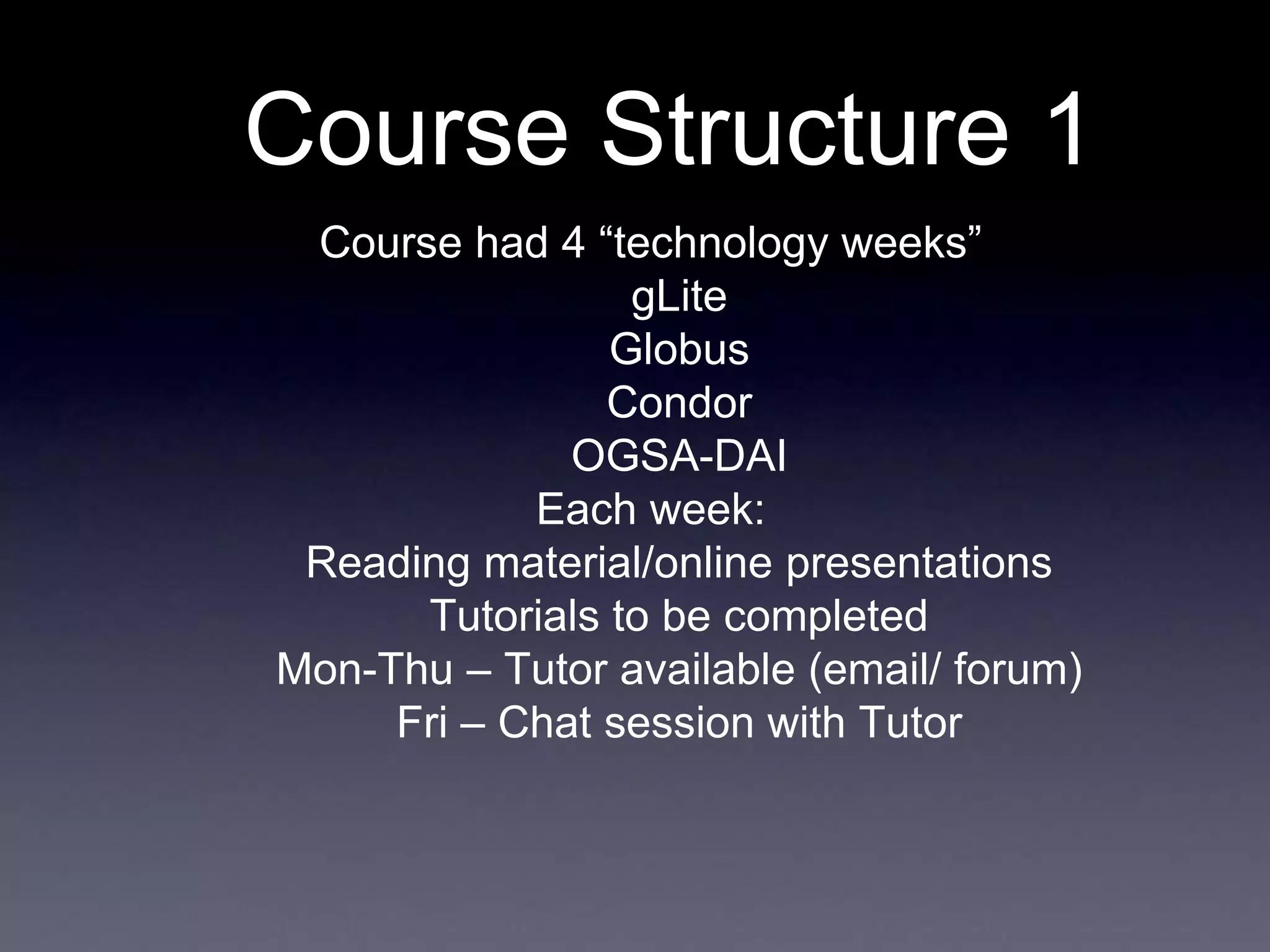
Course Structure 1
Course had 4 “technology weeks”
gLite
Globus
Condor
OGSA-DAI
Each week:
Reading material/online presentations
Tutorials to be completed
Mon-Thu – Tutor available (email/ forum)
Fri – Chat session with Tutor
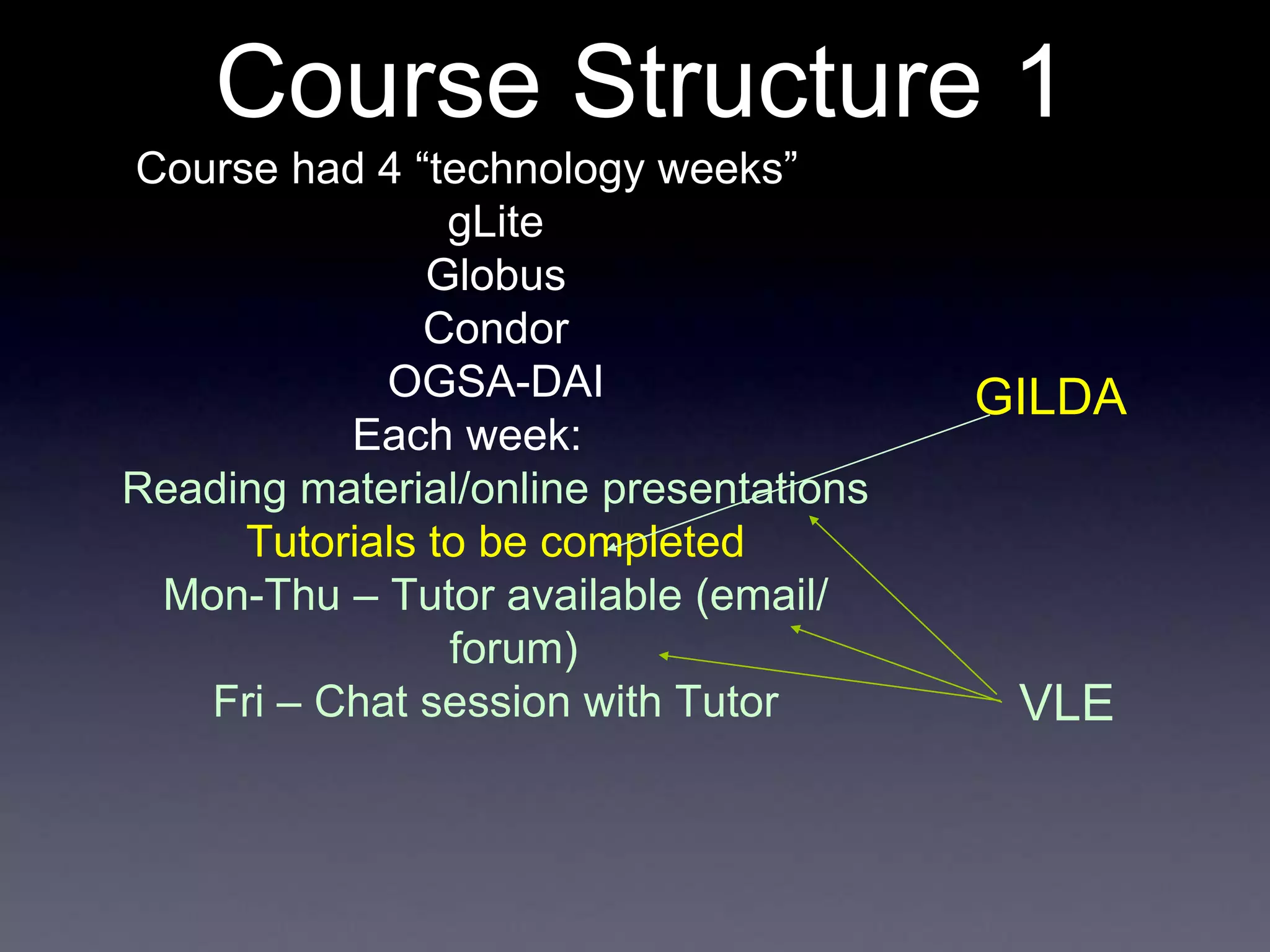
Course Structure 1
Course had 4 “technology weeks”
gLite
Globus
Condor
OGSA-DAI
Each week:
Reading material/online presentations
Tutorials to be completed
Mon-Thu – Tutor available (email/
forum)
Fri – Chat session with Tutor VLE
GILDA
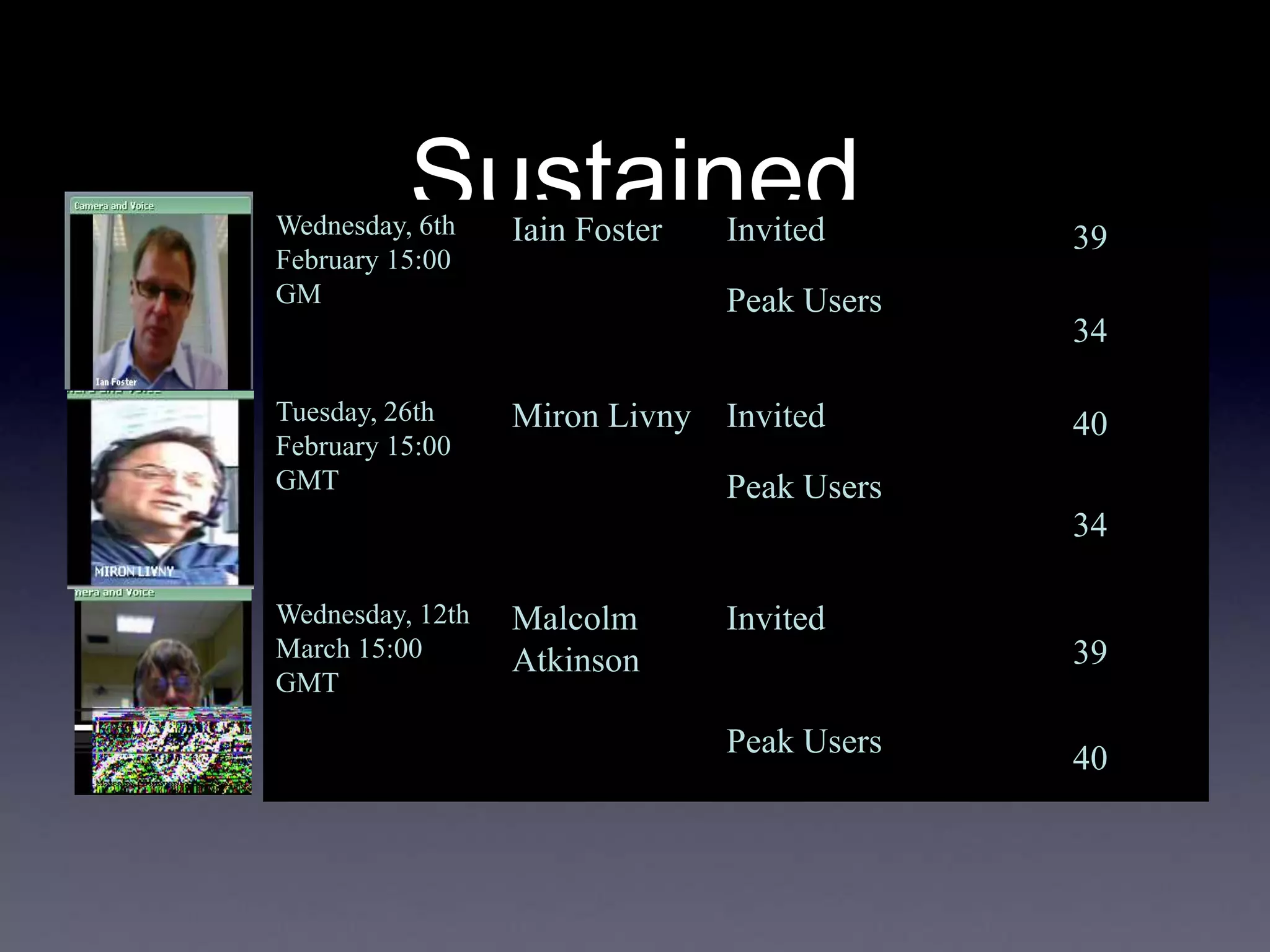
Keynotes
To provide high points for the school (idea taken
from ISSGC)
3 Keynote talks
Ian Foster
Miron Livny
Malcolm Atkinson
Live broadcasts
Provided opportunity for students to chat with some
of the prominent grid experts
Adobe Connect
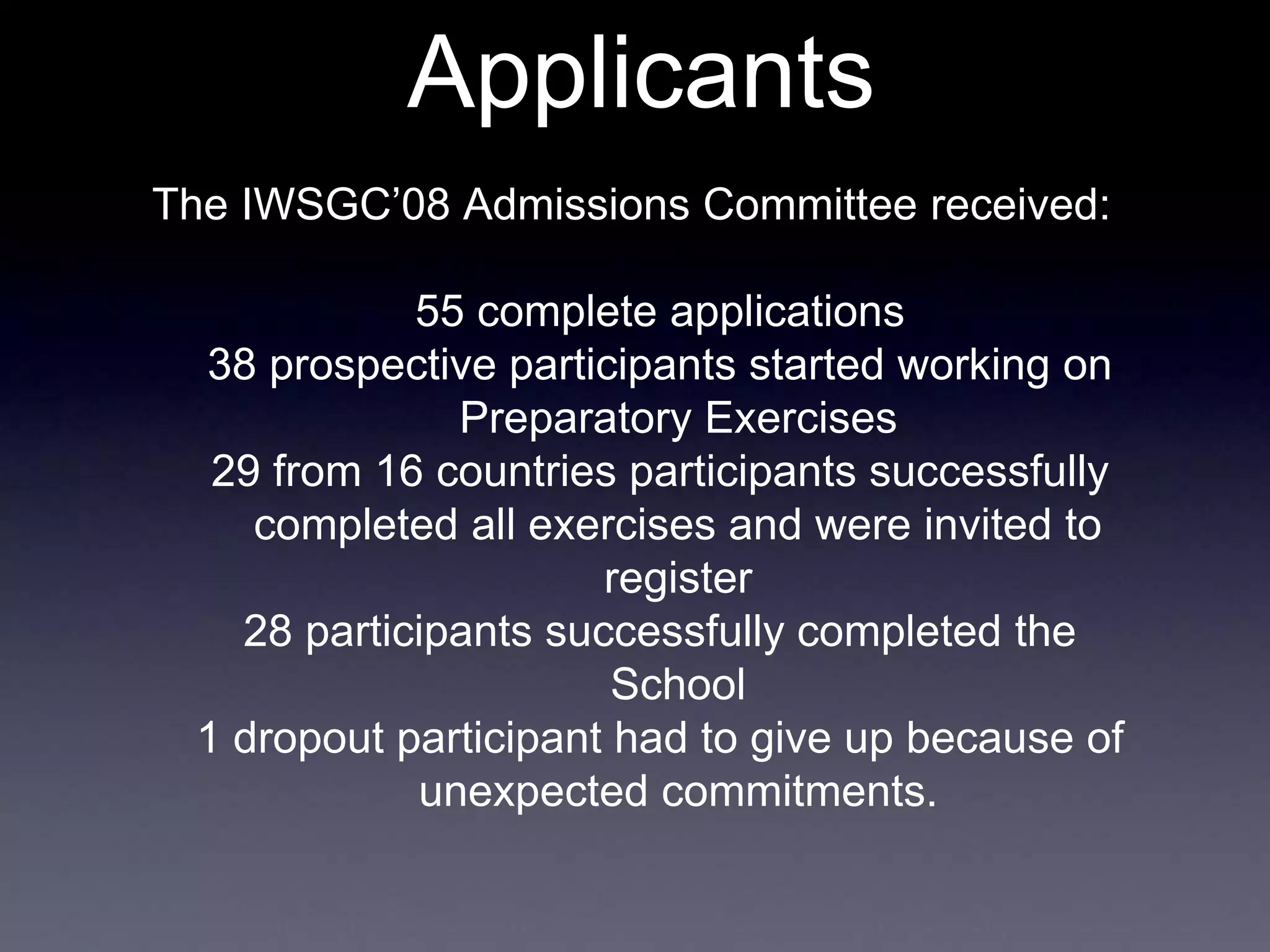
Applicants
The IWSGC’08 Admissions Committee received:
55 complete applications
38 prospective participants started working on
Preparatory Exercises
29 from 16 countries participants successfully
completed all exercises and were invited to
register
28 participants successfully completed the
School
1 dropout participant had to give up because of
unexpected commitments.
demographics
•38 applicants from
16 countries
Users
76%
App Developers
24%
Sustained
engagement in
IWSGC’08
Wednesday, 6th
February 15:00
GM
Iain Foster Invited 39
Peak Users
34
Tuesday, 26th
February 15:00
GMT
Miron Livny Invited 40
Peak Users
34
Wednesday, 12th
March 15:00
GMT
Malcolm
Atkinson
Invited
39
Peak Users 40
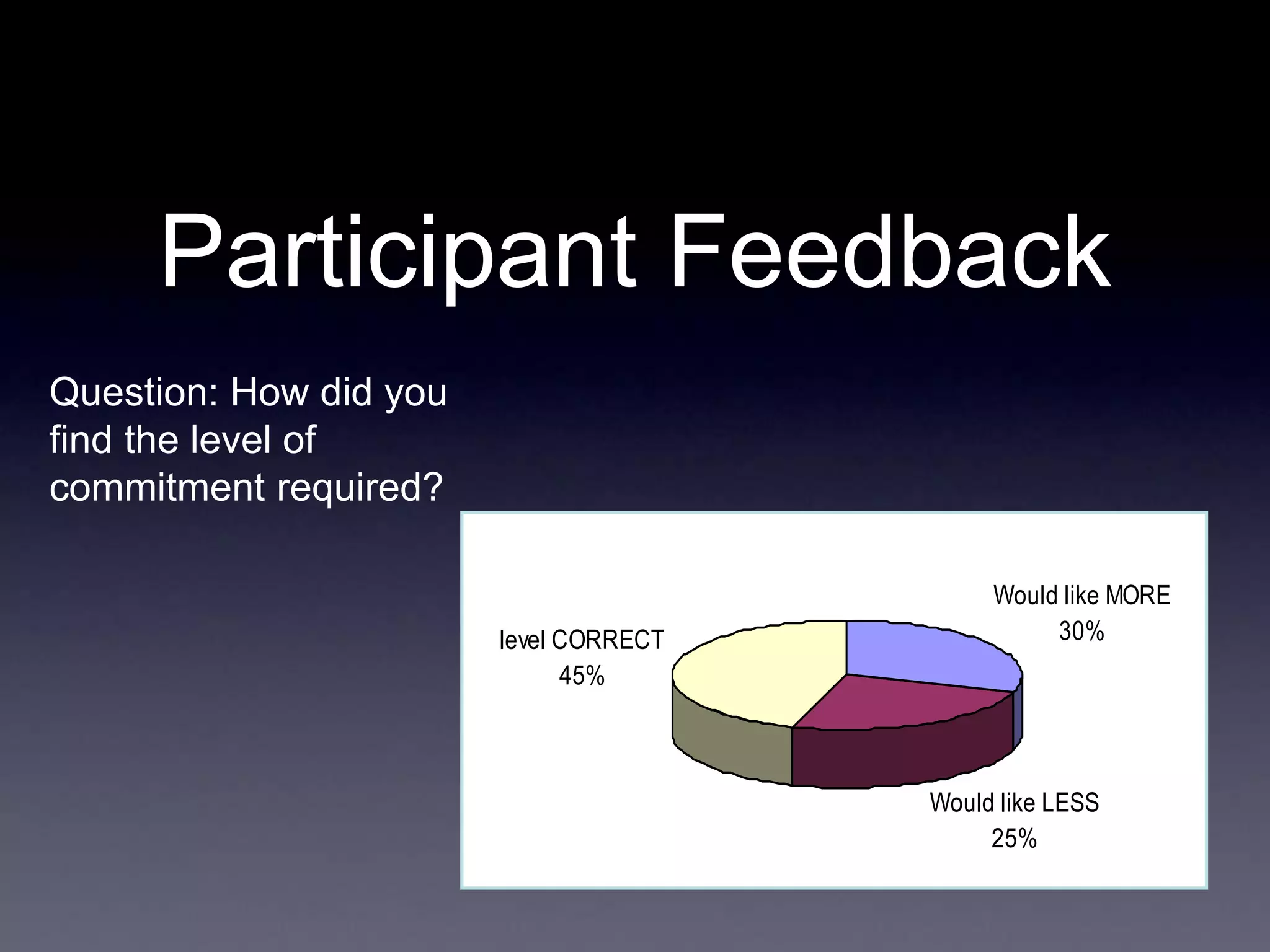
Participant Feedback
Would like MORE
30%
Would like LESS
25%
level CORRECT
45%
Question: How did you
find the level of
commitment required?
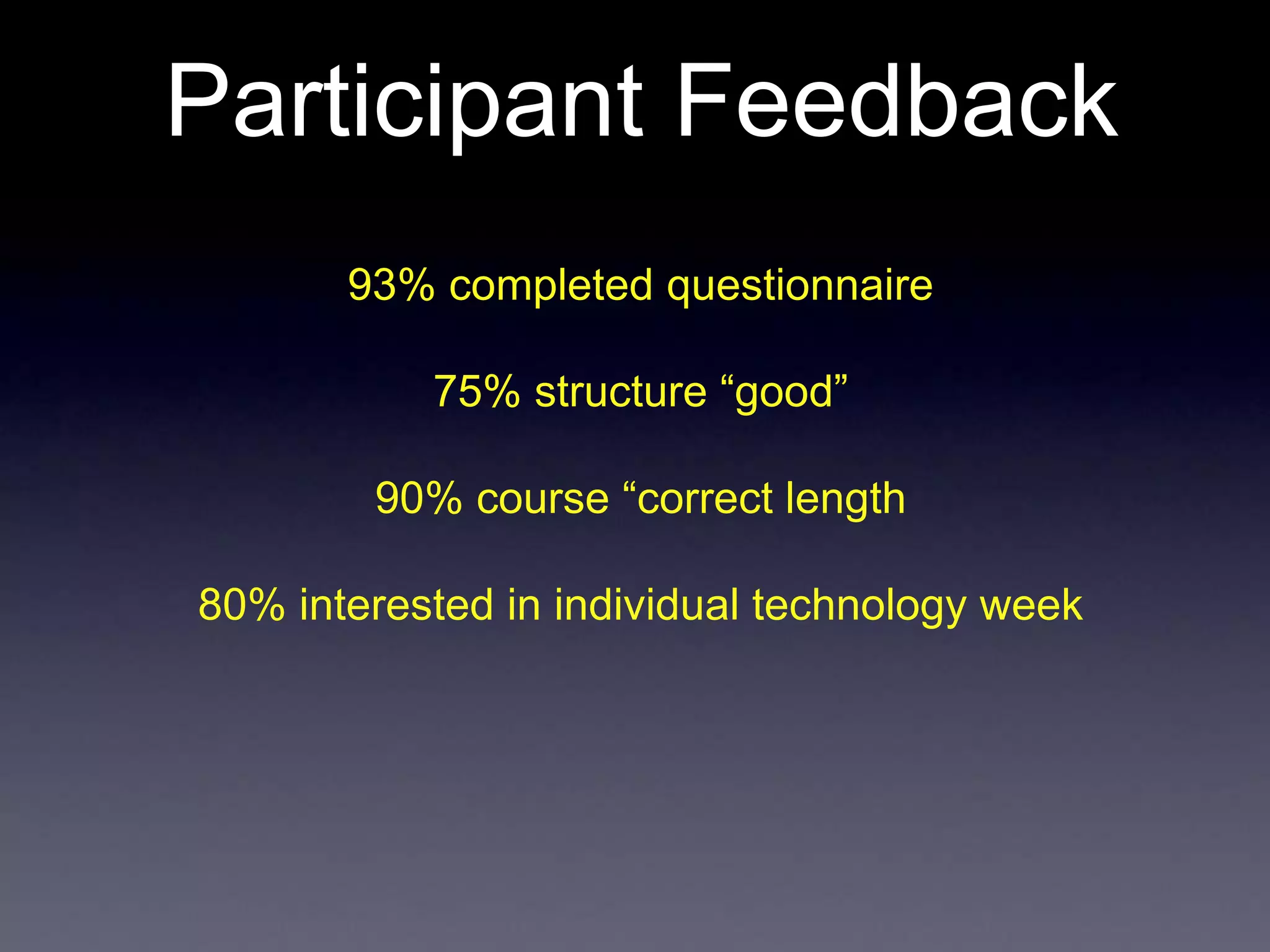
Participant Feedback
93% completed questionnaire
75% structure “good”
90% course “correct length
80% interested in individual technology week
Statistics
600 messages on forum
200 emails sent via VLE
Average student working time 20 hours per week
Average user sessions per day:43
Average user sessions per day on weekdays:54
Average user sessions per day on weekends:16
Summary
A month long “Winter School” in February 2008 & 2009.
Use of support components
Adobe Connect, WebCT, GILDA t-Infrastructure, Digital
Library, NeSC People Registry.
Integration of Training Support services in workflow with
existing tools
4 technologies presentations and practicals
gLite, Globus, Condor, OGSA-DAI
28 students from 16 countries, 9 tutors from 4 countries
3 live presentations by leaders in the field
with chat sessions
High levels of satisfaction from students and presenters
Head in the clouds?
Dynamic (service) provisioning
How is it applicable to the NGS/Edinburgh?
Training
Rapidly deploy services for teaching
Isolate training from production
Other
Specialised research environments
Rapid deployment
Identify use cases and gather requirements
NGS 3 EWP2
“NGS Agile Deployment Environments”
EPSRC funded, 2 years
People
Matteo Turilli (OeRC, Oxford) [0.75 FTE]
Steve Thorn (NeSC, Edinburgh) [0.5 FTE]
David Fergussion (NeSC, Edinburgh) [WP Leader]
Overview (cont.)Realistic usage
Training event on virtualized infrastructure
Hosting infrastructure?
Amazon EC2 compatible
De facto standard currently, with open source
implementation
Ease of deployment
Eucalyptus, Nimbus and others
Hardware
Edinburgh: 8 cores 16+ dual cores
Oxford: 64 cores (older)
Eucalyptus
“Elastic Utility Computing Architecture Linking Your
Programs To Useful Systems”
Open source and Commercial
Amazon Web Services API compatible
EC2, storage - S3, Elastic Block Store (EBS)
Easy to install
Xen and KVM hypervisors
Commercial version supports others (inc. VMWare)
Eucalyptus architecture
Cloud controller
Entry point
Gathers information
Cluster controller
Schedules VM execution
Manages virtual network
Node controller
Controls VM execution
(Xen running on node)
 Storage controller (Walrus)
implements Amazon’s S3 interface
Prototype service
Eucalyptus 1.6.2 (current 2.0)
Migration in next few months
Call for users for prototype
> 20 groups expressed interest
> 25 registered users on system
Increasing constantly
May be reaching the limits of current support
Research domains
Social science
Population simulations (York, St Andrews)
Cloud interface development
Advanced teaching
Edinburgh (MSc)
Canfield (MSc)
Bioscience
Next gen sequencing, micro array
Taxonomic analysis
Geospatial analysis
Civil Engineering (flood risk management)
MyGrid on the cloud

Tien3

  • 1.
    From Training toTechnology Transfer: experiences from an EU perspective in the Asia and Pacific region and opportunities/challenges presented by Cloud Computing David Fergusson
  • 2.
    The problem We canbuild technologies and infrastructures. However without USERS this means nothing. Only when these tools are used (in this case to create new science) do they have any meaning. To do this we have to go out to the communities, they will not come to us.
  • 3.
    NeSC Training, Outreachand Education Founded in 2004 based on national and EU grants (EGEE). Grown from 2 staff to 13 in 3 years. Courses in UK, in Europe, elsewhere China, Korea, Japan, Australia, Africa, South America
  • 4.
    TOE projects EGEE, EGEEII EGEE III European Grid Institute Design Study EGI-Inspire UK National Grid Service OMII-Europe NextGrid ICEAGE University of Edinburgh, eLearning & MSc JISC eLearning JISC eUptake
  • 5.
    TOE services Based arounddigital library to curate material Different project views: EGEE, ICEAGE, OMII-EU, NGS RSS feeds Multimedia (video/audio/presentations) Community editable metadata eLearning services Online assessment ePortfolios T-Infrastructure integration http://egee.lib.ed.ac.uk/ http://baillie.lib.ed.ac.uk:8080/
  • 6.
    Training & EducationSpectrum Training Targeted Immediate goals Specific skills Building a workforce Education Pervasive Long term and sustained Generic conceptual models Developing a culture Both are needed Society Graduates EducationInnovation Invests PreparesCreate Enriches Organisation Skilled Workers TrainingServices & Applications Invests PreparesDevelop Strengthens Changing Culture
  • 7.
    EGEE to EGI Buildinga sustainable international distributed infrastructure
  • 8.
  • 9.
    9 Geographical spread ofevents http://bit.ly/EGEEtrainingmap 185 events in EGEE-III 80 separate locations worldwide 2312 participants Training designated as a NGI task
  • 10.
    10 UPDATE Training eventlocations 2008 - 2010
  • 11.
    11 UPDATE Training eventdata in EGEE-III <- Event duration Average course length 2.5 days 0.0 1.0 2.0 3.0 4.0 5.0 6.0 EvaluationScore(outof6.0) Date of Event EGEE-III Year 1 - average evaluation score 5.1 (out of 6, n=65) 0 10 20 30 40 50 60 1 2 3 4 5 6 or more No.ofEvents Event Duration (Days) Duration of training events (n=101)
  • 12.
    12 Breakdown by eventtype Advanced 3% Application developer 14% Applications 6% Induction 64% System Administrator 8% Train the Trainer 3% Workshop (retreat) 2%
  • 13.
  • 14.
    Services for sustainabletraining GILDA VO became part of the production infrastructure No difference in infrastructure monitoring & maintenance between production and t- infrastructure NGIs can contribute to training with production resources Accreditation of trainers Training support services in EGI Digital library Training event database Trainer registry GILDA VO 14
  • 15.
  • 16.
    Audio and videoin Library
  • 17.
    17 Digital library -updates Improved Search & Filter New eLearning modules Rebran ding
  • 18.
    Digital Library • Opento everyone for search, retrieval, linking http://egee.lib.ed.ac.uk • Also accessible via web services - by negotiation • Based on Fedora open source repository and international standards • Contains now over 6900 learning resources! (>100 videos) 18
  • 19.
    19 GILDA t-Infrastructure Training Infrastructurefor EGEE and other European projects, providing resources for training events GILDA is now one VO of the production infrastructure 13 site ~1100 cpu
  • 20.
    20 Development of EGEEtrainers • Training the trainers – Provide partner autonomy – Experts ensure quality of message • Trainer Accreditation – Accreditation process:  Peer approval  Details of training experience – Currently 104 trainers
  • 21.
    Location of accreditedtrainers (Current; increase in Y2) 22 6 2 717 1 3 8 7 16 5 3 1 2 15 2 5 2 1 4 7 1 Taiwan – 8 Australia – 1 Japan - 1 5 3 +2 +3 +2 +5 +16
  • 22.
    ICEAGE Stimulating academic takeup of grid subjects in education Supporting summer schools - educational cutting edge International Summer School for Grid Computing Biomed SS, GridKa, CERN summer school & others International shared t-Infrastructure Working with OMII-Europe & EGEE to extend Stimulating policy and standards to enable sharing of educational resources and materials
  • 23.
  • 24.
  • 25.
  • 26.
  • 27.
  • 28.
    International Summer Schoolfor Grid Computing
  • 29.
  • 30.
  • 31.
  • 32.
    e-uptake Project Rob Procter,David Fergusson Lorna Hughes, Alex Voss
  • 33.
    Overview WP1 WP2 Sustainability and integrationwith other projects Dissemination Resourcing status Extension request
  • 34.
    WP1: Fieldwork Phase I Aimto develop understanding of academic use of e-Infrastructure. Methodology: desk-based research; questionnaire, and semi-structured interviews: 50 interviews: 8 respondents per RC (AHRC, BBSRC, EPSRC, ESRC, MRC, NERC) plus STFC. Respondents academic users of e-Infrastructure services selected on basis of desk research and questionnaire. Conducted within Community Engagement Framework of Understanding.
  • 35.
    WP1: Fieldwork Phase I Respondentsasked about their use of e-Infrastructure services: Services used and role in research lifecycle How services facilitated research How respondents found out about them Whether training and other kinds of support were available and made use of Barriers encountered, if and how they were overcome Enablers that would improve use of services Transcripts systematically coded up using scheme developed from typology.
  • 36.
  • 37.
    WP1: Data Analysis Identifybarriers, understand their causes and implications. Identify enablers, what they achieve and scope. Evolve the typology. Identify issues to feed into phase II fieldwork. Identify candidate interventions for: WP2 Service ‘intermediaries’, service providers, JISC programme managers Feeds into other deliverables: Current state of adoption Training recommendations Other recommendations
  • 38.
    Barrier: Lack of Awareness Description:There seems to be a lack of systematic introduction to the services and the training available, which results in a lack of awareness as well as a a lack of understanding of how services and methods can facilitate research and what different options exist. Examples: [MR02], [EP02], [AH04] “one barrier is not having heard of these things” [AH03] Candidate responses: Boundary spanning Opportunities for learning about e-Research / e-Infrastructure Systematic training of young researchers Typology: Social Issues / Training, Education and Outreach / Early Engagement & Outreach
  • 39.
    Enabler: Boundary Spanning Description: Boundaryspanning refers to the moving of people from one discipline to another. It can help transfer ideas, knowledge and skills across disciplinary boundaries. Example: As one Arts and Humanities researcher put it: “before I was at [my current institution], I was at an engineering department at [other institution] and so I was kind of aware of a lot of these things that we are talking about – Access Grid, e-Science.” [AH01] Barriers addressed: Lack of awareness of services Typology Social Issues / Individual / Career Choices Training, Education and Outreach
  • 40.
    User Requirements On-going collectionof information Maintaining form of data set to allow aggregations
  • 41.
    Results 110 attendees completedsurveys at the All Hands Meeting, Oxford e-Research Conference and EGEE 2008 in September. The top five training requirements from existing categories are: 1. Introduction to e-Science (25) 2. Application development (15) 3. Monitoring (11) 4. Security (9) 5. Semantic grid (7)
  • 42.
    UK vs International Focus Remaingenerally very similar. Differences: International - Application porting, Monitoring*, Deployment*, Job Submission UK - OGSA-DAI, UNICORE, Campus Grid, IPR, Management issues, Cloud
  • 43.
    2008 Training SurveyResults: New Categories Seven new categories for training have been identified from 2008 Results: 1. Data management (10) 2. Access Grid (6) 3. Interoperation (3) 4. Project management in a distributed environment (3) 5. Campus grid (1) 6. IPR and grid/e-Science (1) 7. Cloud computing (1) Of these new categories, DATA MANAGEMENT ranks in the top five across old and new categories (4).
  • 44.
    One Stop Shop Atom/RSS/webservices/podcast feeds available Improving filtering based on: Community projects’ requirements meeting (filtering requirements) Practical experiences with ENGAGE (eg. chunking) Improved merging of materials and events data Moving to Digital Library@NeSC as single data source Improving support for the creation for community specific clients NGS will implement new versions of clients Discussions agreed for OMII - data & presentation
  • 45.
    Interventions I Earlier SocialScience/Arts & Humanities event allowed investigation of new modes of delivery but poor community engagement at that point Lead to adjustment of plans using outputs of UK & International workshops (eUptake and ICEAGE)
  • 46.
    Interventions II More focussedevents joint event with NGS for specific communities Policy and stakeholder level events (outreach)- eRoadshows Greater profile/impact - NGS sponsored UK summer school ADSSS Introductory “text book” Research in a connected world pamphlet
  • 47.
    eRoadshows Introductory events Delivered tocommunities in their own locations
  • 50.
    54 Model for learning- IWSGC eLearning school Resources eLearning event with collaboration between gLite, Globus, UNICORE, Condor • 4 technology weeks • ~17 hours per week (student average) • 35 Participants
  • 51.
    technology week Training Infrastructure Digital Library Content COURSE Winter SchoolIWSGC site Virtual Learning Environment Live Talks Keynotes Tutor chat Exercises Tuto r 55 Recorded presentations Training documents Research papers Student mailing List Discussion Forum
  • 52.
    Objective To set upan e-Learning version of the International Summer School in Grid Computing
  • 53.
  • 54.
  • 55.
  • 56.
  • 57.
    Course Structure 1 Coursehad 4 “technology weeks” gLite Globus Condor OGSA-DAI Each week: Reading material/online presentations Tutorials to be completed Mon-Thu – Tutor available (email/ forum) Fri – Chat session with Tutor
  • 58.
    Course Structure 1 Coursehad 4 “technology weeks” gLite Globus Condor OGSA-DAI Each week: Reading material/online presentations Tutorials to be completed Mon-Thu – Tutor available (email/ forum) Fri – Chat session with Tutor VLE GILDA
  • 59.
    Keynotes To provide highpoints for the school (idea taken from ISSGC) 3 Keynote talks Ian Foster Miron Livny Malcolm Atkinson Live broadcasts Provided opportunity for students to chat with some of the prominent grid experts Adobe Connect
  • 62.
    Applicants The IWSGC’08 AdmissionsCommittee received: 55 complete applications 38 prospective participants started working on Preparatory Exercises 29 from 16 countries participants successfully completed all exercises and were invited to register 28 participants successfully completed the School 1 dropout participant had to give up because of unexpected commitments.
  • 63.
    demographics •38 applicants from 16countries Users 76% App Developers 24%
  • 64.
    Sustained engagement in IWSGC’08 Wednesday, 6th February15:00 GM Iain Foster Invited 39 Peak Users 34 Tuesday, 26th February 15:00 GMT Miron Livny Invited 40 Peak Users 34 Wednesday, 12th March 15:00 GMT Malcolm Atkinson Invited 39 Peak Users 40
  • 65.
    Participant Feedback Would likeMORE 30% Would like LESS 25% level CORRECT 45% Question: How did you find the level of commitment required?
  • 66.
    Participant Feedback 93% completedquestionnaire 75% structure “good” 90% course “correct length 80% interested in individual technology week
  • 67.
    Statistics 600 messages onforum 200 emails sent via VLE Average student working time 20 hours per week Average user sessions per day:43 Average user sessions per day on weekdays:54 Average user sessions per day on weekends:16
  • 68.
    Summary A month long“Winter School” in February 2008 & 2009. Use of support components Adobe Connect, WebCT, GILDA t-Infrastructure, Digital Library, NeSC People Registry. Integration of Training Support services in workflow with existing tools 4 technologies presentations and practicals gLite, Globus, Condor, OGSA-DAI 28 students from 16 countries, 9 tutors from 4 countries 3 live presentations by leaders in the field with chat sessions High levels of satisfaction from students and presenters
  • 69.
    Head in theclouds? Dynamic (service) provisioning How is it applicable to the NGS/Edinburgh? Training Rapidly deploy services for teaching Isolate training from production Other Specialised research environments Rapid deployment Identify use cases and gather requirements
  • 70.
    NGS 3 EWP2 “NGSAgile Deployment Environments” EPSRC funded, 2 years People Matteo Turilli (OeRC, Oxford) [0.75 FTE] Steve Thorn (NeSC, Edinburgh) [0.5 FTE] David Fergussion (NeSC, Edinburgh) [WP Leader]
  • 71.
    Overview (cont.)Realistic usage Trainingevent on virtualized infrastructure Hosting infrastructure? Amazon EC2 compatible De facto standard currently, with open source implementation Ease of deployment Eucalyptus, Nimbus and others Hardware Edinburgh: 8 cores 16+ dual cores Oxford: 64 cores (older)
  • 72.
    Eucalyptus “Elastic Utility ComputingArchitecture Linking Your Programs To Useful Systems” Open source and Commercial Amazon Web Services API compatible EC2, storage - S3, Elastic Block Store (EBS) Easy to install Xen and KVM hypervisors Commercial version supports others (inc. VMWare)
  • 73.
    Eucalyptus architecture Cloud controller Entrypoint Gathers information Cluster controller Schedules VM execution Manages virtual network Node controller Controls VM execution (Xen running on node)  Storage controller (Walrus) implements Amazon’s S3 interface
  • 74.
    Prototype service Eucalyptus 1.6.2(current 2.0) Migration in next few months Call for users for prototype > 20 groups expressed interest > 25 registered users on system Increasing constantly May be reaching the limits of current support
  • 75.
    Research domains Social science Populationsimulations (York, St Andrews) Cloud interface development Advanced teaching Edinburgh (MSc) Canfield (MSc) Bioscience Next gen sequencing, micro array Taxonomic analysis Geospatial analysis Civil Engineering (flood risk management) MyGrid on the cloud

Editor's Notes

  • #9 29 Active partners (vs. 32 in EGEE) ~ 29 FTEs (average 1 per partner)
  • #10 29 partners spread throughout Europe Widespread geographical coverage
  • #12 Number of
  • #13 To give a flavour of the type of events NA3 provide this chjart provides a breakdown of the event types. Predominantly User induction sessions, But also app developer, training events designed specifically for applications, and also training the trainer events which we have been providing more recently.
  • #18 Mention NA2 images and ISSEG material
  • #19 Historically used throughout EGEE project for storing training content created
  • #20 Better picture from Roerto
  • #54 ICEAGE project final review 8/5/08
  • #55 Training team looking at new eLearning methods of providing training aimed at scalability Organised the winter school series, in collaboration with other technology groups
  • #56 8/5/08 ICEAGE project final review
  • #68 38 successful applicants from 16 countries
  • #71 Add feedback, and more info about elearning for future