Imported Water Committee
August 22, 2013
 What’s new?
 Review approach
 What is BDCP?
 Issues the Water Authority’s evaluation will focus
on to provide comment letter through
environmental review process
 Preliminary analysis
 Next step
2
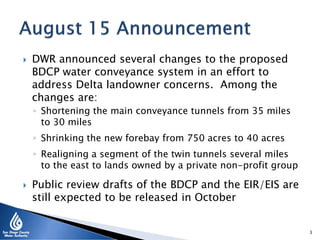
 DWR announced several changes to the proposed
BDCP water conveyance system in an effort to
address Delta landowner concerns. Among the
changes are:
◦ Shortening the main conveyance tunnels from 35 miles
to 30 miles
◦ Shrinking the new forebay from 750 acres to 40 acres
◦ Realigning a segment of the twin tunnels several miles
to the east to lands owned by a private non-profit group
 Public review drafts of the BDCP and the EIR/EIS are
still expected to be released in October
3
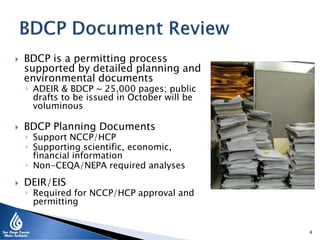
 BDCP is a permitting process
supported by detailed planning and
environmental documents
◦ ADEIR & BDCP ~ 25,000 pages; public
drafts to be issued in October will be
voluminous
 BDCP Planning Documents
◦ Support NCCP/HCP
◦ Supporting scientific, economic,
financial information
◦ Non-CEQA/NEPA required analyses
 DEIR/EIS
◦ Required for NCCP/HCP approval and
permitting
4
5
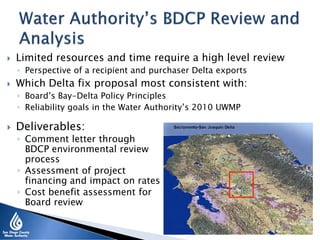
 Limited resources and time require a high level review
◦ Perspective of a recipient and purchaser Delta exports
 Which Delta fix proposal most consistent with:
◦ Board’s Bay-Delta Policy Principles
◦ Reliability goals in the Water Authority’s 2010 UWMP
 Deliverables:
◦ Comment letter through
BDCP environmental review
process
◦ Assessment of project
financing and impact on rates
◦ Cost benefit assessment for
Board review
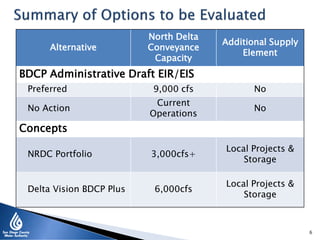
Alternative
North Delta
Conveyance
Capacity
Additional Supply
Element
BDCP Administrative Draft EIR/EIS
Preferred 9,000 cfs No
No Action
Current
Operations
No
Concepts
NRDC Portfolio 3,000cfs+
Local Projects &
Storage
Delta Vision BDCP Plus 6,000cfs
Local Projects &
Storage
6
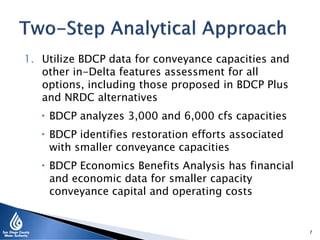
1. Utilize BDCP data for conveyance capacities and
other in-Delta features assessment for all
options, including those proposed in BDCP Plus
and NRDC alternatives
 BDCP analyzes 3,000 and 6,000 cfs capacities
 BDCP identifies restoration efforts associated
with smaller conveyance capacities
 BDCP Economics Benefits Analysis has financial
and economic data for smaller capacity
conveyance capital and operating costs
7
2. Assess the risk, financing, cost, benefit, and need
for additional information for out-of-Delta
features proposed in NRDC/BDCP Plus
 Value of additional storage to increase exports
 Value of additional local supply projects
 Comparison to BDCP Preferred and No Action
 Affect on San Diego regional reliability and rates
 Both quantitative and qualitative risks will be
presented
 Both analyses will support overall evaluation of
alternatives and provide basis of comment letters
8
9
 Comprehensive conservation strategy for
Sacramento-San Joaquin River Delta
 22 Conservation Measures (CMs)
◦ CM 1: water conveyance facilities and operations
◦ CM 2-22: restore, protect and conserve ecosystem
 Allows issuance of Endangered Species Act
permits for 50-year term
◦ Natural Communities Conservation Plan (state)
◦ Habitat Conservation Plan (federal)
 BDCP is the “project” for environmental review
10
 Required for any discretionary governmental
action that may affect the environment
◦ Approve or carry out a project
◦ Authorize funding for a project
◦ Grant a permit for project
 Disclose environmental effects to decision
makers and the public
◦ Identify ways to avoid or reduce effects
◦ Identify feasible alternatives and mitigation
measures
◦ Specify reasons for the action
◦ Enhance public participation
11
 EIR/EIS is a joint CEQA (state) and NEPA
(federal) document
◦ Common practice to issue a combined EIR/EIS
◦ Regulations require very similar analyses
◦ For high level review no material differences
 Review the environmental effects of proposed
project and a reasonable range of alternatives
12
 Lead agency for EIR is DWR
 Co-lead agencies for EIS are
USBR, NMFS, and USFWS
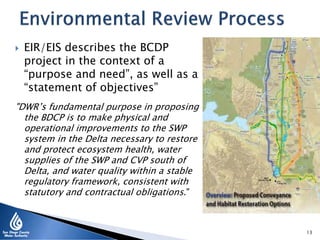
 EIR/EIS describes the BCDP
project in the context of a
“purpose and need”, as well as a
“statement of objectives”
"DWR’s fundamental purpose in proposing
the BDCP is to make physical and
operational improvements to the SWP
system in the Delta necessary to restore
and protect ecosystem health, water
supplies of the SWP and CVP south of
Delta, and water quality within a stable
regulatory framework, consistent with
statutory and contractual obligations."
13
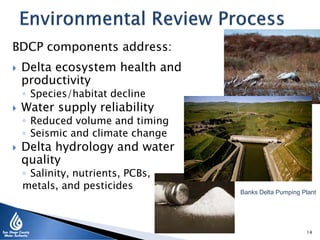
BDCP components address:
 Delta ecosystem health and
productivity
◦ Species/habitat decline
 Water supply reliability
◦ Reduced volume and timing
◦ Seismic and climate change
 Delta hydrology and water
quality
◦ Salinity, nutrients, PCBs,
metals, and pesticides
14
Banks Delta Pumping Plant
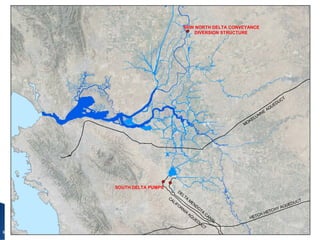
NEW NORTH DELTA CONVEYANCE
DIVERSION STRUCTURE
SOUTH DELTA PUMPS
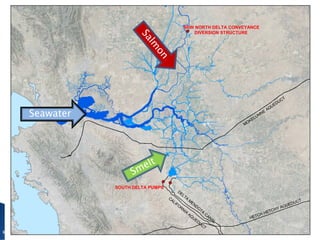
NEW NORTH DELTA CONVEYANCE
DIVERSION STRUCTURE
SOUTH DELTA PUMPS
Seawater
17
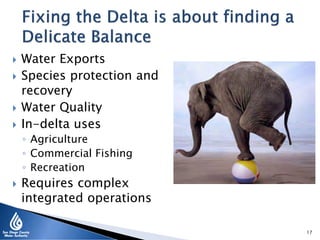
 Water Exports
 Species protection and
recovery
 Water Quality
 In-delta uses
◦ Agriculture
◦ Commercial Fishing
◦ Recreation
 Requires complex
integrated operations
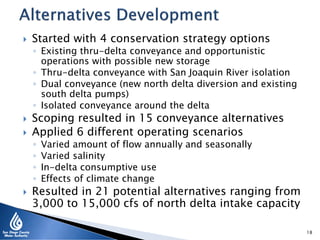
 Started with 4 conservation strategy options
◦ Existing thru-delta conveyance and opportunistic
operations with possible new storage
◦ Thru-delta conveyance with San Joaquin River isolation
◦ Dual conveyance (new north delta diversion and existing
south delta pumps)
◦ Isolated conveyance around the delta
 Scoping resulted in 15 conveyance alternatives
 Applied 6 different operating scenarios
◦ Varied amount of flow annually and seasonally
◦ Varied salinity
◦ In-delta consumptive use
◦ Effects of climate change
 Resulted in 21 potential alternatives ranging from
3,000 to 15,000 cfs of north delta intake capacity
18
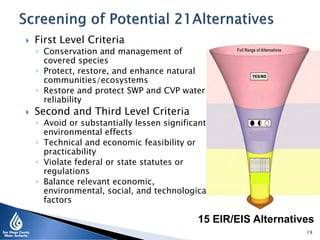
 First Level Criteria
◦ Conservation and management of
covered species
◦ Protect, restore, and enhance natural
communities/ecosystems
◦ Restore and protect SWP and CVP water
reliability
 Second and Third Level Criteria
◦ Avoid or substantially lessen significant
environmental effects
◦ Technical and economic feasibility or
practicability
◦ Violate federal or state statutes or
regulations
◦ Balance relevant economic,
environmental, social, and technological
factors
19
15 EIR/EIS Alternatives
 Assessed environmental impacts of alternatives
 What should Water Authority focus on?
◦ Alternatives (operating scenarios and yield)
◦ Water quality
◦ Species recovery goals
◦ Habitat mitigation
20
Water Supply Agriculture Noise
Surface Water Recreation Hazards/Hazardous Materials
Groundwater Socioeconomics Public Health
Water Quality Aesthetics/Visual Minerals
Geology/Seismicity Cultural Paleontology
Soils Transportation Environmental Justice
Fish/Aquatic Biology Public Services/Utilities Climate Change
Terrestrial Biology Energy Growth Inducement
Land Use Air Quality/Greenhouse Gas
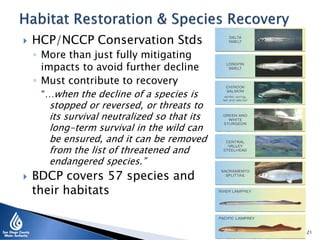
 HCP/NCCP Conservation Stds
◦ More than just fully mitigating
impacts to avoid further decline
◦ Must contribute to recovery
“…when the decline of a species is
stopped or reversed, or threats to
its survival neutralized so that its
long-term survival in the wild can

be ensured, and it can be removed
from the list of threatened and
endangered species.”
 BDCP covers 57 species and
their habitats
21
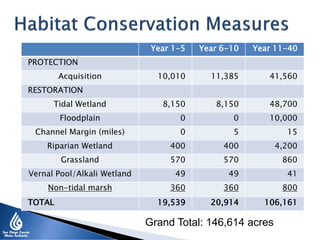
Year 1-5 Year 6-10 Year 11-40
PROTECTION
Acquisition 10,010 11,385 41,560
RESTORATION
Tidal Wetland 8,150 8,150 48,700
Floodplain 0 0 10,000
Channel Margin (miles) 0 5 15
Riparian Wetland 400 400 4,200
Grassland 570 570 860
Vernal Pool/Alkali Wetland 49 49 41
Non-tidal marsh 360 360 800
TOTAL 19,539 20,914 106,161
Grand Total: 146,614 acres
 Unknown if habitat restoration will be
successful
 Concerns about impacts to upstream storage
and other beneficial uses
 Disagreement regarding minimum outflows
for longfin and delta smelt
 BDCP incorporates a “decision tree” that uses
future additional scientific information to
determine flow requirements in 2025
 Once flows initially fixed, any further changes
only via adaptive management
23
 Integrated process to evaluate project
design, effectiveness and modification
 Data from monitoring, combined with new
science, is applied to conservation strategy
 Information from project success/failure
used to modify or develop new approaches
 Includes Changed Circumstances
Could require future structural or operating
criteria changes that increase or decrease
project cost and water availability
 CEQA & NEPA require a “baseline” condition as a
starting point to determine environmental impacts
◦ Baseline usually reflects existing conditions at the time of
the EIR/EIS with minor modifications for expected changes
 Recent case law has allowed the use of a projected
future baseline
◦ Based on substantial evidence
◦ QSA Program EIR trial court decision
◦ Recent California Supreme Court decision
25
 Different assumptions and baselines were used in the
EIR/EIS and BDCP
◦ Baseline is important in determining mitigation, cost/benefit
and a “yes/no” decision on project
 EIR/EIS alternatives evaluated from a perspective of
avoiding or substantially lessening impacts to the whole
“environment”, including humans.
◦ Broad evaluation, all issue areas
◦ Used a “snapshot” baseline of existing conditions with near
term changes
 HCP/NCCP alternatives evaluated from a perspective of
avoiding or lessening “take” of covered fish and wildlife
◦ Narrow evaluation, biology only
◦ Used baseline with forecasted future restrictions
26
27
 On May 29, the BDCP economic benefit analysis
was released for public review
 Economic benefit analysis assesses the value of the
BDCP preferred alternative on:
◦ Water shortage avoidance
◦ Water quality improvement
◦ Seismic risk reduction
 Water Authority staff will review the overall
financing plans, funding sources, and the cost-
benefit analysis of the BDCP alternatives
28
 Demand assumptions influence BDCP economic benefit
analysis
 Unclear what demand assumptions were used for economic
benefit analysis
 Staff to clarify demand assumptions
◦ Recently, DWR now representing demand to reflect updated SCAG
projection and Carlsbad Desalination
 BDCP EIR/EIS Growth Inducement Chapter reviewed water
contractor profiles, including MWD
◦ Relied on MWD’s 2010 RUWMP for demand profile
◦ In 2010, GHA (retained by Water Authority) conducted an analysis
and showed MWD’s RUWMP under-reported 312 taf of planned
local projects that are shown in MWD MA UWMPs combined
29
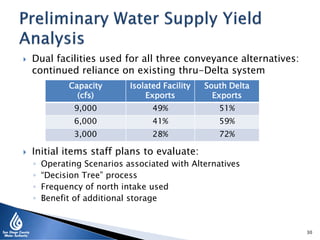
 Dual facilities used for all three conveyance alternatives:
continued reliance on existing thru-Delta system
 Initial items staff plans to evaluate:
◦ Operating Scenarios associated with Alternatives
◦ “Decision Tree” process
◦ Frequency of north intake used
◦ Benefit of additional storage
30
Capacity
(cfs)
Isolated Facility
Exports
South Delta
Exports
9,000 49% 51%
6,000 41% 59%
3,000 28% 72%
 State and federal regulations for HCP/NCCP require
assurance of “adequate funding” by the conservation
plan applicant
◦ Chapter 8 of the BDCP is intended to provide details of the
funding strategy to satisfy the “adequate funding” requirement
 Chapter 8 currently notes:
◦ “It is important to note that this chapter is not a financing plan
for the state or federal water contractors or any other
party…This chapter provides an overview of potential funding
sources that are likely to be available to support the
implementation of the BDCP”
◦ “Details of the financing and repayment described in this
section from the Authorized Entities and other sources are still
being determined…”
31
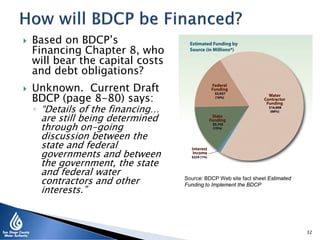
 Based on BDCP’s
Financing Chapter 8, who
will bear the capital costs
and debt obligations?
 Unknown. Current Draft
BDCP (page 8-80) says:
◦ “Details of the financing…
are still being determined
through on-going
discussion between the
state and federal
governments and between
the government, the state
and federal water
contractors and other
interests.”
32
Source: BDCP Web site fact sheet Estimated
Funding to Implement the BDCP
 The Water Authority has identified three specific
substantive issue areas that are lacking necessary
discussion within Chapter 8
◦ Lack of enforceable financial commitments by contractors’
member agencies or units
◦ Lack of analysis regarding the effects of “step up” provisions
◦ Lack of legal analysis examining the feasibility and
appropriateness of using property taxes as additional back-up
security for project debt
 These issues were raised repeatedly in Finance
Workgroup meetings and conveyed in August 28, 2012
and July 30, 2013 correspondence to Dr. Jerry Meral
33
34
 Water Authority staff is continuing its multidisciplinary
evaluation and analysis of the four Delta fix options
 On September 12, a special Board meeting will feature
presentations by Dr. Meral and a panel on economic
benefit analysis of BDCP , including Dr. Sunding
 Water Authority staff will continue to develop
technical analysis, including responses to policy
questions, for the September 26 Board meeting
 May modify the review schedule if EIR/EIS release
date is changed
35
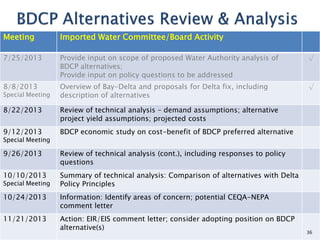
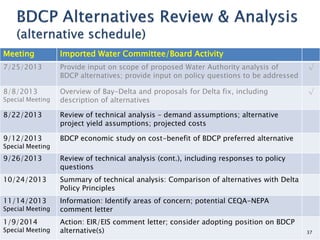
Meeting Imported Water Committee/Board Activity
7/25/2013 Provide input on scope of proposed Water Authority analysis of
BDCP alternatives;
Provide input on policy questions to be addressed
√
8/8/2013
Special Meeting
Overview of Bay-Delta and proposals for Delta fix, including
description of alternatives
√
8/22/2013 Review of technical analysis – demand assumptions; alternative
project yield assumptions; projected costs
9/12/2013
Special Meeting
BDCP economic study on cost-benefit of BDCP preferred alternative
9/26/2013 Review of technical analysis (cont.), including responses to policy
questions
10/10/2013
Special Meeting
Summary of technical analysis: Comparison of alternatives with Delta
Policy Principles
10/24/2013 Information: Identify areas of concern; potential CEQA-NEPA
comment letter
11/21/2013 Action: EIR/EIS comment letter; consider adopting position on BDCP
alternative(s)
36
Meeting Imported Water Committee/Board Activity
7/25/2013 Provide input on scope of proposed Water Authority analysis of
BDCP alternatives; provide input on policy questions to be addressed
√
8/8/2013
Special Meeting
Overview of Bay-Delta and proposals for Delta fix, including
description of alternatives
√
8/22/2013 Review of technical analysis – demand assumptions; alternative
project yield assumptions; projected costs
9/12/2013
Special Meeting
BDCP economic study on cost-benefit of BDCP preferred alternative
9/26/2013 Review of technical analysis (cont.), including responses to policy
questions
10/24/2013 Summary of technical analysis: Comparison of alternatives with Delta
Policy Principles
11/14/2013
Special Meeting
Information: Identify areas of concern; potential CEQA-NEPA
comment letter
1/9/2014
Special Meeting
Action: EIR/EIS comment letter; consider adopting position on BDCP
alternative(s) 37
Bay-Delta Conservation Plan: Review Update - August 22, 2013

Bay-Delta Conservation Plan: Review Update - August 22, 2013

  • 1.
  • 2.
     What’s new? Review approach  What is BDCP?  Issues the Water Authority’s evaluation will focus on to provide comment letter through environmental review process  Preliminary analysis  Next step 2
  • 3.
     DWR announcedseveral changes to the proposed BDCP water conveyance system in an effort to address Delta landowner concerns. Among the changes are: ◦ Shortening the main conveyance tunnels from 35 miles to 30 miles ◦ Shrinking the new forebay from 750 acres to 40 acres ◦ Realigning a segment of the twin tunnels several miles to the east to lands owned by a private non-profit group  Public review drafts of the BDCP and the EIR/EIS are still expected to be released in October 3
  • 4.
     BDCP isa permitting process supported by detailed planning and environmental documents ◦ ADEIR & BDCP ~ 25,000 pages; public drafts to be issued in October will be voluminous  BDCP Planning Documents ◦ Support NCCP/HCP ◦ Supporting scientific, economic, financial information ◦ Non-CEQA/NEPA required analyses  DEIR/EIS ◦ Required for NCCP/HCP approval and permitting 4
  • 5.
    5  Limited resourcesand time require a high level review ◦ Perspective of a recipient and purchaser Delta exports  Which Delta fix proposal most consistent with: ◦ Board’s Bay-Delta Policy Principles ◦ Reliability goals in the Water Authority’s 2010 UWMP  Deliverables: ◦ Comment letter through BDCP environmental review process ◦ Assessment of project financing and impact on rates ◦ Cost benefit assessment for Board review
  • 6.
    Alternative North Delta Conveyance Capacity Additional Supply Element BDCPAdministrative Draft EIR/EIS Preferred 9,000 cfs No No Action Current Operations No Concepts NRDC Portfolio 3,000cfs+ Local Projects & Storage Delta Vision BDCP Plus 6,000cfs Local Projects & Storage 6
  • 7.
    1. Utilize BDCPdata for conveyance capacities and other in-Delta features assessment for all options, including those proposed in BDCP Plus and NRDC alternatives  BDCP analyzes 3,000 and 6,000 cfs capacities  BDCP identifies restoration efforts associated with smaller conveyance capacities  BDCP Economics Benefits Analysis has financial and economic data for smaller capacity conveyance capital and operating costs 7
  • 8.
    2. Assess therisk, financing, cost, benefit, and need for additional information for out-of-Delta features proposed in NRDC/BDCP Plus  Value of additional storage to increase exports  Value of additional local supply projects  Comparison to BDCP Preferred and No Action  Affect on San Diego regional reliability and rates  Both quantitative and qualitative risks will be presented  Both analyses will support overall evaluation of alternatives and provide basis of comment letters 8
  • 9.
  • 10.
     Comprehensive conservationstrategy for Sacramento-San Joaquin River Delta  22 Conservation Measures (CMs) ◦ CM 1: water conveyance facilities and operations ◦ CM 2-22: restore, protect and conserve ecosystem  Allows issuance of Endangered Species Act permits for 50-year term ◦ Natural Communities Conservation Plan (state) ◦ Habitat Conservation Plan (federal)  BDCP is the “project” for environmental review 10
  • 11.
     Required forany discretionary governmental action that may affect the environment ◦ Approve or carry out a project ◦ Authorize funding for a project ◦ Grant a permit for project  Disclose environmental effects to decision makers and the public ◦ Identify ways to avoid or reduce effects ◦ Identify feasible alternatives and mitigation measures ◦ Specify reasons for the action ◦ Enhance public participation 11
  • 12.
     EIR/EIS isa joint CEQA (state) and NEPA (federal) document ◦ Common practice to issue a combined EIR/EIS ◦ Regulations require very similar analyses ◦ For high level review no material differences  Review the environmental effects of proposed project and a reasonable range of alternatives 12  Lead agency for EIR is DWR  Co-lead agencies for EIS are USBR, NMFS, and USFWS
  • 13.
     EIR/EIS describesthe BCDP project in the context of a “purpose and need”, as well as a “statement of objectives” "DWR’s fundamental purpose in proposing the BDCP is to make physical and operational improvements to the SWP system in the Delta necessary to restore and protect ecosystem health, water supplies of the SWP and CVP south of Delta, and water quality within a stable regulatory framework, consistent with statutory and contractual obligations." 13
  • 14.
    BDCP components address: Delta ecosystem health and productivity ◦ Species/habitat decline  Water supply reliability ◦ Reduced volume and timing ◦ Seismic and climate change  Delta hydrology and water quality ◦ Salinity, nutrients, PCBs, metals, and pesticides 14 Banks Delta Pumping Plant
  • 15.
    NEW NORTH DELTACONVEYANCE DIVERSION STRUCTURE SOUTH DELTA PUMPS
  • 16.
    NEW NORTH DELTACONVEYANCE DIVERSION STRUCTURE SOUTH DELTA PUMPS Seawater
  • 17.
    17  Water Exports Species protection and recovery  Water Quality  In-delta uses ◦ Agriculture ◦ Commercial Fishing ◦ Recreation  Requires complex integrated operations
  • 18.
     Started with4 conservation strategy options ◦ Existing thru-delta conveyance and opportunistic operations with possible new storage ◦ Thru-delta conveyance with San Joaquin River isolation ◦ Dual conveyance (new north delta diversion and existing south delta pumps) ◦ Isolated conveyance around the delta  Scoping resulted in 15 conveyance alternatives  Applied 6 different operating scenarios ◦ Varied amount of flow annually and seasonally ◦ Varied salinity ◦ In-delta consumptive use ◦ Effects of climate change  Resulted in 21 potential alternatives ranging from 3,000 to 15,000 cfs of north delta intake capacity 18
  • 19.
     First LevelCriteria ◦ Conservation and management of covered species ◦ Protect, restore, and enhance natural communities/ecosystems ◦ Restore and protect SWP and CVP water reliability  Second and Third Level Criteria ◦ Avoid or substantially lessen significant environmental effects ◦ Technical and economic feasibility or practicability ◦ Violate federal or state statutes or regulations ◦ Balance relevant economic, environmental, social, and technological factors 19 15 EIR/EIS Alternatives
  • 20.
     Assessed environmentalimpacts of alternatives  What should Water Authority focus on? ◦ Alternatives (operating scenarios and yield) ◦ Water quality ◦ Species recovery goals ◦ Habitat mitigation 20 Water Supply Agriculture Noise Surface Water Recreation Hazards/Hazardous Materials Groundwater Socioeconomics Public Health Water Quality Aesthetics/Visual Minerals Geology/Seismicity Cultural Paleontology Soils Transportation Environmental Justice Fish/Aquatic Biology Public Services/Utilities Climate Change Terrestrial Biology Energy Growth Inducement Land Use Air Quality/Greenhouse Gas
  • 21.
     HCP/NCCP ConservationStds ◦ More than just fully mitigating impacts to avoid further decline ◦ Must contribute to recovery “…when the decline of a species is stopped or reversed, or threats to its survival neutralized so that its long-term survival in the wild can be ensured, and it can be removed from the list of threatened and endangered species.”  BDCP covers 57 species and their habitats 21
  • 22.
    Year 1-5 Year6-10 Year 11-40 PROTECTION Acquisition 10,010 11,385 41,560 RESTORATION Tidal Wetland 8,150 8,150 48,700 Floodplain 0 0 10,000 Channel Margin (miles) 0 5 15 Riparian Wetland 400 400 4,200 Grassland 570 570 860 Vernal Pool/Alkali Wetland 49 49 41 Non-tidal marsh 360 360 800 TOTAL 19,539 20,914 106,161 Grand Total: 146,614 acres
  • 23.
     Unknown ifhabitat restoration will be successful  Concerns about impacts to upstream storage and other beneficial uses  Disagreement regarding minimum outflows for longfin and delta smelt  BDCP incorporates a “decision tree” that uses future additional scientific information to determine flow requirements in 2025  Once flows initially fixed, any further changes only via adaptive management 23
  • 24.
     Integrated processto evaluate project design, effectiveness and modification  Data from monitoring, combined with new science, is applied to conservation strategy  Information from project success/failure used to modify or develop new approaches  Includes Changed Circumstances Could require future structural or operating criteria changes that increase or decrease project cost and water availability
  • 25.
     CEQA &NEPA require a “baseline” condition as a starting point to determine environmental impacts ◦ Baseline usually reflects existing conditions at the time of the EIR/EIS with minor modifications for expected changes  Recent case law has allowed the use of a projected future baseline ◦ Based on substantial evidence ◦ QSA Program EIR trial court decision ◦ Recent California Supreme Court decision 25
  • 26.
     Different assumptionsand baselines were used in the EIR/EIS and BDCP ◦ Baseline is important in determining mitigation, cost/benefit and a “yes/no” decision on project  EIR/EIS alternatives evaluated from a perspective of avoiding or substantially lessening impacts to the whole “environment”, including humans. ◦ Broad evaluation, all issue areas ◦ Used a “snapshot” baseline of existing conditions with near term changes  HCP/NCCP alternatives evaluated from a perspective of avoiding or lessening “take” of covered fish and wildlife ◦ Narrow evaluation, biology only ◦ Used baseline with forecasted future restrictions 26
  • 27.
  • 28.
     On May29, the BDCP economic benefit analysis was released for public review  Economic benefit analysis assesses the value of the BDCP preferred alternative on: ◦ Water shortage avoidance ◦ Water quality improvement ◦ Seismic risk reduction  Water Authority staff will review the overall financing plans, funding sources, and the cost- benefit analysis of the BDCP alternatives 28
  • 29.
     Demand assumptionsinfluence BDCP economic benefit analysis  Unclear what demand assumptions were used for economic benefit analysis  Staff to clarify demand assumptions ◦ Recently, DWR now representing demand to reflect updated SCAG projection and Carlsbad Desalination  BDCP EIR/EIS Growth Inducement Chapter reviewed water contractor profiles, including MWD ◦ Relied on MWD’s 2010 RUWMP for demand profile ◦ In 2010, GHA (retained by Water Authority) conducted an analysis and showed MWD’s RUWMP under-reported 312 taf of planned local projects that are shown in MWD MA UWMPs combined 29
  • 30.
     Dual facilitiesused for all three conveyance alternatives: continued reliance on existing thru-Delta system  Initial items staff plans to evaluate: ◦ Operating Scenarios associated with Alternatives ◦ “Decision Tree” process ◦ Frequency of north intake used ◦ Benefit of additional storage 30 Capacity (cfs) Isolated Facility Exports South Delta Exports 9,000 49% 51% 6,000 41% 59% 3,000 28% 72%
  • 31.
     State andfederal regulations for HCP/NCCP require assurance of “adequate funding” by the conservation plan applicant ◦ Chapter 8 of the BDCP is intended to provide details of the funding strategy to satisfy the “adequate funding” requirement  Chapter 8 currently notes: ◦ “It is important to note that this chapter is not a financing plan for the state or federal water contractors or any other party…This chapter provides an overview of potential funding sources that are likely to be available to support the implementation of the BDCP” ◦ “Details of the financing and repayment described in this section from the Authorized Entities and other sources are still being determined…” 31
  • 32.
     Based onBDCP’s Financing Chapter 8, who will bear the capital costs and debt obligations?  Unknown. Current Draft BDCP (page 8-80) says: ◦ “Details of the financing… are still being determined through on-going discussion between the state and federal governments and between the government, the state and federal water contractors and other interests.” 32 Source: BDCP Web site fact sheet Estimated Funding to Implement the BDCP
  • 33.
     The WaterAuthority has identified three specific substantive issue areas that are lacking necessary discussion within Chapter 8 ◦ Lack of enforceable financial commitments by contractors’ member agencies or units ◦ Lack of analysis regarding the effects of “step up” provisions ◦ Lack of legal analysis examining the feasibility and appropriateness of using property taxes as additional back-up security for project debt  These issues were raised repeatedly in Finance Workgroup meetings and conveyed in August 28, 2012 and July 30, 2013 correspondence to Dr. Jerry Meral 33
  • 34.
  • 35.
     Water Authoritystaff is continuing its multidisciplinary evaluation and analysis of the four Delta fix options  On September 12, a special Board meeting will feature presentations by Dr. Meral and a panel on economic benefit analysis of BDCP , including Dr. Sunding  Water Authority staff will continue to develop technical analysis, including responses to policy questions, for the September 26 Board meeting  May modify the review schedule if EIR/EIS release date is changed 35
  • 36.
    Meeting Imported WaterCommittee/Board Activity 7/25/2013 Provide input on scope of proposed Water Authority analysis of BDCP alternatives; Provide input on policy questions to be addressed √ 8/8/2013 Special Meeting Overview of Bay-Delta and proposals for Delta fix, including description of alternatives √ 8/22/2013 Review of technical analysis – demand assumptions; alternative project yield assumptions; projected costs 9/12/2013 Special Meeting BDCP economic study on cost-benefit of BDCP preferred alternative 9/26/2013 Review of technical analysis (cont.), including responses to policy questions 10/10/2013 Special Meeting Summary of technical analysis: Comparison of alternatives with Delta Policy Principles 10/24/2013 Information: Identify areas of concern; potential CEQA-NEPA comment letter 11/21/2013 Action: EIR/EIS comment letter; consider adopting position on BDCP alternative(s) 36
  • 37.
    Meeting Imported WaterCommittee/Board Activity 7/25/2013 Provide input on scope of proposed Water Authority analysis of BDCP alternatives; provide input on policy questions to be addressed √ 8/8/2013 Special Meeting Overview of Bay-Delta and proposals for Delta fix, including description of alternatives √ 8/22/2013 Review of technical analysis – demand assumptions; alternative project yield assumptions; projected costs 9/12/2013 Special Meeting BDCP economic study on cost-benefit of BDCP preferred alternative 9/26/2013 Review of technical analysis (cont.), including responses to policy questions 10/24/2013 Summary of technical analysis: Comparison of alternatives with Delta Policy Principles 11/14/2013 Special Meeting Information: Identify areas of concern; potential CEQA-NEPA comment letter 1/9/2014 Special Meeting Action: EIR/EIS comment letter; consider adopting position on BDCP alternative(s) 37