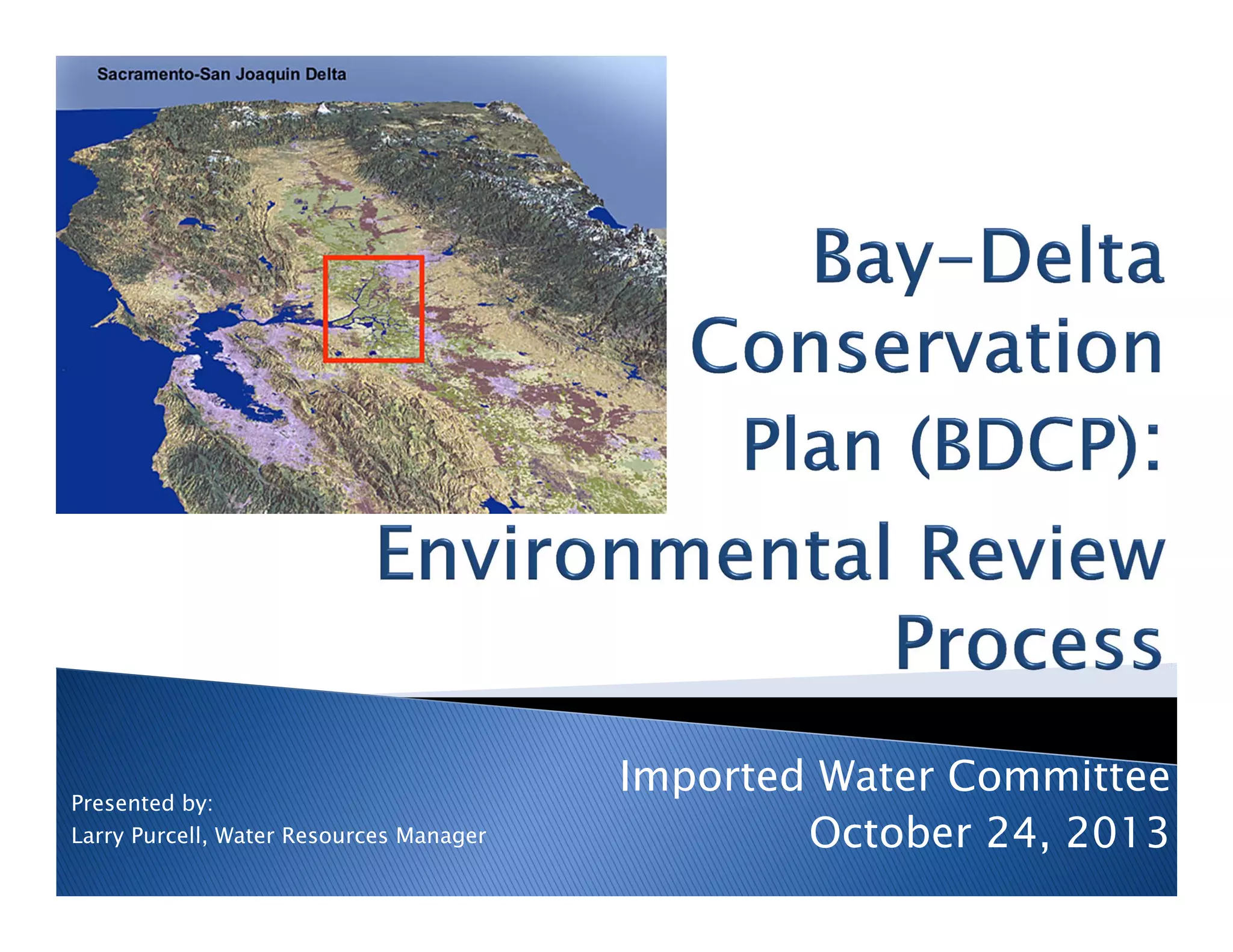
Presented by:
Larry Purcell, Water Resources Manager

Imported Water Committee
October 24, 2013


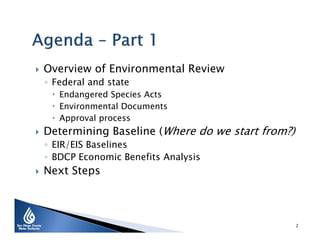
Overview of Environmental Review
◦ Federal and state

 Endangered Species Acts
 Environmental Documents
 Approval process



Determining Baseline (Where do we start from?)
◦ EIR/EIS Baselines
◦ BDCP Economic Benefits Analysis



Next Steps

2


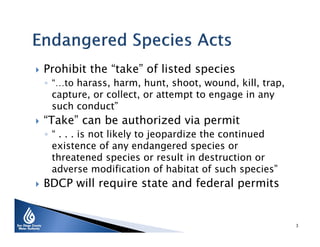
Prohibit the “take” of listed species

◦ “…to harass, harm, hunt, shoot, wound, kill, trap,
capture, or collect, or attempt to engage in any
such conduct”



“Take” can be authorized via permit

◦ “ . . . is not likely to jeopardize the continued
existence of any endangered species or
threatened species or result in destruction or
adverse modification of habitat of such species”



BDCP will require state and federal permits

3
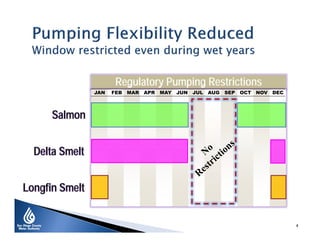
Regulatory Pumping Restrictions
JAN

FEB

MAR

APR

MAY

JUN

JUL

AUG

SEP OCT NOV DEC

Salmon
Delta Smelt
Longfin Smelt

4
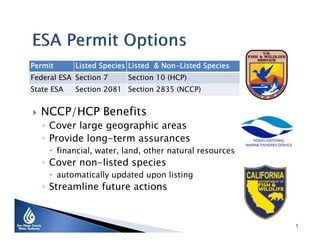
Permit

Listed Species Listed & Non-Listed Species

Federal ESA Section 7
State ESA



Section 10 (HCP)

Section 2081 Section 2835 (NCCP)

NCCP/HCP Benefits

◦ Cover large geographic areas
◦ Provide long-term assurances

 financial, water, land, other natural resources

◦ Cover non-listed species

 automatically updated upon listing

◦ Streamline future actions

5




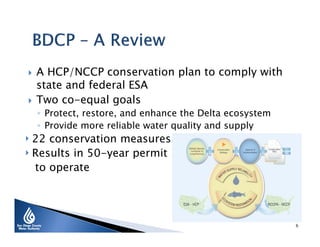
A HCP/NCCP conservation plan to comply with
state and federal ESA
Two co-equal goals
◦ Protect, restore, and enhance the Delta ecosystem
◦ Provide more reliable water quality and supply

‣ 22 conservation measures
‣ Results in 50-year permit
to operate

6
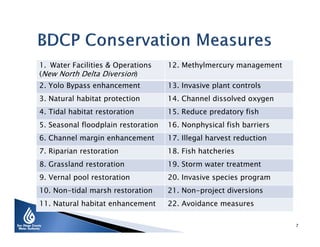
1. Water Facilities & Operations
(New North Delta Diversion)

12. Methylmercury management

2. Yolo Bypass enhancement

13. Invasive plant controls

3. Natural habitat protection

14. Channel dissolved oxygen

4. Tidal habitat restoration

15. Reduce predatory fish

5. Seasonal floodplain restoration

16. Nonphysical fish barriers

6. Channel margin enhancement

17. Illegal harvest reduction

7. Riparian restoration

18. Fish hatcheries

8. Grassland restoration

19. Storm water treatment

9. Vernal pool restoration

20. Invasive species program

10. Non-tidal marsh restoration

21. Non-project diversions

11. Natural habitat enhancement

22. Avoidance measures
7


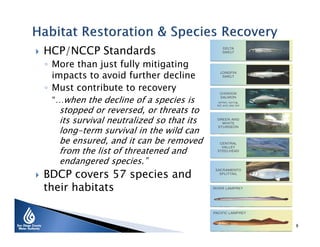
HCP/NCCP Standards

◦ More than just fully mitigating
impacts to avoid further decline
◦ Must contribute to recovery
“…when the decline of a species is
stopped or reversed, or threats to
its survival neutralized so that its
long-term survival in the wild can
be ensured, and it can be removed
from the list of threatened and
endangered species.”



BDCP covers 57 species and
their habitats

8
9


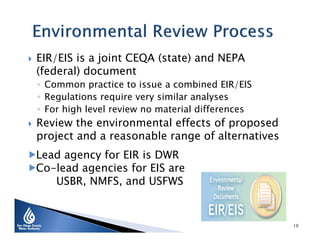
EIR/EIS is a joint CEQA (state) and NEPA
(federal) document

◦ Common practice to issue a combined EIR/EIS
◦ Regulations require very similar analyses
◦ For high level review no material differences



Review the environmental effects of proposed
project and a reasonable range of alternatives

Lead agency for EIR is DWR
Co-lead agencies for EIS are
USBR, NMFS, and USFWS

10
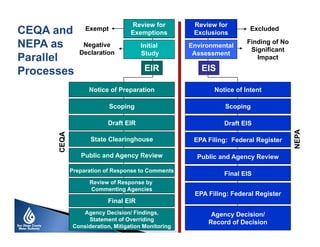
CEQA and
NEPA as
Parallel
Processes

Exempt

Review for
Exemptions

Review for
Exclusions

Negative
Declaration

Initial
Study

Environmental
Assessment

EIR

Excluded
Finding of No
Significant
Impact

EIS

Scoping

Draft EIR

Draft EIS

State Clearinghouse

EPA Filing: Federal Register

Public and Agency Review

Public and Agency Review

Preparation of Response to Comments

Final EIS

Review of Response by
Commenting Agencies

EPA Filing: Federal Register

Final EIR
Agency Decision/ Findings,
Statement of Overriding
Consideration, Mitigation Monitoring

Agency Decision/
Record of Decision

NEPA

Notice of Intent

Scoping

CEQA

Notice of Preparation


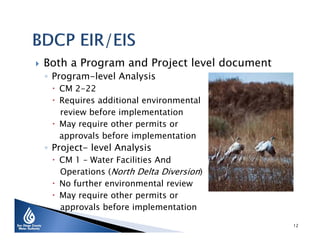
Both a Program and Project level document
◦ Program-level Analysis

 CM 2-22
 Requires additional environmental
review before implementation
 May require other permits or
approvals before implementation

◦ Project- level Analysis

 CM 1 – Water Facilities And
Operations (North Delta Diversion)
 No further environmental review
 May require other permits or
approvals before implementation
12
13



BDCP documents use multiple baselines
EIR/EIS

◦ Used to determine environmental impacts/benefits
and mitigation of various alternatives



Economic Benefits Analysis

◦ Used to determine incremental water supply
improvement and economic benefit of proposed
actions compared to existing conveyance



Baseline conditions allow estimates of water
supply yield from continued reliance on south
delta pumping only (no BDCP)
14




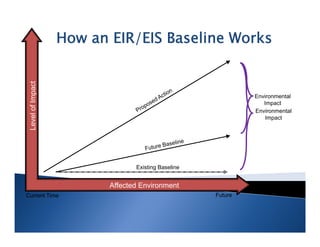
A reference from which to compare the
possible environmental effects of an action
Defined in law
◦ CEQA: “…normally the physical environmental
conditions as they exist at the time Notice of
Preparation is published”
◦ NEPA: “…the environment of the areas to be
affected or created by the proposed action”



Should not provide an artificial analysis of
impacts that can mislead users

15
Level of Impact

How an EIR/EIS Baseline Works

Environmental
Impact
Environmental
Impact

Existing Baseline

Affected Environment
Current Time

Future


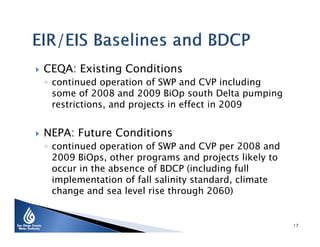
CEQA: Existing Conditions

◦ continued operation of SWP and CVP including
some of 2008 and 2009 BiOp south Delta pumping
restrictions, and projects in effect in 2009



NEPA: Future Conditions

◦ continued operation of SWP and CVP per 2008 and
2009 BiOps, other programs and projects likely to
occur in the absence of BDCP (including full
implementation of fall salinity standard, climate
change and sea level rise through 2060)

17
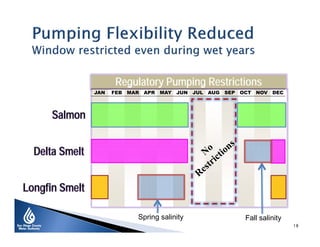
Regulatory Pumping Restrictions
JAN

FEB

MAR

APR

MAY

JUN

JUL

AUG

SEP OCT NOV DEC

Salmon
Delta Smelt
Longfin Smelt
Spring salinity

Fall salinity
18


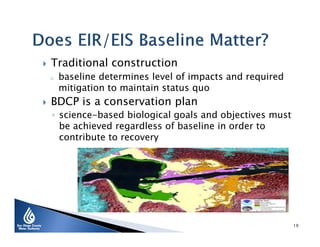
Traditional construction
o



baseline determines level of impacts and required
mitigation to maintain status quo

BDCP is a conservation plan

◦ science-based biological goals and objectives must
be achieved regardless of baseline in order to
contribute to recovery

19



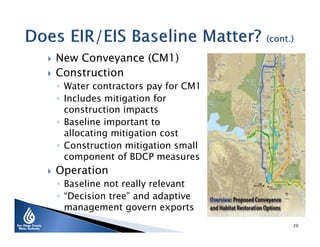
New Conveyance (CM1)
Construction

◦ Water contractors pay for CM1
◦ Includes mitigation for
construction impacts
◦ Baseline important to
allocating mitigation cost
◦ Construction mitigation small
component of BDCP measures



Operation

◦ Baseline not really relevant
◦ “Decision tree” and adaptive
management govern exports
20
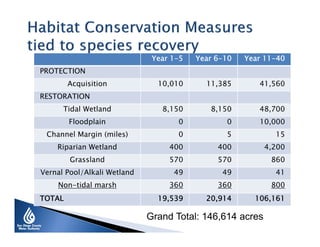
Year 1-5

Year 6-10

Year 11-40

10,010

11,385

41,560

8,150

8,150

48,700

Floodplain

0

0

10,000

Channel Margin (miles)

0

5

15

Riparian Wetland

400

400

4,200

Grassland

570

570

860

49

49

41

360

360

800

19,539

20,914

106,161

PROTECTION
Acquisition
RESTORATION
Tidal Wetland

Vernal Pool/Alkali Wetland
Non-tidal marsh
TOTAL

Grand Total: 146,614 acres



Cost/benefit compared to existing conveyance
Not tied to CEQA/NEPA baseline
◦ Not determining environmental effects



Used higher Delta outflows than in EIR/EIS

◦ Assumed fisheries continue to decline
◦ Assumed fishery agencies will further restrict exports
to protect species via more regulations
◦ Assumed climate change, sea level rise and all other
likely future conditions



It is the “worst case” in BDCP documents

◦ More conservative prediction of future conditions
22
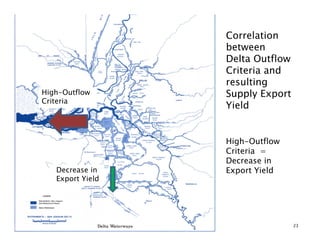
High-Outflow
Criteria

Decrease in
Export Yield

Correlation
between
Delta Outflow
Criteria and
resulting
Supply Export
Yield
High-Outflow
Criteria =
Decrease in
Export Yield

23
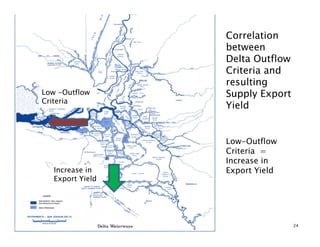
Low -Outflow
Criteria

Increase in
Export Yield

Correlation
between
Delta Outflow
Criteria and
resulting
Supply Export
Yield
Low-Outflow
Criteria =
Increase in
Export Yield

24
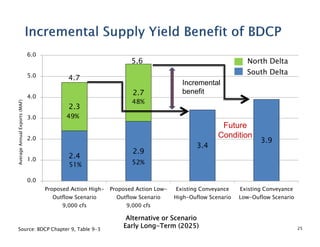
6.0

Average Annual Exports (MAF)

5.0

5.6
4.7
2.7

4.0

2.3

3.0

South Delta
Incremental
benefit

48%

49%

Future
Condition

2.0
1.0

North Delta

2.4

2.9

3.4

3.9

51%

52%

Proposed Action High-

Proposed Action Low-

Existing Conveyance

Existing Conveyance

Outflow Scenario

Outflow Scenario

High-Ouflow Scenario

Low-Ouflow Scenario

9,000 cfs

9,000 cfs

0.0

Source: BDCP Chapter 9, Table 9-3

Alternative or Scenario
Early Long-Term (2025)

25
25
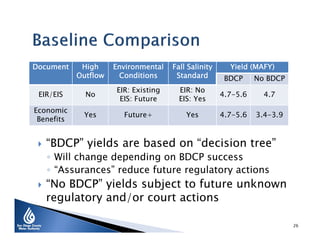
Document

High
Outflow

Environmental
Conditions

Fall Salinity
Standard

EIR/EIS

No

EIR: Existing
EIS: Future

Economic
Benefits

Yes

Future+



Yield (MAFY)
BDCP

No BDCP

EIR: No
EIS: Yes

4.7-5.6

4.7

Yes

4.7-5.6

3.4-3.9

“BDCP” yields are based on “decision tree”
◦ Will change depending on BDCP success
◦ “Assurances” reduce future regulatory actions



“No BDCP” yields subject to future unknown
regulatory and/or court actions
26


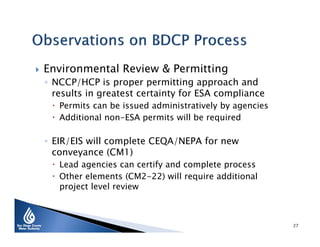
Environmental Review & Permitting

◦ NCCP/HCP is proper permitting approach and
results in greatest certainty for ESA compliance

 Permits can be issued administratively by agencies
 Additional non-ESA permits will be required

◦ EIR/EIS will complete CEQA/NEPA for new
conveyance (CM1)

 Lead agencies can certify and complete process
 Other elements (CM2-22) will require additional
project level review

27


EIR/EIS use different baselines

◦ Reflects differences between state and federal law
 NEPA baseline assumes additional future conditions

◦ Environmental baselines do not drive selection of
alternative or cost of BDCP
 All BDCP measures, including CM1, contribute to
species recovery and must be implemented



Economic Benefits Analysis baseline

◦ Uses even greater future conditions provided by
fisheries agencies

 Conservative approach for evaluating economic benefits
and potential future yield of existing conveyance system
28

Bay-Delta Conservation Plan (BDCP) Environmental Review Process - October 24, 2013

  • 1.
    Presented by: Larry Purcell,Water Resources Manager Imported Water Committee October 24, 2013
  • 2.
     Overview of EnvironmentalReview ◦ Federal and state  Endangered Species Acts  Environmental Documents  Approval process  Determining Baseline (Where do we start from?) ◦ EIR/EIS Baselines ◦ BDCP Economic Benefits Analysis  Next Steps 2
  • 3.
     Prohibit the “take”of listed species ◦ “…to harass, harm, hunt, shoot, wound, kill, trap, capture, or collect, or attempt to engage in any such conduct”  “Take” can be authorized via permit ◦ “ . . . is not likely to jeopardize the continued existence of any endangered species or threatened species or result in destruction or adverse modification of habitat of such species”  BDCP will require state and federal permits 3
  • 4.
    Regulatory Pumping Restrictions JAN FEB MAR APR MAY JUN JUL AUG SEPOCT NOV DEC Salmon Delta Smelt Longfin Smelt 4
  • 5.
    Permit Listed Species Listed& Non-Listed Species Federal ESA Section 7 State ESA  Section 10 (HCP) Section 2081 Section 2835 (NCCP) NCCP/HCP Benefits ◦ Cover large geographic areas ◦ Provide long-term assurances  financial, water, land, other natural resources ◦ Cover non-listed species  automatically updated upon listing ◦ Streamline future actions 5
  • 6.
      A HCP/NCCP conservationplan to comply with state and federal ESA Two co-equal goals ◦ Protect, restore, and enhance the Delta ecosystem ◦ Provide more reliable water quality and supply ‣ 22 conservation measures ‣ Results in 50-year permit to operate 6
  • 7.
    1. Water Facilities& Operations (New North Delta Diversion) 12. Methylmercury management 2. Yolo Bypass enhancement 13. Invasive plant controls 3. Natural habitat protection 14. Channel dissolved oxygen 4. Tidal habitat restoration 15. Reduce predatory fish 5. Seasonal floodplain restoration 16. Nonphysical fish barriers 6. Channel margin enhancement 17. Illegal harvest reduction 7. Riparian restoration 18. Fish hatcheries 8. Grassland restoration 19. Storm water treatment 9. Vernal pool restoration 20. Invasive species program 10. Non-tidal marsh restoration 21. Non-project diversions 11. Natural habitat enhancement 22. Avoidance measures 7
  • 8.
     HCP/NCCP Standards ◦ Morethan just fully mitigating impacts to avoid further decline ◦ Must contribute to recovery “…when the decline of a species is stopped or reversed, or threats to its survival neutralized so that its long-term survival in the wild can be ensured, and it can be removed from the list of threatened and endangered species.”  BDCP covers 57 species and their habitats 8
  • 9.
  • 10.
     EIR/EIS is ajoint CEQA (state) and NEPA (federal) document ◦ Common practice to issue a combined EIR/EIS ◦ Regulations require very similar analyses ◦ For high level review no material differences  Review the environmental effects of proposed project and a reasonable range of alternatives Lead agency for EIR is DWR Co-lead agencies for EIS are USBR, NMFS, and USFWS 10
  • 11.
    CEQA and NEPA as Parallel Processes Exempt Reviewfor Exemptions Review for Exclusions Negative Declaration Initial Study Environmental Assessment EIR Excluded Finding of No Significant Impact EIS Scoping Draft EIR Draft EIS State Clearinghouse EPA Filing: Federal Register Public and Agency Review Public and Agency Review Preparation of Response to Comments Final EIS Review of Response by Commenting Agencies EPA Filing: Federal Register Final EIR Agency Decision/ Findings, Statement of Overriding Consideration, Mitigation Monitoring Agency Decision/ Record of Decision NEPA Notice of Intent Scoping CEQA Notice of Preparation
  • 12.
     Both a Programand Project level document ◦ Program-level Analysis  CM 2-22  Requires additional environmental review before implementation  May require other permits or approvals before implementation ◦ Project- level Analysis  CM 1 – Water Facilities And Operations (North Delta Diversion)  No further environmental review  May require other permits or approvals before implementation 12
  • 13.
  • 14.
      BDCP documents usemultiple baselines EIR/EIS ◦ Used to determine environmental impacts/benefits and mitigation of various alternatives  Economic Benefits Analysis ◦ Used to determine incremental water supply improvement and economic benefit of proposed actions compared to existing conveyance  Baseline conditions allow estimates of water supply yield from continued reliance on south delta pumping only (no BDCP) 14
  • 15.
      A reference fromwhich to compare the possible environmental effects of an action Defined in law ◦ CEQA: “…normally the physical environmental conditions as they exist at the time Notice of Preparation is published” ◦ NEPA: “…the environment of the areas to be affected or created by the proposed action”  Should not provide an artificial analysis of impacts that can mislead users 15
  • 16.
    Level of Impact Howan EIR/EIS Baseline Works Environmental Impact Environmental Impact Existing Baseline Affected Environment Current Time Future
  • 17.
     CEQA: Existing Conditions ◦continued operation of SWP and CVP including some of 2008 and 2009 BiOp south Delta pumping restrictions, and projects in effect in 2009  NEPA: Future Conditions ◦ continued operation of SWP and CVP per 2008 and 2009 BiOps, other programs and projects likely to occur in the absence of BDCP (including full implementation of fall salinity standard, climate change and sea level rise through 2060) 17
  • 18.
    Regulatory Pumping Restrictions JAN FEB MAR APR MAY JUN JUL AUG SEPOCT NOV DEC Salmon Delta Smelt Longfin Smelt Spring salinity Fall salinity 18
  • 19.
     Traditional construction o  baseline determineslevel of impacts and required mitigation to maintain status quo BDCP is a conservation plan ◦ science-based biological goals and objectives must be achieved regardless of baseline in order to contribute to recovery 19
  • 20.
      New Conveyance (CM1) Construction ◦Water contractors pay for CM1 ◦ Includes mitigation for construction impacts ◦ Baseline important to allocating mitigation cost ◦ Construction mitigation small component of BDCP measures  Operation ◦ Baseline not really relevant ◦ “Decision tree” and adaptive management govern exports 20
  • 21.
    Year 1-5 Year 6-10 Year11-40 10,010 11,385 41,560 8,150 8,150 48,700 Floodplain 0 0 10,000 Channel Margin (miles) 0 5 15 Riparian Wetland 400 400 4,200 Grassland 570 570 860 49 49 41 360 360 800 19,539 20,914 106,161 PROTECTION Acquisition RESTORATION Tidal Wetland Vernal Pool/Alkali Wetland Non-tidal marsh TOTAL Grand Total: 146,614 acres
  • 22.
      Cost/benefit compared toexisting conveyance Not tied to CEQA/NEPA baseline ◦ Not determining environmental effects  Used higher Delta outflows than in EIR/EIS ◦ Assumed fisheries continue to decline ◦ Assumed fishery agencies will further restrict exports to protect species via more regulations ◦ Assumed climate change, sea level rise and all other likely future conditions  It is the “worst case” in BDCP documents ◦ More conservative prediction of future conditions 22
  • 23.
    High-Outflow Criteria Decrease in Export Yield Correlation between DeltaOutflow Criteria and resulting Supply Export Yield High-Outflow Criteria = Decrease in Export Yield 23
  • 24.
    Low -Outflow Criteria Increase in ExportYield Correlation between Delta Outflow Criteria and resulting Supply Export Yield Low-Outflow Criteria = Increase in Export Yield 24
  • 25.
    6.0 Average Annual Exports(MAF) 5.0 5.6 4.7 2.7 4.0 2.3 3.0 South Delta Incremental benefit 48% 49% Future Condition 2.0 1.0 North Delta 2.4 2.9 3.4 3.9 51% 52% Proposed Action High- Proposed Action Low- Existing Conveyance Existing Conveyance Outflow Scenario Outflow Scenario High-Ouflow Scenario Low-Ouflow Scenario 9,000 cfs 9,000 cfs 0.0 Source: BDCP Chapter 9, Table 9-3 Alternative or Scenario Early Long-Term (2025) 25 25
  • 26.
    Document High Outflow Environmental Conditions Fall Salinity Standard EIR/EIS No EIR: Existing EIS:Future Economic Benefits Yes Future+  Yield (MAFY) BDCP No BDCP EIR: No EIS: Yes 4.7-5.6 4.7 Yes 4.7-5.6 3.4-3.9 “BDCP” yields are based on “decision tree” ◦ Will change depending on BDCP success ◦ “Assurances” reduce future regulatory actions  “No BDCP” yields subject to future unknown regulatory and/or court actions 26
  • 27.
     Environmental Review &Permitting ◦ NCCP/HCP is proper permitting approach and results in greatest certainty for ESA compliance  Permits can be issued administratively by agencies  Additional non-ESA permits will be required ◦ EIR/EIS will complete CEQA/NEPA for new conveyance (CM1)  Lead agencies can certify and complete process  Other elements (CM2-22) will require additional project level review 27
  • 28.
     EIR/EIS use differentbaselines ◦ Reflects differences between state and federal law  NEPA baseline assumes additional future conditions ◦ Environmental baselines do not drive selection of alternative or cost of BDCP  All BDCP measures, including CM1, contribute to species recovery and must be implemented  Economic Benefits Analysis baseline ◦ Uses even greater future conditions provided by fisheries agencies  Conservative approach for evaluating economic benefits and potential future yield of existing conveyance system 28