Overview of a Water Management Plan
for the Murray-Darling Basin, Australia

River Health Assessment Workshop
Beijing, China
November 2010


Greg Claydon
Executive Director, Strategic Water Initiatives Branch
Water & Ecosystem Outcomes Division
Presentation outline

   Background to the Murray-Darling Basin (MDB)
   Background to the MDB Plan
      Commonwealth Water Act 2007
      Water for the Future Program 2008
   Proposed Basin Plan
      Context
      Process
      Content (with a focus on environmental flows)
   Concluding Remarks
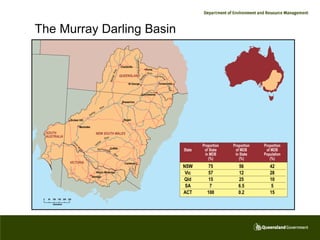
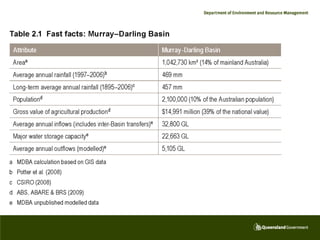
The Murray Darling Basin
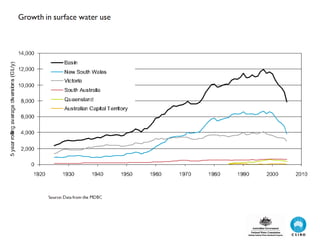
Water management challenges
   Overallocation
   Groundwater use impact on surface water systems
   Serious environmental degradation; reduced environmental flows &
    water quality
   Loss of productivity & economic activity
   Risks to community water supply
   Severe & prolonged drought & conversely floods
   Significant water related impacts due to climate change
   Large and naturally variable basin
   Multiple jurisdictions
Commonwealth Water Act 2007
     Provides for integrated management of water resources
     Enable Commonwealth in conjunction with States to manage
      Basin’s water resources
     Optimise economic, social and environmental outcomes
     Environmental sustainability
     Improve water security
Commonwealth Water Act 2007
   Creation of new, independent Murray Darling Basin Authority
    (MDBA)
   Process for development of the Basin Plan
   Establishment of the Commonwealth Environmental Water
    Holder (CEWH)
   Water information collection, analysis and distribution (by the
    Bureau of Meteorology)
   Audits by the National Water Commission
Water for the Future Program

   A 10 year new $12.9 billion Australian Government fund
   Four key priorities: taking action on climate change, using water
    wisely, securing water supplies and supporting healthy rivers
   Rural Water Use Efficiency ($5.8 billion)
   Purchase of water for the environment ($3.1billion)
   National Water Security Plan for Cities & Towns ($1.5 billion)
   Improving water information ($450 million)
Commonwealth Environmental Water Holder
(CEWH)

   Manages the water entitlements purchased by the
    Commonwealth for the environment
   Water purchased through the Water For the Future Program
    should reduce the impact of new limits on diversions set by the
    basin plan on existing water users
Murray-Darling Basin Authority (MDBA)
•   Role/Functions
     •   Preparing the Basin Plan for Commonwealth Minister’s approval
     •   Accreditation of state water resource plans
     •   Measure, monitor and enforce compliance on water resources
     •   Engaging the community
     •   Some water system operations and natural resources management
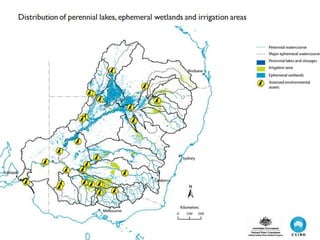
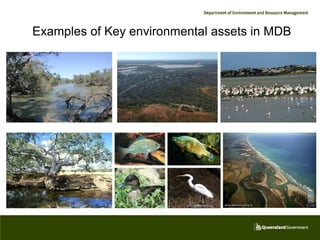
Examples of Key environmental assets in MDB
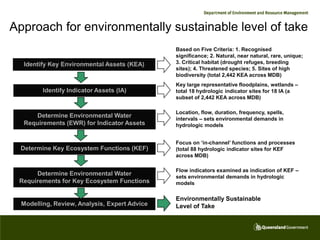
Approach for environmentally sustainable level of take
                                               Based on Five Criteria: 1. Recognised
                                               significance; 2. Natural, near natural, rare, unique;
  Identify Key Environmental Assets (KEA)      3. Critical habitat (drought refuges, breeding
                                               sites); 4. Threatened species; 5. Sites of high
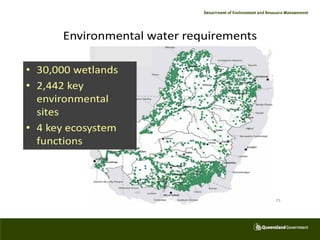
                                               biodiversity (total 2,442 KEA across MDB)
                                               Key large representative floodplains, wetlands –
         Identify Indicator Assets (IA)        total 18 hydrologic indicator sites for 18 IA (a
                                               subset of 2,442 KEA across MDB)

                                               Location, flow, duration, frequency, spells,
      Determine Environmental Water            intervals – sets environmental demands in
  Requirements (EWR) for Indicator Assets      hydrologic models


                                               Focus on ‘in-channel’ functions and processes
  Determine Key Ecosystem Functions (KEF)      (total 88 hydrologic indicator sites for KEF
                                               across MDB)

                                               Flow indicators examined as indication of KEF –
      Determine Environmental Water            sets environmental demands in hydrologic
 Requirements for Key Ecosystem Functions      models

                                               Environmentally Sustainable
  Modelling, Review, Analysis, Expert Advice   Level of Take
What does the Basin Plan Mean for Water
Planning in Queensland?
The Basin Plan binds
- Basin State Agencies
- Infrastructure operators
- Holders of water access entitlements (industry)


Water Planning
- Qld will continue to plan, allocate and manage water resources
  within its borders but…
- Qld Water Resource Plans for MDB catchments will need to be
  accredited by the Commonwealth Minister responsible for water
  (with advice to be provided by the MDBA)
- Must comply with the Basin Plan
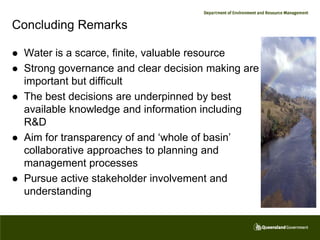
Concluding Remarks

   Water is a scarce, finite, valuable resource
   Strong governance and clear decision making are
    important but difficult
   The best decisions are underpinned by best
    available knowledge and information including
    R&D
   Aim for transparency of and ‘whole of basin’
    collaborative approaches to planning and
    management processes
   Pursue active stakeholder involvement and
    understanding
Concluding Remarks (cont’d)

   Test for consistency and coherence of policy
    (e.g. institutional, entitlement, pricing, planning)
   Remember principles of Ecologically
    Sustainable Development and Triple Bottom
    Line
   Include adaptive management including
    requirements for monitoring, reviewing and
    reporting
   Consider linking reform milestones with
    incentives and sanctions
More information from the websites

www.mdba.gov.au
www.derm.qld.gov.au


Thank You!

Greg claydon mdb plan overview nov 2010

  • 1.
    Overview of aWater Management Plan for the Murray-Darling Basin, Australia River Health Assessment Workshop Beijing, China November 2010 Greg Claydon Executive Director, Strategic Water Initiatives Branch Water & Ecosystem Outcomes Division
  • 2.
    Presentation outline  Background to the Murray-Darling Basin (MDB)  Background to the MDB Plan  Commonwealth Water Act 2007  Water for the Future Program 2008  Proposed Basin Plan  Context  Process  Content (with a focus on environmental flows)  Concluding Remarks
  • 3.
  • 12.
    Water management challenges  Overallocation  Groundwater use impact on surface water systems  Serious environmental degradation; reduced environmental flows & water quality  Loss of productivity & economic activity  Risks to community water supply  Severe & prolonged drought & conversely floods  Significant water related impacts due to climate change  Large and naturally variable basin  Multiple jurisdictions
  • 13.
    Commonwealth Water Act2007  Provides for integrated management of water resources  Enable Commonwealth in conjunction with States to manage Basin’s water resources  Optimise economic, social and environmental outcomes  Environmental sustainability  Improve water security
  • 14.
    Commonwealth Water Act2007  Creation of new, independent Murray Darling Basin Authority (MDBA)  Process for development of the Basin Plan  Establishment of the Commonwealth Environmental Water Holder (CEWH)  Water information collection, analysis and distribution (by the Bureau of Meteorology)  Audits by the National Water Commission
  • 15.
    Water for theFuture Program  A 10 year new $12.9 billion Australian Government fund  Four key priorities: taking action on climate change, using water wisely, securing water supplies and supporting healthy rivers  Rural Water Use Efficiency ($5.8 billion)  Purchase of water for the environment ($3.1billion)  National Water Security Plan for Cities & Towns ($1.5 billion)  Improving water information ($450 million)
  • 16.
    Commonwealth Environmental WaterHolder (CEWH)  Manages the water entitlements purchased by the Commonwealth for the environment  Water purchased through the Water For the Future Program should reduce the impact of new limits on diversions set by the basin plan on existing water users
  • 17.
    Murray-Darling Basin Authority(MDBA) • Role/Functions • Preparing the Basin Plan for Commonwealth Minister’s approval • Accreditation of state water resource plans • Measure, monitor and enforce compliance on water resources • Engaging the community • Some water system operations and natural resources management
  • 28.
    Examples of Keyenvironmental assets in MDB
  • 29.
    Approach for environmentallysustainable level of take Based on Five Criteria: 1. Recognised significance; 2. Natural, near natural, rare, unique; Identify Key Environmental Assets (KEA) 3. Critical habitat (drought refuges, breeding sites); 4. Threatened species; 5. Sites of high biodiversity (total 2,442 KEA across MDB) Key large representative floodplains, wetlands – Identify Indicator Assets (IA) total 18 hydrologic indicator sites for 18 IA (a subset of 2,442 KEA across MDB) Location, flow, duration, frequency, spells, Determine Environmental Water intervals – sets environmental demands in Requirements (EWR) for Indicator Assets hydrologic models Focus on ‘in-channel’ functions and processes Determine Key Ecosystem Functions (KEF) (total 88 hydrologic indicator sites for KEF across MDB) Flow indicators examined as indication of KEF – Determine Environmental Water sets environmental demands in hydrologic Requirements for Key Ecosystem Functions models Environmentally Sustainable Modelling, Review, Analysis, Expert Advice Level of Take
  • 36.
    What does theBasin Plan Mean for Water Planning in Queensland? The Basin Plan binds - Basin State Agencies - Infrastructure operators - Holders of water access entitlements (industry) Water Planning - Qld will continue to plan, allocate and manage water resources within its borders but… - Qld Water Resource Plans for MDB catchments will need to be accredited by the Commonwealth Minister responsible for water (with advice to be provided by the MDBA) - Must comply with the Basin Plan
  • 37.
    Concluding Remarks  Water is a scarce, finite, valuable resource  Strong governance and clear decision making are important but difficult  The best decisions are underpinned by best available knowledge and information including R&D  Aim for transparency of and ‘whole of basin’ collaborative approaches to planning and management processes  Pursue active stakeholder involvement and understanding
  • 38.
    Concluding Remarks (cont’d)  Test for consistency and coherence of policy (e.g. institutional, entitlement, pricing, planning)  Remember principles of Ecologically Sustainable Development and Triple Bottom Line  Include adaptive management including requirements for monitoring, reviewing and reporting  Consider linking reform milestones with incentives and sanctions
  • 39.
    More information fromthe websites www.mdba.gov.au www.derm.qld.gov.au Thank You!