Dennis Cushman, Assistant General Manager
Glenn Farrel, Government Relations Manager
Don Chadwick, Senior Water Resources Specialist
Amy Chen, Director of MWD Program
Board Workshop
August 8, 2013
 Delta History
◦ Central Valley Project
◦ State Water Project
◦ Delta conflicts
◦ Past efforts to resolve conflicts
◦ 2009 Comprehensive Delta Legislative Package
 Bay-Delta Conservation Plan
◦ Purpose
◦ Status
 Alternatives to be reviewed by Water
Authority
2
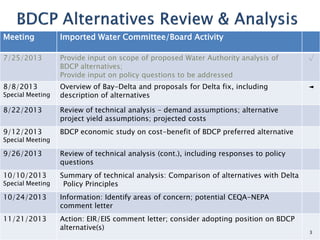
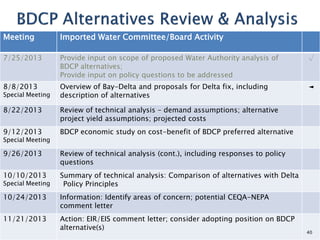
Meeting Imported Water Committee/Board Activity
7/25/2013 Provide input on scope of proposed Water Authority analysis of
BDCP alternatives;
Provide input on policy questions to be addressed
√
8/8/2013
Special Meeting
Overview of Bay-Delta and proposals for Delta fix, including
description of alternatives
◄
8/22/2013 Review of technical analysis – demand assumptions; alternative
project yield assumptions; projected costs
9/12/2013
Special Meeting
BDCP economic study on cost-benefit of BDCP preferred alternative
9/26/2013 Review of technical analysis (cont.), including responses to policy
questions
10/10/2013
Special Meeting
Summary of technical analysis: Comparison of alternatives with Delta
Policy Principles
10/24/2013 Information: Identify areas of concern; potential CEQA-NEPA
comment letter
11/21/2013 Action: EIR/EIS comment letter; consider adopting position on BDCP
alternative(s)
3
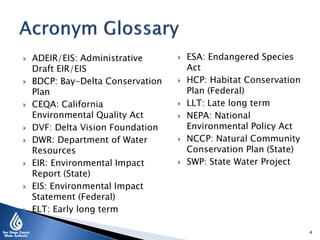
 ADEIR/EIS: Administrative
Draft EIR/EIS
 BDCP: Bay-Delta Conservation
Plan
 CEQA: California
Environmental Quality Act
 DVF: Delta Vision Foundation
 DWR: Department of Water
Resources
 EIR: Environmental Impact
Report (State)
 EIS: Environmental Impact
Statement (Federal)
 ELT: Early long term
 ESA: Endangered Species
Act
 HCP: Habitat Conservation
Plan (Federal)
 LLT: Late long term
 NEPA: National
Environmental Policy Act
 NCCP: Natural Community
Conservation Plan (State)
 SWP: State Water Project
4
Part I
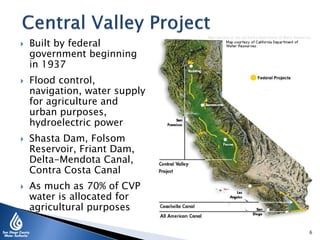
 Built by federal
government beginning
in 1937
 Flood control,
navigation, water supply
for agriculture and
urban purposes,
hydroelectric power
 Shasta Dam, Folsom
Reservoir, Friant Dam,
Delta-Mendota Canal,
Contra Costa Canal
 As much as 70% of CVP
water is allocated for
agricultural purposes
6
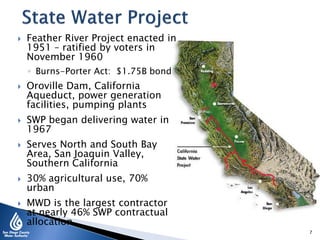
 Feather River Project enacted in
1951 – ratified by voters in
November 1960
◦ Burns-Porter Act: $1.75B bond
 Oroville Dam, California
Aqueduct, power generation
facilities, pumping plants
 SWP began delivering water in
1967
 Serves North and South Bay
Area, San Joaquin Valley,
Southern California
 30% agricultural use, 70%
urban
 MWD is the largest contractor
at nearly 46% SWP contractual
allocation
7
 700-mile sloughs and waterways, surround more
than 60 tracts and islands supported by levees
 500,000 residents, largest use of land is
agricultural, recreation destination, important
transportation and utilities corridor, estuary and
waterways
 Competing interests
◦ Water supply
◦ Ecosystem
 Deteriorating habitat impacts on water suppliers’
ability to export through the Delta
 History of major – but largely failed – efforts to
address water conflicts
8
 1960: Burns-Porter Act: Authorized Delta
facilities for “transfer of water across the
Delta”
 1965: Interagency Delta Commission
recommended Peripheral Canal as transfer
facility
 1973: Delta Environmental Advisory
Committee concludes a federal/state
peripheral canal is necessary to protect the
Delta ecosystem
9
 1980: State Legislature passed and the
Governor signed SB 200
◦ Authorized the peripheral canal
◦ Provided specific guarantees to protect Delta
◦ Intended to meet water needs of the SWP through
2000
 June 1982: California voters defeated
Proposition 9 – a veto referendum – which
included the peripheral canal
◦ 63-37%
10
 From 1987-1992, California endured a six-year
drought
◦ Limited water deliveries
◦ Deteriorated in-Delta and exported water quality
◦ Pushed fish species to brink of extinction
 1992: SWRCB releases draft D-1630 interim
standards that require reductions in Delta exports
to protect wildlife
 1993: Delta smelt declared endangered under the
federal Endangered Species Act
 1995: Winter-run Chinook salmon listed as
endangered
 1999: Spring-run Chinook salmon listed as
endangered
11
 1994: Bay-Delta Accord,
creating CalFed coordination
 Unprecedented collaboration
of federal, state, and
stakeholder interests
 Began 10-year period of
focused effort to on Delta
CalFed Framework signatories agreed to:
•Formulate water quality standards
•Coordinate operations of the SWP and CVP
•Work toward long-term Delta solutions
12
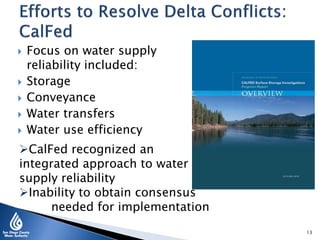
 Focus on water supply
reliability included:
 Storage
 Conveyance
 Water transfers
 Water use efficiency
CalFed recognized an
integrated approach to water
supply reliability
Inability to obtain consensus
needed for implementation
13
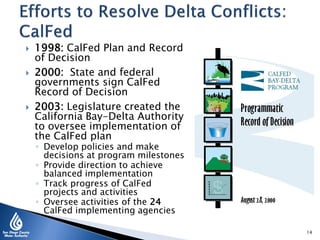
 1998: CalFed Plan and Record
of Decision
 2000: State and federal
governments sign CalFed
Record of Decision
 2003: Legislature created the
California Bay-Delta Authority
to oversee implementation of
the CalFed plan
◦ Develop policies and make
decisions at program milestones
◦ Provide direction to achieve
balanced implementation
◦ Track progress of CalFed
projects and activities
◦ Oversee activities of the 24
CalFed implementing agencies
14
 Stakeholder criticisms of the CalFed program:
◦ Lack of leadership
◦ Inability to advance CalFed program agenda
◦ Unable to demonstrate results
◦ Unable to measure achievements
◦ Lack of real “authority” to direct 24 implementing
agencies
◦ Cost concerns
 CalFed also came under scrutiny by the
Administration, Legislature, Little Hoover
Commission, and Legislative Analyst’s Office
 In 2006, the State Legislature dissolved the CalFed
Bay-Delta Authority
15
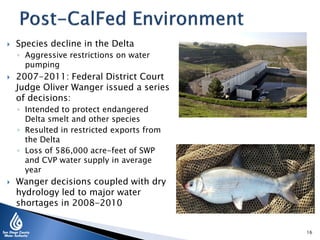
 Species decline in the Delta
◦ Aggressive restrictions on water
pumping
 2007-2011: Federal District Court
Judge Oliver Wanger issued a series
of decisions:
◦ Intended to protect endangered
Delta smelt and other species
◦ Resulted in restricted exports from
the Delta
◦ Loss of 586,000 acre-feet of SWP
and CVP water supply in average
year
 Wanger decisions coupled with dry
hydrology led to major water
shortages in 2008-2010
16
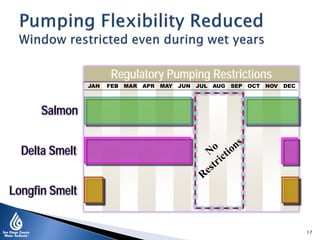
Regulatory Pumping Restrictions
JAN FEB MAR APR MAY JUN JUL AUG SEP OCT NOV DEC
Delta Smelt
Salmon
Longfin Smelt
17
Part II
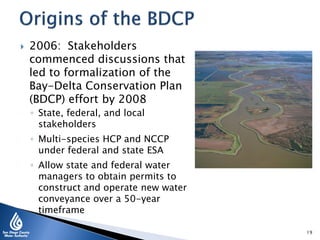
 2006: Stakeholders
commenced discussions that
led to formalization of the
Bay-Delta Conservation Plan
(BDCP) effort by 2008
◦ State, federal, and local
stakeholders
◦ Multi-species HCP and NCCP
under federal and state ESA
◦ Allow state and federal water
managers to obtain permits to
construct and operate new water
conveyance over a 50-year
timeframe
19
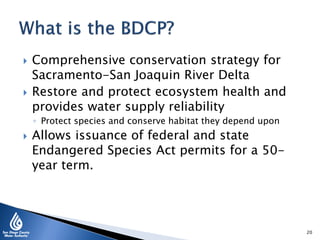
 Comprehensive conservation strategy for
Sacramento-San Joaquin River Delta
 Restore and protect ecosystem health and
provides water supply reliability
◦ Protect species and conserve habitat they depend upon
 Allows issuance of federal and state
Endangered Species Act permits for a 50-
year term.
20
 Combined Natural Community
Conservation Plan Habitat Conservation
Plan/ (NCCP/HCP)
 Satisfies federal and state ESA requirements
◦ Federal ESA Section 10
◦ State Fish and Game Code Section 2835
 Foundation document for ESA Permits to
allow “take” of listed species for certain
construction and operations of SWP/CVP
 Permittees include DWR, USBR and certain
federal and state water contractors
21
 Approved December 2010 (permits in 2011)
 Covers future CIP and O&M activities
 Allowed ESA permitting by both State and
Federal agencies simultaneously
 Targeted natural communities containing
more than one species common to an area
◦ 63 species covered over 993,000 acre area
 Provided regulatory and economic
assurances to all parties for 55 years
◦ Less cost versus project by project mitigation
22
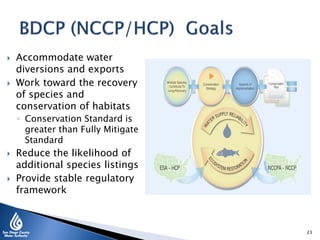
 Accommodate water
diversions and exports
 Work toward the recovery
of species and
conservation of habitats
◦ Conservation Standard is
greater than Fully Mitigate
Standard
 Reduce the likelihood of
additional species listings
 Provide stable regulatory
framework
23
 Identify the geographic
area for coverage
 Identify the species for
coverage together with
their required habitat
 Identify covered
activities & impacts
 Identify measures to
avoid, minimize or
mitigate for impacts
Delta Smelt
Long Fin Smelt
Chinook Salmon
24
 Combined EIR/EIS to review the environmental
effects of proposed BDCP and a reasonable
range of alternatives
 EIR/EIS is the foundational analytical
document used by the issuers of permits
 Lead agency for state-required EIR is DWR
 Co-lead agencies for federally-required EIS:
◦ U.S. Bureau of Reclamation
◦ National Marine Fisheries Service
◦ U.S. Fish and Wildlife Service
25
 No permit coverage for unlisted species
which may become listed in the future
 No comprehensive way to stabilize water
supply reliability or contain mitigation costs
 Future planning and permitting only for
state and federal listed species on case-by
case- basis
 Any new species added to endangered list
results in new permit negotiations and
requirements
26
 Similar to Water Authority NCCP/HCP
◦ Coordinated and comprehensive conservation
strategy
 Dependent on adaptive management and monitoring
◦ Provides 50-year ESA compliance process
 Less costly than project by project mitigation
 Specific to Bay-Delta
◦ Broad-based public participation via the NCCP
Act, NEPA, and CEQA processes
◦ Improved Delta-wide ecological conditions
◦ Achieve a more reliable water supply
27
 Using an NCCP/HCP Approach
◦ Eliminate years of sequential
negotiations on endangered species
◦ Prevent future endangered species
listings by providing broad
ecosystem protections
◦ Comprehensive regional planning to
conserve natural resources
◦ More effective use of public and
private resources for habitat
◦ Reduce risk to species, projects, and
water supply
28
 All 12 chapters of the administrative draft of the
BDCP and the consultant draft of the EIR/EIS have
been released
 The public draft BDCP and final draft EIR/EIS are
expected to be released for public comment by
October 1, 2013
◦ 90-day comment period announced – challenging
timeframe given the administrative drafts are
approximately 25,000 pages
◦ Decision on the EIR/EIS is planned for April 2014
29
Part III
31
 Objective is to provide the Board with an assessment
of which Delta fix proposal is most consistent with
and best advances the:
◦ Board’s Bay-Delta Policy Principles
◦ Reliability and supply diversification goals in the Water
Authority’s 2010 urban water management plan
 Goal: comment letter through BDCP environmental
review process
 Staff is reviewing four options to a Delta fix
◦ BDCP Preferred Alternative (included in BDCP draft)
◦ No Action Alternative (included in BDCP draft)
◦ NRDC’s Portfolio-Based BDCP Conceptual Alternative
◦ Delta Vision Foundation’s BDCP Plus Strategy
 Federal ESA requires analysis of alternatives in HCP
(avoid or reduce “take” of covered species)
 Alternatives to avoid or reduce “take” are distinct
from alternatives developed to satisfy CEQA/NEPA
◦ Alternatives to satisfy CEQA/NEPA must avoid or
substantially lessen impacts to human environment on wide
variety of issues
◦ Alternative actions evaluated in HCP are only required to
avoid or lessen impacts to covered fish and wildlife species
 Key question for staff analysis
◦ Is there a material difference between alternatives and in
use of different baselines
◦ (To be addressed at future Committee meeting)
32
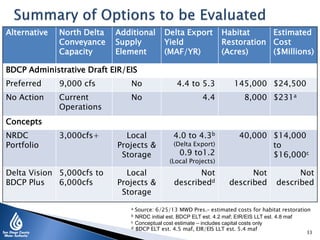
Alternative North Delta
Conveyance
Capacity
Additional
Supply
Element
Delta Export
Yield
(MAF/YR)
Habitat
Restoration
(Acres)
Estimated
Cost
($Millions)
BDCP Administrative Draft EIR/EIS
Preferred 9,000 cfs No 4.4 to 5.3 145,000 $24,500
No Action Current
Operations
No 4.4 8,000 $231a
Concepts
NRDC
Portfolio
3,000cfs+ Local
Projects &
Storage
4.0 to 4.3b
(Delta Export)
0.9 to1.2
(Local Projects)
40,000 $14,000
to
$16,000c
Delta Vision
BDCP Plus
5,000cfs to
6,000cfs
Local
Projects &
Storage
Not
describedd
Not
described
Not
described
a Source: 6/25/13 MWD Pres.– estimated costs for habitat restoration
b NRDC initial est. BDCP ELT est. 4.2 maf; EIR/EIS LLT est. 4.8 maf
c Conceptual cost estimate – includes capital costs only
d BDCP ELT est. 4.5 maf, EIR/EIS LLT est. 5.4 maf
33
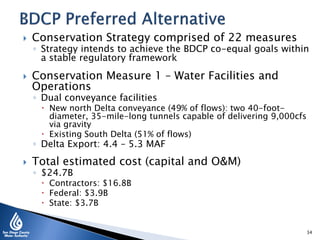
 Conservation Strategy comprised of 22 measures
◦ Strategy intends to achieve the BDCP co-equal goals within
a stable regulatory framework
 Conservation Measure 1 – Water Facilities and
Operations
◦ Dual conveyance facilities
 New north Delta conveyance (49% of flows): two 40-foot-
diameter, 35-mile-long tunnels capable of delivering 9,000cfs
via gravity
 Existing South Delta (51% of flows)
◦ Delta Export: 4.4 – 5.3 MAF
 Total estimated cost (capital and O&M)
◦ $24.7B
 Contractors: $16.8B
 Federal: $3.9B
 State: $3.7B
34
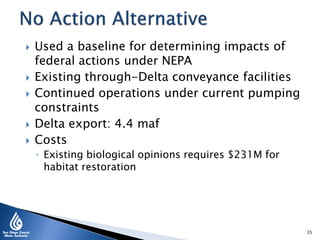
 Used a baseline for determining impacts of
federal actions under NEPA
 Existing through-Delta conveyance facilities
 Continued operations under current pumping
constraints
 Delta export: 4.4 maf
 Costs
◦ Existing biological opinions requires $231M for
habitat restoration
35
 Portfolio approach
◦ Dual conveyance facilities
 New north Delta conveyance (25% of flows): single
tunnel capable of delivering 3,000cfs via gravity
 Existing South Delta (75% of flows)
 Delta Exports: 4.0 to 4.3 MAF
◦ New south of Delta storage (1 MAF)
◦ Proposes increased investments in local projects and
conservation programs (926 TAF – 1,245 TAF)
 309 – 311 TAF of water recycling
 617 – 934 TAF of water efficiency savings
 Estimated investment (capital costs)
◦ $14-$16B (NRDC estimate)
36
DVF proposal emerged because it believes:
 BDCP
◦ Falls short of linked-action approach set forth in
DVF’s “Delta Vision Strategic Plan”
◦ Is insufficient to achieve the coequal goals
 NRDC Portfolio-Based Concept
◦ Includes additional components to BDCP that are
critical to achieve coequal goals
◦ Lacks near-term actions for levee system and
improved thru Delta conveyance; proposed isolated
facility is too small
37
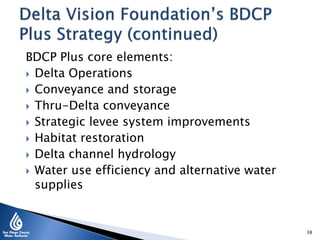
BDCP Plus core elements:
 Delta Operations
 Conveyance and storage
 Thru-Delta conveyance
 Strategic levee system improvements
 Habitat restoration
 Delta channel hydrology
 Water use efficiency and alternative water
supplies
38
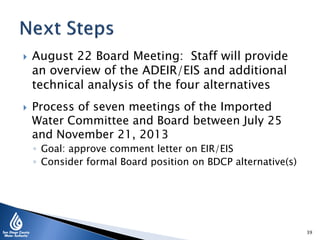
 August 22 Board Meeting: Staff will provide
an overview of the ADEIR/EIS and additional
technical analysis of the four alternatives
 Process of seven meetings of the Imported
Water Committee and Board between July 25
and November 21, 2013
◦ Goal: approve comment letter on EIR/EIS
◦ Consider formal Board position on BDCP alternative(s)
39
Meeting Imported Water Committee/Board Activity
7/25/2013 Provide input on scope of proposed Water Authority analysis of
BDCP alternatives;
Provide input on policy questions to be addressed
√
8/8/2013
Special Meeting
Overview of Bay-Delta and proposals for Delta fix, including
description of alternatives
◄
8/22/2013 Review of technical analysis – demand assumptions; alternative
project yield assumptions; projected costs
9/12/2013
Special Meeting
BDCP economic study on cost-benefit of BDCP preferred alternative
9/26/2013 Review of technical analysis (cont.), including responses to policy
questions
10/10/2013
Special Meeting
Summary of technical analysis: Comparison of alternatives with Delta
Policy Principles
10/24/2013 Information: Identify areas of concern; potential CEQA-NEPA
comment letter
11/21/2013 Action: EIR/EIS comment letter; consider adopting position on BDCP
alternative(s)
40
Bay-Delta Conservation Plan: Background & Options to Review August 8, 2013

Bay-Delta Conservation Plan: Background & Options to Review August 8, 2013

  • 1.
    Dennis Cushman, AssistantGeneral Manager Glenn Farrel, Government Relations Manager Don Chadwick, Senior Water Resources Specialist Amy Chen, Director of MWD Program Board Workshop August 8, 2013
  • 2.
     Delta History ◦Central Valley Project ◦ State Water Project ◦ Delta conflicts ◦ Past efforts to resolve conflicts ◦ 2009 Comprehensive Delta Legislative Package  Bay-Delta Conservation Plan ◦ Purpose ◦ Status  Alternatives to be reviewed by Water Authority 2
  • 3.
    Meeting Imported WaterCommittee/Board Activity 7/25/2013 Provide input on scope of proposed Water Authority analysis of BDCP alternatives; Provide input on policy questions to be addressed √ 8/8/2013 Special Meeting Overview of Bay-Delta and proposals for Delta fix, including description of alternatives ◄ 8/22/2013 Review of technical analysis – demand assumptions; alternative project yield assumptions; projected costs 9/12/2013 Special Meeting BDCP economic study on cost-benefit of BDCP preferred alternative 9/26/2013 Review of technical analysis (cont.), including responses to policy questions 10/10/2013 Special Meeting Summary of technical analysis: Comparison of alternatives with Delta Policy Principles 10/24/2013 Information: Identify areas of concern; potential CEQA-NEPA comment letter 11/21/2013 Action: EIR/EIS comment letter; consider adopting position on BDCP alternative(s) 3
  • 4.
     ADEIR/EIS: Administrative DraftEIR/EIS  BDCP: Bay-Delta Conservation Plan  CEQA: California Environmental Quality Act  DVF: Delta Vision Foundation  DWR: Department of Water Resources  EIR: Environmental Impact Report (State)  EIS: Environmental Impact Statement (Federal)  ELT: Early long term  ESA: Endangered Species Act  HCP: Habitat Conservation Plan (Federal)  LLT: Late long term  NEPA: National Environmental Policy Act  NCCP: Natural Community Conservation Plan (State)  SWP: State Water Project 4
  • 5.
  • 6.
     Built byfederal government beginning in 1937  Flood control, navigation, water supply for agriculture and urban purposes, hydroelectric power  Shasta Dam, Folsom Reservoir, Friant Dam, Delta-Mendota Canal, Contra Costa Canal  As much as 70% of CVP water is allocated for agricultural purposes 6
  • 7.
     Feather RiverProject enacted in 1951 – ratified by voters in November 1960 ◦ Burns-Porter Act: $1.75B bond  Oroville Dam, California Aqueduct, power generation facilities, pumping plants  SWP began delivering water in 1967  Serves North and South Bay Area, San Joaquin Valley, Southern California  30% agricultural use, 70% urban  MWD is the largest contractor at nearly 46% SWP contractual allocation 7
  • 8.
     700-mile sloughsand waterways, surround more than 60 tracts and islands supported by levees  500,000 residents, largest use of land is agricultural, recreation destination, important transportation and utilities corridor, estuary and waterways  Competing interests ◦ Water supply ◦ Ecosystem  Deteriorating habitat impacts on water suppliers’ ability to export through the Delta  History of major – but largely failed – efforts to address water conflicts 8
  • 9.
     1960: Burns-PorterAct: Authorized Delta facilities for “transfer of water across the Delta”  1965: Interagency Delta Commission recommended Peripheral Canal as transfer facility  1973: Delta Environmental Advisory Committee concludes a federal/state peripheral canal is necessary to protect the Delta ecosystem 9
  • 10.
     1980: StateLegislature passed and the Governor signed SB 200 ◦ Authorized the peripheral canal ◦ Provided specific guarantees to protect Delta ◦ Intended to meet water needs of the SWP through 2000  June 1982: California voters defeated Proposition 9 – a veto referendum – which included the peripheral canal ◦ 63-37% 10
  • 11.
     From 1987-1992,California endured a six-year drought ◦ Limited water deliveries ◦ Deteriorated in-Delta and exported water quality ◦ Pushed fish species to brink of extinction  1992: SWRCB releases draft D-1630 interim standards that require reductions in Delta exports to protect wildlife  1993: Delta smelt declared endangered under the federal Endangered Species Act  1995: Winter-run Chinook salmon listed as endangered  1999: Spring-run Chinook salmon listed as endangered 11
  • 12.
     1994: Bay-DeltaAccord, creating CalFed coordination  Unprecedented collaboration of federal, state, and stakeholder interests  Began 10-year period of focused effort to on Delta CalFed Framework signatories agreed to: •Formulate water quality standards •Coordinate operations of the SWP and CVP •Work toward long-term Delta solutions 12
  • 13.
     Focus onwater supply reliability included:  Storage  Conveyance  Water transfers  Water use efficiency CalFed recognized an integrated approach to water supply reliability Inability to obtain consensus needed for implementation 13
  • 14.
     1998: CalFedPlan and Record of Decision  2000: State and federal governments sign CalFed Record of Decision  2003: Legislature created the California Bay-Delta Authority to oversee implementation of the CalFed plan ◦ Develop policies and make decisions at program milestones ◦ Provide direction to achieve balanced implementation ◦ Track progress of CalFed projects and activities ◦ Oversee activities of the 24 CalFed implementing agencies 14
  • 15.
     Stakeholder criticismsof the CalFed program: ◦ Lack of leadership ◦ Inability to advance CalFed program agenda ◦ Unable to demonstrate results ◦ Unable to measure achievements ◦ Lack of real “authority” to direct 24 implementing agencies ◦ Cost concerns  CalFed also came under scrutiny by the Administration, Legislature, Little Hoover Commission, and Legislative Analyst’s Office  In 2006, the State Legislature dissolved the CalFed Bay-Delta Authority 15
  • 16.
     Species declinein the Delta ◦ Aggressive restrictions on water pumping  2007-2011: Federal District Court Judge Oliver Wanger issued a series of decisions: ◦ Intended to protect endangered Delta smelt and other species ◦ Resulted in restricted exports from the Delta ◦ Loss of 586,000 acre-feet of SWP and CVP water supply in average year  Wanger decisions coupled with dry hydrology led to major water shortages in 2008-2010 16
  • 17.
    Regulatory Pumping Restrictions JANFEB MAR APR MAY JUN JUL AUG SEP OCT NOV DEC Delta Smelt Salmon Longfin Smelt 17
  • 18.
  • 19.
     2006: Stakeholders commenceddiscussions that led to formalization of the Bay-Delta Conservation Plan (BDCP) effort by 2008 ◦ State, federal, and local stakeholders ◦ Multi-species HCP and NCCP under federal and state ESA ◦ Allow state and federal water managers to obtain permits to construct and operate new water conveyance over a 50-year timeframe 19
  • 20.
     Comprehensive conservationstrategy for Sacramento-San Joaquin River Delta  Restore and protect ecosystem health and provides water supply reliability ◦ Protect species and conserve habitat they depend upon  Allows issuance of federal and state Endangered Species Act permits for a 50- year term. 20
  • 21.
     Combined NaturalCommunity Conservation Plan Habitat Conservation Plan/ (NCCP/HCP)  Satisfies federal and state ESA requirements ◦ Federal ESA Section 10 ◦ State Fish and Game Code Section 2835  Foundation document for ESA Permits to allow “take” of listed species for certain construction and operations of SWP/CVP  Permittees include DWR, USBR and certain federal and state water contractors 21
  • 22.
     Approved December2010 (permits in 2011)  Covers future CIP and O&M activities  Allowed ESA permitting by both State and Federal agencies simultaneously  Targeted natural communities containing more than one species common to an area ◦ 63 species covered over 993,000 acre area  Provided regulatory and economic assurances to all parties for 55 years ◦ Less cost versus project by project mitigation 22
  • 23.
     Accommodate water diversionsand exports  Work toward the recovery of species and conservation of habitats ◦ Conservation Standard is greater than Fully Mitigate Standard  Reduce the likelihood of additional species listings  Provide stable regulatory framework 23
  • 24.
     Identify thegeographic area for coverage  Identify the species for coverage together with their required habitat  Identify covered activities & impacts  Identify measures to avoid, minimize or mitigate for impacts Delta Smelt Long Fin Smelt Chinook Salmon 24
  • 25.
     Combined EIR/EISto review the environmental effects of proposed BDCP and a reasonable range of alternatives  EIR/EIS is the foundational analytical document used by the issuers of permits  Lead agency for state-required EIR is DWR  Co-lead agencies for federally-required EIS: ◦ U.S. Bureau of Reclamation ◦ National Marine Fisheries Service ◦ U.S. Fish and Wildlife Service 25
  • 26.
     No permitcoverage for unlisted species which may become listed in the future  No comprehensive way to stabilize water supply reliability or contain mitigation costs  Future planning and permitting only for state and federal listed species on case-by case- basis  Any new species added to endangered list results in new permit negotiations and requirements 26
  • 27.
     Similar toWater Authority NCCP/HCP ◦ Coordinated and comprehensive conservation strategy  Dependent on adaptive management and monitoring ◦ Provides 50-year ESA compliance process  Less costly than project by project mitigation  Specific to Bay-Delta ◦ Broad-based public participation via the NCCP Act, NEPA, and CEQA processes ◦ Improved Delta-wide ecological conditions ◦ Achieve a more reliable water supply 27
  • 28.
     Using anNCCP/HCP Approach ◦ Eliminate years of sequential negotiations on endangered species ◦ Prevent future endangered species listings by providing broad ecosystem protections ◦ Comprehensive regional planning to conserve natural resources ◦ More effective use of public and private resources for habitat ◦ Reduce risk to species, projects, and water supply 28
  • 29.
     All 12chapters of the administrative draft of the BDCP and the consultant draft of the EIR/EIS have been released  The public draft BDCP and final draft EIR/EIS are expected to be released for public comment by October 1, 2013 ◦ 90-day comment period announced – challenging timeframe given the administrative drafts are approximately 25,000 pages ◦ Decision on the EIR/EIS is planned for April 2014 29
  • 30.
  • 31.
    31  Objective isto provide the Board with an assessment of which Delta fix proposal is most consistent with and best advances the: ◦ Board’s Bay-Delta Policy Principles ◦ Reliability and supply diversification goals in the Water Authority’s 2010 urban water management plan  Goal: comment letter through BDCP environmental review process  Staff is reviewing four options to a Delta fix ◦ BDCP Preferred Alternative (included in BDCP draft) ◦ No Action Alternative (included in BDCP draft) ◦ NRDC’s Portfolio-Based BDCP Conceptual Alternative ◦ Delta Vision Foundation’s BDCP Plus Strategy
  • 32.
     Federal ESArequires analysis of alternatives in HCP (avoid or reduce “take” of covered species)  Alternatives to avoid or reduce “take” are distinct from alternatives developed to satisfy CEQA/NEPA ◦ Alternatives to satisfy CEQA/NEPA must avoid or substantially lessen impacts to human environment on wide variety of issues ◦ Alternative actions evaluated in HCP are only required to avoid or lessen impacts to covered fish and wildlife species  Key question for staff analysis ◦ Is there a material difference between alternatives and in use of different baselines ◦ (To be addressed at future Committee meeting) 32
  • 33.
    Alternative North Delta Conveyance Capacity Additional Supply Element DeltaExport Yield (MAF/YR) Habitat Restoration (Acres) Estimated Cost ($Millions) BDCP Administrative Draft EIR/EIS Preferred 9,000 cfs No 4.4 to 5.3 145,000 $24,500 No Action Current Operations No 4.4 8,000 $231a Concepts NRDC Portfolio 3,000cfs+ Local Projects & Storage 4.0 to 4.3b (Delta Export) 0.9 to1.2 (Local Projects) 40,000 $14,000 to $16,000c Delta Vision BDCP Plus 5,000cfs to 6,000cfs Local Projects & Storage Not describedd Not described Not described a Source: 6/25/13 MWD Pres.– estimated costs for habitat restoration b NRDC initial est. BDCP ELT est. 4.2 maf; EIR/EIS LLT est. 4.8 maf c Conceptual cost estimate – includes capital costs only d BDCP ELT est. 4.5 maf, EIR/EIS LLT est. 5.4 maf 33
  • 34.
     Conservation Strategycomprised of 22 measures ◦ Strategy intends to achieve the BDCP co-equal goals within a stable regulatory framework  Conservation Measure 1 – Water Facilities and Operations ◦ Dual conveyance facilities  New north Delta conveyance (49% of flows): two 40-foot- diameter, 35-mile-long tunnels capable of delivering 9,000cfs via gravity  Existing South Delta (51% of flows) ◦ Delta Export: 4.4 – 5.3 MAF  Total estimated cost (capital and O&M) ◦ $24.7B  Contractors: $16.8B  Federal: $3.9B  State: $3.7B 34
  • 35.
     Used abaseline for determining impacts of federal actions under NEPA  Existing through-Delta conveyance facilities  Continued operations under current pumping constraints  Delta export: 4.4 maf  Costs ◦ Existing biological opinions requires $231M for habitat restoration 35
  • 36.
     Portfolio approach ◦Dual conveyance facilities  New north Delta conveyance (25% of flows): single tunnel capable of delivering 3,000cfs via gravity  Existing South Delta (75% of flows)  Delta Exports: 4.0 to 4.3 MAF ◦ New south of Delta storage (1 MAF) ◦ Proposes increased investments in local projects and conservation programs (926 TAF – 1,245 TAF)  309 – 311 TAF of water recycling  617 – 934 TAF of water efficiency savings  Estimated investment (capital costs) ◦ $14-$16B (NRDC estimate) 36
  • 37.
    DVF proposal emergedbecause it believes:  BDCP ◦ Falls short of linked-action approach set forth in DVF’s “Delta Vision Strategic Plan” ◦ Is insufficient to achieve the coequal goals  NRDC Portfolio-Based Concept ◦ Includes additional components to BDCP that are critical to achieve coequal goals ◦ Lacks near-term actions for levee system and improved thru Delta conveyance; proposed isolated facility is too small 37
  • 38.
    BDCP Plus coreelements:  Delta Operations  Conveyance and storage  Thru-Delta conveyance  Strategic levee system improvements  Habitat restoration  Delta channel hydrology  Water use efficiency and alternative water supplies 38
  • 39.
     August 22Board Meeting: Staff will provide an overview of the ADEIR/EIS and additional technical analysis of the four alternatives  Process of seven meetings of the Imported Water Committee and Board between July 25 and November 21, 2013 ◦ Goal: approve comment letter on EIR/EIS ◦ Consider formal Board position on BDCP alternative(s) 39
  • 40.
    Meeting Imported WaterCommittee/Board Activity 7/25/2013 Provide input on scope of proposed Water Authority analysis of BDCP alternatives; Provide input on policy questions to be addressed √ 8/8/2013 Special Meeting Overview of Bay-Delta and proposals for Delta fix, including description of alternatives ◄ 8/22/2013 Review of technical analysis – demand assumptions; alternative project yield assumptions; projected costs 9/12/2013 Special Meeting BDCP economic study on cost-benefit of BDCP preferred alternative 9/26/2013 Review of technical analysis (cont.), including responses to policy questions 10/10/2013 Special Meeting Summary of technical analysis: Comparison of alternatives with Delta Policy Principles 10/24/2013 Information: Identify areas of concern; potential CEQA-NEPA comment letter 11/21/2013 Action: EIR/EIS comment letter; consider adopting position on BDCP alternative(s) 40