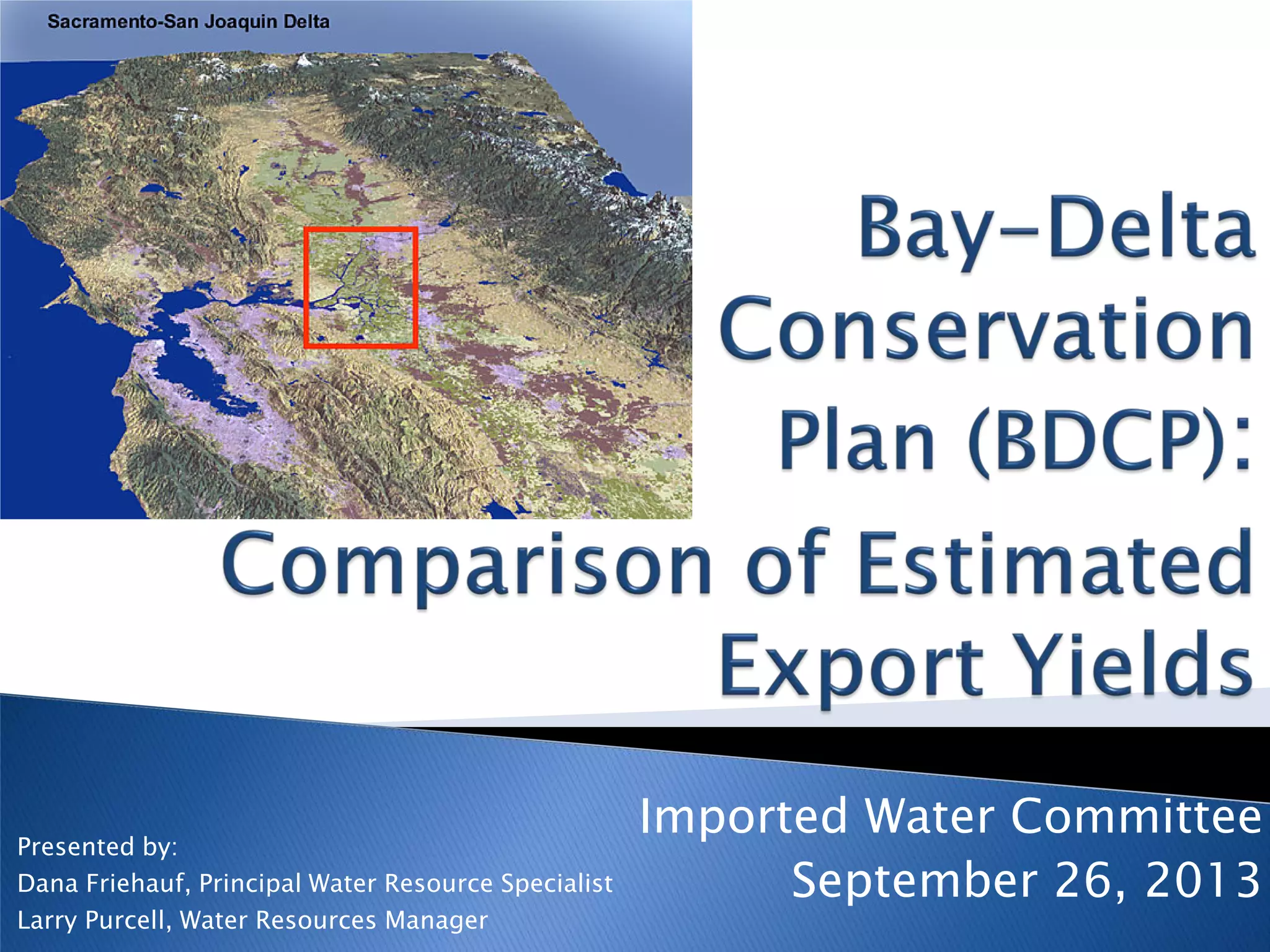
Imported Water Committee
September 26, 2013
Presented by:
Dana Friehauf, Principal Water Resource Specialist
Larry Purcell, Water Resources Manager
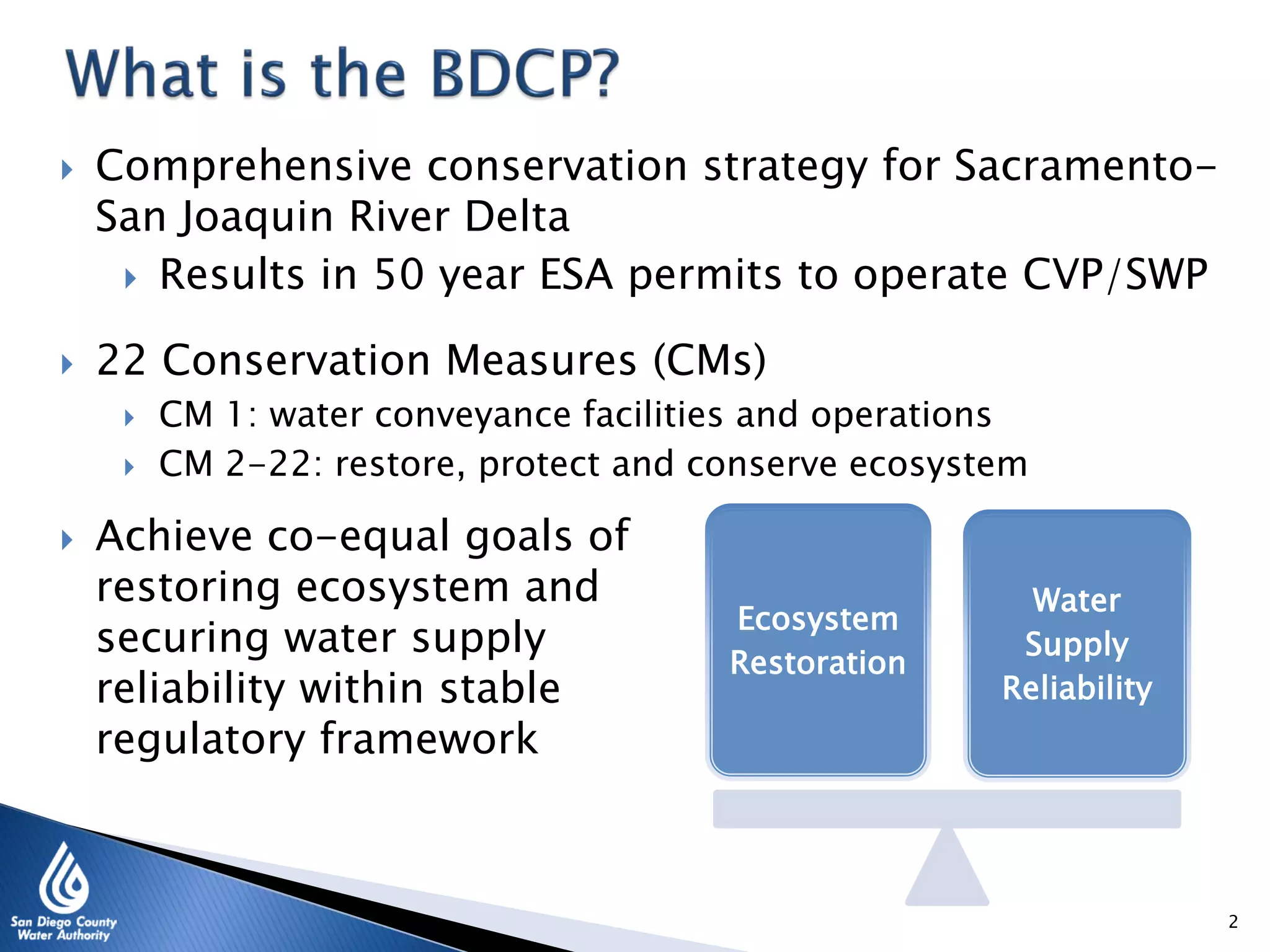
 Achieve co-equal goals of
restoring ecosystem and
securing water supply
reliability within stable
regulatory framework
2
Ecosystem
Restoration
Water
Supply
Reliability
 Comprehensive conservation strategy for Sacramento-
San Joaquin River Delta
 Results in 50 year ESA permits to operate CVP/SWP
 22 Conservation Measures (CMs)
 CM 1: water conveyance facilities and operations
 CM 2-22: restore, protect and conserve ecosystem
◦ Include storage, local supplies as part of BDCP
 NRDC portfolio option
◦ 3,000cfs north Delta conveyance
◦ Include storage, local supplies as part of BDCP
 Existing conveyance (no project alternative)
◦ Sole reliance on south delta diversion and pumping
◦ Levee and habitat improvements as currently identified
3
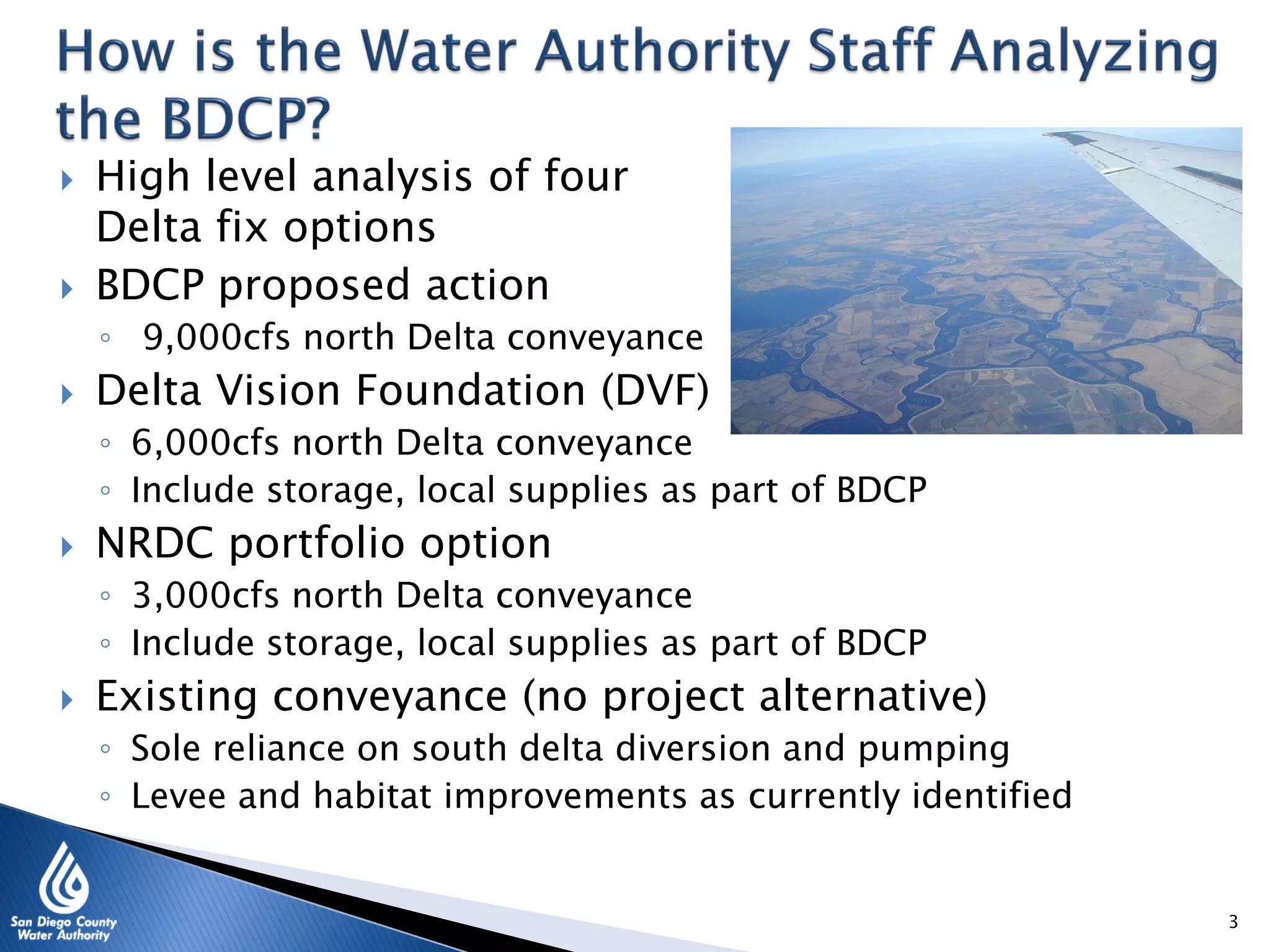
 High level analysis of four
Delta fix options
 BDCP proposed action
◦ 9,000cfs north Delta conveyance
 Delta Vision Foundation (DVF)
◦ 6,000cfs north Delta conveyance
 Two Step Approach
1. Using BDCP documents conduct “apples to apples”
comparison of key in-delta features of each
alternative
◦ August 11 Workshop, Board directed staff to conduct
“apples to apples” comparisons between alternatives
2. Qualitatively assess benefits and risks of adding
local supplies and storage to each alterative
◦ Insufficient information in NRDC and DVF proposals to
quantitatively evaluate out-of–delta components
◦ Where possible, conduct quantitative analysis
4
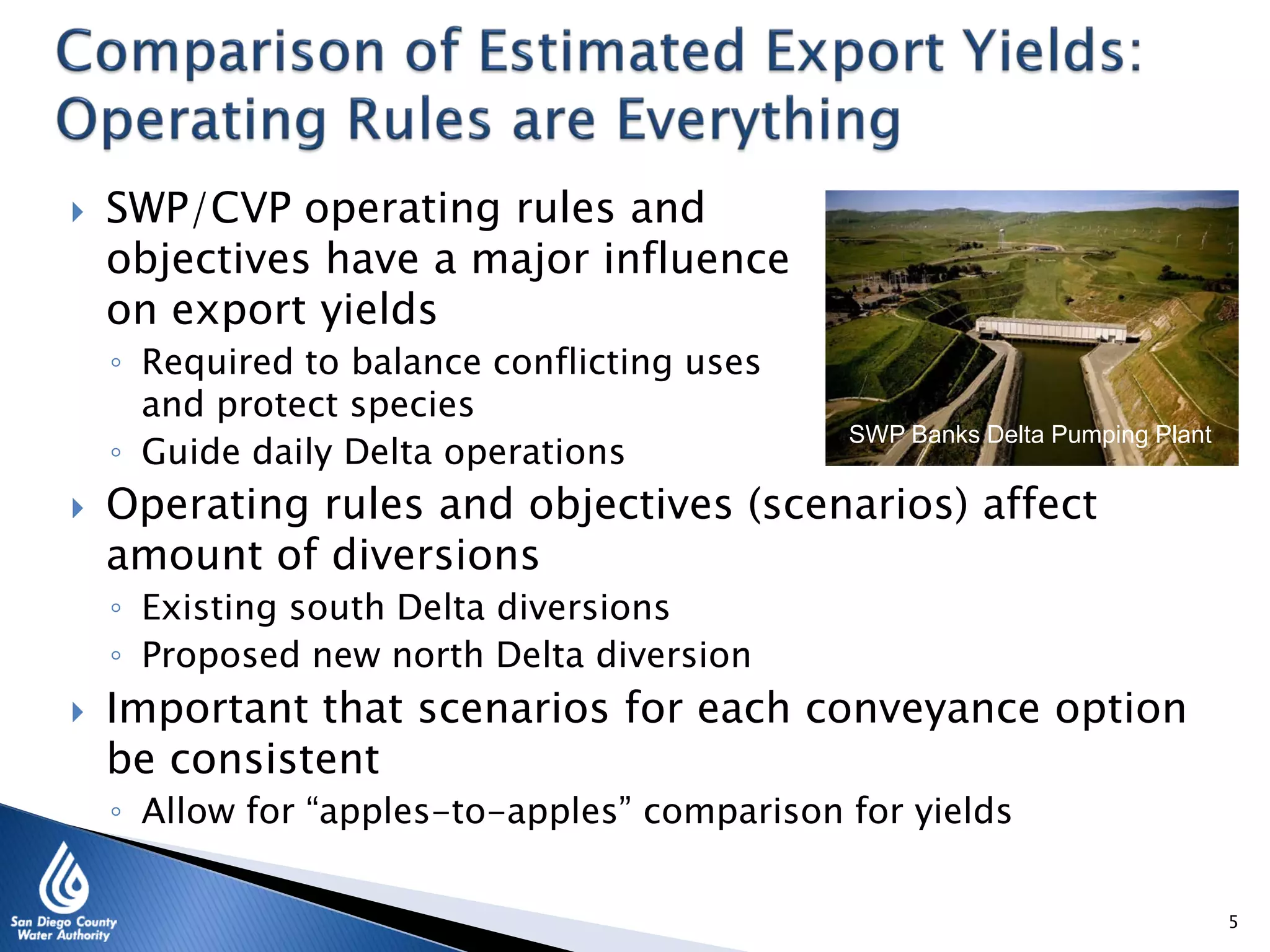
 SWP/CVP operating rules and
objectives have a major influence
on export yields
◦ Required to balance conflicting uses
and protect species
◦ Guide daily Delta operations
5
SWP Banks Delta Pumping Plant
 Operating rules and objectives (scenarios) affect
amount of diversions
◦ Existing south Delta diversions
◦ Proposed new north Delta diversion
 Important that scenarios for each conveyance option
be consistent
◦ Allow for “apples-to-apples” comparison for yields
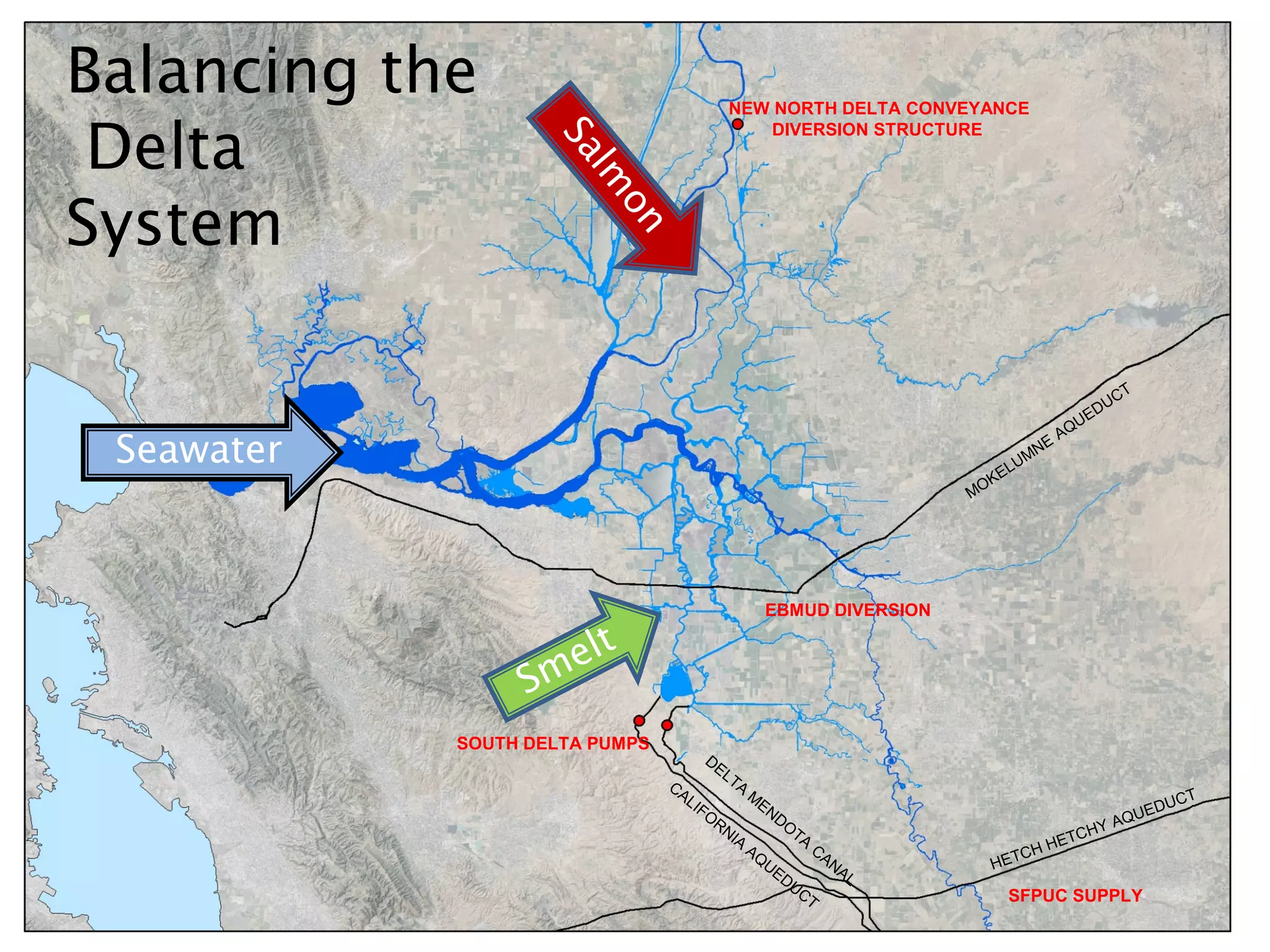
NEW NORTH DELTA CONVEYANCE
DIVERSION STRUCTURE
SOUTH DELTA PUMPS
Seawater
EBMUD DIVERSION
SFPUC SUPPLY
Balancing the
Delta
System
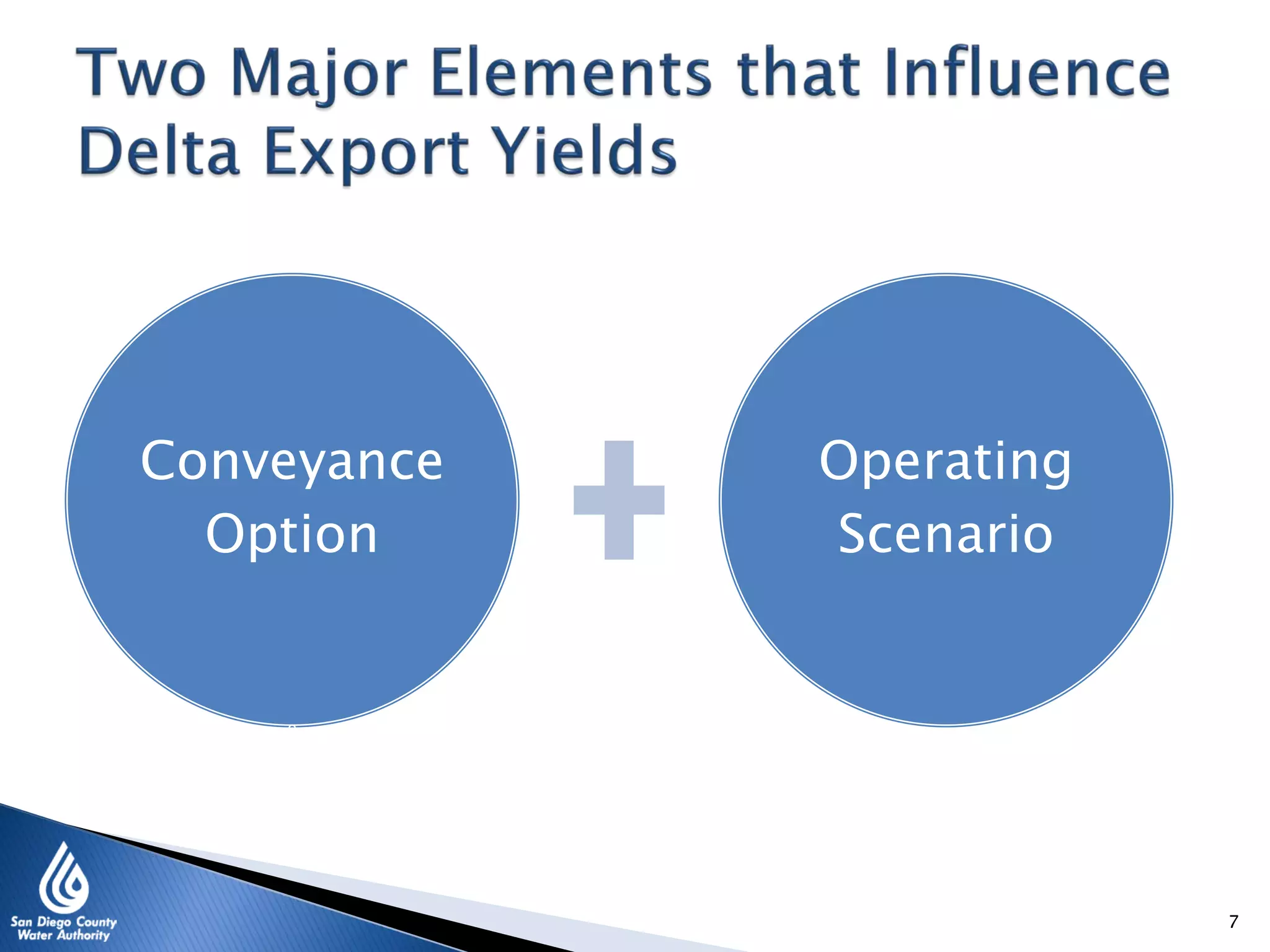
Conveyance
Option
Operating
Scenario
7
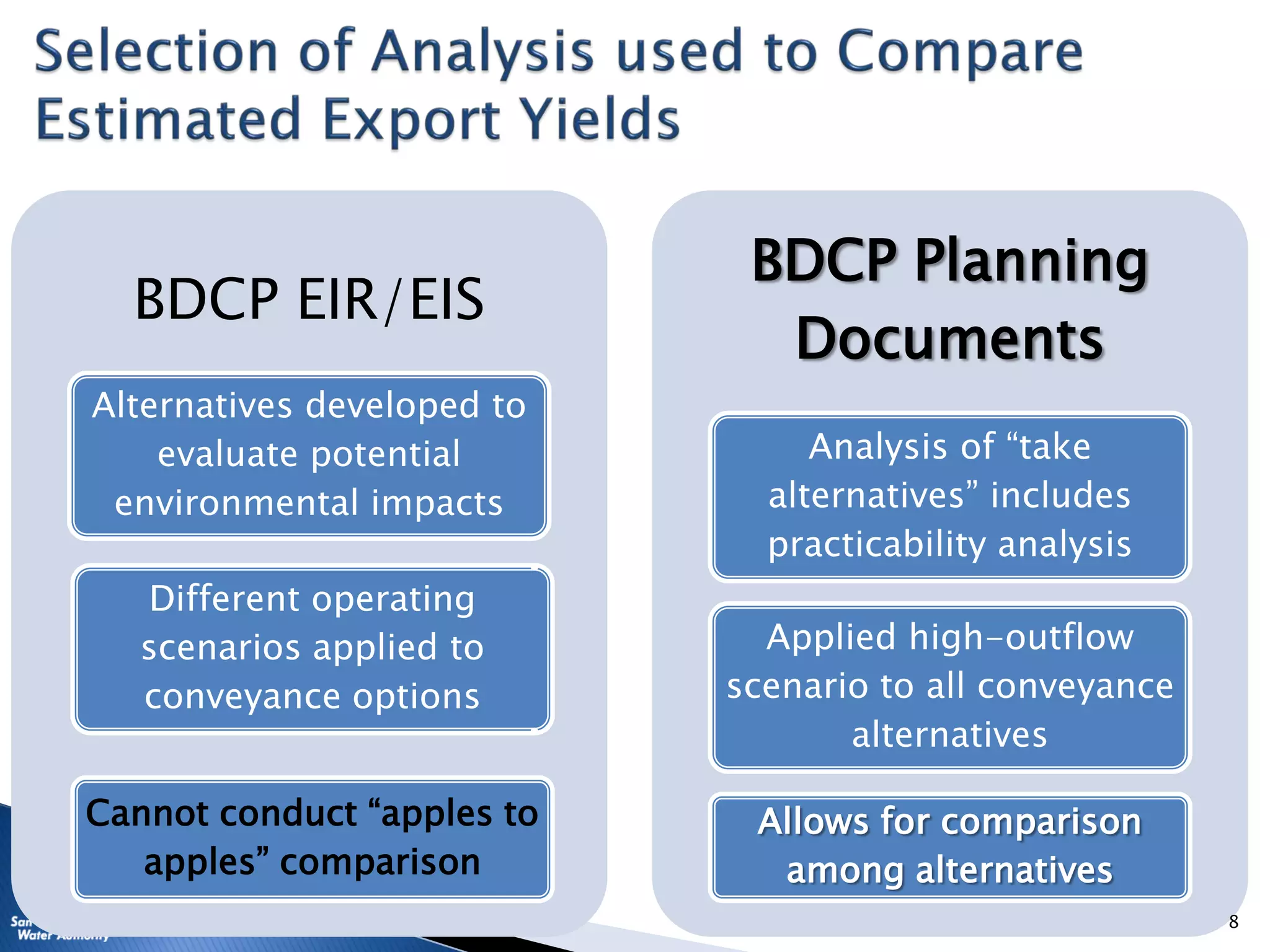
BDCP EIR/EIS
Alternatives developed to
evaluate potential
environmental impacts
Different operating
scenarios applied to
conveyance options
Cannot conduct “apples to
apples” comparison
BDCP Planning
Documents
Analysis of “take
alternatives” includes
practicability analysis
Applied high-outflow
scenario to all conveyance
alternatives
Allows for comparison
among alternatives
8
9
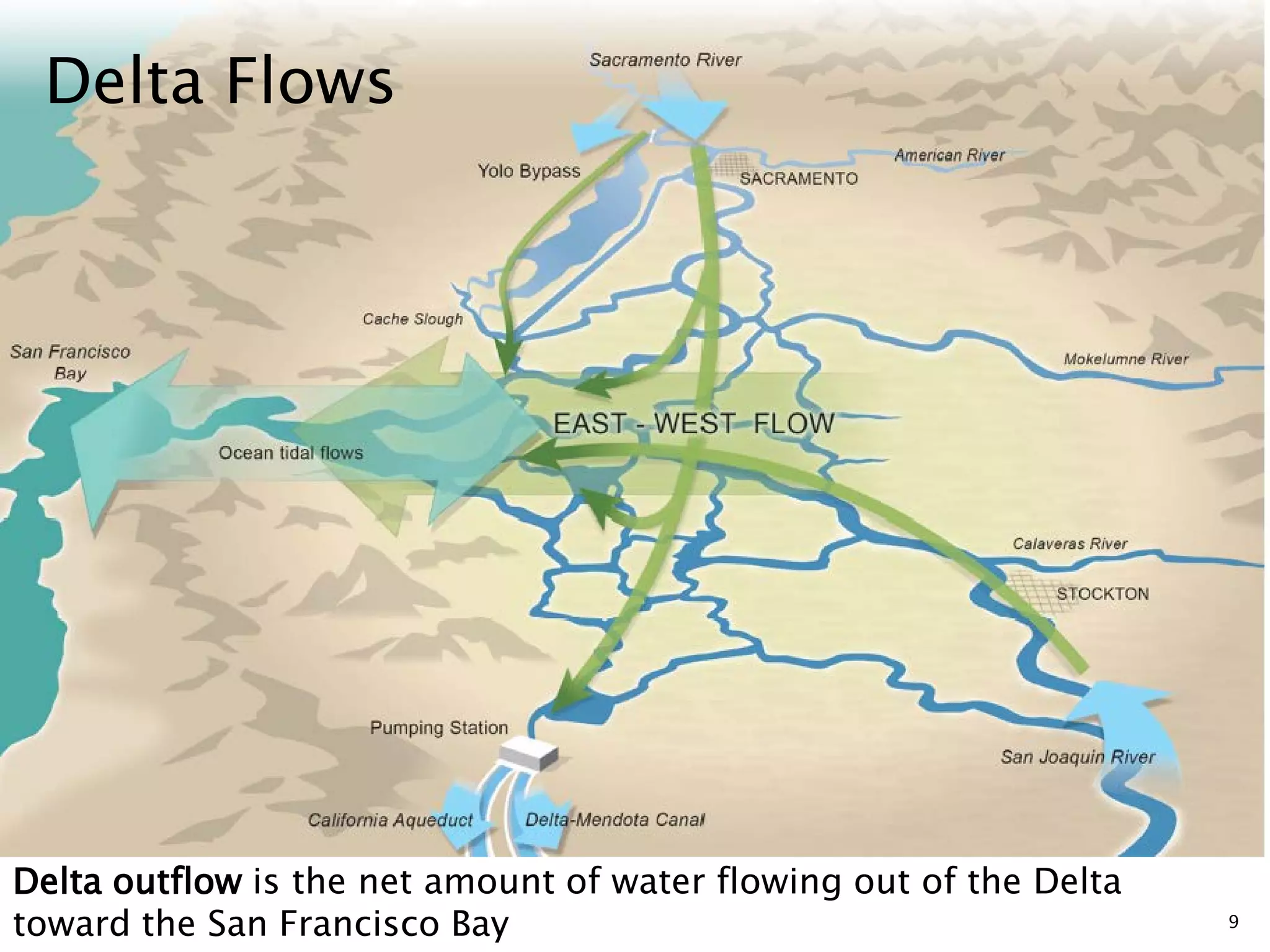
Delta Flows
Delta outflow is the net amount of water flowing out of the Delta
toward the San Francisco Bay
10
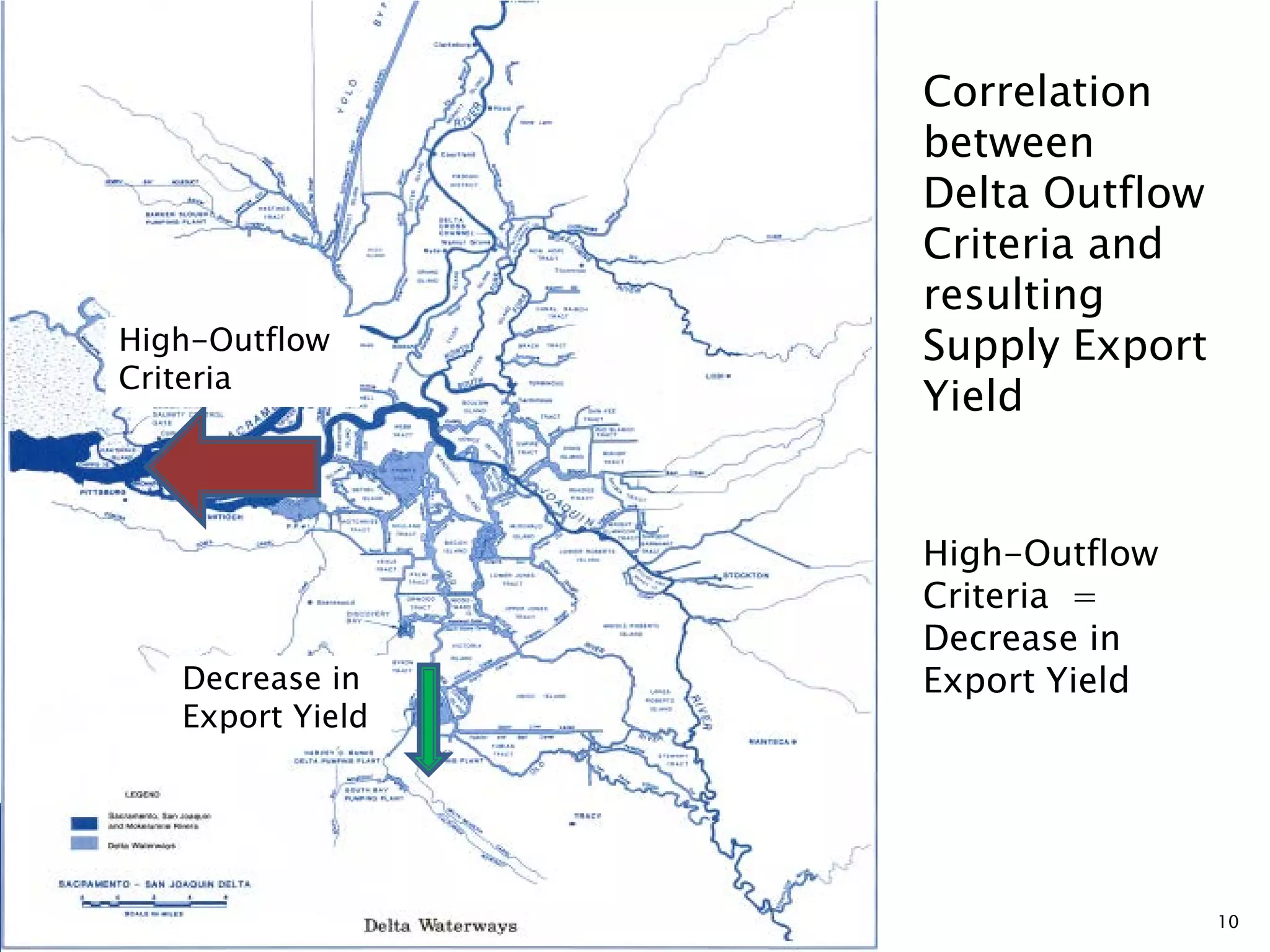
Correlation
between
Delta Outflow
Criteria and
resulting
Supply Export
Yield
High-Outflow
Criteria
Decrease in
Export Yield
High-Outflow
Criteria =
Decrease in
Export Yield
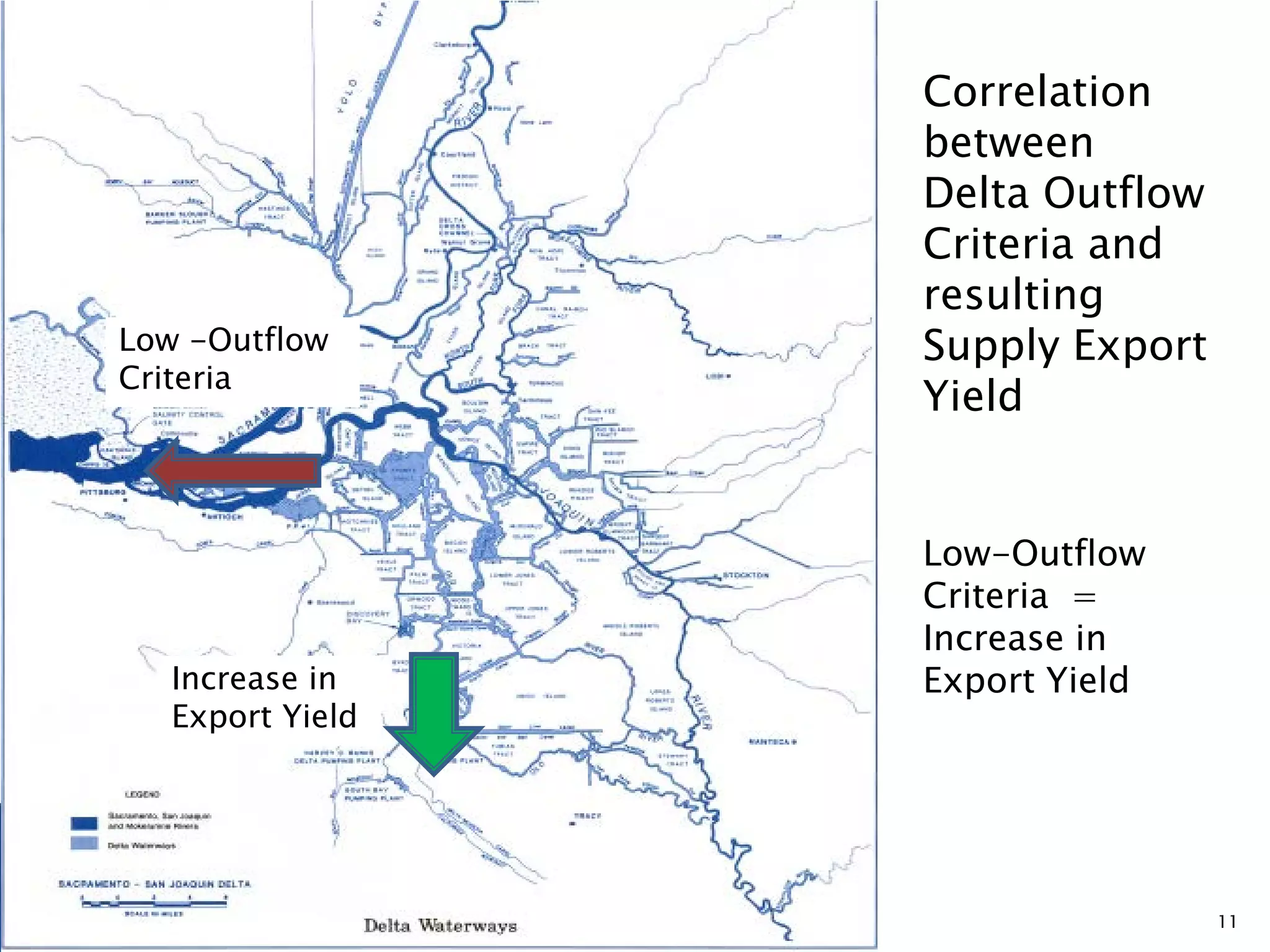
11
Correlation
between
Delta Outflow
Criteria and
resulting
Supply Export
Yield
Low -Outflow
Criteria
Increase in
Export Yield
Low-Outflow
Criteria =
Increase in
Export Yield
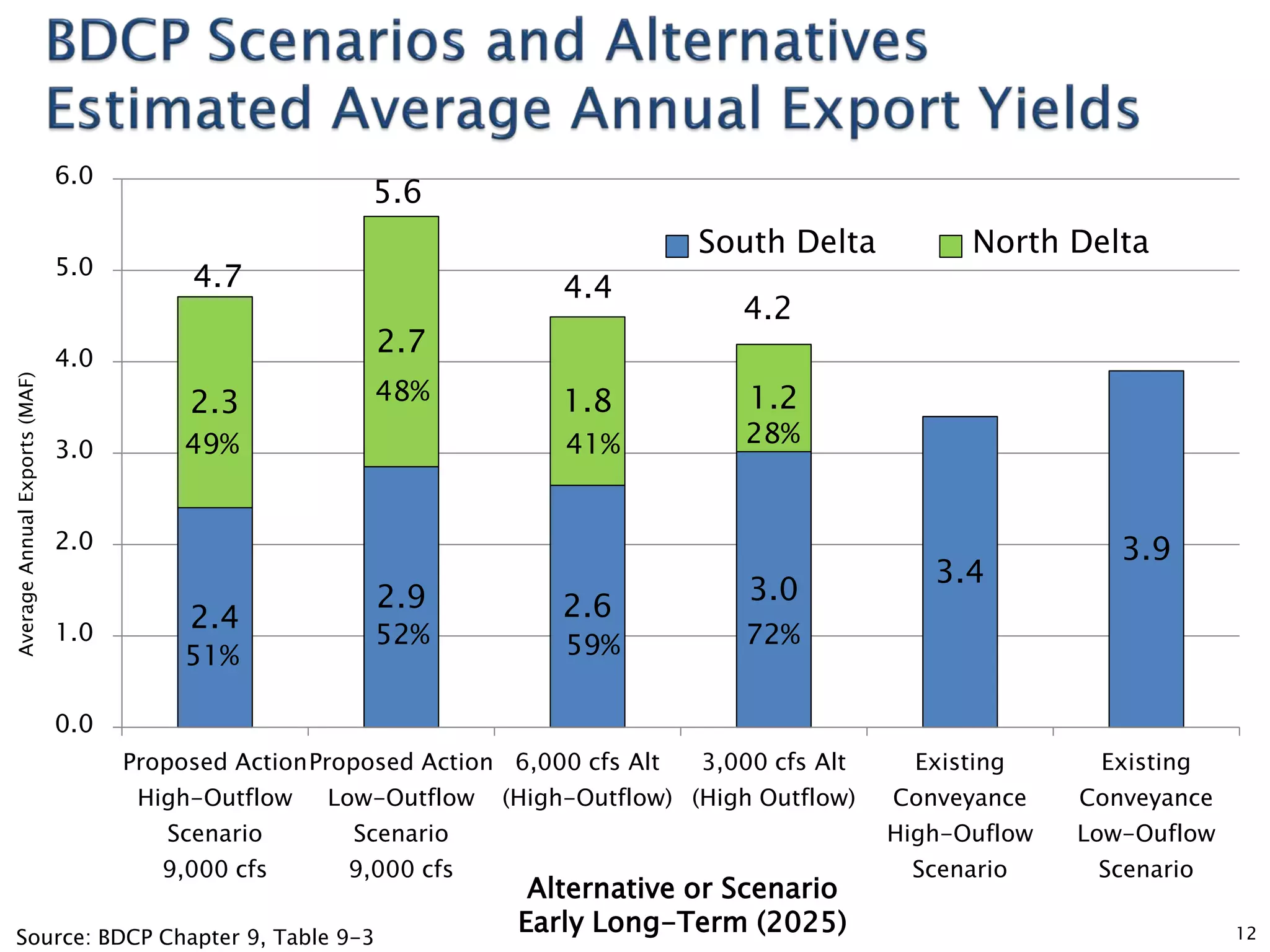
12
2.4
2.9 2.6
3.0
3.4
3.9
2.3
2.7
1.8 1.2
0.0
1.0
2.0
3.0
4.0
5.0
6.0
Proposed Action
High-Outflow
Scenario
9,000 cfs
Proposed Action
Low-Outflow
Scenario
9,000 cfs
6,000 cfs Alt
(High-Outflow)
3,000 cfs Alt
(High Outflow)
Existing
Conveyance
High-Ouflow
Scenario
Existing
Conveyance
Low-Ouflow
Scenario
South Delta North Delta
Alternative or Scenario
Early Long-Term (2025)
AverageAnnualExports(MAF)
4.7
4.2
4.4
5.6
Source: BDCP Chapter 9, Table 9-3 12
51%
28%
72%
41%
59%
48%
52%
49%
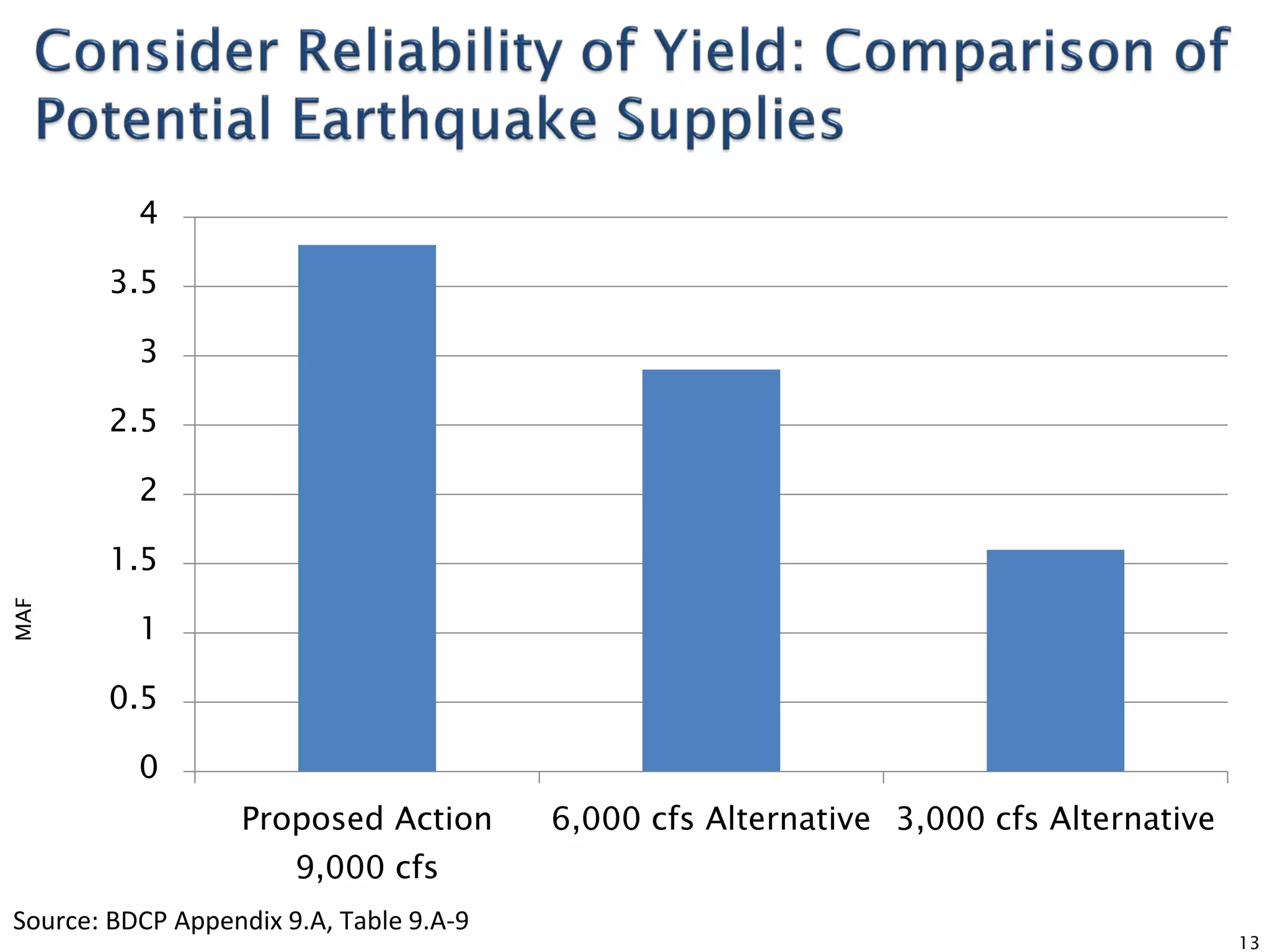
13
0
0.5
1
1.5
2
2.5
3
3.5
4
Proposed Action
9,000 cfs
6,000 cfs Alternative 3,000 cfs Alternative
MAF
Source: BDCP Appendix 9.A, Table 9.A-9
13
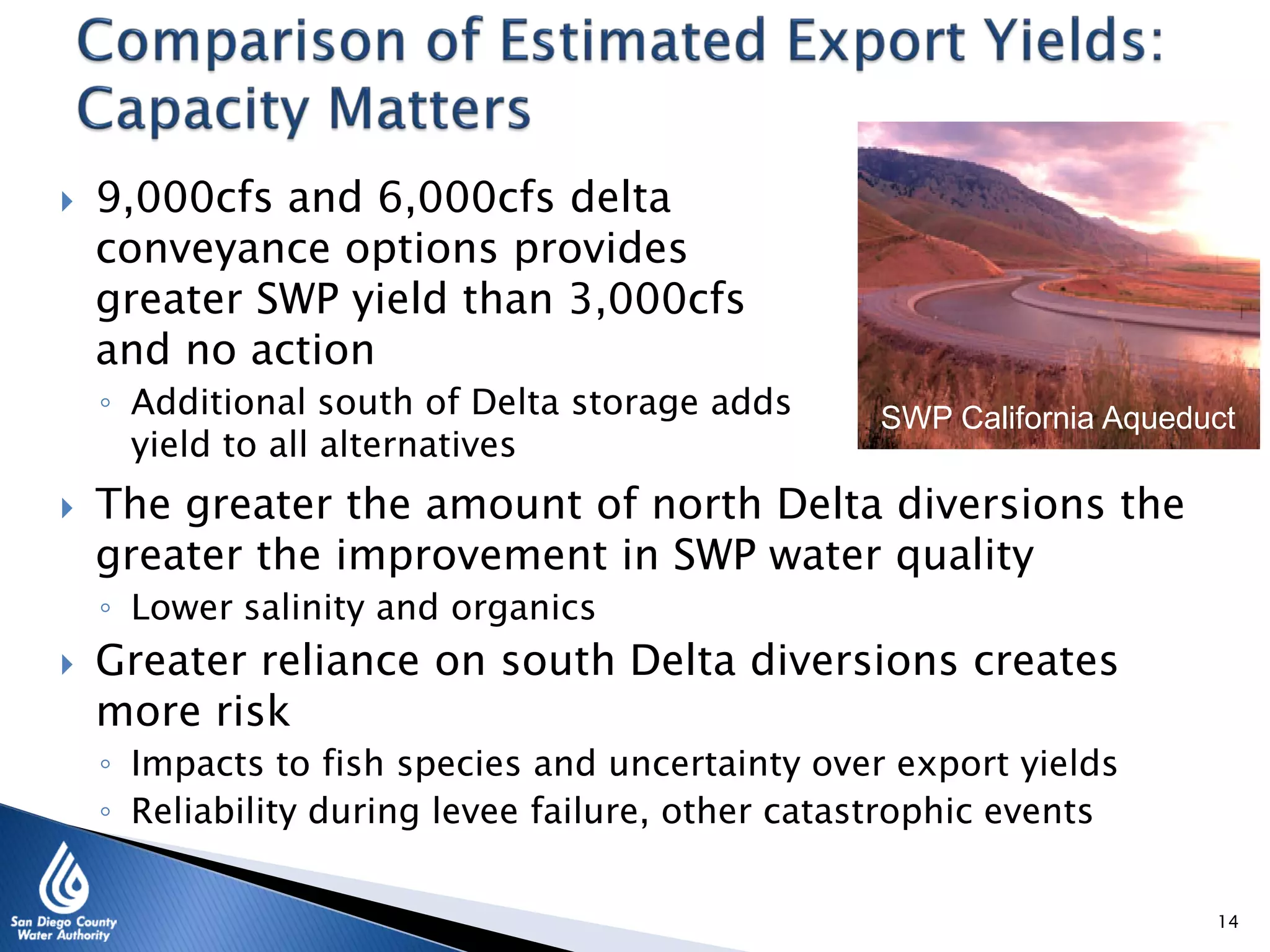
 9,000cfs and 6,000cfs delta
conveyance options provides
greater SWP yield than 3,000cfs
and no action
◦ Additional south of Delta storage adds
yield to all alternatives
14
SWP California Aqueduct
 The greater the amount of north Delta diversions the
greater the improvement in SWP water quality
◦ Lower salinity and organics
 Greater reliance on south Delta diversions creates
more risk
◦ Impacts to fish species and uncertainty over export yields
◦ Reliability during levee failure, other catastrophic events
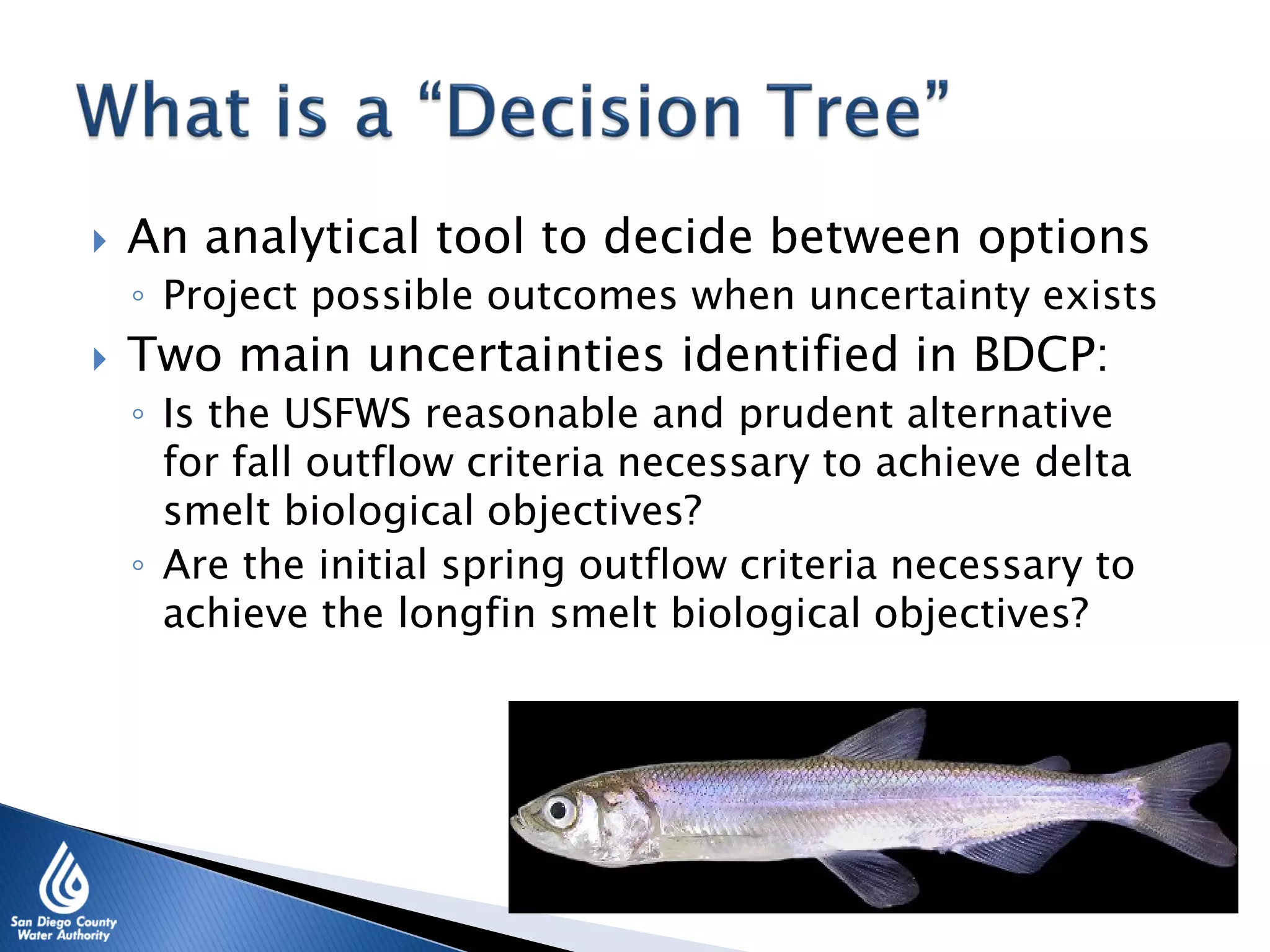
 An analytical tool to decide between options
◦ Project possible outcomes when uncertainty exists
 Two main uncertainties identified in BDCP:
◦ Is the USFWS reasonable and prudent alternative
for fall outflow criteria necessary to achieve delta
smelt biological objectives?
◦ Are the initial spring outflow criteria necessary to
achieve the longfin smelt biological objectives?
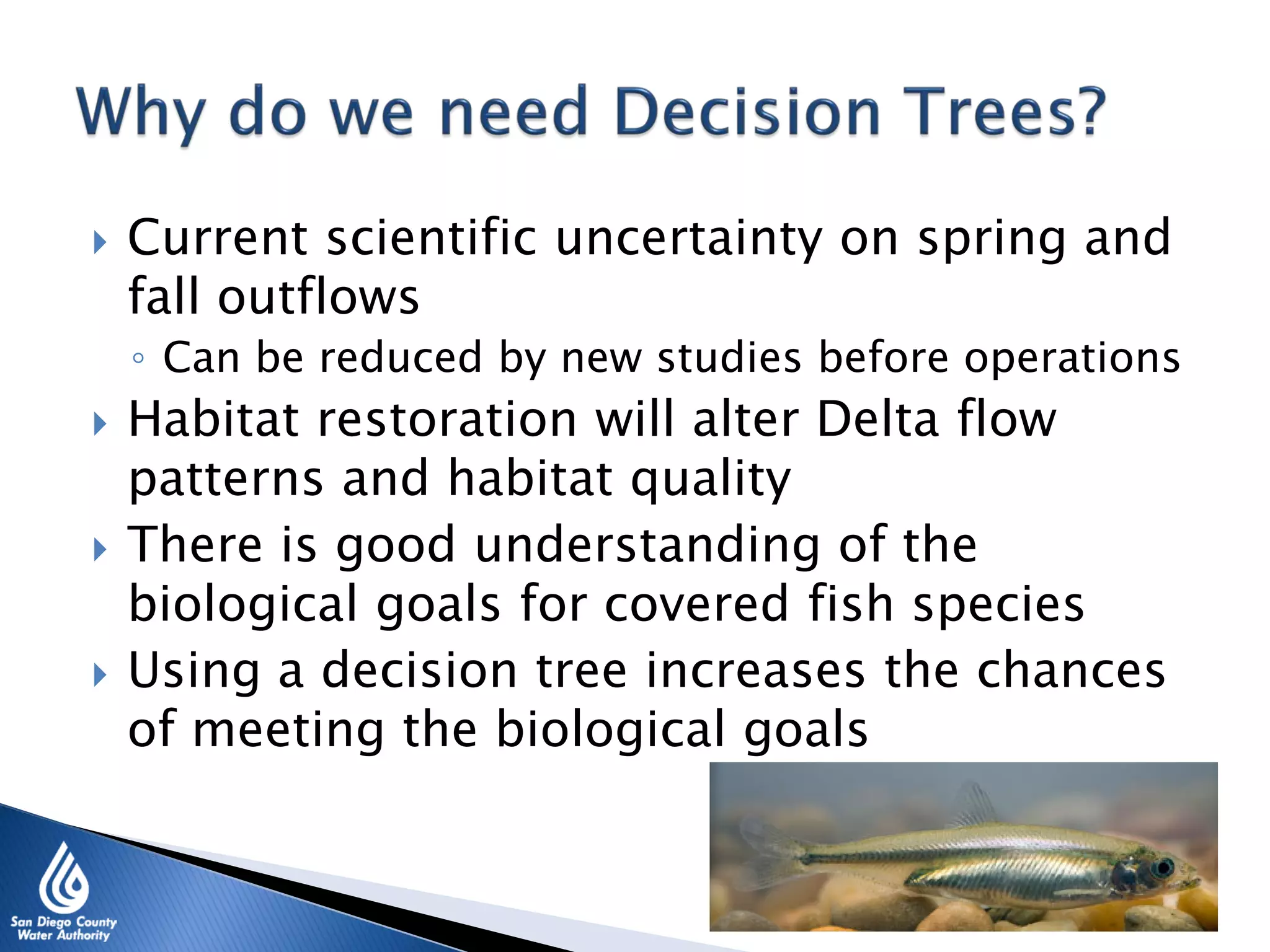
 Current scientific uncertainty on spring and
fall outflows
◦ Can be reduced by new studies before operations
 Habitat restoration will alter Delta flow
patterns and habitat quality
 There is good understanding of the
biological goals for covered fish species
 Using a decision tree increases the chances
of meeting the biological goals
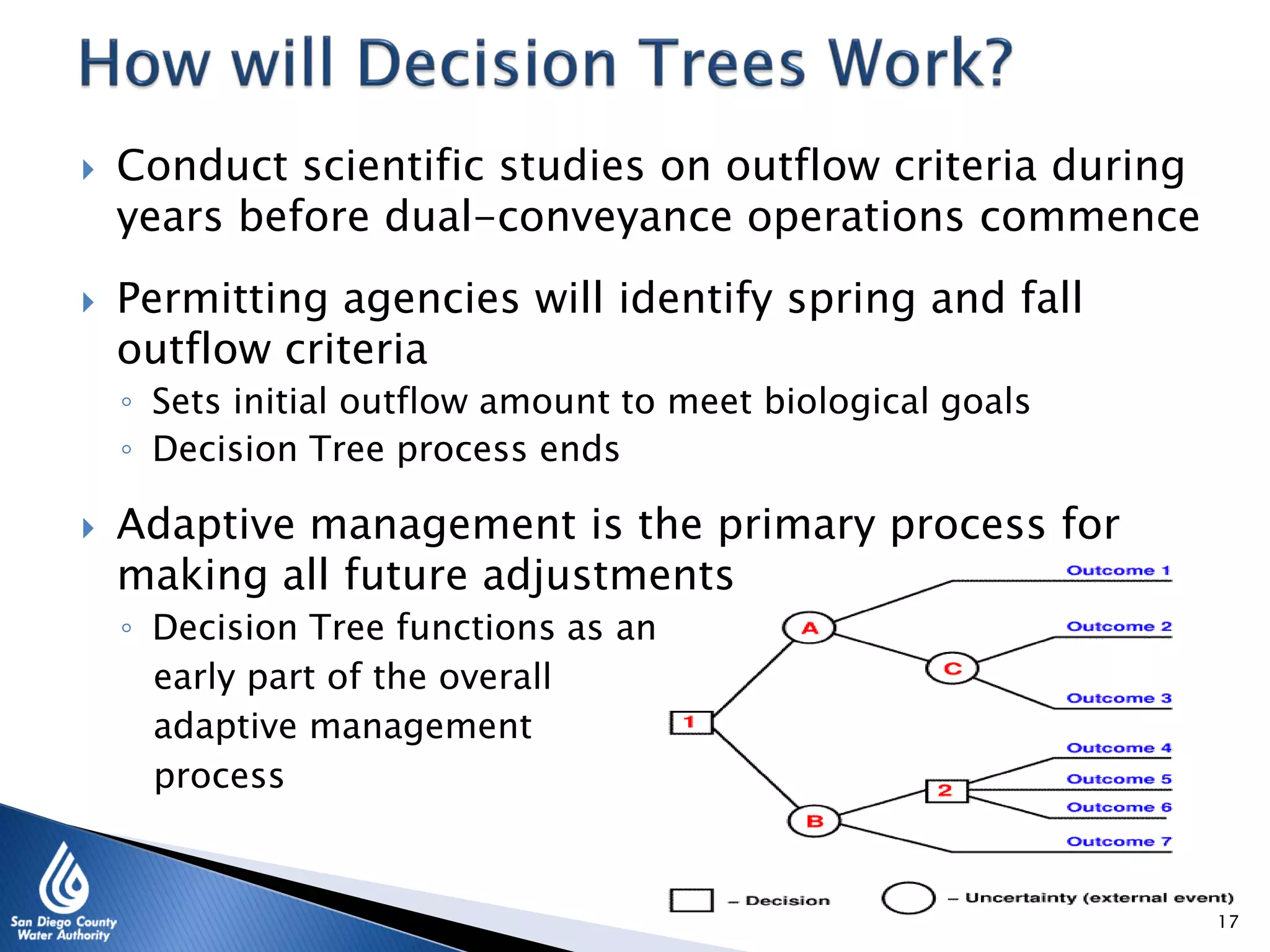
 Conduct scientific studies on outflow criteria during
years before dual-conveyance operations commence
 Permitting agencies will identify spring and fall
outflow criteria
◦ Sets initial outflow amount to meet biological goals
◦ Decision Tree process ends
 Adaptive management is the primary process for
making all future adjustments
◦ Decision Tree functions as an
early part of the overall
adaptive management
process
17
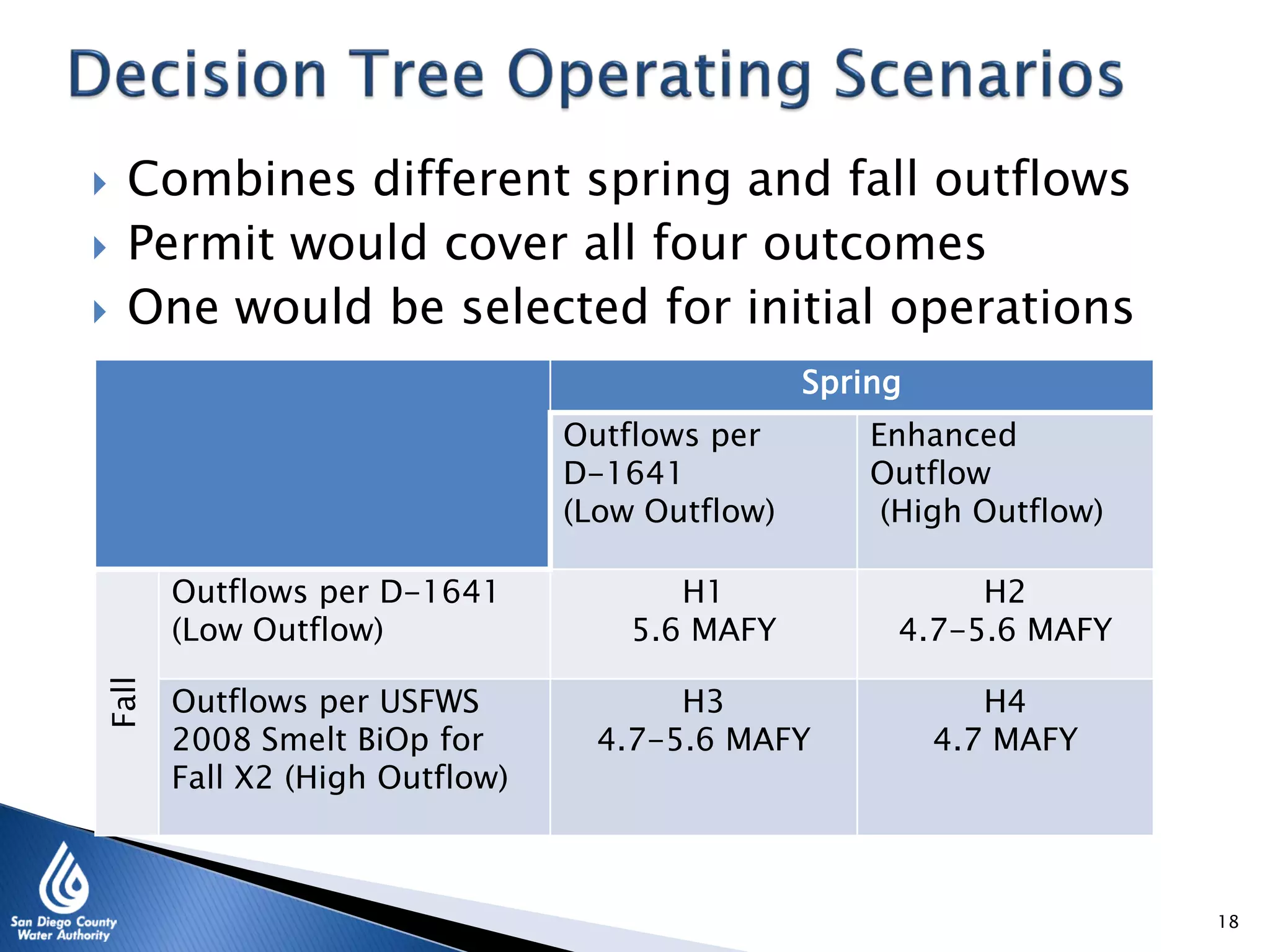
 Combines different spring and fall outflows
 Permit would cover all four outcomes
 One would be selected for initial operations
18
Spring
Outflows per
D-1641
(Low Outflow)
Enhanced
Outflow
(High Outflow)
Fall
Outflows per D-1641
(Low Outflow)
H1
5.6 MAFY
H2
4.7-5.6 MAFY
Outflows per USFWS
2008 Smelt BiOp for
Fall X2 (High Outflow)
H3
4.7-5.6 MAFY
H4
4.7 MAFY
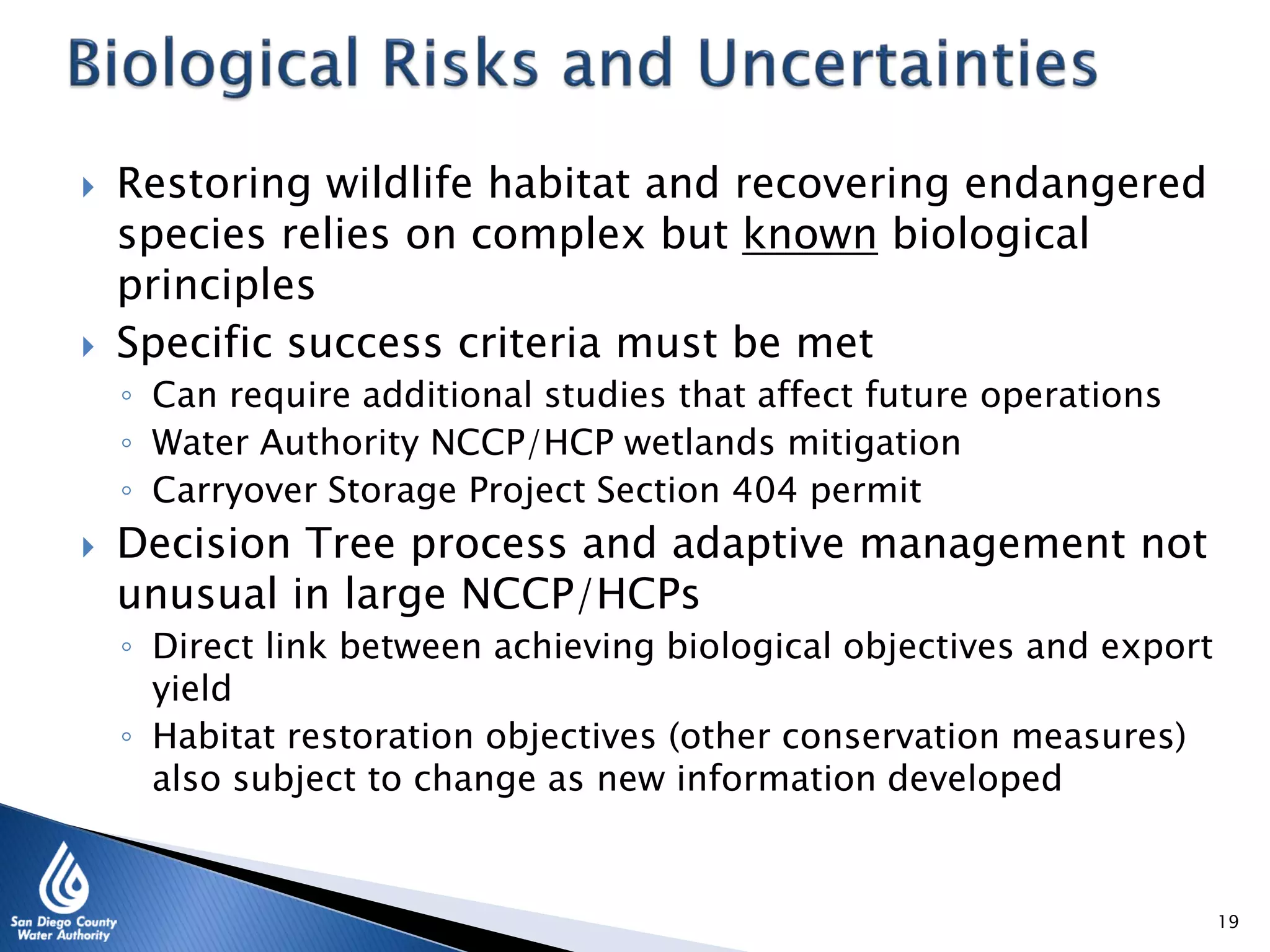
 Restoring wildlife habitat and recovering endangered
species relies on complex but known biological
principles
 Specific success criteria must be met
◦ Can require additional studies that affect future operations
◦ Water Authority NCCP/HCP wetlands mitigation
◦ Carryover Storage Project Section 404 permit
 Decision Tree process and adaptive management not
unusual in large NCCP/HCPs
◦ Direct link between achieving biological objectives and export
yield
◦ Habitat restoration objectives (other conservation measures)
also subject to change as new information developed
19
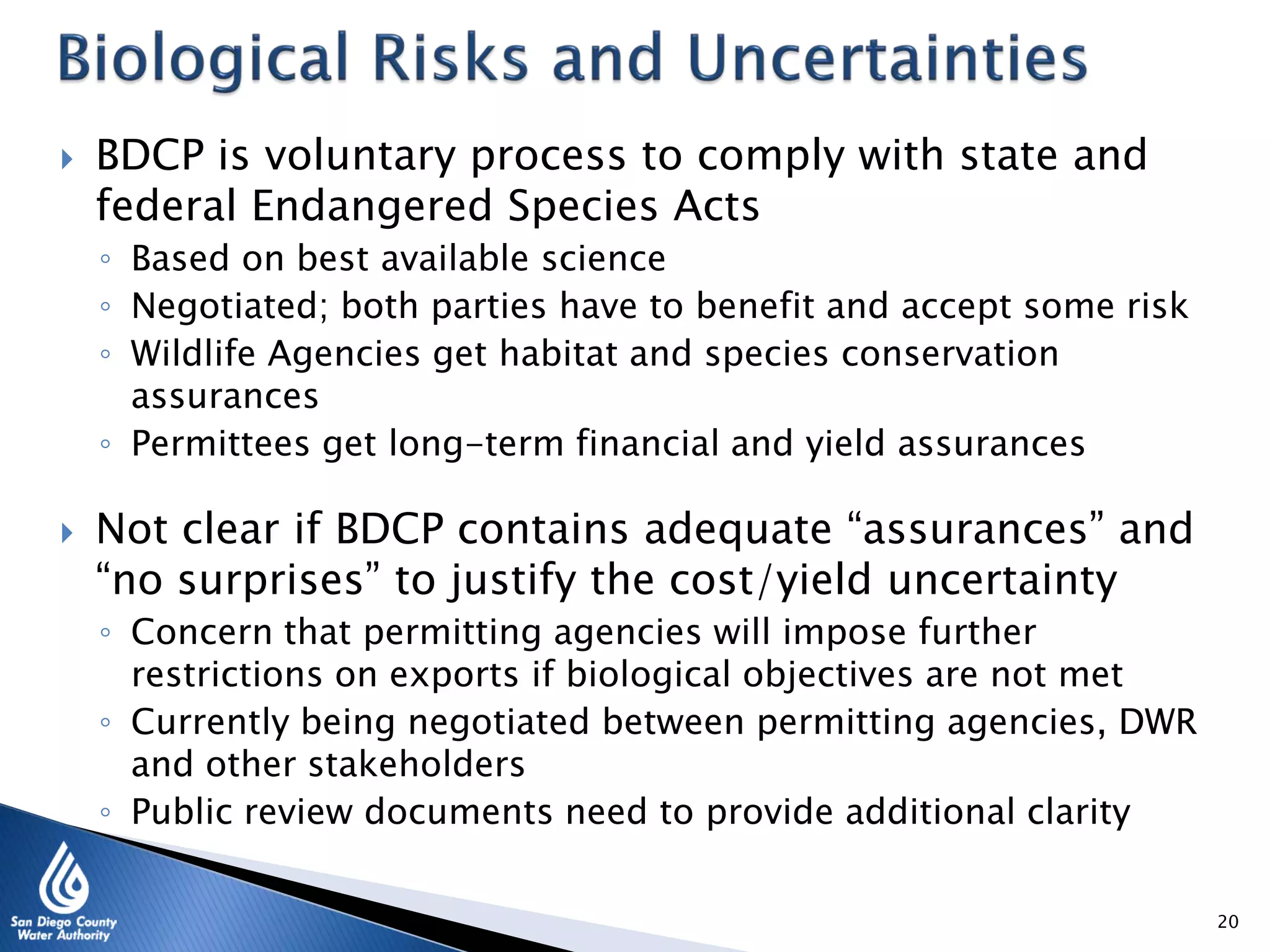
 BDCP is voluntary process to comply with state and
federal Endangered Species Acts
◦ Based on best available science
◦ Negotiated; both parties have to benefit and accept some risk
◦ Wildlife Agencies get habitat and species conservation
assurances
◦ Permittees get long-term financial and yield assurances
 Not clear if BDCP contains adequate “assurances” and
“no surprises” to justify the cost/yield uncertainty
◦ Concern that permitting agencies will impose further
restrictions on exports if biological objectives are not met
◦ Currently being negotiated between permitting agencies, DWR
and other stakeholders
◦ Public review documents need to provide additional clarity
20
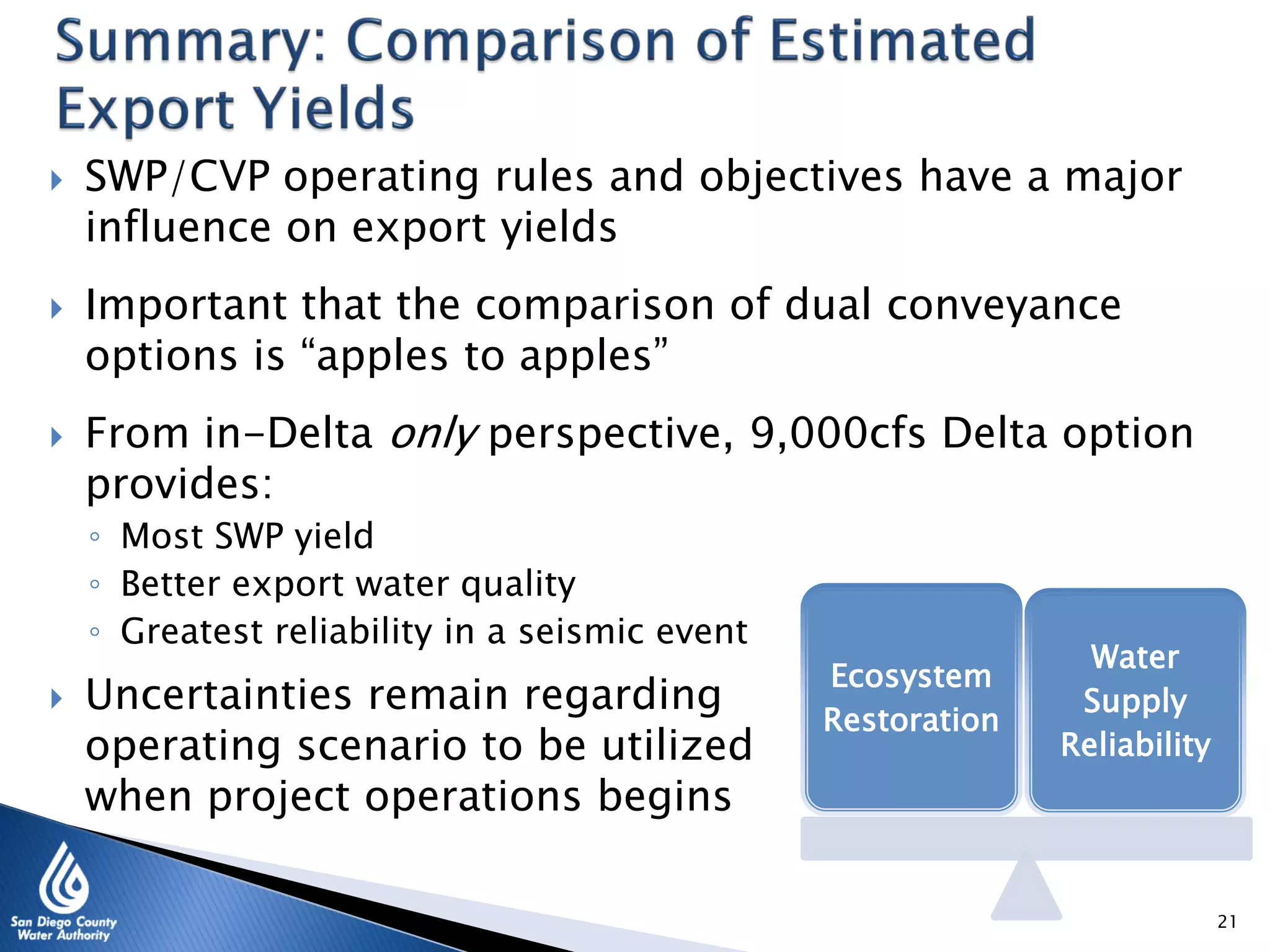
 SWP/CVP operating rules and objectives have a major
influence on export yields
 Important that the comparison of dual conveyance
options is “apples to apples”
 From in-Delta only perspective, 9,000cfs Delta option
provides:
◦ Most SWP yield
◦ Better export water quality
◦ Greatest reliability in a seismic event
21
Ecosystem
Restoration
Water
Supply
Reliability
 Uncertainties remain regarding
operating scenario to be utilized
when project operations begins
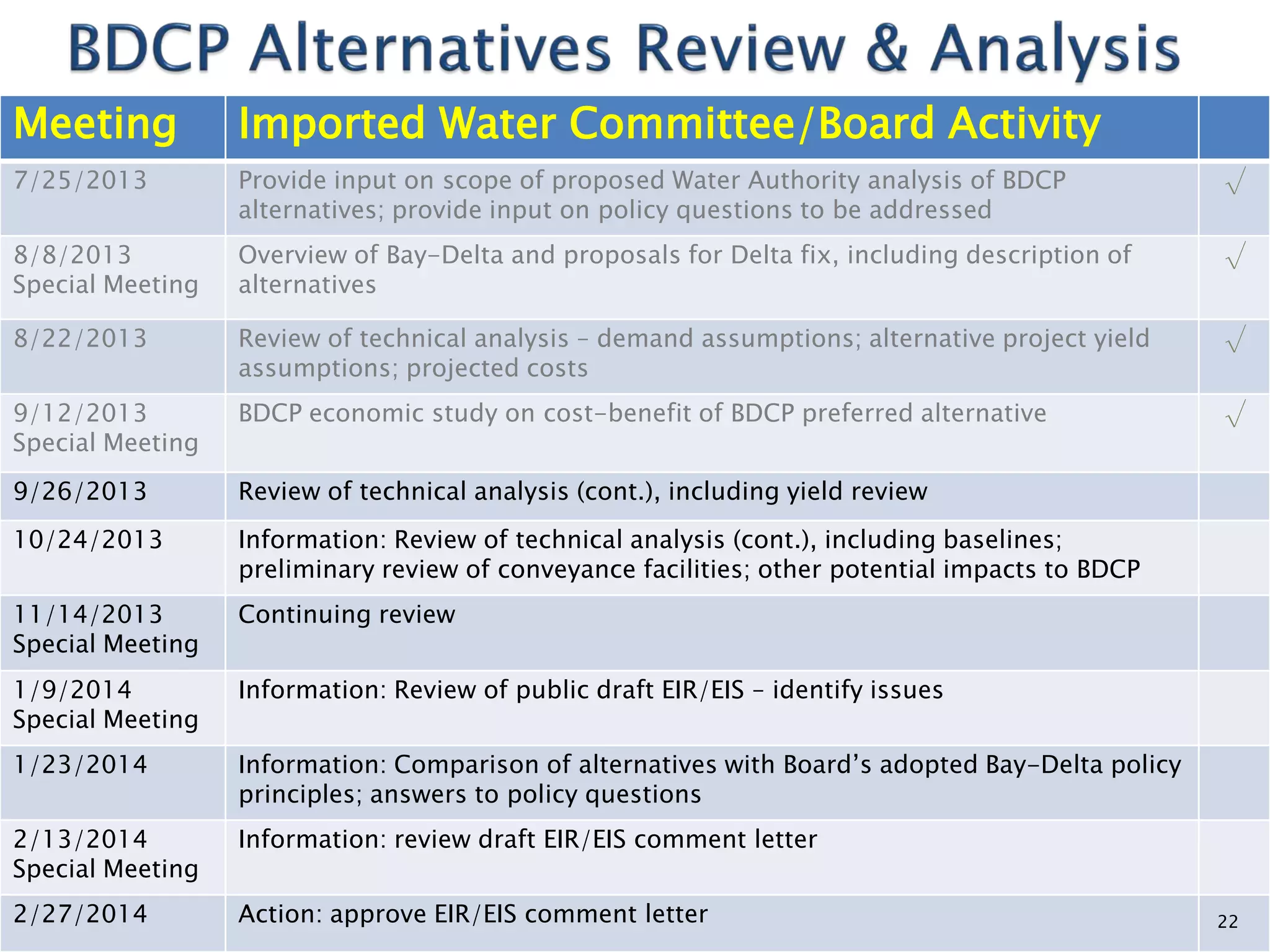
Meeting Imported Water Committee/Board Activity
7/25/2013 Provide input on scope of proposed Water Authority analysis of BDCP
alternatives; provide input on policy questions to be addressed
√
8/8/2013
Special Meeting
Overview of Bay-Delta and proposals for Delta fix, including description of
alternatives
√
8/22/2013 Review of technical analysis – demand assumptions; alternative project yield
assumptions; projected costs
√
9/12/2013
Special Meeting
BDCP economic study on cost-benefit of BDCP preferred alternative √
9/26/2013 Review of technical analysis (cont.), including yield review
10/24/2013 Information: Review of technical analysis (cont.), including baselines;
preliminary review of conveyance facilities; other potential impacts to BDCP
11/14/2013
Special Meeting
Continuing review
1/9/2014
Special Meeting
Information: Review of public draft EIR/EIS – identify issues
1/23/2014 Information: Comparison of alternatives with Board’s adopted Bay-Delta policy
principles; answers to policy questions
2/13/2014
Special Meeting
Information: review draft EIR/EIS comment letter
2/27/2014 Action: approve EIR/EIS comment letter 22
Bay-Delta Conservation Plan: Comparison of Estimated Yields - Sept. 26, 2013

Bay-Delta Conservation Plan: Comparison of Estimated Yields - Sept. 26, 2013

  • 1.
    Imported Water Committee September26, 2013 Presented by: Dana Friehauf, Principal Water Resource Specialist Larry Purcell, Water Resources Manager
  • 2.
     Achieve co-equalgoals of restoring ecosystem and securing water supply reliability within stable regulatory framework 2 Ecosystem Restoration Water Supply Reliability  Comprehensive conservation strategy for Sacramento- San Joaquin River Delta  Results in 50 year ESA permits to operate CVP/SWP  22 Conservation Measures (CMs)  CM 1: water conveyance facilities and operations  CM 2-22: restore, protect and conserve ecosystem
  • 3.
    ◦ Include storage,local supplies as part of BDCP  NRDC portfolio option ◦ 3,000cfs north Delta conveyance ◦ Include storage, local supplies as part of BDCP  Existing conveyance (no project alternative) ◦ Sole reliance on south delta diversion and pumping ◦ Levee and habitat improvements as currently identified 3  High level analysis of four Delta fix options  BDCP proposed action ◦ 9,000cfs north Delta conveyance  Delta Vision Foundation (DVF) ◦ 6,000cfs north Delta conveyance
  • 4.
     Two StepApproach 1. Using BDCP documents conduct “apples to apples” comparison of key in-delta features of each alternative ◦ August 11 Workshop, Board directed staff to conduct “apples to apples” comparisons between alternatives 2. Qualitatively assess benefits and risks of adding local supplies and storage to each alterative ◦ Insufficient information in NRDC and DVF proposals to quantitatively evaluate out-of–delta components ◦ Where possible, conduct quantitative analysis 4
  • 5.
     SWP/CVP operatingrules and objectives have a major influence on export yields ◦ Required to balance conflicting uses and protect species ◦ Guide daily Delta operations 5 SWP Banks Delta Pumping Plant  Operating rules and objectives (scenarios) affect amount of diversions ◦ Existing south Delta diversions ◦ Proposed new north Delta diversion  Important that scenarios for each conveyance option be consistent ◦ Allow for “apples-to-apples” comparison for yields
  • 6.
    NEW NORTH DELTACONVEYANCE DIVERSION STRUCTURE SOUTH DELTA PUMPS Seawater EBMUD DIVERSION SFPUC SUPPLY Balancing the Delta System
  • 7.
  • 8.
    BDCP EIR/EIS Alternatives developedto evaluate potential environmental impacts Different operating scenarios applied to conveyance options Cannot conduct “apples to apples” comparison BDCP Planning Documents Analysis of “take alternatives” includes practicability analysis Applied high-outflow scenario to all conveyance alternatives Allows for comparison among alternatives 8
  • 9.
    9 Delta Flows Delta outflowis the net amount of water flowing out of the Delta toward the San Francisco Bay
  • 10.
    10 Correlation between Delta Outflow Criteria and resulting SupplyExport Yield High-Outflow Criteria Decrease in Export Yield High-Outflow Criteria = Decrease in Export Yield
  • 11.
    11 Correlation between Delta Outflow Criteria and resulting SupplyExport Yield Low -Outflow Criteria Increase in Export Yield Low-Outflow Criteria = Increase in Export Yield
  • 12.
    12 2.4 2.9 2.6 3.0 3.4 3.9 2.3 2.7 1.8 1.2 0.0 1.0 2.0 3.0 4.0 5.0 6.0 ProposedAction High-Outflow Scenario 9,000 cfs Proposed Action Low-Outflow Scenario 9,000 cfs 6,000 cfs Alt (High-Outflow) 3,000 cfs Alt (High Outflow) Existing Conveyance High-Ouflow Scenario Existing Conveyance Low-Ouflow Scenario South Delta North Delta Alternative or Scenario Early Long-Term (2025) AverageAnnualExports(MAF) 4.7 4.2 4.4 5.6 Source: BDCP Chapter 9, Table 9-3 12 51% 28% 72% 41% 59% 48% 52% 49%
  • 13.
    13 0 0.5 1 1.5 2 2.5 3 3.5 4 Proposed Action 9,000 cfs 6,000cfs Alternative 3,000 cfs Alternative MAF Source: BDCP Appendix 9.A, Table 9.A-9 13
  • 14.
     9,000cfs and6,000cfs delta conveyance options provides greater SWP yield than 3,000cfs and no action ◦ Additional south of Delta storage adds yield to all alternatives 14 SWP California Aqueduct  The greater the amount of north Delta diversions the greater the improvement in SWP water quality ◦ Lower salinity and organics  Greater reliance on south Delta diversions creates more risk ◦ Impacts to fish species and uncertainty over export yields ◦ Reliability during levee failure, other catastrophic events
  • 15.
     An analyticaltool to decide between options ◦ Project possible outcomes when uncertainty exists  Two main uncertainties identified in BDCP: ◦ Is the USFWS reasonable and prudent alternative for fall outflow criteria necessary to achieve delta smelt biological objectives? ◦ Are the initial spring outflow criteria necessary to achieve the longfin smelt biological objectives?
  • 16.
     Current scientificuncertainty on spring and fall outflows ◦ Can be reduced by new studies before operations  Habitat restoration will alter Delta flow patterns and habitat quality  There is good understanding of the biological goals for covered fish species  Using a decision tree increases the chances of meeting the biological goals
  • 17.
     Conduct scientificstudies on outflow criteria during years before dual-conveyance operations commence  Permitting agencies will identify spring and fall outflow criteria ◦ Sets initial outflow amount to meet biological goals ◦ Decision Tree process ends  Adaptive management is the primary process for making all future adjustments ◦ Decision Tree functions as an early part of the overall adaptive management process 17
  • 18.
     Combines differentspring and fall outflows  Permit would cover all four outcomes  One would be selected for initial operations 18 Spring Outflows per D-1641 (Low Outflow) Enhanced Outflow (High Outflow) Fall Outflows per D-1641 (Low Outflow) H1 5.6 MAFY H2 4.7-5.6 MAFY Outflows per USFWS 2008 Smelt BiOp for Fall X2 (High Outflow) H3 4.7-5.6 MAFY H4 4.7 MAFY
  • 19.
     Restoring wildlifehabitat and recovering endangered species relies on complex but known biological principles  Specific success criteria must be met ◦ Can require additional studies that affect future operations ◦ Water Authority NCCP/HCP wetlands mitigation ◦ Carryover Storage Project Section 404 permit  Decision Tree process and adaptive management not unusual in large NCCP/HCPs ◦ Direct link between achieving biological objectives and export yield ◦ Habitat restoration objectives (other conservation measures) also subject to change as new information developed 19
  • 20.
     BDCP isvoluntary process to comply with state and federal Endangered Species Acts ◦ Based on best available science ◦ Negotiated; both parties have to benefit and accept some risk ◦ Wildlife Agencies get habitat and species conservation assurances ◦ Permittees get long-term financial and yield assurances  Not clear if BDCP contains adequate “assurances” and “no surprises” to justify the cost/yield uncertainty ◦ Concern that permitting agencies will impose further restrictions on exports if biological objectives are not met ◦ Currently being negotiated between permitting agencies, DWR and other stakeholders ◦ Public review documents need to provide additional clarity 20
  • 21.
     SWP/CVP operatingrules and objectives have a major influence on export yields  Important that the comparison of dual conveyance options is “apples to apples”  From in-Delta only perspective, 9,000cfs Delta option provides: ◦ Most SWP yield ◦ Better export water quality ◦ Greatest reliability in a seismic event 21 Ecosystem Restoration Water Supply Reliability  Uncertainties remain regarding operating scenario to be utilized when project operations begins
  • 22.
    Meeting Imported WaterCommittee/Board Activity 7/25/2013 Provide input on scope of proposed Water Authority analysis of BDCP alternatives; provide input on policy questions to be addressed √ 8/8/2013 Special Meeting Overview of Bay-Delta and proposals for Delta fix, including description of alternatives √ 8/22/2013 Review of technical analysis – demand assumptions; alternative project yield assumptions; projected costs √ 9/12/2013 Special Meeting BDCP economic study on cost-benefit of BDCP preferred alternative √ 9/26/2013 Review of technical analysis (cont.), including yield review 10/24/2013 Information: Review of technical analysis (cont.), including baselines; preliminary review of conveyance facilities; other potential impacts to BDCP 11/14/2013 Special Meeting Continuing review 1/9/2014 Special Meeting Information: Review of public draft EIR/EIS – identify issues 1/23/2014 Information: Comparison of alternatives with Board’s adopted Bay-Delta policy principles; answers to policy questions 2/13/2014 Special Meeting Information: review draft EIR/EIS comment letter 2/27/2014 Action: approve EIR/EIS comment letter 22