



Using Augmented Reality to Create
Empathic Experiences
Mark Billinghurst
mark.billinghurst@hitlabnz.org
The HIT Lab NZ, University of Canterbury
February 27th 2014
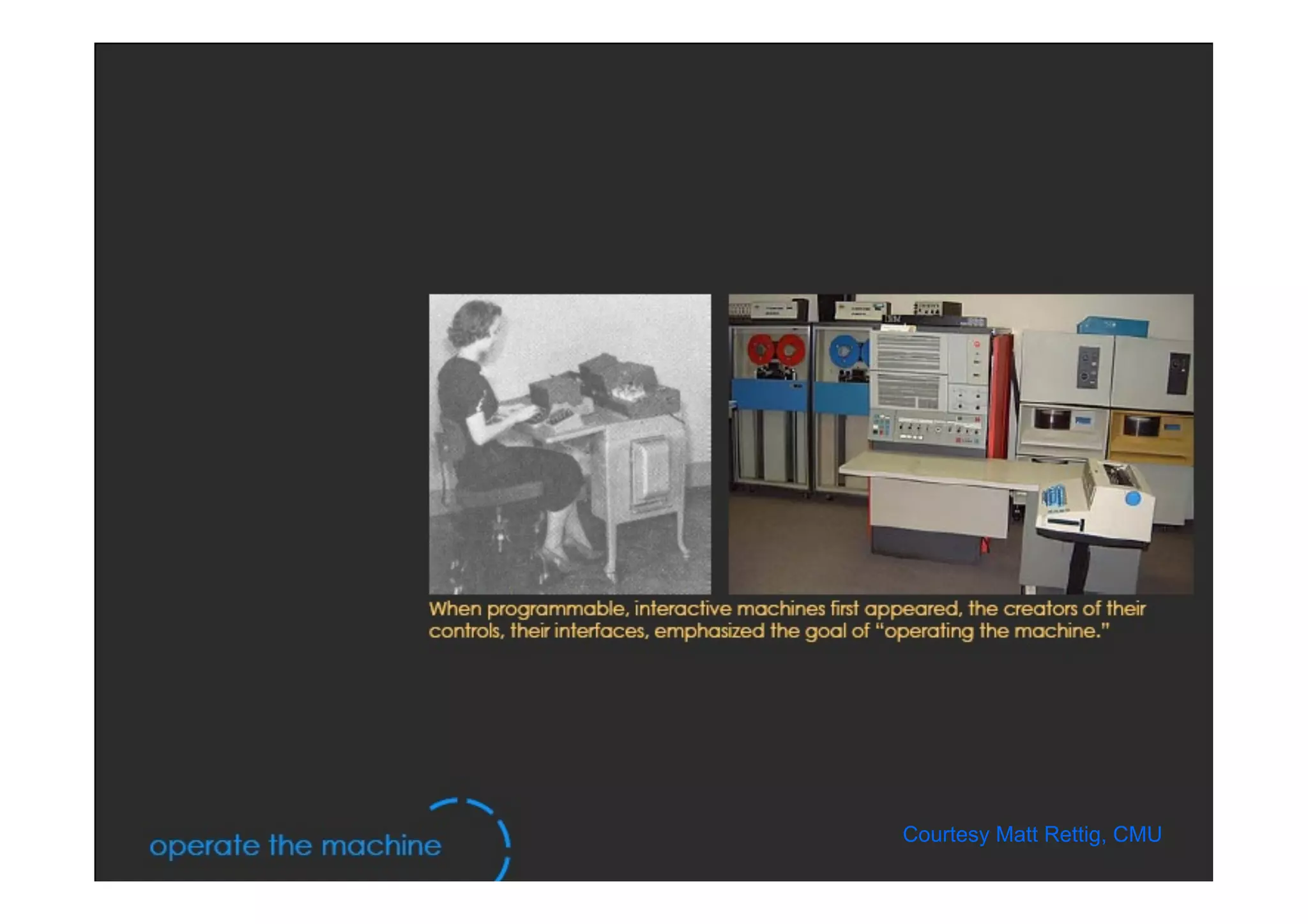
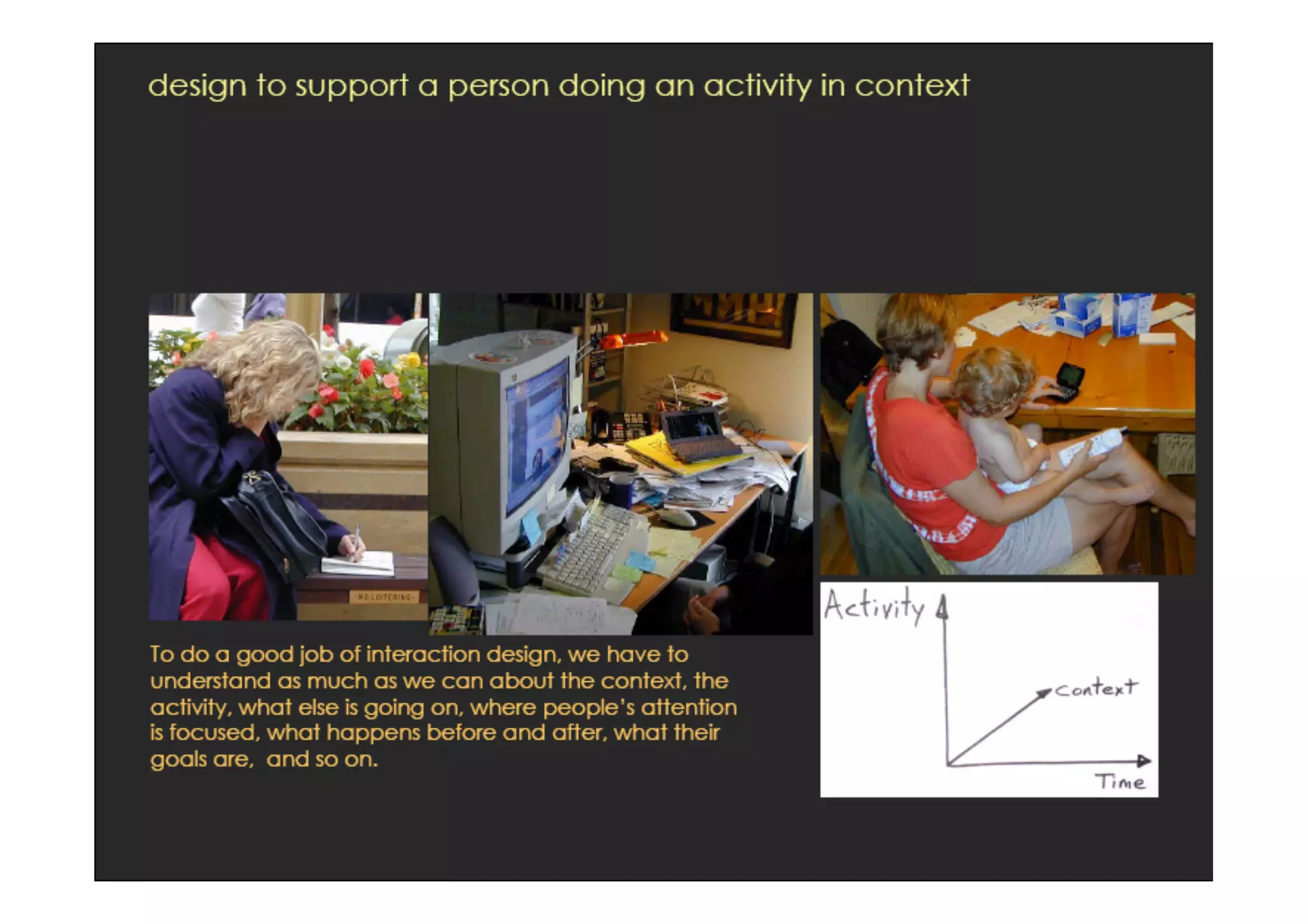
Courtesy Matt Rettig, CMU
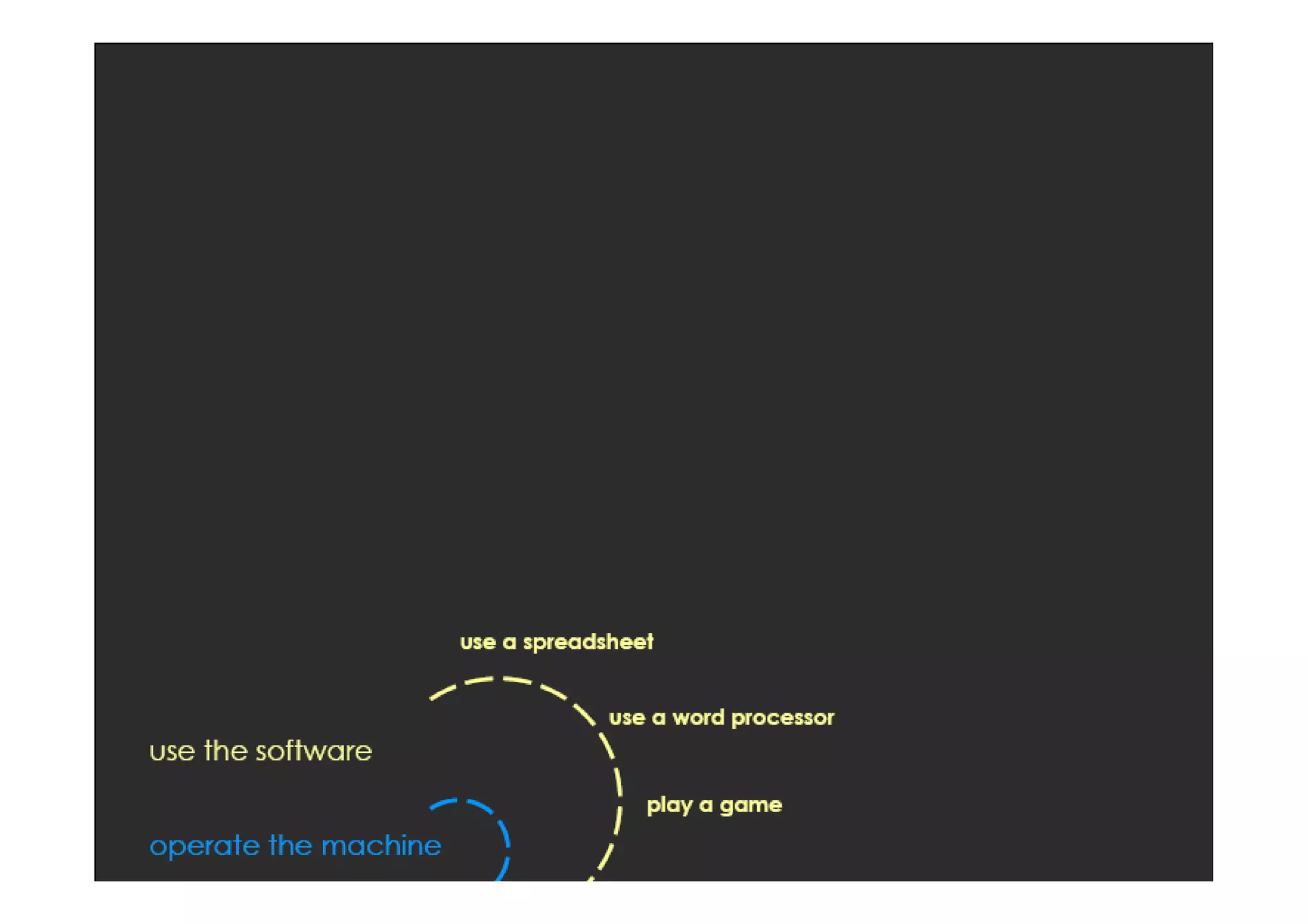
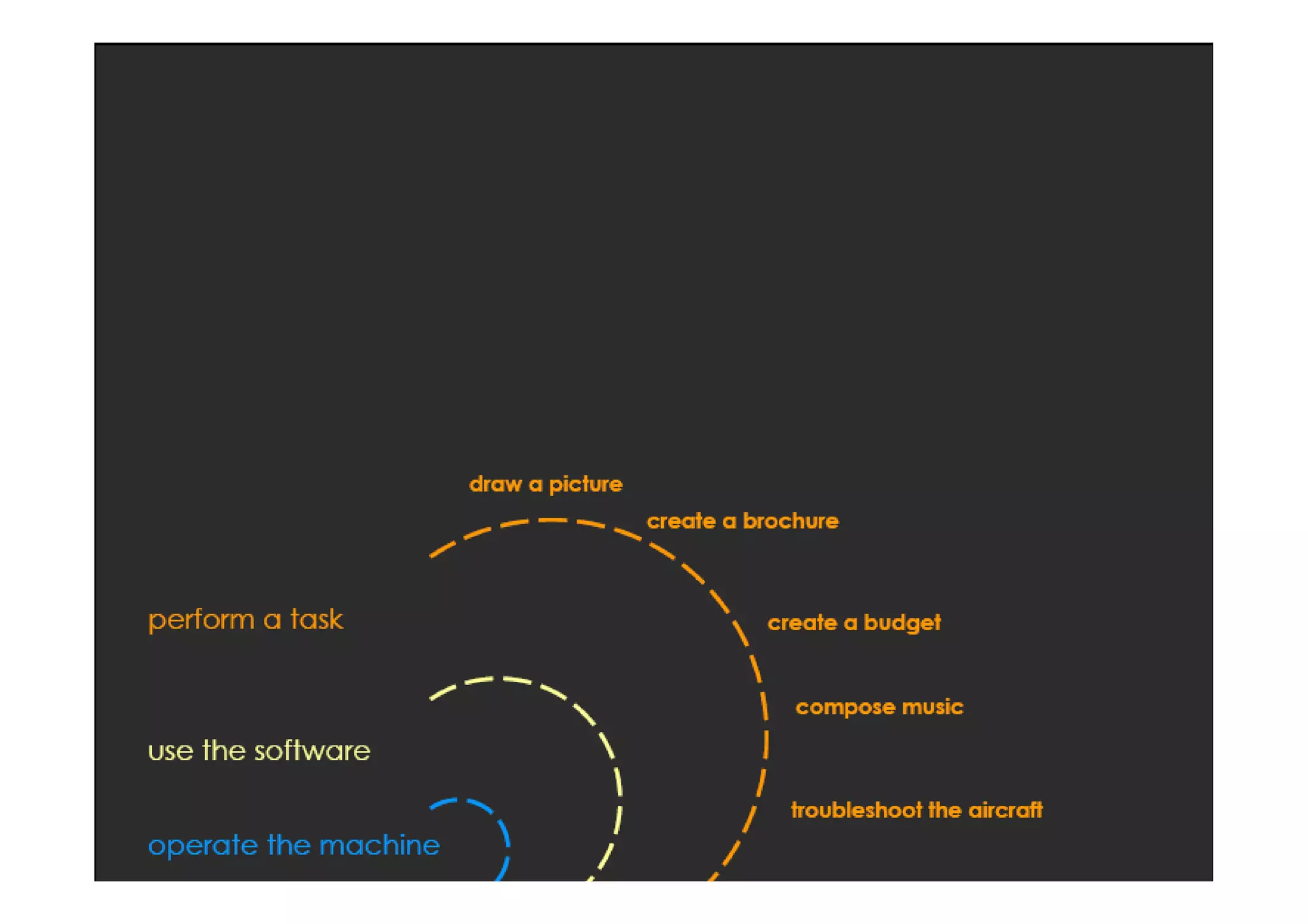
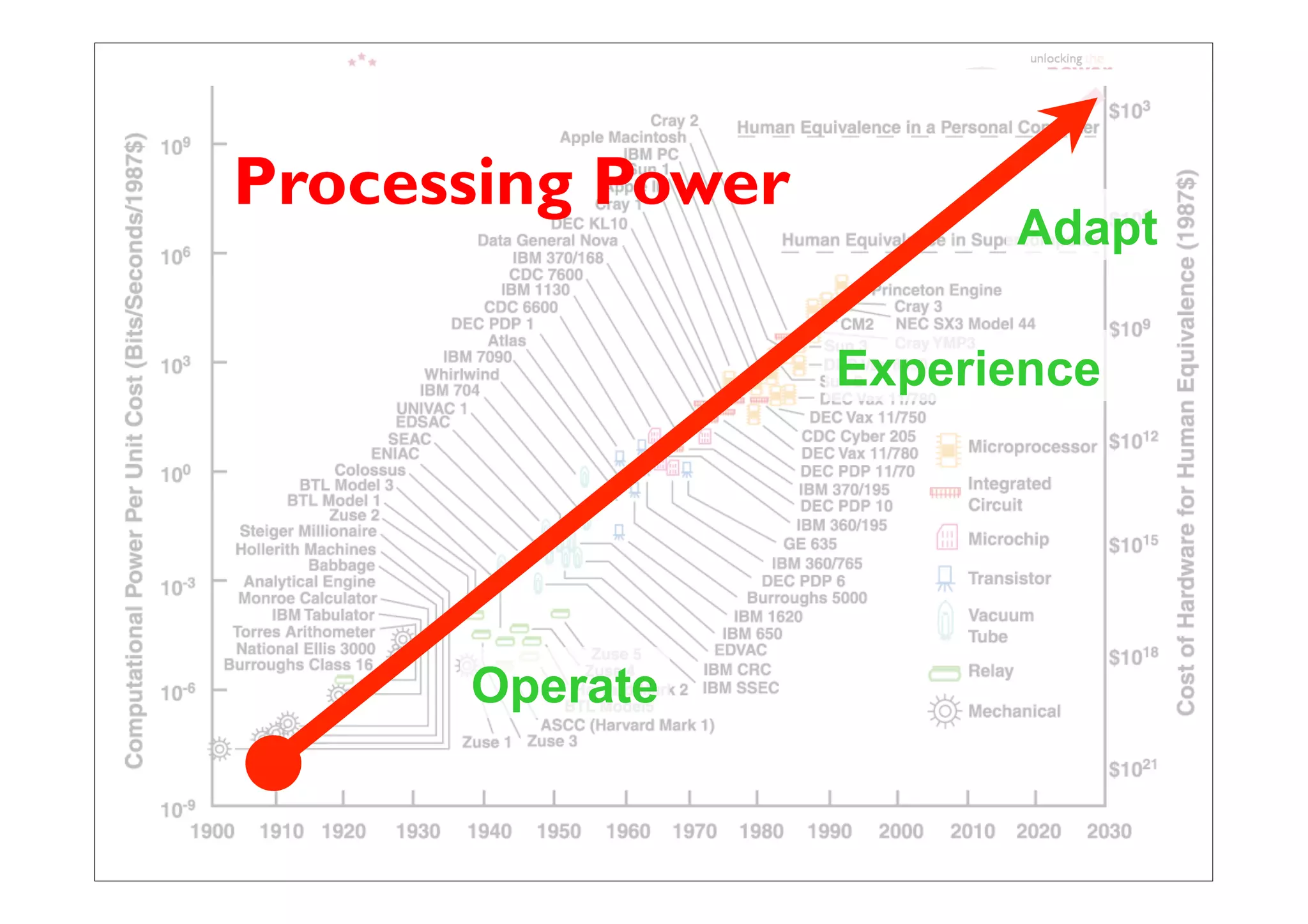
Processing Power

Adapt
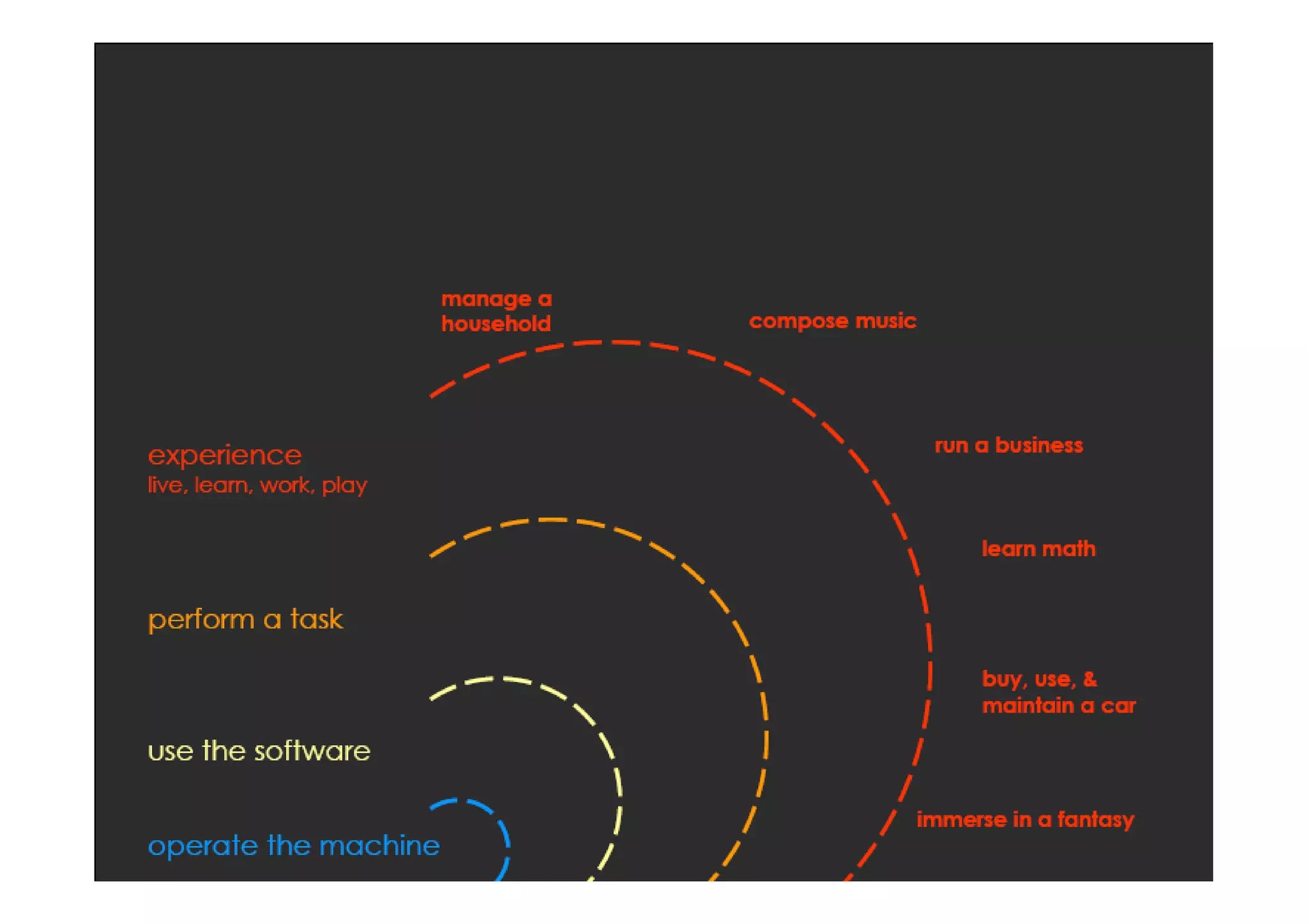
Experience

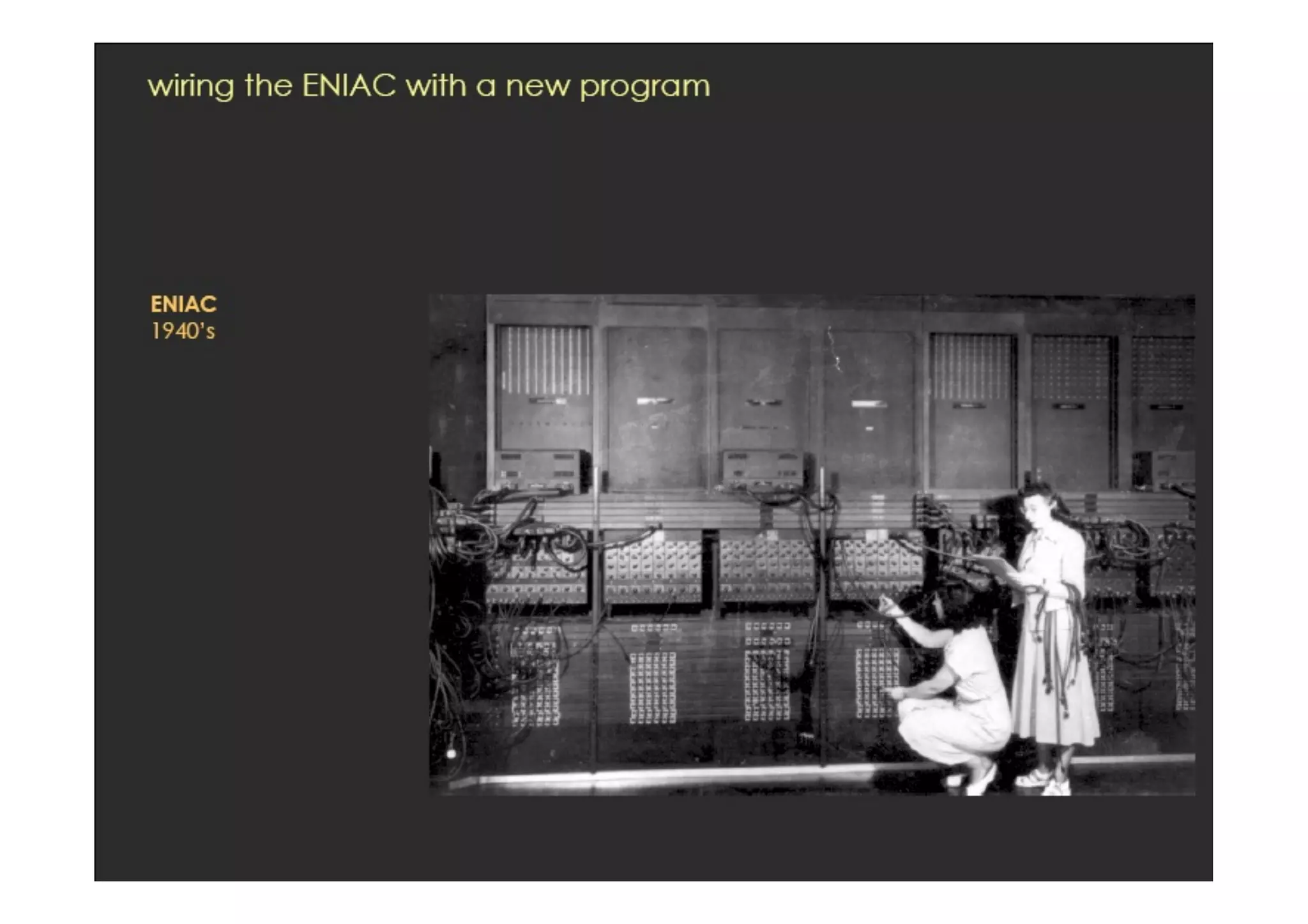
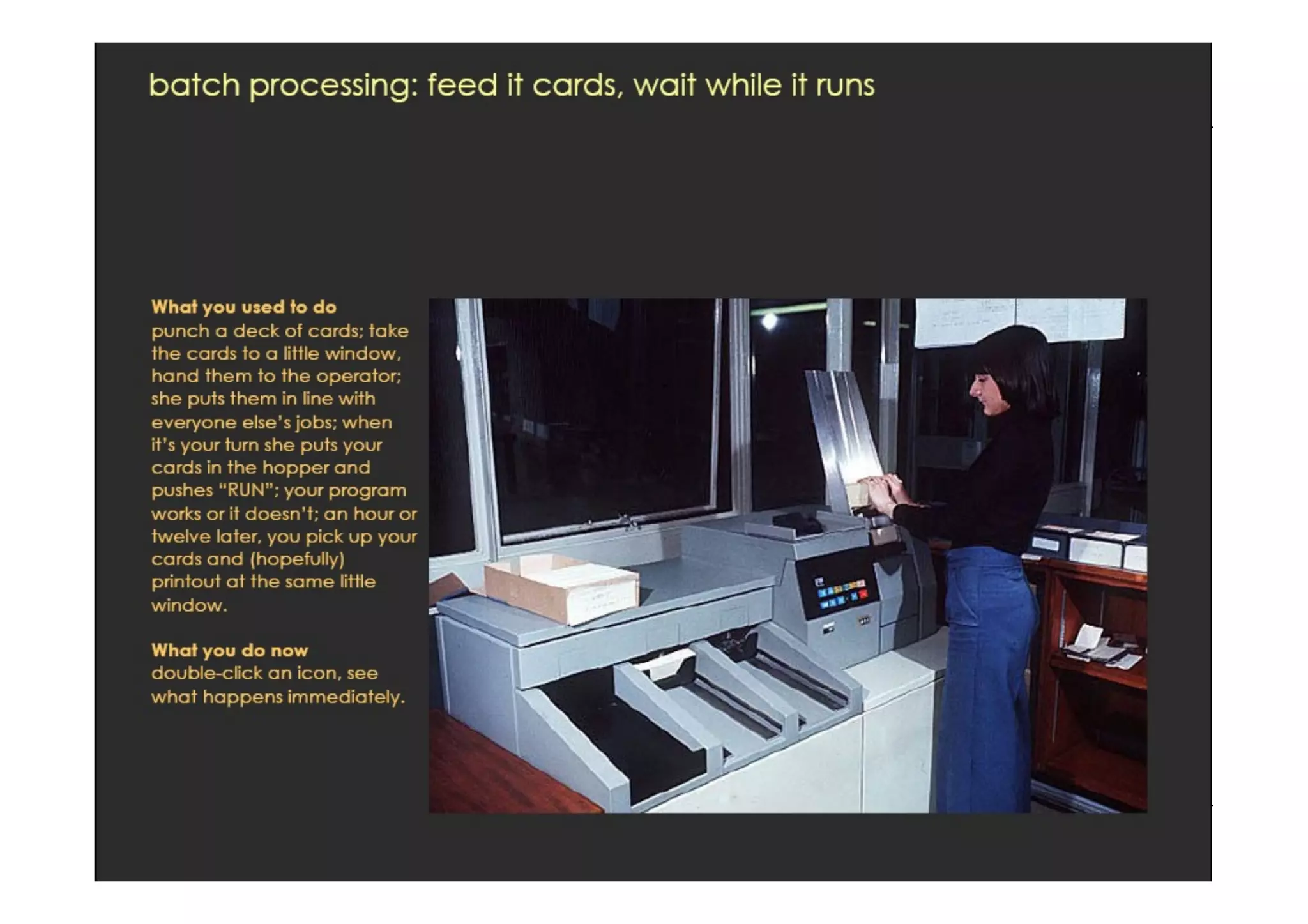
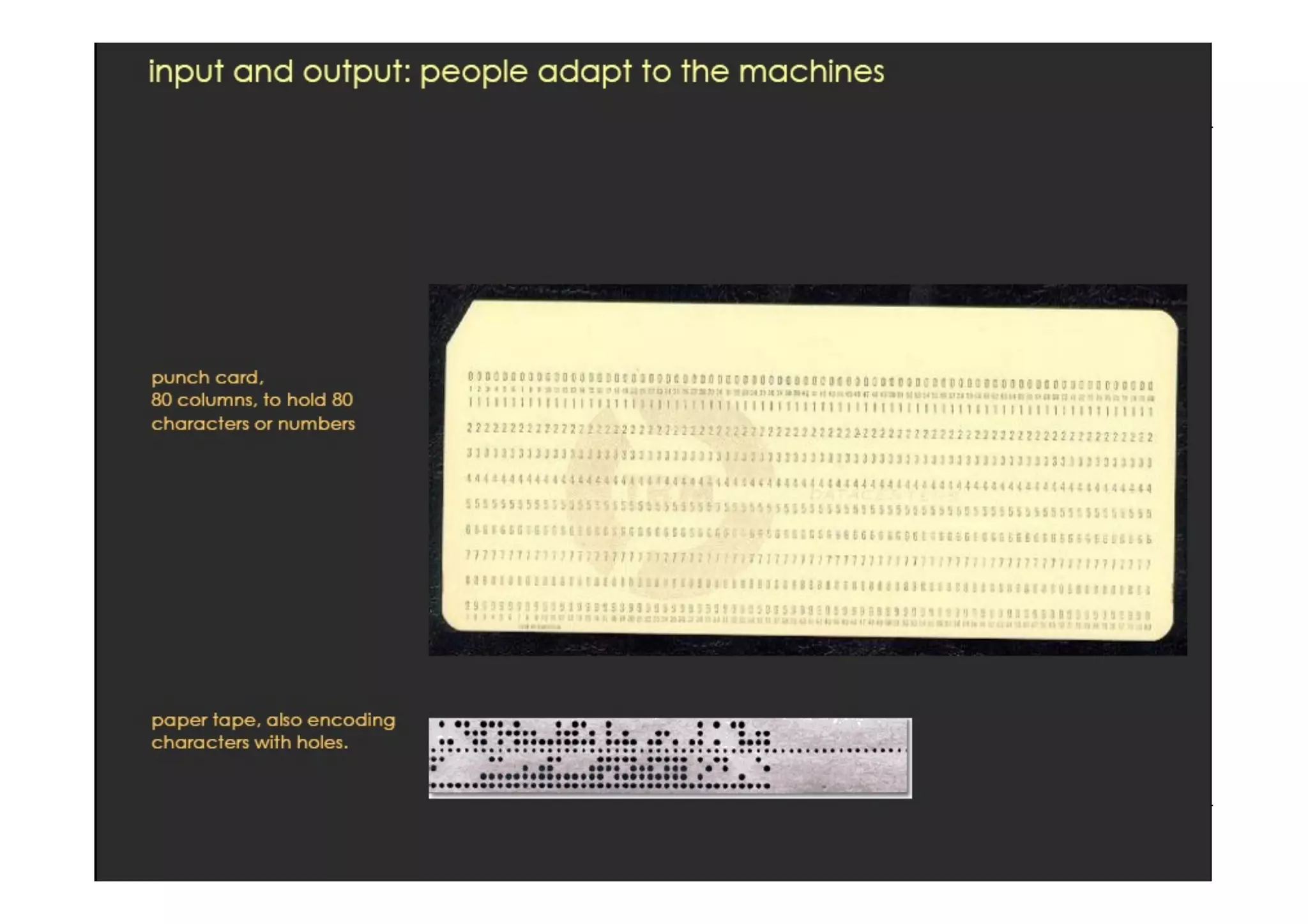
Operate
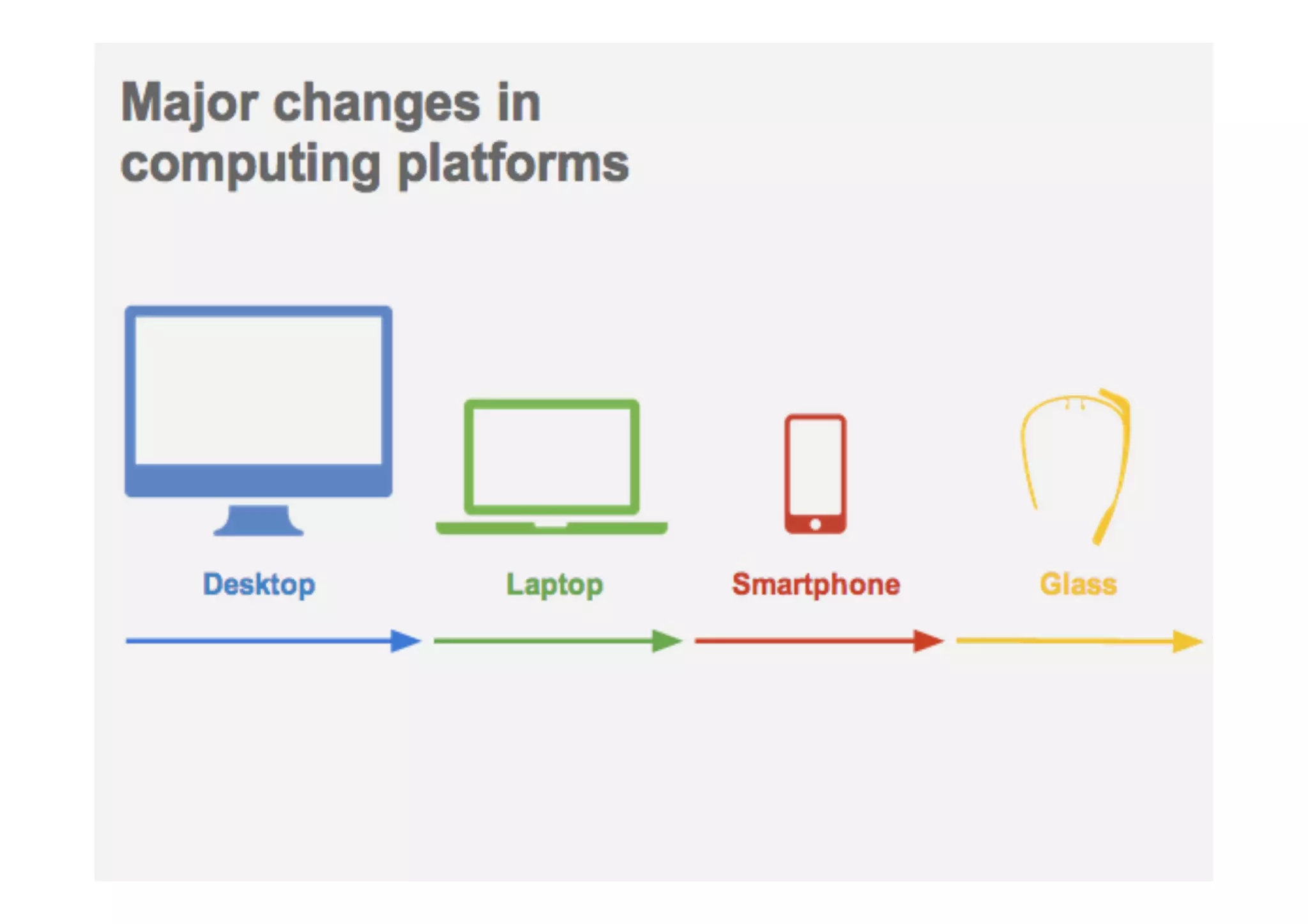
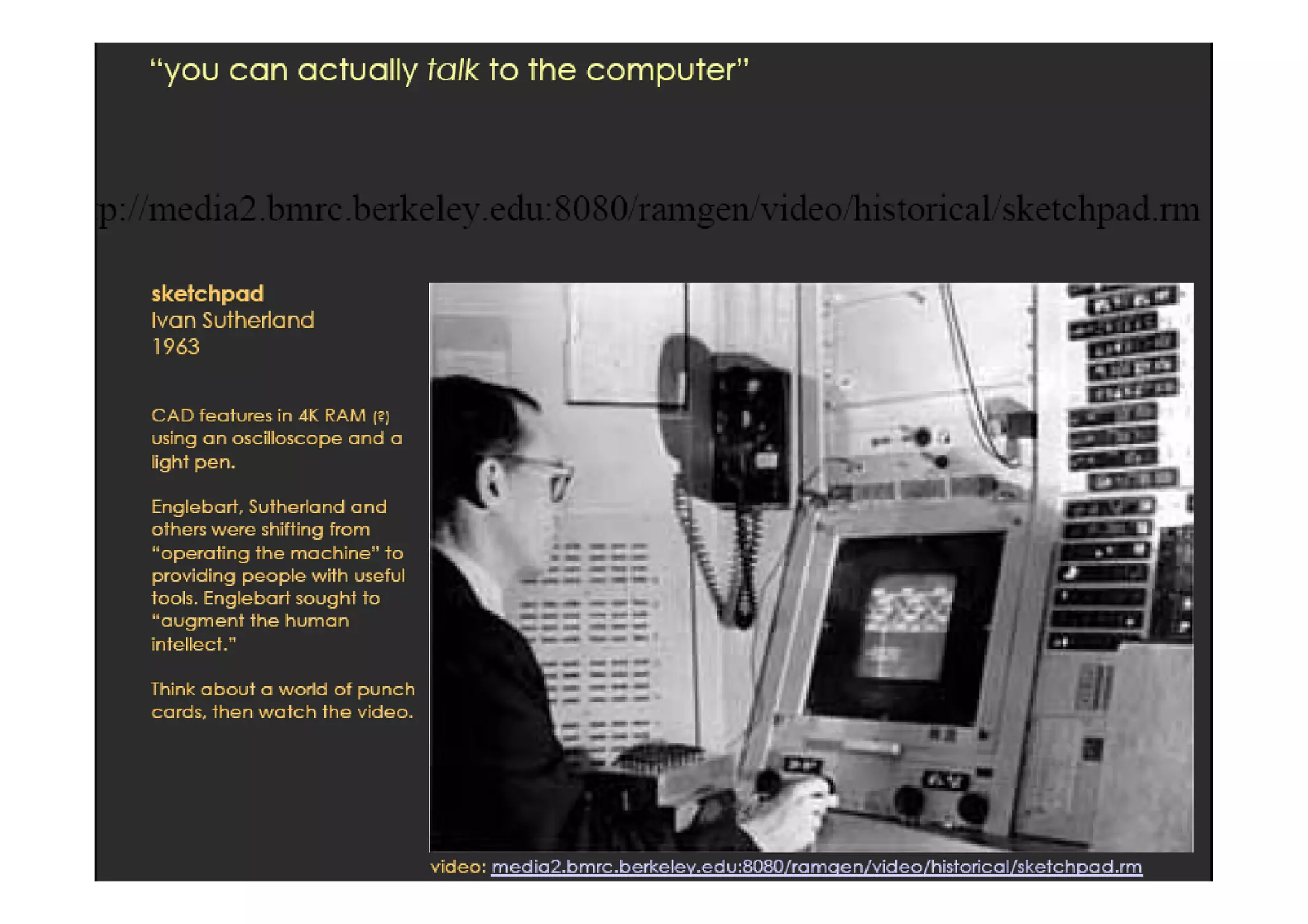
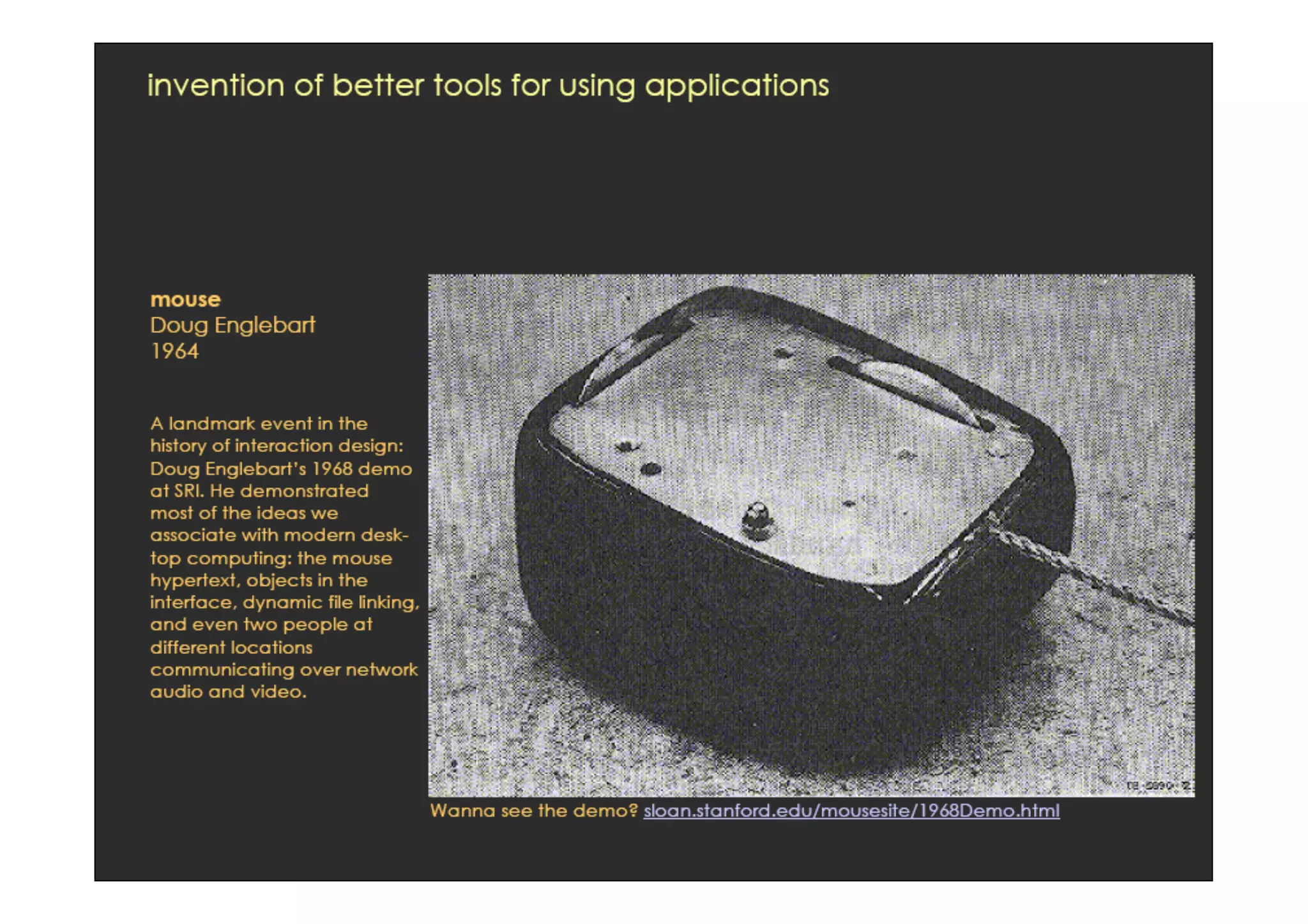
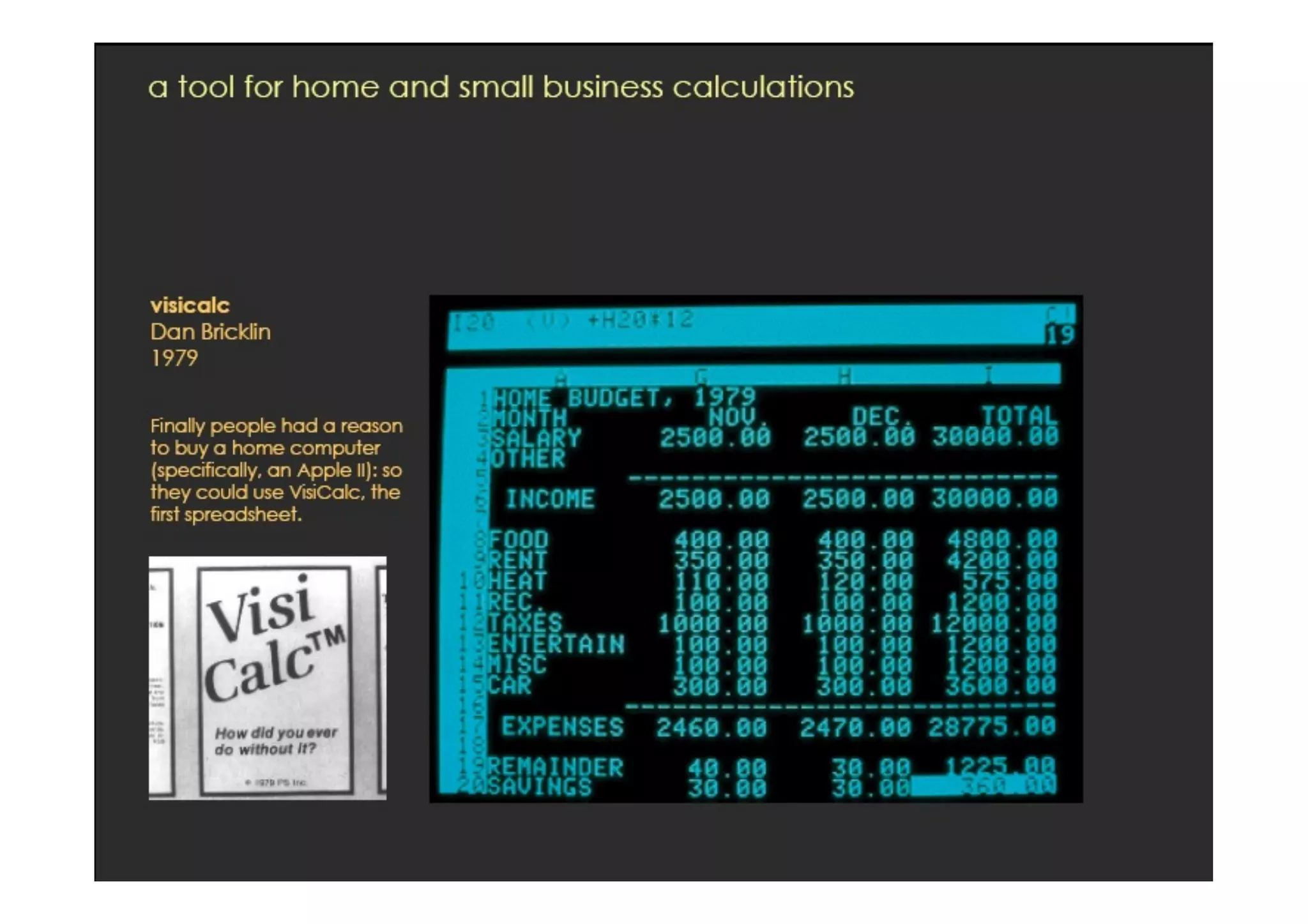
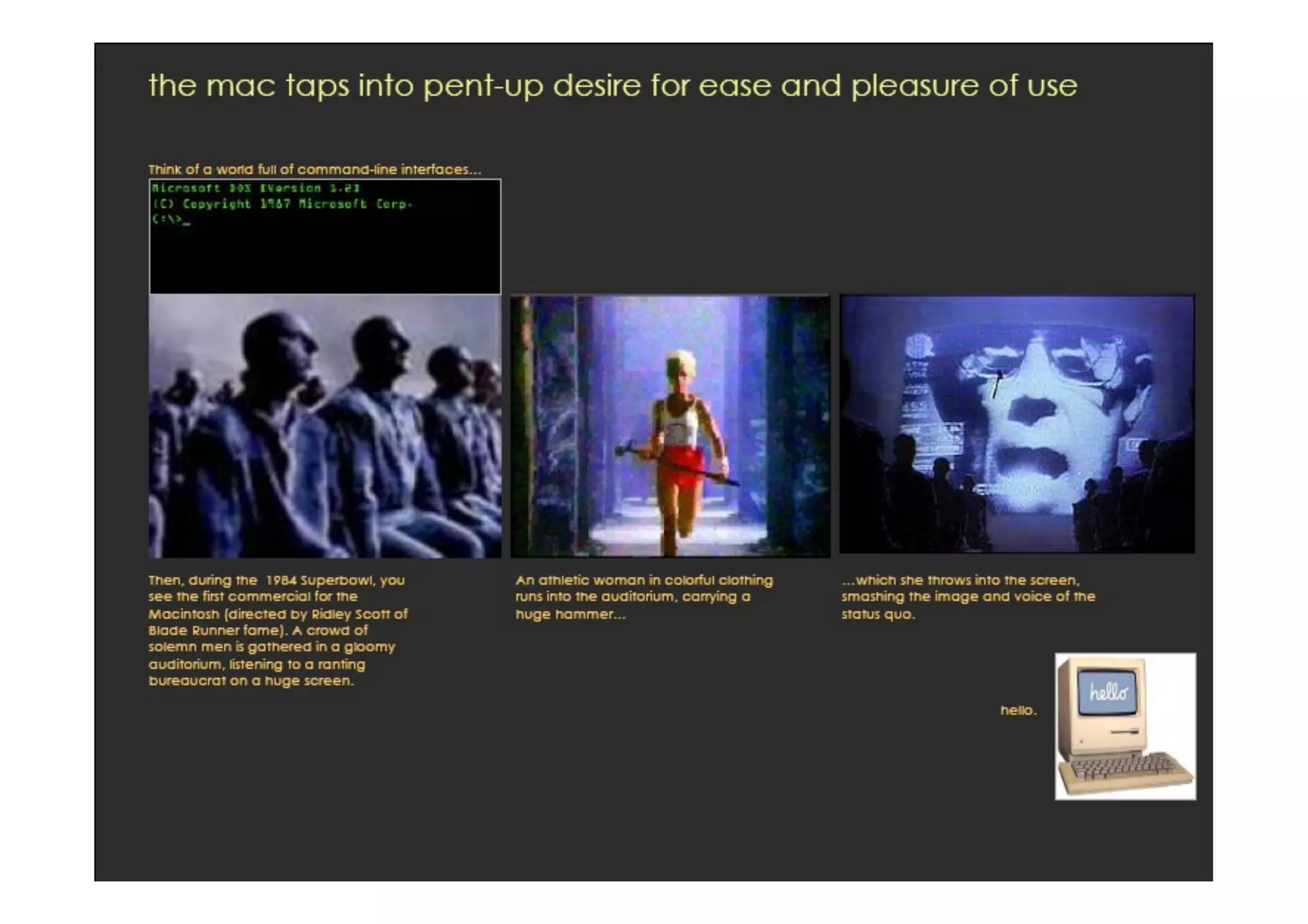
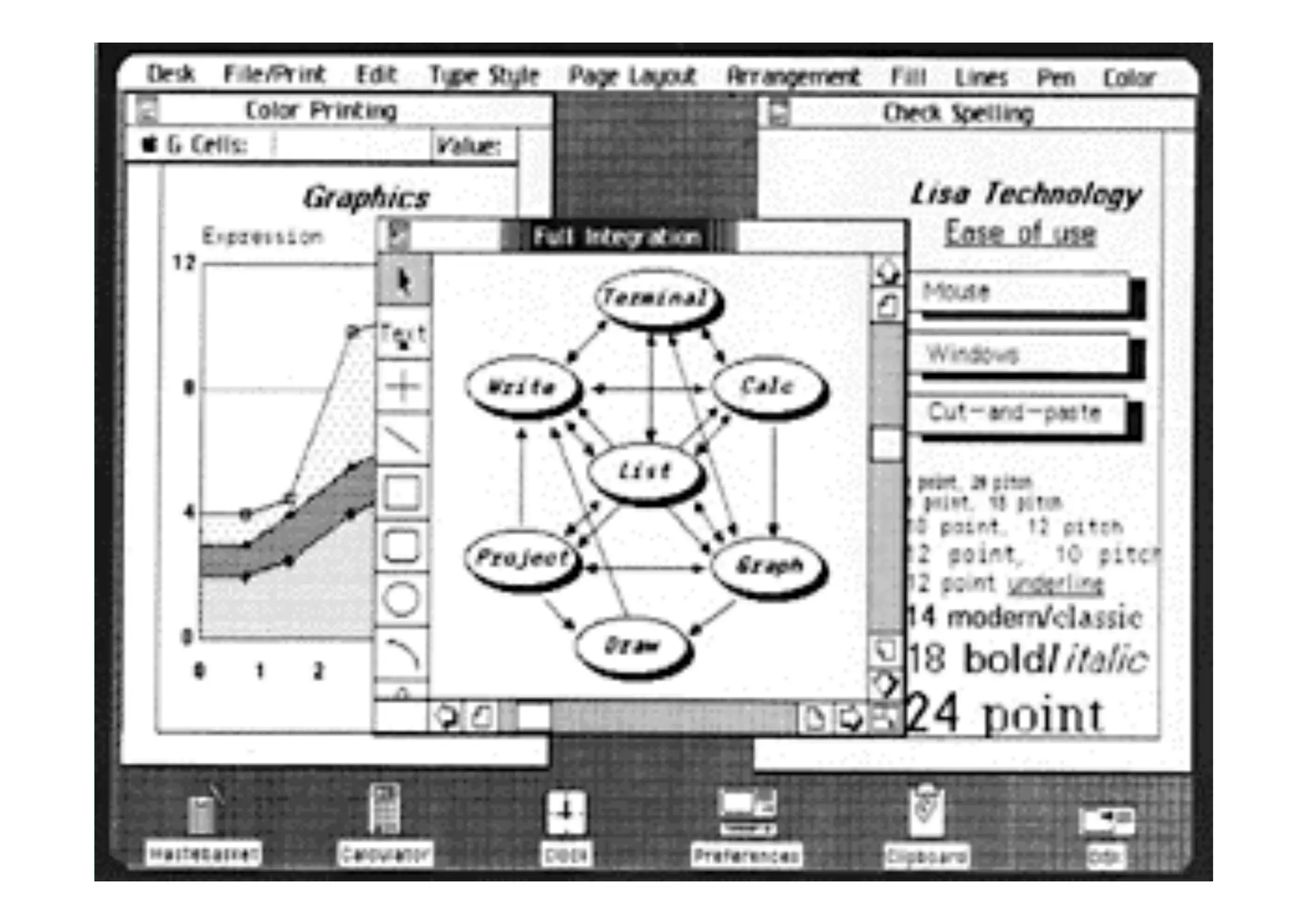
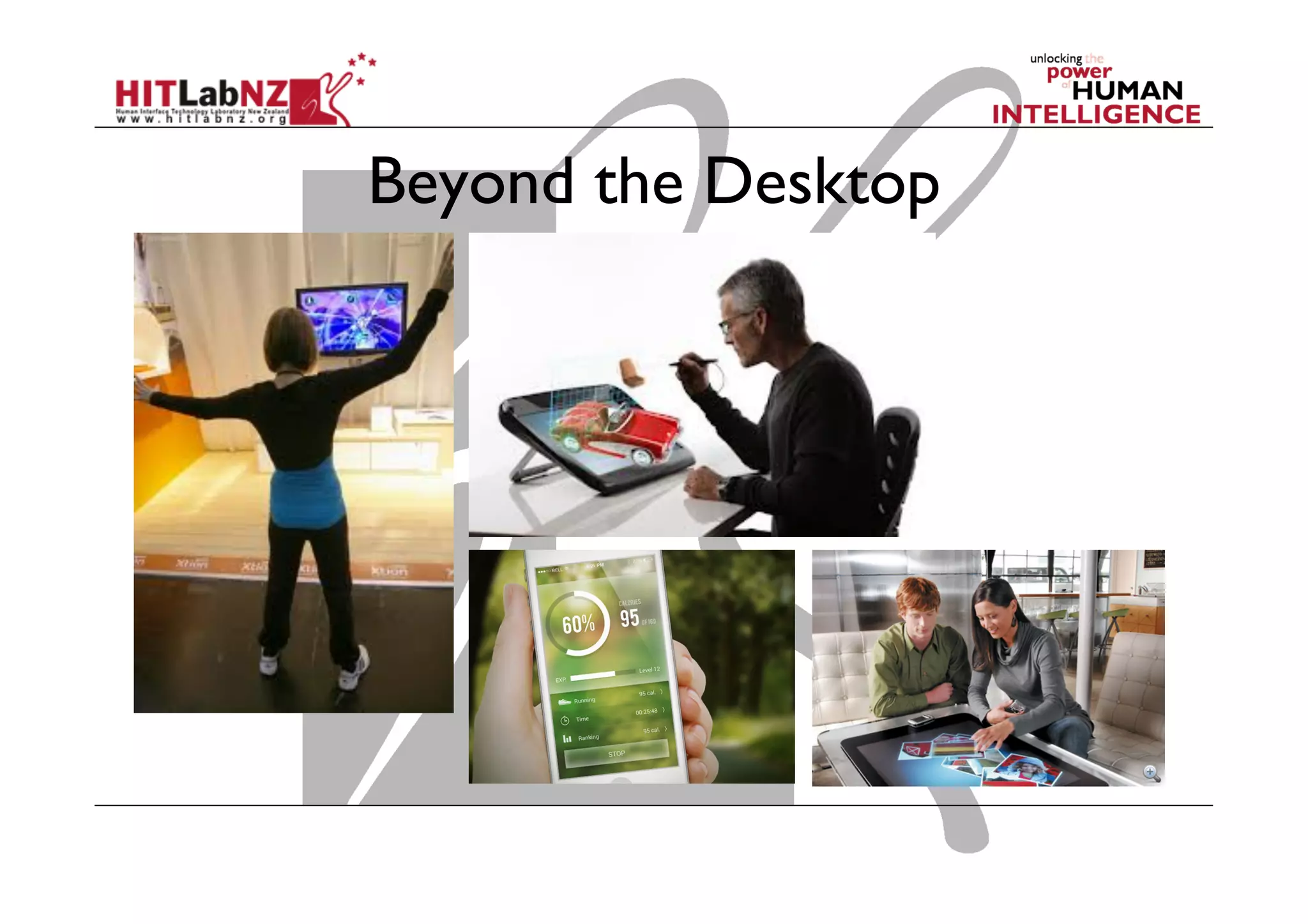
Beyond the Desktop
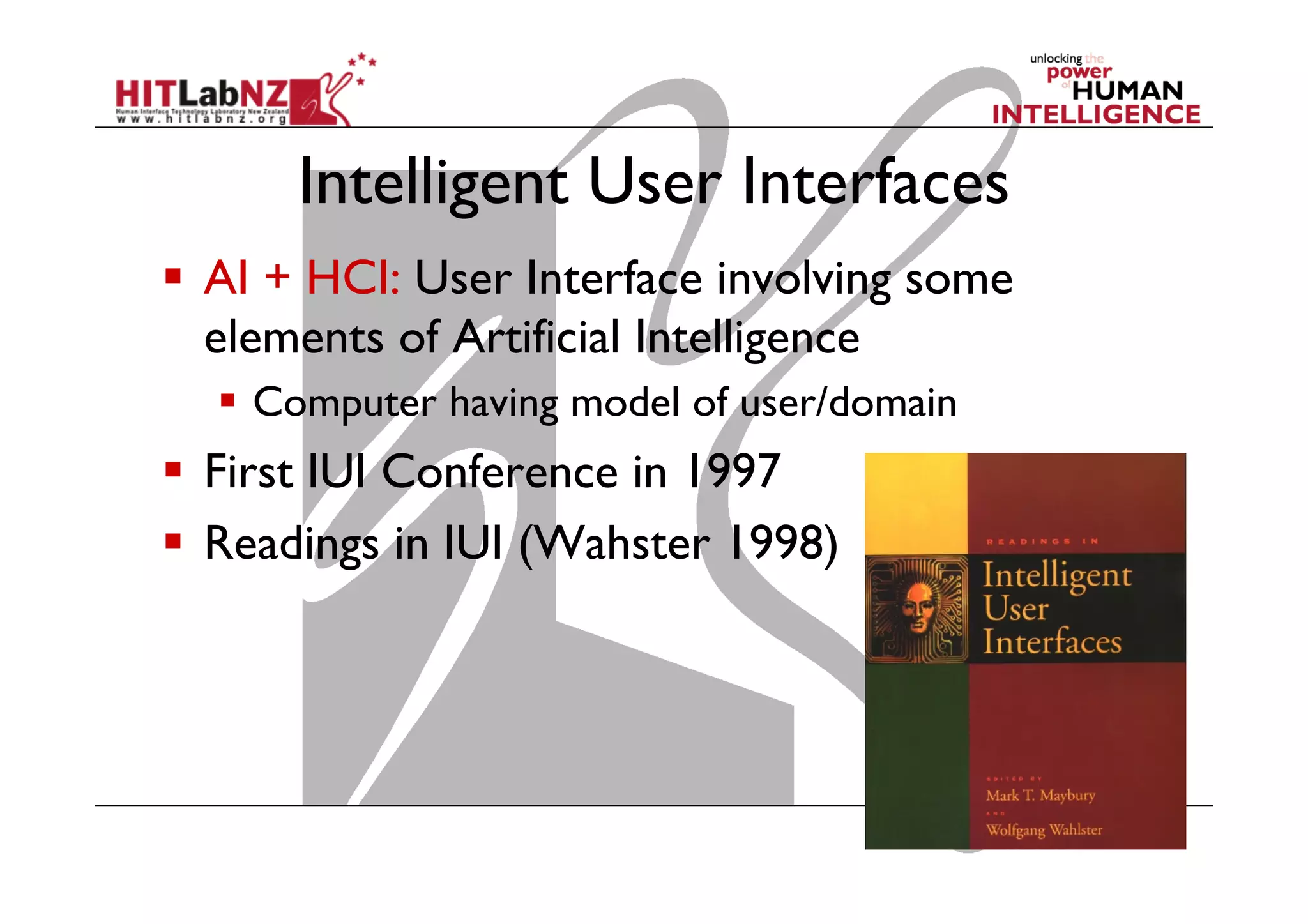
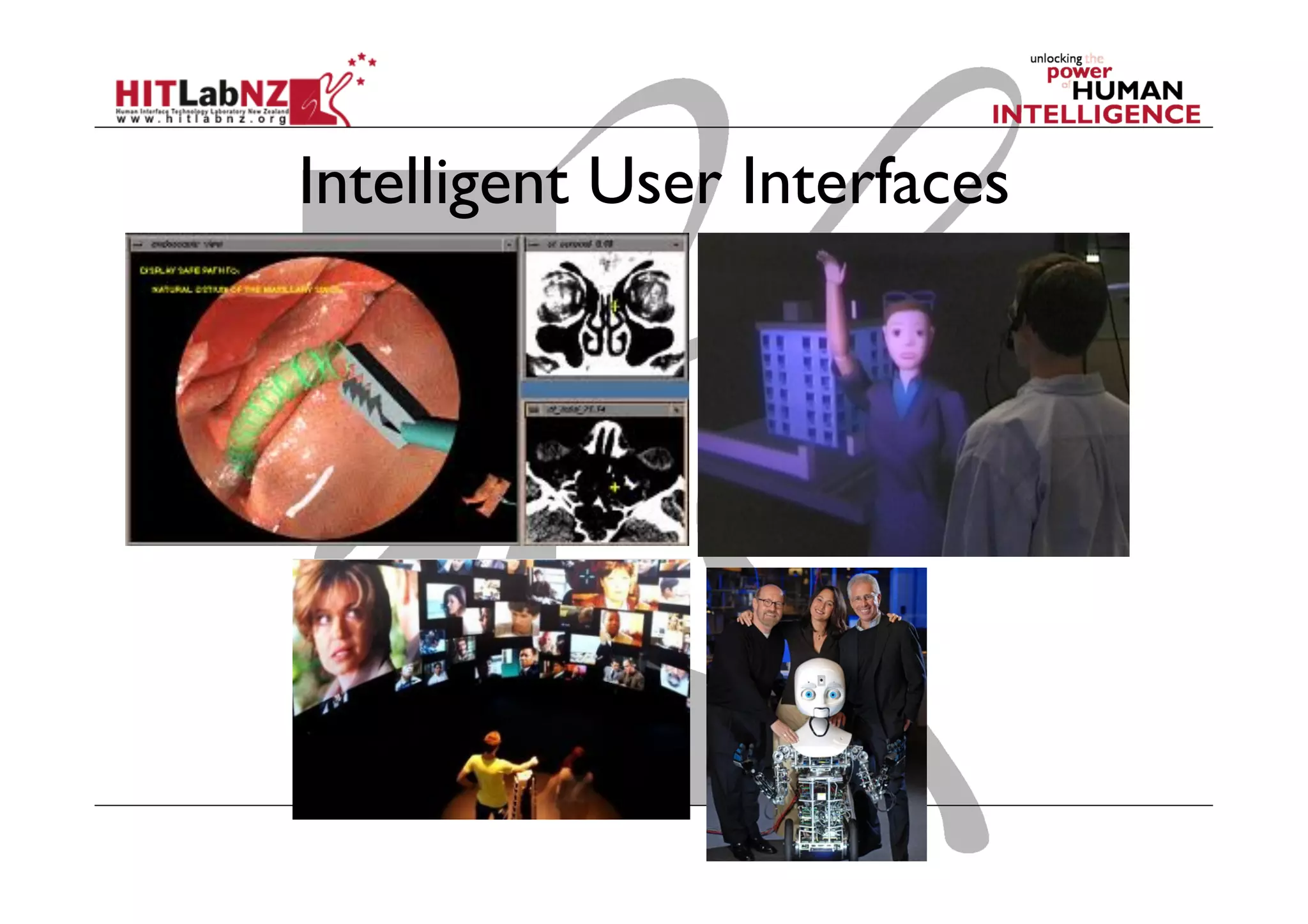
Intelligent User Interfaces
  AI + HCI: User Interface involving some
elements of Artificial Intelligence
  Computer having model of user/domain

  First IUI Conference in 1997
  Readings in IUI (Wahster 1998)
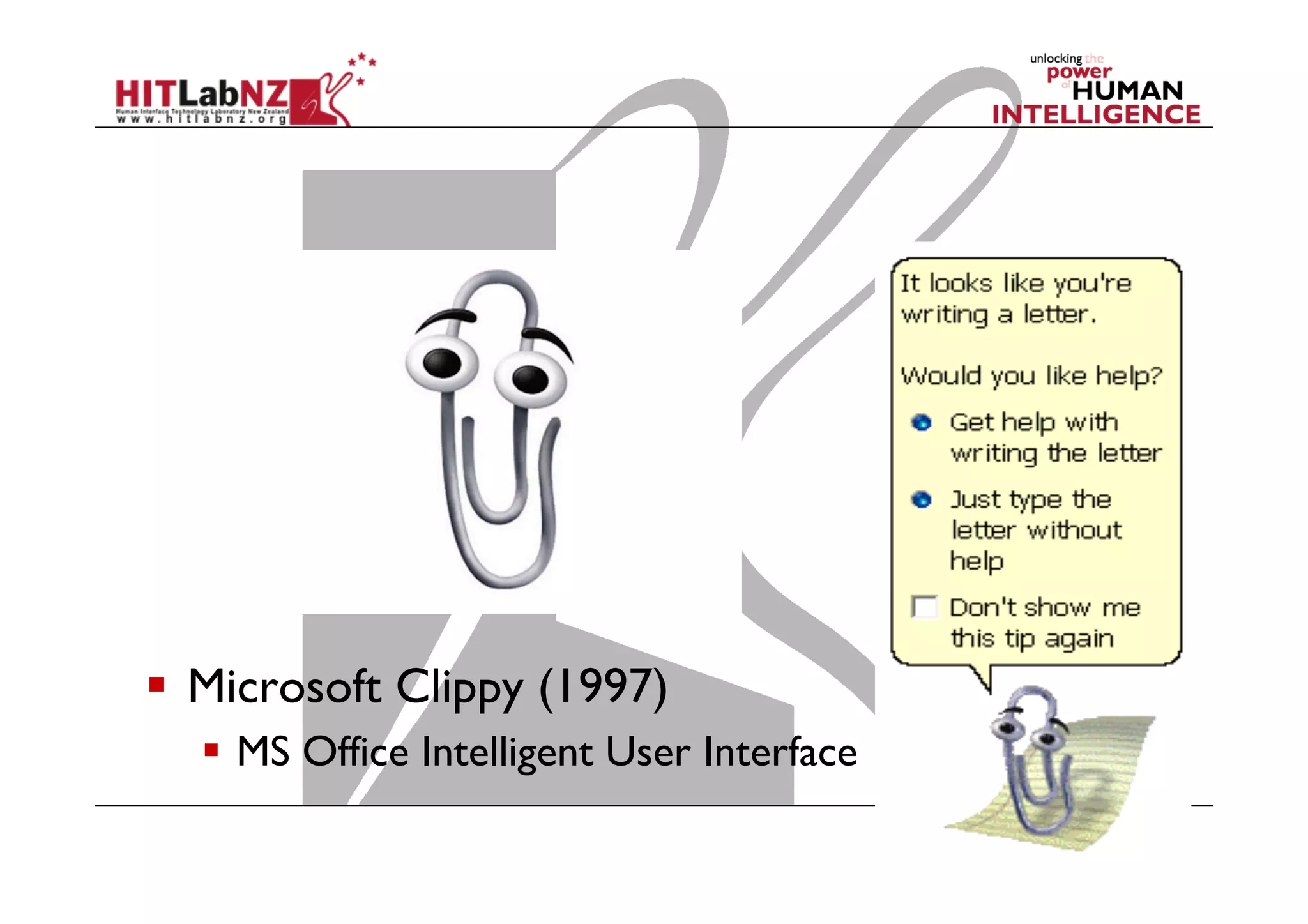
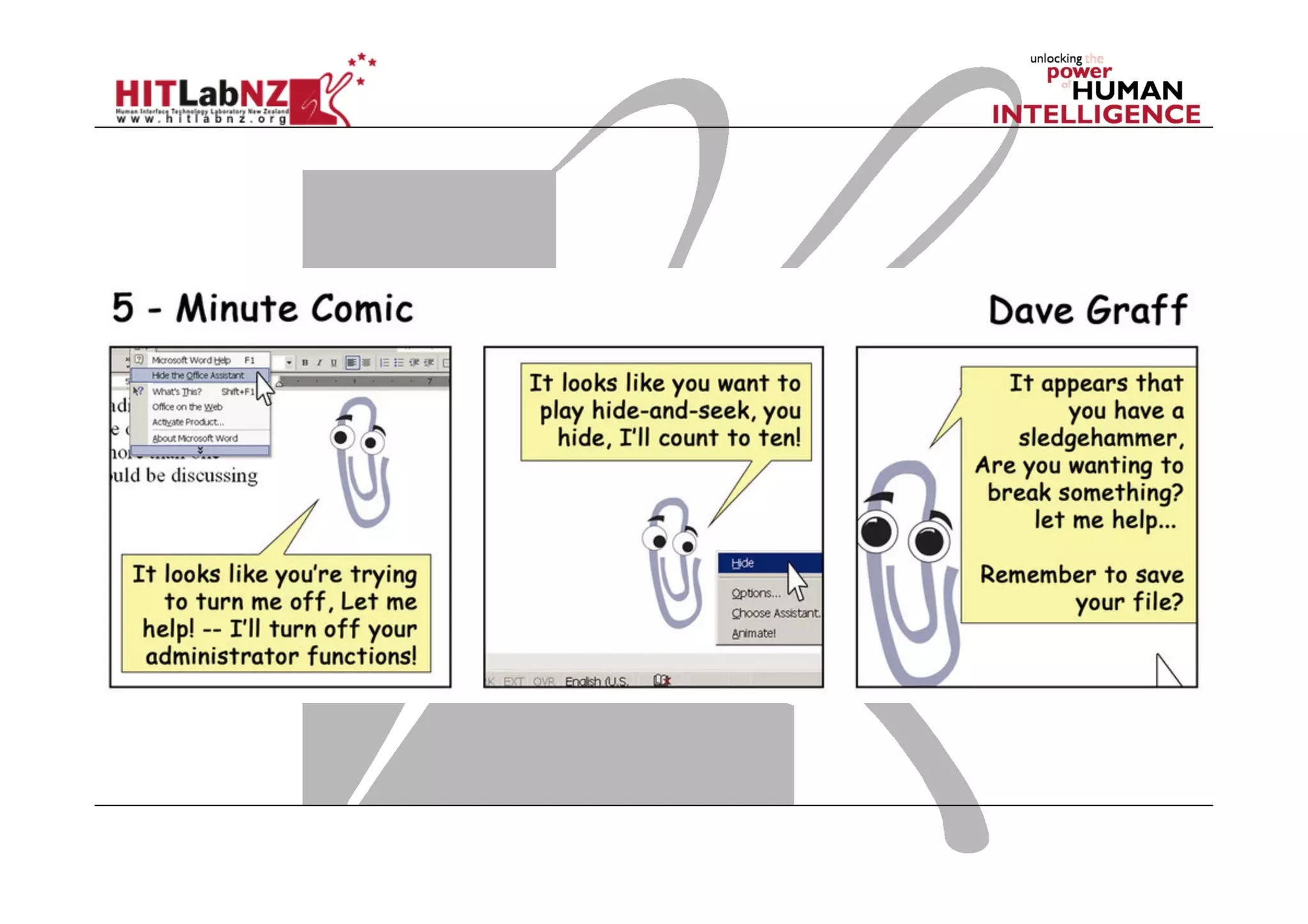
  Microsoft Clippy (1997)
  MS Office Intelligent User Interface
Intelligent User Interfaces
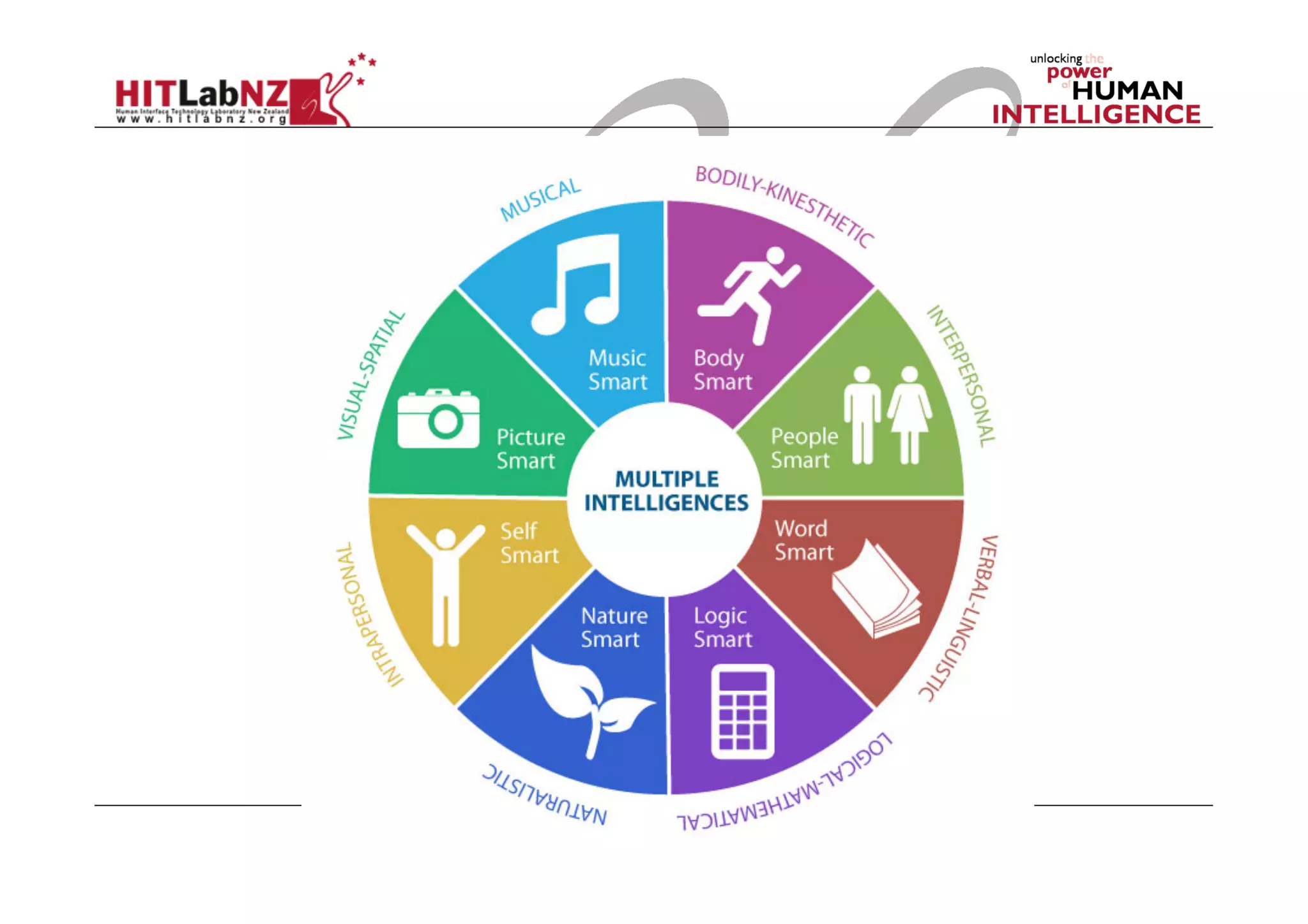
Multiple Intelligences
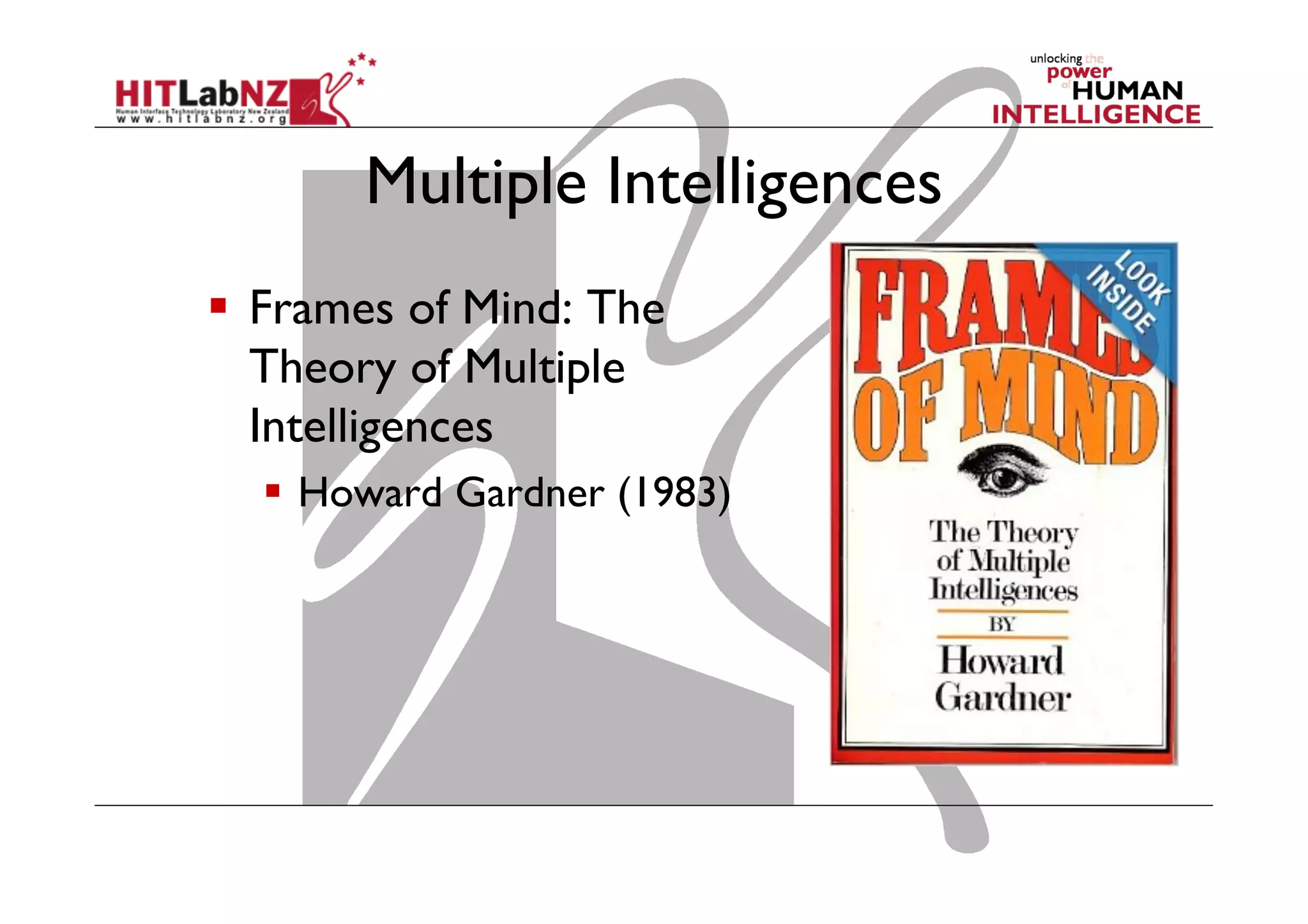
  Frames of Mind: The
Theory of Multiple
Intelligences
  Howard Gardner (1983)
Multiple Intelligences
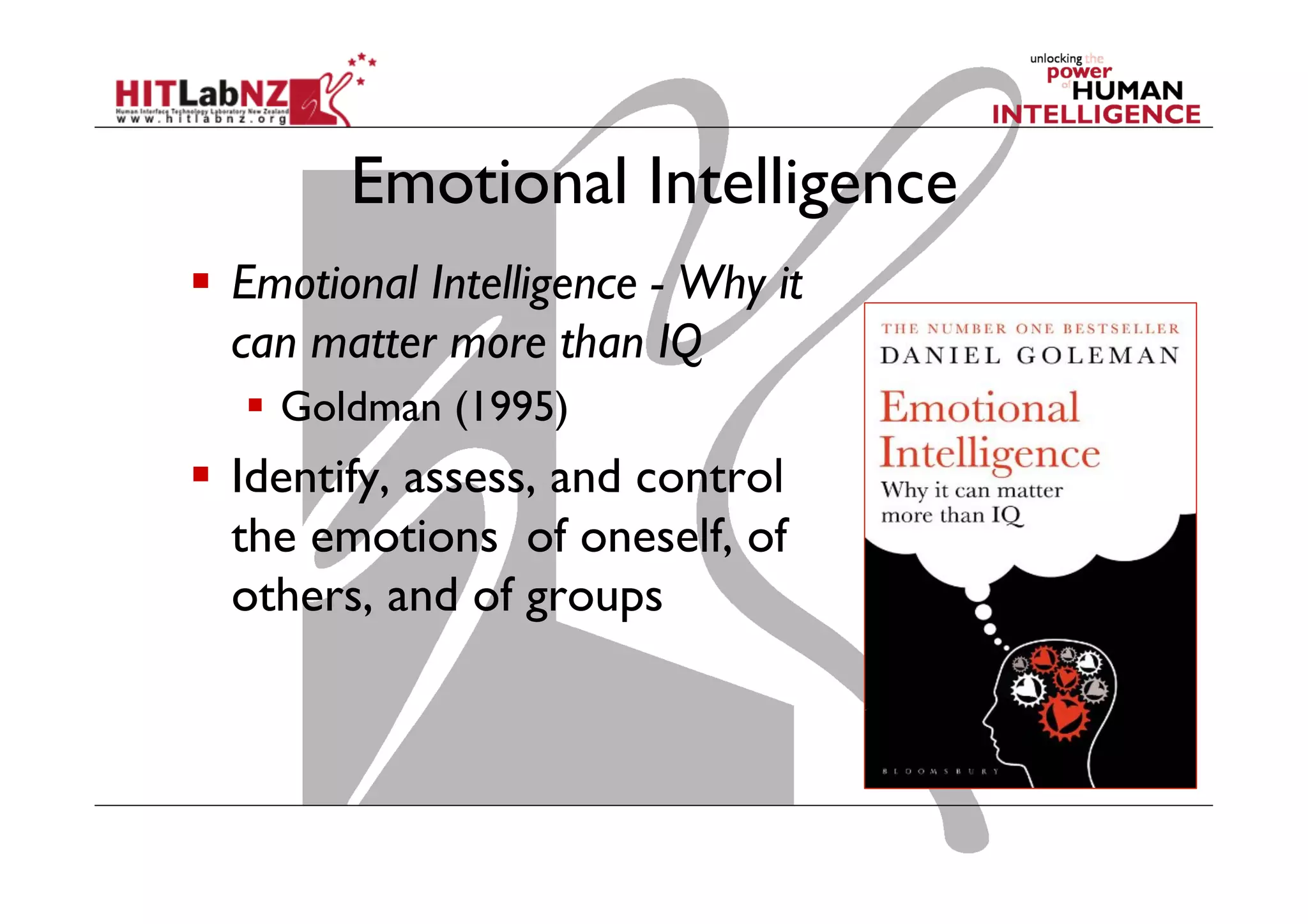
Emotional Intelligence
  Emotional Intelligence - Why it
can matter more than IQ
  Goldman (1995)

  Identify, assess, and control
the emotions  of oneself, of
others, and of groups
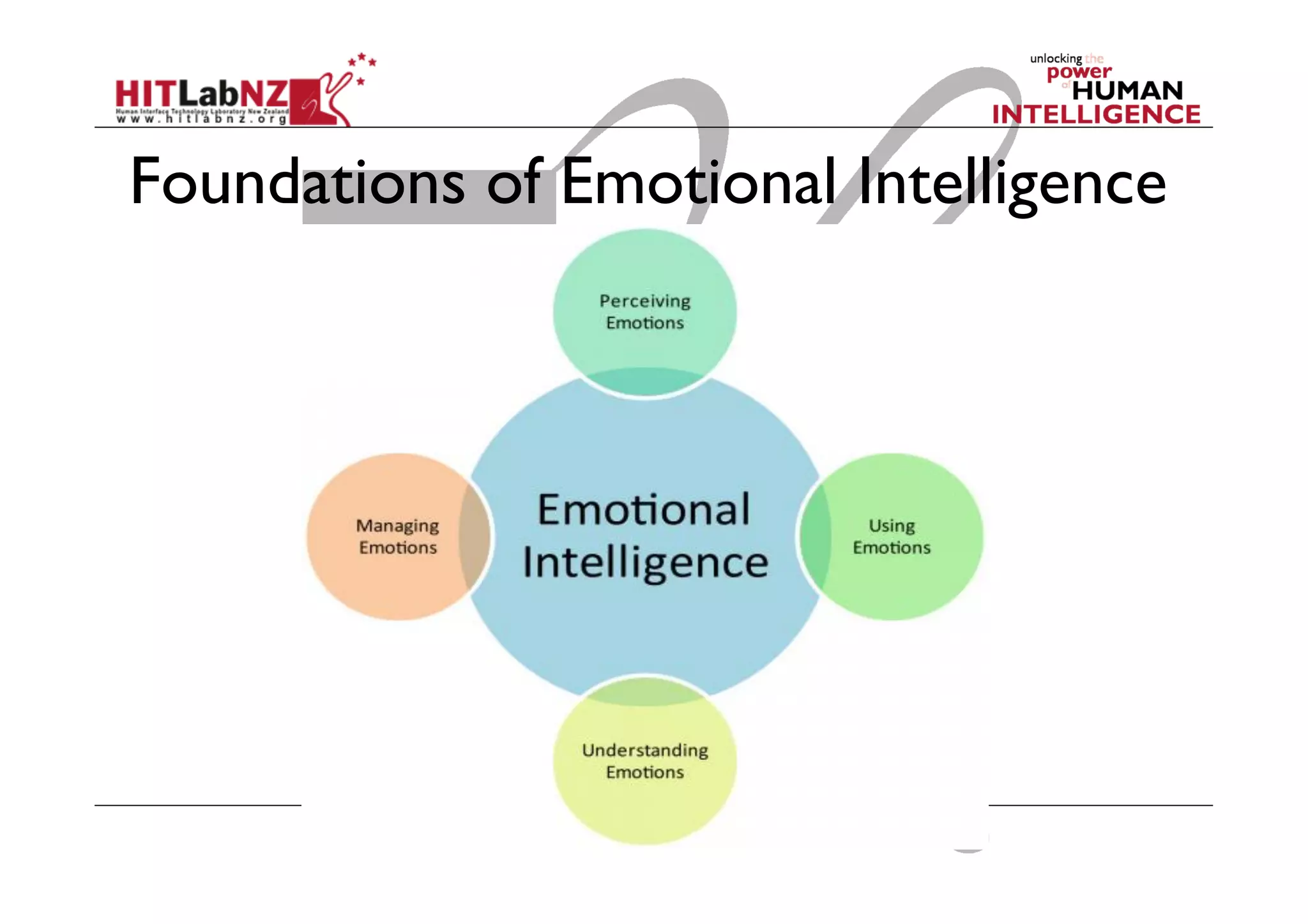
Foundations of Emotional Intelligence
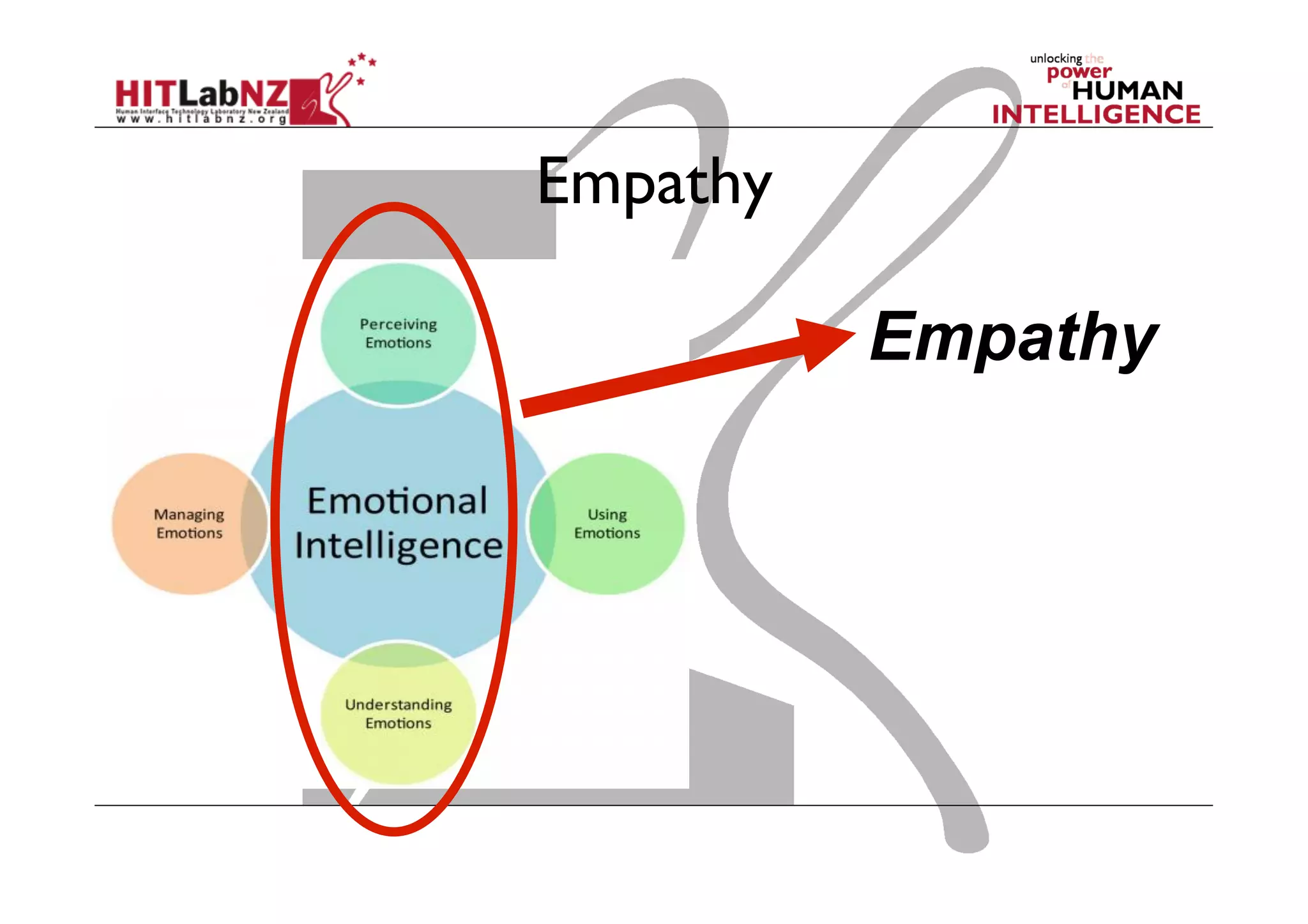
Empathy
Empathy
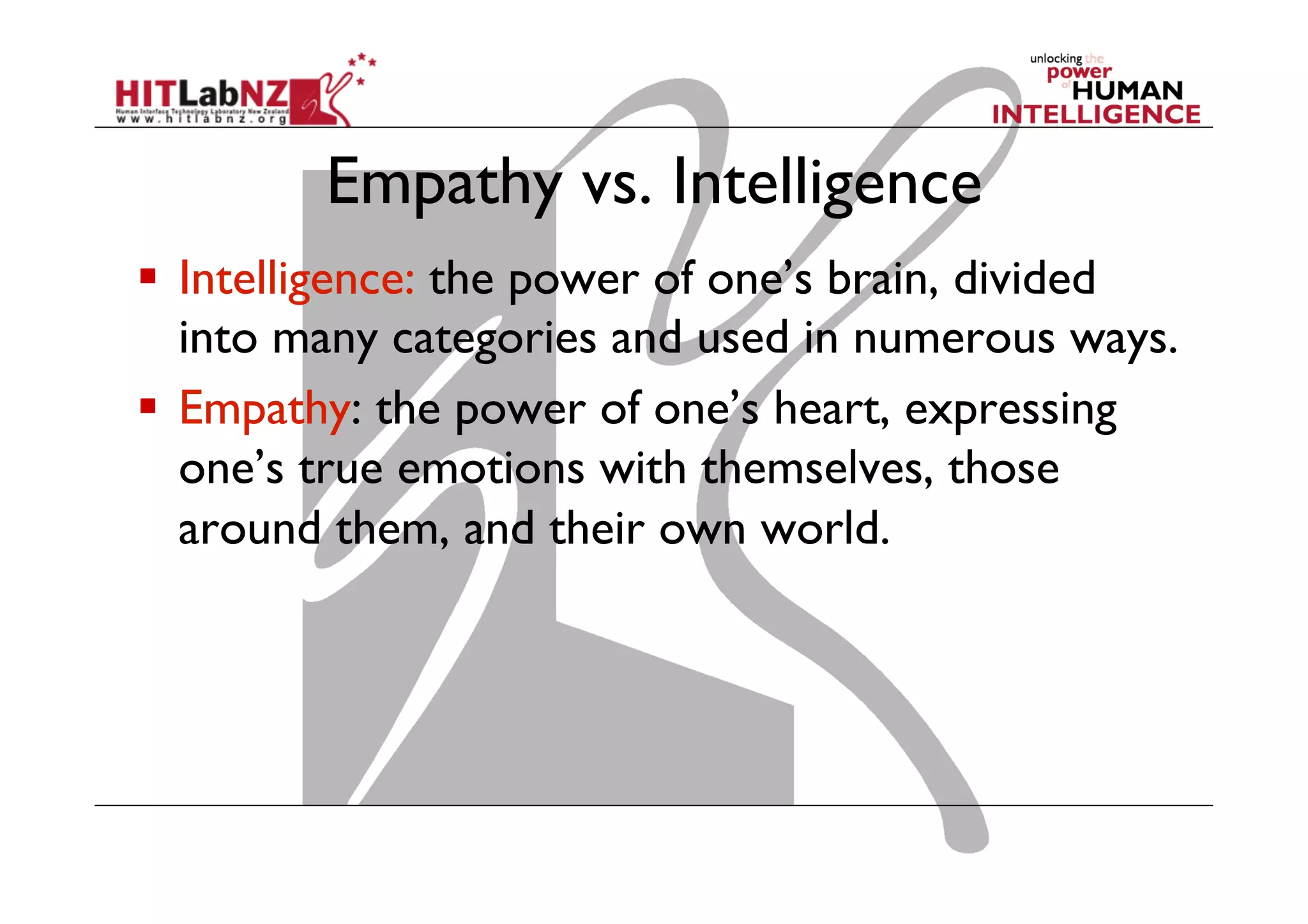
Empathy vs. Intelligence
  Intelligence: the power of one’s brain, divided
into many categories and used in numerous ways.
  Empathy: the power of one’s heart, expressing
one’s true emotions with themselves, those
around them, and their own world. 
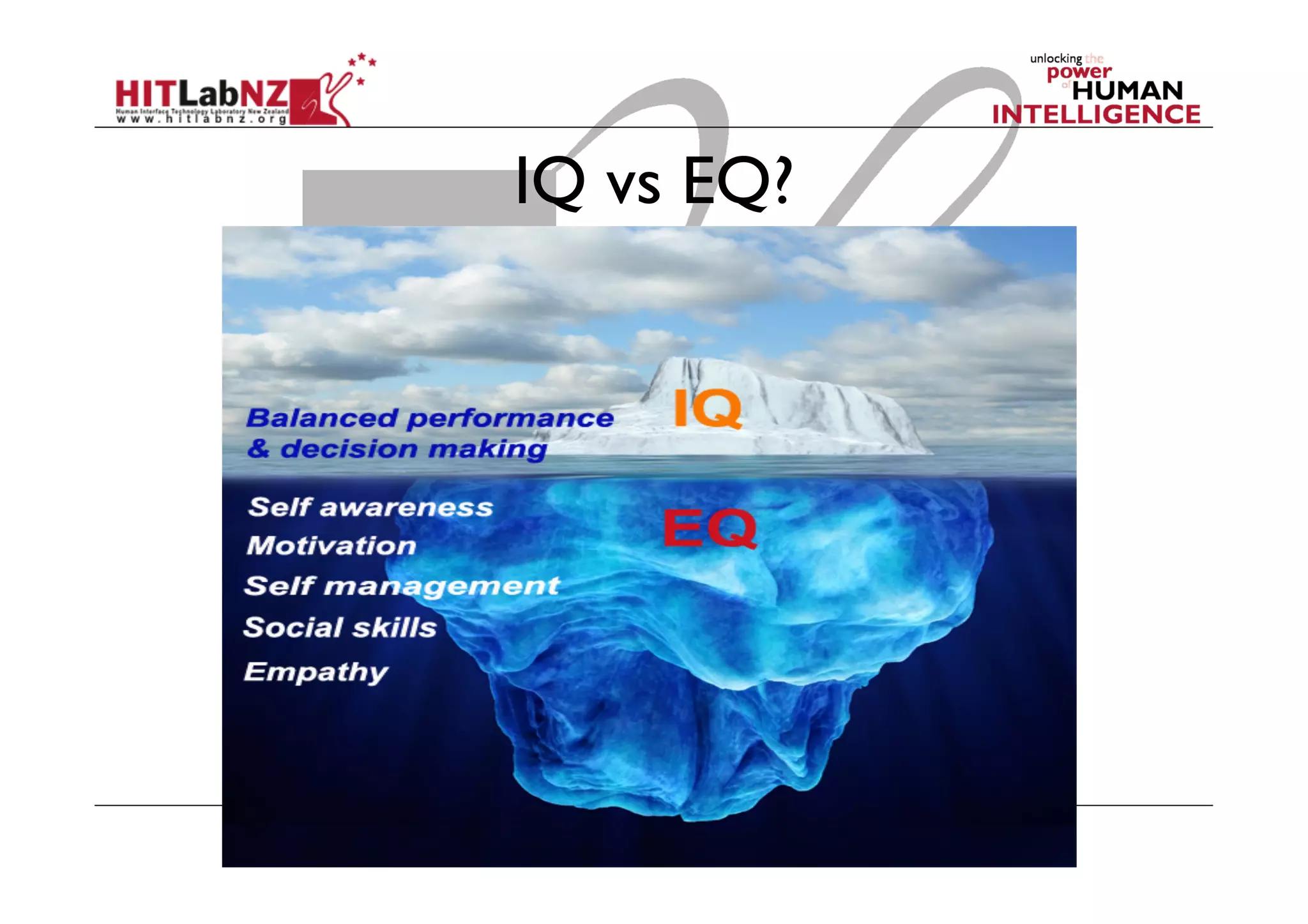
IQ vs EQ?
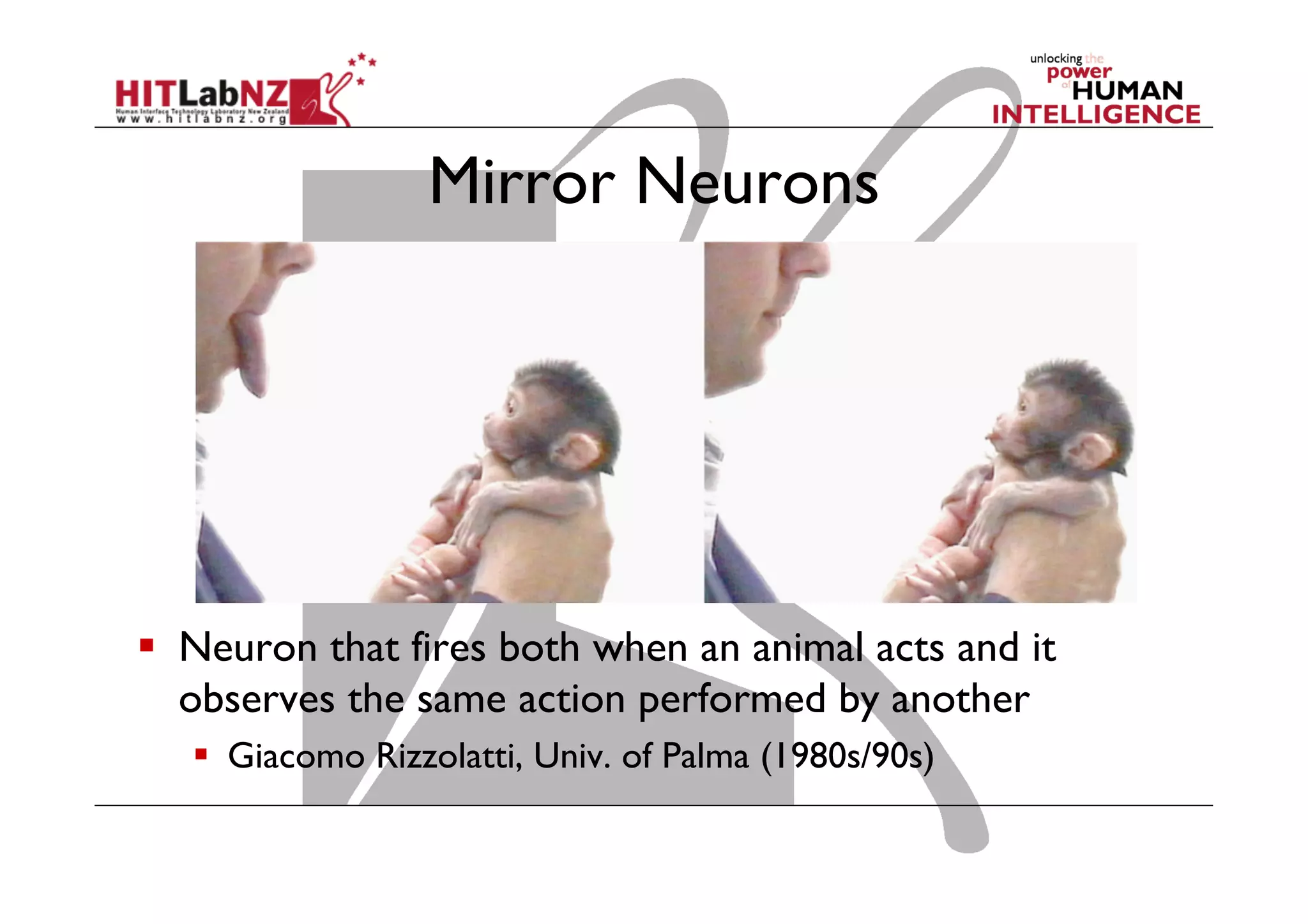
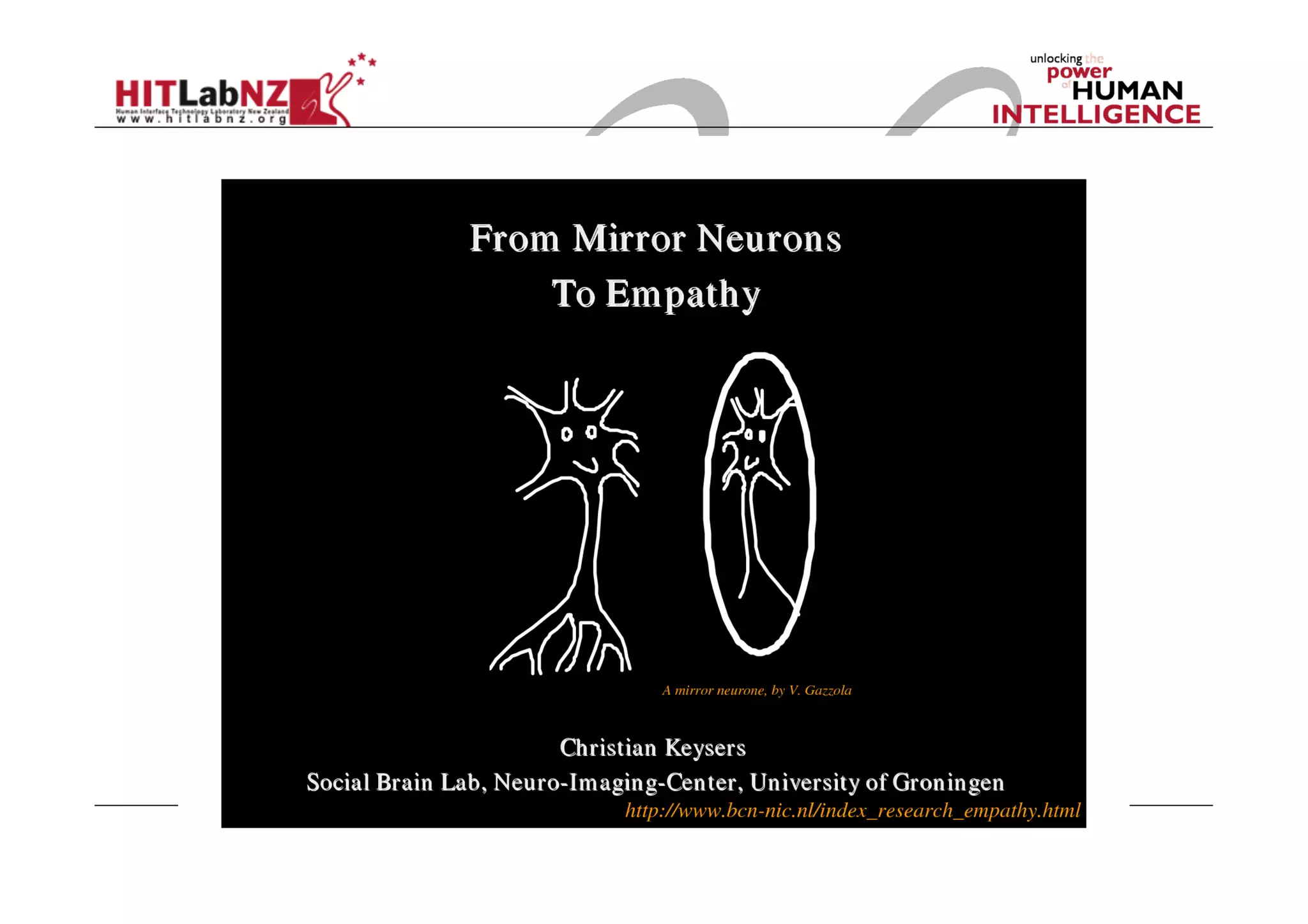
Mirror Neurons

  Neuron that fires both when an animal acts and it
observes the same action performed by another
  Giacomo Rizzolatti, Univ. of Palma (1980s/90s)
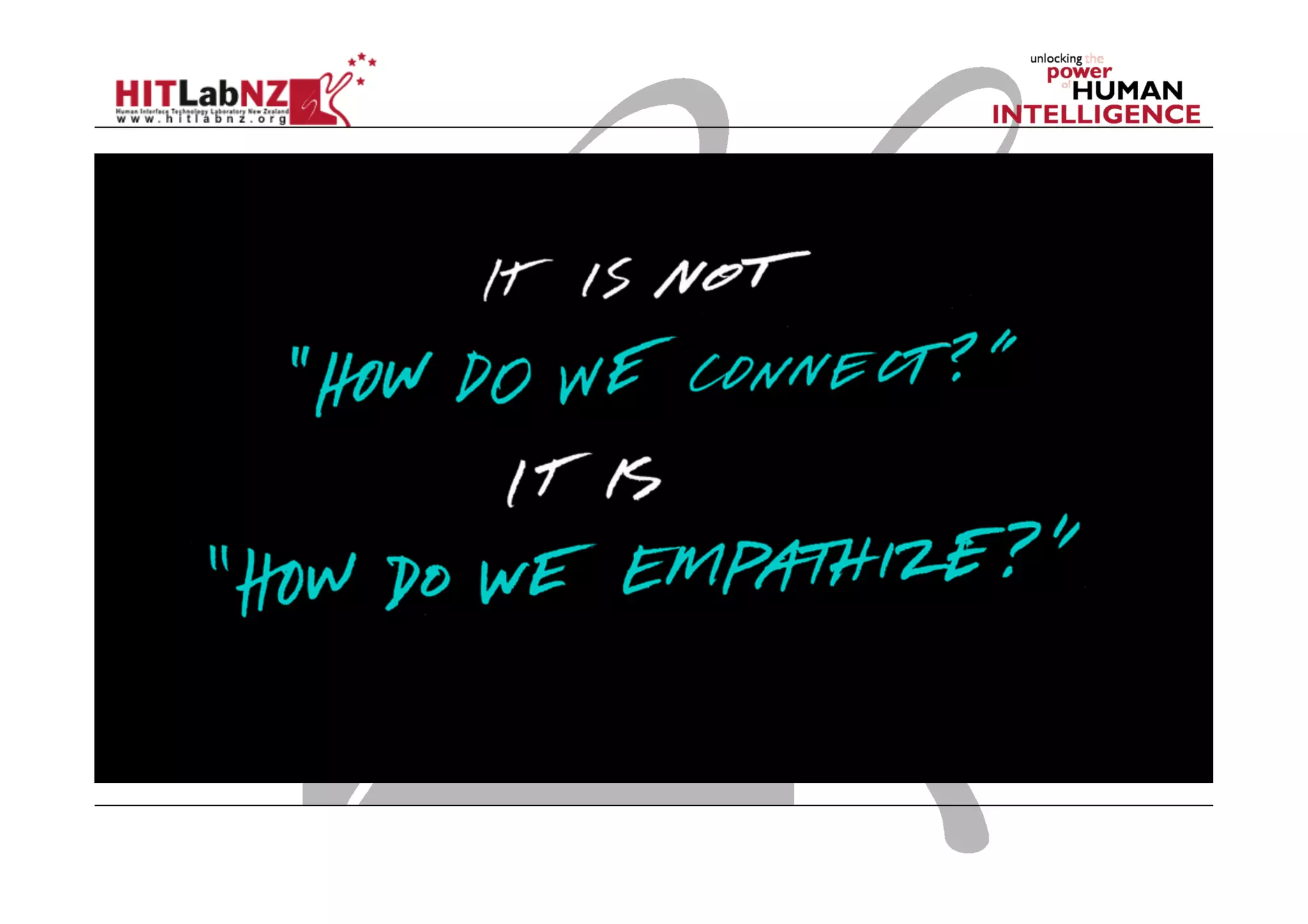
Empathic Computing
1. Computing systems that can
understand your feelings and emotions
2. Computing systems that help you
better understand the feelings of others
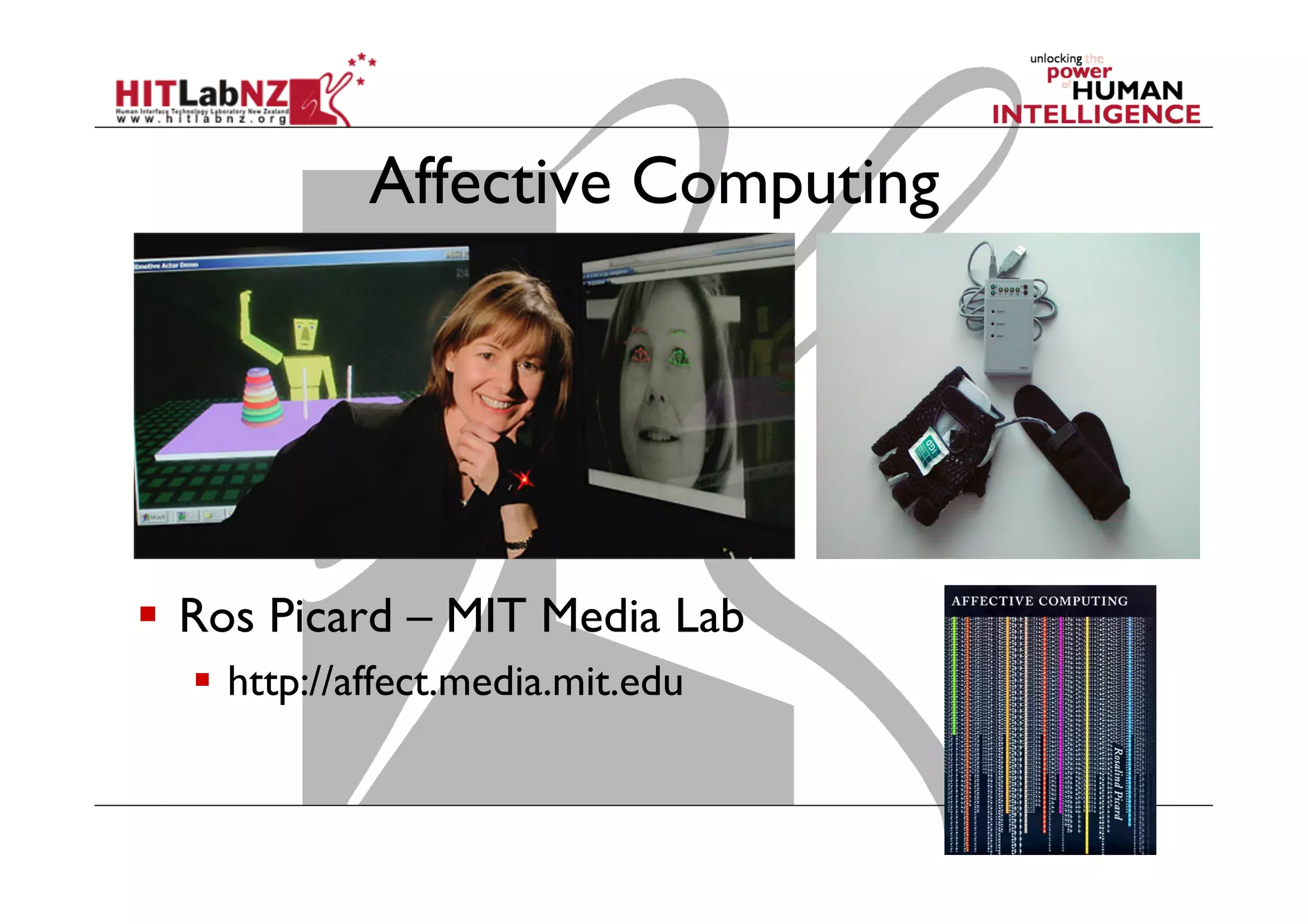
Affective Computing

  Ros Picard – MIT Media Lab
  http://affect.media.mit.edu
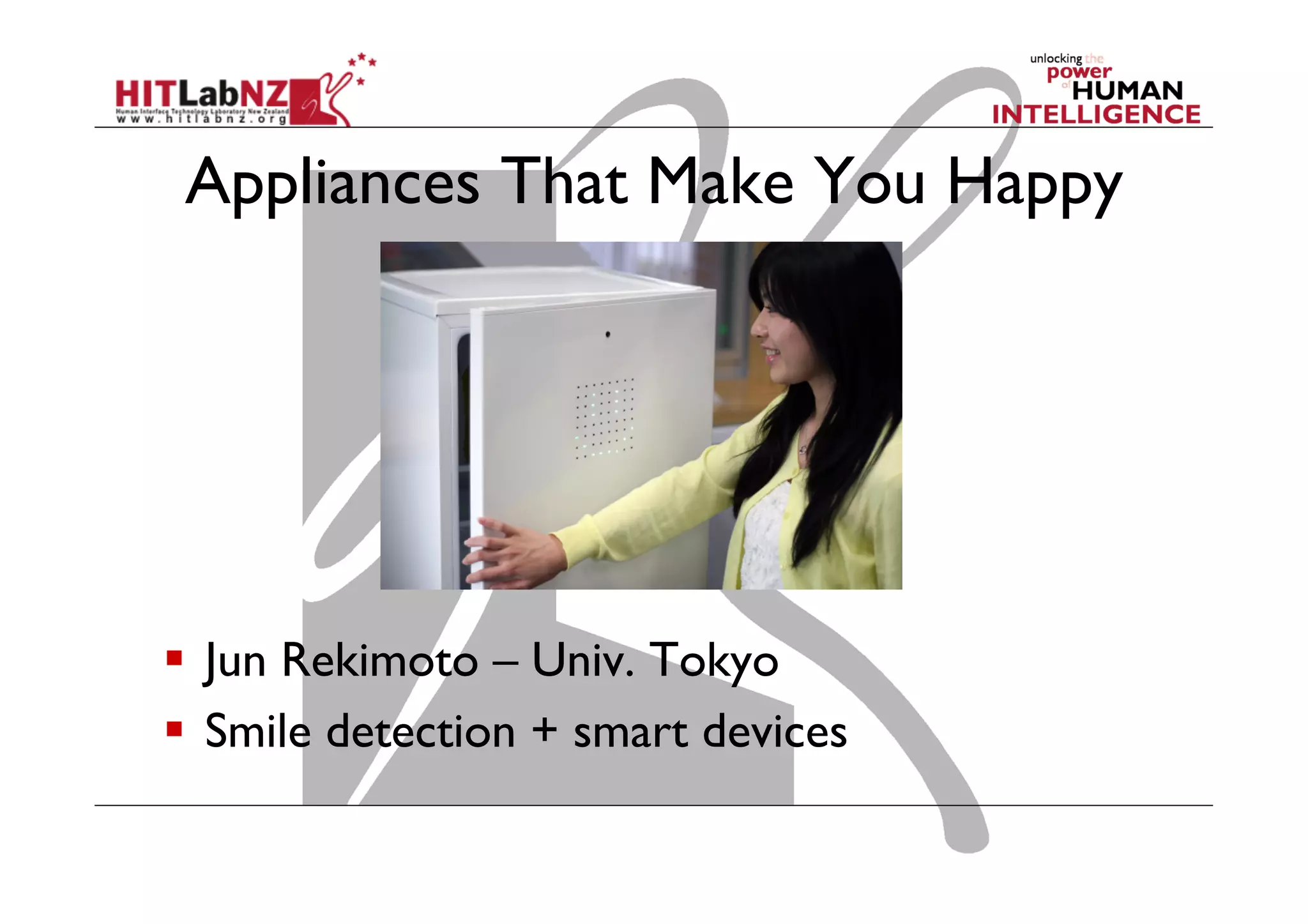
Appliances That Make You Happy

  Jun Rekimoto – Univ. Tokyo
  Smile detection + smart devices
Can we develop interfaces
that allow us to be more
empathetic to others?
  adsf
Empathy Computing Requirements
 Basic Requirements
 Making the technology transparent

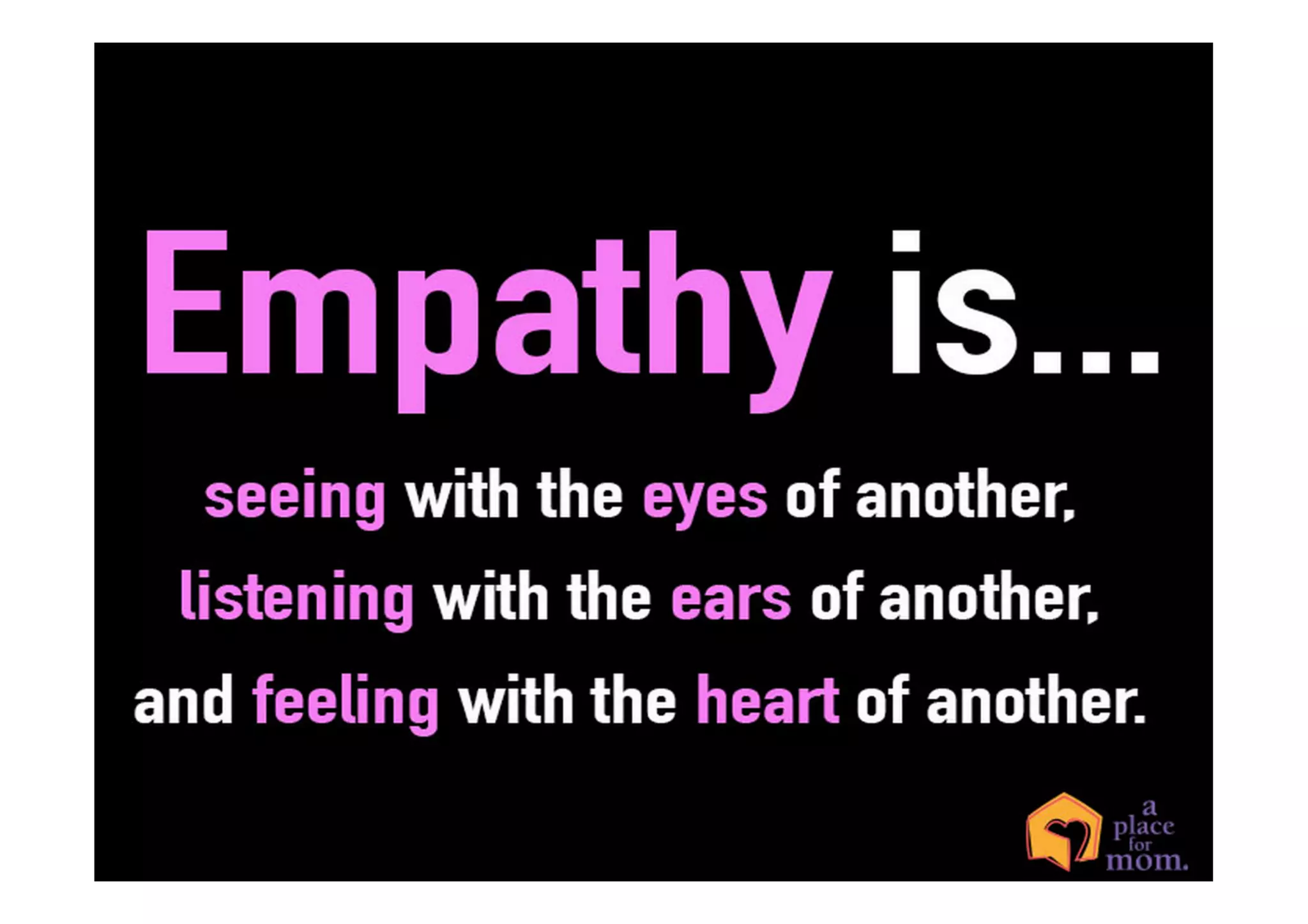
 Empathy Definition
 Seeing with the eyes of another
 Hearing with the ears of another
 Feeling with the heart of another
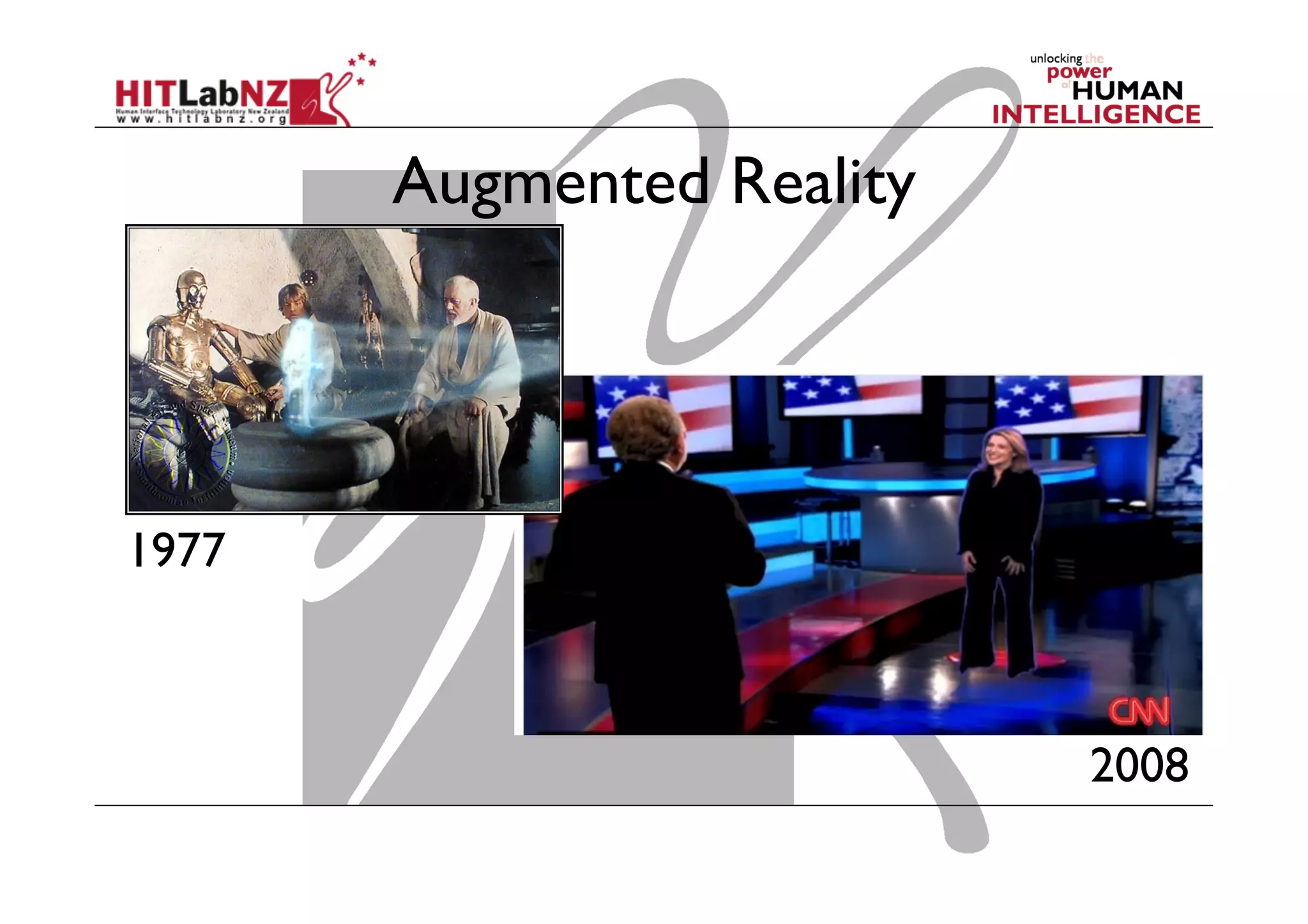
Augmented Reality

1977

2008
Using AR for Empathy
 Augmented Reality can:
 Remove technology barriers
 Enhance communication
 Change perspective
 Share experiences
 Enhance interaction in real world
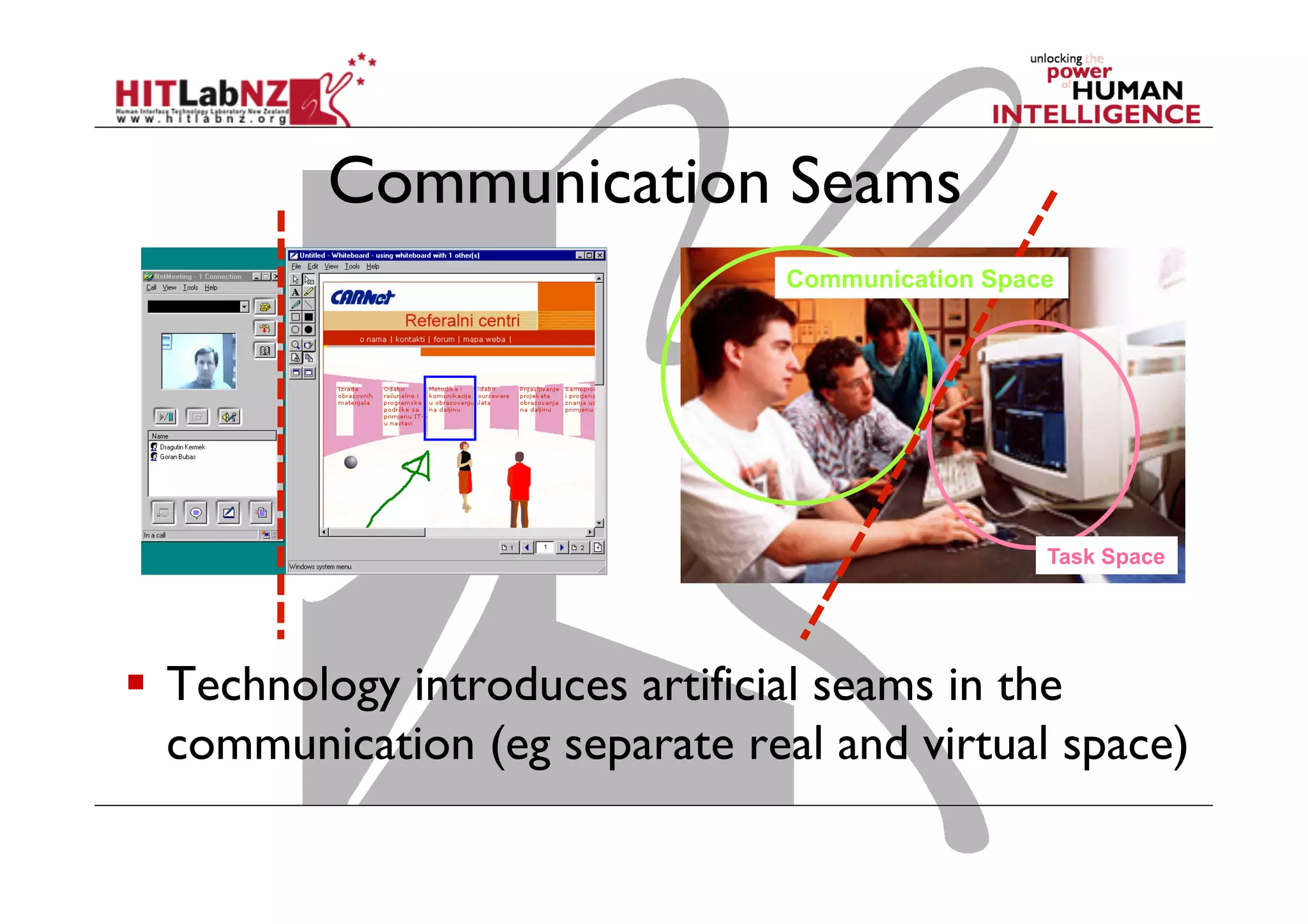
Communication Seams
Communication Space

Task Space

  Technology introduces artificial seams in the
communication (eg separate real and virtual space)
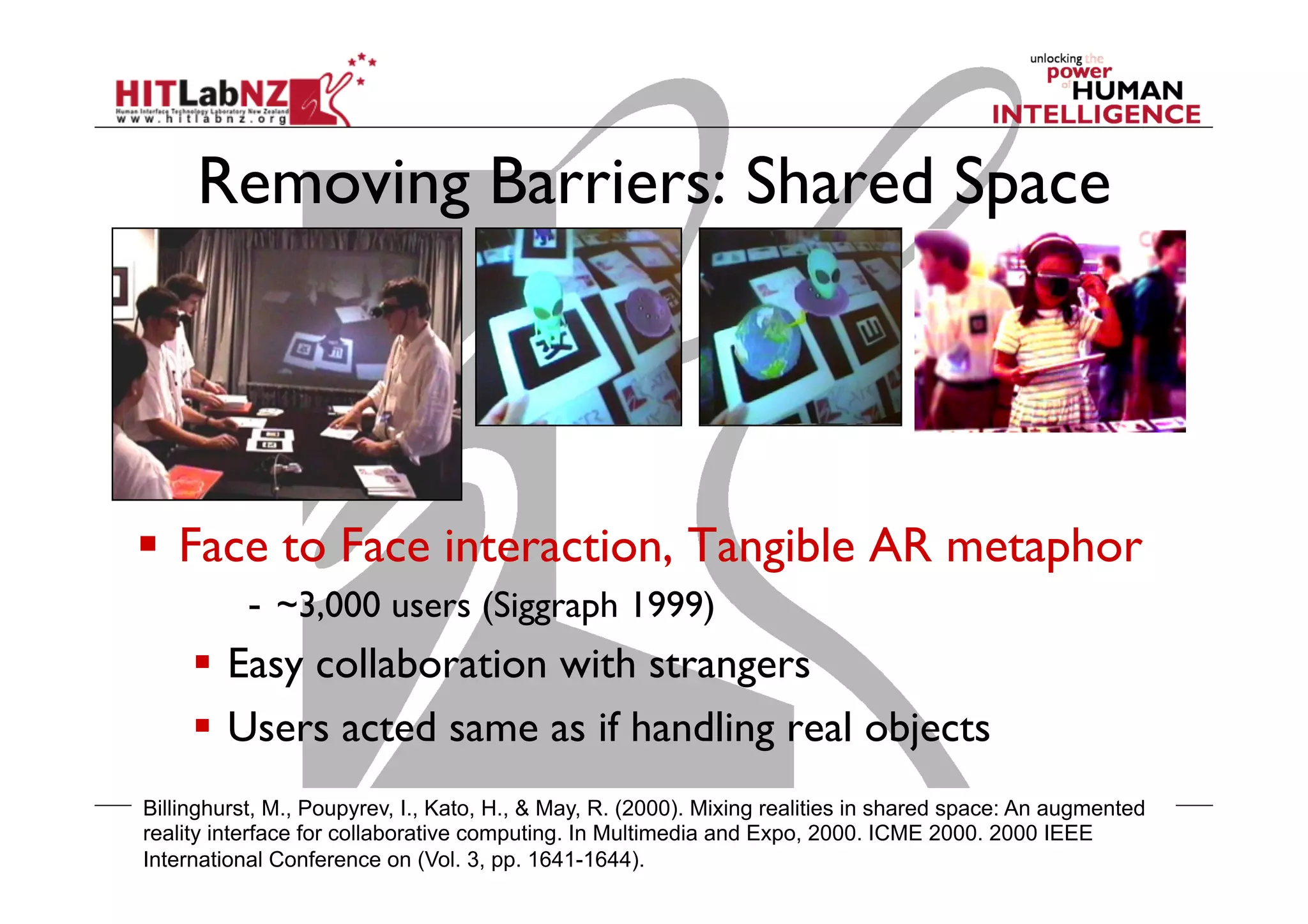
Removing Barriers: Shared Space

  Face to Face interaction, Tangible AR metaphor
-  ~3,000 users (Siggraph 1999)

  Easy collaboration with strangers
  Users acted same as if handling real objects
Billinghurst, M., Poupyrev, I., Kato, H., & May, R. (2000). Mixing realities in shared space: An augmented
reality interface for collaborative computing. In Multimedia and Expo, 2000. ICME 2000. 2000 IEEE
International Conference on (Vol. 3, pp. 1641-1644).
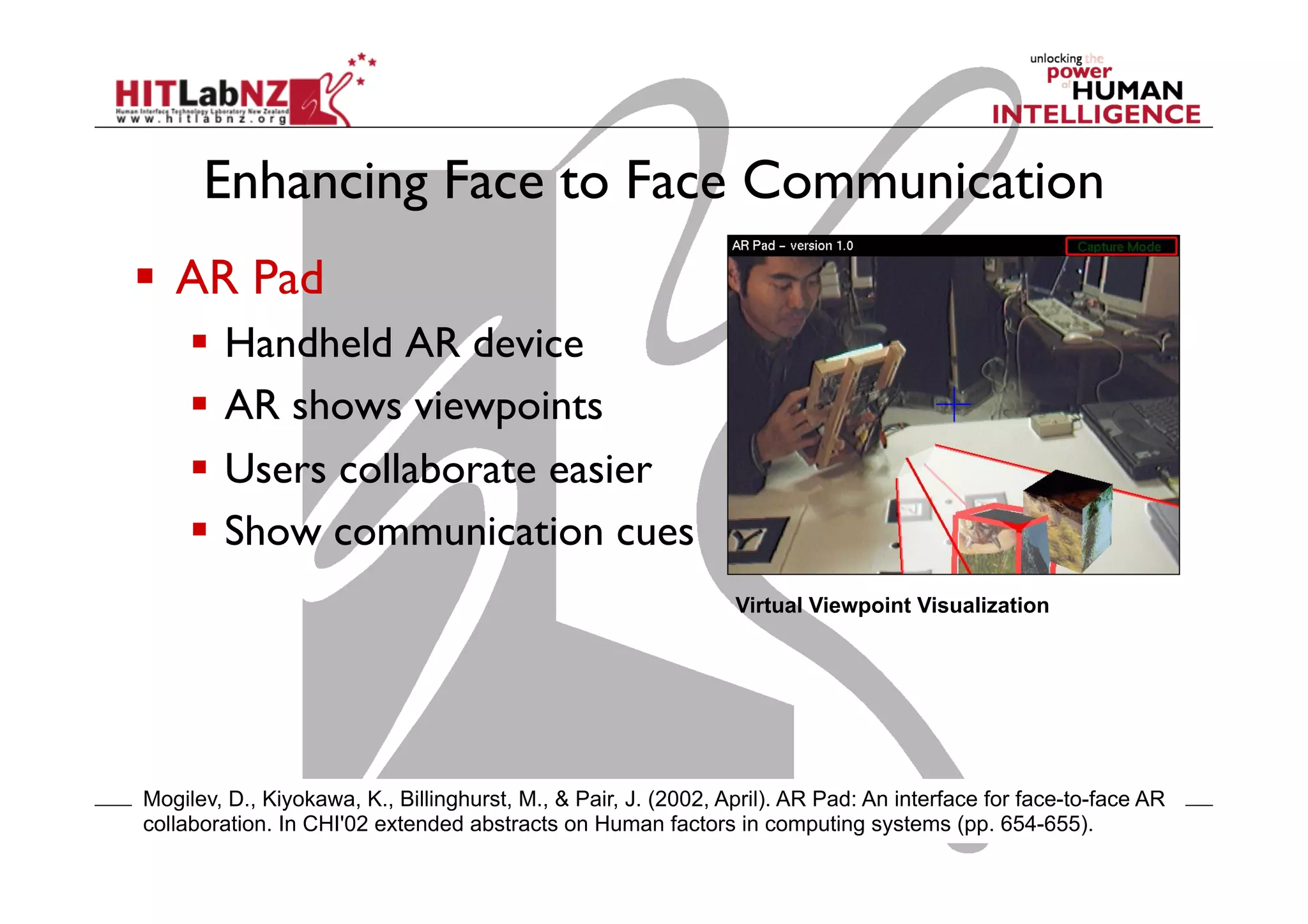
Enhancing Face to Face Communication
  AR Pad
  Handheld AR device
  AR shows viewpoints
  Users collaborate easier
  Show communication cues
Virtual Viewpoint Visualization

Mogilev, D., Kiyokawa, K., Billinghurst, M., & Pair, J. (2002, April). AR Pad: An interface for face-to-face AR
collaboration. In CHI'02 extended abstracts on Human factors in computing systems (pp. 654-655).
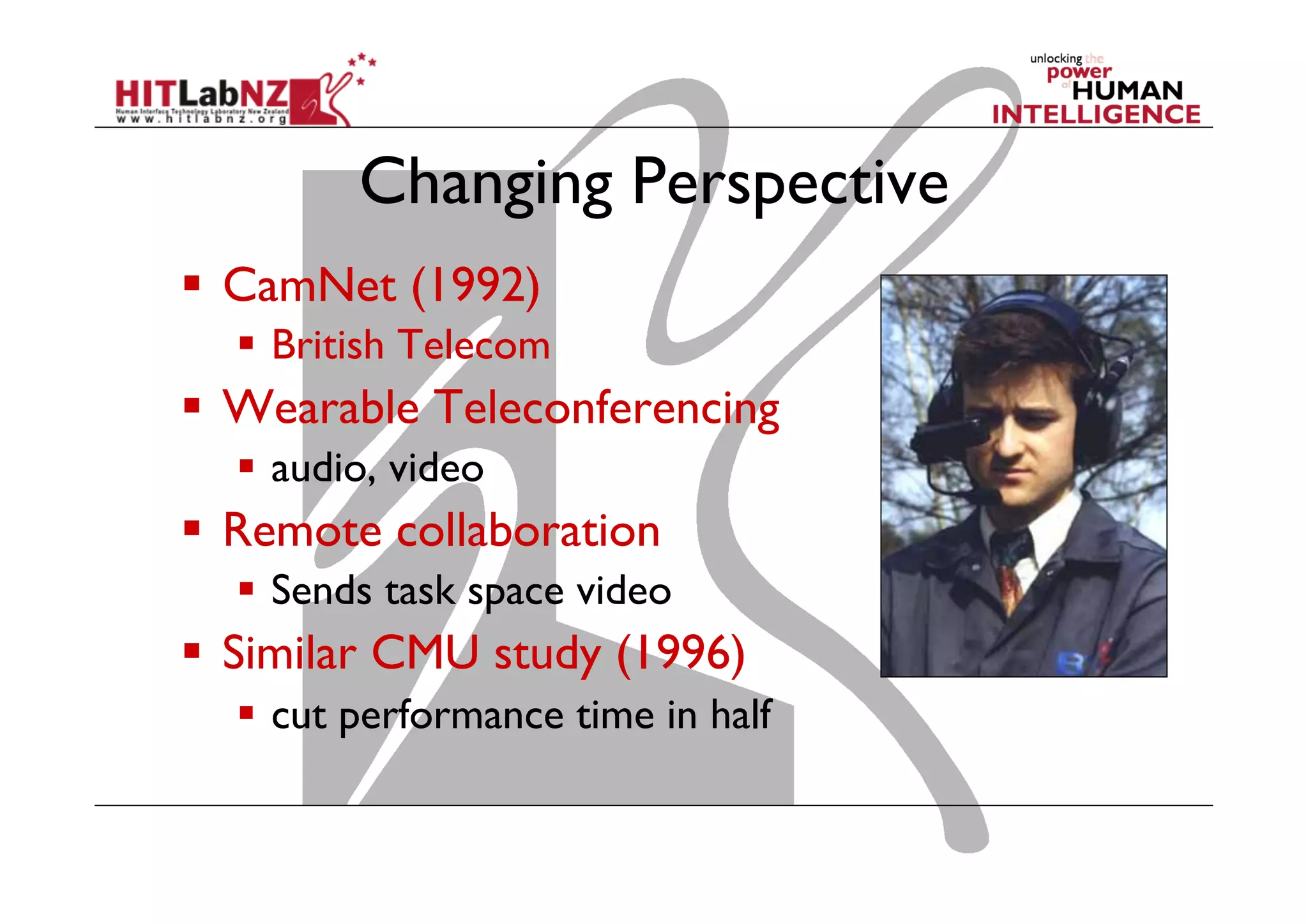
Changing Perspective
  CamNet (1992)
  British Telecom

  Wearable Teleconferencing
  audio, video

  Remote collaboration
  Sends task space video

  Similar CMU study (1996)
  cut performance time in half
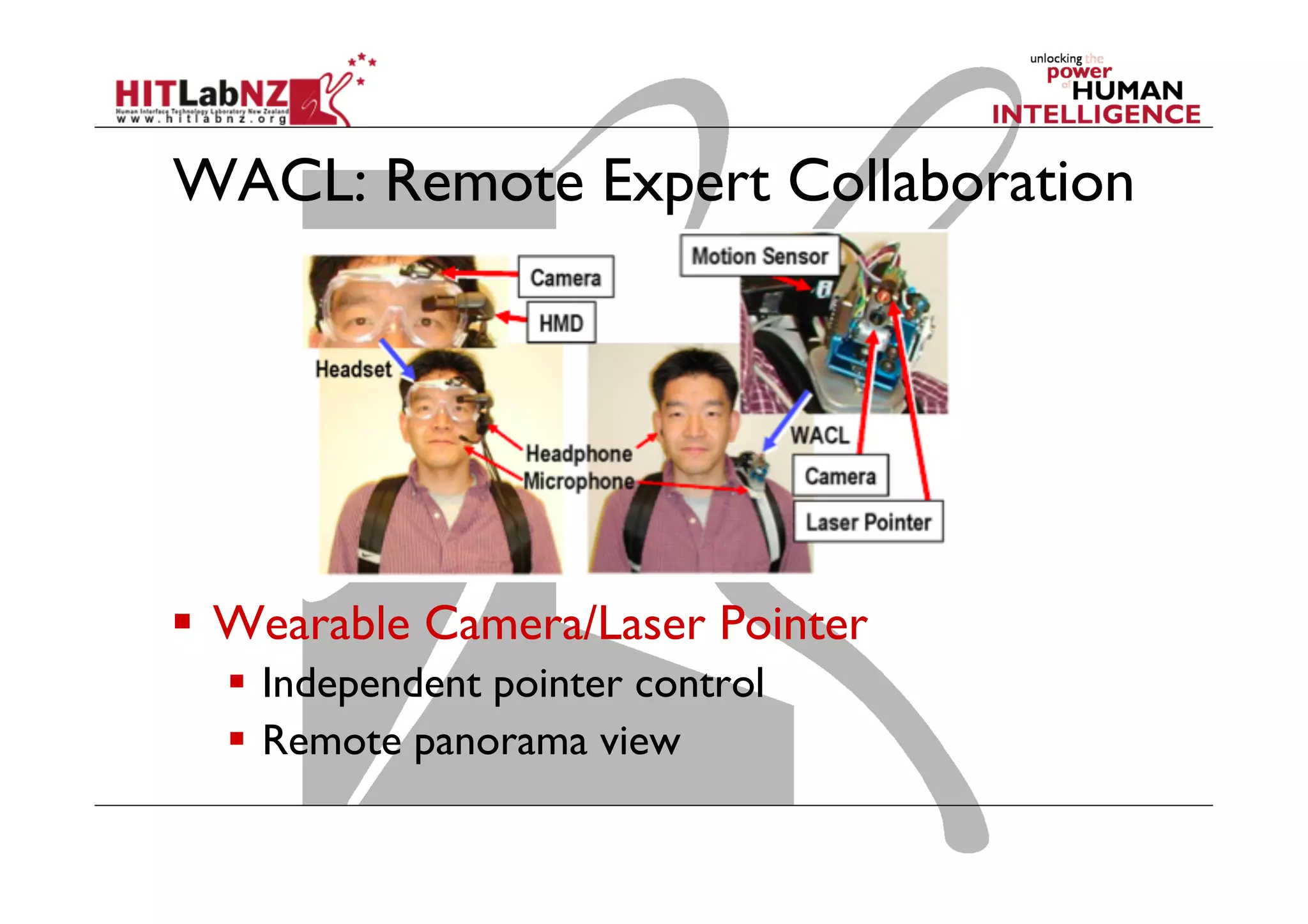
WACL: Remote Expert Collaboration

  Wearable Camera/Laser Pointer
  Independent pointer control
  Remote panorama view
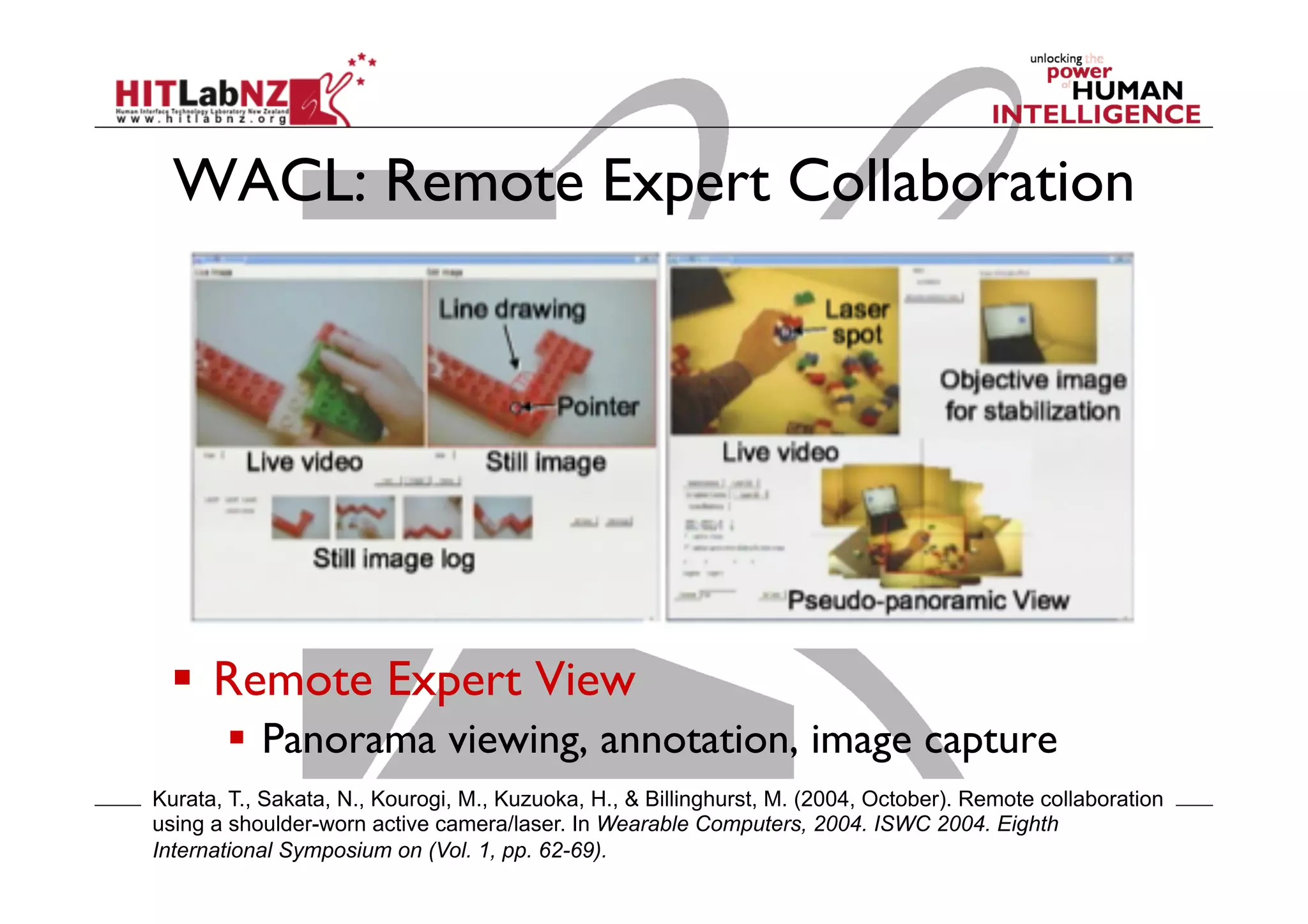
WACL: Remote Expert Collaboration

  Remote Expert View
  Panorama viewing, annotation, image capture
Kurata, T., Sakata, N., Kourogi, M., Kuzuoka, H., & Billinghurst, M. (2004, October). Remote collaboration
using a shoulder-worn active camera/laser. In Wearable Computers, 2004. ISWC 2004. Eighth
International Symposium on (Vol. 1, pp. 62-69).
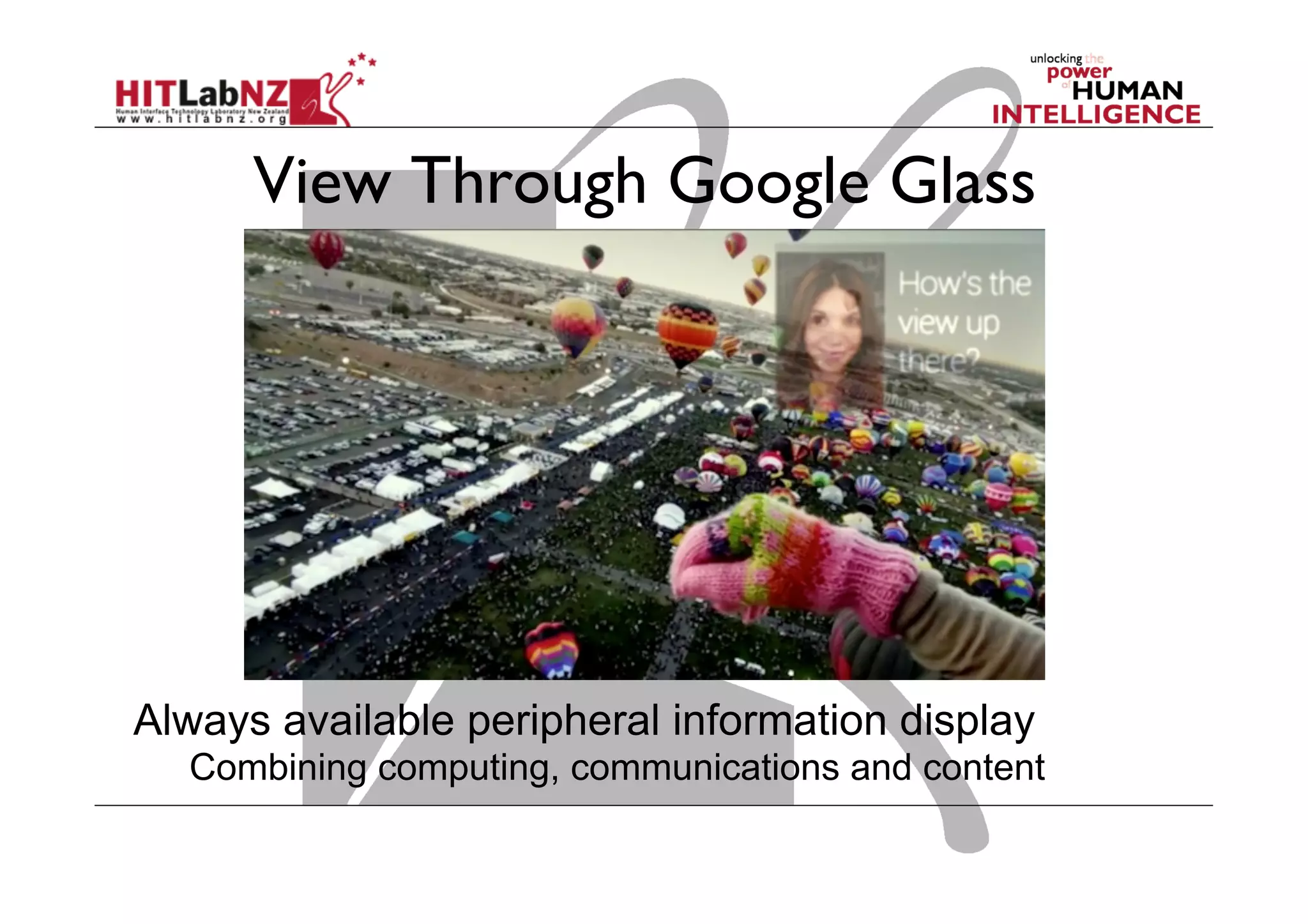
View Through Google Glass

Always available peripheral information display
Combining computing, communications and content capture
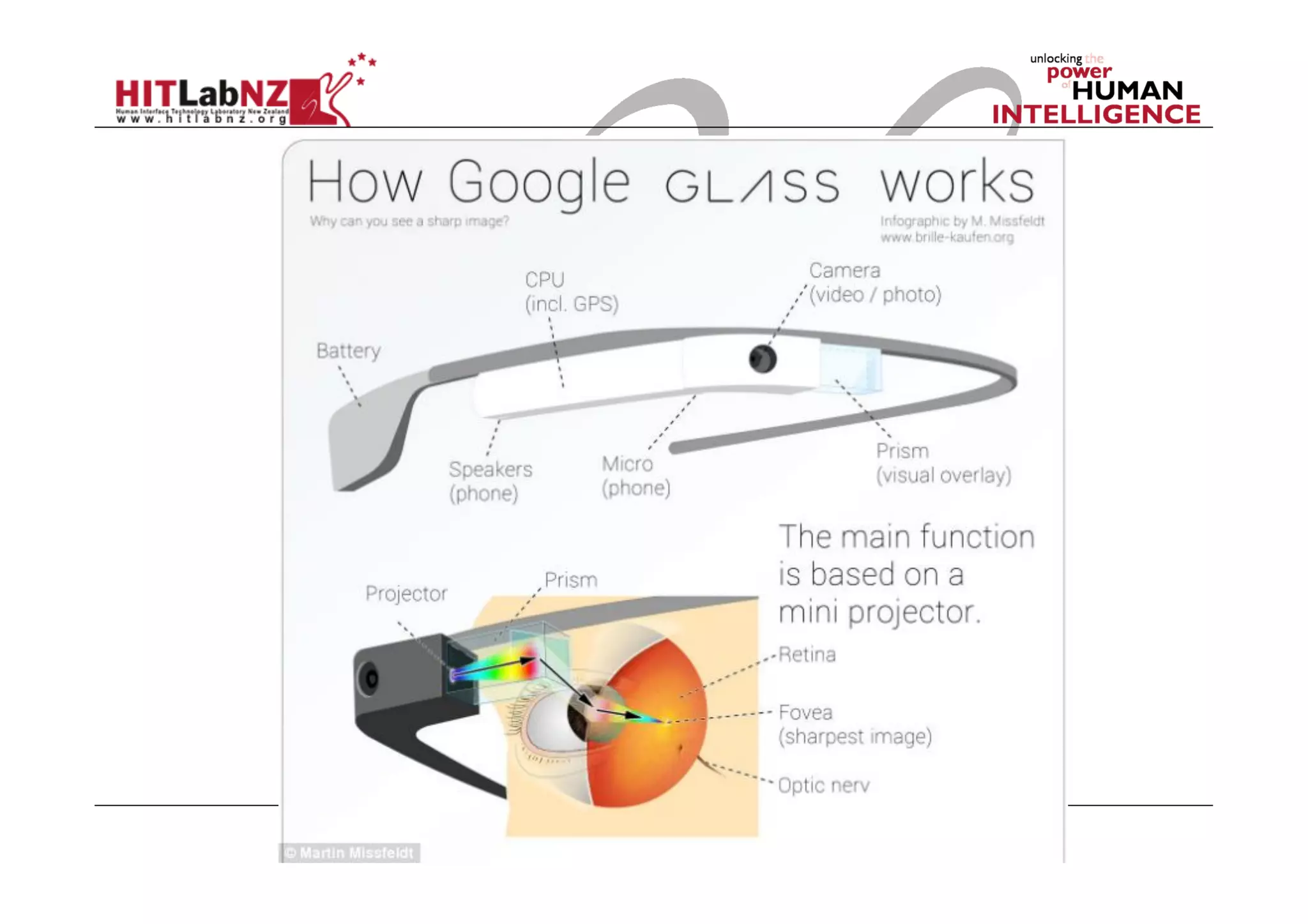
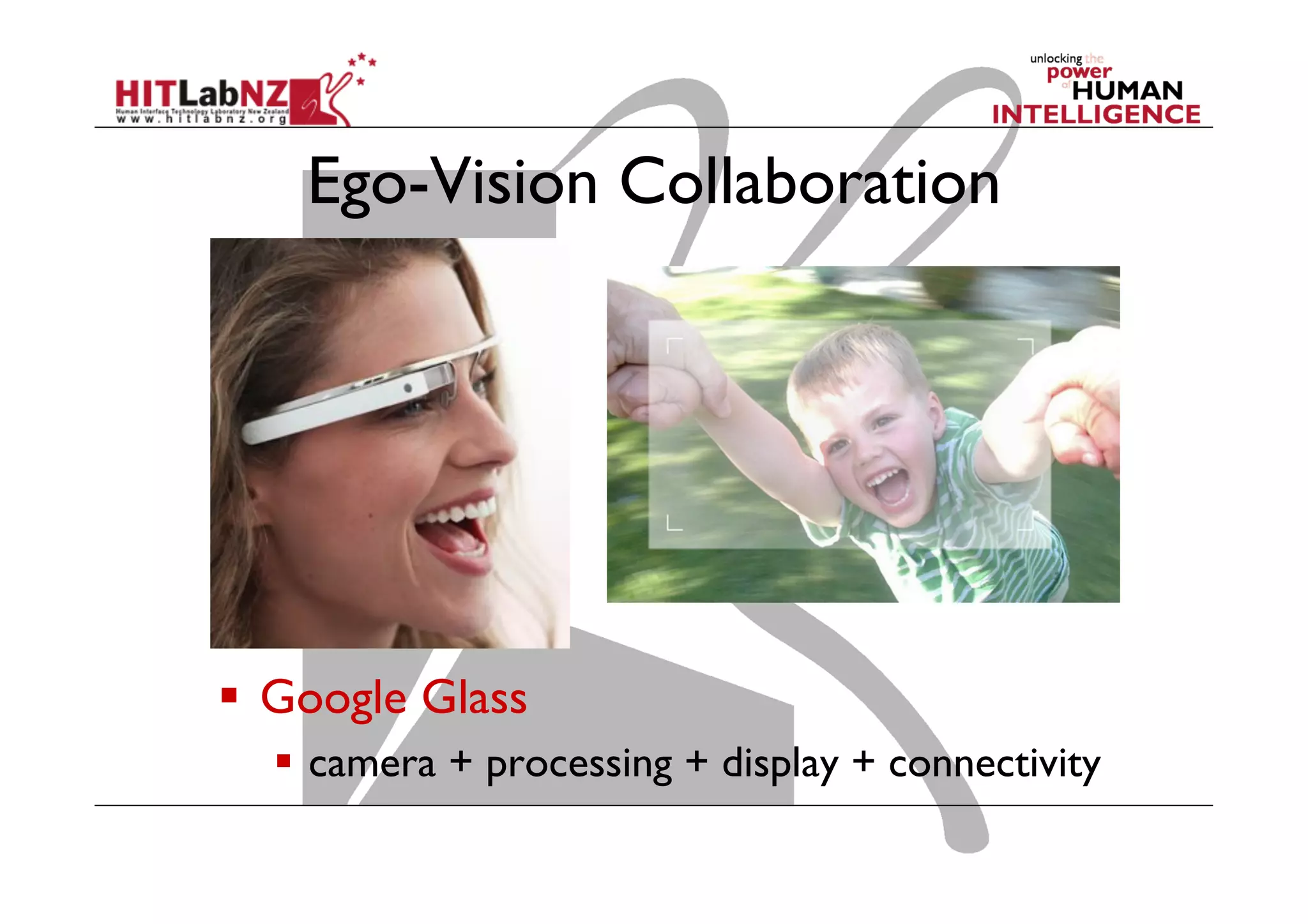
Ego-Vision Collaboration

  Google Glass
  camera + processing + display + connectivity
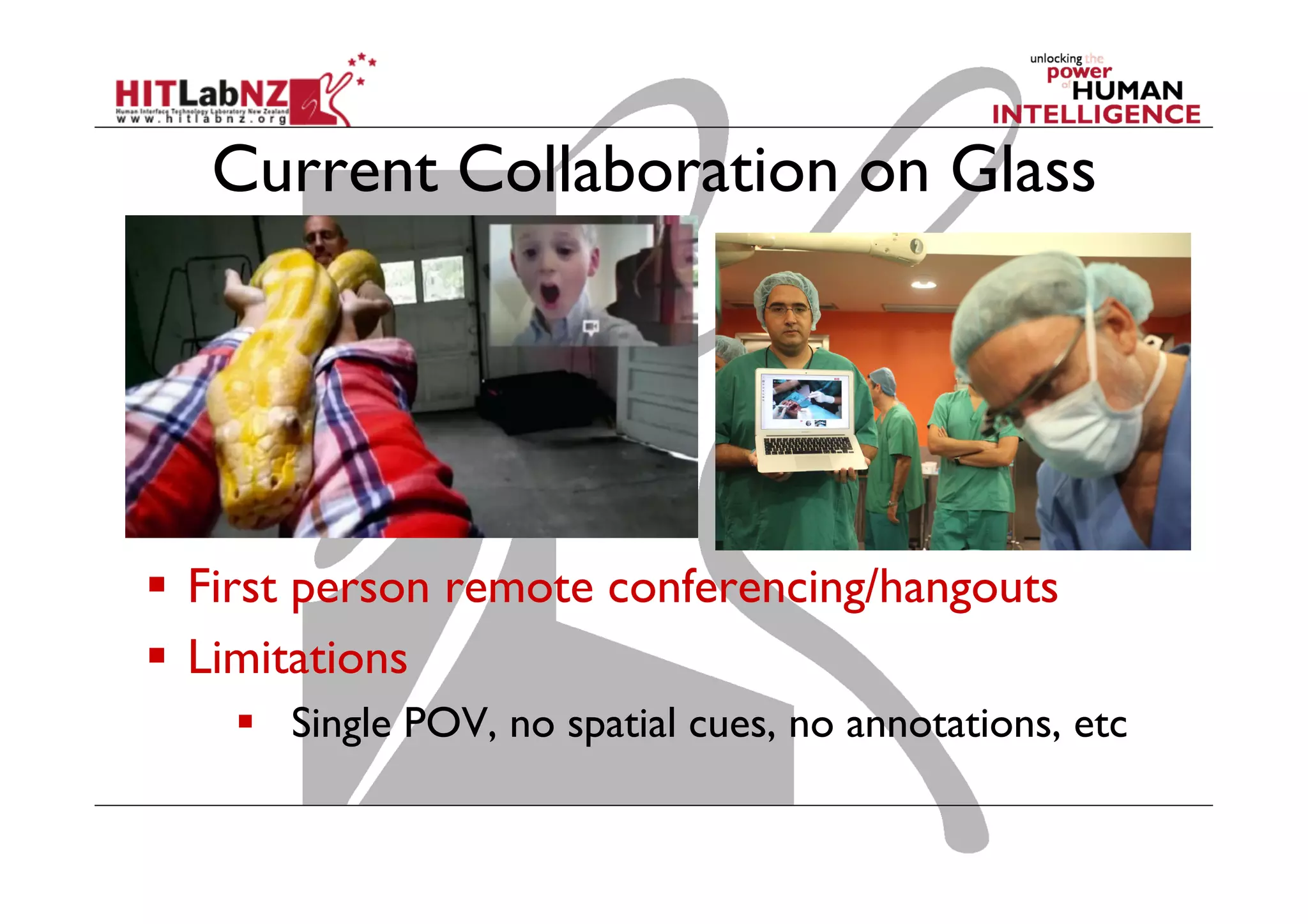
Current Collaboration on Glass

  First person remote conferencing/hangouts
  Limitations
  Single POV, no spatial cues, no annotations, etc
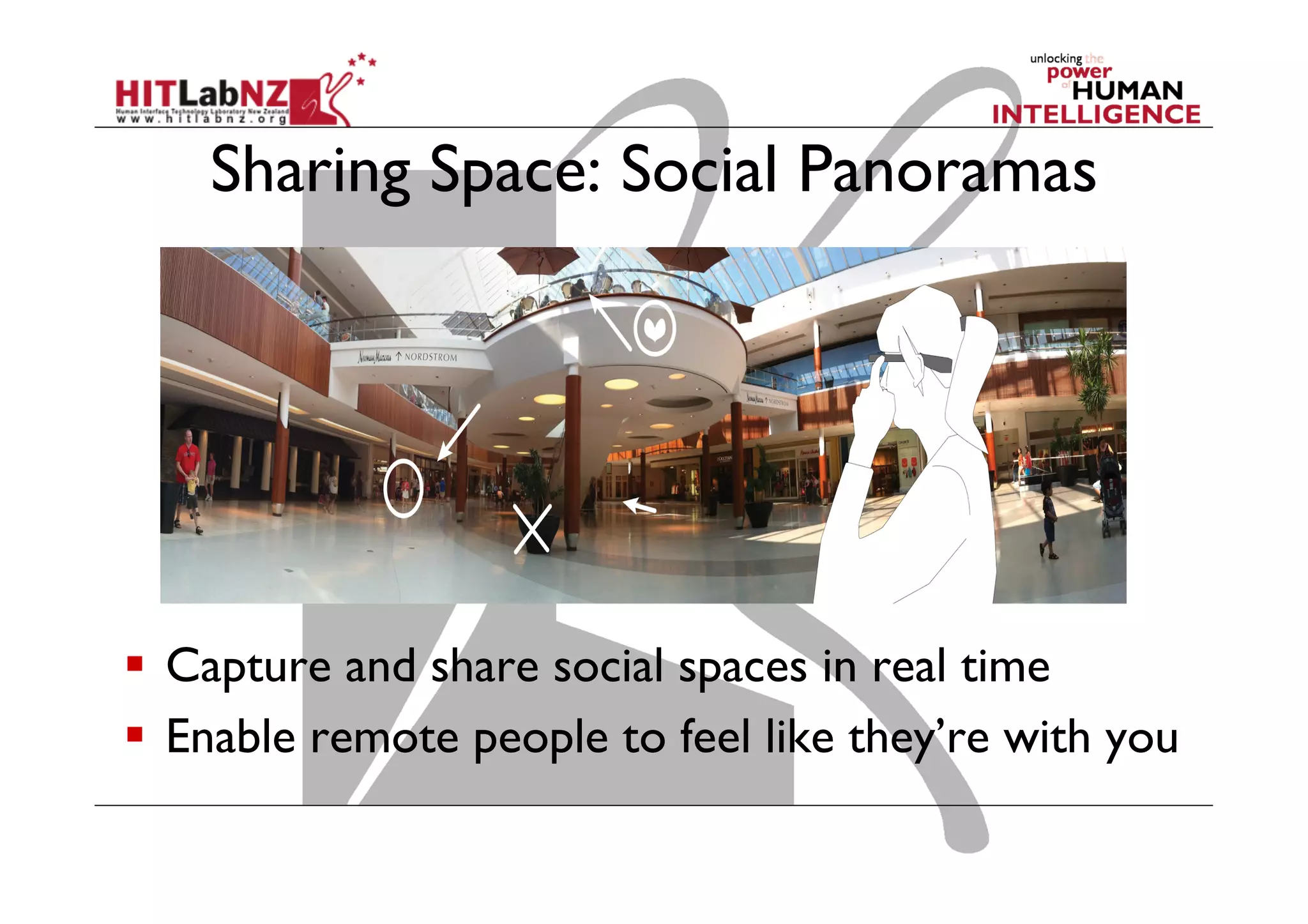
Sharing Space: Social Panoramas

  Capture and share social spaces in real time
  Enable remote people to feel like they’re with you
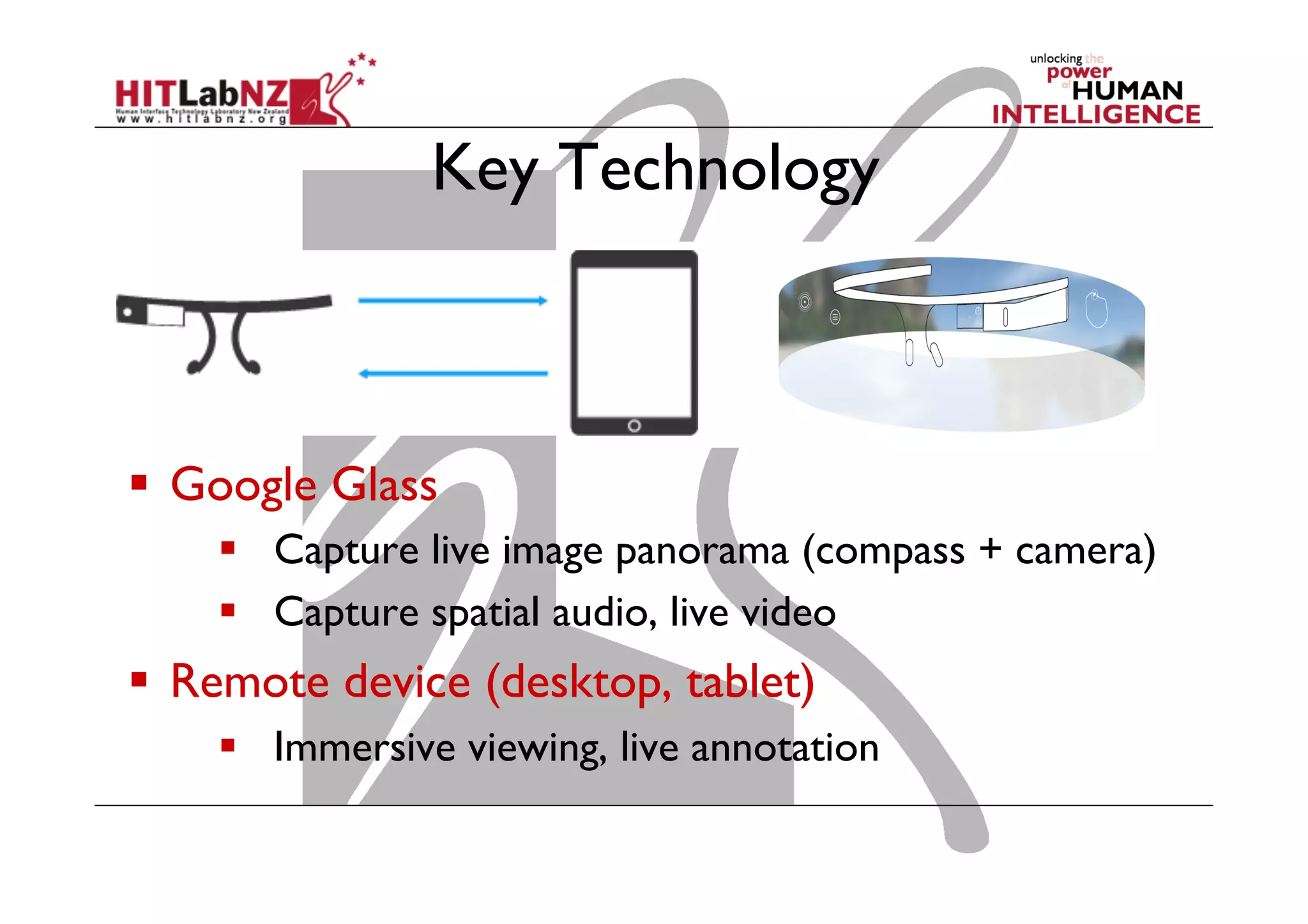
Key Technology

  Google Glass
  Capture live image panorama (compass + camera)
  Capture spatial audio, live video

  Remote device (desktop, tablet)
  Immersive viewing, live annotation
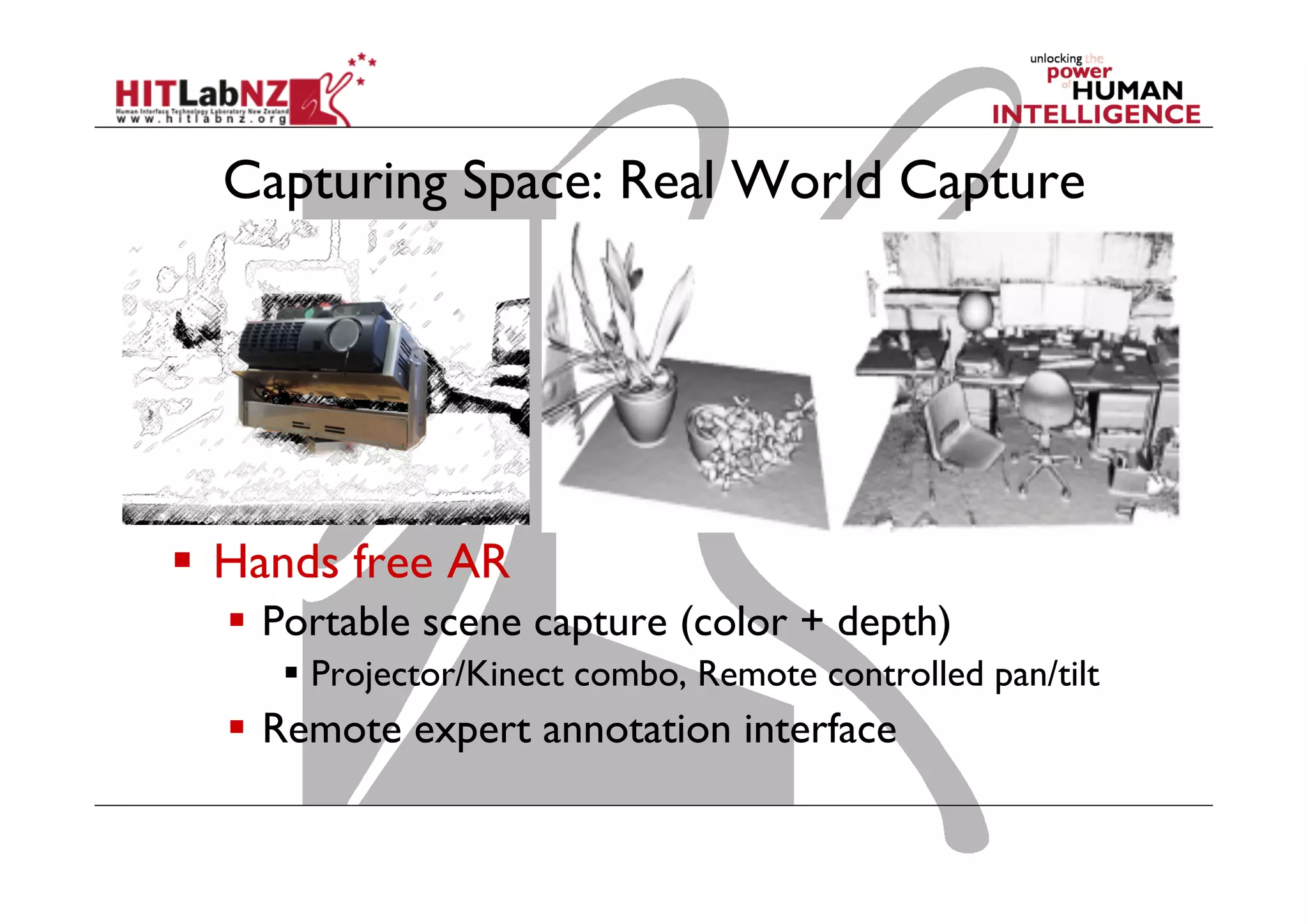
Capturing Space: Real World Capture

  Hands free AR
  Portable scene capture (color + depth)
  Projector/Kinect combo, Remote controlled pan/tilt

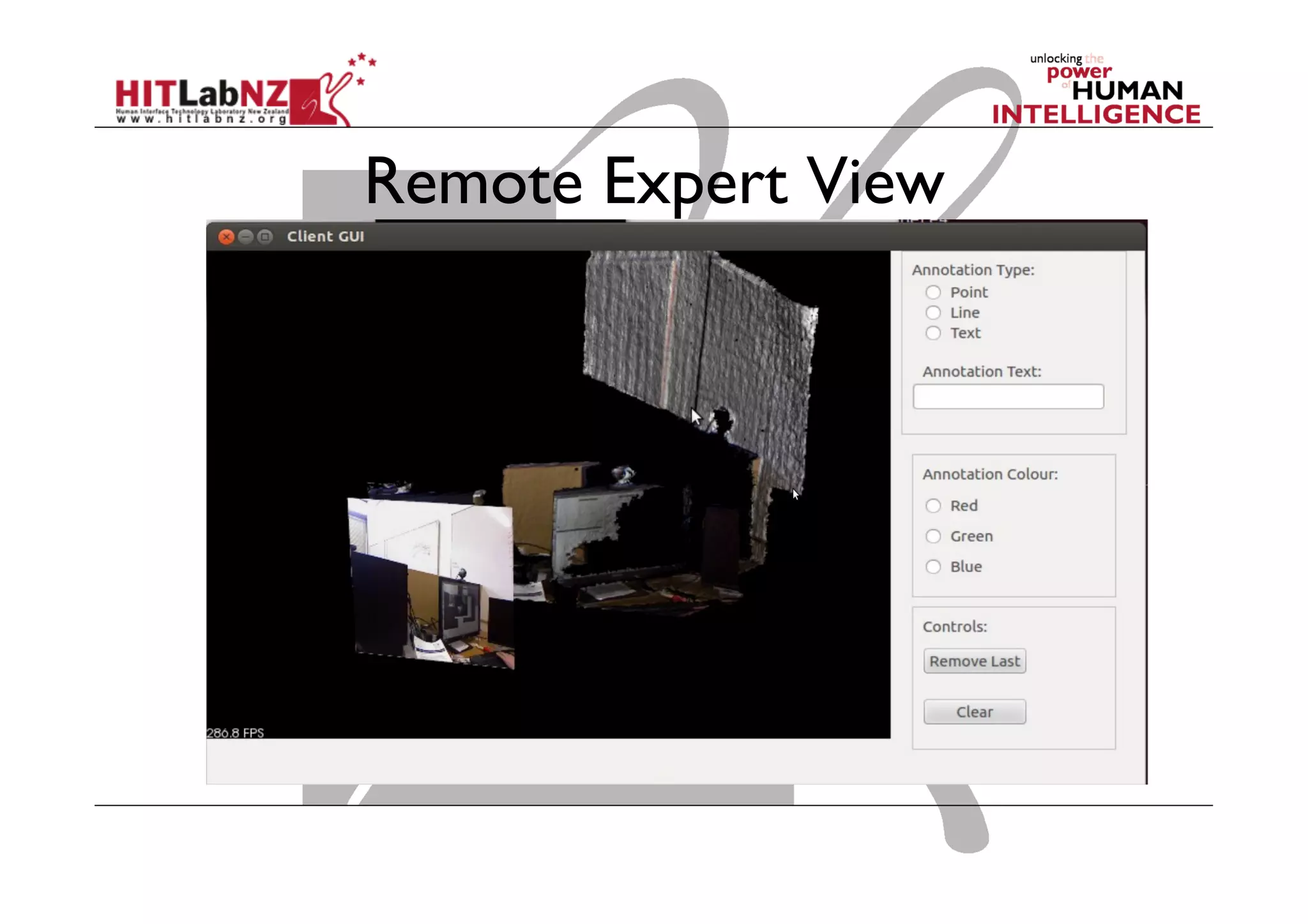
  Remote expert annotation interface
Remote Expert View
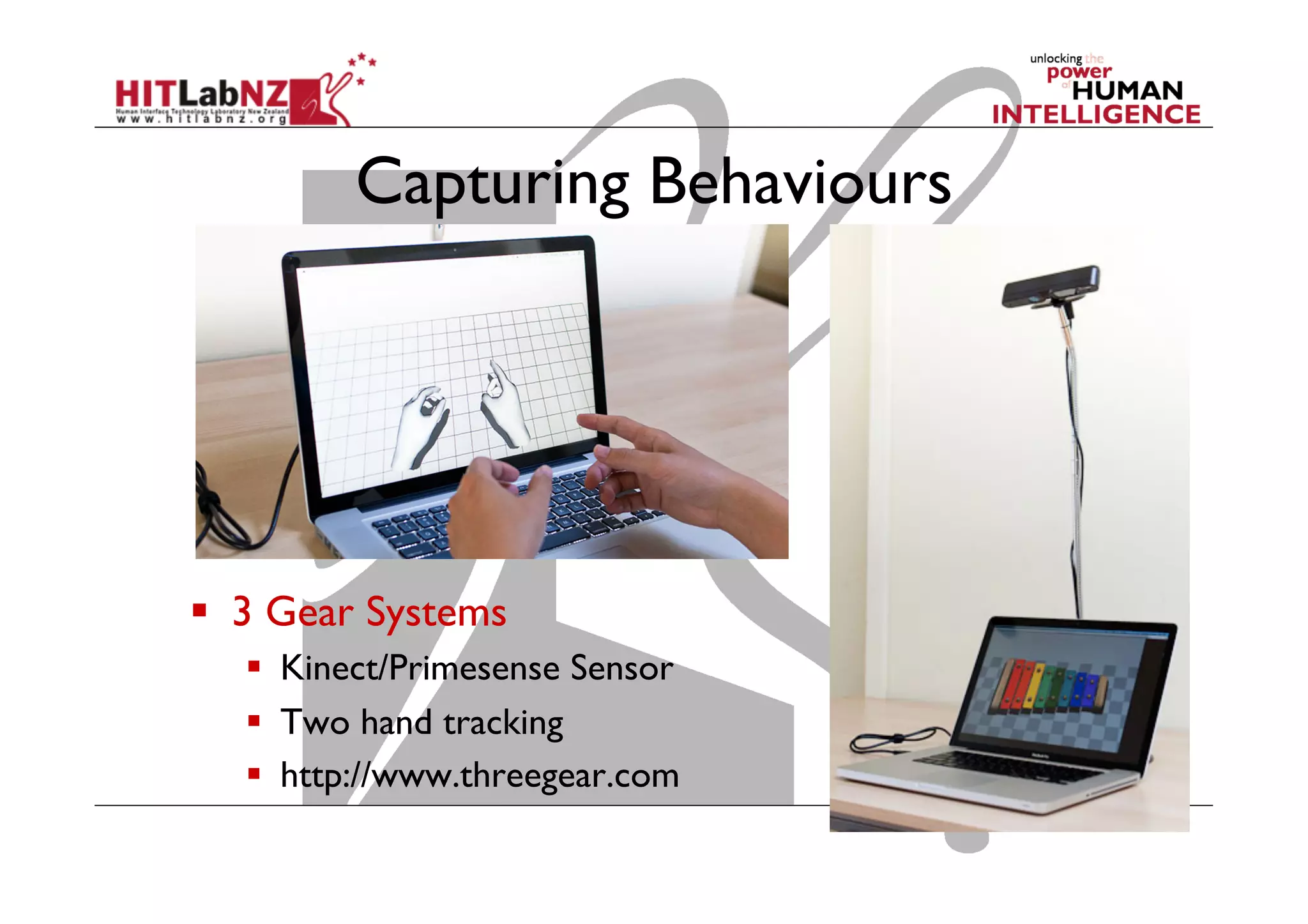
Capturing Behaviours

  3 Gear Systems
  Kinect/Primesense Sensor
  Two hand tracking
  http://www.threegear.com
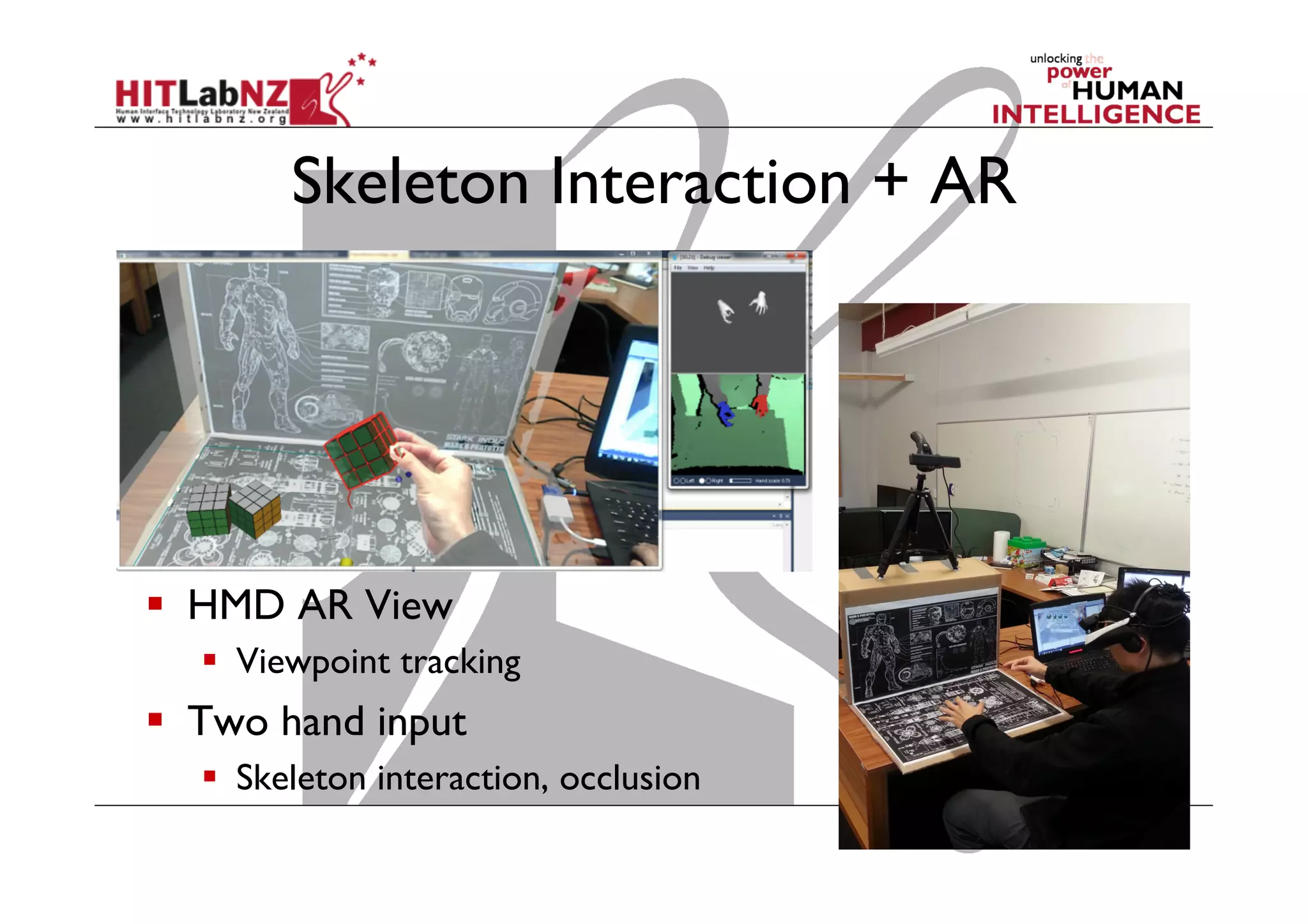
Skeleton Interaction + AR

  HMD AR View
  Viewpoint tracking

  Two hand input
  Skeleton interaction, occlusion
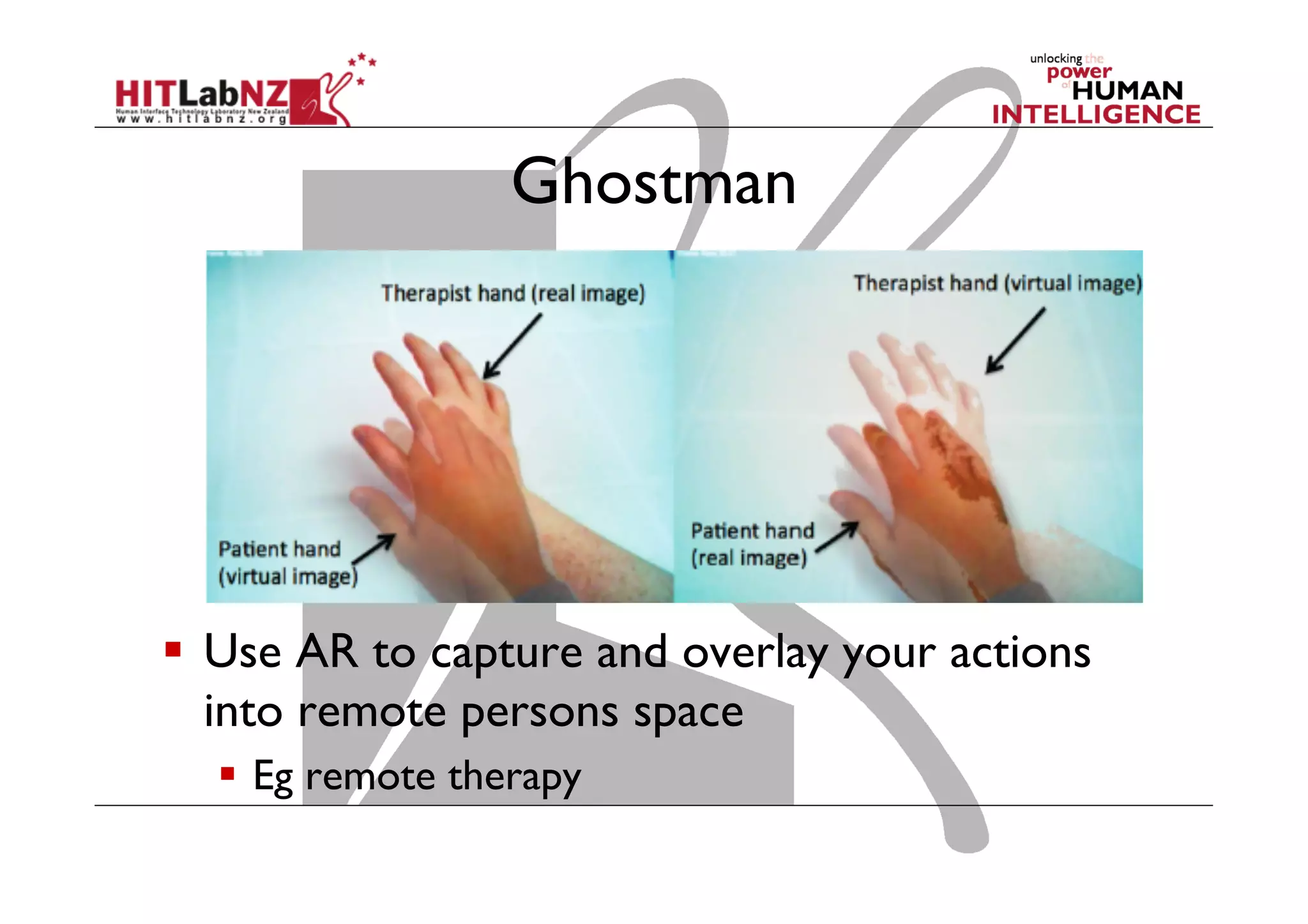
Ghostman

  Use AR to capture and overlay your actions
into remote persons space
  Eg remote therapy
Looking to the Future

What’s Next?
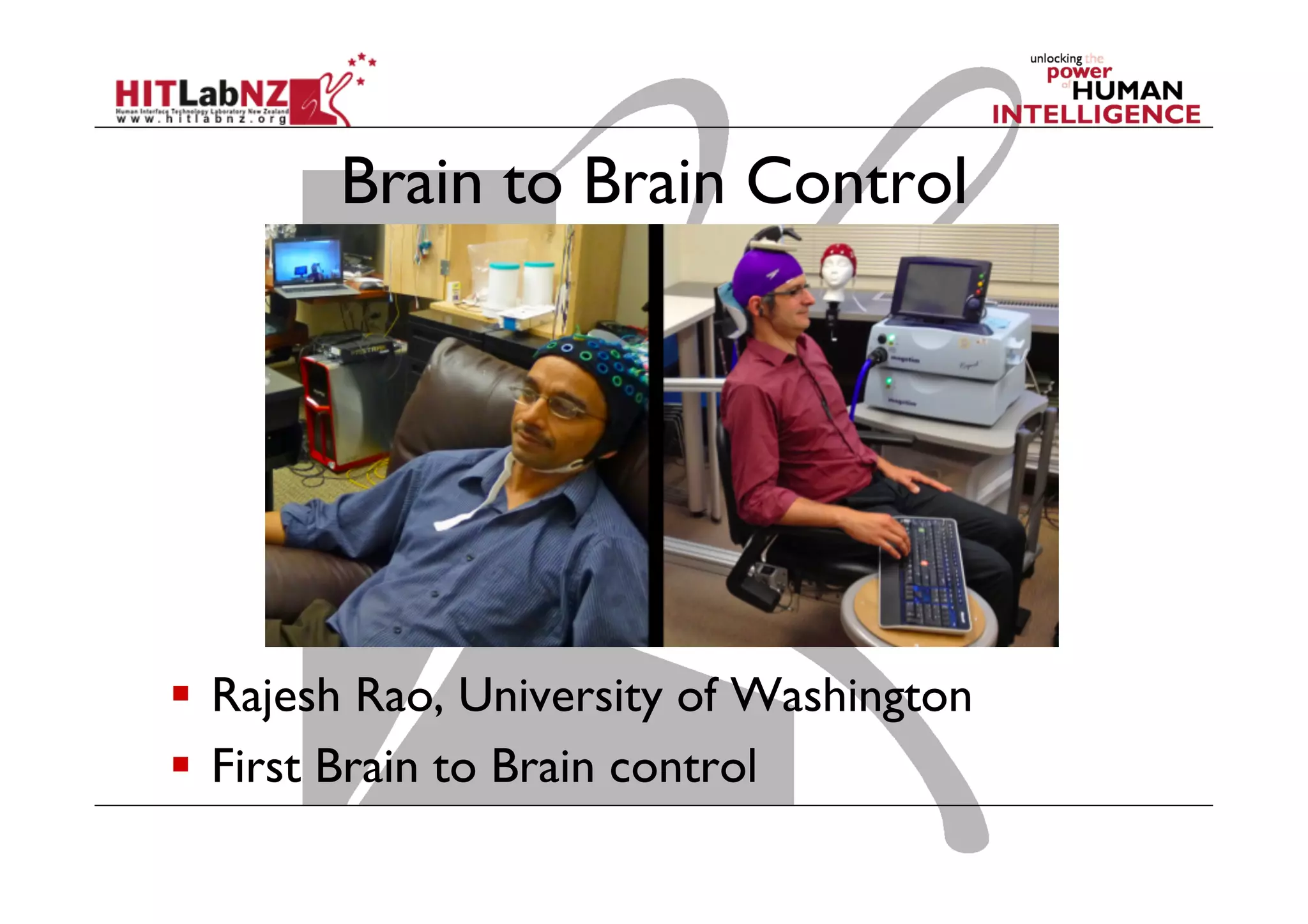
Brain to Brain Control

  Rajesh Rao, University of Washington
  First Brain to Brain control
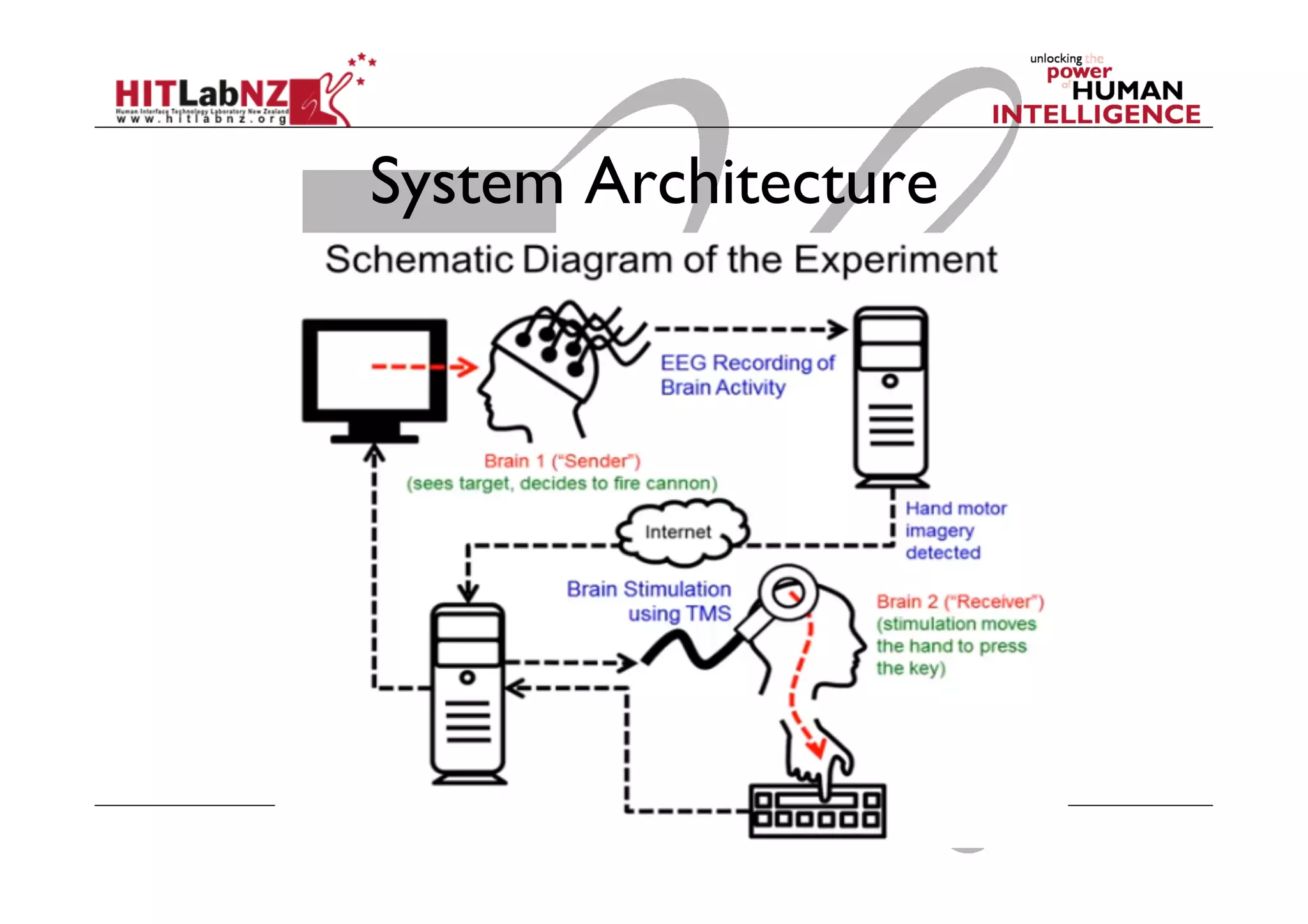
System Architecture
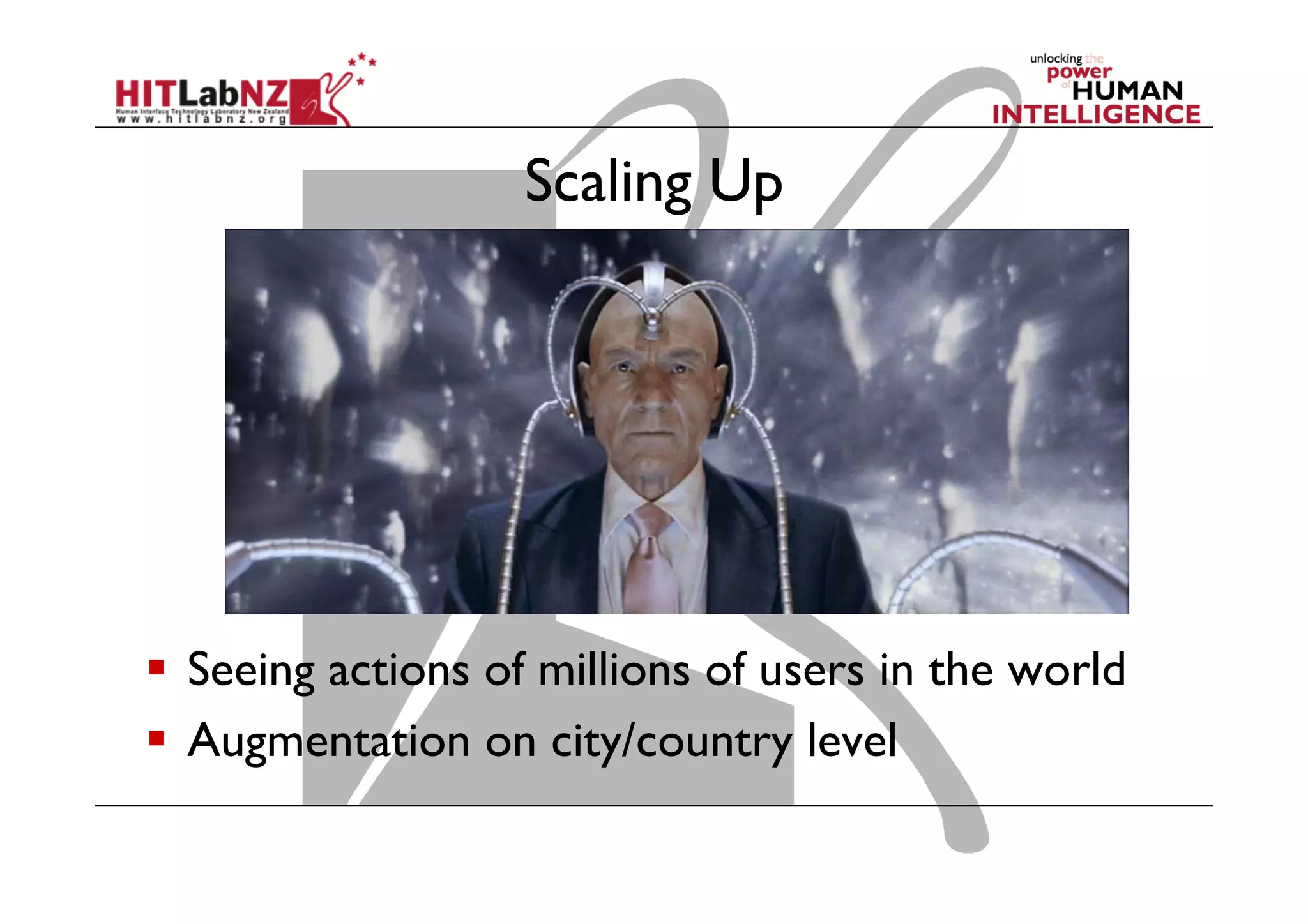
Scaling Up

  Seeing actions of millions of users in the world
  Augmentation on city/country level
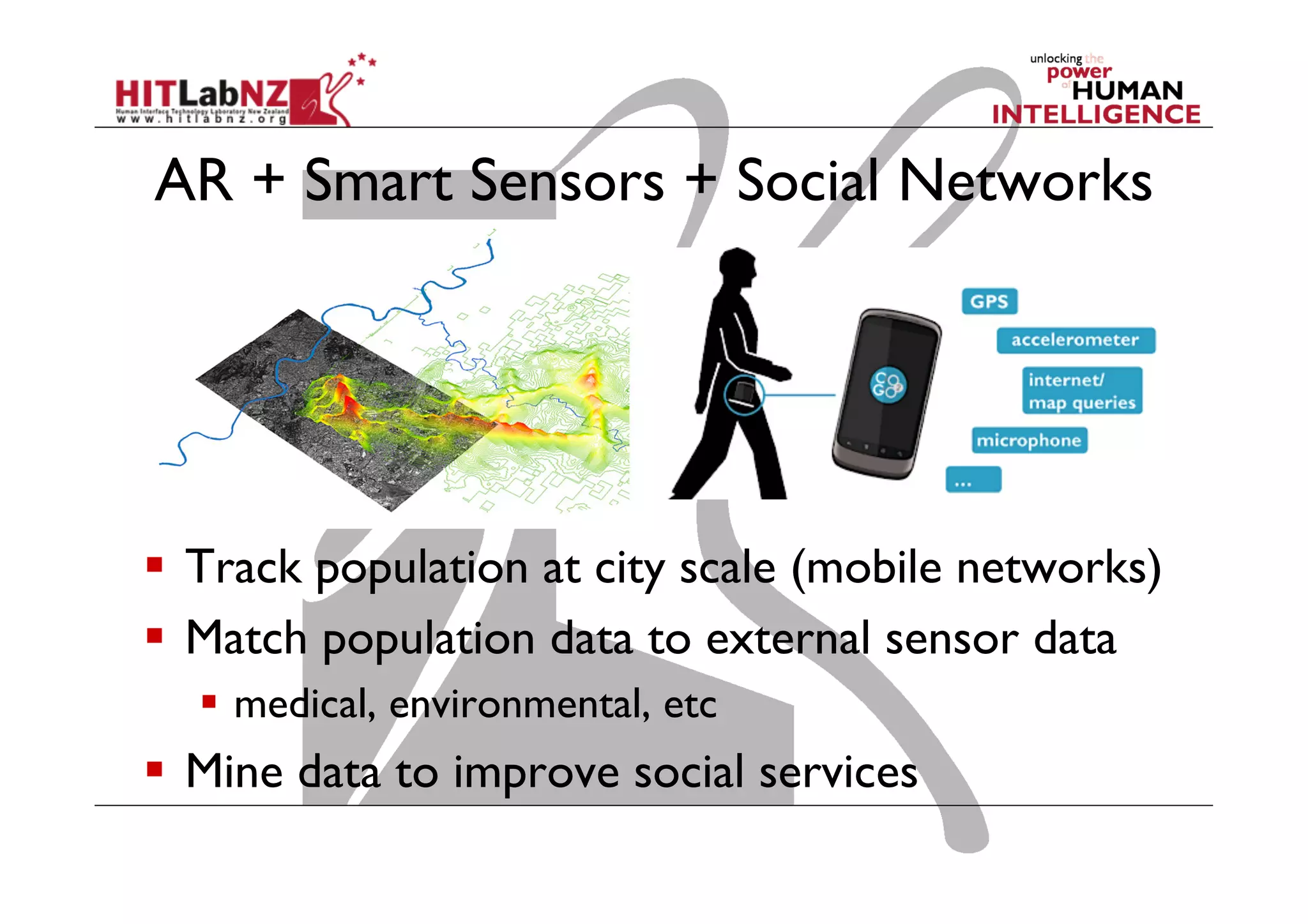
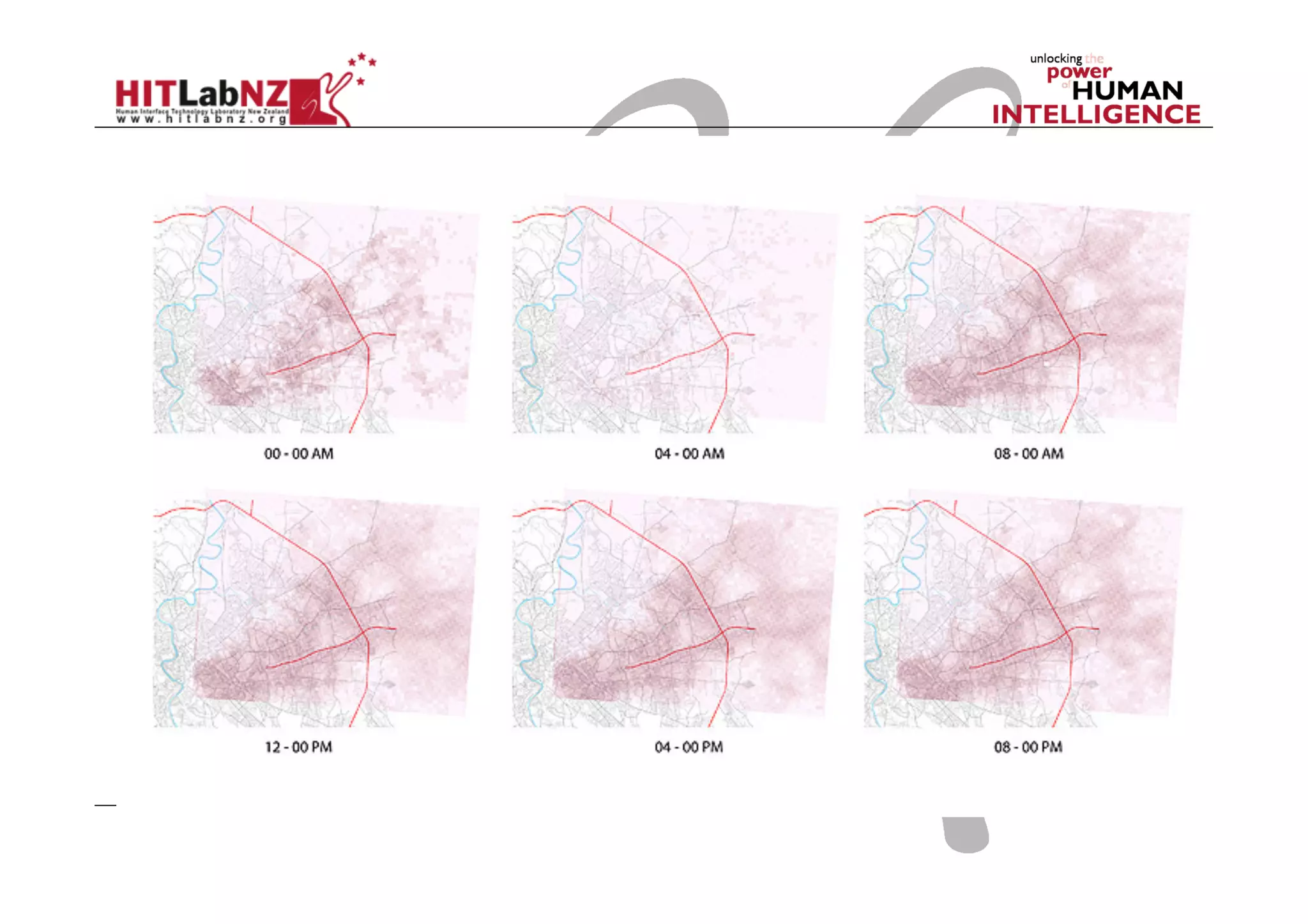
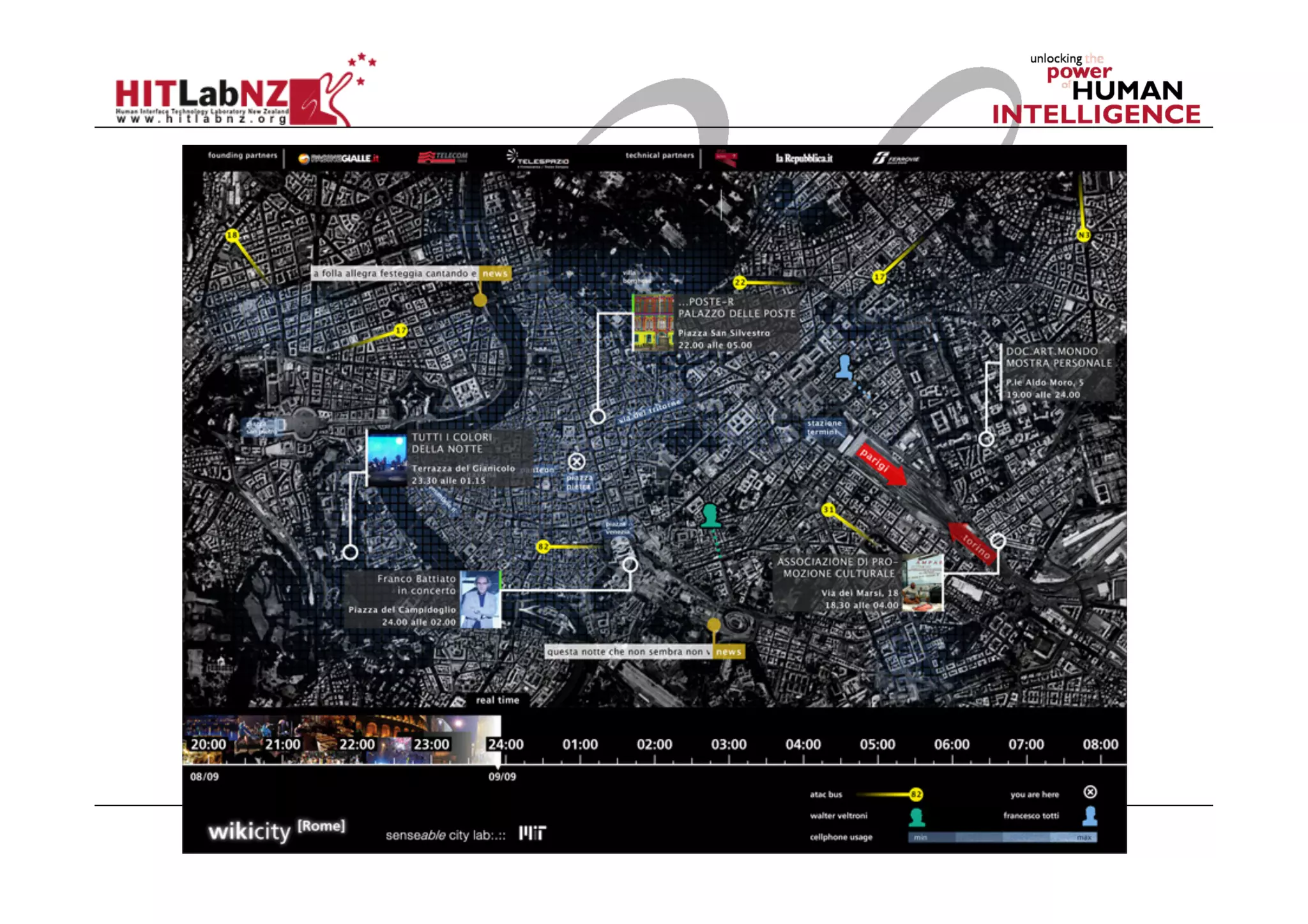
AR + Smart Sensors + Social Networks

  Track population at city scale (mobile networks)
  Match population data to external sensor data
  medical, environmental, etc

  Mine data to improve social services
Research Challenges
  How to convey emotion?
  How to measure empathy?
  Interface/interaction models?
  How to communicate emotion?
  Scaling up to city/country scale?
Conclusion
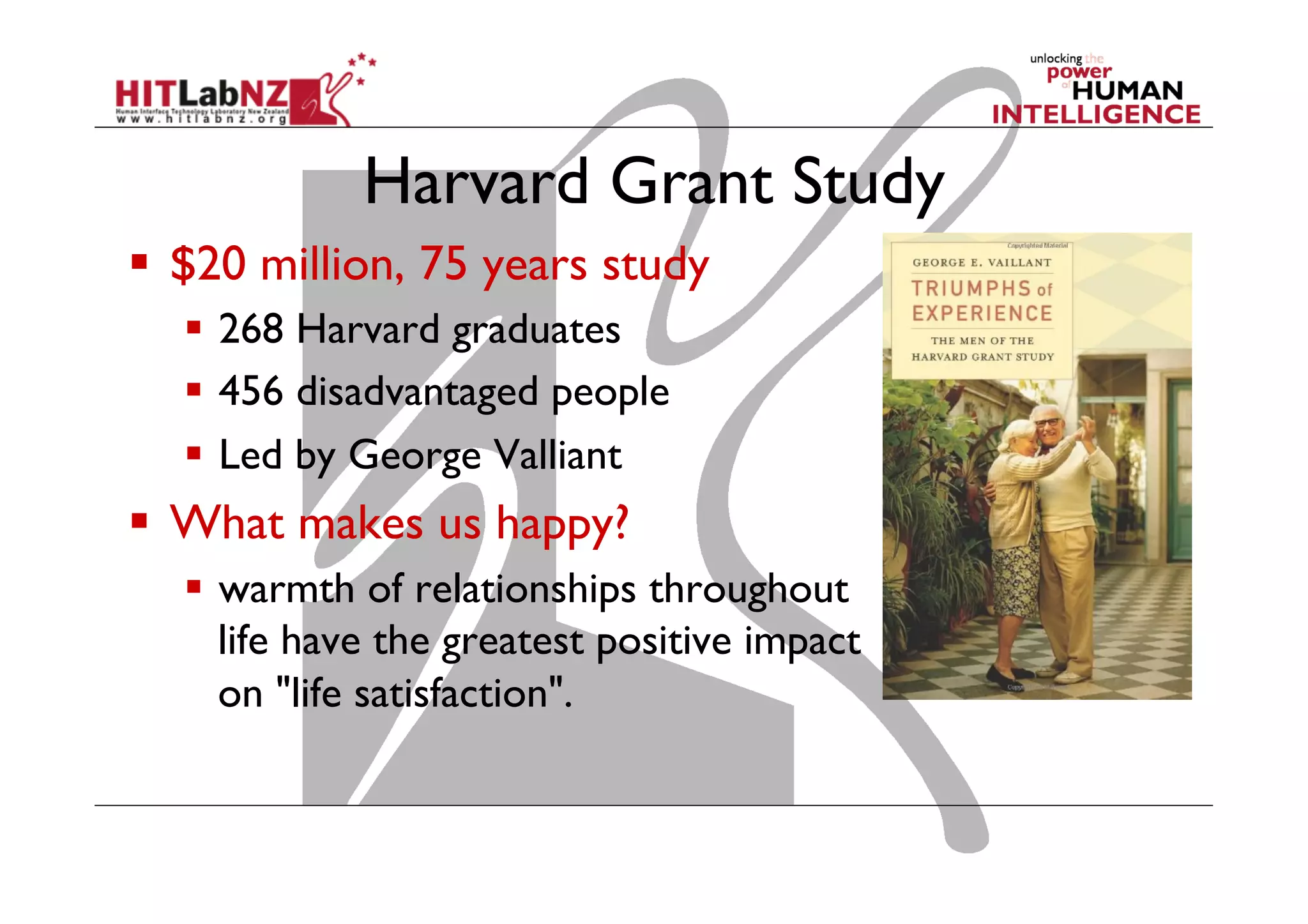
Harvard Grant Study
  $20 million, 75 years study
  268 Harvard graduates
  456 disadvantaged people
  Led by George Valliant

  What makes us happy?
  warmth of relationships throughout
life have the greatest positive impact
on "life satisfaction".
“The seventy-five years and twenty million dollars
expended on the Grant Study points to a
straightforward five-word conclusion: Happiness is
love.  Full stop.” 
 
George Valliant
Conclusions
  Empathic Computing
  Sharing what you see, hear and feel

  AR Enables Empathic Experiences
  Removing technology
  Changing perspective
  Sharing space/experience

  Many directions for future research
More Information
•  Mark Billinghurst
–  Email: mark.billinghurst@hitlabnz.org
–  Twitter: @marknb00

•  Website
–  http://www.hitlabnz.org/

Using Augmented Reality to Create Empathic Experiences

  • 1.
    Using Augmented Realityto Create Empathic Experiences Mark Billinghurst mark.billinghurst@hitlabnz.org The HIT Lab NZ, University of Canterbury February 27th 2014
  • 5.
  • 18.
  • 19.
  • 20.
    Intelligent User Interfaces  AI + HCI: User Interface involving some elements of Artificial Intelligence   Computer having model of user/domain   First IUI Conference in 1997   Readings in IUI (Wahster 1998)
  • 21.
      Microsoft Clippy(1997)   MS Office Intelligent User Interface
  • 23.
  • 24.
    Multiple Intelligences   Framesof Mind: The Theory of Multiple Intelligences   Howard Gardner (1983)
  • 25.
  • 26.
    Emotional Intelligence   EmotionalIntelligence - Why it can matter more than IQ   Goldman (1995)   Identify, assess, and control the emotions  of oneself, of others, and of groups
  • 27.
  • 28.
  • 30.
    Empathy vs. Intelligence  Intelligence: the power of one’s brain, divided into many categories and used in numerous ways.   Empathy: the power of one’s heart, expressing one’s true emotions with themselves, those around them, and their own world. 
  • 31.
  • 32.
    Mirror Neurons   Neuronthat fires both when an animal acts and it observes the same action performed by another   Giacomo Rizzolatti, Univ. of Palma (1980s/90s)
  • 34.
    Empathic Computing 1. Computingsystems that can understand your feelings and emotions 2. Computing systems that help you better understand the feelings of others
  • 35.
    Affective Computing   RosPicard – MIT Media Lab   http://affect.media.mit.edu
  • 36.
    Appliances That MakeYou Happy   Jun Rekimoto – Univ. Tokyo   Smile detection + smart devices
  • 37.
    Can we developinterfaces that allow us to be more empathetic to others?
  • 38.
  • 39.
    Empathy Computing Requirements  BasicRequirements  Making the technology transparent  Empathy Definition  Seeing with the eyes of another  Hearing with the ears of another  Feeling with the heart of another
  • 40.
  • 41.
    Using AR forEmpathy  Augmented Reality can:  Remove technology barriers  Enhance communication  Change perspective  Share experiences  Enhance interaction in real world
  • 42.
    Communication Seams Communication Space TaskSpace   Technology introduces artificial seams in the communication (eg separate real and virtual space)
  • 43.
    Removing Barriers: SharedSpace   Face to Face interaction, Tangible AR metaphor -  ~3,000 users (Siggraph 1999)   Easy collaboration with strangers   Users acted same as if handling real objects Billinghurst, M., Poupyrev, I., Kato, H., & May, R. (2000). Mixing realities in shared space: An augmented reality interface for collaborative computing. In Multimedia and Expo, 2000. ICME 2000. 2000 IEEE International Conference on (Vol. 3, pp. 1641-1644).
  • 44.
    Enhancing Face toFace Communication   AR Pad   Handheld AR device   AR shows viewpoints   Users collaborate easier   Show communication cues Virtual Viewpoint Visualization Mogilev, D., Kiyokawa, K., Billinghurst, M., & Pair, J. (2002, April). AR Pad: An interface for face-to-face AR collaboration. In CHI'02 extended abstracts on Human factors in computing systems (pp. 654-655).
  • 45.
    Changing Perspective   CamNet(1992)   British Telecom   Wearable Teleconferencing   audio, video   Remote collaboration   Sends task space video   Similar CMU study (1996)   cut performance time in half
  • 46.
    WACL: Remote ExpertCollaboration   Wearable Camera/Laser Pointer   Independent pointer control   Remote panorama view
  • 47.
    WACL: Remote ExpertCollaboration   Remote Expert View   Panorama viewing, annotation, image capture Kurata, T., Sakata, N., Kourogi, M., Kuzuoka, H., & Billinghurst, M. (2004, October). Remote collaboration using a shoulder-worn active camera/laser. In Wearable Computers, 2004. ISWC 2004. Eighth International Symposium on (Vol. 1, pp. 62-69).
  • 49.
    View Through GoogleGlass Always available peripheral information display Combining computing, communications and content capture
  • 50.
    Ego-Vision Collaboration   GoogleGlass   camera + processing + display + connectivity
  • 51.
    Current Collaboration onGlass   First person remote conferencing/hangouts   Limitations   Single POV, no spatial cues, no annotations, etc
  • 52.
    Sharing Space: SocialPanoramas   Capture and share social spaces in real time   Enable remote people to feel like they’re with you
  • 53.
    Key Technology   GoogleGlass   Capture live image panorama (compass + camera)   Capture spatial audio, live video   Remote device (desktop, tablet)   Immersive viewing, live annotation
  • 54.
    Capturing Space: RealWorld Capture   Hands free AR   Portable scene capture (color + depth)   Projector/Kinect combo, Remote controlled pan/tilt   Remote expert annotation interface
  • 55.
  • 56.
    Capturing Behaviours   3Gear Systems   Kinect/Primesense Sensor   Two hand tracking   http://www.threegear.com
  • 57.
    Skeleton Interaction +AR   HMD AR View   Viewpoint tracking   Two hand input   Skeleton interaction, occlusion
  • 58.
    Ghostman   Use ARto capture and overlay your actions into remote persons space   Eg remote therapy
  • 59.
    Looking to theFuture What’s Next?
  • 60.
    Brain to BrainControl   Rajesh Rao, University of Washington   First Brain to Brain control
  • 61.
  • 62.
    Scaling Up   Seeingactions of millions of users in the world   Augmentation on city/country level
  • 63.
    AR + SmartSensors + Social Networks   Track population at city scale (mobile networks)   Match population data to external sensor data   medical, environmental, etc   Mine data to improve social services
  • 66.
    Research Challenges   Howto convey emotion?   How to measure empathy?   Interface/interaction models?   How to communicate emotion?   Scaling up to city/country scale?
  • 67.
  • 68.
    Harvard Grant Study  $20 million, 75 years study   268 Harvard graduates   456 disadvantaged people   Led by George Valliant   What makes us happy?   warmth of relationships throughout life have the greatest positive impact on "life satisfaction".
  • 69.
    “The seventy-five yearsand twenty million dollars expended on the Grant Study points to a straightforward five-word conclusion: Happiness is love.  Full stop.”    George Valliant
  • 70.
    Conclusions   Empathic Computing  Sharing what you see, hear and feel   AR Enables Empathic Experiences   Removing technology   Changing perspective   Sharing space/experience   Many directions for future research
  • 71.
    More Information •  MarkBillinghurst –  Email: mark.billinghurst@hitlabnz.org –  Twitter: @marknb00 •  Website –  http://www.hitlabnz.org/