A view about
kernels
PRESENTED BY
S.KIRAN BASKAR
18MCC1001
M. TECH CSE WITH SPECIALIZATION IN
CLOUD COMPUTING
Kernels
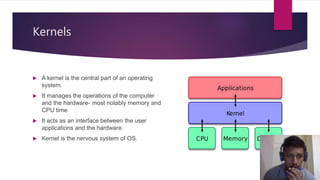
 A kernel is the central part of an operating
system.
 It manages the operations of the computer
and the hardware- most notably memory and
CPU time
 It acts as an interface between the user
applications and the hardware.
 Kernel is the nervous system of OS.
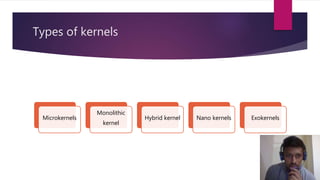
Types of kernels
Microkernels
Monolithic
kernel
Hybrid kernel Nano kernels Exokernels
Monolithic kernals
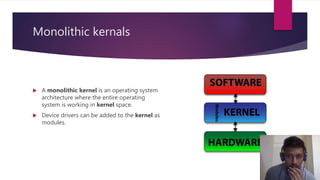
 A monolithic kernel is an operating system
architecture where the entire operating
system is working in kernel space.
 Device drivers can be added to the kernel as
modules.
Micro kernals
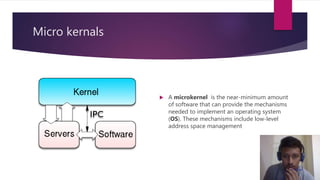
 A microkernel is the near-minimum amount
of software that can provide the mechanisms
needed to implement an operating system
(OS). These mechanisms include low-level
address space management
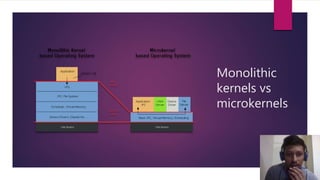
Monolithic
kernels vs
microkernels
Hybrid (or modular) kernels
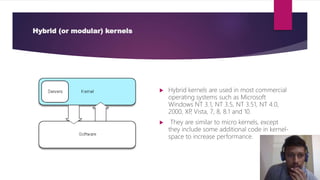
 Hybrid kernels are used in most commercial
operating systems such as Microsoft
Windows NT 3.1, NT 3.5, NT 3.51, NT 4.0,
2000, XP, Vista, 7, 8, 8.1 and 10.
 They are similar to micro kernels, except
they include some additional code in kernel-
space to increase performance.
Advantages and Disadvantages
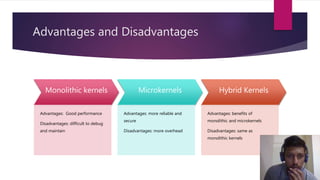
Monolithic kernels
Advantages: Good performance
Disadvantages: difficult to debug
and maintain
Microkernels
Advantages: more reliable and
secure
Disadvantages: more overhead
Hybrid Kernels
Advantages: benefits of
monolithic and microkernels
Disadvantages: same as
monolithic kernels
Nano kernels and Exokernels
 A nanokernel delegates virtually all
services including even the most basic ones
like interrupt controllers or the timer
 Device drivers to make the kernel memory
requirement even smaller than a traditional
microkernel
 Exokernels are a still-experimental approach to
operating system design..
 Exokernels in themselves are extremely small.
However, they are accompanied by library
operating systems providing application
developers with the functionalities of a
conventional operating system.
 A major advantage of exokernel-based systems is
that they can incorporate multiple library
operating systems, each exporting a different API
 for example one for high level UI development
and one for real-time control.
Functions of
a kernel
RESOURCE
MANAGEMENT
MEMORY
MANAGEMENT
DEVICE
MANAGEMENT
SYSTEM CALLS
Resource
management
Kernels also provide methods
for synchronization and inter-
process communication(IPC).
These implementations may be
within the Kernel itself or the
kernel can also rely on other
processes it is running.
Although the kernel must
provide inter-process
communication in order to
provide access to the facilities
provided by each other
kernels must also provide
running programs with a
method to make requests to
access these facilities.
Memory management
 The Kernel has full access to the system's memory and must
allow processes to safely access this memory as they require it.
Device management
 To perform useful functions, processes need access to
the peripherals connected to the computer, which are
controlled by the kernel through device drivers
 A device driver is a computer program that enables the
operating system to interact with a hardware device.
System calls
IN COMPUTING, A SYSTEM CALL IS HOW A
PROCESS REQUESTS A SERVICE FROM AN
OPERATING SYSTEM'S KERNEL THAT IT DOES
NOT NORMALLY HAVE PERMISSION TO RUN.
SYSTEM CALLS PROVIDE THE INTERFACE
BETWEEN A PROCESS AND THE OPERATING
SYSTEM
Thank
you

kernels

  • 1.
    A view about kernels PRESENTEDBY S.KIRAN BASKAR 18MCC1001 M. TECH CSE WITH SPECIALIZATION IN CLOUD COMPUTING
  • 2.
    Kernels  A kernelis the central part of an operating system.  It manages the operations of the computer and the hardware- most notably memory and CPU time  It acts as an interface between the user applications and the hardware.  Kernel is the nervous system of OS.
  • 3.
  • 4.
    Monolithic kernals  Amonolithic kernel is an operating system architecture where the entire operating system is working in kernel space.  Device drivers can be added to the kernel as modules.
  • 5.
    Micro kernals  Amicrokernel is the near-minimum amount of software that can provide the mechanisms needed to implement an operating system (OS). These mechanisms include low-level address space management
  • 6.
  • 7.
    Hybrid (or modular)kernels  Hybrid kernels are used in most commercial operating systems such as Microsoft Windows NT 3.1, NT 3.5, NT 3.51, NT 4.0, 2000, XP, Vista, 7, 8, 8.1 and 10.  They are similar to micro kernels, except they include some additional code in kernel- space to increase performance.
  • 8.
    Advantages and Disadvantages Monolithickernels Advantages: Good performance Disadvantages: difficult to debug and maintain Microkernels Advantages: more reliable and secure Disadvantages: more overhead Hybrid Kernels Advantages: benefits of monolithic and microkernels Disadvantages: same as monolithic kernels
  • 9.
    Nano kernels andExokernels  A nanokernel delegates virtually all services including even the most basic ones like interrupt controllers or the timer  Device drivers to make the kernel memory requirement even smaller than a traditional microkernel  Exokernels are a still-experimental approach to operating system design..  Exokernels in themselves are extremely small. However, they are accompanied by library operating systems providing application developers with the functionalities of a conventional operating system.  A major advantage of exokernel-based systems is that they can incorporate multiple library operating systems, each exporting a different API  for example one for high level UI development and one for real-time control.
  • 10.
  • 11.
    Resource management Kernels also providemethods for synchronization and inter- process communication(IPC). These implementations may be within the Kernel itself or the kernel can also rely on other processes it is running. Although the kernel must provide inter-process communication in order to provide access to the facilities provided by each other kernels must also provide running programs with a method to make requests to access these facilities.
  • 12.
    Memory management  TheKernel has full access to the system's memory and must allow processes to safely access this memory as they require it.
  • 13.
    Device management  Toperform useful functions, processes need access to the peripherals connected to the computer, which are controlled by the kernel through device drivers  A device driver is a computer program that enables the operating system to interact with a hardware device.
  • 14.
    System calls IN COMPUTING,A SYSTEM CALL IS HOW A PROCESS REQUESTS A SERVICE FROM AN OPERATING SYSTEM'S KERNEL THAT IT DOES NOT NORMALLY HAVE PERMISSION TO RUN. SYSTEM CALLS PROVIDE THE INTERFACE BETWEEN A PROCESS AND THE OPERATING SYSTEM
  • 15.