CHARCHIT FOOD
PRODUCTS LTD.
PRESENTED BY:
Astha
Saloni
Akanksha
Himanshu
Mayank
Sagar
Organisation Behaviour
CASE FACTS
• Charchit Food Products Company was founded in 1935.
• Manufactures grocery and other food products
• Vast enterprise having offices and branches in almost all the important
cities of India
• Annual sales – ₹50 to 60 lakhs a year
• Head office and Factory located in Calcutta
• 5 Zonal sales offices
• 25 District sales offices
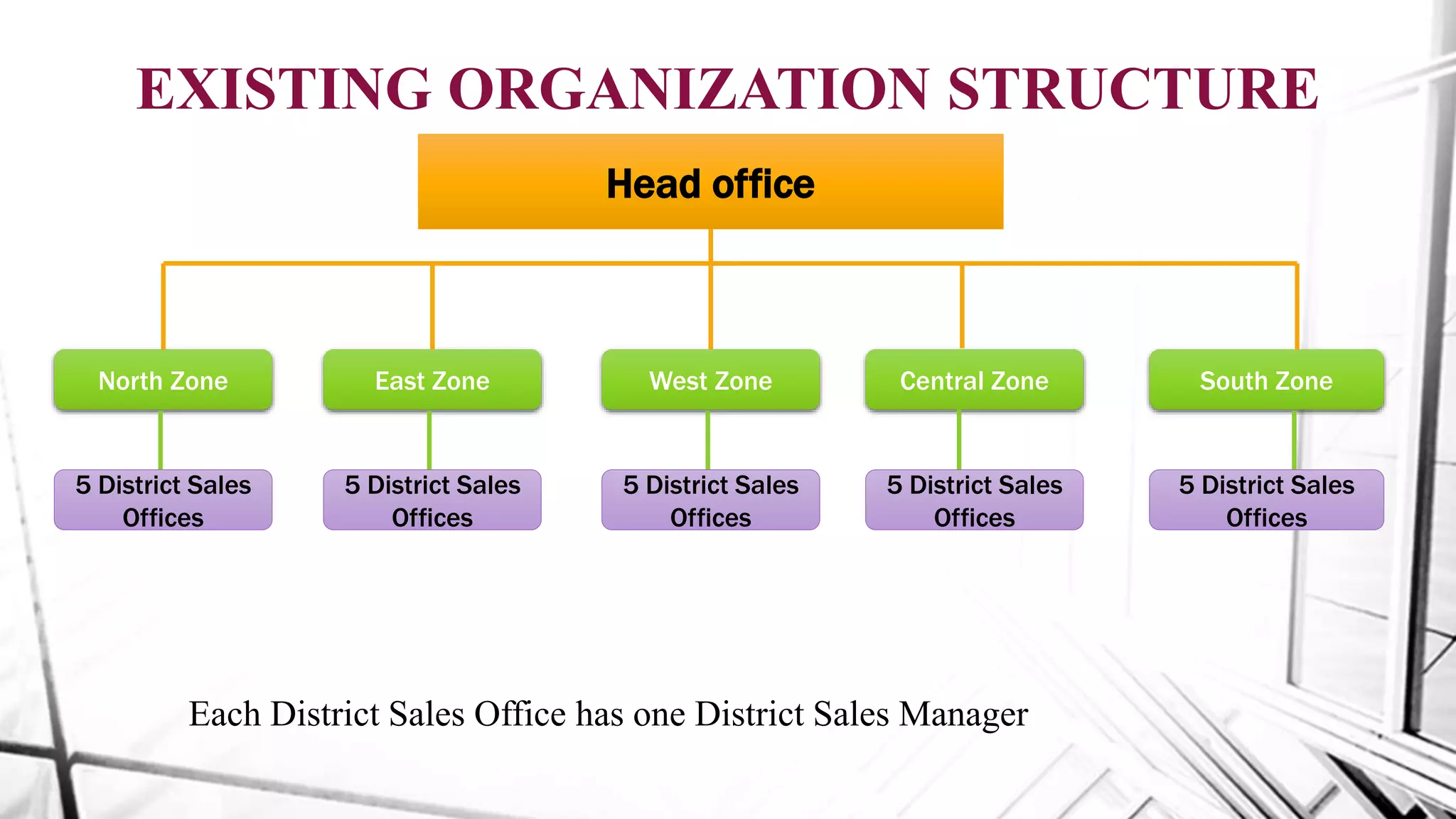
EXISTING ORGANIZATION STRUCTURE
Head office
North Zone East Zone West Zone Central Zone South Zone
Each District Sales Office has one District Sales Manager
5 District Sales
Offices
5 District Sales
Offices
5 District Sales
Offices
5 District Sales
Offices
5 District Sales
Offices
ORGANISATIONAL HIERARCHY
ZONAL MANAGER
PERSONAL
MANAGER
ACCOUNTS
MANAGER
SALES MANAGER OFFICE MANAGER
On matters related to sales the zonal manager receives advice from the Sales Manager
DISTRICT SALES
MANAGER
3 PRODUCT
MANAGERS
5 SALES
SUPERVISORS
Salesmen
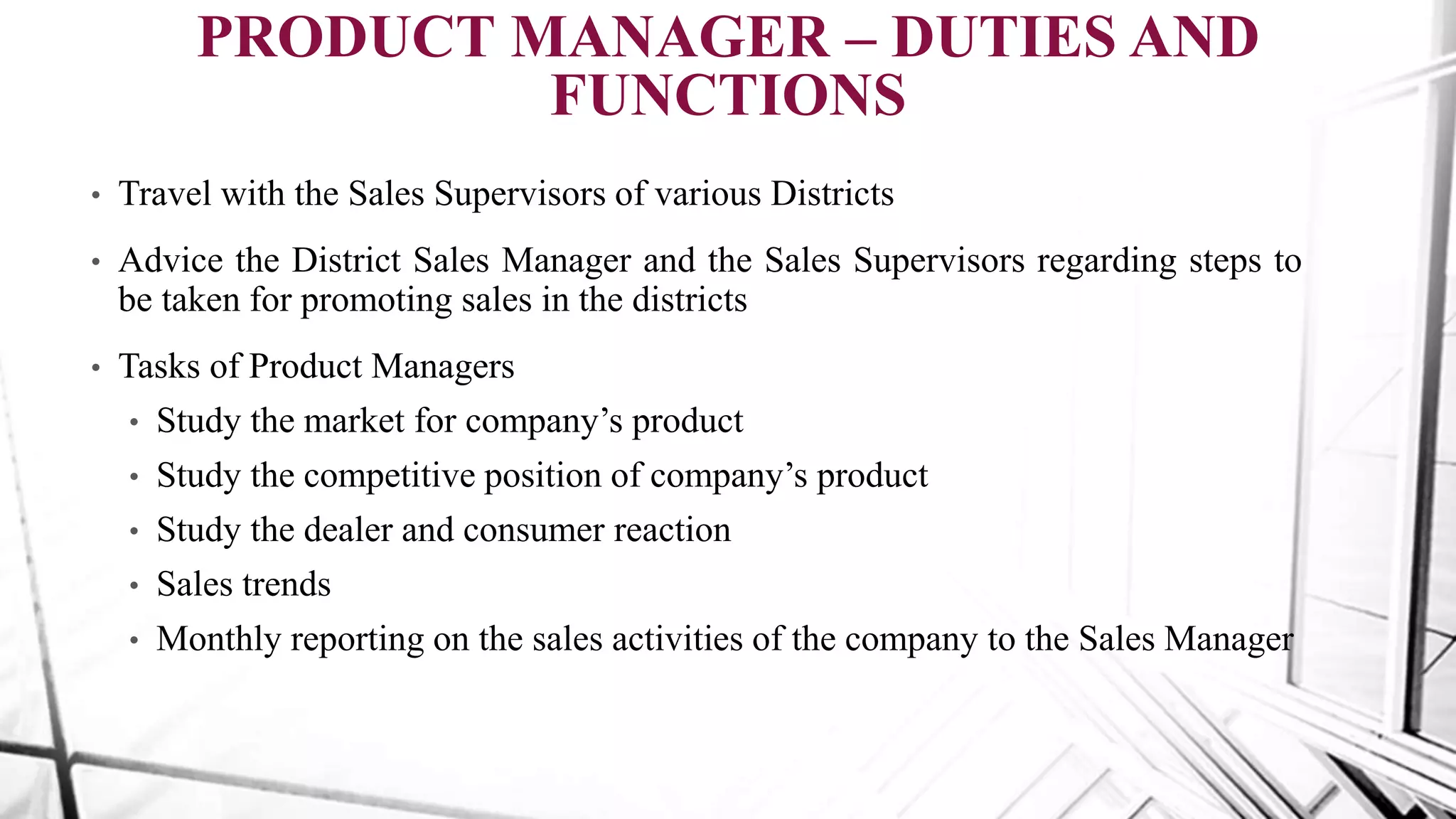
• Travel with the Sales Supervisors of various Districts
• Advice the District Sales Manager and the Sales Supervisors regarding steps to
be taken for promoting sales in the districts
• Tasks of Product Managers
• Study the market for company’s product
• Study the competitive position of company’s product
• Study the dealer and consumer reaction
• Sales trends
• Monthly reporting on the sales activities of the company to the Sales Manager
PRODUCT MANAGER – DUTIES AND
FUNCTIONS
• Select, train and supervise his sales supervisors
• Make a study of the nature of consumer demand, changing market
condition, existing stock and formulate sales campaign, promotional
methods
• Fix the sales target
• Formulate the credit policies to be followed
• Develop better team work among the sales supervisors and salesmen
• Customer satisfaction
• Undertake other functions and duties which are assigned to him by the zonal
manager
DISTRICT SALES MANAGER - DUTIES AND
FUNCTIONS
• Conflict between District Sales Manager and Product Manager
• Perceived loss of control over the sales supervisors because of too
much interference from the Product Managers
• Structural issues
• District Manager (Mr. Shankar) communicating with the Zonal
Sales Manager (Mr. Rajan)
• Very wide span of control to Zonal Manager
• Lack of proper root cause analysis by the Zonal Sales Manager
• Decline in the sales in that particular district
ISSUES IN THE CASE
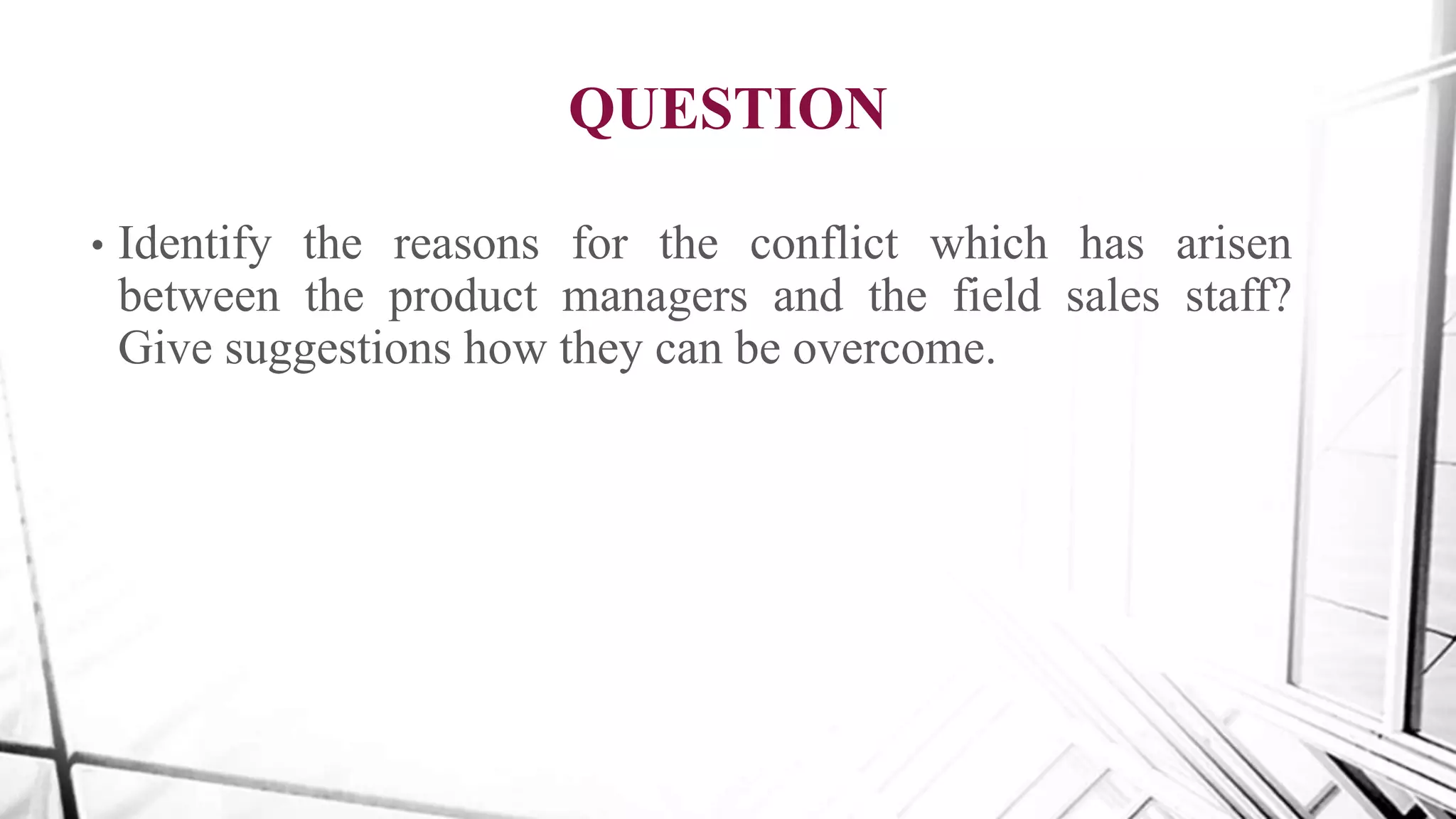
QUESTION
• Identify the reasons for the conflict which has arisen
between the product managers and the field sales staff?
Give suggestions how they can be overcome.
REASONS FOR CONFLICTConflict:
A process that begins when one party perceives that another party has negatively affected
something that the first party cares about.
• Task Conflict
Conflicts over content and goals of the work. There was friction because of the task of
advising the DSM and the Sales Supervisors carried out by Product Managers
• Relationship Conflict
Conflict based on interpersonal relationships leading to disagreements and incompatibility.
This could have existed between the PMs and the DSM.
• Process Conflict
Conflict over how work gets done. Maybe the PMs were interfering with the work of Sales
supervisors.
• Role Conflict
Conflict over the roles and responsibility taken over by Product manager and Sales Manager
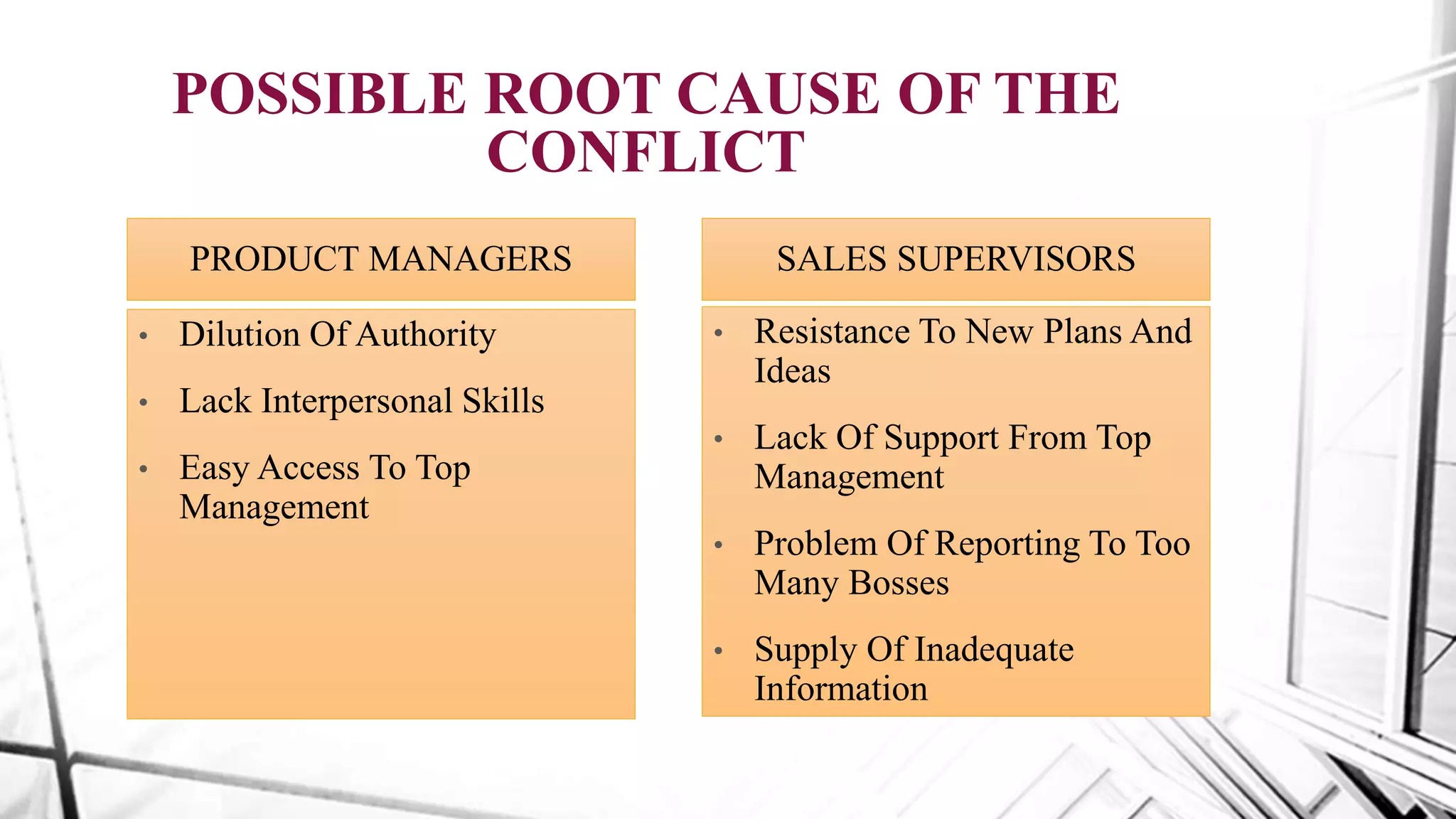
POSSIBLE ROOT CAUSE OF THE
CONFLICT
PRODUCT MANAGERS
• Dilution Of Authority
• Lack Interpersonal Skills
• Easy Access To Top
Management
SALES SUPERVISORS
• Resistance To New Plans And
Ideas
• Lack Of Support From Top
Management
• Problem Of Reporting To Too
Many Bosses
• Supply Of Inadequate
Information
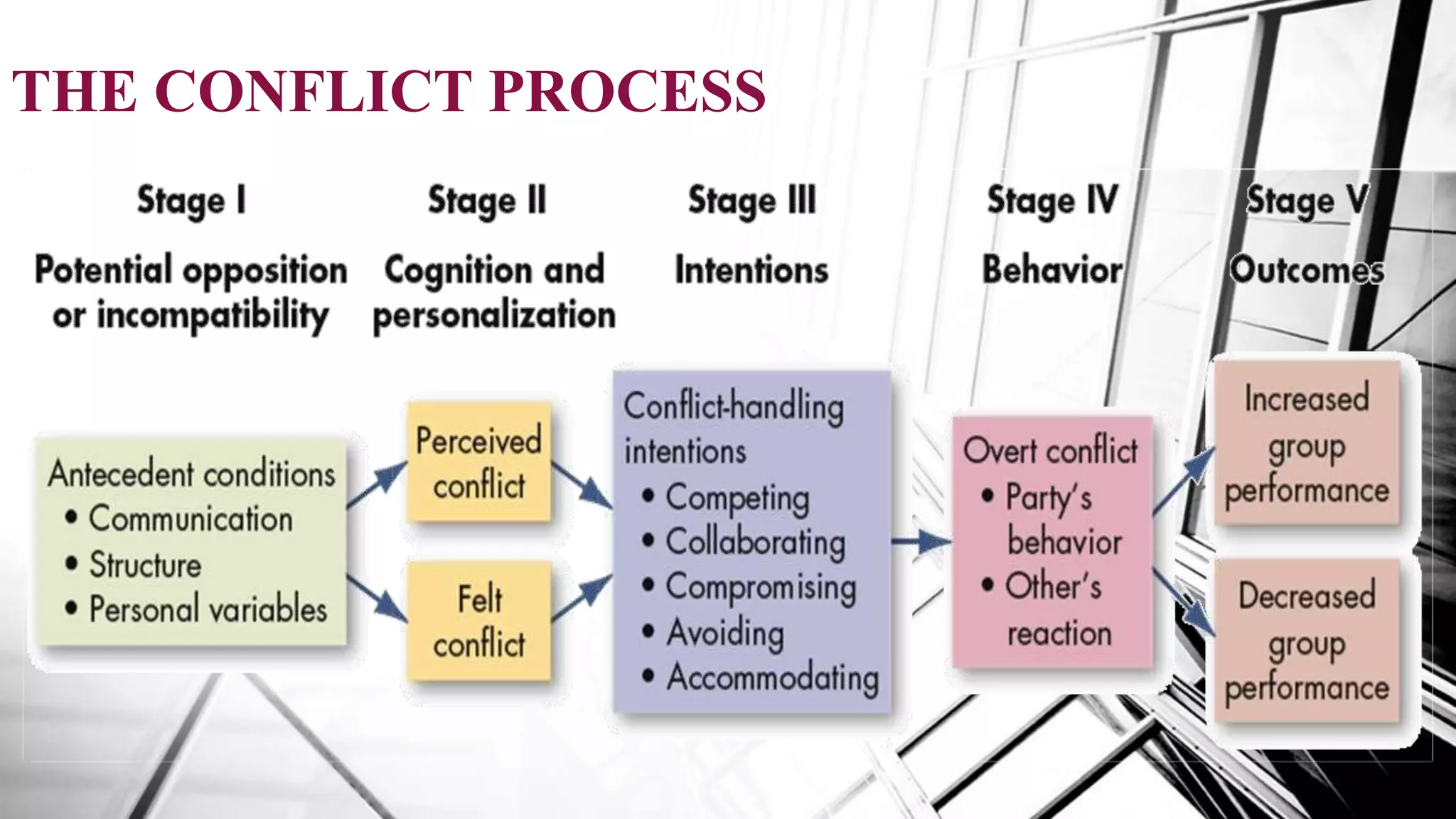
THE CONFLICT PROCESS
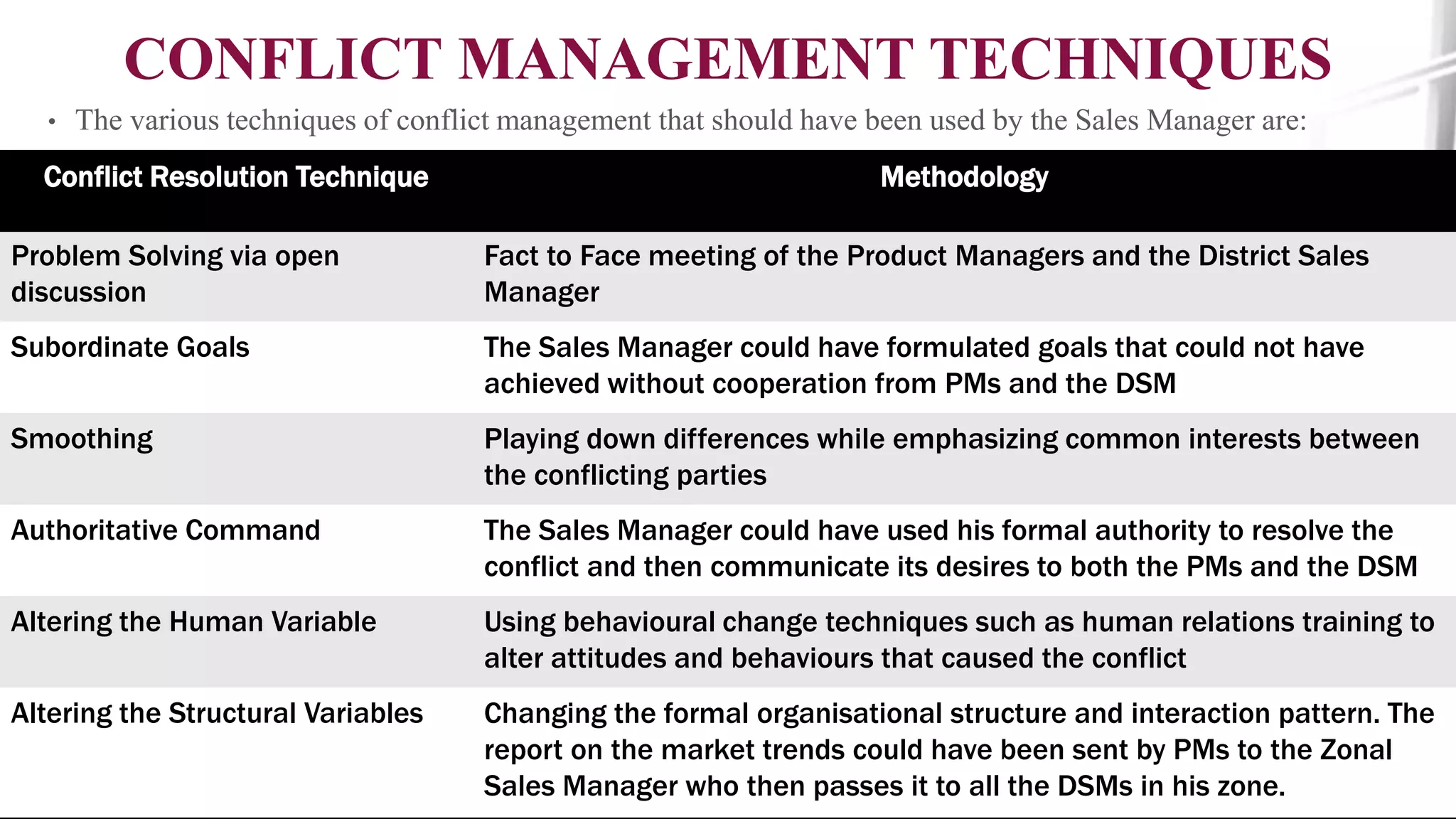
CONFLICT MANAGEMENT TECHNIQUES
• The various techniques of conflict management that should have been used by the Sales Manager are:
Conflict Resolution Technique Methodology
Problem Solving via open
discussion
Fact to Face meeting of the Product Managers and the District Sales
Manager
Subordinate Goals The Sales Manager could have formulated goals that could not have
achieved without cooperation from PMs and the DSM
Smoothing Playing down differences while emphasizing common interests between
the conflicting parties
Authoritative Command The Sales Manager could have used his formal authority to resolve the
conflict and then communicate its desires to both the PMs and the DSM
Altering the Human Variable Using behavioural change techniques such as human relations training to
alter attitudes and behaviours that caused the conflict
Altering the Structural Variables Changing the formal organisational structure and interaction pattern. The
report on the market trends could have been sent by PMs to the Zonal
Sales Manager who then passes it to all the DSMs in his zone.
THIRD PARTY ARBITRATION
• The Sales Manager could have used Third Party Arbitration in order to resolve the conflict between
the PMs and the DSM. The arbitrator needs to carefully selected (someone who is respected by both
the parties and whose judgements are considered just by both the parties)
• The object of arbitration is to obtain a fair resolution of disputes by an impartial third party without
unnecessary expense or delay.
The following are the advantages of Third party arbitration:
• Choice of Decision Maker – Conflicting parties choose a person as arbitrator mutually agreeing on
the abilities of the person.
• Privacy – Arbitration hearings are confidential, private meetings. Final decisions are not published,
nor are they directly accessible. This is particularly useful to the employer who does not want his
‘dirty laundry’ being aired.
• Convenience – Hearings are arranged at times and places to suit the parties, arbitrators and witnesses.
• Flexibility – The procedures can be segmented, streamlined or simplified, according to the
circumstances.
• Cost Effective
OTHER RECOMMENDATIONS
• Mr. Rajan should first know the root cause before giving instructions
• Product manager should think from the company’s prospective
• Weekly Reporting by Sales Supervisor to District Sales Manager
• Fortnightly reporting by District Manager to Zonal Manager
• Monthly meeting of DSM, SM and Zonal Manager.
• Monthly evaluation rather than quarterly evaluation
• Line authority :
• Zonal manager to Sales Manager and district sales manager
• District Sales Manager to Supervisor and sales people
• Staff authority:
• Product manager to line managers relationship should be like that of Sales
Manager and District Sales Manager
• Functional authority:
• Advisory relation directed towards the goals of the organization
• Better Span of Control
• No person should have more than one boss
• “If a person receives instructions from multiple sources, it may lead to chaos”
OTHER RECOMMENDATIONS -
BETTER DEFINING OF ORGANISATIONAL AUTHORITY
Thank You

Organisational Behaviour case study conflict management

  • 1.
    CHARCHIT FOOD PRODUCTS LTD. PRESENTEDBY: Astha Saloni Akanksha Himanshu Mayank Sagar Organisation Behaviour
  • 2.
    CASE FACTS • CharchitFood Products Company was founded in 1935. • Manufactures grocery and other food products • Vast enterprise having offices and branches in almost all the important cities of India • Annual sales – ₹50 to 60 lakhs a year • Head office and Factory located in Calcutta • 5 Zonal sales offices • 25 District sales offices
  • 3.
    EXISTING ORGANIZATION STRUCTURE Headoffice North Zone East Zone West Zone Central Zone South Zone Each District Sales Office has one District Sales Manager 5 District Sales Offices 5 District Sales Offices 5 District Sales Offices 5 District Sales Offices 5 District Sales Offices
  • 4.
    ORGANISATIONAL HIERARCHY ZONAL MANAGER PERSONAL MANAGER ACCOUNTS MANAGER SALESMANAGER OFFICE MANAGER On matters related to sales the zonal manager receives advice from the Sales Manager DISTRICT SALES MANAGER 3 PRODUCT MANAGERS 5 SALES SUPERVISORS Salesmen
  • 5.
    • Travel withthe Sales Supervisors of various Districts • Advice the District Sales Manager and the Sales Supervisors regarding steps to be taken for promoting sales in the districts • Tasks of Product Managers • Study the market for company’s product • Study the competitive position of company’s product • Study the dealer and consumer reaction • Sales trends • Monthly reporting on the sales activities of the company to the Sales Manager PRODUCT MANAGER – DUTIES AND FUNCTIONS
  • 6.
    • Select, trainand supervise his sales supervisors • Make a study of the nature of consumer demand, changing market condition, existing stock and formulate sales campaign, promotional methods • Fix the sales target • Formulate the credit policies to be followed • Develop better team work among the sales supervisors and salesmen • Customer satisfaction • Undertake other functions and duties which are assigned to him by the zonal manager DISTRICT SALES MANAGER - DUTIES AND FUNCTIONS
  • 7.
    • Conflict betweenDistrict Sales Manager and Product Manager • Perceived loss of control over the sales supervisors because of too much interference from the Product Managers • Structural issues • District Manager (Mr. Shankar) communicating with the Zonal Sales Manager (Mr. Rajan) • Very wide span of control to Zonal Manager • Lack of proper root cause analysis by the Zonal Sales Manager • Decline in the sales in that particular district ISSUES IN THE CASE
  • 8.
    QUESTION • Identify thereasons for the conflict which has arisen between the product managers and the field sales staff? Give suggestions how they can be overcome.
  • 9.
    REASONS FOR CONFLICTConflict: Aprocess that begins when one party perceives that another party has negatively affected something that the first party cares about. • Task Conflict Conflicts over content and goals of the work. There was friction because of the task of advising the DSM and the Sales Supervisors carried out by Product Managers • Relationship Conflict Conflict based on interpersonal relationships leading to disagreements and incompatibility. This could have existed between the PMs and the DSM. • Process Conflict Conflict over how work gets done. Maybe the PMs were interfering with the work of Sales supervisors. • Role Conflict Conflict over the roles and responsibility taken over by Product manager and Sales Manager
  • 10.
    POSSIBLE ROOT CAUSEOF THE CONFLICT PRODUCT MANAGERS • Dilution Of Authority • Lack Interpersonal Skills • Easy Access To Top Management SALES SUPERVISORS • Resistance To New Plans And Ideas • Lack Of Support From Top Management • Problem Of Reporting To Too Many Bosses • Supply Of Inadequate Information
  • 11.
  • 12.
    CONFLICT MANAGEMENT TECHNIQUES •The various techniques of conflict management that should have been used by the Sales Manager are: Conflict Resolution Technique Methodology Problem Solving via open discussion Fact to Face meeting of the Product Managers and the District Sales Manager Subordinate Goals The Sales Manager could have formulated goals that could not have achieved without cooperation from PMs and the DSM Smoothing Playing down differences while emphasizing common interests between the conflicting parties Authoritative Command The Sales Manager could have used his formal authority to resolve the conflict and then communicate its desires to both the PMs and the DSM Altering the Human Variable Using behavioural change techniques such as human relations training to alter attitudes and behaviours that caused the conflict Altering the Structural Variables Changing the formal organisational structure and interaction pattern. The report on the market trends could have been sent by PMs to the Zonal Sales Manager who then passes it to all the DSMs in his zone.
  • 13.
    THIRD PARTY ARBITRATION •The Sales Manager could have used Third Party Arbitration in order to resolve the conflict between the PMs and the DSM. The arbitrator needs to carefully selected (someone who is respected by both the parties and whose judgements are considered just by both the parties) • The object of arbitration is to obtain a fair resolution of disputes by an impartial third party without unnecessary expense or delay. The following are the advantages of Third party arbitration: • Choice of Decision Maker – Conflicting parties choose a person as arbitrator mutually agreeing on the abilities of the person. • Privacy – Arbitration hearings are confidential, private meetings. Final decisions are not published, nor are they directly accessible. This is particularly useful to the employer who does not want his ‘dirty laundry’ being aired. • Convenience – Hearings are arranged at times and places to suit the parties, arbitrators and witnesses. • Flexibility – The procedures can be segmented, streamlined or simplified, according to the circumstances. • Cost Effective
  • 14.
    OTHER RECOMMENDATIONS • Mr.Rajan should first know the root cause before giving instructions • Product manager should think from the company’s prospective • Weekly Reporting by Sales Supervisor to District Sales Manager • Fortnightly reporting by District Manager to Zonal Manager • Monthly meeting of DSM, SM and Zonal Manager. • Monthly evaluation rather than quarterly evaluation
  • 15.
    • Line authority: • Zonal manager to Sales Manager and district sales manager • District Sales Manager to Supervisor and sales people • Staff authority: • Product manager to line managers relationship should be like that of Sales Manager and District Sales Manager • Functional authority: • Advisory relation directed towards the goals of the organization • Better Span of Control • No person should have more than one boss • “If a person receives instructions from multiple sources, it may lead to chaos” OTHER RECOMMENDATIONS - BETTER DEFINING OF ORGANISATIONAL AUTHORITY
  • 16.