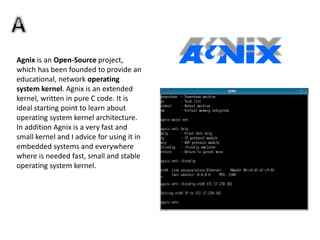
Agnix is an Open-Source project,
which has been founded to provide an
educational, network operating
system kernel. Agnix is an extended
kernel, written in pure C code. It is
ideal starting point to learn about
operating system kernel architecture.
In addition Agnix is a very fast and
small kernel and I advice for using it in
embedded systems and everywhere
where is needed fast, small and stable
operating system kernel.
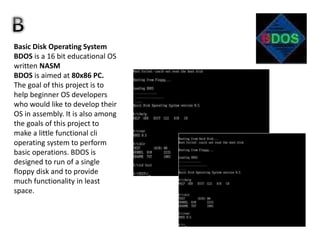
Basic Disk Operating System
BDOS is a 16 bit educational OS
written NASM
BDOS is aimed at 80x86 PC.
The goal of this project is to
help beginner OS developers
who would like to develop their
OS in assembly. It is also among
the goals of this project to
make a little functional cli
operating system to perform
basic operations. BDOS is
designed to run of a single
floppy disk and to provide
much functionality in least
space.
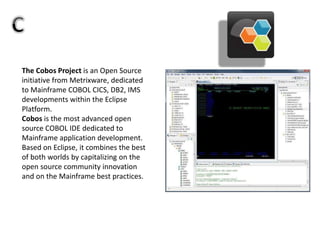
The Cobos Project is an Open Source
initiative from Metrixware, dedicated
to Mainframe COBOL CICS, DB2, IMS
developments within the Eclipse
Platform.
Cobos is the most advanced open
source COBOL IDE dedicated to
Mainframe application development.
Based on Eclipse, it combines the best
of both worlds by capitalizing on the
open source community innovation
and on the Mainframe best practices.
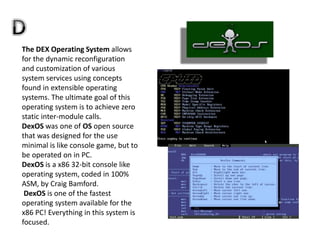
The DEX Operating System allows
for the dynamic reconfiguration
and customization of various
system services using concepts
found in extensible operating
systems. The ultimate goal of this
operating system is to achieve zero
static inter-module calls.
DexOS was one of OS open source
that was designed for the use
minimal is like console game, but to
be operated on in PC.
DexOS is a x86 32-bit console like
operating system, coded in 100%
ASM, by Craig Bamford.
DexOS is one of the fastest
operating system available for the
x86 PC! Everything in this system is
focused.
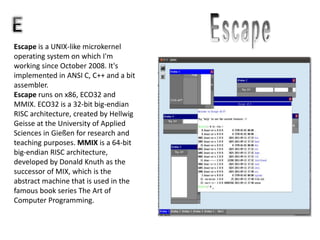
Escape is a UNIX-like microkernel
operating system on which I'm
working since October 2008. It's
implemented in ANSI C, C++ and a bit
assembler.
Escape runs on x86, ECO32 and
MMIX. ECO32 is a 32-bit big-endian
RISC architecture, created by Hellwig
Geisse at the University of Applied
Sciences in Gießen for research and
teaching purposes. MMIX is a 64-bit
big-endian RISC architecture,
developed by Donald Knuth as the
successor of MIX, which is the
abstract machine that is used in the
famous book series The Art of
Computer Programming.
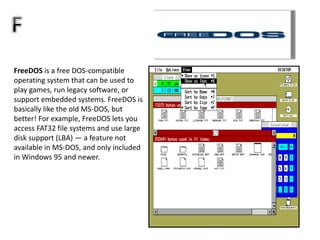
FreeDOS is a free DOS-compatible
operating system that can be used to
play games, run legacy software, or
support embedded systems. FreeDOS is
basically like the old MS-DOS, but
better! For example, FreeDOS lets you
access FAT32 file systems and use large
disk support (LBA) — a feature not
available in MS-DOS, and only included
in Windows 95 and newer.
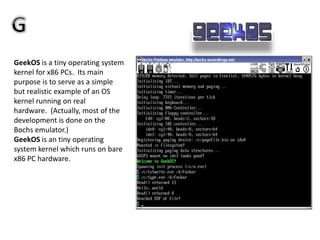
GeekOS is a tiny operating system
kernel for x86 PCs. Its main
purpose is to serve as a simple
but realistic example of an OS
kernel running on real
hardware. (Actually, most of the
development is done on the
Bochs emulator.)
GeekOS is an tiny operating
system kernel which runs on bare
x86 PC hardware.
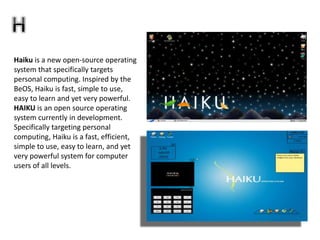
Haiku is a new open-source operating
system that specifically targets
personal computing. Inspired by the
BeOS, Haiku is fast, simple to use,
easy to learn and yet very powerful.
HAIKU is an open source operating
system currently in development.
Specifically targeting personal
computing, Haiku is a fast, efficient,
simple to use, easy to learn, and yet
very powerful system for computer
users of all levels.
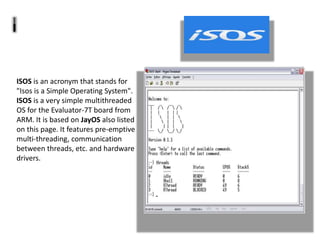
ISOS is an acronym that stands for
"Isos is a Simple Operating System".
ISOS is a very simple multithreaded
OS for the Evaluator-7T board from
ARM. It is based on JayOS also listed
on this page. It features pre-emptive
multi-threading, communication
between threads, etc. and hardware
drivers.
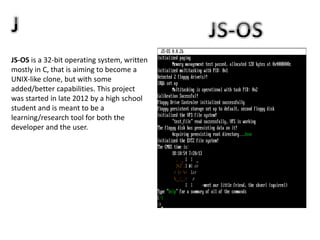
JS-OS is a 32-bit operating system, written
mostly in C, that is aiming to become a
UNIX-like clone, but with some
added/better capabilities. This project
was started in late 2012 by a high school
student and is meant to be a
learning/research tool for both the
developer and the user.
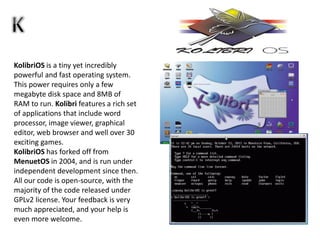
KolibriOS is a tiny yet incredibly
powerful and fast operating system.
This power requires only a few
megabyte disk space and 8MB of
RAM to run. Kolibri features a rich set
of applications that include word
processor, image viewer, graphical
editor, web browser and well over 30
exciting games.
KolibriOS has forked off from
MenuetOS in 2004, and is run under
independent development since then.
All our code is open-source, with the
majority of the code released under
GPLv2 license. Your feedback is very
much appreciated, and your help is
even more welcome.
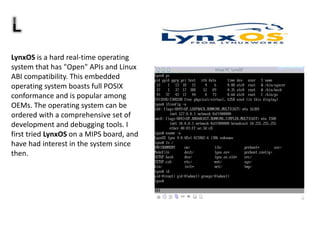
LynxOS is a hard real-time operating
system that has "Open" APIs and Linux
ABI compatibility. This embedded
operating system boasts full POSIX
conformance and is popular among
OEMs. The operating system can be
ordered with a comprehensive set of
development and debugging tools. I
first tried LynxOS on a MIPS board, and
have had interest in the system since
then.
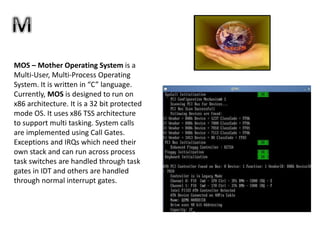
MOS – Mother Operating System is a
Multi-User, Multi-Process Operating
System. It is written in “C” language.
Currently, MOS is designed to run on
x86 architecture. It is a 32 bit protected
mode OS. It uses x86 TSS architecture
to support multi tasking. System calls
are implemented using Call Gates.
Exceptions and IRQs which need their
own stack and can run across process
task switches are handled through task
gates in IDT and others are handled
through normal interrupt gates.
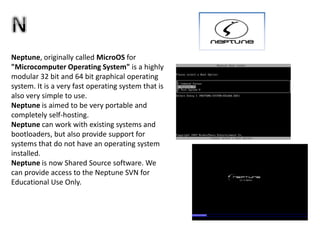
Neptune, originally called MicroOS for
"Microcomputer Operating System" is a highly
modular 32 bit and 64 bit graphical operating
system. It is a very fast operating system that is
also very simple to use.
Neptune is aimed to be very portable and
completely self-hosting.
Neptune can work with existing systems and
bootloaders, but also provide support for
systems that do not have an operating system
installed.
Neptune is now Shared Source software. We
can provide access to the Neptune SVN for
Educational Use Only.
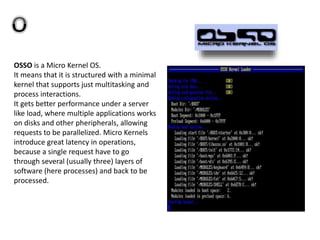
OSSO is a Micro Kernel OS.
It means that it is structured with a minimal
kernel that supports just multitasking and
process interactions.
It gets better performance under a server
like load, where multiple applications works
on disks and other pheripherals, allowing
requests to be parallelized. Micro Kernels
introduce great latency in operations,
because a single request have to go
through several (usually three) layers of
software (here processes) and back to be
processed.
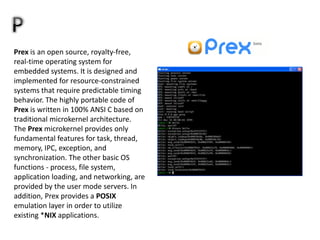
Prex is an open source, royalty-free,
real-time operating system for
embedded systems. It is designed and
implemented for resource-constrained
systems that require predictable timing
behavior. The highly portable code of
Prex is written in 100% ANSI C based on
traditional microkernel architecture.
The Prex microkernel provides only
fundamental features for task, thread,
memory, IPC, exception, and
synchronization. The other basic OS
functions - process, file system,
application loading, and networking, are
provided by the user mode servers. In
addition, Prex provides a POSIX
emulation layer in order to utilize
existing *NIX applications.
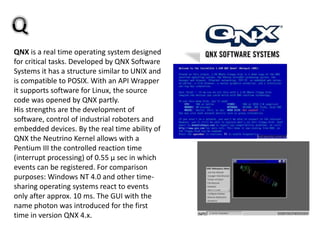
QNX is a real time operating system designed
for critical tasks. Developed by QNX Software
Systems it has a structure similar to UNIX and
is compatible to POSIX. With an API Wrapper
it supports software for Linux, the source
code was opened by QNX partly.
His strengths are the development of
software, control of industrial roboters and
embedded devices. By the real time ability of
QNX the Neutrino Kernel allows with a
Pentium III the controlled reaction time
(interrupt processing) of 0.55 µ sec in which
events can be registered. For comparison
purposes: Windows NT 4.0 and other time-
sharing operating systems react to events
only after approx. 10 ms. The GUI with the
name photon was introduced for the first
time in version QNX 4.x.
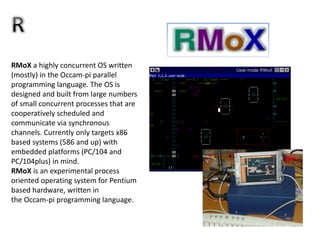
RMoX a highly concurrent OS written
(mostly) in the Occam-pi parallel
programming language. The OS is
designed and built from large numbers
of small concurrent processes that are
cooperatively scheduled and
communicate via synchronous
channels. Currently only targets x86
based systems (586 and up) with
embedded platforms (PC/104 and
PC/104plus) in mind.
RMoX is an experimental process
oriented operating system for Pentium
based hardware, written in
the Occam-pi programming language.
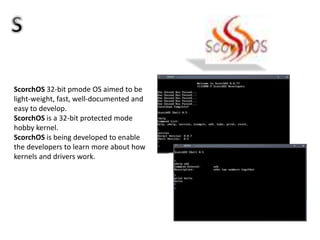
ScorchOS 32-bit pmode OS aimed to be
light-weight, fast, well-documented and
easy to develop.
ScorchOS is a 32-bit protected mode
hobby kernel.
ScorchOS is being developed to enable
the developers to learn more about how
kernels and drivers work.
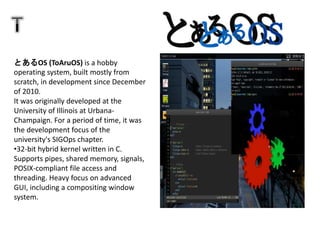
とあるOS (ToAruOS) is a hobby
operating system, built mostly from
scratch, in development since December
of 2010.
It was originally developed at the
University of Illinois at Urbana-
Champaign. For a period of time, it was
the development focus of the
university's SIGOps chapter.
•32-bit hybrid kernel written in C.
Supports pipes, shared memory, signals,
POSIX-compliant file access and
threading. Heavy focus on advanced
GUI, including a compositing window
system.
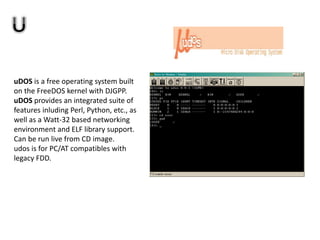
uDOS is a free operating system built
on the FreeDOS kernel with DJGPP.
uDOS provides an integrated suite of
features inluding Perl, Python, etc., as
well as a Watt-32 based networking
environment and ELF library support.
Can be run live from CD image.
udos is for PC/AT compatibles with
legacy FDD.
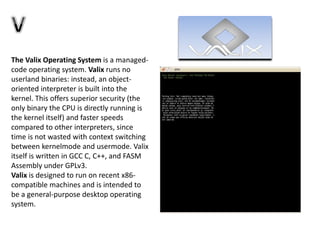
The Valix Operating System is a managed-
code operating system. Valix runs no
userland binaries: instead, an object-
oriented interpreter is built into the
kernel. This offers superior security (the
only binary the CPU is directly running is
the kernel itself) and faster speeds
compared to other interpreters, since
time is not wasted with context switching
between kernelmode and usermode. Valix
itself is written in GCC C, C++, and FASM
Assembly under GPLv3.
Valix is designed to run on recent x86-
compatible machines and is intended to
be a general-purpose desktop operating
system.
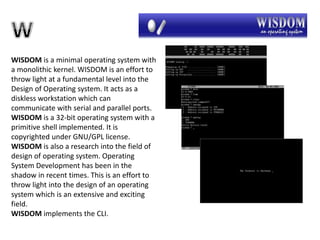
WISDOM is a minimal operating system with
a monolithic kernel. WISDOM is an effort to
throw light at a fundamental level into the
Design of Operating system. It acts as a
diskless workstation which can
communicate with serial and parallel ports.
WISDOM is a 32-bit operating system with a
primitive shell implemented. It is
copyrighted under GNU/GPL license.
WISDOM is also a research into the field of
design of operating system. Operating
System Development has been in the
shadow in recent times. This is an effort to
throw light into the design of an operating
system which is an extensive and exciting
field.
WISDOM implements the CLI.
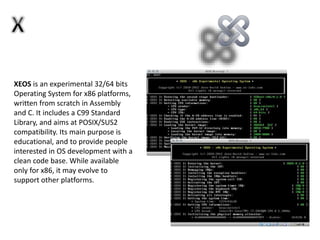
XEOS is an experimental 32/64 bits
Operating System for x86 platforms,
written from scratch in Assembly
and C. It includes a C99 Standard
Library, and aims at POSIX/SUS2
compatibility. Its main purpose is
educational, and to provide people
interested in OS development with a
clean code base. While available
only for x86, it may evolve to
support other platforms.
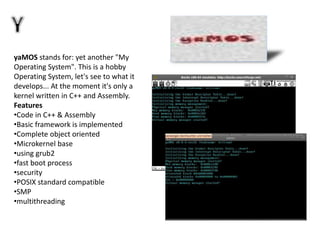
yaMOS stands for: yet another "My
Operating System". This is a hobby
Operating System, let's see to what it
develops... At the moment it's only a
kernel written in C++ and Assembly.
Features
•Code in C++ & Assembly
•Basic framework is implemented
•Complete object oriented
•Microkernel base
•using grub2
•fast boot process
•security
•POSIX standard compatible
•SMP
•multithreading
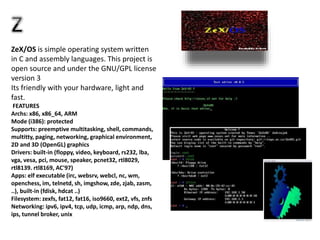
ZeX/OS is simple operating system written
in C and assembly languages. This project is
open source and under the GNU/GPL license
version 3
Its friendly with your hardware, light and
fast.
FEATURES
Archs: x86, x86_64, ARM
Mode (i386): protected
Supports: preemptive multitasking, shell, commands,
multitty, paging, networking, graphical environment,
2D and 3D (OpenGL) graphics
Drivers: built-in (floppy, video, keyboard, rs232, lba,
vga, vesa, pci, mouse, speaker, pcnet32, rtl8029,
rtl8139. rtl8169, AC'97)
Apps: elf executable (irc, websrv, webcl, nc, wm,
openchess, im, telnetd, sh, imgshow, zde, zjab, zasm,
..), built-in (fdisk, hdcat ..)
Filesystem: zexfs, fat12, fat16, iso9660, ext2, vfs, znfs
Networking: ipv6, ipv4, tcp, udp, icmp, arp, ndp, dns,
ips, tunnel broker, unix

Operating Systems A-Z

  • 2.
    Agnix is anOpen-Source project, which has been founded to provide an educational, network operating system kernel. Agnix is an extended kernel, written in pure C code. It is ideal starting point to learn about operating system kernel architecture. In addition Agnix is a very fast and small kernel and I advice for using it in embedded systems and everywhere where is needed fast, small and stable operating system kernel.
  • 3.
    Basic Disk OperatingSystem BDOS is a 16 bit educational OS written NASM BDOS is aimed at 80x86 PC. The goal of this project is to help beginner OS developers who would like to develop their OS in assembly. It is also among the goals of this project to make a little functional cli operating system to perform basic operations. BDOS is designed to run of a single floppy disk and to provide much functionality in least space.
  • 4.
    The Cobos Projectis an Open Source initiative from Metrixware, dedicated to Mainframe COBOL CICS, DB2, IMS developments within the Eclipse Platform. Cobos is the most advanced open source COBOL IDE dedicated to Mainframe application development. Based on Eclipse, it combines the best of both worlds by capitalizing on the open source community innovation and on the Mainframe best practices.
  • 5.
    The DEX OperatingSystem allows for the dynamic reconfiguration and customization of various system services using concepts found in extensible operating systems. The ultimate goal of this operating system is to achieve zero static inter-module calls. DexOS was one of OS open source that was designed for the use minimal is like console game, but to be operated on in PC. DexOS is a x86 32-bit console like operating system, coded in 100% ASM, by Craig Bamford. DexOS is one of the fastest operating system available for the x86 PC! Everything in this system is focused.
  • 6.
    Escape is aUNIX-like microkernel operating system on which I'm working since October 2008. It's implemented in ANSI C, C++ and a bit assembler. Escape runs on x86, ECO32 and MMIX. ECO32 is a 32-bit big-endian RISC architecture, created by Hellwig Geisse at the University of Applied Sciences in Gießen for research and teaching purposes. MMIX is a 64-bit big-endian RISC architecture, developed by Donald Knuth as the successor of MIX, which is the abstract machine that is used in the famous book series The Art of Computer Programming.
  • 7.
    FreeDOS is afree DOS-compatible operating system that can be used to play games, run legacy software, or support embedded systems. FreeDOS is basically like the old MS-DOS, but better! For example, FreeDOS lets you access FAT32 file systems and use large disk support (LBA) — a feature not available in MS-DOS, and only included in Windows 95 and newer.
  • 8.
    GeekOS is atiny operating system kernel for x86 PCs. Its main purpose is to serve as a simple but realistic example of an OS kernel running on real hardware. (Actually, most of the development is done on the Bochs emulator.) GeekOS is an tiny operating system kernel which runs on bare x86 PC hardware.
  • 9.
    Haiku is anew open-source operating system that specifically targets personal computing. Inspired by the BeOS, Haiku is fast, simple to use, easy to learn and yet very powerful. HAIKU is an open source operating system currently in development. Specifically targeting personal computing, Haiku is a fast, efficient, simple to use, easy to learn, and yet very powerful system for computer users of all levels.
  • 10.
    ISOS is anacronym that stands for "Isos is a Simple Operating System". ISOS is a very simple multithreaded OS for the Evaluator-7T board from ARM. It is based on JayOS also listed on this page. It features pre-emptive multi-threading, communication between threads, etc. and hardware drivers.
  • 11.
    JS-OS is a32-bit operating system, written mostly in C, that is aiming to become a UNIX-like clone, but with some added/better capabilities. This project was started in late 2012 by a high school student and is meant to be a learning/research tool for both the developer and the user.
  • 12.
    KolibriOS is atiny yet incredibly powerful and fast operating system. This power requires only a few megabyte disk space and 8MB of RAM to run. Kolibri features a rich set of applications that include word processor, image viewer, graphical editor, web browser and well over 30 exciting games. KolibriOS has forked off from MenuetOS in 2004, and is run under independent development since then. All our code is open-source, with the majority of the code released under GPLv2 license. Your feedback is very much appreciated, and your help is even more welcome.
  • 13.
    LynxOS is ahard real-time operating system that has "Open" APIs and Linux ABI compatibility. This embedded operating system boasts full POSIX conformance and is popular among OEMs. The operating system can be ordered with a comprehensive set of development and debugging tools. I first tried LynxOS on a MIPS board, and have had interest in the system since then.
  • 14.
    MOS – MotherOperating System is a Multi-User, Multi-Process Operating System. It is written in “C” language. Currently, MOS is designed to run on x86 architecture. It is a 32 bit protected mode OS. It uses x86 TSS architecture to support multi tasking. System calls are implemented using Call Gates. Exceptions and IRQs which need their own stack and can run across process task switches are handled through task gates in IDT and others are handled through normal interrupt gates.
  • 15.
    Neptune, originally calledMicroOS for "Microcomputer Operating System" is a highly modular 32 bit and 64 bit graphical operating system. It is a very fast operating system that is also very simple to use. Neptune is aimed to be very portable and completely self-hosting. Neptune can work with existing systems and bootloaders, but also provide support for systems that do not have an operating system installed. Neptune is now Shared Source software. We can provide access to the Neptune SVN for Educational Use Only.
  • 16.
    OSSO is aMicro Kernel OS. It means that it is structured with a minimal kernel that supports just multitasking and process interactions. It gets better performance under a server like load, where multiple applications works on disks and other pheripherals, allowing requests to be parallelized. Micro Kernels introduce great latency in operations, because a single request have to go through several (usually three) layers of software (here processes) and back to be processed.
  • 17.
    Prex is anopen source, royalty-free, real-time operating system for embedded systems. It is designed and implemented for resource-constrained systems that require predictable timing behavior. The highly portable code of Prex is written in 100% ANSI C based on traditional microkernel architecture. The Prex microkernel provides only fundamental features for task, thread, memory, IPC, exception, and synchronization. The other basic OS functions - process, file system, application loading, and networking, are provided by the user mode servers. In addition, Prex provides a POSIX emulation layer in order to utilize existing *NIX applications.
  • 18.
    QNX is areal time operating system designed for critical tasks. Developed by QNX Software Systems it has a structure similar to UNIX and is compatible to POSIX. With an API Wrapper it supports software for Linux, the source code was opened by QNX partly. His strengths are the development of software, control of industrial roboters and embedded devices. By the real time ability of QNX the Neutrino Kernel allows with a Pentium III the controlled reaction time (interrupt processing) of 0.55 µ sec in which events can be registered. For comparison purposes: Windows NT 4.0 and other time- sharing operating systems react to events only after approx. 10 ms. The GUI with the name photon was introduced for the first time in version QNX 4.x.
  • 19.
    RMoX a highlyconcurrent OS written (mostly) in the Occam-pi parallel programming language. The OS is designed and built from large numbers of small concurrent processes that are cooperatively scheduled and communicate via synchronous channels. Currently only targets x86 based systems (586 and up) with embedded platforms (PC/104 and PC/104plus) in mind. RMoX is an experimental process oriented operating system for Pentium based hardware, written in the Occam-pi programming language.
  • 20.
    ScorchOS 32-bit pmodeOS aimed to be light-weight, fast, well-documented and easy to develop. ScorchOS is a 32-bit protected mode hobby kernel. ScorchOS is being developed to enable the developers to learn more about how kernels and drivers work.
  • 21.
    とあるOS (ToAruOS) isa hobby operating system, built mostly from scratch, in development since December of 2010. It was originally developed at the University of Illinois at Urbana- Champaign. For a period of time, it was the development focus of the university's SIGOps chapter. •32-bit hybrid kernel written in C. Supports pipes, shared memory, signals, POSIX-compliant file access and threading. Heavy focus on advanced GUI, including a compositing window system.
  • 22.
    uDOS is afree operating system built on the FreeDOS kernel with DJGPP. uDOS provides an integrated suite of features inluding Perl, Python, etc., as well as a Watt-32 based networking environment and ELF library support. Can be run live from CD image. udos is for PC/AT compatibles with legacy FDD.
  • 23.
    The Valix OperatingSystem is a managed- code operating system. Valix runs no userland binaries: instead, an object- oriented interpreter is built into the kernel. This offers superior security (the only binary the CPU is directly running is the kernel itself) and faster speeds compared to other interpreters, since time is not wasted with context switching between kernelmode and usermode. Valix itself is written in GCC C, C++, and FASM Assembly under GPLv3. Valix is designed to run on recent x86- compatible machines and is intended to be a general-purpose desktop operating system.
  • 24.
    WISDOM is aminimal operating system with a monolithic kernel. WISDOM is an effort to throw light at a fundamental level into the Design of Operating system. It acts as a diskless workstation which can communicate with serial and parallel ports. WISDOM is a 32-bit operating system with a primitive shell implemented. It is copyrighted under GNU/GPL license. WISDOM is also a research into the field of design of operating system. Operating System Development has been in the shadow in recent times. This is an effort to throw light into the design of an operating system which is an extensive and exciting field. WISDOM implements the CLI.
  • 25.
    XEOS is anexperimental 32/64 bits Operating System for x86 platforms, written from scratch in Assembly and C. It includes a C99 Standard Library, and aims at POSIX/SUS2 compatibility. Its main purpose is educational, and to provide people interested in OS development with a clean code base. While available only for x86, it may evolve to support other platforms.
  • 26.
    yaMOS stands for:yet another "My Operating System". This is a hobby Operating System, let's see to what it develops... At the moment it's only a kernel written in C++ and Assembly. Features •Code in C++ & Assembly •Basic framework is implemented •Complete object oriented •Microkernel base •using grub2 •fast boot process •security •POSIX standard compatible •SMP •multithreading
  • 27.
    ZeX/OS is simpleoperating system written in C and assembly languages. This project is open source and under the GNU/GPL license version 3 Its friendly with your hardware, light and fast. FEATURES Archs: x86, x86_64, ARM Mode (i386): protected Supports: preemptive multitasking, shell, commands, multitty, paging, networking, graphical environment, 2D and 3D (OpenGL) graphics Drivers: built-in (floppy, video, keyboard, rs232, lba, vga, vesa, pci, mouse, speaker, pcnet32, rtl8029, rtl8139. rtl8169, AC'97) Apps: elf executable (irc, websrv, webcl, nc, wm, openchess, im, telnetd, sh, imgshow, zde, zjab, zasm, ..), built-in (fdisk, hdcat ..) Filesystem: zexfs, fat12, fat16, iso9660, ext2, vfs, znfs Networking: ipv6, ipv4, tcp, udp, icmp, arp, ndp, dns, ips, tunnel broker, unix