TOOLS IN FAMILY
ASSESSMENT
BY: ETHYL JOY H. GOLOSINDA, MD
FAMILY MEDICINE
Medical specialty that provides a continuing and
comprehensive health care for the individual and the
family.
FAMILY PHYSICIAN
Possess distinct attitudes, skills, and knowledge that
qualify them to provide continuing and comprehensive
medical care, health maintenance, and preventive services
to each member of a family regardless of gender, age, or
type of problem.
The management of illness requires a consideration of
personal and religious beliefs: social, economic, or
cultural problems; personal feelings and expectations;
and the patient’s family.
REASONS WHY WE HAVE TO
UNDERSTAND THE FILIPINO FAMILY
• Families are a source of health beliefs that affect
health behaviors
• Families are an important resource in care
management
REASONS WHY WE HAVE TO
UNDERSTAND THE FILIPINO FAMILY
• Somatic symptoms, which contribute to high utilization of health
care resources, can serve as an adaptive function within the family
and can be maintained by family patterns of interaction
REASONS WHY WE HAVE TO
UNDERSTAND THE FILIPINO FAMILY
• The health of each member of the family is
affected by healthy relationship patterns
• Families are affected by the health problems of
their members
FAMILY ASSESSMENT TOOLS
- used to have a systematic way of understanding the family
and to aid them in evaluating the impact of illness on a
person and on his/her role in the family.
Steps in incorporating a Family Systems Approach
into Clinical PRACTICE are:
Step One: Recognize Family Structure
Step Two: Understand Normal Family Function
Step Three: Learn to Assess Family Structure &
Function in Clinical Practice
STEP 1: RECOGNITION OF FAMILY
STRUCTURE
– initial step in understanding a family is to
know each individual in the family
– a good source of information about family
structure is the Family Genogram
FAMILY GENOGRAM
• summarizes on one page a large amount of information relating to
the family
• purpose: to develop a realistic overview of the family’s background
and potential future health problems
DISADVANTAGE:
• much time is needed in its preparation
FAMILY GENOGRAM
• shows a graphic representation of the following:
❖ Genetic Pedigree Chart or the Family Tree
❖ Functional Charting of psychosocial and interactional
data
❖ Medical history or family illnesses
USES AND INFORMATION:
• records names and roles of each member of the Family
• separates extended family into several households
• documents medical problems of each member of the family
• documents significant dates in the family history
• reveals more subtle information about the family
• helps both the clinician and the family to understand problems, issues,
events and symptoms, their potential consequences and their meaning
to the family
• preventive intervention
FAMILY TREE
• family composition and structure
• a quick overview of family and their interrelationships
• must consist of 3 or more generations and each generation is identified
by Roman numerals
• the first born of each generation is farthest to the left with siblings
following to the right in order of birth
FAMILY TREE
• the family name is placed above each major family unit
• given names and ages are placed below each symbol
• one member of the family is of greater medical significance and
is known as the index patient (identified with an arrow)
• date is indicated when the chart was made so ages can be
adjusted over time
FUNCTIONAL CHART
● More dynamic image of the family
● Relationship of members
● Allows to judge the totality of the family, its strengths
and weakness & ability to withstand future stressful
situation
FAMILY HISTORY/ILLNESS
• denotes the presence of inherited diseases or familial
tendencies indicating potential problems in the family
STEP 2: UNDERSTAND NORMAL FAMILY
FUNCTION
5 basic functions performed by all families which are as
follows:
1. Families provide support to each other.
2. Families establish autonomy and independence for each person in the system
which enhance
3. Families create rules that govern the conduct of the family and the individuals
within the family.
4. Families adapt to change in the environment.
5. Families communicate with each other.
DYSFUNCTIONAL FAMILY
Defined as a family with chronic inability to respond to the
needs of the members or to cope with changes and stresses
in the environment
CHECKLIST TO ASSESS FAMILY
FUNCTION
1. How many are there in the family?
2. Who lives at home?
3. In what phase of Family Life Cycle is the family?
4. What problems has the family had in the past?
5. What major problems has the family had in the past?
CHECKLIST TO ASSESS FAMILY
FUNCTION
6. Does the family feel these problems were dealt with satisfactorily?
7. Is there any history of alcoholism, drug abuse or dependency?
8. How are major decisions made in the family and by whom?
9. Are there in-laws & relatives helpful? Do they create problems for the family?
10. Do the family members have many friends in the neighborhood? To what groups or
clubs do family members belong?
CHECKLIST TO ASSESS FAMILY
FUNCTION
11. What community resources has the family used? Would the members use them again?
12. Has the family not used community resources at times when they would have been
appropriate?
13. A. What does each parent expect of each child, both on day to day basis & for the future?
B. What do the children expect of each parent?
C. Are these expectations realistic?
CHECKLIST TO ASSESS FAMILY
FUNCTION
14. What does each member of the family have to do to get attention?
15. How much tolerance for individual differences is there in the family?
16. What are the goals, interests, and values of the family?
17. Do all the family members work together toward these goals?
18. What is the educational level & financial status of the parents?
STEP 3: LEARN TO ASSESS FAMILY
STRUCTURE & FUNCTION IN CLINICAL
PRACTICE
FAMILY ASSESSMENT INSTRUMENTS:
● Family Genogram
● Family Circle
● Family APGAR
● FACES (Family Adaptability & cohesion evaluation scale)
● FES (Family Environmental Scale)
● Clinical Biography & Life Events
● SCREEM
● DRAFT (Draw a Family Test)
FAMILY APGAR
● 5-item questionnaire
● was originally described by Smilkstein
● Rapid screening for family dysfunction
● elicit the patient’s perceptions of the current state of
family relationships & level of satisfaction about
family relationship
4 basic situations where the FAMILY
APGAR is needed:
1. When the family will be directly involved in caring for the patient
2. When treating a new patient in order to get information to serve as
general view of family function
3. When treating a patient whose family is in crisis
4. When a pt’s behavior makes you suspect a psychosocial problem
possibly due to family dysfunction
ADAPTATION
is the capability of the family
to utilize and
share inherent resources
which are either intra-familial
or extra-familial
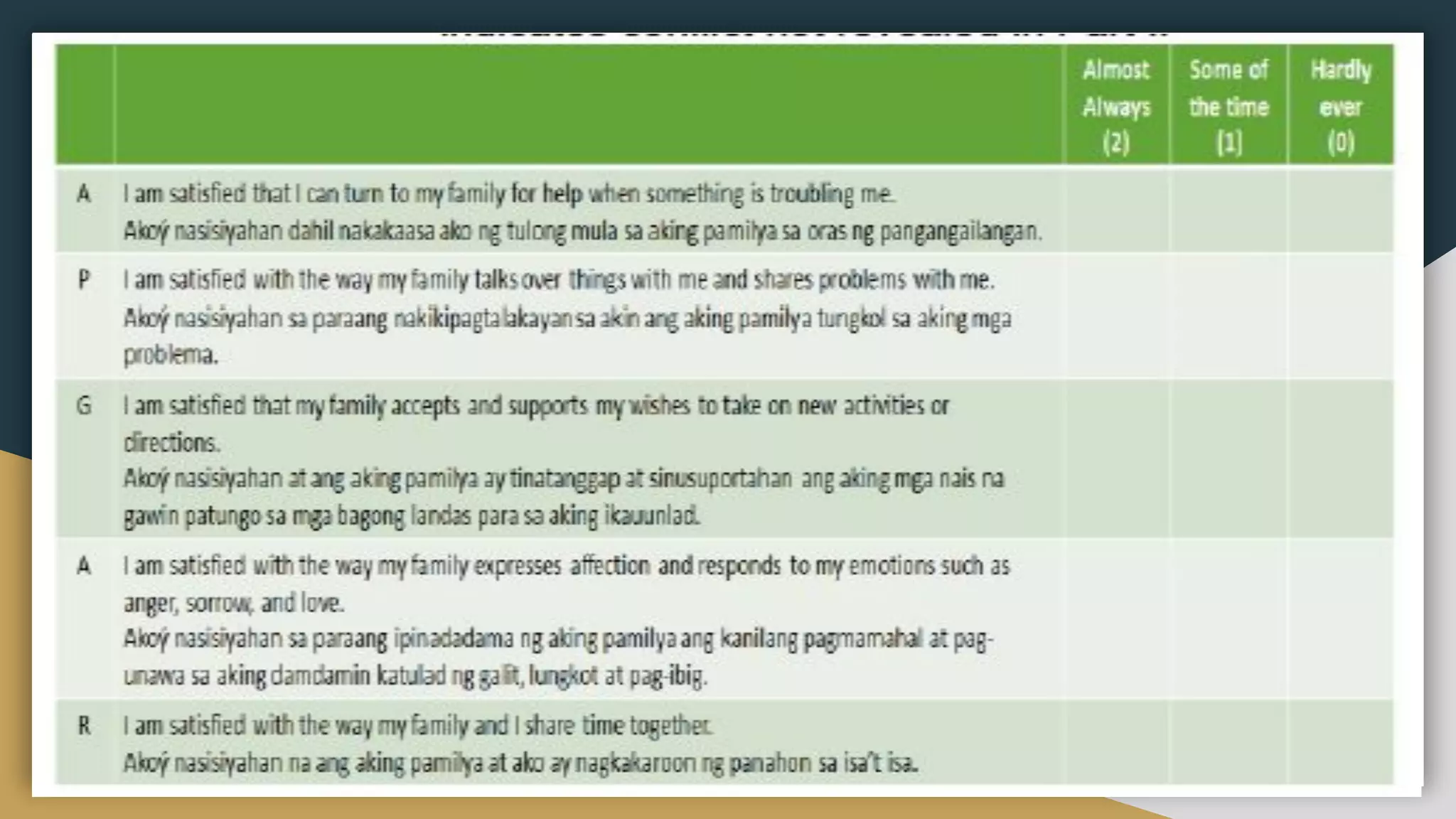
“I am satisfied that I can turn to
my family for help when
something is troubling me”
“Ako’y nasisiyahan dahil
nakakaasa ako ng tulong sa
aking pamilya sa oras ng mga
problema”
PARTNERSHIP
is the sharing of decision-
making.This measures
satisfaction attained in solving
problems by communicating
with each other.
“ I am satisfied with the way my
family talks on things with me &
shares problem with me.”
“Ako’y nasisiyahan sa parang
nakikipagtalakayan sa akin ang aking
pamilya tungkol sa aking mga
suliranin.”
GROWTH
refers to both physical and
emotional growth. It measures
satisfaction of the available
freedom to change.
“I am satisfied that my family accepts
and supports my wishes to take on new
directions.”
“Ako’y nasisiyahan na ang aking
pamilya ay tinatanggap at
sinusuportahan ang aking mga nais
gawin patungo sa mga bagong landas
para sa aking ikauunlad.”
AFFECTION
is how emotions like love, anger and
hatred are shared between members.
This measures the members’
satisfaction with the intimacy and
emotional interaction that exist in the
family.
“I am satisfied with the way my family
expresses affection and responds to emotion
such as anger, sorrow
and love.”
“Ako’y nasisiyahan sa paraang ipinadadama
ng aking pamilya ang kanilang pagmamahal
at nauunawaan ang aking damdamin katulad
ng galit, lungkot at pag-ibig.”
RESOLVE
Refers to how time, space,
money are shared. This
measures the members’
satisfaction with the commitment
made by other members of the
family.
“I am satisfied with the way my
family and I share time together.”
“Ako’y nasisiyahan na ang aking
pamilya at ako ay nagkakaroon ng
panahon para sa isa’t-isa.”
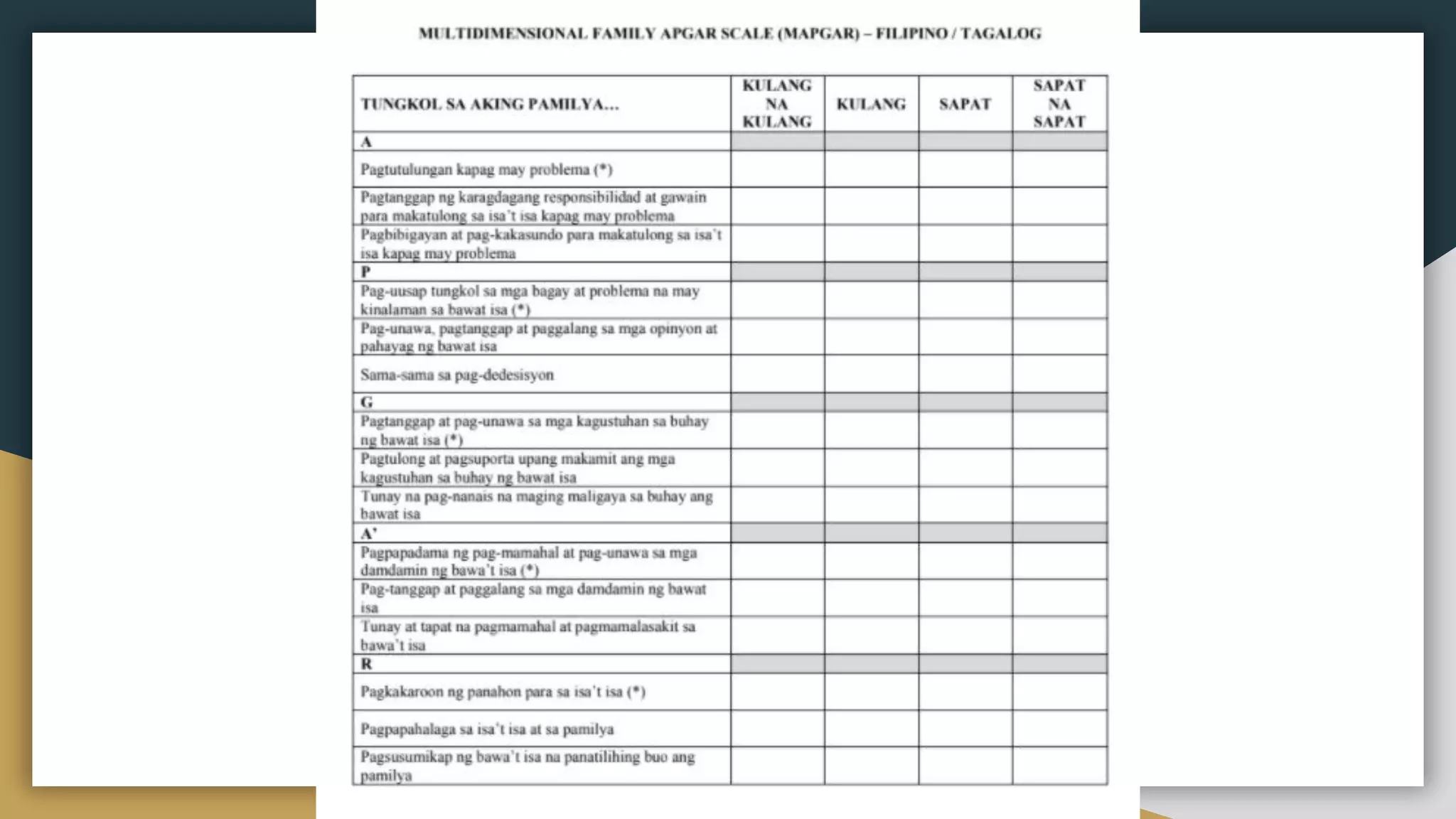
FAMILY APGAR QUESTIONNAIRE
Part I
• helps define degree of patient’s
satisfaction or dissatisfaction with
family function
Part II
• delineates patient’s relationship with
other members
• identifies persons who can give
assistance
• indicates conflict not revealed in
Part I
SCREEM
• is used to assess the capacity of the family to participate
in its provision of health care or to cope with crisis
• aids in reviewing the strengths and deficiencies of the
various categories of resources available to the family
• an acronym that stands for Social, Cultural, Religious,
Economic, Educational & Medical
FAMILY LIFELINE (CLINICAL
BIOGRAPHIES & LIFE CHART)
● Summarizes the history of the family, particularly the significant experiences
over a period of time in a chronologically-sequenced manner. ○ Also includes
how the family has coped with these stressful life events
● It emphasizes the application of the biopsychosocial approach
○ It can involve physical, psychological, social and even spiritual factors.
● Interpretation is based on the most significant event that probably affected the
health of each member or influenced the health-seeking behavior or perception
on health of the individual or the family.
FAMILY LIFELINE
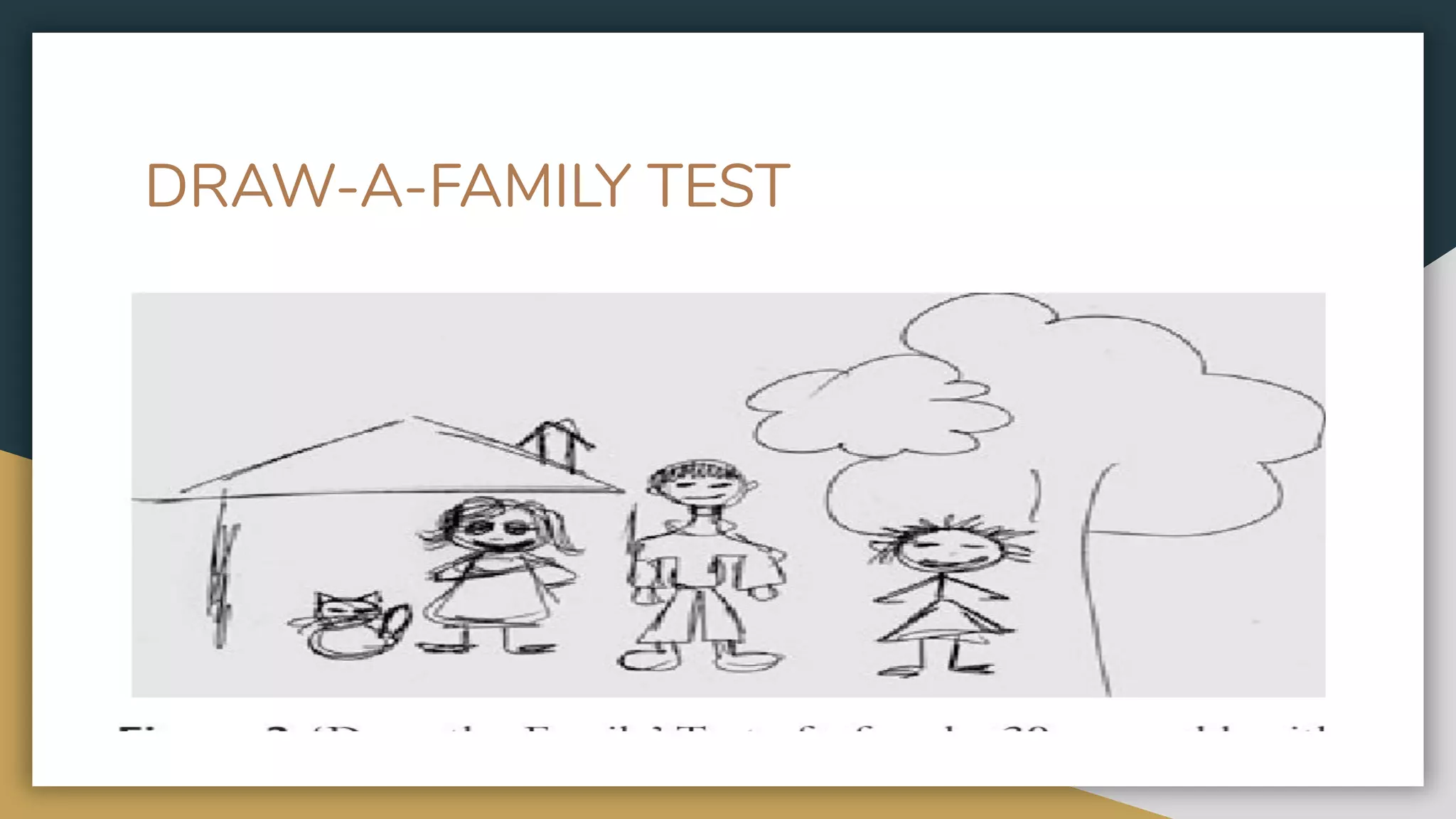
DRAW-A-FAMILY TEST
● Simple, practical, & cost-effective tool to assess family
function
● Clues on personalities of a family member
● Revealing and relieving innate difficulties within the
family system
● Measure how the pt pictures his family
DRAW-A-FAMILY TEST
FAMILY CIRCLE
● Usually used in individuals or small groups
● Adv: described by the patient
● Disadv: difficulty standardizing & interpreting the tool
FAMILY CIRCLE
THANK YOU!

Tools in family assessment

  • 1.
    TOOLS IN FAMILY ASSESSMENT BY:ETHYL JOY H. GOLOSINDA, MD
  • 2.
    FAMILY MEDICINE Medical specialtythat provides a continuing and comprehensive health care for the individual and the family.
  • 3.
    FAMILY PHYSICIAN Possess distinctattitudes, skills, and knowledge that qualify them to provide continuing and comprehensive medical care, health maintenance, and preventive services to each member of a family regardless of gender, age, or type of problem.
  • 4.
    The management ofillness requires a consideration of personal and religious beliefs: social, economic, or cultural problems; personal feelings and expectations; and the patient’s family.
  • 5.
    REASONS WHY WEHAVE TO UNDERSTAND THE FILIPINO FAMILY • Families are a source of health beliefs that affect health behaviors • Families are an important resource in care management
  • 6.
    REASONS WHY WEHAVE TO UNDERSTAND THE FILIPINO FAMILY • Somatic symptoms, which contribute to high utilization of health care resources, can serve as an adaptive function within the family and can be maintained by family patterns of interaction
  • 7.
    REASONS WHY WEHAVE TO UNDERSTAND THE FILIPINO FAMILY • The health of each member of the family is affected by healthy relationship patterns • Families are affected by the health problems of their members
  • 8.
    FAMILY ASSESSMENT TOOLS -used to have a systematic way of understanding the family and to aid them in evaluating the impact of illness on a person and on his/her role in the family.
  • 9.
    Steps in incorporatinga Family Systems Approach into Clinical PRACTICE are: Step One: Recognize Family Structure Step Two: Understand Normal Family Function Step Three: Learn to Assess Family Structure & Function in Clinical Practice
  • 10.
    STEP 1: RECOGNITIONOF FAMILY STRUCTURE – initial step in understanding a family is to know each individual in the family – a good source of information about family structure is the Family Genogram
  • 11.
    FAMILY GENOGRAM • summarizeson one page a large amount of information relating to the family • purpose: to develop a realistic overview of the family’s background and potential future health problems DISADVANTAGE: • much time is needed in its preparation
  • 12.
    FAMILY GENOGRAM • showsa graphic representation of the following: ❖ Genetic Pedigree Chart or the Family Tree ❖ Functional Charting of psychosocial and interactional data ❖ Medical history or family illnesses
  • 13.
    USES AND INFORMATION: •records names and roles of each member of the Family • separates extended family into several households • documents medical problems of each member of the family • documents significant dates in the family history • reveals more subtle information about the family • helps both the clinician and the family to understand problems, issues, events and symptoms, their potential consequences and their meaning to the family • preventive intervention
  • 14.
    FAMILY TREE • familycomposition and structure • a quick overview of family and their interrelationships • must consist of 3 or more generations and each generation is identified by Roman numerals • the first born of each generation is farthest to the left with siblings following to the right in order of birth
  • 15.
    FAMILY TREE • thefamily name is placed above each major family unit • given names and ages are placed below each symbol • one member of the family is of greater medical significance and is known as the index patient (identified with an arrow) • date is indicated when the chart was made so ages can be adjusted over time
  • 18.
    FUNCTIONAL CHART ● Moredynamic image of the family ● Relationship of members ● Allows to judge the totality of the family, its strengths and weakness & ability to withstand future stressful situation
  • 21.
    FAMILY HISTORY/ILLNESS • denotesthe presence of inherited diseases or familial tendencies indicating potential problems in the family
  • 22.
    STEP 2: UNDERSTANDNORMAL FAMILY FUNCTION 5 basic functions performed by all families which are as follows: 1. Families provide support to each other. 2. Families establish autonomy and independence for each person in the system which enhance 3. Families create rules that govern the conduct of the family and the individuals within the family. 4. Families adapt to change in the environment. 5. Families communicate with each other.
  • 23.
    DYSFUNCTIONAL FAMILY Defined asa family with chronic inability to respond to the needs of the members or to cope with changes and stresses in the environment
  • 24.
    CHECKLIST TO ASSESSFAMILY FUNCTION 1. How many are there in the family? 2. Who lives at home? 3. In what phase of Family Life Cycle is the family? 4. What problems has the family had in the past? 5. What major problems has the family had in the past?
  • 25.
    CHECKLIST TO ASSESSFAMILY FUNCTION 6. Does the family feel these problems were dealt with satisfactorily? 7. Is there any history of alcoholism, drug abuse or dependency? 8. How are major decisions made in the family and by whom? 9. Are there in-laws & relatives helpful? Do they create problems for the family? 10. Do the family members have many friends in the neighborhood? To what groups or clubs do family members belong?
  • 26.
    CHECKLIST TO ASSESSFAMILY FUNCTION 11. What community resources has the family used? Would the members use them again? 12. Has the family not used community resources at times when they would have been appropriate? 13. A. What does each parent expect of each child, both on day to day basis & for the future? B. What do the children expect of each parent? C. Are these expectations realistic?
  • 27.
    CHECKLIST TO ASSESSFAMILY FUNCTION 14. What does each member of the family have to do to get attention? 15. How much tolerance for individual differences is there in the family? 16. What are the goals, interests, and values of the family? 17. Do all the family members work together toward these goals? 18. What is the educational level & financial status of the parents?
  • 28.
    STEP 3: LEARNTO ASSESS FAMILY STRUCTURE & FUNCTION IN CLINICAL PRACTICE FAMILY ASSESSMENT INSTRUMENTS: ● Family Genogram ● Family Circle ● Family APGAR ● FACES (Family Adaptability & cohesion evaluation scale) ● FES (Family Environmental Scale) ● Clinical Biography & Life Events ● SCREEM ● DRAFT (Draw a Family Test)
  • 29.
    FAMILY APGAR ● 5-itemquestionnaire ● was originally described by Smilkstein ● Rapid screening for family dysfunction ● elicit the patient’s perceptions of the current state of family relationships & level of satisfaction about family relationship
  • 30.
    4 basic situationswhere the FAMILY APGAR is needed: 1. When the family will be directly involved in caring for the patient 2. When treating a new patient in order to get information to serve as general view of family function 3. When treating a patient whose family is in crisis 4. When a pt’s behavior makes you suspect a psychosocial problem possibly due to family dysfunction
  • 31.
    ADAPTATION is the capabilityof the family to utilize and share inherent resources which are either intra-familial or extra-familial “I am satisfied that I can turn to my family for help when something is troubling me” “Ako’y nasisiyahan dahil nakakaasa ako ng tulong sa aking pamilya sa oras ng mga problema”
  • 32.
    PARTNERSHIP is the sharingof decision- making.This measures satisfaction attained in solving problems by communicating with each other. “ I am satisfied with the way my family talks on things with me & shares problem with me.” “Ako’y nasisiyahan sa parang nakikipagtalakayan sa akin ang aking pamilya tungkol sa aking mga suliranin.”
  • 33.
    GROWTH refers to bothphysical and emotional growth. It measures satisfaction of the available freedom to change. “I am satisfied that my family accepts and supports my wishes to take on new directions.” “Ako’y nasisiyahan na ang aking pamilya ay tinatanggap at sinusuportahan ang aking mga nais gawin patungo sa mga bagong landas para sa aking ikauunlad.”
  • 34.
    AFFECTION is how emotionslike love, anger and hatred are shared between members. This measures the members’ satisfaction with the intimacy and emotional interaction that exist in the family. “I am satisfied with the way my family expresses affection and responds to emotion such as anger, sorrow and love.” “Ako’y nasisiyahan sa paraang ipinadadama ng aking pamilya ang kanilang pagmamahal at nauunawaan ang aking damdamin katulad ng galit, lungkot at pag-ibig.”
  • 35.
    RESOLVE Refers to howtime, space, money are shared. This measures the members’ satisfaction with the commitment made by other members of the family. “I am satisfied with the way my family and I share time together.” “Ako’y nasisiyahan na ang aking pamilya at ako ay nagkakaroon ng panahon para sa isa’t-isa.”
  • 36.
    FAMILY APGAR QUESTIONNAIRE PartI • helps define degree of patient’s satisfaction or dissatisfaction with family function Part II • delineates patient’s relationship with other members • identifies persons who can give assistance • indicates conflict not revealed in Part I
  • 41.
    SCREEM • is usedto assess the capacity of the family to participate in its provision of health care or to cope with crisis • aids in reviewing the strengths and deficiencies of the various categories of resources available to the family • an acronym that stands for Social, Cultural, Religious, Economic, Educational & Medical
  • 46.
    FAMILY LIFELINE (CLINICAL BIOGRAPHIES& LIFE CHART) ● Summarizes the history of the family, particularly the significant experiences over a period of time in a chronologically-sequenced manner. ○ Also includes how the family has coped with these stressful life events ● It emphasizes the application of the biopsychosocial approach ○ It can involve physical, psychological, social and even spiritual factors. ● Interpretation is based on the most significant event that probably affected the health of each member or influenced the health-seeking behavior or perception on health of the individual or the family.
  • 47.
  • 48.
    DRAW-A-FAMILY TEST ● Simple,practical, & cost-effective tool to assess family function ● Clues on personalities of a family member ● Revealing and relieving innate difficulties within the family system ● Measure how the pt pictures his family
  • 49.
  • 50.
    FAMILY CIRCLE ● Usuallyused in individuals or small groups ● Adv: described by the patient ● Disadv: difficulty standardizing & interpreting the tool
  • 51.
  • 52.