Medical DocumentationMedical Documentation
Prof. AMER ELTWATI IRHUMA M.B.ch.B FRCS
Consultant Surgeon
"you are what you write"
QuoteQuote
"Knowing is not enough;
we must apply.
Willing is not enough;
we must do.
“ -Johann von Goethe “
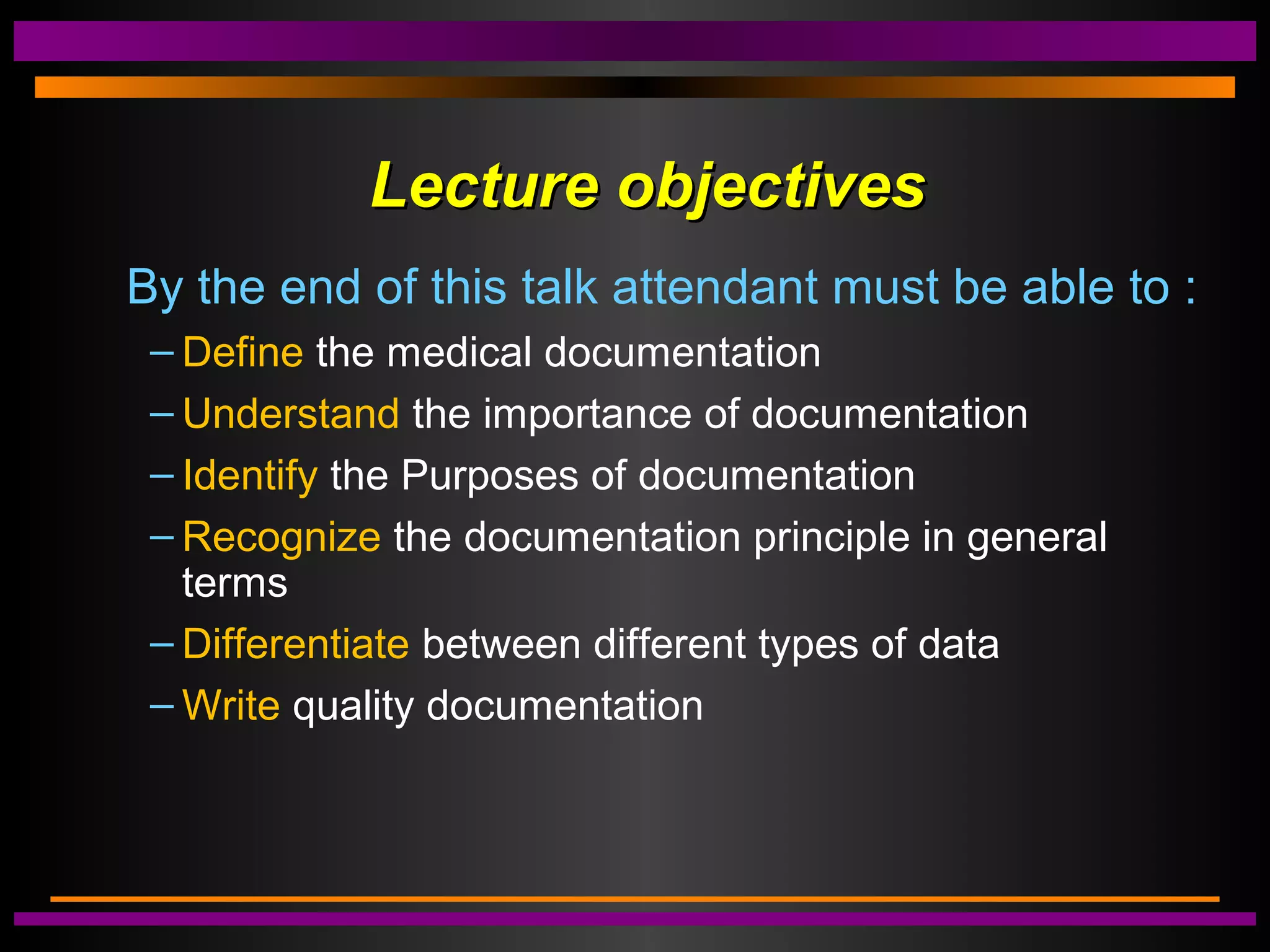
Lecture objectivesLecture objectives
By the end of this talk attendant must be able to :
– Define the medical documentation
– Understand the importance of documentation
– Identify the Purposes of documentation
– Recognize the documentation principle in general
terms
– Differentiate between different types of data
– Write quality documentation
DEFINTIONDEFINTION
documentation of a medical condition mean
a statement from a licensed physician or
other appropriate practitioner that provides
information
INTRODUCTIONINTRODUCTION
Doctors and other providers should remember that the first and
primary purpose of a medical record is to accurately and
completely document patient-status and care.
The medical record is a communication amongst health care
providers to document type of care, quality of care, patient progress,
and patient status. It is important to remember the intended
purpose of medical records.
Records that are kept solely because of their legal significance will
appear to be self-serving and defensive.
Improper or biased documentation can hurt a cause just as much,
if not more, than proper documentation can help.
INTRODUCTIONINTRODUCTION
Medical records are one of the primary sources of evidence
used by the court in deciding whether a physician is liable for
malpractice. Incomplete records can be devastating to the
defense of a claim; as far as the court is concerned, if it’s not in
the medical record, it simply did not happen. Sloppy or
inaccurate documentation can create the impression that the
medical care rendered was less than professional.
Accurate and legible entries are mandatory for appropriate
patient management, continuity of care, coding procedures, and
appropriate risk management.
Documentation of patient evaluations and treatment must be
completed at the time the service is performed.
Importance of the Medical RecordImportance of the Medical Record
 The medical record you prepare today may be
reviewed by others, both within and outside
the hospital or practice.
 The accuracy and completeness may be
questioned or discussed and you may be
asked to justify your record-keeping methods
and practices by non-medical personnel.
Importance of the Medical RecordImportance of the Medical Record
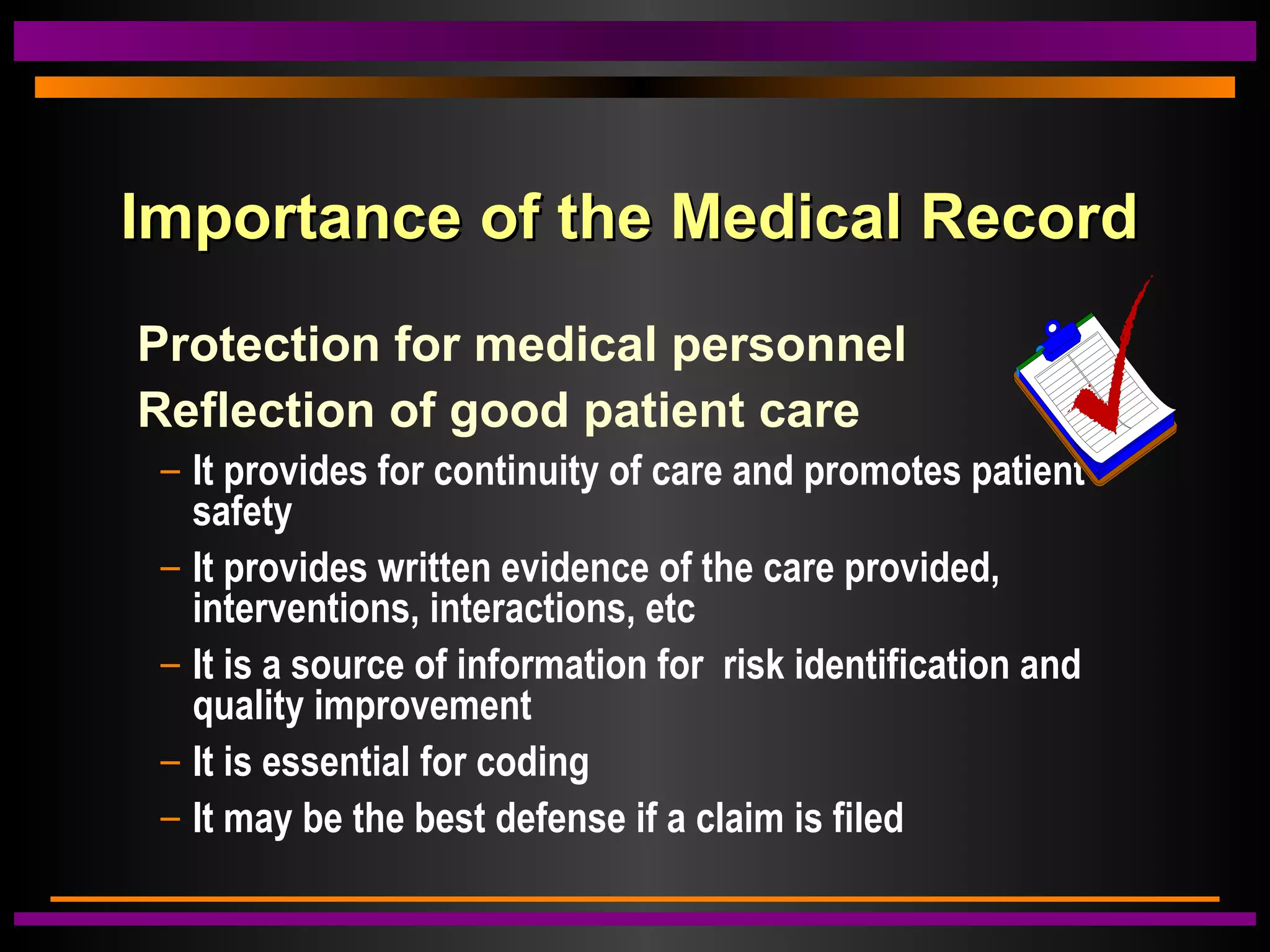
Protection for medical personnel
Reflection of good patient care
– It provides for continuity of care and promotes patient
safety
– It provides written evidence of the care provided,
interventions, interactions, etc
– It is a source of information for risk identification and
quality improvement
– It is essential for coding
– It may be the best defense if a claim is filed
DocumentationDocumentation
Purposes
Preserves basic patient information
Justifies treatment
Allows continuity of care
Satisfies regulatory requirements
Provides data for quality control and research
Is documentary evidence of evaluation,
treatment, change in condition, etc
Is a communication tool between clinicians
DocumentationDocumentation
The general principles of documentation
The medical record should be complete and legible.
The documentation of each patient encounter should
include:
- the chief complaint and relevant history
- physical examination findings
- prior diagnostic test results; assessment
- clinical impression or diagnosis
- plan for care
- date and a verifiable legible identity of the health care professional
who provided the service.
DocumentationDocumentation
The general principles of documentation
If not specifically documented, the rationale for ordering
diagnostic and other ancillary services should be able to be easily
inferred.
To the greatest extent possible, past and present diagnoses and
conditions, should be accessible to the treating and / or consulting
physician.
Appropriate health risk factors should be identified.
The patient's progress, response to and changes in treatment, planned
follow-up care and instructions, and diagnosis should be documented.
DocumentationDocumentation
The general principles of documentation
The ICD-9-CM codes( International Classification of Diseases - Clinical
Modification (ICD-CM). should be followed
An addendum to a medical record should be dated the day the
information is added to the medical record and not dated for the
date the service was provided.
A service should be documented during, or as soon as practicable
after it is provided in order to maintain an accurate medical record.
The Confidentiality of the medical record should be fully
maintained consistent with the requirements of medical ethics and
of law.
The Medical Record
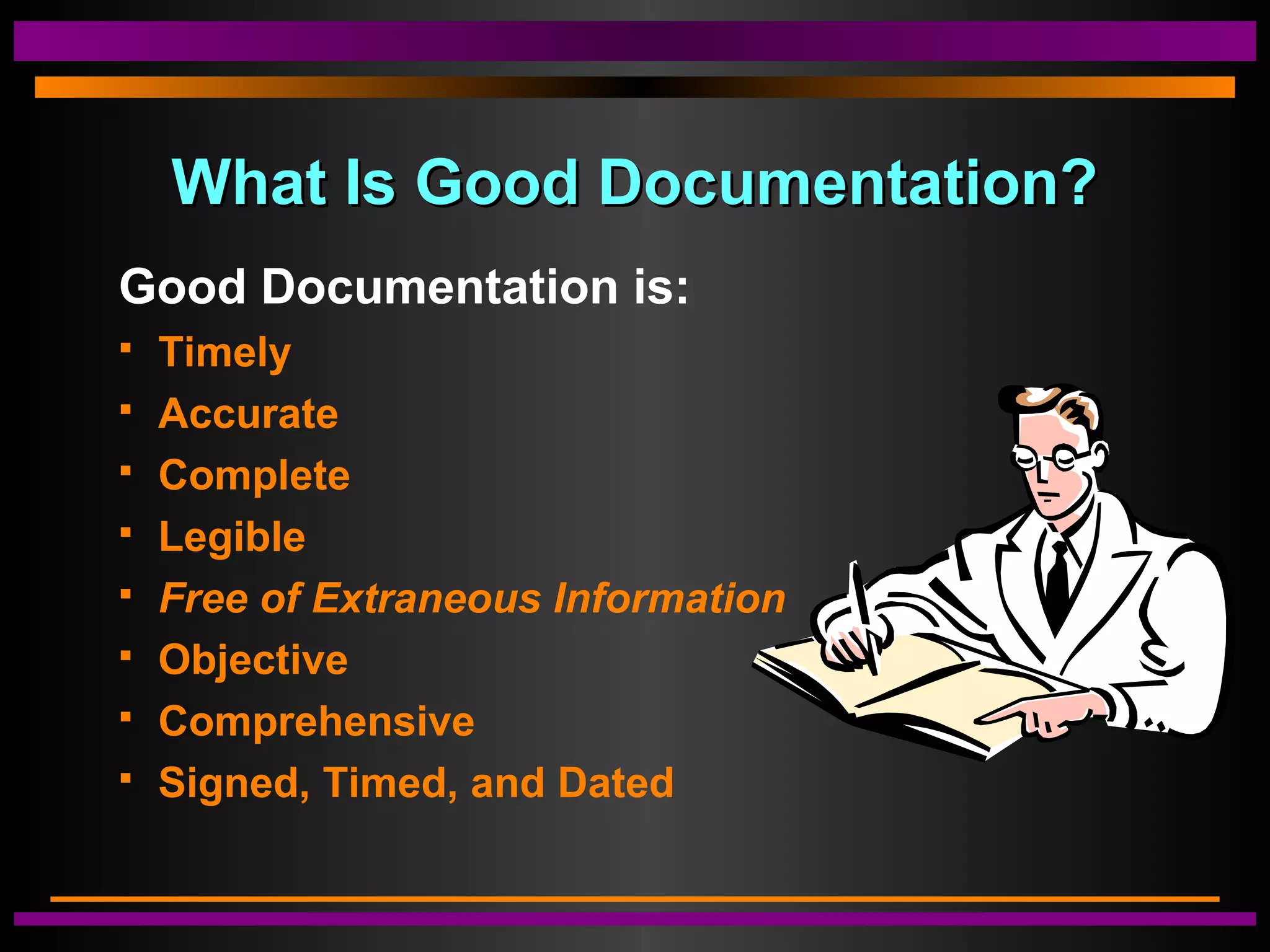
What Is Good Documentation?What Is Good Documentation?
Good Documentation is:
 Timely
 Accurate
 Complete
 Legible
 Free of Extraneous Information
 Objective
 Comprehensive
 Signed, Timed, and Dated
AA POORPOOR Medical Record Is:Medical Record Is:
Blaming or accusatory
Stated with innuendo
Incomplete
Inconsistent
Falsified
Illegible
DocumentationDocumentation
An accurate, complete, legible medical record
IMPLIES
accurate, complete, organized assessment and
management
AccurateAccurate
Document facts, observations only
Do NOT speculate about patient or incident
Double-check numerical entries
Recheck spellings of:
• Persons
• Locations
• Medical terms
AccurateAccurate
 If you make a mistake, document it.
 It is better to record your own mistakes that
for someone else to uncover them.
AccurateAccurate
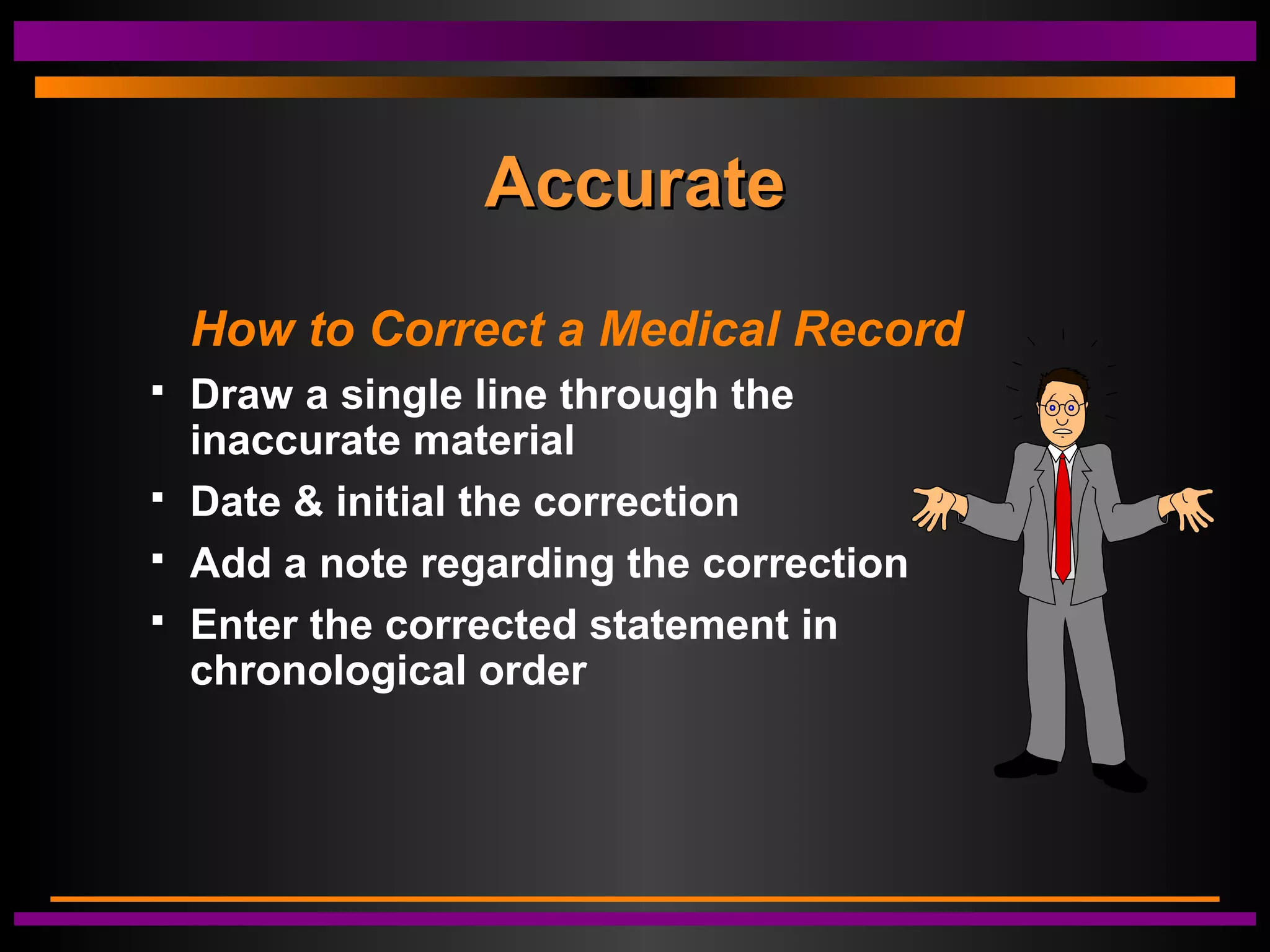
How to Correct a Medical Record
 Draw a single line through the
inaccurate material
 Date & initial the correction
 Add a note regarding the correction
 Enter the corrected statement in
chronological order
AccurateAccurate
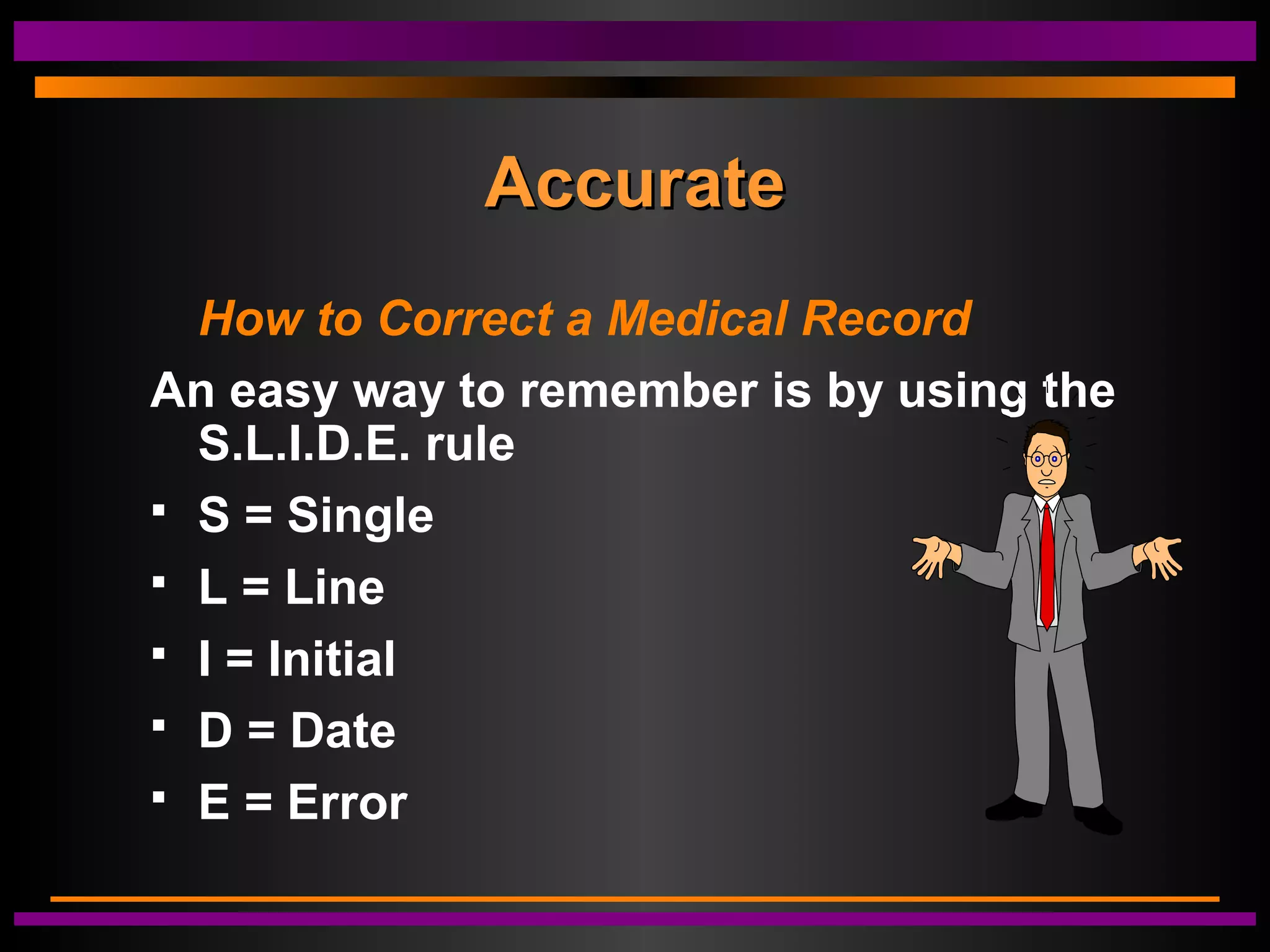
How to Correct a Medical Record
An easy way to remember is by using the
S.L.I.D.E. rule
 S = Single
 L = Line
 I = Initial
 D = Date
 E = Error
When in doubt.....
AccurateAccurate
CompleteComplete
Include all requested information
If information requested does not apply,
note “not applicable” or “N/A”
If you look for something and it isn’t there,
document its absence
Failure to document implies failure to
consider
CompleteComplete
Documenting Patient Education
 Specific information given to the patient
 List any handouts by name that you give
the patient
 Document patient understanding of
instruction, information, etc. such as
“patient verbalized understanding”
 Documenting “ the patient understood” is
not appropriate and is poorly defensible
If you have a long report, don’t
hesitate to use additional pages
CompleteComplete
CompleteComplete
IF IT ISN’T DOCUMENTED,
IT WASN’T
DONE!
LegibleLegible
If you cannot read the report, you
may be unable to determine what
happened
Documents presented in court must
“speak for themselves”
If a document cannot be deciphered,
the court has the right to ignore it
altogether
LegibleLegible
 Legible Charting It is the single most effective
way to improve medical records!
 Writing legibly requires little or no additional
time
 When defending malpractice actions, an
illegible record is of no help
LegibleLegible
If the report is sloppy, others
will assume that the care was
equally sloppy
Free of Extraneous InformationFree of Extraneous Information
Avoid labeling patients (“drunk”,
“psych patient”)
Describe the observations you made
Preface comments made by the patient
with “per the patient” or “patient
stated”
Free of Extraneous InformationFree of Extraneous Information
Record hearsay only if applicable
Do NOT record hearsay as facts
Use quotation marks only if a
statement is accurate word-for-word
Free of Extraneous InformationFree of Extraneous Information
Avoid interjecting humor The public
does not regard medicine as a funny
business
Types of DocumentationTypes of Documentation
The type of documentation that you use will
depend on the facility policy
Regardless of the type of documentation
you use, there are several key components
OBJECTIVE DATAOBJECTIVE DATA
SUBJECTIVE DATA
vs
ObjectiveObjective vsvs.. SubjectiveSubjective
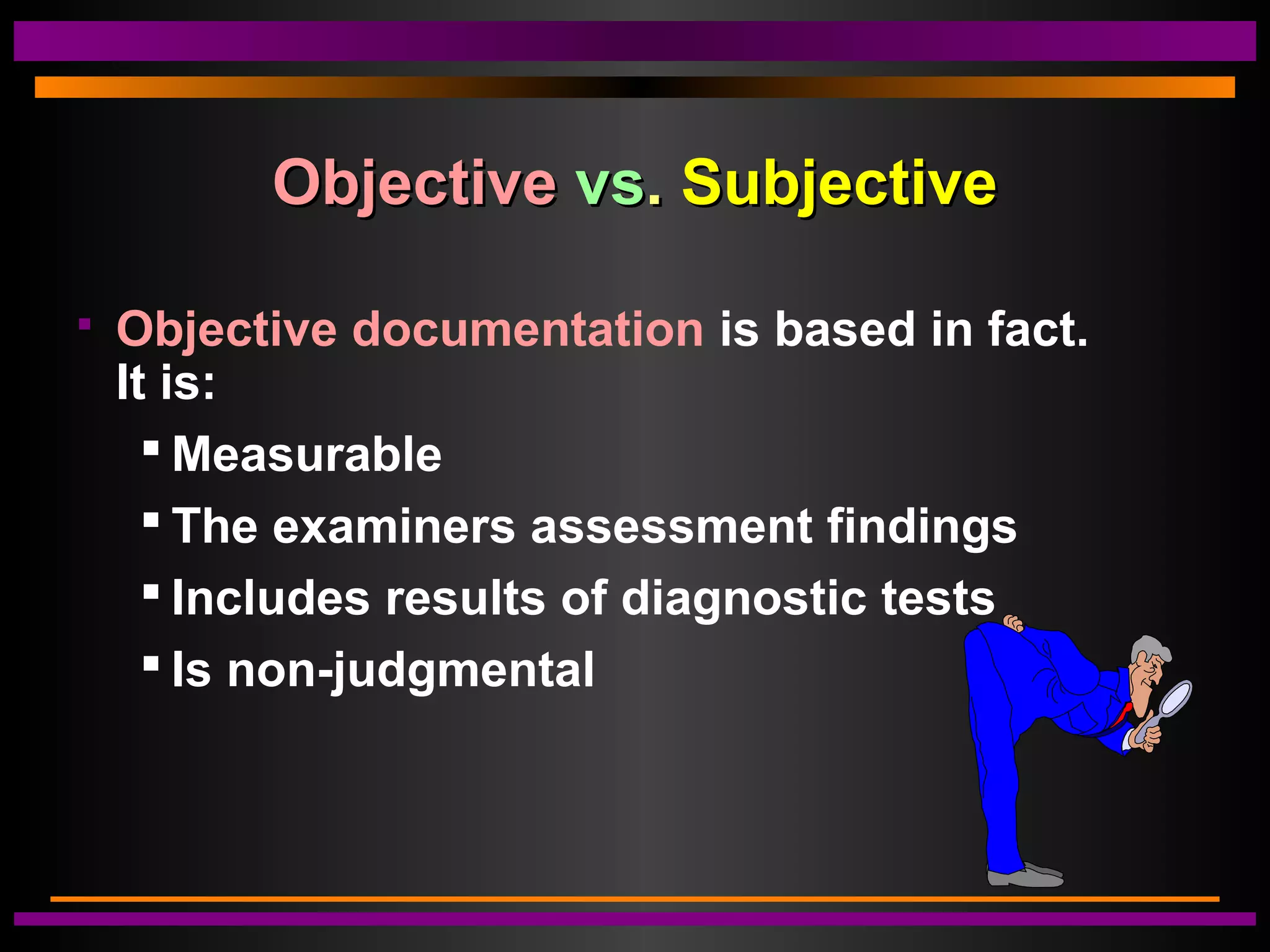
 Objective documentation is based in fact.
It is:
 Measurable
 The examiners assessment findings
 Includes results of diagnostic tests
 Is non-judgmental
ObjectiveObjective vsvs.. SubjectiveSubjective
Objective data is what you:
See
Hear / auscultate
Smell
Palpate
ObjectiveObjective vsvs.. SubjectiveSubjective
Objective data also includes what you don’t find
 Statements of non- findings:
 May be what leads you to consider a
differential diagnosis
 Indicates that thorough exam was
completed, that you didn’t overlook
anything
 May eliminate the potential for your word
against theirs situations if you find yourself
in court
ObjectiveObjective vsvs.. SubjectiveSubjective
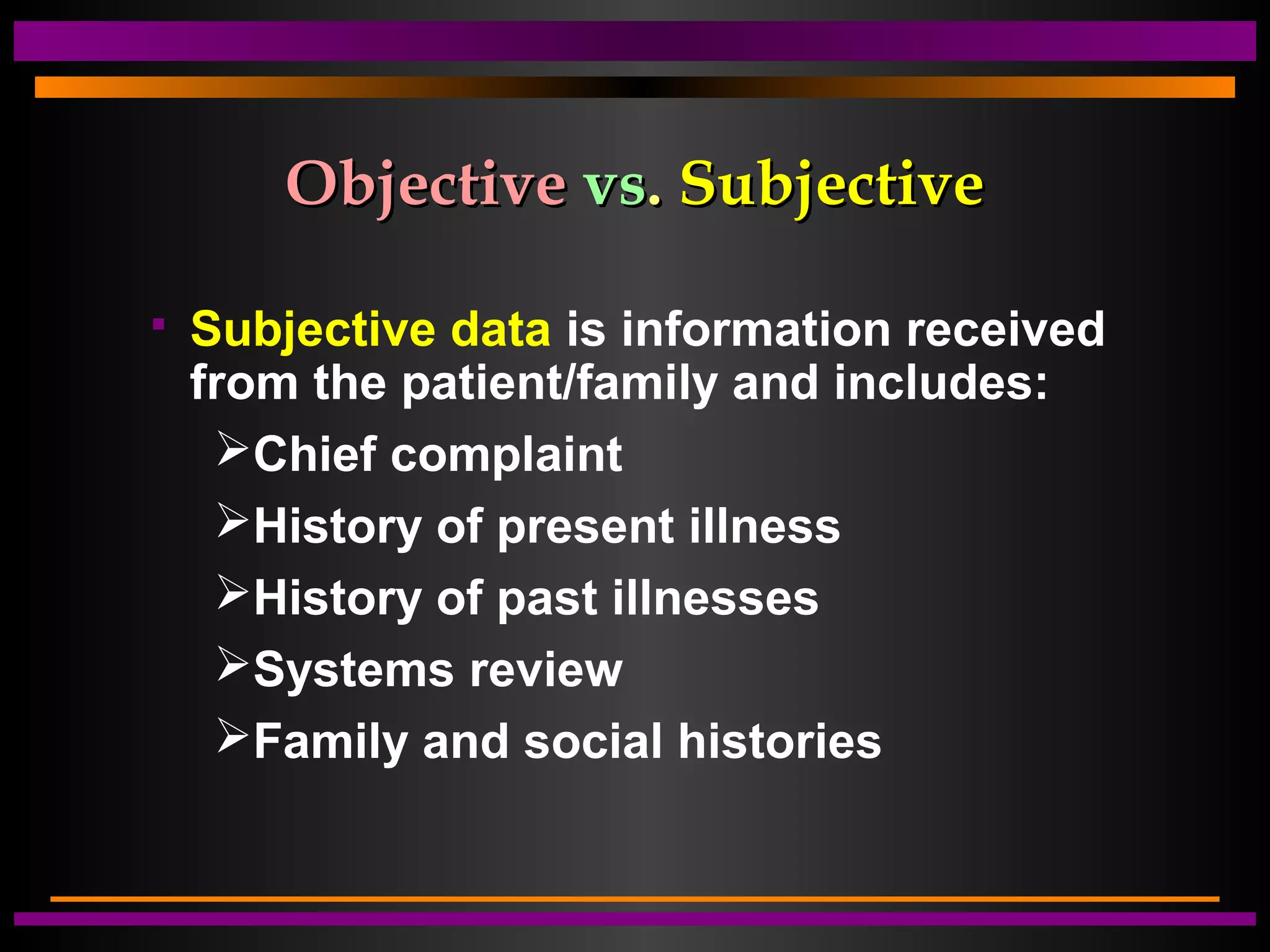
 Subjective data is information received
from the patient/family and includes:
Chief complaint
History of present illness
History of past illnesses
Systems review
Family and social histories
Informed ConsentInformed Consent
Informed consent is a dialog; an
exchange of information, between the
physician and the patient .
The purpose is to provide adequate
information to the patient so the patient
can make an informed choice regarding
their health care
Informed ConsentInformed Consent
Informed consent is a process, it is
NOT a piece of paper
Informed consent occurs as the
physician discusses with the patient
–The disease/diagnosis
–Proposed treatment with other
options
–Risks and benefits
Informed ConsentInformed Consent
This implies:
–The patient is given objective
medical information related to their
state of health in language they can
understand
–The patient is allowed to ask
questions and have them answered
to their satisfaction before making a
decision
Quality Documentation
Sign Your Notes!Sign Your Notes!
 Sign every entry
 Every entry must have a date and time
 Never sign someone else’s notes
 Countersign someone else’s notes only as
verification
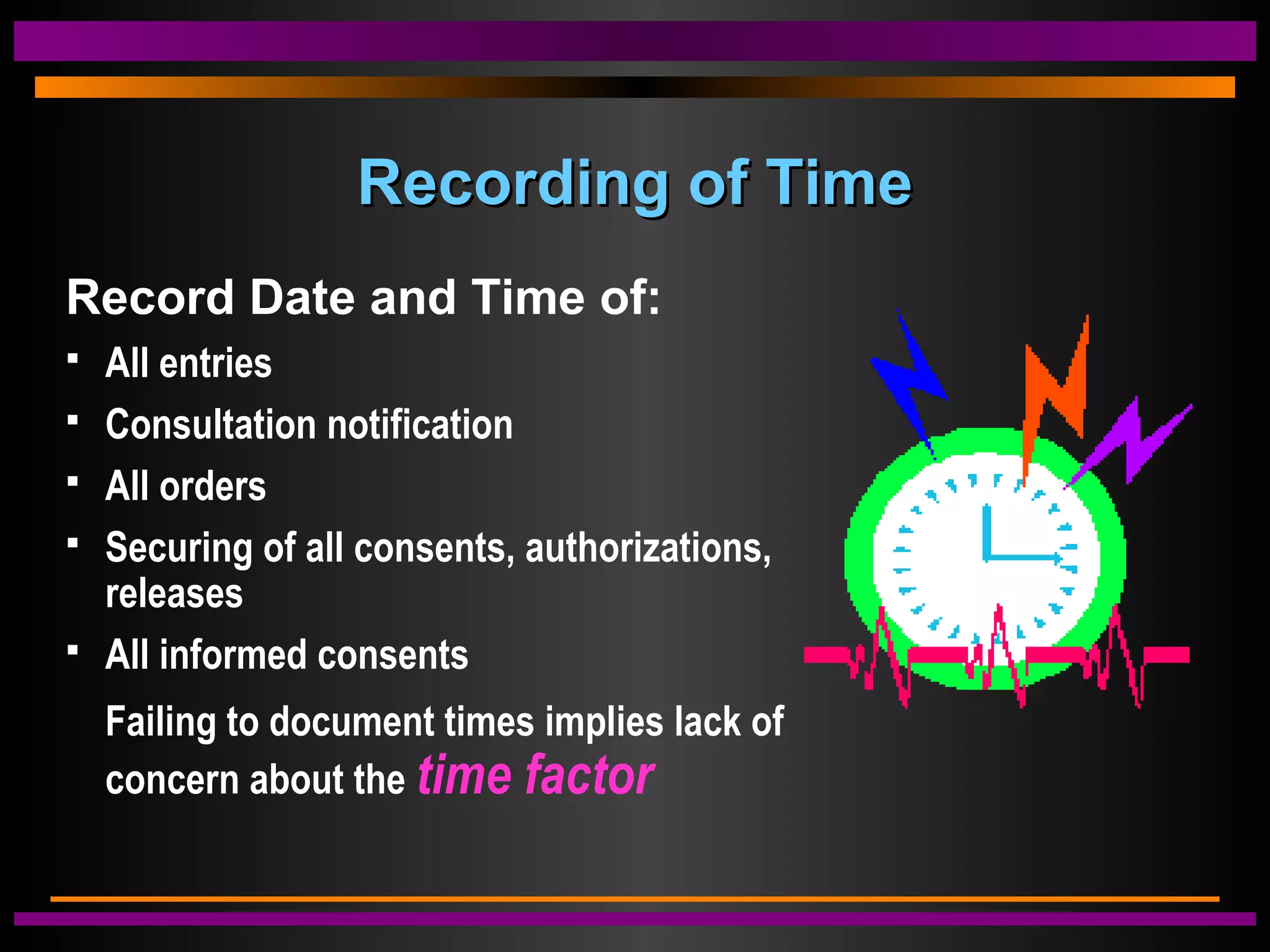
Recording of TimeRecording of Time
Record Date and Time of:
 All entries
 Consultation notification
 All orders
 Securing of all consents, authorizations,
releases
 All informed consents
Failing to document times implies lack of
concern about the time factor
Protect YourselfProtect Yourself
 Never alter medical records
 Never skip lines or leave blanks
 Never obliterate
 Document only with ink
Select Your Words CarefullySelect Your Words Carefully
 Selecting your words carefully and
thoughtfully is very important. You want to
state your documentation with confidence
and without hesitation.
 Don’t use vague words
Select Your Words CarefullySelect Your Words Carefully
 Avoid using vague words such as:
“Unintentionally”
“Inadvertently”
“Somehow”
“Unexplainably”
“Unfortunately”
“Apparently”
Medical Records & Confidentiality &Medical Records & Confidentiality &
SecuritySecurity
 Maintain physical security of records
 Never remove records from the facility /office
 Release records only through proper
procedure
 No unauthorized copying of records
 No access to records by unauthorized
individuals
In SummaryIn Summary
Remember…………………
POOR DOCUMENTATION MAKES
GOOD CARE LOOK BAD!!!!
In SummaryIn Summary
REMEMBER……..DOCUMENT
OBJECTIVELY
Good documentation may be your best
defense in a malpractice claim
DocumentationDocumentation
COMMITMENTS
HONESTY
PROFESSIONALISM
CONCLUSIONCONCLUSION
 As responsibility grows so does accountability.
There are few, if any, professions that bear more
responsibility than the medical profession. With this
huge responsibility there is strict accountability.
 What does this accountability mean to the average
physician, nurse, hospital, or other health care
provider ?
 It means that proper documentation and record
keeping can be as important as providing proper
care.
THE MESSAGETHE MESSAGE
Better SAFE
than SORRY
Thank you

Medical documentation

  • 1.
    Medical DocumentationMedical Documentation Prof.AMER ELTWATI IRHUMA M.B.ch.B FRCS Consultant Surgeon
  • 2.
    "you are whatyou write"
  • 3.
    QuoteQuote "Knowing is notenough; we must apply. Willing is not enough; we must do. “ -Johann von Goethe “
  • 4.
    Lecture objectivesLecture objectives Bythe end of this talk attendant must be able to : – Define the medical documentation – Understand the importance of documentation – Identify the Purposes of documentation – Recognize the documentation principle in general terms – Differentiate between different types of data – Write quality documentation
  • 5.
    DEFINTIONDEFINTION documentation of amedical condition mean a statement from a licensed physician or other appropriate practitioner that provides information
  • 6.
    INTRODUCTIONINTRODUCTION Doctors and otherproviders should remember that the first and primary purpose of a medical record is to accurately and completely document patient-status and care. The medical record is a communication amongst health care providers to document type of care, quality of care, patient progress, and patient status. It is important to remember the intended purpose of medical records. Records that are kept solely because of their legal significance will appear to be self-serving and defensive. Improper or biased documentation can hurt a cause just as much, if not more, than proper documentation can help.
  • 7.
    INTRODUCTIONINTRODUCTION Medical records areone of the primary sources of evidence used by the court in deciding whether a physician is liable for malpractice. Incomplete records can be devastating to the defense of a claim; as far as the court is concerned, if it’s not in the medical record, it simply did not happen. Sloppy or inaccurate documentation can create the impression that the medical care rendered was less than professional. Accurate and legible entries are mandatory for appropriate patient management, continuity of care, coding procedures, and appropriate risk management. Documentation of patient evaluations and treatment must be completed at the time the service is performed.
  • 8.
    Importance of theMedical RecordImportance of the Medical Record  The medical record you prepare today may be reviewed by others, both within and outside the hospital or practice.  The accuracy and completeness may be questioned or discussed and you may be asked to justify your record-keeping methods and practices by non-medical personnel.
  • 9.
    Importance of theMedical RecordImportance of the Medical Record Protection for medical personnel Reflection of good patient care – It provides for continuity of care and promotes patient safety – It provides written evidence of the care provided, interventions, interactions, etc – It is a source of information for risk identification and quality improvement – It is essential for coding – It may be the best defense if a claim is filed
  • 10.
    DocumentationDocumentation Purposes Preserves basic patientinformation Justifies treatment Allows continuity of care Satisfies regulatory requirements Provides data for quality control and research Is documentary evidence of evaluation, treatment, change in condition, etc Is a communication tool between clinicians
  • 11.
    DocumentationDocumentation The general principlesof documentation The medical record should be complete and legible. The documentation of each patient encounter should include: - the chief complaint and relevant history - physical examination findings - prior diagnostic test results; assessment - clinical impression or diagnosis - plan for care - date and a verifiable legible identity of the health care professional who provided the service.
  • 12.
    DocumentationDocumentation The general principlesof documentation If not specifically documented, the rationale for ordering diagnostic and other ancillary services should be able to be easily inferred. To the greatest extent possible, past and present diagnoses and conditions, should be accessible to the treating and / or consulting physician. Appropriate health risk factors should be identified. The patient's progress, response to and changes in treatment, planned follow-up care and instructions, and diagnosis should be documented.
  • 13.
    DocumentationDocumentation The general principlesof documentation The ICD-9-CM codes( International Classification of Diseases - Clinical Modification (ICD-CM). should be followed An addendum to a medical record should be dated the day the information is added to the medical record and not dated for the date the service was provided. A service should be documented during, or as soon as practicable after it is provided in order to maintain an accurate medical record. The Confidentiality of the medical record should be fully maintained consistent with the requirements of medical ethics and of law.
  • 14.
  • 15.
    What Is GoodDocumentation?What Is Good Documentation? Good Documentation is:  Timely  Accurate  Complete  Legible  Free of Extraneous Information  Objective  Comprehensive  Signed, Timed, and Dated
  • 16.
    AA POORPOOR MedicalRecord Is:Medical Record Is: Blaming or accusatory Stated with innuendo Incomplete Inconsistent Falsified Illegible
  • 17.
    DocumentationDocumentation An accurate, complete,legible medical record IMPLIES accurate, complete, organized assessment and management
  • 18.
    AccurateAccurate Document facts, observationsonly Do NOT speculate about patient or incident Double-check numerical entries Recheck spellings of: • Persons • Locations • Medical terms
  • 19.
    AccurateAccurate  If youmake a mistake, document it.  It is better to record your own mistakes that for someone else to uncover them.
  • 20.
    AccurateAccurate How to Correcta Medical Record  Draw a single line through the inaccurate material  Date & initial the correction  Add a note regarding the correction  Enter the corrected statement in chronological order
  • 21.
    AccurateAccurate How to Correcta Medical Record An easy way to remember is by using the S.L.I.D.E. rule  S = Single  L = Line  I = Initial  D = Date  E = Error
  • 22.
  • 23.
    CompleteComplete Include all requestedinformation If information requested does not apply, note “not applicable” or “N/A” If you look for something and it isn’t there, document its absence Failure to document implies failure to consider
  • 24.
    CompleteComplete Documenting Patient Education Specific information given to the patient  List any handouts by name that you give the patient  Document patient understanding of instruction, information, etc. such as “patient verbalized understanding”  Documenting “ the patient understood” is not appropriate and is poorly defensible
  • 25.
    If you havea long report, don’t hesitate to use additional pages CompleteComplete
  • 26.
    CompleteComplete IF IT ISN’TDOCUMENTED, IT WASN’T DONE!
  • 27.
    LegibleLegible If you cannotread the report, you may be unable to determine what happened Documents presented in court must “speak for themselves” If a document cannot be deciphered, the court has the right to ignore it altogether
  • 28.
    LegibleLegible  Legible ChartingIt is the single most effective way to improve medical records!  Writing legibly requires little or no additional time  When defending malpractice actions, an illegible record is of no help
  • 29.
    LegibleLegible If the reportis sloppy, others will assume that the care was equally sloppy
  • 30.
    Free of ExtraneousInformationFree of Extraneous Information Avoid labeling patients (“drunk”, “psych patient”) Describe the observations you made Preface comments made by the patient with “per the patient” or “patient stated”
  • 31.
    Free of ExtraneousInformationFree of Extraneous Information Record hearsay only if applicable Do NOT record hearsay as facts Use quotation marks only if a statement is accurate word-for-word
  • 32.
    Free of ExtraneousInformationFree of Extraneous Information Avoid interjecting humor The public does not regard medicine as a funny business
  • 33.
    Types of DocumentationTypesof Documentation The type of documentation that you use will depend on the facility policy Regardless of the type of documentation you use, there are several key components
  • 34.
  • 35.
    ObjectiveObjective vsvs.. SubjectiveSubjective Objective documentation is based in fact. It is:  Measurable  The examiners assessment findings  Includes results of diagnostic tests  Is non-judgmental
  • 36.
    ObjectiveObjective vsvs.. SubjectiveSubjective Objectivedata is what you: See Hear / auscultate Smell Palpate
  • 37.
    ObjectiveObjective vsvs.. SubjectiveSubjective Objectivedata also includes what you don’t find  Statements of non- findings:  May be what leads you to consider a differential diagnosis  Indicates that thorough exam was completed, that you didn’t overlook anything  May eliminate the potential for your word against theirs situations if you find yourself in court
  • 38.
    ObjectiveObjective vsvs.. SubjectiveSubjective Subjective data is information received from the patient/family and includes: Chief complaint History of present illness History of past illnesses Systems review Family and social histories
  • 39.
    Informed ConsentInformed Consent Informedconsent is a dialog; an exchange of information, between the physician and the patient . The purpose is to provide adequate information to the patient so the patient can make an informed choice regarding their health care
  • 40.
    Informed ConsentInformed Consent Informedconsent is a process, it is NOT a piece of paper Informed consent occurs as the physician discusses with the patient –The disease/diagnosis –Proposed treatment with other options –Risks and benefits
  • 41.
    Informed ConsentInformed Consent Thisimplies: –The patient is given objective medical information related to their state of health in language they can understand –The patient is allowed to ask questions and have them answered to their satisfaction before making a decision
  • 42.
  • 43.
    Sign Your Notes!SignYour Notes!  Sign every entry  Every entry must have a date and time  Never sign someone else’s notes  Countersign someone else’s notes only as verification
  • 44.
    Recording of TimeRecordingof Time Record Date and Time of:  All entries  Consultation notification  All orders  Securing of all consents, authorizations, releases  All informed consents Failing to document times implies lack of concern about the time factor
  • 45.
    Protect YourselfProtect Yourself Never alter medical records  Never skip lines or leave blanks  Never obliterate  Document only with ink
  • 46.
    Select Your WordsCarefullySelect Your Words Carefully  Selecting your words carefully and thoughtfully is very important. You want to state your documentation with confidence and without hesitation.  Don’t use vague words
  • 47.
    Select Your WordsCarefullySelect Your Words Carefully  Avoid using vague words such as: “Unintentionally” “Inadvertently” “Somehow” “Unexplainably” “Unfortunately” “Apparently”
  • 48.
    Medical Records &Confidentiality &Medical Records & Confidentiality & SecuritySecurity  Maintain physical security of records  Never remove records from the facility /office  Release records only through proper procedure  No unauthorized copying of records  No access to records by unauthorized individuals
  • 49.
    In SummaryIn Summary Remember………………… POORDOCUMENTATION MAKES GOOD CARE LOOK BAD!!!!
  • 50.
    In SummaryIn Summary REMEMBER……..DOCUMENT OBJECTIVELY Gooddocumentation may be your best defense in a malpractice claim
  • 51.
  • 52.
    CONCLUSIONCONCLUSION  As responsibilitygrows so does accountability. There are few, if any, professions that bear more responsibility than the medical profession. With this huge responsibility there is strict accountability.  What does this accountability mean to the average physician, nurse, hospital, or other health care provider ?  It means that proper documentation and record keeping can be as important as providing proper care.
  • 53.
  • 54.