Is Clinical Documentation Improvement the Answer?   MAPAM /MAHIMA  Joint Meeting Thursday, November 19, 2009 Thomas D. Sills, M.D. Lori Beaudry, CCS-P Clinical Financial Resource
What are the Issues? Inpatient MS-DRGs AP-DRGs SOI ROM Quality rankings Health Grades US News &WR CMS data Blue Cross
Outpatient Emergency Department Levels, procedure capture, medical necessity Ancillary services:  lab,  radiology,  etc. Medical necessity Anesthesia/Pain Clinic Accurate coding
Professional Services Emergency Department Hospitalists Clinics Anesthesia/Pain
Audits RAC MIC BC Other payors
A physician who heals for nothing is worth nothing.  -  The Talmud
All Billing Depends on Documentation Documentation Coding Billing
Quality Measurement Documentation Coding  Quality metrics  Billing
Inpatient CDI
Hospitals with Clinical Documentation Improvement Program Report Increased Reimbursement... Mon Aug 11, 2008 8:30am EDT   -(Business Wire)--J.A. Thomas and Associates, the leader in healthcare clinical documentation improvement, published today a set of benchmarking reports that show 188 hospitals using its Compliant Documentation
Management Program (CDMP(R)) have realized an overall 5 % improvement in CMI than projected by the Centers for Medicare and Medicaid Services/MEDPAR for hospitals adjusting to the new MS-DRG coding system. To download the full report, visit www.jathomas.com.
Inpatient Example 1  77 y/o pt admitted from N.H. with documented urosepsis, azotemia, and chronic sacral decubitus.  Treated with IV antibiotics; seen by plastic surgeon, who leaves illegible note.  Discharged after 8 days.
Principal dx:  UTI, 599.0 Secondary dx:  azotemia, 790.6;  sacral    decubitus 707.03  MS-DRG 690  Kidney and Urinary    Infections without MCC Relative weight 0.7708 Payment $ 4600 ROM  2
Principal dx:  UTI, 599.0 Secondary dx:  azotemia, 790.6; sacral    decubitus 707.03; stage III    decub  MS-DRG 689  Kidney and Urinary    Infections with MCC Relative weight 1.2122 Payment $ 7300 ROM  3
Principal dx:  Septicemia, 038.9, Secondary dx:  sepsis, 995.91; azotemia,    790.6; sacral decubitus    707.03; stage III decub   MS-DRG 871  Septicemia w/o MV 96h+    w/ MCC Relative weight 1.8437 Payment   $11,000 ROM  3
Principal dx:  Septicemia, 038.9, Secondary dx:  sepsis, 995.91; AKI, 584.9   sacral decubitus 707.03;    stage III decub  Px: Excisional Debridement, 86.22 MS-DRG 853  Septicemia with MCC    with procedure
Relative weight 5.4946 Payment   $33,000 ROM  4
Hospitalist - Example 2 77 y/o pt admitted to the ICU with urosepsis.  On hospital day 2, progress note documents, “Looks better.  VS stable but rales 1/3 up.  Will decrease IVF and give IV lasix.  +BC for E Coli.  Cr down to 1.8.  Continue Rocephin.  Check CXR.”
Documentation  as is supports  assignment of  Level 1 subsequent care, 99231 RVU  =  1.03 Payment  =  $37 Good documentation would support assignment of Critical Care, 99291 RVU  =  5.88 Payment  =  $212
Radiology -  Example 3 65 y/o sees his primary care physician with a persistent headache, one day after falling and striking his head.  The only findings were tenderness of scalp.  Because pt was on Plavix, a head CT was obtained.
Contusion of head, 920, was documented on record and requisition.  Blue Cross denied payment due to lack of Medical Necessity. Head injury, 959.01, was documented on record and requisition.  Blue Cross paid the claim.
In the midst of your illness you promise a goat, but when you have recovered, a chicken will seem sufficient.  -  African Proverb
Causes of poor inpatient documentation Lack of education Lack motivation Lack of structure for documentation Lack of uniformity of medical semantics Mismatch between language of clinical medicine and coding
Approaches to CDI Multiple targets Multiple methodologies No one silver bullet Detail driven Look at each category
Inpatient CDI Improve documentation to fully capture complexity by coding.  Severity of Illness (SOI) Affects Case Mix Risk of Mortality (ROM) Quality measures
Organizational Issues Potential conflict between: Quality and Coding CDS and Coding Increased Staffing: CDI Coding staff
Inpatient - Example 3 65 y/o admitted for elective  hemicolectomy.  On post op day #1 post op patient has episode of atrial fibrillation which resolves with treatment.  Pt had prior episode of a fib. 4 years before.
Principal dx:  Colon Cancer, 153.6 Secondary dx: a. fib, 427.31  Procedure: rt hemicolectomy, 45.73 MS-DRG 331 Major bowel  surgery w/o cc/mcc Relative weight 1.8415 Payment $11,417 ROM  1
Principal dx:  Colon Cancer, 153.6 Secondary dx: a. fib, 427.31; cardiac comp  997.1  Procedure: rt  hemicolectomy, 45.73 MS-DRG 330 Major bowel  surgery w/o cc/mcc Relative weight   2.8935 Payment  $17,940 ROM  1
Inpatient - Example 4 69 y/o pt with widely metastatic breast CA is for management of pain due to new bony mets. CT of head showed 4 cm brain lesion in temporal lobe with vasogenic edema and effacement of sulci and compression of lateral ventricle.  Neuro is consulted because of question of focal seizures.  The pt is seen in consult and is started on anti seizure medication.  During her stay the pt also received a Greenfield filter for recurrent DVT and contraindication to anti coagulation.
Principal dx:  bone mets 198.5 Secondary dx:  seizure, 345.50; brain  met, 198.3; DVT, 453.40 Procedure:    Vena Cava filter, 38.7 MS-DRGs 516  Other Musc/Skel  proc   with cc Relative weight 1.8083 Payment $11,400 ROM  3
Principal dx:  bone mets 198.5 Secondary dx:  seizure, 345.50; brain    met, 198.3; DVT, 453.40;    brain edema 348.5;    compression  brain, 348.4 Procedure:    Vena Cava filter , 38.7 MS-DRG     515 Musc/Skel  proc/ mcc Relative weight  3.0669 Payment   $18 ,800 ROM   3
Inpatient - Example 5 65 y/o male was admitted for surgical resection of his pancreatic cancer.  The patient had obstructive jaundice and CAT scan showed dilated biliary and  pancreatic ducts.  The patient had surgical resection with mild post op ileus and was discharged home after 7 days.
Principal dx:  Pancreatic Cancer, 157.1 Secondary dx:  post op ileus, 997.4;    hypertension, 401.9;  gout    274.9 Px: Radical Pancreatectomy, 57.2 MS-DRG 406  Pancreas procedures w cc Relative Wt.  2.6729 Payment   $16,000 ROM    2
The pt was admitted for surgical resection of his pancreatic cancer.  The patient presented with obstructive jaundice and CAT scan showed dilated biliary and  pancreatic ducts.  Did the pt have:  1.  obstruction of the biliary duct?  2.  obstruction of the pancreatic duct?  3.  other_____________?
Principal dx:  Pancreatic Cancer, 157.1 Secondary dx:  post op ileus, 997.4;    hypertension, 401.9;  gout    274.9; obstruction of bile duct,   576.2 Px: Radical Pancreatectomy, 57.2 MS-DRG 405  Pancreas procedures w MCC Relative Wt.  5.5911 Payment   $33,500 ROM    3
A physician is an angel when employed but a devil when one must pay him.  -  Latin Proverb
How to approach Inpt CDI Conventional approach:  Hire RNs; train them in coding issues; educate physicians; concurrent chart review on floor; prompt physicians for documentation; communicate with coders Advantages:  Dedicated staff to CDI Increase CMI
Disadvantages: High cost Staffing Lack of coding expertise New level of bureaucracy Reporting relationship with  HIM Compliance  Issues
Inpatient CDI Thorough Coding:  Back end validation with robust physician query system Front end review and back end queries Adding focused reviews of documentation with ongoing feed back to medical staff
Inpatient CDI Separate but equally important issue of documentation for medical necessity
Impact of Documentation on  E.D. Facility Coding and Billing Assignment of levels Procedure coding Diagnostic coding (Medical Necessity)
Assignment of E.D. levels "While awaiting the development of a national set of facility-specific codes and guidelines, we have advised hospitals …” 1. Levels should reasonably relate to intensity of services. 2. Levels should be consistently applied.
Assignment of E.D. levels Point systems Includes electronic records; documentation  and coding can be problematic ACEP guidelines (2004/2007) Documentation is not an issue
E.D. Procedure Coding Documentation can be problematic Infusions and Injections Drug, dose, route of administration, time started, time stopped Splinting Explicit documentation of application
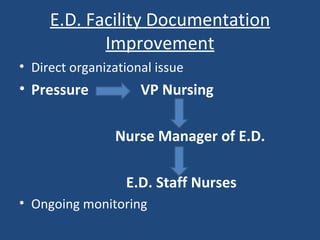
E.D. Facility Documentation Improvement Direct organizational issue Pressure   VP Nursing Nurse Manager of E.D.   E.D. Staff Nurses Ongoing monitoring
E.D.  Diagnostic Coding Problematic diagnoses: ‘ Normal exam’ ‘ Medical Clearance’ Odd diagnoses
E.D.  Diagnostic Coding
Professional Coding and Billing Evaluation and Management (E/M) E.D. Physicians Hospitalists Clinic Physicians
Physician documentation example  64 y/o male c/o  chest  pain for  2 days .  Hx of CAD with prior CABG 2004 and repeat  CABG in 2007.  Pt had done well until two months ago pt underwent cardiac catheterization after episode of chest pain— Drug eluting stent was placed in circumflex artery.  Pt last saw own doctor last week.  Two elements of HPI:  location and duration
Physician  documentation example  64 y/o male c/o  mild, dull, constant chest  pain for  2 days ,  better after eating  and  associated with dyspnea .  NTG helped slightly . Seven elements of HPI: location, quality, timing, duration, context, associated signs/symptoms, modifying factors.
EMERGENCY DEPARTMENT E/M E/M CODE  HISTORY  EXAM  DECISION MAKING  99281  LEVEL 1  c.c.  1-3 HPI  AFFECTED AREA  STRAIGHTFORWARD  99282  LEVEL 2  c.c.  1-3 HPI  1 ROS  AFFECTED AREA+  1 OTHER  LOW COMPLEXITY  99283  LEVEL 3  c.c.  1-3 HPI  1 ROS  1-3 AREAS OR SYSTEMS  MODERATE COMPLEXITY  99284  LEVEL 4  c.c.  4+ HPI  2-9 ROS  1 PFS Hx  5-7 SYSTEMS  MODERATE COMPLEXITY  99285  LEVEL 5  c.c.  4+ HPI  10+ ROS  2-3 PFS Hx  8+ SYSTEMS  HIGH COMPLEXITY
HPI ROS Past Medical, Fam. Soc. Hx Body Areas Organ Systems 1. location 2. quality 3. severity 4. duration 5. context 6. timing 7. modifying  factors 8. signs/symp. 1.constitutional 2.eyes 3.ENT 4.cardiovascular 5.respiratory 6. GI 7. GU 8.musculoskeletal 9.derm 10.neuro 11.psych 12.heme/lymph/ immuno 1. past med hx 2. family hx 3. social hx 1. head&face 2. neck 3. chest 4. abdomen 5.genitals 6.back&spine 7. each extremity 1.constitutional 2.eyes 3.ENT 4.cardiovasc. 5.respiratory 6.GI 7.GU 8.musculo- skeletal 9.skin 10.neuro 11.psych 12.heme/lymph/ immuno
2 OUT OF 3 TYPE OF DECISION MAKING  NUMBER OF DIAGNOSES OR MANAGEMENT OPTIONS  COMPLEXITY OF DATA OF TO BE REVIEWED  RISK OF COMPLICATIONS AND/OR MORBIDITY OR MORTALITY  STRAIGHTFORWARD  MINIMAL (1)  MINIMAL (1) OR NONE  MINIMAL  (1 Minor problem) e.g. insect bite, cold  LOW COMPLEXITY  LIMITED (2)  Limited (2)  Low  (Acute uncomplicated illness or injury)  MODERATE COMPLEXITY  MULTIPLE (3) (new problem or 3+ stable problems)  MODERATE (3)  MODERATE (prescriptions, acute illness w/syst symp, mild exac. chronic illnesses, undiagnosed new problem)  HIGH COMPLEXITY  EXTENSIVE (4)  EXTENSIVE (4)  HIGH  ( severe exac. of chronic illness: threat to life or function: parenteral controlled substances
E/M TABLE OF RISK  Level of  Risk  Presenting Problem(s)  Diagnostic Procedure(s)  Ordered  Management Options Selected  Minimal  one self-limited or minor problem, e.g., cold, insect bite, tinea corporis  laboratory tests requiring:  venipuncture  chest x-rays  EKG/EEG  urinalysis  ultrasound  echocardiography  KOH prep  rest  gargles  elastic bandages  superficial dressings  Low  two or more self-limited or minor problems  one stable chronic illness, e.g., well controlled hypertension, non-insulin-dependent diabetes, cataract, BPH  acute uncomplicated illness or injury, e.g., cystitis, allergic rhinitis, simple sprain  physiologic tests not under stress, e.g., pulmonary function tests  non-cardiovascular imaging studies with contrast, e.g., barium enema  superficial needle biopsies  clinical laboratory tests requiring arterial puncture  skin biopsies  over-the-counter drugs  minor surgery with no identified risk factors  physical therapy  occupational therapy  IV fluids without additives  Moderate  one or more chronic illnesses with mild exacerbation, progression, or side effects of treatment  two or more stable chronic illnesses  undiagnosed new problem with uncertain prognosis, e.g., lump in breast  acute illness with systematic symptoms, e.g., pyelonephritis, pneumonitis, colitis  acute complicated injury, e.g., head injury with brief loss of consciousness  physiologic test under stress, e.g., cardiac stress test, fetal contraction stress test  diagnostic endoscopies with no identified risk factors  deep needle or incisional biopsy  cardiovascular imaging studies with contrast and no identified risk factors e.g., arteriogram, cardiac catheterization  obtain fluid from body cavity, e.g., lumbar puncture, thoracentesis, culdocentesis  minor surgery with identified risk factors  elective major surgery (open, percutaneous, endoscopic) with no identified risk factors  prescription drug management  therapeutic nuclear medicine  IV fluids with additives  closed treatment of fracture or dislocation without manipulation
Hospitalist Documentation Example Called to see 75 y/o woman admitted by PMD earlier today to ICU for pneumonia and COPD exacerbation.  Patient has hx of severe COPD and was quite dyspneic on admission.  Improved initially with Solumedrol, nebs but increasing dyspnea and confusion over last 20’.  Pulse ox now 88. Meds--  Physical exam:  fully documented
Labs, ABGs, repeat CXR done Pt placed on BiPAP, given pressors, diuretics, watched closely for 90 minutes. Consult or initial hospital visit 99252 to 99255,  99221-99223 Critical Care 99291, 99292
Documentation of Procedures Sutures Incision and Drainage Splinting Smoking cessation Central lines
Documentation for Pain Clinic Facet joint injections of spine Trigger point injections Procedures under Fluoroscopic guidance
Approach to CDI Identify all areas where improved documentation will have significant impact - inpatient coding - inpatient medical necessity - E.D. coding - Professional coding - Other services
Obtain Administrative Support Educate Physicians Effective Feedback Never stop monitoring
The doctor demands his fees whether he has killed the illness or the patient.  -  Polish Proverb

Mapam mahima talk 11 09

  • 1.
    Is Clinical DocumentationImprovement the Answer? MAPAM /MAHIMA Joint Meeting Thursday, November 19, 2009 Thomas D. Sills, M.D. Lori Beaudry, CCS-P Clinical Financial Resource
  • 2.
    What are theIssues? Inpatient MS-DRGs AP-DRGs SOI ROM Quality rankings Health Grades US News &WR CMS data Blue Cross
  • 3.
    Outpatient Emergency DepartmentLevels, procedure capture, medical necessity Ancillary services: lab, radiology, etc. Medical necessity Anesthesia/Pain Clinic Accurate coding
  • 4.
    Professional Services EmergencyDepartment Hospitalists Clinics Anesthesia/Pain
  • 5.
    Audits RAC MICBC Other payors
  • 6.
    A physician whoheals for nothing is worth nothing. - The Talmud
  • 7.
    All Billing Dependson Documentation Documentation Coding Billing
  • 8.
    Quality Measurement DocumentationCoding Quality metrics Billing
  • 9.
  • 10.
    Hospitals with ClinicalDocumentation Improvement Program Report Increased Reimbursement... Mon Aug 11, 2008 8:30am EDT   -(Business Wire)--J.A. Thomas and Associates, the leader in healthcare clinical documentation improvement, published today a set of benchmarking reports that show 188 hospitals using its Compliant Documentation
  • 11.
    Management Program (CDMP(R))have realized an overall 5 % improvement in CMI than projected by the Centers for Medicare and Medicaid Services/MEDPAR for hospitals adjusting to the new MS-DRG coding system. To download the full report, visit www.jathomas.com.
  • 12.
    Inpatient Example 1 77 y/o pt admitted from N.H. with documented urosepsis, azotemia, and chronic sacral decubitus. Treated with IV antibiotics; seen by plastic surgeon, who leaves illegible note. Discharged after 8 days.
  • 13.
    Principal dx: UTI, 599.0 Secondary dx: azotemia, 790.6; sacral decubitus 707.03 MS-DRG 690 Kidney and Urinary Infections without MCC Relative weight 0.7708 Payment $ 4600 ROM 2
  • 14.
    Principal dx: UTI, 599.0 Secondary dx: azotemia, 790.6; sacral decubitus 707.03; stage III decub MS-DRG 689 Kidney and Urinary Infections with MCC Relative weight 1.2122 Payment $ 7300 ROM 3
  • 15.
    Principal dx: Septicemia, 038.9, Secondary dx: sepsis, 995.91; azotemia, 790.6; sacral decubitus 707.03; stage III decub MS-DRG 871 Septicemia w/o MV 96h+ w/ MCC Relative weight 1.8437 Payment $11,000 ROM 3
  • 16.
    Principal dx: Septicemia, 038.9, Secondary dx: sepsis, 995.91; AKI, 584.9 sacral decubitus 707.03; stage III decub Px: Excisional Debridement, 86.22 MS-DRG 853 Septicemia with MCC with procedure
  • 17.
    Relative weight 5.4946Payment $33,000 ROM 4
  • 18.
    Hospitalist - Example2 77 y/o pt admitted to the ICU with urosepsis. On hospital day 2, progress note documents, “Looks better. VS stable but rales 1/3 up. Will decrease IVF and give IV lasix. +BC for E Coli. Cr down to 1.8. Continue Rocephin. Check CXR.”
  • 19.
    Documentation asis supports assignment of Level 1 subsequent care, 99231 RVU = 1.03 Payment = $37 Good documentation would support assignment of Critical Care, 99291 RVU = 5.88 Payment = $212
  • 20.
    Radiology - Example 3 65 y/o sees his primary care physician with a persistent headache, one day after falling and striking his head. The only findings were tenderness of scalp. Because pt was on Plavix, a head CT was obtained.
  • 21.
    Contusion of head,920, was documented on record and requisition. Blue Cross denied payment due to lack of Medical Necessity. Head injury, 959.01, was documented on record and requisition. Blue Cross paid the claim.
  • 22.
    In the midstof your illness you promise a goat, but when you have recovered, a chicken will seem sufficient. - African Proverb
  • 23.
    Causes of poorinpatient documentation Lack of education Lack motivation Lack of structure for documentation Lack of uniformity of medical semantics Mismatch between language of clinical medicine and coding
  • 24.
    Approaches to CDIMultiple targets Multiple methodologies No one silver bullet Detail driven Look at each category
  • 25.
    Inpatient CDI Improvedocumentation to fully capture complexity by coding. Severity of Illness (SOI) Affects Case Mix Risk of Mortality (ROM) Quality measures
  • 26.
    Organizational Issues Potentialconflict between: Quality and Coding CDS and Coding Increased Staffing: CDI Coding staff
  • 27.
    Inpatient - Example3 65 y/o admitted for elective hemicolectomy. On post op day #1 post op patient has episode of atrial fibrillation which resolves with treatment. Pt had prior episode of a fib. 4 years before.
  • 28.
    Principal dx: Colon Cancer, 153.6 Secondary dx: a. fib, 427.31 Procedure: rt hemicolectomy, 45.73 MS-DRG 331 Major bowel surgery w/o cc/mcc Relative weight 1.8415 Payment $11,417 ROM 1
  • 29.
    Principal dx: Colon Cancer, 153.6 Secondary dx: a. fib, 427.31; cardiac comp 997.1 Procedure: rt hemicolectomy, 45.73 MS-DRG 330 Major bowel surgery w/o cc/mcc Relative weight 2.8935 Payment $17,940 ROM 1
  • 30.
    Inpatient - Example4 69 y/o pt with widely metastatic breast CA is for management of pain due to new bony mets. CT of head showed 4 cm brain lesion in temporal lobe with vasogenic edema and effacement of sulci and compression of lateral ventricle. Neuro is consulted because of question of focal seizures. The pt is seen in consult and is started on anti seizure medication. During her stay the pt also received a Greenfield filter for recurrent DVT and contraindication to anti coagulation.
  • 31.
    Principal dx: bone mets 198.5 Secondary dx: seizure, 345.50; brain met, 198.3; DVT, 453.40 Procedure: Vena Cava filter, 38.7 MS-DRGs 516 Other Musc/Skel proc with cc Relative weight 1.8083 Payment $11,400 ROM 3
  • 32.
    Principal dx: bone mets 198.5 Secondary dx: seizure, 345.50; brain met, 198.3; DVT, 453.40; brain edema 348.5; compression brain, 348.4 Procedure: Vena Cava filter , 38.7 MS-DRG 515 Musc/Skel proc/ mcc Relative weight 3.0669 Payment $18 ,800 ROM 3
  • 33.
    Inpatient - Example5 65 y/o male was admitted for surgical resection of his pancreatic cancer. The patient had obstructive jaundice and CAT scan showed dilated biliary and pancreatic ducts. The patient had surgical resection with mild post op ileus and was discharged home after 7 days.
  • 34.
    Principal dx: Pancreatic Cancer, 157.1 Secondary dx: post op ileus, 997.4; hypertension, 401.9; gout 274.9 Px: Radical Pancreatectomy, 57.2 MS-DRG 406 Pancreas procedures w cc Relative Wt. 2.6729 Payment $16,000 ROM 2
  • 35.
    The pt wasadmitted for surgical resection of his pancreatic cancer. The patient presented with obstructive jaundice and CAT scan showed dilated biliary and pancreatic ducts. Did the pt have: 1. obstruction of the biliary duct? 2. obstruction of the pancreatic duct? 3. other_____________?
  • 36.
    Principal dx: Pancreatic Cancer, 157.1 Secondary dx: post op ileus, 997.4; hypertension, 401.9; gout 274.9; obstruction of bile duct, 576.2 Px: Radical Pancreatectomy, 57.2 MS-DRG 405 Pancreas procedures w MCC Relative Wt. 5.5911 Payment $33,500 ROM 3
  • 37.
    A physician isan angel when employed but a devil when one must pay him. - Latin Proverb
  • 38.
    How to approachInpt CDI Conventional approach: Hire RNs; train them in coding issues; educate physicians; concurrent chart review on floor; prompt physicians for documentation; communicate with coders Advantages: Dedicated staff to CDI Increase CMI
  • 39.
    Disadvantages: High costStaffing Lack of coding expertise New level of bureaucracy Reporting relationship with HIM Compliance Issues
  • 40.
    Inpatient CDI ThoroughCoding: Back end validation with robust physician query system Front end review and back end queries Adding focused reviews of documentation with ongoing feed back to medical staff
  • 41.
    Inpatient CDI Separatebut equally important issue of documentation for medical necessity
  • 42.
    Impact of Documentationon E.D. Facility Coding and Billing Assignment of levels Procedure coding Diagnostic coding (Medical Necessity)
  • 43.
    Assignment of E.D.levels "While awaiting the development of a national set of facility-specific codes and guidelines, we have advised hospitals …” 1. Levels should reasonably relate to intensity of services. 2. Levels should be consistently applied.
  • 44.
    Assignment of E.D.levels Point systems Includes electronic records; documentation and coding can be problematic ACEP guidelines (2004/2007) Documentation is not an issue
  • 45.
    E.D. Procedure CodingDocumentation can be problematic Infusions and Injections Drug, dose, route of administration, time started, time stopped Splinting Explicit documentation of application
  • 46.
    E.D. Facility DocumentationImprovement Direct organizational issue Pressure VP Nursing Nurse Manager of E.D. E.D. Staff Nurses Ongoing monitoring
  • 47.
    E.D. DiagnosticCoding Problematic diagnoses: ‘ Normal exam’ ‘ Medical Clearance’ Odd diagnoses
  • 48.
  • 49.
    Professional Coding andBilling Evaluation and Management (E/M) E.D. Physicians Hospitalists Clinic Physicians
  • 50.
    Physician documentation example 64 y/o male c/o chest pain for 2 days . Hx of CAD with prior CABG 2004 and repeat CABG in 2007. Pt had done well until two months ago pt underwent cardiac catheterization after episode of chest pain— Drug eluting stent was placed in circumflex artery. Pt last saw own doctor last week. Two elements of HPI: location and duration
  • 51.
    Physician documentationexample 64 y/o male c/o mild, dull, constant chest pain for 2 days , better after eating and associated with dyspnea . NTG helped slightly . Seven elements of HPI: location, quality, timing, duration, context, associated signs/symptoms, modifying factors.
  • 52.
    EMERGENCY DEPARTMENT E/ME/M CODE HISTORY EXAM DECISION MAKING 99281 LEVEL 1 c.c. 1-3 HPI AFFECTED AREA STRAIGHTFORWARD 99282 LEVEL 2 c.c. 1-3 HPI 1 ROS AFFECTED AREA+ 1 OTHER LOW COMPLEXITY 99283 LEVEL 3 c.c. 1-3 HPI 1 ROS 1-3 AREAS OR SYSTEMS MODERATE COMPLEXITY 99284 LEVEL 4 c.c. 4+ HPI 2-9 ROS 1 PFS Hx 5-7 SYSTEMS MODERATE COMPLEXITY 99285 LEVEL 5 c.c. 4+ HPI 10+ ROS 2-3 PFS Hx 8+ SYSTEMS HIGH COMPLEXITY
  • 53.
    HPI ROS PastMedical, Fam. Soc. Hx Body Areas Organ Systems 1. location 2. quality 3. severity 4. duration 5. context 6. timing 7. modifying factors 8. signs/symp. 1.constitutional 2.eyes 3.ENT 4.cardiovascular 5.respiratory 6. GI 7. GU 8.musculoskeletal 9.derm 10.neuro 11.psych 12.heme/lymph/ immuno 1. past med hx 2. family hx 3. social hx 1. head&face 2. neck 3. chest 4. abdomen 5.genitals 6.back&spine 7. each extremity 1.constitutional 2.eyes 3.ENT 4.cardiovasc. 5.respiratory 6.GI 7.GU 8.musculo- skeletal 9.skin 10.neuro 11.psych 12.heme/lymph/ immuno
  • 54.
    2 OUT OF3 TYPE OF DECISION MAKING NUMBER OF DIAGNOSES OR MANAGEMENT OPTIONS COMPLEXITY OF DATA OF TO BE REVIEWED RISK OF COMPLICATIONS AND/OR MORBIDITY OR MORTALITY STRAIGHTFORWARD MINIMAL (1) MINIMAL (1) OR NONE MINIMAL (1 Minor problem) e.g. insect bite, cold LOW COMPLEXITY LIMITED (2) Limited (2) Low (Acute uncomplicated illness or injury) MODERATE COMPLEXITY MULTIPLE (3) (new problem or 3+ stable problems) MODERATE (3) MODERATE (prescriptions, acute illness w/syst symp, mild exac. chronic illnesses, undiagnosed new problem) HIGH COMPLEXITY EXTENSIVE (4) EXTENSIVE (4) HIGH ( severe exac. of chronic illness: threat to life or function: parenteral controlled substances
  • 55.
    E/M TABLE OFRISK Level of Risk Presenting Problem(s) Diagnostic Procedure(s) Ordered Management Options Selected Minimal one self-limited or minor problem, e.g., cold, insect bite, tinea corporis laboratory tests requiring: venipuncture chest x-rays EKG/EEG urinalysis ultrasound echocardiography KOH prep rest gargles elastic bandages superficial dressings Low two or more self-limited or minor problems one stable chronic illness, e.g., well controlled hypertension, non-insulin-dependent diabetes, cataract, BPH acute uncomplicated illness or injury, e.g., cystitis, allergic rhinitis, simple sprain physiologic tests not under stress, e.g., pulmonary function tests non-cardiovascular imaging studies with contrast, e.g., barium enema superficial needle biopsies clinical laboratory tests requiring arterial puncture skin biopsies over-the-counter drugs minor surgery with no identified risk factors physical therapy occupational therapy IV fluids without additives Moderate one or more chronic illnesses with mild exacerbation, progression, or side effects of treatment two or more stable chronic illnesses undiagnosed new problem with uncertain prognosis, e.g., lump in breast acute illness with systematic symptoms, e.g., pyelonephritis, pneumonitis, colitis acute complicated injury, e.g., head injury with brief loss of consciousness physiologic test under stress, e.g., cardiac stress test, fetal contraction stress test diagnostic endoscopies with no identified risk factors deep needle or incisional biopsy cardiovascular imaging studies with contrast and no identified risk factors e.g., arteriogram, cardiac catheterization obtain fluid from body cavity, e.g., lumbar puncture, thoracentesis, culdocentesis minor surgery with identified risk factors elective major surgery (open, percutaneous, endoscopic) with no identified risk factors prescription drug management therapeutic nuclear medicine IV fluids with additives closed treatment of fracture or dislocation without manipulation
  • 56.
    Hospitalist Documentation ExampleCalled to see 75 y/o woman admitted by PMD earlier today to ICU for pneumonia and COPD exacerbation. Patient has hx of severe COPD and was quite dyspneic on admission. Improved initially with Solumedrol, nebs but increasing dyspnea and confusion over last 20’. Pulse ox now 88. Meds-- Physical exam: fully documented
  • 57.
    Labs, ABGs, repeatCXR done Pt placed on BiPAP, given pressors, diuretics, watched closely for 90 minutes. Consult or initial hospital visit 99252 to 99255, 99221-99223 Critical Care 99291, 99292
  • 58.
    Documentation of ProceduresSutures Incision and Drainage Splinting Smoking cessation Central lines
  • 59.
    Documentation for PainClinic Facet joint injections of spine Trigger point injections Procedures under Fluoroscopic guidance
  • 60.
    Approach to CDIIdentify all areas where improved documentation will have significant impact - inpatient coding - inpatient medical necessity - E.D. coding - Professional coding - Other services
  • 61.
    Obtain Administrative SupportEducate Physicians Effective Feedback Never stop monitoring
  • 62.
    The doctor demandshis fees whether he has killed the illness or the patient. - Polish Proverb

Editor's Notes

  • #9 Therefore; the issues are Coding, Quality Measurements, Case Management, Billing in all areas of service all depend on documentation. Obviously, CDI is key. Everyone is already doing CDI in one form or another. How do you expand your efforts? How do you do it better?
  • #12 Initially driven by MS DRGs and proposed CMS cuts expecting increase in CMI. Consulting firms plus home grown initiatives. Reasons are obvious
  • #18 Target is to have documentation that fully captures the complexity of the case both for purposes of SOI and ROM
  • #24 Structure: SOAP notes. Medical Semantics: urosepsis tds anecdote;hosp to hosp; specialty to specialty. Examples of mismatches.
  • #25 Most of your facilities already have some form of CDI. How do you do it better, how do you expand it.
  • #27 Example: Health Grades increases SOI and ROM w/ sec dx of psvt, but if 997.1 added, increases complication rate.
  • #30 Increase in R.W. in MS-DRG; no change in ROM in AP-DRGs; complication in Health Grades
  • #41 Doable if baseline documentation is good.; How to provide efficient CDI. Too expensive (too difficult to staff) covering all cases.
  • #49 Add Blue leg syndrome.
  • #61 Note reliance on hard coded diagnoses in cdm
  • #62 Plan Do Check Act (PDCA)