ITIL- Faculty Development  Program conducted at GCET By Sharbani Bhattacharya 22 FEB’2008
IT INFRASTRUCTURE MANAGEMENT-SERVICE LEVEL MANAGEMENT BY Sharbani Bhattacharya 29 feb’2008
Business Challenges Customer Satisfaction (Broad Vision & Goal) Maintain & Increase Profits Competition (Neck to Neck)   Qualitative Products, Solutions & Services  Meeting Quantative Targets Meeting Service Level Agreements  On Demand Changes Employee Retention  Etc …………………………………..
TIL Defined Information Technology Infrastructure Library (ITIL) A library of books describing best practices for IT Service Management (ITSM) Not a “standard” – evolving industry best practices Describes goals, activities, inputs & outputs of processes Specific procedures vary from organization to organization Worldwide de facto approach to IT management Open approach – not tied to any vendor
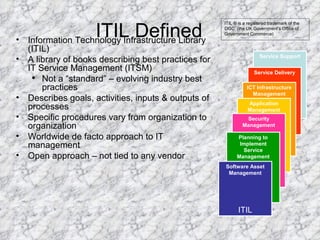
ITIL Defined Information Technology Infrastructure Library (ITIL) A library of books describing best practices for IT Service Management (ITSM) Not a “standard” – evolving industry best practices Describes goals, activities, inputs & outputs of processes Specific procedures vary from organization to organization Worldwide de facto approach to IT management Open approach – not tied to any vendor ITIL ® is a registered trademark of the OGC  (the UK Government's Office of Government Commerce) Service Support Service Delivery ICT Infrastructure Management Application Management Security Management Planning to Implement Service Management ITIL Software Asset Management ITIL
Service Delivery Service Level Management Financial Management and Costing IT service Continuity Management Capacity Management Availability Management
Service Support Configuration Management Service-Desk Incident Management Problem Management Change Management Release Management
ITIL (®, the IT Infrastructure Library) is essentially a representation of best practice for IT service management. It comprises a series of books and information which provide guidance on the quality provision of IT services  What is ITIL ?
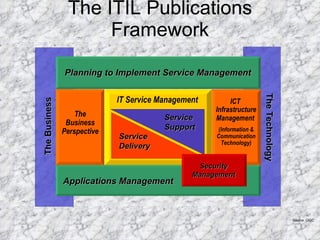
The ITIL Publications Framework Source: OGC The Business The Technology Planning to Implement Service Management IT Service Management The Business Perspective ICT  Infrastructure Management   (Information & Communication Technology) Applications Management Service Support Service Delivery Security Management
The ITIL disciplines are organized as COST: Personnel – to man Service Desk ( Set-up and ongoing)  Accommodation – Physical location ( Set-up and ongoing)   Software – Tools  (Set-up and ongoing)   Hardware – Infrastructure  (Set-up)   Education – Training  (Set-up and ongoing)   Procedures – external consultants etc  (Set-up)
The ITIL disciplines are organized as BENEFITS: Improved Customer Service  perception and satisfaction   Increased accessibility through a  single  point of contact,  communication, and information  Better-quality  and quicker turnaround of customer requests  Improved   teamwork and communication   Enhanced focus and  a proactive approach  to Service provision  A reduced  negative business  impact  Better managed infrastructure and control  Improved usage of IT support resources and  increased productivity  of business personnel  More meaningful management information  to support decisions
ITIL Challenges
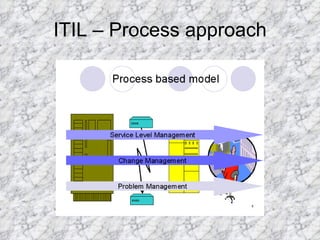
ITIL – Process approach
Service Level Management It receives input from the  Service Support  processes (incident, problem, change management) and provides information used by all  Service Delivery processes .
The objective of the Service Level Management process To manage and maintain the  quality of IT services  delivered to customers. The process also seeks to improve on the quality of service delivered to customers  by reviewing the level of performance  achieved by the IT Service Desk.
To achieve ITIL objectives Agreeing  Monitoring  Reporting  On IT service level performance
Three types of agreements with  customers  Service Level Agreements  (SLAs) – agreements between the customer and the Service Desk on the level of service provision delivered to the customer  Operational Level Agreements  (OLAs) – agreements made between internal IT departments of an organization (e.g., Network Management and IT Operations  Underpinning Contracts  (UCs) – contracts between the Service Desk and an external supplier.
Service level agreement one can expect to see  Service description  – The service description details the key business functions and deliverables, and information to describe the service and its scale, impact, and priority for the business. It also includes signatory details.  Service hours  – Service hours list the hours that customers can expect the service to be available.  Service availability  – Service availability is all about the targeted levels the IT organization will deliver within the agreed-upon service hours.  Support levels  – Support levels explain how to reach out to the service desk, the hours the service desk is open, and what the process is to receive help after hours.  Performance  – The performance point provides the expected responsive of the IT service, such as workstation response times, details of expected service, and the threshold of unacceptable service.  Functionality  – The functionality section specifically details how many errors of a specific category can be tolerated before calling a breach of service.  Charges  – The charges component clearly revels any charging formulas or costs for the service.  Continuity  – Continuity refers to continuity of operations planning with references to the disaster recovery plan, specifying how the service will be provided and estimated recovery time.  Security  – Security lists the procedures and protocols surrounding security of IT services as well as the measures needed to assure that security.  Changes  – The changes section list the organizational change management policies and procedures and how to properly follow these procedures.
 
Service Level Management activities  Identifying business requirements by working with business units  Establishing the scope of services, timeliness, hours of operation, recovery aspects, and service performance   Translating business requirements into IT requirements  Developing and maintaining a service catalog, including costs for different tiers of service performance   Performing gap analysis between business requirements and available services.  Determining the costs related to services such that service goals satisfy business needs at a price the business can afford   Drafting, negotiating and refining SLAs with the business units, ensuring business requirements are met and agreement from all parties involved  Implementing SLAs   Measuring SLA performance, reporting results and adjusting as necessary
The Service Level Management process involves the following five stages: Negotiation   Finalizing   Monitoring   Reporting   Reviewing
Negotiation  – The negotiating phase is where the IT service provide and customer collaborate to ascertain  SMART  service levels. SMART refers to Specific, Measurable, Agreed to, Realistic, and within a Time Frame. This collaboration is cyclical as both parties work to refine according to the customer’s needs.  Finalizing  – In the Finalizing Phase, the Service Level Agreement is completed along with any other sustaining and supporting agreements.  Monitoring  – In the monitoring phase, service quality is measured by the SLA’s defined service targets. Service targets refer to the agreed-upon levels of service. Any variances need to have an action plan of how to correct and resolve them before the business is adversely affected.  Reporting  – In the reporting phase, Reports are generated that compare the agreed-upon service levels with baseline service levels. These reports are the basis for continual service improvement.  Reviewing  – In the review phase, a comprehensive enterprise wide review of service quality is provided. Problems are brought into the light of the examinations and lessons from the problems and issues are shared and hopefully learned.
ITIL Service Strategy Principles The documented principles cover• Value Creation • Service Provider Types • Service Assets • Service Structures • Service Strategy FundamentalsApproximate ver2 process cross reference (caution): Financial Management.
The five core components of Service Level Management Service Strategy  Service Design  Service Transition  Service Operation  Continual Service Improvement
Service Strategy Service Strategy deals with the strategic management approach in respect of IT Service Management; strategic analysis, planning, positioning, and implementation relating to service models, strategies, and strategic objectives.
ITIL Service Strategy Principles The documented principles cover• Value Creation • Service Provider Types • Service Assets • Service Structures • Service Strategy  FundamentalsApproximate ver2 process cross reference (caution): Financial Management.
Service Design  Service Design translates strategic plans and objectives and creates the designs and specifications for execution through service transition and operations.
ITIL Service Design Principles The documented principles cover •  Business Change Process • Balanced Design • Design Constraints • Design Activities • Design Aspects • Subsequent Design Activities • Service Oriented Architecture • Business Service management • Service Design Models Approx (very) v2 process cross reference (caution): Availability Management, Capacity Management, IT Service Continuity Management
Service Transition Service Transition provides guidance on the service design and implementation, ensuring that the service delivers the intended strategy and that it can be operated and maintained effectively.
ITIL Service Transition Principles The documented principles cover • Service Utilities • Service Warranties Approx (very) v2 process cross reference (caution): Change Management, Configuration Management, Release Management
Service Operation Service Operation provides guidance on the management of a service through its day-to-day production life. It also provides guidance on supporting operations by means of new models and architectures such as shared services, utility computing, web services, and mobile commerce.
ITIL Service Operation Principles The documented principles cover •  Functions, Groups, Teams, Departments and Divisions • Providing Service • Achieving Balance in Service Operation • Operation Staff involvement in Design/Transition • Operational Health • Documentation • Communication Approx (very) version 2 process cross reference (we urge caution): Incident Management, Problem Management, Service/Help Desk
Continual Service Improvement Continual Service Improvement provides guidance on the measurement of service performance through the service life-cycle, suggesting improvements to ensure that a service delivers the maximum benefit.
ITIL Continual Service Improvement Principles The documented principles cover •  Continual Service Improvement and Organizational Change • External and Internal Drivers • Ownership • SLM • The Deming Cycle • Knowledge Management • Service management and improvement • Benchmarks
References OGC ITIL ToolKit EBook Prashant Pokarnaa- ITIL Certification at GCET FDP Program www.itsmf.com ITIL essential study guide www.google.com
VOTE OF THANKS TO ALL

Itil Service Level Mgmnt

  • 1.
    ITIL- Faculty Development Program conducted at GCET By Sharbani Bhattacharya 22 FEB’2008
  • 2.
    IT INFRASTRUCTURE MANAGEMENT-SERVICELEVEL MANAGEMENT BY Sharbani Bhattacharya 29 feb’2008
  • 3.
    Business Challenges CustomerSatisfaction (Broad Vision & Goal) Maintain & Increase Profits Competition (Neck to Neck) Qualitative Products, Solutions & Services Meeting Quantative Targets Meeting Service Level Agreements On Demand Changes Employee Retention Etc …………………………………..
  • 4.
    TIL Defined InformationTechnology Infrastructure Library (ITIL) A library of books describing best practices for IT Service Management (ITSM) Not a “standard” – evolving industry best practices Describes goals, activities, inputs & outputs of processes Specific procedures vary from organization to organization Worldwide de facto approach to IT management Open approach – not tied to any vendor
  • 5.
    ITIL Defined InformationTechnology Infrastructure Library (ITIL) A library of books describing best practices for IT Service Management (ITSM) Not a “standard” – evolving industry best practices Describes goals, activities, inputs & outputs of processes Specific procedures vary from organization to organization Worldwide de facto approach to IT management Open approach – not tied to any vendor ITIL ® is a registered trademark of the OGC (the UK Government's Office of Government Commerce) Service Support Service Delivery ICT Infrastructure Management Application Management Security Management Planning to Implement Service Management ITIL Software Asset Management ITIL
  • 6.
    Service Delivery ServiceLevel Management Financial Management and Costing IT service Continuity Management Capacity Management Availability Management
  • 7.
    Service Support ConfigurationManagement Service-Desk Incident Management Problem Management Change Management Release Management
  • 8.
    ITIL (®, theIT Infrastructure Library) is essentially a representation of best practice for IT service management. It comprises a series of books and information which provide guidance on the quality provision of IT services What is ITIL ?
  • 9.
    The ITIL PublicationsFramework Source: OGC The Business The Technology Planning to Implement Service Management IT Service Management The Business Perspective ICT Infrastructure Management (Information & Communication Technology) Applications Management Service Support Service Delivery Security Management
  • 10.
    The ITIL disciplinesare organized as COST: Personnel – to man Service Desk ( Set-up and ongoing) Accommodation – Physical location ( Set-up and ongoing) Software – Tools (Set-up and ongoing) Hardware – Infrastructure (Set-up) Education – Training (Set-up and ongoing) Procedures – external consultants etc (Set-up)
  • 11.
    The ITIL disciplinesare organized as BENEFITS: Improved Customer Service perception and satisfaction Increased accessibility through a single point of contact, communication, and information Better-quality and quicker turnaround of customer requests Improved teamwork and communication Enhanced focus and a proactive approach to Service provision A reduced negative business impact Better managed infrastructure and control Improved usage of IT support resources and increased productivity of business personnel More meaningful management information to support decisions
  • 12.
  • 13.
  • 14.
    Service Level ManagementIt receives input from the Service Support processes (incident, problem, change management) and provides information used by all Service Delivery processes .
  • 15.
    The objective ofthe Service Level Management process To manage and maintain the quality of IT services delivered to customers. The process also seeks to improve on the quality of service delivered to customers by reviewing the level of performance achieved by the IT Service Desk.
  • 16.
    To achieve ITILobjectives Agreeing Monitoring Reporting On IT service level performance
  • 17.
    Three types ofagreements with customers Service Level Agreements (SLAs) – agreements between the customer and the Service Desk on the level of service provision delivered to the customer Operational Level Agreements (OLAs) – agreements made between internal IT departments of an organization (e.g., Network Management and IT Operations Underpinning Contracts (UCs) – contracts between the Service Desk and an external supplier.
  • 18.
    Service level agreementone can expect to see Service description – The service description details the key business functions and deliverables, and information to describe the service and its scale, impact, and priority for the business. It also includes signatory details. Service hours – Service hours list the hours that customers can expect the service to be available. Service availability – Service availability is all about the targeted levels the IT organization will deliver within the agreed-upon service hours. Support levels – Support levels explain how to reach out to the service desk, the hours the service desk is open, and what the process is to receive help after hours. Performance – The performance point provides the expected responsive of the IT service, such as workstation response times, details of expected service, and the threshold of unacceptable service. Functionality – The functionality section specifically details how many errors of a specific category can be tolerated before calling a breach of service. Charges – The charges component clearly revels any charging formulas or costs for the service. Continuity – Continuity refers to continuity of operations planning with references to the disaster recovery plan, specifying how the service will be provided and estimated recovery time. Security – Security lists the procedures and protocols surrounding security of IT services as well as the measures needed to assure that security. Changes – The changes section list the organizational change management policies and procedures and how to properly follow these procedures.
  • 19.
  • 20.
    Service Level Managementactivities Identifying business requirements by working with business units Establishing the scope of services, timeliness, hours of operation, recovery aspects, and service performance Translating business requirements into IT requirements Developing and maintaining a service catalog, including costs for different tiers of service performance Performing gap analysis between business requirements and available services. Determining the costs related to services such that service goals satisfy business needs at a price the business can afford Drafting, negotiating and refining SLAs with the business units, ensuring business requirements are met and agreement from all parties involved Implementing SLAs Measuring SLA performance, reporting results and adjusting as necessary
  • 21.
    The Service LevelManagement process involves the following five stages: Negotiation Finalizing Monitoring Reporting Reviewing
  • 22.
    Negotiation –The negotiating phase is where the IT service provide and customer collaborate to ascertain SMART service levels. SMART refers to Specific, Measurable, Agreed to, Realistic, and within a Time Frame. This collaboration is cyclical as both parties work to refine according to the customer’s needs. Finalizing – In the Finalizing Phase, the Service Level Agreement is completed along with any other sustaining and supporting agreements. Monitoring – In the monitoring phase, service quality is measured by the SLA’s defined service targets. Service targets refer to the agreed-upon levels of service. Any variances need to have an action plan of how to correct and resolve them before the business is adversely affected. Reporting – In the reporting phase, Reports are generated that compare the agreed-upon service levels with baseline service levels. These reports are the basis for continual service improvement. Reviewing – In the review phase, a comprehensive enterprise wide review of service quality is provided. Problems are brought into the light of the examinations and lessons from the problems and issues are shared and hopefully learned.
  • 23.
    ITIL Service StrategyPrinciples The documented principles cover• Value Creation • Service Provider Types • Service Assets • Service Structures • Service Strategy FundamentalsApproximate ver2 process cross reference (caution): Financial Management.
  • 24.
    The five corecomponents of Service Level Management Service Strategy Service Design Service Transition Service Operation Continual Service Improvement
  • 25.
    Service Strategy ServiceStrategy deals with the strategic management approach in respect of IT Service Management; strategic analysis, planning, positioning, and implementation relating to service models, strategies, and strategic objectives.
  • 26.
    ITIL Service StrategyPrinciples The documented principles cover• Value Creation • Service Provider Types • Service Assets • Service Structures • Service Strategy FundamentalsApproximate ver2 process cross reference (caution): Financial Management.
  • 27.
    Service Design Service Design translates strategic plans and objectives and creates the designs and specifications for execution through service transition and operations.
  • 28.
    ITIL Service DesignPrinciples The documented principles cover • Business Change Process • Balanced Design • Design Constraints • Design Activities • Design Aspects • Subsequent Design Activities • Service Oriented Architecture • Business Service management • Service Design Models Approx (very) v2 process cross reference (caution): Availability Management, Capacity Management, IT Service Continuity Management
  • 29.
    Service Transition ServiceTransition provides guidance on the service design and implementation, ensuring that the service delivers the intended strategy and that it can be operated and maintained effectively.
  • 30.
    ITIL Service TransitionPrinciples The documented principles cover • Service Utilities • Service Warranties Approx (very) v2 process cross reference (caution): Change Management, Configuration Management, Release Management
  • 31.
    Service Operation ServiceOperation provides guidance on the management of a service through its day-to-day production life. It also provides guidance on supporting operations by means of new models and architectures such as shared services, utility computing, web services, and mobile commerce.
  • 32.
    ITIL Service OperationPrinciples The documented principles cover • Functions, Groups, Teams, Departments and Divisions • Providing Service • Achieving Balance in Service Operation • Operation Staff involvement in Design/Transition • Operational Health • Documentation • Communication Approx (very) version 2 process cross reference (we urge caution): Incident Management, Problem Management, Service/Help Desk
  • 33.
    Continual Service ImprovementContinual Service Improvement provides guidance on the measurement of service performance through the service life-cycle, suggesting improvements to ensure that a service delivers the maximum benefit.
  • 34.
    ITIL Continual ServiceImprovement Principles The documented principles cover • Continual Service Improvement and Organizational Change • External and Internal Drivers • Ownership • SLM • The Deming Cycle • Knowledge Management • Service management and improvement • Benchmarks
  • 35.
    References OGC ITILToolKit EBook Prashant Pokarnaa- ITIL Certification at GCET FDP Program www.itsmf.com ITIL essential study guide www.google.com
  • 36.