© 2010, Educational Institute
1
PRESENTATION ON
BASIC STUDY OF RESORTS AND THEIR TYPOLOGY
PRESENTED BY,
SUBHAM KUAMR SAH
ID-130213003
DEPT. OF ARCHITECTURE T&R.P
IIEST SHIBPUR
© 2010, Educational Institute
1. Classic hotels
2. Resorts
3. Spas
4. Convention hotels
5. Motels and motor hotels
6. Condominium hotels
7. Residential hotels and service apartments
8. Casino hotels and resorts
9. All-suite hotels
NINE TYPES OF LODGING OPERATIONS
2
© 2010, Educational Institute
3
RESORT-A resort is a full-service lodging facility that provides access to or offers a
range
of amenities and recreation facilities to emphasize a leisure experience. Resorts
serve as the primary provider of the guests’ experience, often provides services
for business and meetings and are characteristically located in vacation-oriented
settings.
HOTEL-A hotel is a place that offers you lodgings and meals. Persons who travel
from one place to another place with a purpose will book into hotels. The purpose of
their travel may be to attend a conference, a function, a wedding, or an official
meeting or even it can be a vacation.
Persons who are unable to spend the night at their home are likely to spend the night
in a hotel room. They may or may not stay with their families. This is because of the
fact that they are away from home for that matter.
© 2010, Educational Institute
4
What is the difference between Resort and Hotel?
• Resorts are places or towns or commercial establishments that provide relaxation
and recreation over and above the accommodation, meals and other basic
amnesties.
• In other words, a resort combines a hotel and a variety of recreations, while a
hotel is a place that offers you lodging and meals.
• People specifically frequenty visit resorts for relaxation or for recreation. They are
the places targeted for family vacations. But, on the other hand, hotel can be used
for short stay or for even a vacation.
• Hotel stay can be long too at times depending upon the purpose of the stay and the
visit.
• Hotels are normally located in popular destinations such as near airports, railway
stations of major cities and towns or in business areas or localities. Resorts, on the
other hand, are located in the midst of natural and picturesque surroundings.
© 2010, Educational Institute
TYPES OF RESORTS
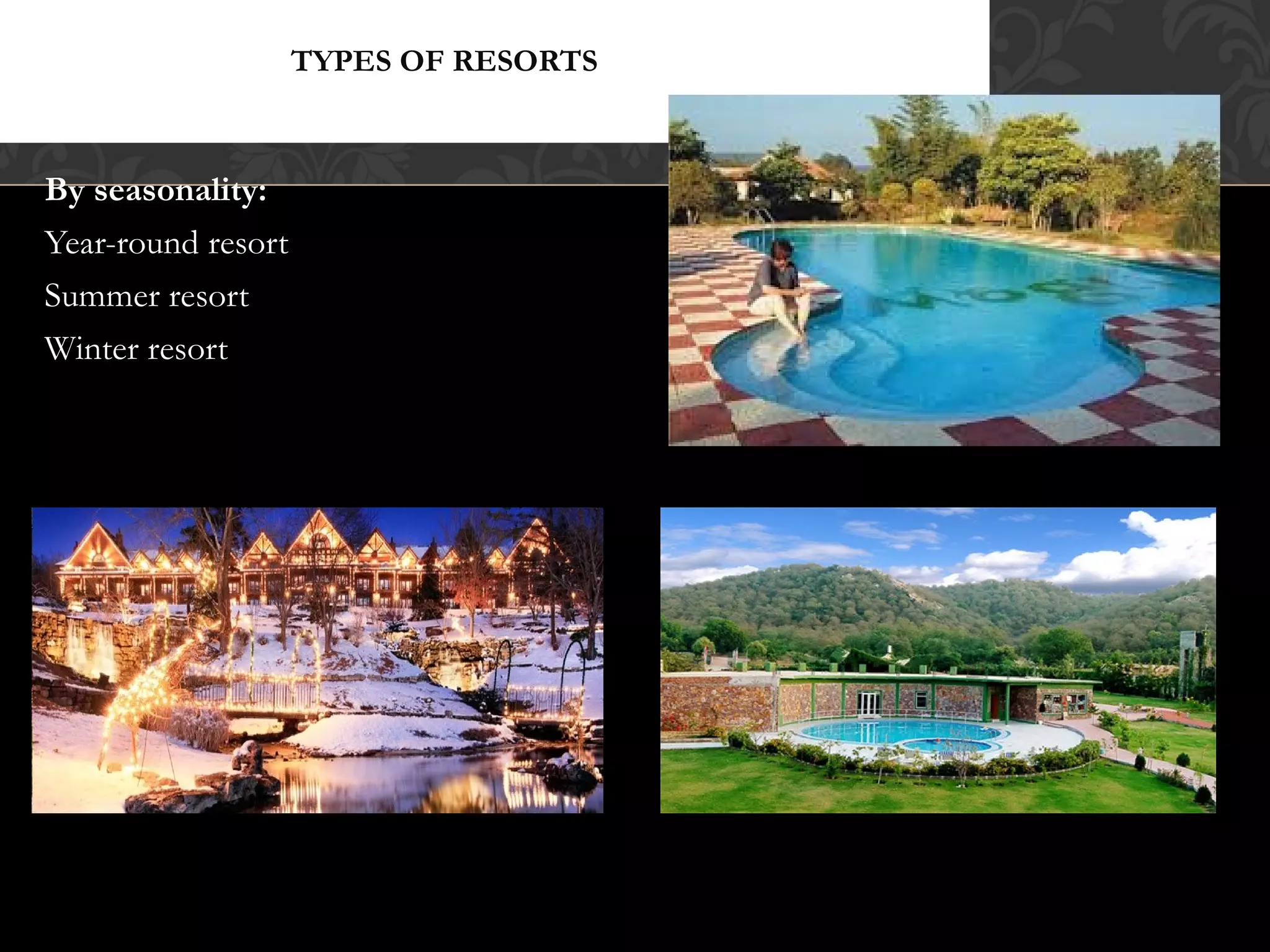
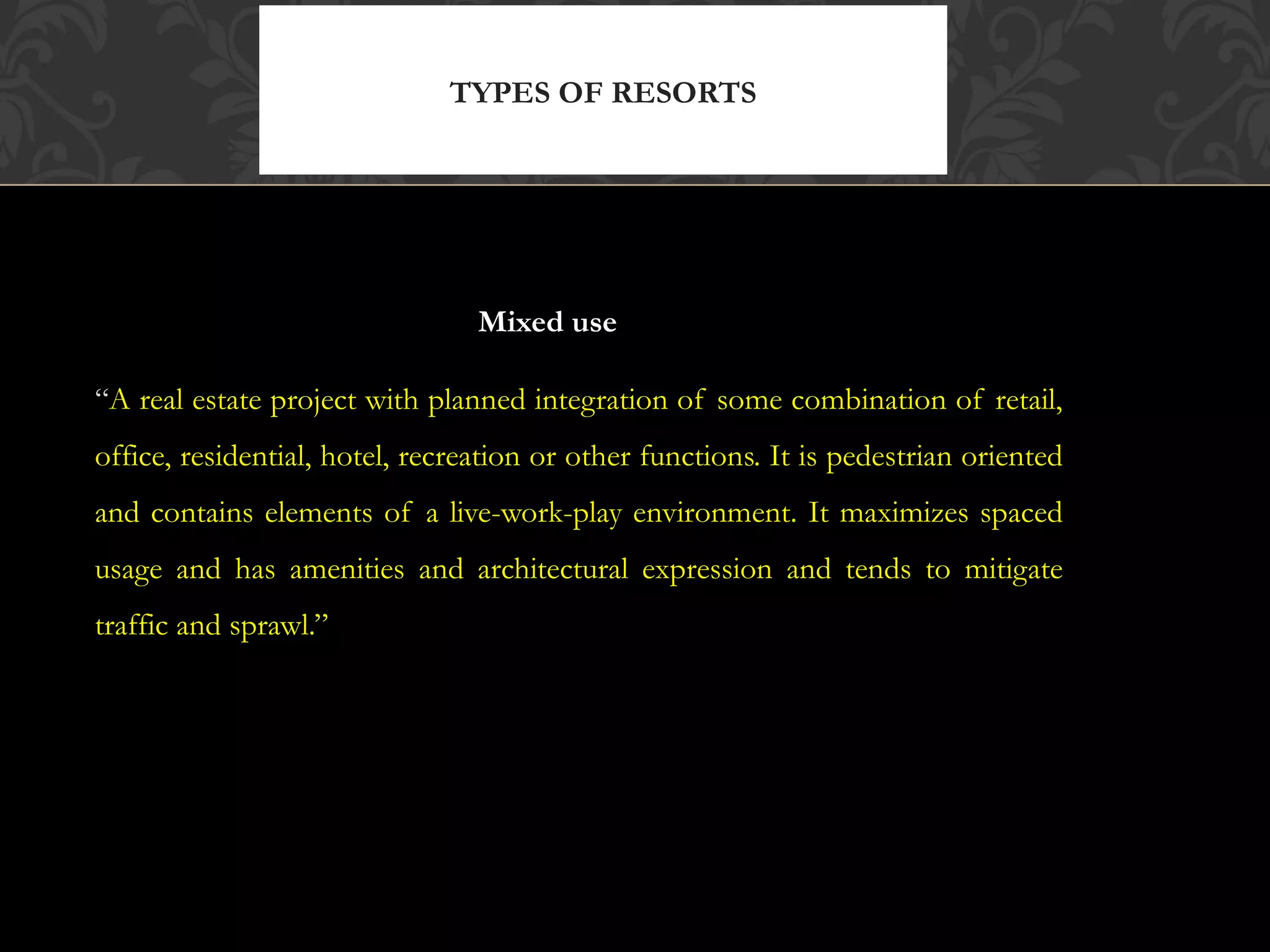
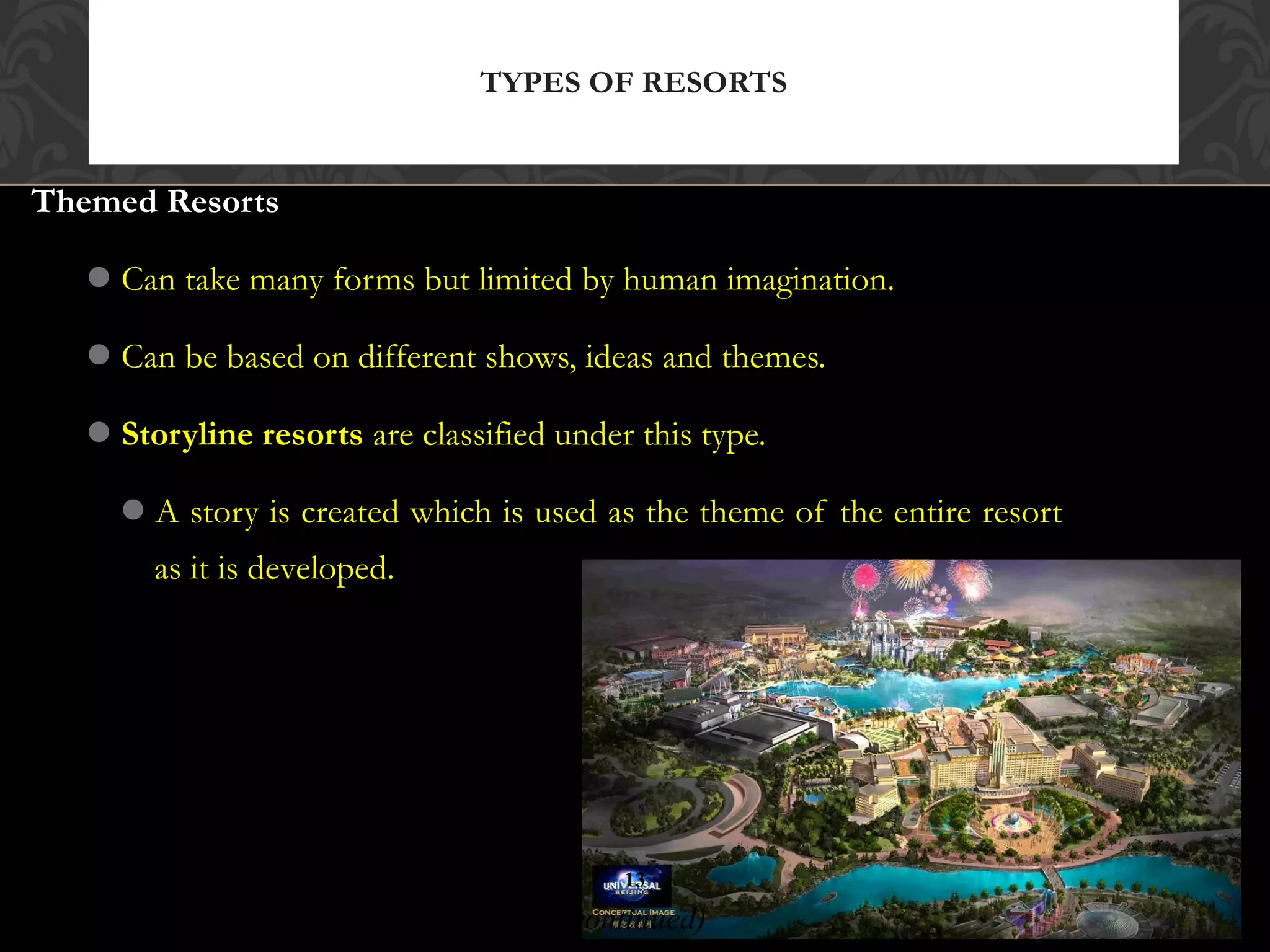
By seasonality:
Year-round resort
Summer resort
Winter resort
5
(continued)
Winter resort
Summer resort
Year-round resort
© 2010, Educational Institute
By designation:
Spa resort
Golf resort
Ski resort
Guest ranch
Diving resort
Fishing resort
TYPES OF RESORTS
6
(continued)
Spa resort Golf resort
Ski resort Guest ranch Diving resort
© 2010, Educational Institute
By size:
Mega-resort
Characterized by size of property and size of investment that reaches
billions of dollars.
3,000 rooms with multiple golf courses and other recreational facilities.
Their size requires the entire property to be zoned into smaller geographical
areas
TYPES OF RESORTS
7
(continued)
Boutique resort
Characterized by a smaller level of development
100-200 room size.
Despite their size, they can be very lucrative investments
especially those that are classified as luxury botique resorts. (Villa
Feltrinelli by Lake Garda)
© 2010, Educational Institute
By location:
Urban resort
Beach or seaside resort
Lake resort
Mountain resort
Island resort
Desert resort
Tropical rainforest resort (sensitive and
restrictive)
Farm-related
CATEGORIES OF RESORT
8
8
By form of ownership:
(continued)
Resort Hotel
• Person “leases” the
room/cottage for transient stay
Second-Home Development
• Person develops/buys another
home in outdoor areas
Timeshare Ownership
• Person pays for the right to
accommodations at a vacation
development for a specified
period each year, for a
specified number of years or
for perpetuity.
© 2010, Educational Institute
Others:
All-inclusive resort
Mixed-use resort
Themed/fantasy (storyline)
Floating (cruise ships)
TYPES OF RESORTS
9
9
(continued)
© 2010, Educational Institute
All inclusive
Total vacation packages that includes transportation to and from the
resort.
Based on the model created by Club Med
All inclusive resorts can be found in Mexico, Carribean, Bahamas
and Bermuda.
Popular with families because of the convenience it provides.
Costs in this type are all upfront- no hidden charges.
More profitable to sell for TMC’s.
TYPES OF RESORTS
10
(continued)
© 2010, Educational Institute
Mixed use
“A real estate project with planned integration of some combination of retail,
office, residential, hotel, recreation or other functions. It is pedestrian oriented
and contains elements of a live-work-play environment. It maximizes spaced
usage and has amenities and architectural expression and tends to mitigate
traffic and sprawl.”
TYPES OF RESORTS
11
(continued)
© 2010, Educational Institute
Mixed use
These have hotels that serve as the center piece of a customer friendly
leisure work environment.
Attracts offices, shopper traffic for retail stores, buyers for timeshares,
players for recreational activities and others for purposes beyond the hotel’s
own purpose.
TYPES OF RESORTS
12
(continued)
© 2010, Educational Institute
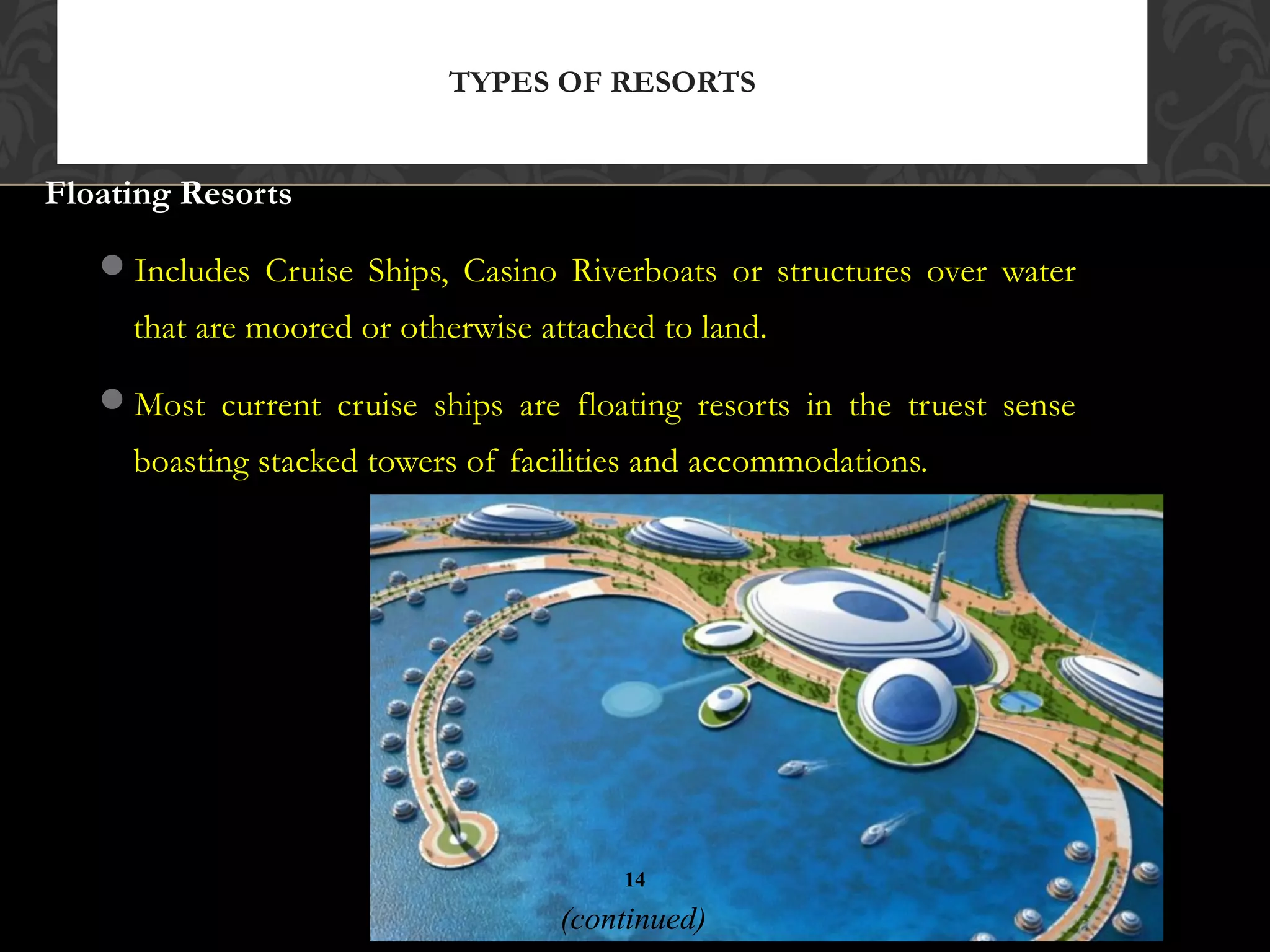
Themed Resorts
Can take many forms but limited by human imagination.
Can be based on different shows, ideas and themes.
Storyline resorts are classified under this type.
A story is created which is used as the theme of the entire resort
as it is developed.
TYPES OF RESORTS
13
(continued)
© 2010, Educational Institute
Floating Resorts
Includes Cruise Ships, Casino Riverboats or structures over water
that are moored or otherwise attached to land.
Most current cruise ships are floating resorts in the truest sense
boasting stacked towers of facilities and accommodations.
TYPES OF RESORTS
14
(continued)
© 2010, Educational Institute
Basic products are beds and meals
Hotels by nature are labor-intensive
Hotels have buildings and grounds that require constant physical maintenance
and upkeep.
The hospitality and service factor
Common laws of inn-keeping apply equally to all hotels in the matter of safety
and security.
COMMON ELEMENTS OF LODGING
15
© 2010, Educational Institute
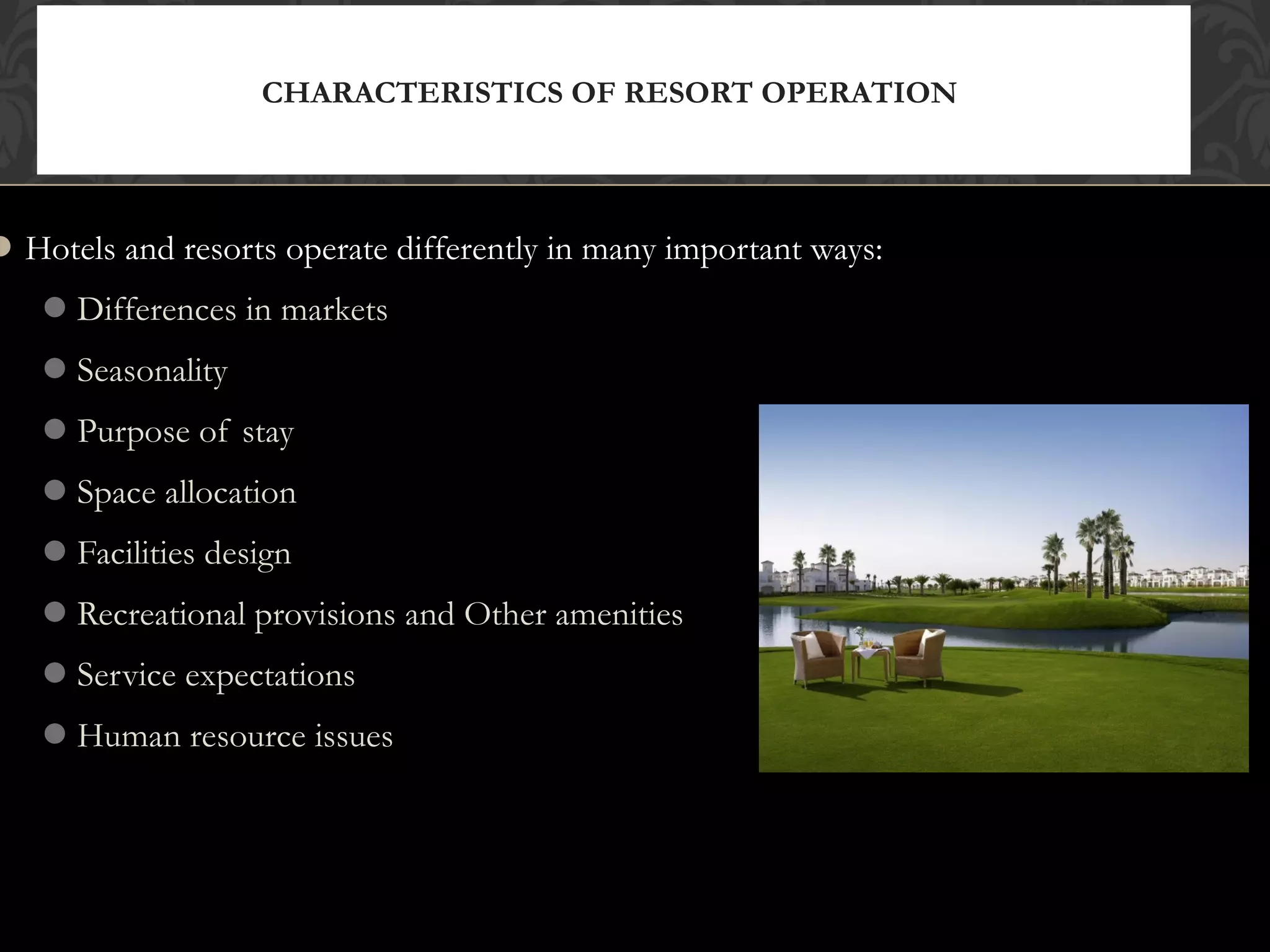
Hotels and resorts operate differently in many important ways:
Differences in markets
Seasonality
Purpose of stay
Space allocation
Facilities design
Recreational provisions and Other amenities
Service expectations
Human resource issues
CHARACTERISTICS OF RESORT OPERATION
16
© 2010, Educational Institute
Visitor Market
◦ Caters primarily to vacation and leisure segments of the travel market and
the business-pleasure conventions, meetings and incentive markets.
◦ Resort visitors are attracted to a resort based on reputation, cultural or
scenic attractions in the area, resort recreation activities
◦ Resort are hotels that cater to business travellers schedule meetings that
coincide with scheduled recreational activities.
CHARACTERISTICS OF RESORT
OPERATION
17
© 2010, Educational Institute
Facilities
Resort planning and its facilities focus solely on pleasing its users. Focus on vacationers
who have different needs from business travellers are considered.
Adequate space is needed inside rooms because of the longer expected stay of those using
resorts.
Some facilities are based on specific activities, and the resorts positioning and market
focus.
CHARACTERISTICS OF RESORT OPERATION
18
© 2010, Educational Institute
Location
◦ Advantages to developing in remote locations
Cheap land to government interests in tourism development.
Tax incentives
A resort is a place used for relaxation or recreation, attracting visitors
for vacations, tourism and/or going swimming in a pool. Resorts are
places, towns or sometimes commercial establishment operated by a
single company
19
© 2010, Educational Institute
Location
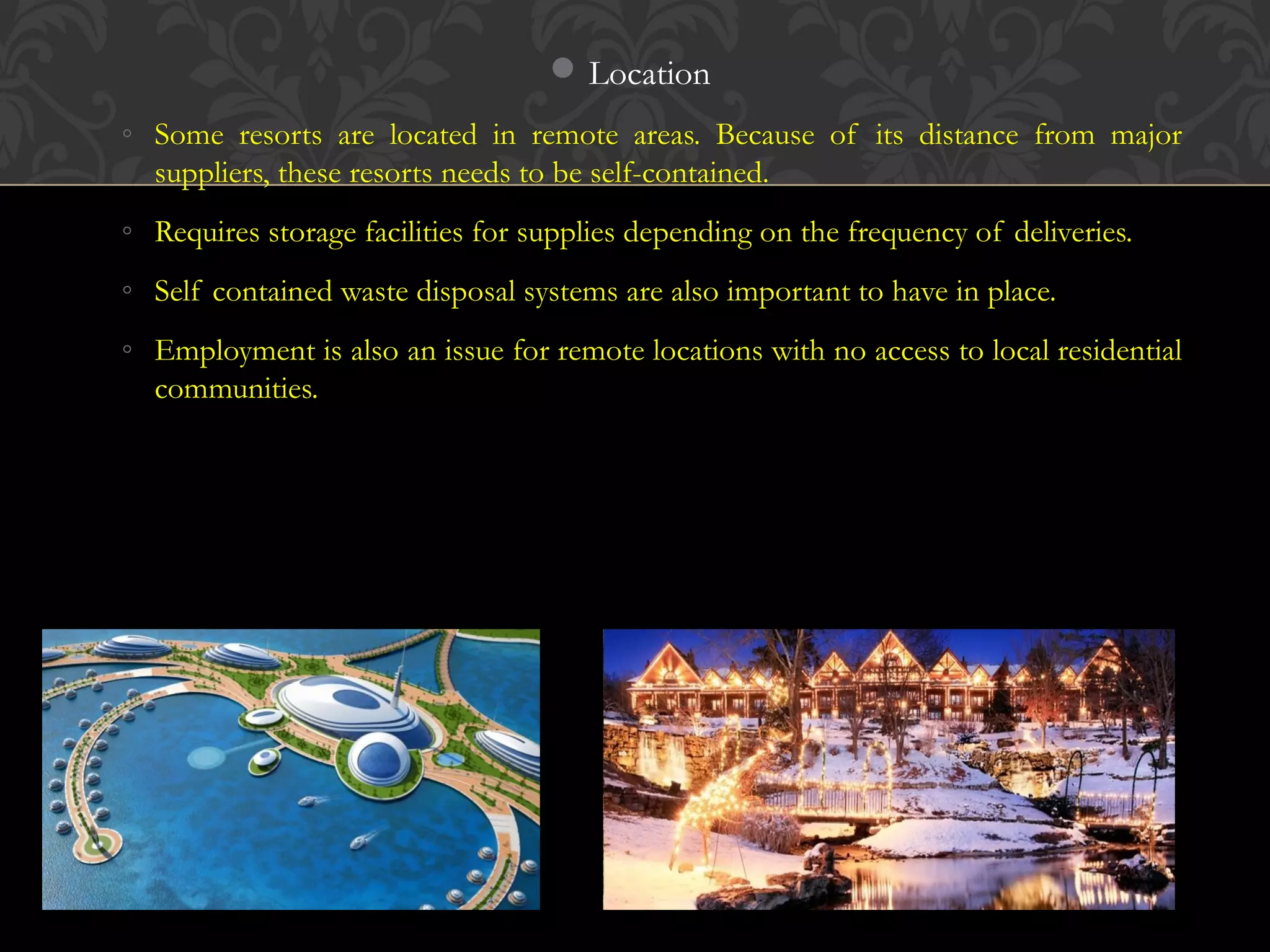
◦ Some resorts are located in remote areas. Because of its distance from major
suppliers, these resorts needs to be self-contained.
◦ Requires storage facilities for supplies depending on the frequency of deliveries.
◦ Self contained waste disposal systems are also important to have in place.
◦ Employment is also an issue for remote locations with no access to local residential
communities.
20
© 2010, Educational Institute
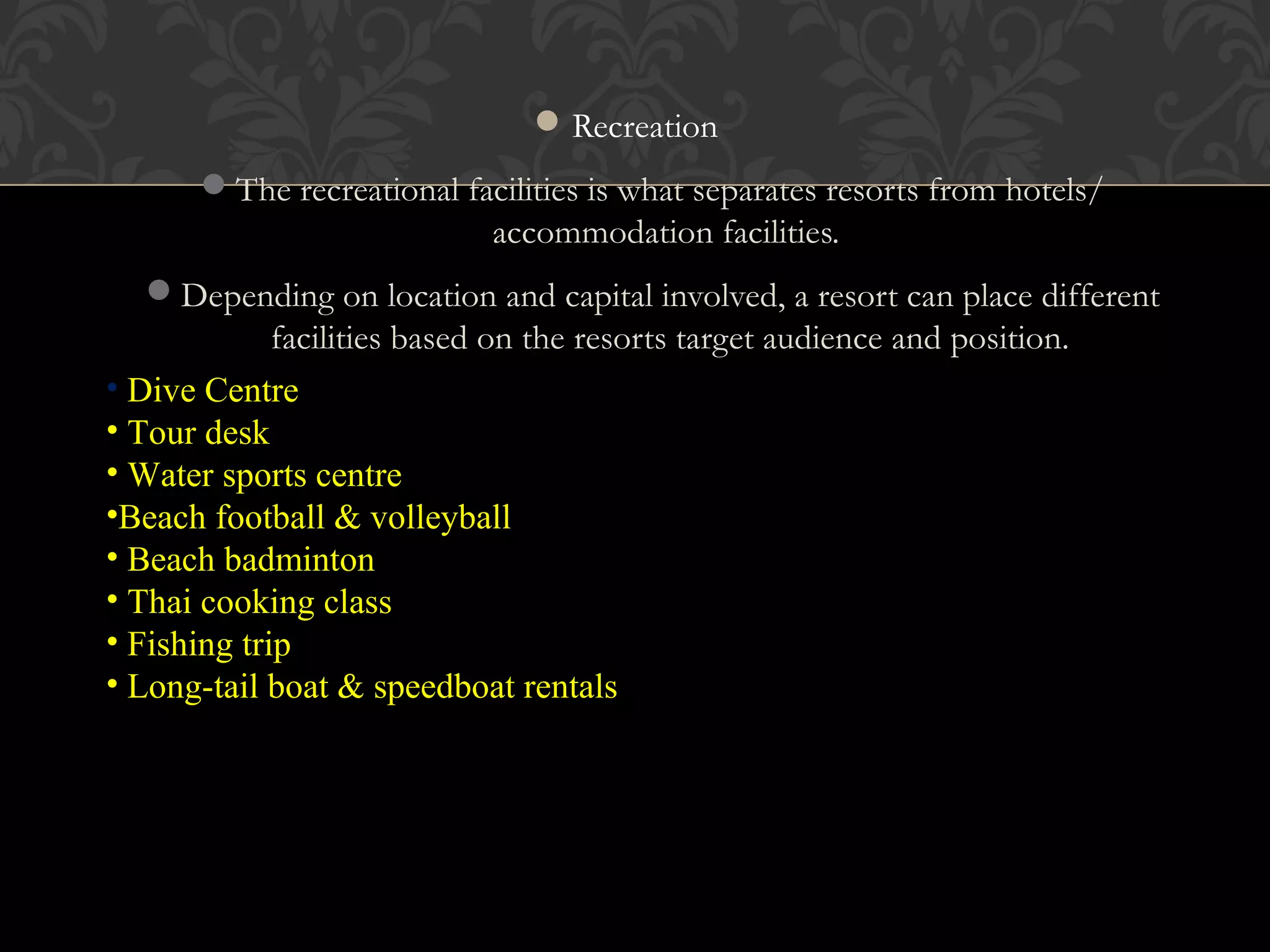
Recreation
The recreational facilities is what separates resorts from hotels/
accommodation facilities.
Depending on location and capital involved, a resort can place different
facilities based on the resorts target audience and position.
21
• Dive Centre
• Tour desk
• Water sports centre
•Beach football & volleyball
• Beach badminton
• Thai cooking class
• Fishing trip
• Long-tail boat & speedboat rentals
© 2010, Educational Institute
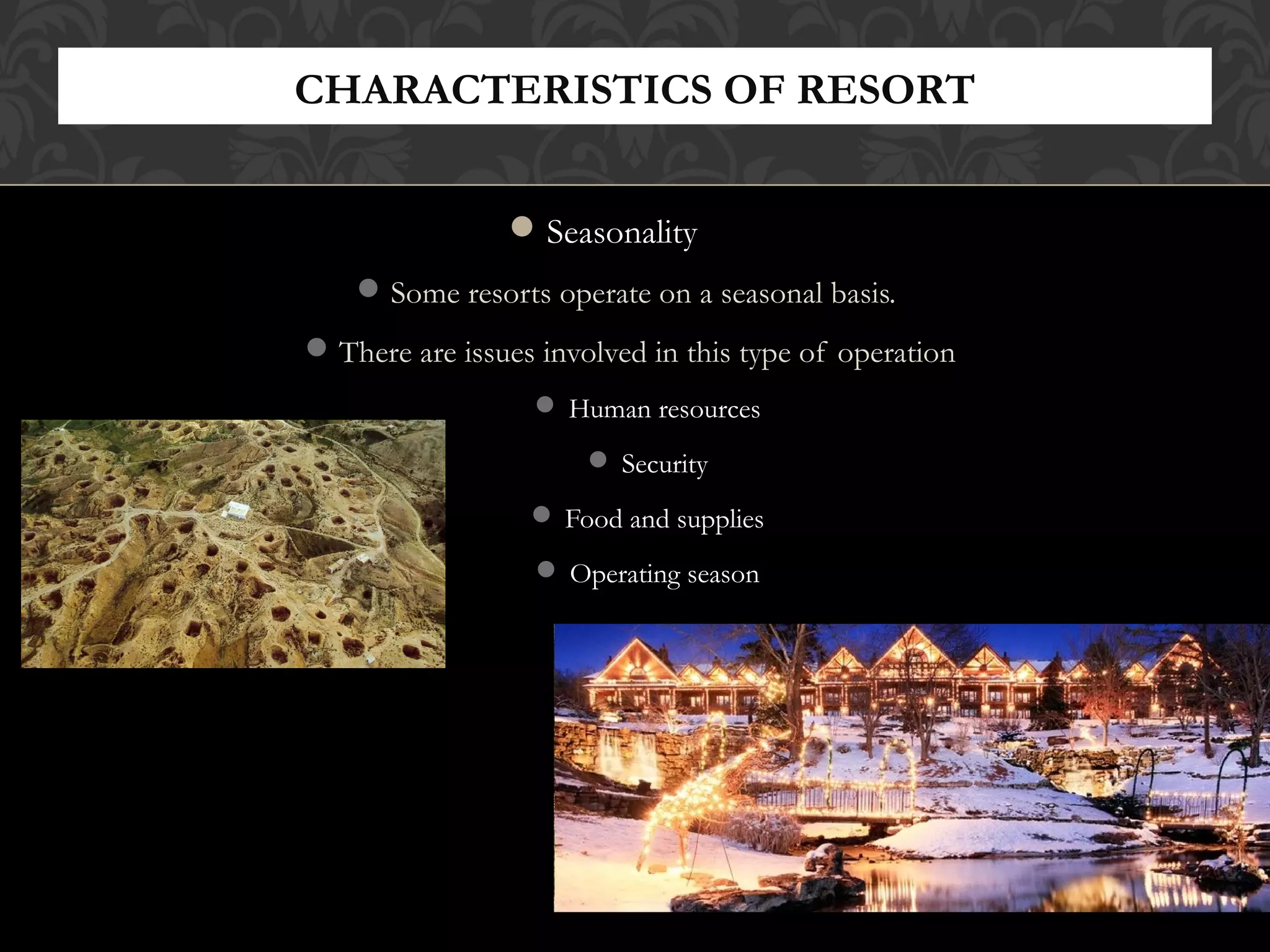
Seasonality
Some resorts operate on a seasonal basis.
There are issues involved in this type of operation
 Human resources
 Security
 Food and supplies
 Operating season
CHARACTERISTICS OF RESORT
22
© 2010, Educational Institute
23
CLASSIFICATION OF RESORTS:-
Resorts are classified and certified by the Department of Tourism. Resorts falling
hereunder have complied with its minimum standards in the operation of the
establishment concerned to ensure the safety, comfort, and convenience of tourists
CLASS AAA
Following are the minimum requirements for the operation of a Class AAA
Resort l in the Philippines when accredited by the Department of Tourism:
in a suitable location free of noise, atmospheric, and marine pollution
free parking for guests (if applicable)
First Class guest Zimmer
public washZimmer
at least four (4) sports and recreational facilities
conference and convention facilities
employee facilities
© 2010, Educational Institute
24
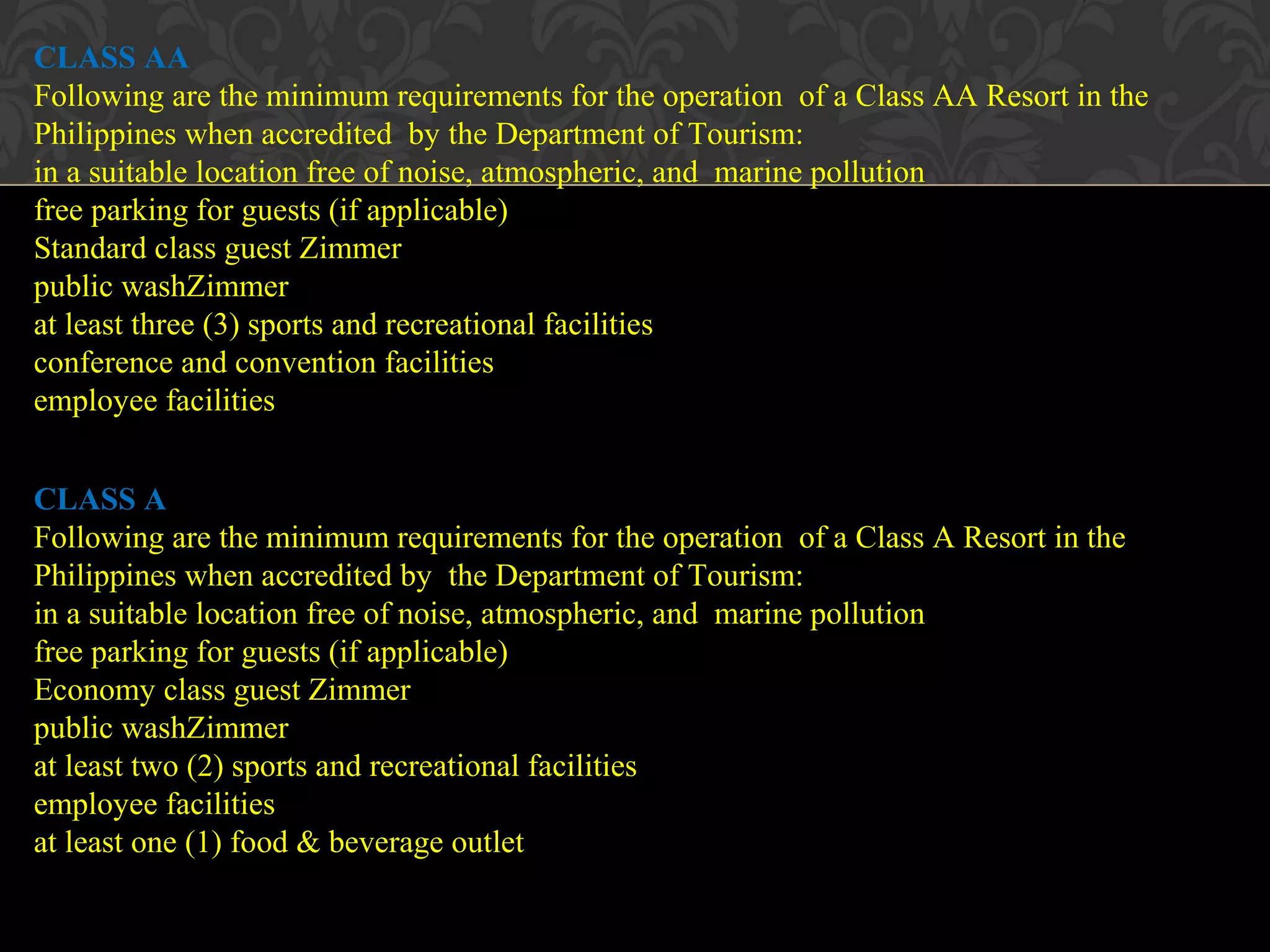
CLASS AA
Following are the minimum requirements for the operation of a Class AA Resort in the
Philippines when accredited by the Department of Tourism:
in a suitable location free of noise, atmospheric, and marine pollution
free parking for guests (if applicable)
Standard class guest Zimmer
public washZimmer
at least three (3) sports and recreational facilities
conference and convention facilities
employee facilities
CLASS A
Following are the minimum requirements for the operation of a Class A Resort in the
Philippines when accredited by the Department of Tourism:
in a suitable location free of noise, atmospheric, and marine pollution
free parking for guests (if applicable)
Economy class guest Zimmer
public washZimmer
at least two (2) sports and recreational facilities
employee facilities
at least one (1) food & beverage outlet
© 2010, Educational Institute
25
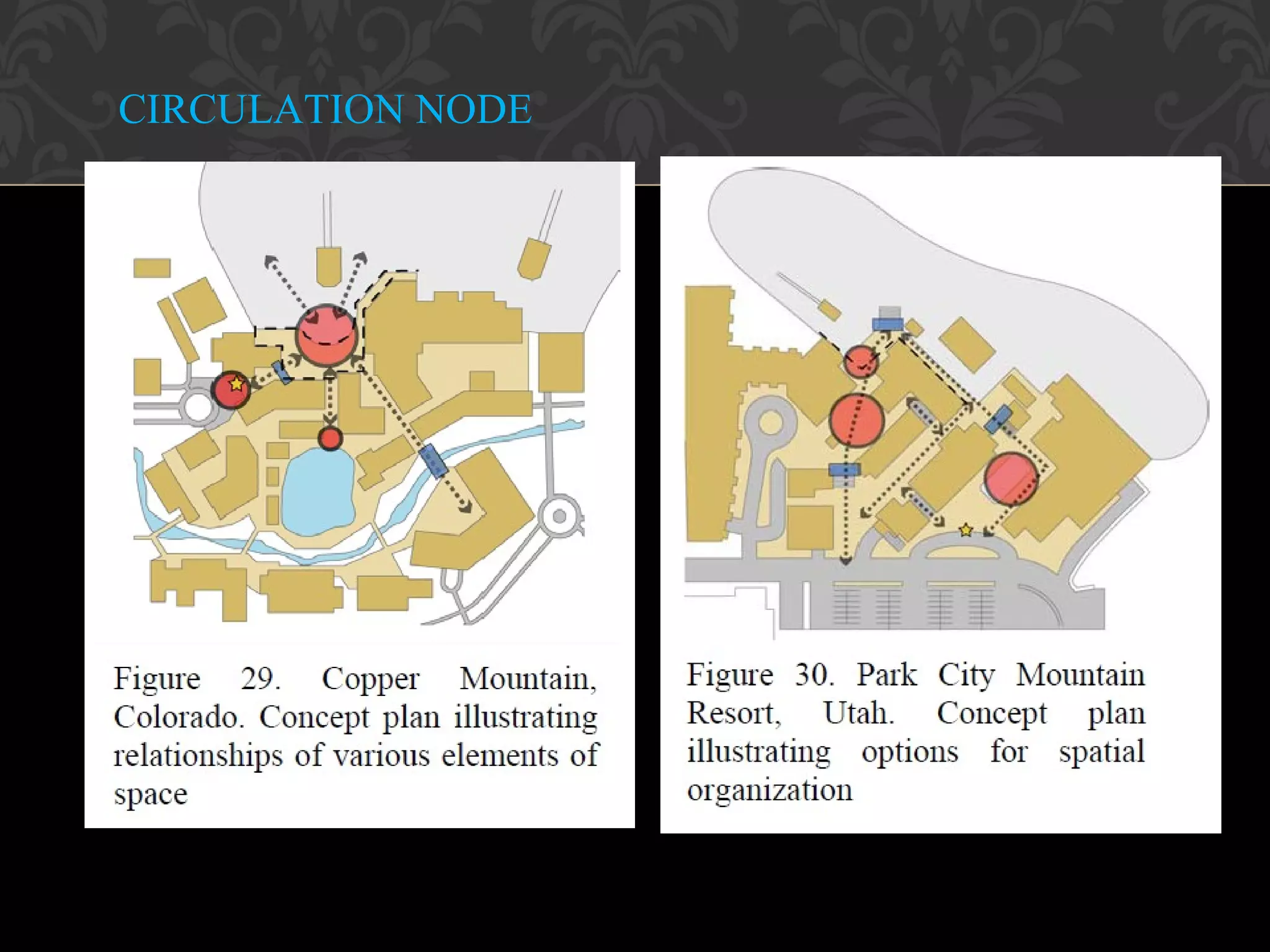
CIRCULATION PATTERN IN A RESORT
 Central Node Concept
 Terminus Node Concept
 Urban Grid Concept
 Circulation Node Concept
Central Node Concept :-
© 2010, Educational Institute
26
Terminus Node :-
© 2010, Educational Institute
27
CIRCULATION NODE
© 2010, Educational Institute
EXAMPLE FROM INDIA
© 2010, Educational Institute
THANK YOU

Subham resort

  • 1.
    © 2010, EducationalInstitute 1 PRESENTATION ON BASIC STUDY OF RESORTS AND THEIR TYPOLOGY PRESENTED BY, SUBHAM KUAMR SAH ID-130213003 DEPT. OF ARCHITECTURE T&R.P IIEST SHIBPUR
  • 2.
    © 2010, EducationalInstitute 1. Classic hotels 2. Resorts 3. Spas 4. Convention hotels 5. Motels and motor hotels 6. Condominium hotels 7. Residential hotels and service apartments 8. Casino hotels and resorts 9. All-suite hotels NINE TYPES OF LODGING OPERATIONS 2
  • 3.
    © 2010, EducationalInstitute 3 RESORT-A resort is a full-service lodging facility that provides access to or offers a range of amenities and recreation facilities to emphasize a leisure experience. Resorts serve as the primary provider of the guests’ experience, often provides services for business and meetings and are characteristically located in vacation-oriented settings. HOTEL-A hotel is a place that offers you lodgings and meals. Persons who travel from one place to another place with a purpose will book into hotels. The purpose of their travel may be to attend a conference, a function, a wedding, or an official meeting or even it can be a vacation. Persons who are unable to spend the night at their home are likely to spend the night in a hotel room. They may or may not stay with their families. This is because of the fact that they are away from home for that matter.
  • 4.
    © 2010, EducationalInstitute 4 What is the difference between Resort and Hotel? • Resorts are places or towns or commercial establishments that provide relaxation and recreation over and above the accommodation, meals and other basic amnesties. • In other words, a resort combines a hotel and a variety of recreations, while a hotel is a place that offers you lodging and meals. • People specifically frequenty visit resorts for relaxation or for recreation. They are the places targeted for family vacations. But, on the other hand, hotel can be used for short stay or for even a vacation. • Hotel stay can be long too at times depending upon the purpose of the stay and the visit. • Hotels are normally located in popular destinations such as near airports, railway stations of major cities and towns or in business areas or localities. Resorts, on the other hand, are located in the midst of natural and picturesque surroundings.
  • 5.
    © 2010, EducationalInstitute TYPES OF RESORTS By seasonality: Year-round resort Summer resort Winter resort 5 (continued) Winter resort Summer resort Year-round resort
  • 6.
    © 2010, EducationalInstitute By designation: Spa resort Golf resort Ski resort Guest ranch Diving resort Fishing resort TYPES OF RESORTS 6 (continued) Spa resort Golf resort Ski resort Guest ranch Diving resort
  • 7.
    © 2010, EducationalInstitute By size: Mega-resort Characterized by size of property and size of investment that reaches billions of dollars. 3,000 rooms with multiple golf courses and other recreational facilities. Their size requires the entire property to be zoned into smaller geographical areas TYPES OF RESORTS 7 (continued) Boutique resort Characterized by a smaller level of development 100-200 room size. Despite their size, they can be very lucrative investments especially those that are classified as luxury botique resorts. (Villa Feltrinelli by Lake Garda)
  • 8.
    © 2010, EducationalInstitute By location: Urban resort Beach or seaside resort Lake resort Mountain resort Island resort Desert resort Tropical rainforest resort (sensitive and restrictive) Farm-related CATEGORIES OF RESORT 8 8 By form of ownership: (continued) Resort Hotel • Person “leases” the room/cottage for transient stay Second-Home Development • Person develops/buys another home in outdoor areas Timeshare Ownership • Person pays for the right to accommodations at a vacation development for a specified period each year, for a specified number of years or for perpetuity.
  • 9.
    © 2010, EducationalInstitute Others: All-inclusive resort Mixed-use resort Themed/fantasy (storyline) Floating (cruise ships) TYPES OF RESORTS 9 9 (continued)
  • 10.
    © 2010, EducationalInstitute All inclusive Total vacation packages that includes transportation to and from the resort. Based on the model created by Club Med All inclusive resorts can be found in Mexico, Carribean, Bahamas and Bermuda. Popular with families because of the convenience it provides. Costs in this type are all upfront- no hidden charges. More profitable to sell for TMC’s. TYPES OF RESORTS 10 (continued)
  • 11.
    © 2010, EducationalInstitute Mixed use “A real estate project with planned integration of some combination of retail, office, residential, hotel, recreation or other functions. It is pedestrian oriented and contains elements of a live-work-play environment. It maximizes spaced usage and has amenities and architectural expression and tends to mitigate traffic and sprawl.” TYPES OF RESORTS 11 (continued)
  • 12.
    © 2010, EducationalInstitute Mixed use These have hotels that serve as the center piece of a customer friendly leisure work environment. Attracts offices, shopper traffic for retail stores, buyers for timeshares, players for recreational activities and others for purposes beyond the hotel’s own purpose. TYPES OF RESORTS 12 (continued)
  • 13.
    © 2010, EducationalInstitute Themed Resorts Can take many forms but limited by human imagination. Can be based on different shows, ideas and themes. Storyline resorts are classified under this type. A story is created which is used as the theme of the entire resort as it is developed. TYPES OF RESORTS 13 (continued)
  • 14.
    © 2010, EducationalInstitute Floating Resorts Includes Cruise Ships, Casino Riverboats or structures over water that are moored or otherwise attached to land. Most current cruise ships are floating resorts in the truest sense boasting stacked towers of facilities and accommodations. TYPES OF RESORTS 14 (continued)
  • 15.
    © 2010, EducationalInstitute Basic products are beds and meals Hotels by nature are labor-intensive Hotels have buildings and grounds that require constant physical maintenance and upkeep. The hospitality and service factor Common laws of inn-keeping apply equally to all hotels in the matter of safety and security. COMMON ELEMENTS OF LODGING 15
  • 16.
    © 2010, EducationalInstitute Hotels and resorts operate differently in many important ways: Differences in markets Seasonality Purpose of stay Space allocation Facilities design Recreational provisions and Other amenities Service expectations Human resource issues CHARACTERISTICS OF RESORT OPERATION 16
  • 17.
    © 2010, EducationalInstitute Visitor Market ◦ Caters primarily to vacation and leisure segments of the travel market and the business-pleasure conventions, meetings and incentive markets. ◦ Resort visitors are attracted to a resort based on reputation, cultural or scenic attractions in the area, resort recreation activities ◦ Resort are hotels that cater to business travellers schedule meetings that coincide with scheduled recreational activities. CHARACTERISTICS OF RESORT OPERATION 17
  • 18.
    © 2010, EducationalInstitute Facilities Resort planning and its facilities focus solely on pleasing its users. Focus on vacationers who have different needs from business travellers are considered. Adequate space is needed inside rooms because of the longer expected stay of those using resorts. Some facilities are based on specific activities, and the resorts positioning and market focus. CHARACTERISTICS OF RESORT OPERATION 18
  • 19.
    © 2010, EducationalInstitute Location ◦ Advantages to developing in remote locations Cheap land to government interests in tourism development. Tax incentives A resort is a place used for relaxation or recreation, attracting visitors for vacations, tourism and/or going swimming in a pool. Resorts are places, towns or sometimes commercial establishment operated by a single company 19
  • 20.
    © 2010, EducationalInstitute Location ◦ Some resorts are located in remote areas. Because of its distance from major suppliers, these resorts needs to be self-contained. ◦ Requires storage facilities for supplies depending on the frequency of deliveries. ◦ Self contained waste disposal systems are also important to have in place. ◦ Employment is also an issue for remote locations with no access to local residential communities. 20
  • 21.
    © 2010, EducationalInstitute Recreation The recreational facilities is what separates resorts from hotels/ accommodation facilities. Depending on location and capital involved, a resort can place different facilities based on the resorts target audience and position. 21 • Dive Centre • Tour desk • Water sports centre •Beach football & volleyball • Beach badminton • Thai cooking class • Fishing trip • Long-tail boat & speedboat rentals
  • 22.
    © 2010, EducationalInstitute Seasonality Some resorts operate on a seasonal basis. There are issues involved in this type of operation  Human resources  Security  Food and supplies  Operating season CHARACTERISTICS OF RESORT 22
  • 23.
    © 2010, EducationalInstitute 23 CLASSIFICATION OF RESORTS:- Resorts are classified and certified by the Department of Tourism. Resorts falling hereunder have complied with its minimum standards in the operation of the establishment concerned to ensure the safety, comfort, and convenience of tourists CLASS AAA Following are the minimum requirements for the operation of a Class AAA Resort l in the Philippines when accredited by the Department of Tourism: in a suitable location free of noise, atmospheric, and marine pollution free parking for guests (if applicable) First Class guest Zimmer public washZimmer at least four (4) sports and recreational facilities conference and convention facilities employee facilities
  • 24.
    © 2010, EducationalInstitute 24 CLASS AA Following are the minimum requirements for the operation of a Class AA Resort in the Philippines when accredited by the Department of Tourism: in a suitable location free of noise, atmospheric, and marine pollution free parking for guests (if applicable) Standard class guest Zimmer public washZimmer at least three (3) sports and recreational facilities conference and convention facilities employee facilities CLASS A Following are the minimum requirements for the operation of a Class A Resort in the Philippines when accredited by the Department of Tourism: in a suitable location free of noise, atmospheric, and marine pollution free parking for guests (if applicable) Economy class guest Zimmer public washZimmer at least two (2) sports and recreational facilities employee facilities at least one (1) food & beverage outlet
  • 25.
    © 2010, EducationalInstitute 25 CIRCULATION PATTERN IN A RESORT  Central Node Concept  Terminus Node Concept  Urban Grid Concept  Circulation Node Concept Central Node Concept :-
  • 26.
    © 2010, EducationalInstitute 26 Terminus Node :-
  • 27.
    © 2010, EducationalInstitute 27 CIRCULATION NODE
  • 28.
    © 2010, EducationalInstitute EXAMPLE FROM INDIA
  • 29.
  • 30.
  • 31.
    © 2010, EducationalInstitute THANK YOU

Editor's Notes

  • #7 Eco- resorts: low rise small scale development that is designed and constructed to blend with the natural environment to minimize impact.
  • #9 Time shares: superdevoluy created the idea
  • #15 r