IT322: MICROPROCESSOR BASED DESIGN
Elements of Assembly Language
Assembly Language Statements
• An assembly language source code file consists of a
collection of statements.
• MASM 6.x accepts statements up to 512 characters long.
• Comments can be used with any statement. A semicolon
(;) begins the comment, and the comment then extends
until the end of the line.
• There are three types of functional assembly language
statements:-
 An instruction is translated by the assembler into one or
more bytes of object code (machine code), which will be
executed at run time. Each instruction corresponds to one
of the operations that can be executed by the 80×86
CPU.
add eax, 158
• A directive tells the assembler to take some action.
Such an action does not result in machine instructions
and often has no effect on the object code.
 For example, the assembler can produce a listing file
showing the original source code, the object code, and
other information.
.NOLIST
• A macro is "shorthand" for a sequence of other
statements, be they instructions, directives, or even other
macros.
The assembler expands a macro to the statements it
represents and then assembles these new statements.
• In the instruction add eax, 158;the mnemonic is add and the operands
are eax and 158.
• The assembler recognizes add as a mnemonic for an instruction that
will perform some sort of addition.
• The operands provide the rest of the information that the assembler
needs.
• The first operand eax tells the assembler that the doubleword in the
EAX register is to be one of the values added, and that the EAX
register will be the destination of the sum.
• Since the second operand is a number (as opposed to another
register designation or a memory designation), the assembler knows
that it is the actual value to be added to the doubleword in the EAX
register.
• The resulting object code is 05 00 00 00 9E, where 05 stands for "add
the doubleword immediately following this byte in memory to the
doubleword already in EAX."
• The assembler takes care of converting the decimal number 158 to its
doubleword length 2's complement representation 0000009E.
• The bytes of this doubleword are actually stored backwards in the
object code, a fact that we can almost always ignore.
A Complete MASM 6.1 Code
• Start with a pseudocode design for the program.
It is easy to get lost in the details of assembly language, so your
programming job will be much easier if you make a design first and
then implement the design in assembly language code.
This program will prompt for two numbers and then find and display
their sum.
• The algorithm implemented by this program is prompt for the first
number;
• Input ASCII characters representing the first number;
• Convert the characters to a 2's complement doubleword;
• Store the first number in memory;
• Prompt for the second number;
• Input ASCII characters representing the second number;
• Convert the characters to a 2's complement doubleword;
• Add the first number to the second number;
• Convert the sum to a string of ASCII characters;
• Display a label and the characters representing the sum.
; Example assembly language program -- adds two numbers
; Author: R. Detmer
; Date: revised 7/97
.386
.MODEL FLAT
ExitProcess PROTO NEAR32 stdcall, dwExitCode:DWORD
INCLUDE io.h ; header file for input/output
cr EQU 0dh ; carriage return character
Lf EQU 0ah ; line feed
.STACK 4096 ; reserve 4096-byte stack
.DATA ; reserve storage for data
number1 DWORD ?
number2 DWORD ?
prompt1 BYTE "Enter first number: ", 0
prompt2 BYTE "Enter second number: ", 0
string BYTE 40 DUP (?)
label1 BYTE cr, Lf, "The sum is "
sum BYTE 11 DUP (?)
BYTE cr, Lf, 0
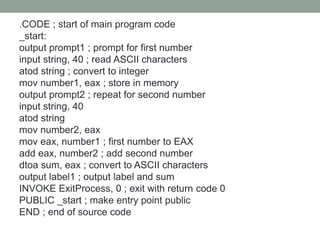
.CODE ; start of main program code
_start:
output prompt1 ; prompt for first number
input string, 40 ; read ASCII characters
atod string ; convert to integer
mov number1, eax ; store in memory
output prompt2 ; repeat for second number
input string, 40
atod string
mov number2, eax
mov eax, number1 ; first number to EAX
add eax, number2 ; add second number
dtoa sum, eax ; convert to ASCII characters
output label1 ; output label and sum
INVOKE ExitProcess, 0 ; exit with return code 0
PUBLIC _start ; make entry point public
END ; end of source code
.386 directive
• Without the directive .386, MASM accepts only 8086/8088
instructions; with it, the assembler accepts the additional
instructions that are executed by 80186, 80286, and
80386 processors.
• The .486 and .586 directives enable use of even more
instructions, but we will not be programming with these
instructions. There is also a .386P directive that allows the
assembler to recognize privileged 80386 instructions; we
will not use these instructions.
.MODEL FLAT directive
• The directive .MODEL FLAT tells the assembler to
generate 32-bit code using a flat memory model.
• It must follow the .386 directive.
.STACK directive
• It tells the assembler how many bytes to reserve for a run-time
stack-4096 bytes is generous for the programs we will be
writing.
• The stack is used primarily for procedure calls.
.DATA directive
• It starts the data segment of the program, the portion of the
code where memory space for variables is reserved. In this
program, the BYTE and DWORD directives are used to reserve
bytes and doublewords of storage, respectively.
number1 DWORD ? directive
• It reserves a single doubleword of storage, associating the
symbolic name number1 with the address 00000000 since it is
the first data item.
• The question mark (?) indicates that this doubleword will have
no designated initial value, although actually MASM 6.x will
initialize it to zero.
number2 DWORD ? statement
• It reserves another doubleword of storage, associating the
symbolic name number2 with the next available address,
00000004, since it follows the doubleword already
reserved.
• The run-time addresses for number1 and number2 will be
different than 00000000 and 00000004, but these
doublewords will be stored consecutively in memory.
prompt1 BYTE "Enter first number: ", 0 directive
• It has two operands, the string "Enter first number" and the
number 0. It reserves one byte for each character inside
the quotation marks and one byte for the number 0.
• For each character, the byte reserved is the ASCII code of
the letter.
• For the number, it is simply its byte-length 2's complement
representation.
• This directive thus reserves 22 bytes of memory
containing 45 6E 74 65 72 20 66 69 72
• 73 74 20 6E 75 6D 62 65 72 3A 20 20 00. The name
prompt1 is associated with the address 00000008 since
eight previous bytes have been allocated.
prompt2 BYTE "Enter second number: ", 0 directive
• This next BYTE directive reserves 23 bytes of memory,
with the name prompt2 associated with address
0000001E.
string BYTE 40 DUP (?) directive
• Reserves 40 uninitialized bytes of memory that will have
the symbolic address string.
• The DUP operator says to repeat the item(s) in
parentheses.
label1 BYTE cr, Lf, "The sum is “ directive
• has three operands and reserves 13 bytes of storage. The
first two bytes contain 0D and 0A since these are the
values to which cr and Lf are equated. The next 11 bytes
are the ASCII codes of the characters in quotation marks.
Notice that there is no trailing 0 operand for this BYTE
directive or the next, so there will be no trailing 00 byte
generated.
• The next-to-last BYTE directive reserves 11 uninitialized
bytes with address associated with the name sum. Even
though the last BYTE directive has no label, it reserves
three initialized bytes of memory immediately following
the 11 for sum.
• The next segment of the program contains executable
statements. It begins with the directive
.CODE
• The line of code with only the label
_start:
• marks the entry point of the program, the address of the
first statement to be executed.
• The name used is the programmer's choice, but we will
consistently use _start for this purpose.
Macros to perform Program functions
• Finally we come to the statements that really do
something!
• Since this program performs mostly input and output, the
bulk of its statements are macros to perform these
functions.
output prompt1 macro
• Displays characters stored at the address referenced by
prompt1, using a null (00) byte to terminate the display. In
this program, the user will be prompted to enter the first
number.
• Since there is no carriage return or line feed character at
the end of the prompt, the cursor will remain on the line
• following the colon and the two blanks.
input string, 40 statement
• Is a macro that functionally causes the computer to pause and
wait for characters to be entered at the keyboard until the user
presses the Enter key to terminate the input.
• The first operand (string) identifies where the ASCII codes for
these characters will be stored.
• The second operand (40) identifies the maximum number of
characters that can be entered.
• Notice that 40 uninitialized bytes were reserved at address
string.
• The input macro inputs ASCII codes, but the CPU does
arithmetic with numbers in 2's complement form.
• The atod (for "ASCII to double") macro scans memory at the
address specified by its single operand and converts the ASCII
codes there to the corresponding 2's complement doubleword;
the result is stored in EAX.
atod string instruction
• scans memory starting at string, skips leading blanks,
notes any plus (+) or minus (- ) sign, and builds a number
from ASCII codes for digits.
• The scan stops when any non digit is encountered.
mov number1, eax instruction
• The mnemonic mov stands for "move" but the instruction
really performs a copy operation like an assignment
statement in a high-level language.
• This particular instruction copies the value in the EAX
register to the doubleword of memory at address
number1.
Statements output prompt2; input string, 40; atod string and
mov number2, eax
• The above four statements repeat the tasks just performed:
prompt for the second number; input ASCII codes; convert the
ASCII codes to a 2's complement doubleword; and copy the
doubleword to memory. Note that the input area is reused.
The next two instructions add the numbers – Addition must
be done in a register.
• The first number is copied to the EAX register with the
instruction;
 mov eax, number1
• Then the second is added to the first with the instruction;
add eax, number2
Is there a more efficient way to get the sum in EAX?????
• The sum is now in the EAX register in 2's complement
form.
• For display purposes we need a sequence of ASCII
characters that represent this value.
• The dtoa ("double to ASCII") macro takes the doubleword
specified by its second operand and converts it to a string
exactly 11 bytes long at the destination specified by the
first operand.
dtoa sum, eax macro
• Uses the contents of EAX as the source, and fills in the 11
bytes at sum with ASCII codes corresponding to this
value.
• For a typical small number, leading space characters are
used fill a total of 11 bytes.
output label1 macro
• Displays bytes of memory, starting at label1 and continuing
until a null byte (00) is encountered.
• Since the undefined bytes at sum have been replaced by ASCII
codes, the first null byte in memory will be the one following the
carriage return and line feed codes in the unlabeled BYTE
directive-a total of 26 characters will be displayed.
INVOKE ExitProcess, 0 statement
• Is a directive that generates code to call the procedure
ExitProcess with the value 0 for the parameter symbolically
called dwExitCode in the prototype.
• This terminates the program, with exit code value 0 telling the
operating system that the program terminated normally.
• Nonzero values can be used to indicate error conditions.
PUBLIC _start directive
• It makes the entry point address visible outside this file,
so that the linker can identify the first instruction to be
executed as it constructs an executable program file.
END directive
• The final statement in an assembly language source file is
the.
• This marks the physical end of the program.
• There should be no statement following END.

It322 intro 3

  • 1.
    IT322: MICROPROCESSOR BASEDDESIGN Elements of Assembly Language
  • 2.
    Assembly Language Statements •An assembly language source code file consists of a collection of statements. • MASM 6.x accepts statements up to 512 characters long. • Comments can be used with any statement. A semicolon (;) begins the comment, and the comment then extends until the end of the line. • There are three types of functional assembly language statements:-  An instruction is translated by the assembler into one or more bytes of object code (machine code), which will be executed at run time. Each instruction corresponds to one of the operations that can be executed by the 80×86 CPU. add eax, 158
  • 3.
    • A directivetells the assembler to take some action. Such an action does not result in machine instructions and often has no effect on the object code.  For example, the assembler can produce a listing file showing the original source code, the object code, and other information. .NOLIST • A macro is "shorthand" for a sequence of other statements, be they instructions, directives, or even other macros. The assembler expands a macro to the statements it represents and then assembles these new statements.
  • 4.
    • In theinstruction add eax, 158;the mnemonic is add and the operands are eax and 158. • The assembler recognizes add as a mnemonic for an instruction that will perform some sort of addition. • The operands provide the rest of the information that the assembler needs. • The first operand eax tells the assembler that the doubleword in the EAX register is to be one of the values added, and that the EAX register will be the destination of the sum. • Since the second operand is a number (as opposed to another register designation or a memory designation), the assembler knows that it is the actual value to be added to the doubleword in the EAX register. • The resulting object code is 05 00 00 00 9E, where 05 stands for "add the doubleword immediately following this byte in memory to the doubleword already in EAX." • The assembler takes care of converting the decimal number 158 to its doubleword length 2's complement representation 0000009E. • The bytes of this doubleword are actually stored backwards in the object code, a fact that we can almost always ignore.
  • 5.
    A Complete MASM6.1 Code • Start with a pseudocode design for the program. It is easy to get lost in the details of assembly language, so your programming job will be much easier if you make a design first and then implement the design in assembly language code. This program will prompt for two numbers and then find and display their sum. • The algorithm implemented by this program is prompt for the first number; • Input ASCII characters representing the first number; • Convert the characters to a 2's complement doubleword; • Store the first number in memory; • Prompt for the second number; • Input ASCII characters representing the second number; • Convert the characters to a 2's complement doubleword; • Add the first number to the second number; • Convert the sum to a string of ASCII characters; • Display a label and the characters representing the sum.
  • 6.
    ; Example assemblylanguage program -- adds two numbers ; Author: R. Detmer ; Date: revised 7/97 .386 .MODEL FLAT ExitProcess PROTO NEAR32 stdcall, dwExitCode:DWORD INCLUDE io.h ; header file for input/output cr EQU 0dh ; carriage return character Lf EQU 0ah ; line feed .STACK 4096 ; reserve 4096-byte stack .DATA ; reserve storage for data number1 DWORD ? number2 DWORD ? prompt1 BYTE "Enter first number: ", 0 prompt2 BYTE "Enter second number: ", 0 string BYTE 40 DUP (?) label1 BYTE cr, Lf, "The sum is " sum BYTE 11 DUP (?) BYTE cr, Lf, 0
  • 7.
    .CODE ; startof main program code _start: output prompt1 ; prompt for first number input string, 40 ; read ASCII characters atod string ; convert to integer mov number1, eax ; store in memory output prompt2 ; repeat for second number input string, 40 atod string mov number2, eax mov eax, number1 ; first number to EAX add eax, number2 ; add second number dtoa sum, eax ; convert to ASCII characters output label1 ; output label and sum INVOKE ExitProcess, 0 ; exit with return code 0 PUBLIC _start ; make entry point public END ; end of source code
  • 8.
    .386 directive • Withoutthe directive .386, MASM accepts only 8086/8088 instructions; with it, the assembler accepts the additional instructions that are executed by 80186, 80286, and 80386 processors. • The .486 and .586 directives enable use of even more instructions, but we will not be programming with these instructions. There is also a .386P directive that allows the assembler to recognize privileged 80386 instructions; we will not use these instructions. .MODEL FLAT directive • The directive .MODEL FLAT tells the assembler to generate 32-bit code using a flat memory model. • It must follow the .386 directive.
  • 9.
    .STACK directive • Ittells the assembler how many bytes to reserve for a run-time stack-4096 bytes is generous for the programs we will be writing. • The stack is used primarily for procedure calls. .DATA directive • It starts the data segment of the program, the portion of the code where memory space for variables is reserved. In this program, the BYTE and DWORD directives are used to reserve bytes and doublewords of storage, respectively. number1 DWORD ? directive • It reserves a single doubleword of storage, associating the symbolic name number1 with the address 00000000 since it is the first data item. • The question mark (?) indicates that this doubleword will have no designated initial value, although actually MASM 6.x will initialize it to zero.
  • 10.
    number2 DWORD ?statement • It reserves another doubleword of storage, associating the symbolic name number2 with the next available address, 00000004, since it follows the doubleword already reserved. • The run-time addresses for number1 and number2 will be different than 00000000 and 00000004, but these doublewords will be stored consecutively in memory. prompt1 BYTE "Enter first number: ", 0 directive • It has two operands, the string "Enter first number" and the number 0. It reserves one byte for each character inside the quotation marks and one byte for the number 0. • For each character, the byte reserved is the ASCII code of the letter.
  • 11.
    • For thenumber, it is simply its byte-length 2's complement representation. • This directive thus reserves 22 bytes of memory containing 45 6E 74 65 72 20 66 69 72 • 73 74 20 6E 75 6D 62 65 72 3A 20 20 00. The name prompt1 is associated with the address 00000008 since eight previous bytes have been allocated. prompt2 BYTE "Enter second number: ", 0 directive • This next BYTE directive reserves 23 bytes of memory, with the name prompt2 associated with address 0000001E.
  • 12.
    string BYTE 40DUP (?) directive • Reserves 40 uninitialized bytes of memory that will have the symbolic address string. • The DUP operator says to repeat the item(s) in parentheses. label1 BYTE cr, Lf, "The sum is “ directive • has three operands and reserves 13 bytes of storage. The first two bytes contain 0D and 0A since these are the values to which cr and Lf are equated. The next 11 bytes are the ASCII codes of the characters in quotation marks. Notice that there is no trailing 0 operand for this BYTE directive or the next, so there will be no trailing 00 byte generated.
  • 13.
    • The next-to-lastBYTE directive reserves 11 uninitialized bytes with address associated with the name sum. Even though the last BYTE directive has no label, it reserves three initialized bytes of memory immediately following the 11 for sum. • The next segment of the program contains executable statements. It begins with the directive .CODE • The line of code with only the label _start: • marks the entry point of the program, the address of the first statement to be executed. • The name used is the programmer's choice, but we will consistently use _start for this purpose.
  • 14.
    Macros to performProgram functions • Finally we come to the statements that really do something! • Since this program performs mostly input and output, the bulk of its statements are macros to perform these functions. output prompt1 macro • Displays characters stored at the address referenced by prompt1, using a null (00) byte to terminate the display. In this program, the user will be prompted to enter the first number. • Since there is no carriage return or line feed character at the end of the prompt, the cursor will remain on the line • following the colon and the two blanks.
  • 15.
    input string, 40statement • Is a macro that functionally causes the computer to pause and wait for characters to be entered at the keyboard until the user presses the Enter key to terminate the input. • The first operand (string) identifies where the ASCII codes for these characters will be stored. • The second operand (40) identifies the maximum number of characters that can be entered. • Notice that 40 uninitialized bytes were reserved at address string. • The input macro inputs ASCII codes, but the CPU does arithmetic with numbers in 2's complement form. • The atod (for "ASCII to double") macro scans memory at the address specified by its single operand and converts the ASCII codes there to the corresponding 2's complement doubleword; the result is stored in EAX.
  • 16.
    atod string instruction •scans memory starting at string, skips leading blanks, notes any plus (+) or minus (- ) sign, and builds a number from ASCII codes for digits. • The scan stops when any non digit is encountered. mov number1, eax instruction • The mnemonic mov stands for "move" but the instruction really performs a copy operation like an assignment statement in a high-level language. • This particular instruction copies the value in the EAX register to the doubleword of memory at address number1.
  • 17.
    Statements output prompt2;input string, 40; atod string and mov number2, eax • The above four statements repeat the tasks just performed: prompt for the second number; input ASCII codes; convert the ASCII codes to a 2's complement doubleword; and copy the doubleword to memory. Note that the input area is reused. The next two instructions add the numbers – Addition must be done in a register. • The first number is copied to the EAX register with the instruction;  mov eax, number1 • Then the second is added to the first with the instruction; add eax, number2 Is there a more efficient way to get the sum in EAX?????
  • 18.
    • The sumis now in the EAX register in 2's complement form. • For display purposes we need a sequence of ASCII characters that represent this value. • The dtoa ("double to ASCII") macro takes the doubleword specified by its second operand and converts it to a string exactly 11 bytes long at the destination specified by the first operand. dtoa sum, eax macro • Uses the contents of EAX as the source, and fills in the 11 bytes at sum with ASCII codes corresponding to this value. • For a typical small number, leading space characters are used fill a total of 11 bytes.
  • 19.
    output label1 macro •Displays bytes of memory, starting at label1 and continuing until a null byte (00) is encountered. • Since the undefined bytes at sum have been replaced by ASCII codes, the first null byte in memory will be the one following the carriage return and line feed codes in the unlabeled BYTE directive-a total of 26 characters will be displayed. INVOKE ExitProcess, 0 statement • Is a directive that generates code to call the procedure ExitProcess with the value 0 for the parameter symbolically called dwExitCode in the prototype. • This terminates the program, with exit code value 0 telling the operating system that the program terminated normally. • Nonzero values can be used to indicate error conditions.
  • 20.
    PUBLIC _start directive •It makes the entry point address visible outside this file, so that the linker can identify the first instruction to be executed as it constructs an executable program file. END directive • The final statement in an assembly language source file is the. • This marks the physical end of the program. • There should be no statement following END.