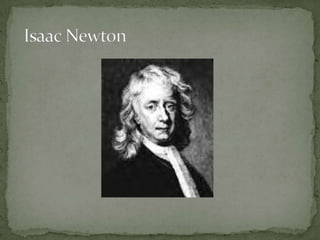
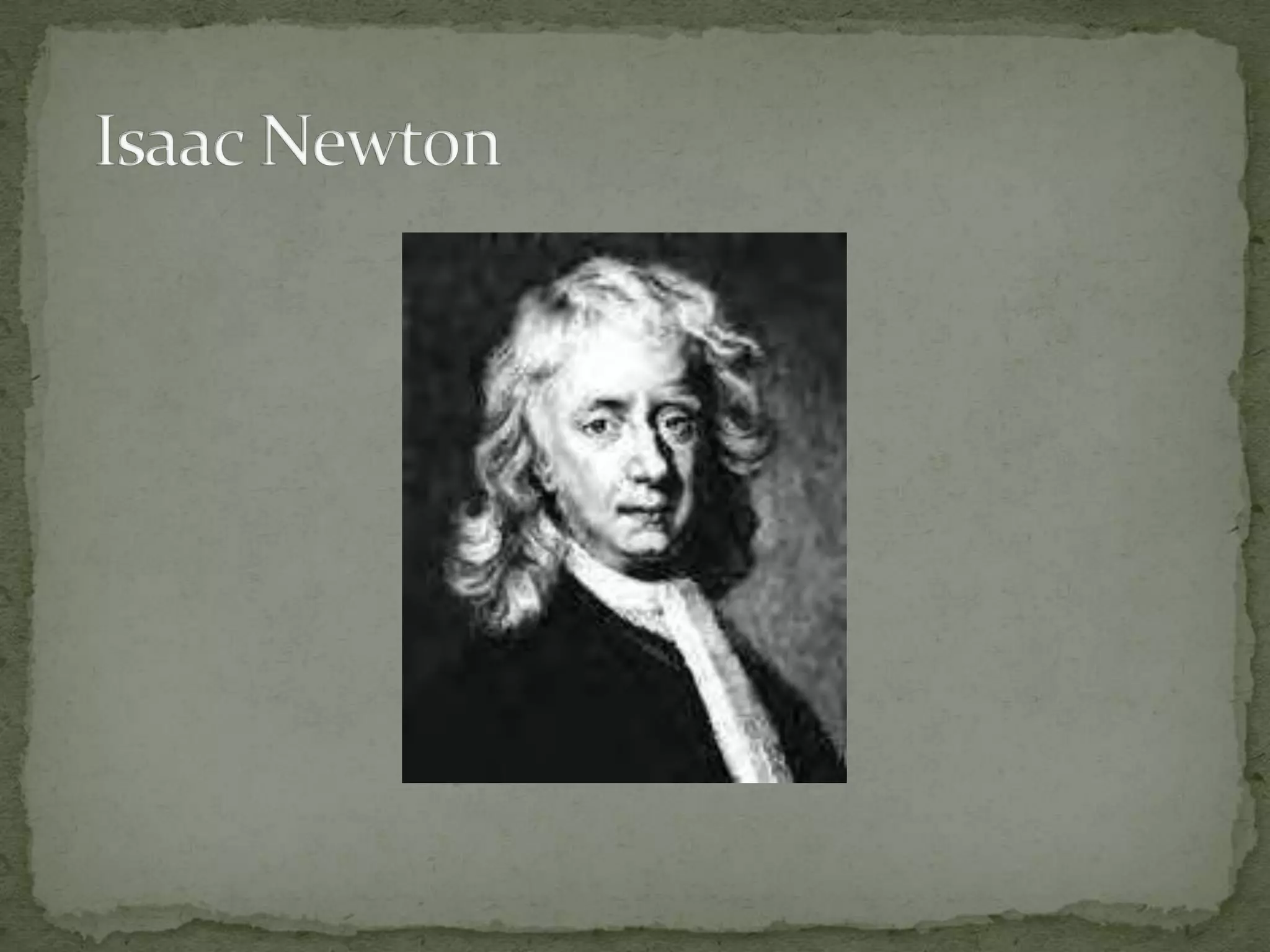
Isaac Newton
Sir Isaac Newton was born in 1643 in Woolsthorpe, England.
 His father was a wealthy, uneducated farmer who died three months before Newton was born. Newton's mother remarried and he was left in the care of his grandmother.
 . He attended Free Grammar school; though Newton did not excel in school, he did earn the opportunity to attend Trinity College Cambridge where he wanted to study law.
Later on in 1665, he discovered the generalized binomial theorem, and began to develop a mathematical theory that would later become infinitesimal calculus.  By 1666, he had completed his early work on his three laws of motion and was later published in his book Principia.
 As the years progressed, Newton completed his work on universal gravitation, diffraction of light, centrifugal force, centripetal force, inverse-square law, bodies in motion and the variations in tides due to gravity.
However, in 1679 his work came to standstill after he suffered a nervous breakdown. Upon regaining his health Newton returned to the University, and he became a leader against what he saw as an attack on the University by King James II. When William of Orange drove James out of England, Newton was elected to Parliament.
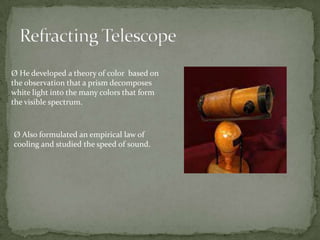
 Throughout his career he was torn between fame and his fear of criticism of plagiarism. His overwhelming fear of criticism caused him to resist immediate publication of his work, later died in 1727.Refracting Telescope He developed a theory of color  based on the observation that a prism decomposes white light into the many colors that form the visible spectrum.
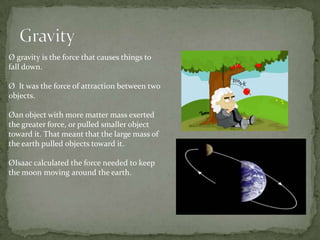
 Also formulated an empirical law of cooling and studied the speed of sound.Gravity gravity is the force that causes things to fall down.
  It was the force of attraction between two objects.

Nenafunches

  • 1.
  • 2.
    Sir Isaac Newtonwas born in 1643 in Woolsthorpe, England.
  • 3.
    His fatherwas a wealthy, uneducated farmer who died three months before Newton was born. Newton's mother remarried and he was left in the care of his grandmother.
  • 4.
    . Heattended Free Grammar school; though Newton did not excel in school, he did earn the opportunity to attend Trinity College Cambridge where he wanted to study law.
  • 5.
    Later on in1665, he discovered the generalized binomial theorem, and began to develop a mathematical theory that would later become infinitesimal calculus. By 1666, he had completed his early work on his three laws of motion and was later published in his book Principia.
  • 6.
    As theyears progressed, Newton completed his work on universal gravitation, diffraction of light, centrifugal force, centripetal force, inverse-square law, bodies in motion and the variations in tides due to gravity.
  • 7.
    However, in 1679his work came to standstill after he suffered a nervous breakdown. Upon regaining his health Newton returned to the University, and he became a leader against what he saw as an attack on the University by King James II. When William of Orange drove James out of England, Newton was elected to Parliament.
  • 8.
    Throughout hiscareer he was torn between fame and his fear of criticism of plagiarism. His overwhelming fear of criticism caused him to resist immediate publication of his work, later died in 1727.Refracting Telescope He developed a theory of color based on the observation that a prism decomposes white light into the many colors that form the visible spectrum.
  • 9.
    Also formulatedan empirical law of cooling and studied the speed of sound.Gravity gravity is the force that causes things to fall down.
  • 10.
    Itwas the force of attraction between two objects.