Forming technology
Unit -III
Co :Identify and select proper manufacturing process for a specific
component
Forming
Forming, metal forming, is the metalworking process of fashioning metal parts and objects
through mechanical deformation; the workpiece is reshaped without adding or removing material,
and its mass remains unchanged.
Recrystallization temperature is a particular temperature point below the melting point of a metal (or material).
Usually, metals, in microscopic scale are made up of grain like particles.
At recrystallization temperature, if you impart enough force, you can easily succeed to change the size and shape of
these grains
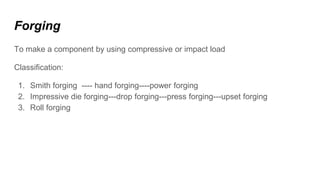
Forging
To make a component by using compressive or impact load
Classification:
1. Smith forging ---- hand forging----power forging
2. Impressive die forging---drop forging---press forging---upset forging
3. Roll forging
Smith Forging
• Smith forging is also called flat die and open die forging. It includes
the broad field of forging work produced between flat faced dies and
possibly supplemented by stock tooling.
• The final shape of the forging depends on the skill of the smith for
size and shape.
• Smith forging produces work pieces of lesser accuracy as compared
to impression or closed die forging.
• Tooling is simple, inexpensive and allows the production of a large
variety of shapes.
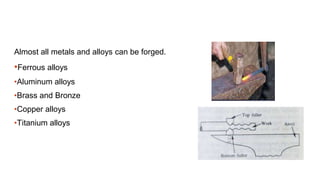
Almost all metals and alloys can be forged.
•Ferrous alloys
•Aluminum alloys
•Brass and Bronze
•Copper alloys
•Titanium alloys
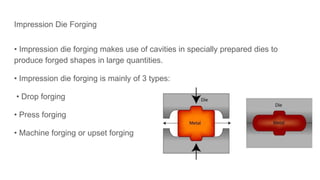
Impression Die Forging
• Impression die forging makes use of cavities in specially prepared dies to
produce forged shapes in large quantities.
• Impression die forging is mainly of 3 types:
• Drop forging
• Press forging
• Machine forging or upset forging
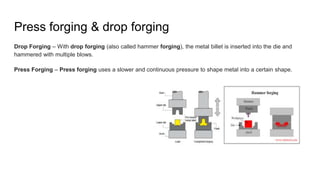
Press forging & drop forging
Drop Forging – With drop forging (also called hammer forging), the metal billet is inserted into the die and
hammered with multiple blows.
Press Forging – Press forging uses a slower and continuous pressure to shape metal into a certain shape.
Type of presses
Manually operated presses
Power operated presses
A. Mechanical press
B. Hydraulic press
C. Pnueumatic press
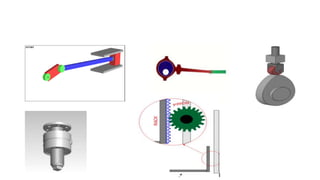
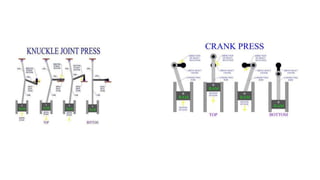
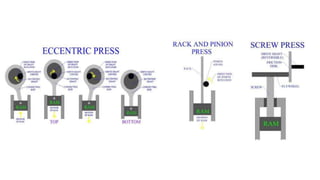
Types of drive
Crank and connecting rod drive
Eccentric drive
Knuckle joint drive
Cam drive
Toggle drive
Screw drive
Rack and pinion drive rotational motional change into linear motion
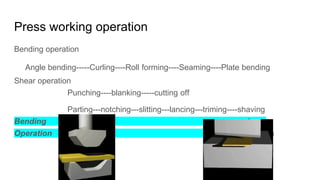
Press working operation
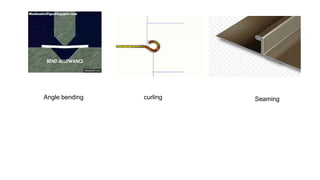
Bending operation
Angle bending-----Curling----Roll forming----Seaming----Plate bending
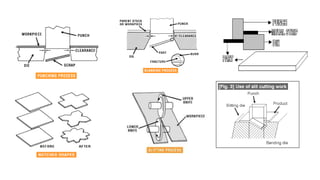
Shear operation
Punching----blanking-----cutting off
Parting---notching---slitting---lancing---triming----shaving
Bending shear
Operation operation
Angle bending curling Seaming
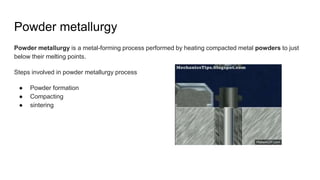
Powder metallurgy
Powder metallurgy is a metal-forming process performed by heating compacted metal powders to just
below their melting points.
Steps involved in powder metallurgy process
● Powder formation
● Compacting
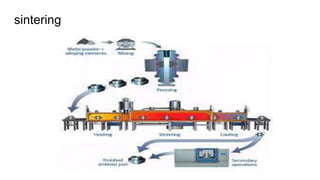
● sintering
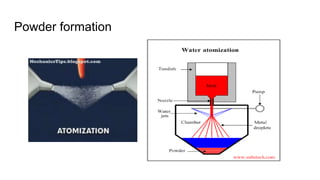
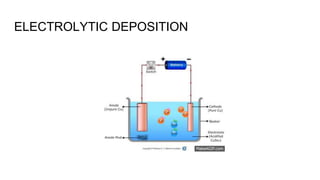
Powder formation
ELECTROLYTIC DEPOSITION
sintering
Sintering is a process were green compact strength increased and required
mechanical properties can obtained
Basically melting point of powder metal are between 70 c to 90c .
This heating process done in vacuum chamber.
sintering

Forming technology

  • 1.
  • 2.
    Co :Identify andselect proper manufacturing process for a specific component
  • 3.
    Forming Forming, metal forming,is the metalworking process of fashioning metal parts and objects through mechanical deformation; the workpiece is reshaped without adding or removing material, and its mass remains unchanged.
  • 5.
    Recrystallization temperature isa particular temperature point below the melting point of a metal (or material). Usually, metals, in microscopic scale are made up of grain like particles. At recrystallization temperature, if you impart enough force, you can easily succeed to change the size and shape of these grains
  • 6.
    Forging To make acomponent by using compressive or impact load Classification: 1. Smith forging ---- hand forging----power forging 2. Impressive die forging---drop forging---press forging---upset forging 3. Roll forging
  • 7.
    Smith Forging • Smithforging is also called flat die and open die forging. It includes the broad field of forging work produced between flat faced dies and possibly supplemented by stock tooling. • The final shape of the forging depends on the skill of the smith for size and shape. • Smith forging produces work pieces of lesser accuracy as compared to impression or closed die forging. • Tooling is simple, inexpensive and allows the production of a large variety of shapes.
  • 8.
    Almost all metalsand alloys can be forged. •Ferrous alloys •Aluminum alloys •Brass and Bronze •Copper alloys •Titanium alloys
  • 9.
    Impression Die Forging •Impression die forging makes use of cavities in specially prepared dies to produce forged shapes in large quantities. • Impression die forging is mainly of 3 types: • Drop forging • Press forging • Machine forging or upset forging
  • 10.
    Press forging &drop forging Drop Forging – With drop forging (also called hammer forging), the metal billet is inserted into the die and hammered with multiple blows. Press Forging – Press forging uses a slower and continuous pressure to shape metal into a certain shape.
  • 11.
    Type of presses Manuallyoperated presses Power operated presses A. Mechanical press B. Hydraulic press C. Pnueumatic press
  • 12.
    Types of drive Crankand connecting rod drive Eccentric drive Knuckle joint drive Cam drive Toggle drive Screw drive Rack and pinion drive rotational motional change into linear motion
  • 16.
    Press working operation Bendingoperation Angle bending-----Curling----Roll forming----Seaming----Plate bending Shear operation Punching----blanking-----cutting off Parting---notching---slitting---lancing---triming----shaving Bending shear Operation operation
  • 17.
  • 19.
    Powder metallurgy Powder metallurgyis a metal-forming process performed by heating compacted metal powders to just below their melting points. Steps involved in powder metallurgy process ● Powder formation ● Compacting ● sintering
  • 20.
  • 21.
  • 22.
    sintering Sintering is aprocess were green compact strength increased and required mechanical properties can obtained Basically melting point of powder metal are between 70 c to 90c . This heating process done in vacuum chamber.
  • 23.