International Organization for Standardization
(ISO)
ISO 9001 & ISO 17025
Deepak Basyal
Department of Pharmacy, Maharajgunj Medical Campus
Institute of Medicine (www.iom.edu.np)
International Organization for Standardization (ISO)
• It was founded in 1947, and since then have published 23570 International Standards
covering almost all aspects of technology and business.
• (International Organization for Standardization) is the world's largest developer and
publisher of International Standards.
• ISO sets standards or guidelines to help companies manage "quality" within their
organizations.
• ISO does not carry out certification and does not issue or approve certificates
• ISO does not accredit, approve or control the certification bodies.
• ISO develops standards and guides to encourage good practice in accreditation and
certification.
• Central Secretariat in Geneva, Switzerland, that coordinates the system.
• ISO 9001 and ISO 14001 are among ISO's most well known standards ever.
• They are implemented by more than a million organizations in some 175 countries.
• ISO 9001 helps organizations to implement quality management.
• ISO 9001 is principle-based international standard that describes a quality management
system that organizations can use to be more efficient and improve customer satisfaction
• ISO 14001 helps organizations to implement environmental management.
ISO 9000
ISO 9000 is a series, or family, of quality management standards
The ISO 9000 family contains these standards
• ISO 9000:2015: Quality Management Systems - Fundamentals and Vocabulary
(definitions)
• ISO 9001:2015: Quality Management Systems – Requirements (only needs certification)
• ISO 9004:2018: Quality Management - Quality of an Organization - Guidance to Achieve
Sustained Success (continuous improvement)
• ISO 19011:2018: Guidelines for Auditing Management Systems
ISO 9000 history and revisions: ISO 9000:2000, 2008, and 2015 (most current version)
Published in 1987 by the International Organization
for Standardization (ISO)
Goals of ISO 9001
• Meet stakeholder needs
• Be usable by all sizes of organizations
• Be usable by all sectors
• Be simple and clearly understood
• Connect quality management system to business processes
Quality Principles of QMS ( ISO 9001)
• Engagement of people.
• Customer focus.
• Leadership.
• Process approach.
• System approach.
• Continuous Improvement.
• Evidence-based decision making.
• Relationship management.
Implemented by more than a million
organizations in some 175 countries
ISO 9001: 2015 certification is applicable to all kinds of organization i.e. service, trading , manufacturing, small, medium and
big size organization, business enterprise, a public administration, Government department (Generic standards).
Quality refers to all those features of a product (or service)
which are required by the customer
• They are not product standards.
• They are not service standards.
• They are process standards
ISO 9001 (Quality Management System)
• It outlines a framework for improving quality management system for any organization looking
to provide products and services that consistently meet the requirements and expectations of
customers
• ISO 9001 gives the requirements for what the organization must do to manage
processes affecting quality of its products and services.
Quality management means what the organization does to
• ensure that its products or services satisfy the customer's quality requirements and
• comply with any regulations applicable to those products or services.
• Quality management also means what the organization does to
• enhance customer satisfaction, and
• achieve continual improvement of its performance.
• Nothing important is left out
• Everyone is clear about who is responsible for doing what, when, how, why and where
• Management system standards provide the organization with an international, state-of-the-art model to
follow
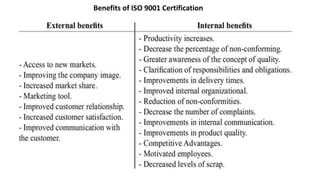
Benefits of ISO 9001 Certification
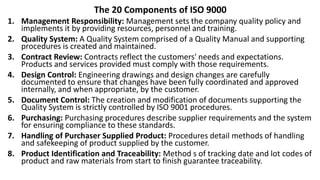
The 20 Components of ISO 9000
1. Management Responsibility: Management sets the company quality policy and
implements it by providing resources, personnel and training.
2. Quality System: A Quality System comprised of a Quality Manual and supporting
procedures is created and maintained.
3. Contract Review: Contracts reflect the customers' needs and expectations.
Products and services provided must comply with those requirements.
4. Design Control: Engineering drawings and design changes are carefully
documented to ensure that changes have been fully coordinated and approved
internally, and when appropriate, by the customer.
5. Document Control: The creation and modification of documents supporting the
Quality System is strictly controlled by ISO 9001 procedures.
6. Purchasing: Purchasing procedures describe supplier requirements and the system
for ensuring compliance to these standards.
7. Handling of Purchaser Supplied Product: Procedures detail methods of handling
and safekeeping of product supplied by the customer.
8. Product Identification and Traceability: Method s of tracking date and lot codes of
product and raw materials from start to finish guarantee traceability.
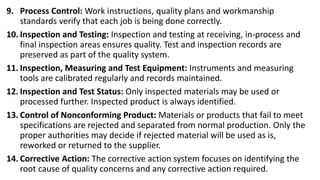
9. Process Control: Work instructions, quality plans and workmanship
standards verify that each job is being done correctly.
10. Inspection and Testing: Inspection and testing at receiving, in-process and
final inspection areas ensures quality. Test and inspection records are
preserved as part of the quality system.
11. Inspection, Measuring and Test Equipment: Instruments and measuring
tools are calibrated regularly and records maintained.
12. Inspection and Test Status: Only inspected materials may be used or
processed further. Inspected product is always identified.
13. Control of Nonconforming Product: Materials or products that fail to meet
specifications are rejected and separated from normal production. Only the
proper authorities may decide if rejected material will be used as is,
reworked or returned to the supplier.
14. Corrective Action: The corrective action system focuses on identifying the
root cause of quality concerns and any corrective action required.
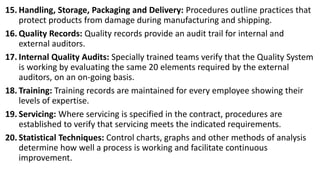
15. Handling, Storage, Packaging and Delivery: Procedures outline practices that
protect products from damage during manufacturing and shipping.
16. Quality Records: Quality records provide an audit trail for internal and
external auditors.
17. Internal Quality Audits: Specially trained teams verify that the Quality System
is working by evaluating the same 20 elements required by the external
auditors, on an on-going basis.
18. Training: Training records are maintained for every employee showing their
levels of expertise.
19. Servicing: Where servicing is specified in the contract, procedures are
established to verify that servicing meets the indicated requirements.
20. Statistical Techniques: Control charts, graphs and other methods of analysis
determine how well a process is working and facilitate continuous
improvement.
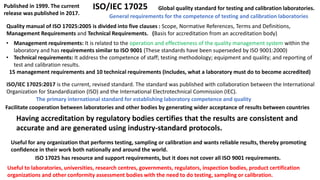
ISO/IEC 17025
Published in 1999. The current
release was published in 2017.
Quality manual of ISO 17025:2005 is divided into five clauses : Scope, Normative References, Terms and Definitions,
Management Requirements and Technical Requirements. (Basis for accreditation from an accreditation body)
• Management requirements: It is related to the operation and effectiveness of the quality management system within the
laboratory and has requirements similar to ISO 9001 (These standards have been superseded by ISO 9001:2000)
• Technical requirements: It address the competence of staff; testing methodology; equipment and quality; and reporting of
test and calibration results.
15 management requirements and 10 technical requirements (Includes, what a laboratory must do to become accredited)
Global quality standard for testing and calibration laboratories.
Facilitate cooperation between laboratories and other bodies by generating wider acceptance of results between countries
Useful to laboratories, universities, research centres, governments, regulators, inspection bodies, product certification
organizations and other conformity assessment bodies with the need to do testing, sampling or calibration.
ISO/IEC 17025:2017 is the current, revised standard. The standard was published with collaboration between the International
Organization for Standardization (ISO) and the International Electrotechnical Commission (IEC).
Useful for any organization that performs testing, sampling or calibration and wants reliable results, thereby promoting
confidence in their work both nationally and around the world.
General requirements for the competence of testing and calibration laboratories
Having accreditation by regulatory bodies certifies that the results are consistent and
accurate and are generated using industry-standard protocols.
The primary international standard for establishing laboratory competence and quality
ISO 17025 has resource and support requirements, but it does not cover all ISO 9001 requirements.
ISO/IEC 17025
• International standard used by laboratories in developing their quality, administrative and technical
systems that govern their operations.
• It includes management and technical requirements that enable a testing or calibration laboratory to
claim their technical competency.
• It specifies the activities that must be included in laboratory operations to promote confidence in its
ability to produce valid and consistently reliable testing, calibration, and sampling results.
• ISO/IEC 17025 has had two revisions so far, it was first revised in 2005 and then in 2017 to stay up-to-
date with the industry and to follow the ISO 9001:2015 standard as closely as possible.
• It not only enables you to meet the management and technical requirements of ISO/IEC 17025 but
also helps your laboratory meet other regulatory guidelines, such as ISO 9001:2015, GLP/GALP, and
21 CFR Part 11.
Why ISO/IEC 17025:2017 accreditation??
• Increasing customer confidence
• Defined activities, policies, and quality objectives are the foundation for the strategic direction of the
organization (Creating a proactive risk-based business and quality culture)
• Assuring your laboratory’s creditability
• Facilitating cooperation between testing laboratories and other bodies by establishing wider
acceptance of results between countries and organizations (better international trade)
• Creating an environment of professionalism and pride (Third-party assessment and accreditation
provides a sense of pride for the entire organization.
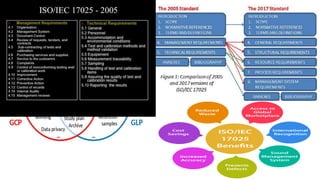
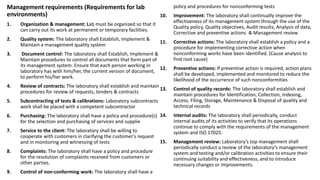
Management requirements (Requirements for lab
environments)
1. Organization & management: Lab must be organized so that it
can carry out its work at permanent or temporary facilities.
2. Quality system: The laboratory shall Establish, Implement &
Maintain a management quality system
3. Document control: The laboratory shall Establish, Implement &
Maintain procedures to control all documents that form part of
its management system. Ensure that each person working in
laboratory has with him/her, the current version of document,
to perform his/her work.
4. Review of contracts: The laboratory shall establish and maintain
procedures for review of requests, tenders & contracts
5. Subcontracting of tests & calibrations: Laboratory subcontracts
work shall be placed with a competent subcontractor
6. Purchasing: The laboratory shall have a policy and procedure(s)
for the selection and purchasing of services and supplie
7. Service to the client: The laboratory shall be willing to
cooperate with customers in clarifying the customer's request
and in monitoring and witnessing of tests
8. Complaints: The laboratory shall have a policy and procedure
for the resolution of complaints received from customers or
other parties.
9. Control of non-conforming work: The laboratory shall have a
policy and procedures for nonconforming tests
10. Improvement: The laboratory shall continually improve the
effectiveness of its management system through the use of the
Quality policy, Quality objectives, Audit results, Analysis of data,
Corrective and preventive actions & Management review
11. Corrective actions: The laboratory shall establish a policy and a
procedure for implementing corrective action when
nonconforming works have been identified. (Cause analysis to
find root cause)
12. Preventive actions: If preventive action is required, action plans
shall be developed, implemented and monitored to reduce the
likelihood of the occurrence of such nonconformities
13. Control of quality records: The laboratory shall establish and
maintain procedures for Identification, Collection, Indexing,
Access, Filing, Storage, Maintenance & Disposal of quality and
technical records
14. Internal audits: The laboratory shall periodically, conduct
internal audits of its activities to verify that its operations
continue to comply with the requirements of the management
system and ISO 17025.
15. Management review: Laboratory’s top management shall
periodically conduct a review of the laboratory's management
system and testing and/or calibration activities to ensure their
continuing suitability and effectiveness, and to introduce
necessary changes or improvements.
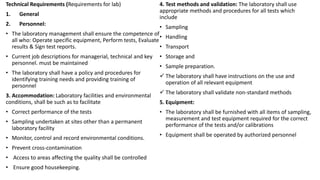
Technical Requirements (Requirements for lab)
1. General
2. Personnel:
• The laboratory management shall ensure the competence of
all who: Operate specific equipment, Perform tests, Evaluate
results & Sign test reports.
• Current job descriptions for managerial, technical and key
personnel. must be maintained
• The laboratory shall have a policy and procedures for
identifying training needs and providing training of
personnel
3. Accommodation: Laboratory facilities and environmental
conditions, shall be such as to facilitate
• Correct performance of the tests
• Sampling undertaken at sites other than a permanent
laboratory facility
• Monitor, control and record environmental conditions.
• Prevent cross-contamination
• Access to areas affecting the quality shall be controlled
• Ensure good housekeeping.
4. Test methods and validation: The laboratory shall use
appropriate methods and procedures for all tests which
include
• Sampling
• Handling
• Transport
• Storage and
• Sample preparation.
 The laboratory shall have instructions on the use and
operation of all relevant equipment
 The laboratory shall validate non-standard methods
5. Equipment:
• The laboratory shall be furnished with all items of sampling,
measurement and test equipment required for the correct
performance of the tests and/or calibrations
• Equipment shall be operated by authorized personnel
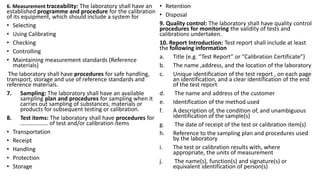
6. Measurement traceability: The laboratory shall have an
established programme and procedure for the calibration
of its equipment, which should include a system for
• Selecting
• Using Calibrating
• Checking
• Controlling
• Maintaining measurement standards (Reference
materials)
The laboratory shall have procedures for safe handling,
transport, storage and use of reference standards and
reference materials.
7. Sampling: The laboratory shall have an available
sampling plan and procedures for sampling when it
carries out sampling of substances, materials or
products for subsequent testing or calibration.
8. Test items: The laboratory shall have procedures for
………………. of test and/or calibration items
• Transportation
• Receipt
• Handling
• Protection
• Storage
• Retention
• Disposal
9. Quality control: The laboratory shall have quality control
procedures for monitoring the validity of tests and
calibrations undertaken.
10. Report Introduction: Test report shall include at least
the following information
a. Title (e.g. “Test Report” or “Calibration Certificate”)
b. The name ,address, and the location of the laboratory
c. Unique identification of the test report , on each page
an identification, and a clear identification of the end
of the test report
d. The name and address of the customer
e. Identification of the method used
f. A description of, the condition of, and unambiguous
identification of the sample(s)
g. The date of receipt of the test or calibration item(s)
h. Reference to the sampling plan and procedures used
by the laboratory
i. The test or calibration results with, where
appropriate, the units of measurement
j. The name(s), function(s) and signature(s) or
equivalent identification of person(s)
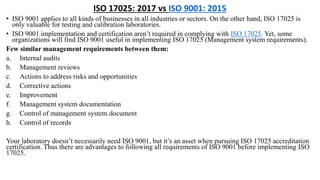
ISO 17025: 2017 vs ISO 9001: 2015
• ISO 9001 applies to all kinds of businesses in all industries or sectors. On the other hand, ISO 17025 is
only valuable for testing and calibration laboratories.
• ISO 9001 implementation and certification aren’t required in complying with ISO 17025. Yet, some
organizations will find ISO 9001 useful in implementing ISO 17025 (Management system requirements).
Few similar management requirements between them:
a. Internal audits
b. Management reviews
c. Actions to address risks and opportunities
d. Corrective actions
e. Improvement
f. Management system documentation
g. Control of management system document
h. Control of records
Your laboratory doesn’t necessarily need ISO 9001, but it’s an asset when pursuing ISO 17025 accreditation
certification. Thus there are advantages to following all requirements of ISO 9001 before implementing ISO
17025.
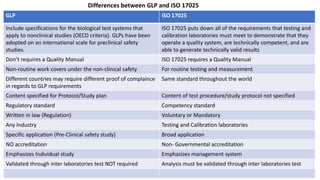
Differences between GLP and ISO 17025
GLP ISO 17025
Include specifications for the biological test systems that
apply to nonclinical studies (OECD criteria). GLPs have been
adopted on an international scale for preclinical safety
studies.
ISO 17025 puts down all of the requirements that testing and
calibration laboratories must meet to demonstrate that they
operate a quality system, are technically competent, and are
able to generate technically valid results
Don’t requires a Quality Manual ISO 17025 requires a Quality Manual
Non-routine work covers under the non-clinical safety For routine testing and measurement
Different countries may require different proof of complaince
in regards to GLP requirements
Same standard throughout the world
Content specified for Protocol/Study plan Content of test procedure/study protocol not specified
Regulatory standard Competency standard
Written in law (Regulation) Voluntary or Mandatory
Any Industry Testing and Calibration laboratories
Specific application (Pre-Clinical safety study) Broad application
NO accreditation Non- Governmental accreditation
Emphasizes Individual study Emphasizes management system
Validated through inter laboratories test NOT required Analysis must be validated through inter laboratories test
THANKS

ISO 9001 & ISO 17025

  • 1.
    International Organization forStandardization (ISO) ISO 9001 & ISO 17025 Deepak Basyal Department of Pharmacy, Maharajgunj Medical Campus Institute of Medicine (www.iom.edu.np)
  • 2.
    International Organization forStandardization (ISO) • It was founded in 1947, and since then have published 23570 International Standards covering almost all aspects of technology and business. • (International Organization for Standardization) is the world's largest developer and publisher of International Standards. • ISO sets standards or guidelines to help companies manage "quality" within their organizations. • ISO does not carry out certification and does not issue or approve certificates • ISO does not accredit, approve or control the certification bodies. • ISO develops standards and guides to encourage good practice in accreditation and certification. • Central Secretariat in Geneva, Switzerland, that coordinates the system. • ISO 9001 and ISO 14001 are among ISO's most well known standards ever. • They are implemented by more than a million organizations in some 175 countries. • ISO 9001 helps organizations to implement quality management. • ISO 9001 is principle-based international standard that describes a quality management system that organizations can use to be more efficient and improve customer satisfaction • ISO 14001 helps organizations to implement environmental management.
  • 3.
    ISO 9000 ISO 9000is a series, or family, of quality management standards The ISO 9000 family contains these standards • ISO 9000:2015: Quality Management Systems - Fundamentals and Vocabulary (definitions) • ISO 9001:2015: Quality Management Systems – Requirements (only needs certification) • ISO 9004:2018: Quality Management - Quality of an Organization - Guidance to Achieve Sustained Success (continuous improvement) • ISO 19011:2018: Guidelines for Auditing Management Systems ISO 9000 history and revisions: ISO 9000:2000, 2008, and 2015 (most current version) Published in 1987 by the International Organization for Standardization (ISO) Goals of ISO 9001 • Meet stakeholder needs • Be usable by all sizes of organizations • Be usable by all sectors • Be simple and clearly understood • Connect quality management system to business processes Quality Principles of QMS ( ISO 9001) • Engagement of people. • Customer focus. • Leadership. • Process approach. • System approach. • Continuous Improvement. • Evidence-based decision making. • Relationship management. Implemented by more than a million organizations in some 175 countries ISO 9001: 2015 certification is applicable to all kinds of organization i.e. service, trading , manufacturing, small, medium and big size organization, business enterprise, a public administration, Government department (Generic standards). Quality refers to all those features of a product (or service) which are required by the customer • They are not product standards. • They are not service standards. • They are process standards
  • 4.
    ISO 9001 (QualityManagement System) • It outlines a framework for improving quality management system for any organization looking to provide products and services that consistently meet the requirements and expectations of customers • ISO 9001 gives the requirements for what the organization must do to manage processes affecting quality of its products and services. Quality management means what the organization does to • ensure that its products or services satisfy the customer's quality requirements and • comply with any regulations applicable to those products or services. • Quality management also means what the organization does to • enhance customer satisfaction, and • achieve continual improvement of its performance. • Nothing important is left out • Everyone is clear about who is responsible for doing what, when, how, why and where • Management system standards provide the organization with an international, state-of-the-art model to follow
  • 5.
    Benefits of ISO9001 Certification
  • 6.
    The 20 Componentsof ISO 9000 1. Management Responsibility: Management sets the company quality policy and implements it by providing resources, personnel and training. 2. Quality System: A Quality System comprised of a Quality Manual and supporting procedures is created and maintained. 3. Contract Review: Contracts reflect the customers' needs and expectations. Products and services provided must comply with those requirements. 4. Design Control: Engineering drawings and design changes are carefully documented to ensure that changes have been fully coordinated and approved internally, and when appropriate, by the customer. 5. Document Control: The creation and modification of documents supporting the Quality System is strictly controlled by ISO 9001 procedures. 6. Purchasing: Purchasing procedures describe supplier requirements and the system for ensuring compliance to these standards. 7. Handling of Purchaser Supplied Product: Procedures detail methods of handling and safekeeping of product supplied by the customer. 8. Product Identification and Traceability: Method s of tracking date and lot codes of product and raw materials from start to finish guarantee traceability.
  • 7.
    9. Process Control:Work instructions, quality plans and workmanship standards verify that each job is being done correctly. 10. Inspection and Testing: Inspection and testing at receiving, in-process and final inspection areas ensures quality. Test and inspection records are preserved as part of the quality system. 11. Inspection, Measuring and Test Equipment: Instruments and measuring tools are calibrated regularly and records maintained. 12. Inspection and Test Status: Only inspected materials may be used or processed further. Inspected product is always identified. 13. Control of Nonconforming Product: Materials or products that fail to meet specifications are rejected and separated from normal production. Only the proper authorities may decide if rejected material will be used as is, reworked or returned to the supplier. 14. Corrective Action: The corrective action system focuses on identifying the root cause of quality concerns and any corrective action required.
  • 8.
    15. Handling, Storage,Packaging and Delivery: Procedures outline practices that protect products from damage during manufacturing and shipping. 16. Quality Records: Quality records provide an audit trail for internal and external auditors. 17. Internal Quality Audits: Specially trained teams verify that the Quality System is working by evaluating the same 20 elements required by the external auditors, on an on-going basis. 18. Training: Training records are maintained for every employee showing their levels of expertise. 19. Servicing: Where servicing is specified in the contract, procedures are established to verify that servicing meets the indicated requirements. 20. Statistical Techniques: Control charts, graphs and other methods of analysis determine how well a process is working and facilitate continuous improvement.
  • 9.
    ISO/IEC 17025 Published in1999. The current release was published in 2017. Quality manual of ISO 17025:2005 is divided into five clauses : Scope, Normative References, Terms and Definitions, Management Requirements and Technical Requirements. (Basis for accreditation from an accreditation body) • Management requirements: It is related to the operation and effectiveness of the quality management system within the laboratory and has requirements similar to ISO 9001 (These standards have been superseded by ISO 9001:2000) • Technical requirements: It address the competence of staff; testing methodology; equipment and quality; and reporting of test and calibration results. 15 management requirements and 10 technical requirements (Includes, what a laboratory must do to become accredited) Global quality standard for testing and calibration laboratories. Facilitate cooperation between laboratories and other bodies by generating wider acceptance of results between countries Useful to laboratories, universities, research centres, governments, regulators, inspection bodies, product certification organizations and other conformity assessment bodies with the need to do testing, sampling or calibration. ISO/IEC 17025:2017 is the current, revised standard. The standard was published with collaboration between the International Organization for Standardization (ISO) and the International Electrotechnical Commission (IEC). Useful for any organization that performs testing, sampling or calibration and wants reliable results, thereby promoting confidence in their work both nationally and around the world. General requirements for the competence of testing and calibration laboratories Having accreditation by regulatory bodies certifies that the results are consistent and accurate and are generated using industry-standard protocols. The primary international standard for establishing laboratory competence and quality ISO 17025 has resource and support requirements, but it does not cover all ISO 9001 requirements.
  • 11.
    ISO/IEC 17025 • Internationalstandard used by laboratories in developing their quality, administrative and technical systems that govern their operations. • It includes management and technical requirements that enable a testing or calibration laboratory to claim their technical competency. • It specifies the activities that must be included in laboratory operations to promote confidence in its ability to produce valid and consistently reliable testing, calibration, and sampling results. • ISO/IEC 17025 has had two revisions so far, it was first revised in 2005 and then in 2017 to stay up-to- date with the industry and to follow the ISO 9001:2015 standard as closely as possible. • It not only enables you to meet the management and technical requirements of ISO/IEC 17025 but also helps your laboratory meet other regulatory guidelines, such as ISO 9001:2015, GLP/GALP, and 21 CFR Part 11. Why ISO/IEC 17025:2017 accreditation?? • Increasing customer confidence • Defined activities, policies, and quality objectives are the foundation for the strategic direction of the organization (Creating a proactive risk-based business and quality culture) • Assuring your laboratory’s creditability • Facilitating cooperation between testing laboratories and other bodies by establishing wider acceptance of results between countries and organizations (better international trade) • Creating an environment of professionalism and pride (Third-party assessment and accreditation provides a sense of pride for the entire organization.
  • 13.
    Management requirements (Requirementsfor lab environments) 1. Organization & management: Lab must be organized so that it can carry out its work at permanent or temporary facilities. 2. Quality system: The laboratory shall Establish, Implement & Maintain a management quality system 3. Document control: The laboratory shall Establish, Implement & Maintain procedures to control all documents that form part of its management system. Ensure that each person working in laboratory has with him/her, the current version of document, to perform his/her work. 4. Review of contracts: The laboratory shall establish and maintain procedures for review of requests, tenders & contracts 5. Subcontracting of tests & calibrations: Laboratory subcontracts work shall be placed with a competent subcontractor 6. Purchasing: The laboratory shall have a policy and procedure(s) for the selection and purchasing of services and supplie 7. Service to the client: The laboratory shall be willing to cooperate with customers in clarifying the customer's request and in monitoring and witnessing of tests 8. Complaints: The laboratory shall have a policy and procedure for the resolution of complaints received from customers or other parties. 9. Control of non-conforming work: The laboratory shall have a policy and procedures for nonconforming tests 10. Improvement: The laboratory shall continually improve the effectiveness of its management system through the use of the Quality policy, Quality objectives, Audit results, Analysis of data, Corrective and preventive actions & Management review 11. Corrective actions: The laboratory shall establish a policy and a procedure for implementing corrective action when nonconforming works have been identified. (Cause analysis to find root cause) 12. Preventive actions: If preventive action is required, action plans shall be developed, implemented and monitored to reduce the likelihood of the occurrence of such nonconformities 13. Control of quality records: The laboratory shall establish and maintain procedures for Identification, Collection, Indexing, Access, Filing, Storage, Maintenance & Disposal of quality and technical records 14. Internal audits: The laboratory shall periodically, conduct internal audits of its activities to verify that its operations continue to comply with the requirements of the management system and ISO 17025. 15. Management review: Laboratory’s top management shall periodically conduct a review of the laboratory's management system and testing and/or calibration activities to ensure their continuing suitability and effectiveness, and to introduce necessary changes or improvements.
  • 14.
    Technical Requirements (Requirementsfor lab) 1. General 2. Personnel: • The laboratory management shall ensure the competence of all who: Operate specific equipment, Perform tests, Evaluate results & Sign test reports. • Current job descriptions for managerial, technical and key personnel. must be maintained • The laboratory shall have a policy and procedures for identifying training needs and providing training of personnel 3. Accommodation: Laboratory facilities and environmental conditions, shall be such as to facilitate • Correct performance of the tests • Sampling undertaken at sites other than a permanent laboratory facility • Monitor, control and record environmental conditions. • Prevent cross-contamination • Access to areas affecting the quality shall be controlled • Ensure good housekeeping. 4. Test methods and validation: The laboratory shall use appropriate methods and procedures for all tests which include • Sampling • Handling • Transport • Storage and • Sample preparation.  The laboratory shall have instructions on the use and operation of all relevant equipment  The laboratory shall validate non-standard methods 5. Equipment: • The laboratory shall be furnished with all items of sampling, measurement and test equipment required for the correct performance of the tests and/or calibrations • Equipment shall be operated by authorized personnel
  • 15.
    6. Measurement traceability:The laboratory shall have an established programme and procedure for the calibration of its equipment, which should include a system for • Selecting • Using Calibrating • Checking • Controlling • Maintaining measurement standards (Reference materials) The laboratory shall have procedures for safe handling, transport, storage and use of reference standards and reference materials. 7. Sampling: The laboratory shall have an available sampling plan and procedures for sampling when it carries out sampling of substances, materials or products for subsequent testing or calibration. 8. Test items: The laboratory shall have procedures for ………………. of test and/or calibration items • Transportation • Receipt • Handling • Protection • Storage • Retention • Disposal 9. Quality control: The laboratory shall have quality control procedures for monitoring the validity of tests and calibrations undertaken. 10. Report Introduction: Test report shall include at least the following information a. Title (e.g. “Test Report” or “Calibration Certificate”) b. The name ,address, and the location of the laboratory c. Unique identification of the test report , on each page an identification, and a clear identification of the end of the test report d. The name and address of the customer e. Identification of the method used f. A description of, the condition of, and unambiguous identification of the sample(s) g. The date of receipt of the test or calibration item(s) h. Reference to the sampling plan and procedures used by the laboratory i. The test or calibration results with, where appropriate, the units of measurement j. The name(s), function(s) and signature(s) or equivalent identification of person(s)
  • 16.
    ISO 17025: 2017vs ISO 9001: 2015 • ISO 9001 applies to all kinds of businesses in all industries or sectors. On the other hand, ISO 17025 is only valuable for testing and calibration laboratories. • ISO 9001 implementation and certification aren’t required in complying with ISO 17025. Yet, some organizations will find ISO 9001 useful in implementing ISO 17025 (Management system requirements). Few similar management requirements between them: a. Internal audits b. Management reviews c. Actions to address risks and opportunities d. Corrective actions e. Improvement f. Management system documentation g. Control of management system document h. Control of records Your laboratory doesn’t necessarily need ISO 9001, but it’s an asset when pursuing ISO 17025 accreditation certification. Thus there are advantages to following all requirements of ISO 9001 before implementing ISO 17025.
  • 17.
    Differences between GLPand ISO 17025 GLP ISO 17025 Include specifications for the biological test systems that apply to nonclinical studies (OECD criteria). GLPs have been adopted on an international scale for preclinical safety studies. ISO 17025 puts down all of the requirements that testing and calibration laboratories must meet to demonstrate that they operate a quality system, are technically competent, and are able to generate technically valid results Don’t requires a Quality Manual ISO 17025 requires a Quality Manual Non-routine work covers under the non-clinical safety For routine testing and measurement Different countries may require different proof of complaince in regards to GLP requirements Same standard throughout the world Content specified for Protocol/Study plan Content of test procedure/study protocol not specified Regulatory standard Competency standard Written in law (Regulation) Voluntary or Mandatory Any Industry Testing and Calibration laboratories Specific application (Pre-Clinical safety study) Broad application NO accreditation Non- Governmental accreditation Emphasizes Individual study Emphasizes management system Validated through inter laboratories test NOT required Analysis must be validated through inter laboratories test
  • 18.