INTEGRATED MANAGEMENT SYSTEM
PHARM-614
PHARMACEUTICS-VIA(PHARMACEUTICAL QUALITY MANAGEMENT)
TABLE OF CONTENTS
q Introduction Of Integrated Management System
q Various Integrated Management Systems
q The Four Stages Of The PDCA cycle
q Elements Of Quality Management System
q Requirements Of Quality Management system
q Industrial Influence On Quality And Standard
q Benefits Of Integrated Management System
q Applications
q Conclusion
3
12/06/2022
1.INTRODUCTION OF IMS
 An Integrated Management System (IMS) integrates all of an organization's systems and processes into a single
comprehensive framework, allowing the organization to function as a single unit with a unified goal.
QMS + EMS + SMS + EnMS+ FSMS + ISMS = IMS
 Organizations frequently focus on management systems separately, often in silos and sometimes in conflict.A
quality team is concerned with the QMS, and an EHS manager is often in charge of both environmental and health
issues, or a SHEQ Manager is in charge of safety, health, environment, and quality, and so on.
 PDCA cycle for implementation of IMS.
4
12/06/2022
HTTPS://INTEGRATED-STANDARDS.COM/ARTICLES/WHAT-IS-INTEGRATED-MANAGEMENT-SYSTEM
2.VARIOUS INTEGRATED MANAGEMENT SYSTEM
1) QMS – quality management system
 A quality management system (QMS) is a set of policies, processes, and procedures required for planning and
execution (manufacturing, development, service) in an organization's core business area that may affect the
organization's ability to meet customer requirements.
 Example of QMS is ISO 9001:2015.
 Other types of quality management systems are used in many industries:
 AS9100 Aerospace and Defence
 ISO 13485 Medical devices
 IATF 16949 Automotive industry
5
12/06/2022
HTTPS://BESTPRACTICE.BIZ/WHAT-IS-THE-DIFFERENCE-BETWEEN-QMS-EMS
CONT…
2) EMS- Environment Management System
 An environmental management system (EMS) is a set of processes and procedures that enable an organization to
reduce environmental impacts and increase its operational efficiency.
 The environmental management system (EMS) determines and continuously improves the environmental position
and performance of the organization.
 The three current EMS in place are:
 ISO 14001 Environmental management systems
 ecological management and audit system (EMAS)
 ISO 14005
6
12/06/2022
HTTPS://BESTPRACTICE.BIZ/WHAT-IS-THE-DIFFERENCE-BETWEEN-QMS-EMS
CONT…
 The main elements used in the environmental management system:
 Ecological policy.
 Environmental requirements and voluntary initiatives.
 Goals/Objectives.
 Structure, responsibility and resources.
 Operational control.
 Corrective and preventive measures and emergency procedures.
 Training & awareness
7
12/06/2022
CONT…
3) SMS- Safety Management System
 An SMS determines and continuously improves an organization's health and safety position and performance.
 Example :
1. ISO 45001
2. Occupational health and safety management systems
 SMS has four components:
1. Security principles
2. Security risk management
3. Ensuring safety
4. Security support
8
12/06/2022
HTTPS://WWW.FAA.GOV/ABOUT/INITIATIVES/SMS
CONT…
4) EnMS – Energy Management System
 An Energy Management System (EnMS) is a framework for energy consumers, including organizations from the
industrial, commercial and public sectors, to manage their energy consumption. EnMS determines and
continuously improves the energy consumption and impact of the organization.
 An example is:
 ISO 50001 energy management system
9
12/06/2022
HTTPS://WWW.UNIDO.ORG/STORIES/WHAT-ENERGY-MANAGEMENT-SYSTEM
CONT…
5) FSMS – Food Safety Management System
 A food safety management system confirms that companies in the food industry follow certain procedures and
guidelines to ensure the safety of their products for customers.
 FSSC 22000 food safety certification
 ISO 22000
 SQF (Safe Quality Food)
6) ISMS – Information Security Management System
 An information security management system defines how your organization should organize and manage its information
security.
 Example is:
 ISO 27000 Internet Security Management System
10
12/06/2022
1. SWAINSON'S HANDBOOK OF TECHNICAL AND QUALITY MANAGEMENT FOR THE FOOD MANUFACTURING SECTOR
2. HTTPS://WWW.ISMS.ONLINE/INFORMATION-SECURITY-MANAGEMENT-SYSTEM-ISMS
3.FOUR STAGES OF PDCA CYCLE
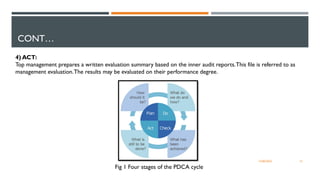
1) PLAN:
A quality officer is appointed who makes plans for
 quality management
 formulating the excellent policies in a written assertion.
2) DO:
 After planning,The stated objectives are processed, introduced and implemented. Resources required are made
available and responsibilities should be determined.
3) CHECK:
 Inner audits can assist to verify that the management system operates well and generates the planned outcomes.
 The approaches are monitored and the consequences are documented and reported to the top management.
11
12/06/2022
HTTPS://ASQ.ORG/QUALITY-RESOURCES/PDCA-CYCLE
CONT…
Fig 1 Four stages of the PDCA cycle
12
12/06/2022
4) ACT:
Top management prepares a written evaluation summary based on the inner audit reports.This file is referred to as
management evaluation.The results may be evaluated on their performance degree.
4.ELEMENTS OF QMS
 The elements of quality management system are:
01- Quality planning
02- Quality assurance
03- Quality control
04- Quality improvement
13
12/06/2022
CONT…
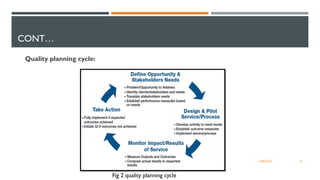
1) Quality planning
The quality planning is basically design a process that will meet the goals which are set or fixed under
operating conditions. it os a methodology which is used:
 When previous service is not meeting the requirement of customer
 Process is extremely variable , not well defined
How to conduct quality planning:
1. Identify customers
2. Develop service/product features
3. Establish quality goals
4. Develop a process
5. Prove process capability
14
12/06/2022
CONT…
Quality planning cycle:
15
12/06/2022
Fig 2 quality planning cycle
CONT…
2) Quality Assurance:
Ø Quality assurance is a systematic process to find out performed service or product meets specific requirement
that is set
Ø At initial phase,quality assurance is implement,when product is in process,so it is process oriented approach
Ø Quality assurance is to prevent the defects
Importance of Quality Assurance:
 Quality assurance helps to create products and services that
• meet the needs
• expectations
• requirements of customers.
16
12/06/2022
CONT…
 It yields high-quality product offerings that build trust and loyalty with customers.
 The standards and procedures defined by a quality assurance program help prevent product defects before
they arise
Why does quality assurance matter
 If you will not assure quality, there will be defects in product , problems will occur and these problems will
influence your entire brand:
 You Will Lose Customer
 Profit will also reduce
 Reputation will be less
 You Will Lose Revenue
17
12/06/2022
CONT…
3) Quality control
The quality control process refers to the steps involved in maintaining consistent standards and
specifications for the products and services you provide to consumers.
Benefits of QC process:
To maintain consistent quality standards, you can develop quality control processes for companies,
departments, and even individual products. Here are some of the benefits of using a quality control
process in the workplace
 Developing a reputation
 Establishing Stakeholder Trust
 Improved customer relations
 Create automation
18
12/06/2022
CONT…
How to create QC process:
 Check industry standards
 Select the most important measures
 Set detailed expectations
 Align process with results
 Develop training materials
 Review and documentation data
 Collect and use feedback
19
12/06/2022
CONT…
4) Quality improvement:
Developing more efficient processes to achieve better end results. Shifting from defect detection to defect
prevention to reduce costs and waste. Standardize processes across to improve quality.
Main goal of quality improvement:
Quality improvement aims to create efficiency in the manufacturing department and satisfy customer needs. In
healthcare, the main purpose of quality improvement is to improve outcomes.
Benefits of the quality improvement process
 Solutions that focus on process failures.
 Relying on objective, data-driven solutions, rather than subjective opinions, to identify inefficiencies, avoidable
errors, and inadequate processes
 Improvements
 A localized focus on testing small, incremental improvements
 Collect data to track improvement efforts
20
12/06/2022
CONT…
Primary issue of quality improvement:
 Quality improvement plans are often measured based on results, employee and stakeholder satisfaction, ease of change, and
cost.
 Quality improvement plans must also help companies understand how to meet the needs of various stakeholders (employees,
customers, regulators, and others), find a way to prioritize those stakeholders' improvement requests,
Difficulty implementing the quality improvement process plan
 Expectations are not clear.
 Leadership is not sufficiently engaged,.
 There is not enough time and resources to properly implement the initiative.
 Collaboration between teams is poor.
 In healthcare, some doctors will not implement new systems until they have confidence in the new processes.
21
12/06/2022
HTTPS://INFO.DOCXELLENT.COM/BLOG/MAIN-COMPONENTS-QUALITY-MANAGEMENT
CONT…
 Specific improvement cycles cannot be evaluated.
 Not enough emphasis is placed on the importance and use of new measures.
 The costs can not be specified.
 The small sample size makes generalizations impossible.
 Solving some problems creates other problems.
 The goals are too ambitious and therefore difficult to achieve.
22
12/06/2022
5.REQUIREMENTS OF QMS
 Its purpose is to ensure that, every time a process is performed, the same information, methods, skills and
controls are used and applied in a consistent manner. Ultimately, this helps to ensure customer satisfaction.
 This may seem simple enough. However, it is essential that certain obstacles are overcome for your QMS to be
successful.With this in mind, ask yourself the following questions:
 Do the same mistakes keep on being repeated?
 No , you can not repeat mistakes, if you will repeat same mistakes, production loss will increase, customer will
not satisfy, profit minimize, and repetition zero.
23
12/06/2022
CONT…
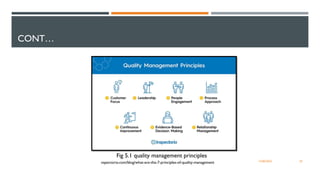
Fig 5.1 quality management principles
24
12/06/2022
nspectorio.com/blog/what-are-the-7-principles-of-quality-management
SEVEN QUALITY MANAGEMENT PRINCIPLES
ISO 9001 QMS is based on seven principles, each one is integral focus of QMS system.These seven principles are as follows:
1 Focus on the customer:
 By putting your customers first and consistently delivering what they want, you increase customer value, satisfaction and loyalty.
 The best companies in the world are all focused on customer satisfaction.They don't just make products and sell them.They
talk to their customers and involve them in co-creation.They listen to their feedback and then act on it.
2 Leadership:
 Great leaders will help your team reach the same quality goals and improve the overall level of quality in your organization.
 To be a great leader, you need to create unity of purpose and direction in your organization.You need to communicate your
common purpose throughout your company.And you must build and maintain values while ensuring that other leaders in your
business adhere to the ethical model.
25
12/06/2022
CONT…
3 People involvement:
 Having engaged and motivated employees and supply chain partners is key to meeting your quality goals and creating value.
 To begin with, you need to set achievable goals.Then you need to reward your employees when they reach or exceed them and
be open to their suggestions.
 When it comes to empowering your suppliers and factories, you can proactively share information about your quality standards
with them and hold them accountable for the quality of the products they supply.
4 Process approach:
 Streamlining your processes and ensuring everyone is on the same page about what needs to be done will help your business deliver consistent
quality to customers.
 you then to analyze your processes and use the results to better deploy resources.
 Digital platforms can help with this process by measuring and analyzing the effectiveness of your processes.You can then optimize your processes
and create higher quality products.
26
12/06/2022
HTTPS://ASQ.ORG/QUALITY-RESOURCES/QUALITY-MANAGEMENT-SYSTEM
5 continuous improvement:
 Innovation is a balancing act.You have to find a balance between learning from your mistakes and acknowledging your successes.
 Rewarding employees and suppliers for their hard work and offering them ways to learn and improve is essential to continuous
improvement.
 However, tracking the performance of your processes and employees can be a tedious process.You can benefit from using a
digital platform to keep track of your company's continuous improvement.
6 Evidence-based decision making:
 You need to collect and analyze useful data.You then need to use data-driven insights to make more informed decisions.
 A data-driven approach has three key advantages.First, it takes a lot of guesswork out of the decision-making process. Second,
you can be more confident in your decisions.And third, you can objectively review and analyze your past decisions.
7 Relationship management:
 Maintaining a strong supply chain requires nurturing your supplier relationships. Over time, this will create a strong spirit of
collaboration from one end of your supply chain to the other. 12/06/2022 27
CONT…
6.INDUSTRIAL INFLUENCE ON QUALITY AND STANDARDIZATION
 When the Industrial Revolution came, early quality management systems were used as standards that controlled
product and process outcomes. Best practices for controlling product and process outcomes were established
and documented.These documented best practices turned into standard practices for quality management
systems.
 Quality became increasingly important during World War II,for example, when bullets made in one state had to
work with rifles made in another.The armed forces initially inspected virtually every unit of product and began to
use quality techniques of sampling for inspection, aided by the publication of military-specification standards.
 The Japanese enjoyed a quality revolution, improving their reputation for shoddy exports.
 By the 1970s, the U.S. industrial sectors, such as electronics and automobiles, had been broadsided by Japan’s high-
quality competition.
28
12/06/2022
CONT…
 The Rise of Quality Management System
 The American response to the quality revolution in Japan gave birth to the concept of total quality management
(TQM)
 In the late 20th century, independent organizations began producing standards to assist in the creation and
implementation of quality management systems.
 18 At the start of the 21st century, QMS had begun to merge with the ideas of sustainability and transparency, as
these themes became increasingly important to consumer satisfaction.
 The implementation of integrated Management system
29
12/06/2022
HTTPS://WWW.QAD.COM/BLOG/2020/02/UNDERSTANDING-THE-IMPORTANCE-OF-QUALITY-STANDARDS
7.BENEFITS OF INTEGRATED MANGEMENT AND CONTROL
1-Improve business focus:
 The system promotes concentrating on the organization's activity, IMS improves and strengthens the connections
between quality, employee health and safety, and social responsibility.
 IMS can improve management efficiency and, in the long run, the business itself, as well as change and improve
organizational culture.
 The researcher acknowledges that IMS can provide a competitive advantage to an organization that implements
IMS by guiding management direction and improving performance.
 IMS can manage business risk because it covers the risk for various management systems
 The researcher believes that each ISO or management system contains a component that focuses on risk
management. In IMS, the system will simultaneously cover the aspects of quality, environment, occupational health
and safety, and risk management risks.
30
12/06/2022
CONT…
2-Conflicts between individual management:
 "IMS helps to promote lean management because both certifications include an internal audit and management review.“
 Instead of having two separate sessions for internal audit and management review, after integration, one session would suffice.
 IMS has the potential to reduce redundancies in management system documentation while also saving resources.
 MS reduce conflict between individual management systems as the integration is identified and rationalized .conflicting, ambiguity,
redundancy, or conflicts in the documentation because it covers the procedure from various perspectives, primarily quality,
environment, occupational health, and safety.
 IMS can reduce the number of audits, the number of documentation and also reduce replication issues.
 One of the benefits of integration is the elimination of duplicate procedures in the systems.
31
12/06/2022
CONT…
 The IMS enables organization to reduce the amount of documentation and bureaucracy that results from work
organization and control by referring to separate procedures or different standards.
3-Raise customer Satisfaction
 There are a number of quality management standards, one of which is employees motivation.
32
12/06/2022
HTTPS://WWW.SQMC.CO.UK/NEWS/BLOG/WHAT-ARE-THE-BENEFITS-OF-A-QUALITY-MANAGEMENT-SYSTEM
8.APPLICATIONS
 Improving Performance
 Eliminating Redundancies
 Accountability
 Establishing consistency
 Reducing Bureaucracy and cost reduction
 Optimize Processes and Resources
 Reducing Maintenance
 Integrated audits
 Facilitated decision making
33
12/06/2022
1. HOLDSWORTH, R. (2003). PRACTICAL APPLICATIONS APPROACH TO DESIGN, DEVELOPMENT AND IMPLEMENTATION OF AN
INTEGRATED MANAGEMENT SYSTEM. JOURNAL OF HAZARDOUS MATERIALS, 104(1-3), 193-205.
2. HTTPS://WWW.IBM.COM/DOCS/EN/BPM/8.5.7?TOPIC=SOURCES-IMS-APPLICATIONS
9.CONCLUSION
 Due to industrial revolution it has been become more difficult and intense to stay competent in this competition.
 The integrated management system must be implied which made it more convenient, effective, flexible and
competitive in industry.
 Different departments have different demands,so all these departments can not be integrated together,the main
objective is towards cost effectiveness, improve management, customer satisfaction etc.
 Organizational culture is improved by using integrated management system and the benefits got from the
combined management system.
34
12/06/2022
REFERENCE
35
12/06/2022
12/06/2022 36

INTEGRATED MANAGEMENT SYSTEM IMS

  • 1.
  • 2.
    TABLE OF CONTENTS qIntroduction Of Integrated Management System q Various Integrated Management Systems q The Four Stages Of The PDCA cycle q Elements Of Quality Management System q Requirements Of Quality Management system q Industrial Influence On Quality And Standard q Benefits Of Integrated Management System q Applications q Conclusion 3 12/06/2022
  • 3.
    1.INTRODUCTION OF IMS An Integrated Management System (IMS) integrates all of an organization's systems and processes into a single comprehensive framework, allowing the organization to function as a single unit with a unified goal. QMS + EMS + SMS + EnMS+ FSMS + ISMS = IMS  Organizations frequently focus on management systems separately, often in silos and sometimes in conflict.A quality team is concerned with the QMS, and an EHS manager is often in charge of both environmental and health issues, or a SHEQ Manager is in charge of safety, health, environment, and quality, and so on.  PDCA cycle for implementation of IMS. 4 12/06/2022 HTTPS://INTEGRATED-STANDARDS.COM/ARTICLES/WHAT-IS-INTEGRATED-MANAGEMENT-SYSTEM
  • 4.
    2.VARIOUS INTEGRATED MANAGEMENTSYSTEM 1) QMS – quality management system  A quality management system (QMS) is a set of policies, processes, and procedures required for planning and execution (manufacturing, development, service) in an organization's core business area that may affect the organization's ability to meet customer requirements.  Example of QMS is ISO 9001:2015.  Other types of quality management systems are used in many industries:  AS9100 Aerospace and Defence  ISO 13485 Medical devices  IATF 16949 Automotive industry 5 12/06/2022 HTTPS://BESTPRACTICE.BIZ/WHAT-IS-THE-DIFFERENCE-BETWEEN-QMS-EMS
  • 5.
    CONT… 2) EMS- EnvironmentManagement System  An environmental management system (EMS) is a set of processes and procedures that enable an organization to reduce environmental impacts and increase its operational efficiency.  The environmental management system (EMS) determines and continuously improves the environmental position and performance of the organization.  The three current EMS in place are:  ISO 14001 Environmental management systems  ecological management and audit system (EMAS)  ISO 14005 6 12/06/2022 HTTPS://BESTPRACTICE.BIZ/WHAT-IS-THE-DIFFERENCE-BETWEEN-QMS-EMS
  • 6.
    CONT…  The mainelements used in the environmental management system:  Ecological policy.  Environmental requirements and voluntary initiatives.  Goals/Objectives.  Structure, responsibility and resources.  Operational control.  Corrective and preventive measures and emergency procedures.  Training & awareness 7 12/06/2022
  • 7.
    CONT… 3) SMS- SafetyManagement System  An SMS determines and continuously improves an organization's health and safety position and performance.  Example : 1. ISO 45001 2. Occupational health and safety management systems  SMS has four components: 1. Security principles 2. Security risk management 3. Ensuring safety 4. Security support 8 12/06/2022 HTTPS://WWW.FAA.GOV/ABOUT/INITIATIVES/SMS
  • 8.
    CONT… 4) EnMS –Energy Management System  An Energy Management System (EnMS) is a framework for energy consumers, including organizations from the industrial, commercial and public sectors, to manage their energy consumption. EnMS determines and continuously improves the energy consumption and impact of the organization.  An example is:  ISO 50001 energy management system 9 12/06/2022 HTTPS://WWW.UNIDO.ORG/STORIES/WHAT-ENERGY-MANAGEMENT-SYSTEM
  • 9.
    CONT… 5) FSMS –Food Safety Management System  A food safety management system confirms that companies in the food industry follow certain procedures and guidelines to ensure the safety of their products for customers.  FSSC 22000 food safety certification  ISO 22000  SQF (Safe Quality Food) 6) ISMS – Information Security Management System  An information security management system defines how your organization should organize and manage its information security.  Example is:  ISO 27000 Internet Security Management System 10 12/06/2022 1. SWAINSON'S HANDBOOK OF TECHNICAL AND QUALITY MANAGEMENT FOR THE FOOD MANUFACTURING SECTOR 2. HTTPS://WWW.ISMS.ONLINE/INFORMATION-SECURITY-MANAGEMENT-SYSTEM-ISMS
  • 10.
    3.FOUR STAGES OFPDCA CYCLE 1) PLAN: A quality officer is appointed who makes plans for  quality management  formulating the excellent policies in a written assertion. 2) DO:  After planning,The stated objectives are processed, introduced and implemented. Resources required are made available and responsibilities should be determined. 3) CHECK:  Inner audits can assist to verify that the management system operates well and generates the planned outcomes.  The approaches are monitored and the consequences are documented and reported to the top management. 11 12/06/2022 HTTPS://ASQ.ORG/QUALITY-RESOURCES/PDCA-CYCLE
  • 11.
    CONT… Fig 1 Fourstages of the PDCA cycle 12 12/06/2022 4) ACT: Top management prepares a written evaluation summary based on the inner audit reports.This file is referred to as management evaluation.The results may be evaluated on their performance degree.
  • 12.
    4.ELEMENTS OF QMS The elements of quality management system are: 01- Quality planning 02- Quality assurance 03- Quality control 04- Quality improvement 13 12/06/2022
  • 13.
    CONT… 1) Quality planning Thequality planning is basically design a process that will meet the goals which are set or fixed under operating conditions. it os a methodology which is used:  When previous service is not meeting the requirement of customer  Process is extremely variable , not well defined How to conduct quality planning: 1. Identify customers 2. Develop service/product features 3. Establish quality goals 4. Develop a process 5. Prove process capability 14 12/06/2022
  • 14.
  • 15.
    CONT… 2) Quality Assurance: ØQuality assurance is a systematic process to find out performed service or product meets specific requirement that is set Ø At initial phase,quality assurance is implement,when product is in process,so it is process oriented approach Ø Quality assurance is to prevent the defects Importance of Quality Assurance:  Quality assurance helps to create products and services that • meet the needs • expectations • requirements of customers. 16 12/06/2022
  • 16.
    CONT…  It yieldshigh-quality product offerings that build trust and loyalty with customers.  The standards and procedures defined by a quality assurance program help prevent product defects before they arise Why does quality assurance matter  If you will not assure quality, there will be defects in product , problems will occur and these problems will influence your entire brand:  You Will Lose Customer  Profit will also reduce  Reputation will be less  You Will Lose Revenue 17 12/06/2022
  • 17.
    CONT… 3) Quality control Thequality control process refers to the steps involved in maintaining consistent standards and specifications for the products and services you provide to consumers. Benefits of QC process: To maintain consistent quality standards, you can develop quality control processes for companies, departments, and even individual products. Here are some of the benefits of using a quality control process in the workplace  Developing a reputation  Establishing Stakeholder Trust  Improved customer relations  Create automation 18 12/06/2022
  • 18.
    CONT… How to createQC process:  Check industry standards  Select the most important measures  Set detailed expectations  Align process with results  Develop training materials  Review and documentation data  Collect and use feedback 19 12/06/2022
  • 19.
    CONT… 4) Quality improvement: Developingmore efficient processes to achieve better end results. Shifting from defect detection to defect prevention to reduce costs and waste. Standardize processes across to improve quality. Main goal of quality improvement: Quality improvement aims to create efficiency in the manufacturing department and satisfy customer needs. In healthcare, the main purpose of quality improvement is to improve outcomes. Benefits of the quality improvement process  Solutions that focus on process failures.  Relying on objective, data-driven solutions, rather than subjective opinions, to identify inefficiencies, avoidable errors, and inadequate processes  Improvements  A localized focus on testing small, incremental improvements  Collect data to track improvement efforts 20 12/06/2022
  • 20.
    CONT… Primary issue ofquality improvement:  Quality improvement plans are often measured based on results, employee and stakeholder satisfaction, ease of change, and cost.  Quality improvement plans must also help companies understand how to meet the needs of various stakeholders (employees, customers, regulators, and others), find a way to prioritize those stakeholders' improvement requests, Difficulty implementing the quality improvement process plan  Expectations are not clear.  Leadership is not sufficiently engaged,.  There is not enough time and resources to properly implement the initiative.  Collaboration between teams is poor.  In healthcare, some doctors will not implement new systems until they have confidence in the new processes. 21 12/06/2022 HTTPS://INFO.DOCXELLENT.COM/BLOG/MAIN-COMPONENTS-QUALITY-MANAGEMENT
  • 21.
    CONT…  Specific improvementcycles cannot be evaluated.  Not enough emphasis is placed on the importance and use of new measures.  The costs can not be specified.  The small sample size makes generalizations impossible.  Solving some problems creates other problems.  The goals are too ambitious and therefore difficult to achieve. 22 12/06/2022
  • 22.
    5.REQUIREMENTS OF QMS Its purpose is to ensure that, every time a process is performed, the same information, methods, skills and controls are used and applied in a consistent manner. Ultimately, this helps to ensure customer satisfaction.  This may seem simple enough. However, it is essential that certain obstacles are overcome for your QMS to be successful.With this in mind, ask yourself the following questions:  Do the same mistakes keep on being repeated?  No , you can not repeat mistakes, if you will repeat same mistakes, production loss will increase, customer will not satisfy, profit minimize, and repetition zero. 23 12/06/2022
  • 23.
    CONT… Fig 5.1 qualitymanagement principles 24 12/06/2022 nspectorio.com/blog/what-are-the-7-principles-of-quality-management
  • 24.
    SEVEN QUALITY MANAGEMENTPRINCIPLES ISO 9001 QMS is based on seven principles, each one is integral focus of QMS system.These seven principles are as follows: 1 Focus on the customer:  By putting your customers first and consistently delivering what they want, you increase customer value, satisfaction and loyalty.  The best companies in the world are all focused on customer satisfaction.They don't just make products and sell them.They talk to their customers and involve them in co-creation.They listen to their feedback and then act on it. 2 Leadership:  Great leaders will help your team reach the same quality goals and improve the overall level of quality in your organization.  To be a great leader, you need to create unity of purpose and direction in your organization.You need to communicate your common purpose throughout your company.And you must build and maintain values while ensuring that other leaders in your business adhere to the ethical model. 25 12/06/2022
  • 25.
    CONT… 3 People involvement: Having engaged and motivated employees and supply chain partners is key to meeting your quality goals and creating value.  To begin with, you need to set achievable goals.Then you need to reward your employees when they reach or exceed them and be open to their suggestions.  When it comes to empowering your suppliers and factories, you can proactively share information about your quality standards with them and hold them accountable for the quality of the products they supply. 4 Process approach:  Streamlining your processes and ensuring everyone is on the same page about what needs to be done will help your business deliver consistent quality to customers.  you then to analyze your processes and use the results to better deploy resources.  Digital platforms can help with this process by measuring and analyzing the effectiveness of your processes.You can then optimize your processes and create higher quality products. 26 12/06/2022 HTTPS://ASQ.ORG/QUALITY-RESOURCES/QUALITY-MANAGEMENT-SYSTEM
  • 26.
    5 continuous improvement: Innovation is a balancing act.You have to find a balance between learning from your mistakes and acknowledging your successes.  Rewarding employees and suppliers for their hard work and offering them ways to learn and improve is essential to continuous improvement.  However, tracking the performance of your processes and employees can be a tedious process.You can benefit from using a digital platform to keep track of your company's continuous improvement. 6 Evidence-based decision making:  You need to collect and analyze useful data.You then need to use data-driven insights to make more informed decisions.  A data-driven approach has three key advantages.First, it takes a lot of guesswork out of the decision-making process. Second, you can be more confident in your decisions.And third, you can objectively review and analyze your past decisions. 7 Relationship management:  Maintaining a strong supply chain requires nurturing your supplier relationships. Over time, this will create a strong spirit of collaboration from one end of your supply chain to the other. 12/06/2022 27 CONT…
  • 27.
    6.INDUSTRIAL INFLUENCE ONQUALITY AND STANDARDIZATION  When the Industrial Revolution came, early quality management systems were used as standards that controlled product and process outcomes. Best practices for controlling product and process outcomes were established and documented.These documented best practices turned into standard practices for quality management systems.  Quality became increasingly important during World War II,for example, when bullets made in one state had to work with rifles made in another.The armed forces initially inspected virtually every unit of product and began to use quality techniques of sampling for inspection, aided by the publication of military-specification standards.  The Japanese enjoyed a quality revolution, improving their reputation for shoddy exports.  By the 1970s, the U.S. industrial sectors, such as electronics and automobiles, had been broadsided by Japan’s high- quality competition. 28 12/06/2022
  • 28.
    CONT…  The Riseof Quality Management System  The American response to the quality revolution in Japan gave birth to the concept of total quality management (TQM)  In the late 20th century, independent organizations began producing standards to assist in the creation and implementation of quality management systems.  18 At the start of the 21st century, QMS had begun to merge with the ideas of sustainability and transparency, as these themes became increasingly important to consumer satisfaction.  The implementation of integrated Management system 29 12/06/2022 HTTPS://WWW.QAD.COM/BLOG/2020/02/UNDERSTANDING-THE-IMPORTANCE-OF-QUALITY-STANDARDS
  • 29.
    7.BENEFITS OF INTEGRATEDMANGEMENT AND CONTROL 1-Improve business focus:  The system promotes concentrating on the organization's activity, IMS improves and strengthens the connections between quality, employee health and safety, and social responsibility.  IMS can improve management efficiency and, in the long run, the business itself, as well as change and improve organizational culture.  The researcher acknowledges that IMS can provide a competitive advantage to an organization that implements IMS by guiding management direction and improving performance.  IMS can manage business risk because it covers the risk for various management systems  The researcher believes that each ISO or management system contains a component that focuses on risk management. In IMS, the system will simultaneously cover the aspects of quality, environment, occupational health and safety, and risk management risks. 30 12/06/2022
  • 30.
    CONT… 2-Conflicts between individualmanagement:  "IMS helps to promote lean management because both certifications include an internal audit and management review.“  Instead of having two separate sessions for internal audit and management review, after integration, one session would suffice.  IMS has the potential to reduce redundancies in management system documentation while also saving resources.  MS reduce conflict between individual management systems as the integration is identified and rationalized .conflicting, ambiguity, redundancy, or conflicts in the documentation because it covers the procedure from various perspectives, primarily quality, environment, occupational health, and safety.  IMS can reduce the number of audits, the number of documentation and also reduce replication issues.  One of the benefits of integration is the elimination of duplicate procedures in the systems. 31 12/06/2022
  • 31.
    CONT…  The IMSenables organization to reduce the amount of documentation and bureaucracy that results from work organization and control by referring to separate procedures or different standards. 3-Raise customer Satisfaction  There are a number of quality management standards, one of which is employees motivation. 32 12/06/2022 HTTPS://WWW.SQMC.CO.UK/NEWS/BLOG/WHAT-ARE-THE-BENEFITS-OF-A-QUALITY-MANAGEMENT-SYSTEM
  • 32.
    8.APPLICATIONS  Improving Performance Eliminating Redundancies  Accountability  Establishing consistency  Reducing Bureaucracy and cost reduction  Optimize Processes and Resources  Reducing Maintenance  Integrated audits  Facilitated decision making 33 12/06/2022 1. HOLDSWORTH, R. (2003). PRACTICAL APPLICATIONS APPROACH TO DESIGN, DEVELOPMENT AND IMPLEMENTATION OF AN INTEGRATED MANAGEMENT SYSTEM. JOURNAL OF HAZARDOUS MATERIALS, 104(1-3), 193-205. 2. HTTPS://WWW.IBM.COM/DOCS/EN/BPM/8.5.7?TOPIC=SOURCES-IMS-APPLICATIONS
  • 33.
    9.CONCLUSION  Due toindustrial revolution it has been become more difficult and intense to stay competent in this competition.  The integrated management system must be implied which made it more convenient, effective, flexible and competitive in industry.  Different departments have different demands,so all these departments can not be integrated together,the main objective is towards cost effectiveness, improve management, customer satisfaction etc.  Organizational culture is improved by using integrated management system and the benefits got from the combined management system. 34 12/06/2022
  • 34.
  • 35.