International Organization
for Standardization
Er. Vaibhav Agarwal
Asst. Prof.
BBD University, Lucknow
Overview of ISO 9
a d 1 S O 14001
By:
Er.
Vai
bh
av
Ag
arw
al
Asst. Prof.
SOM, BBDU
ISO 9001 and ISO 14001 in brief
►
►
►
ISO's most well
ISO 9001 and ISO 14001 are among
known standards ever.
They are implemented by more than a million
organizations in some 175 countries.
ISO 9001 helps organizations to implement
quality management.
» ISO 14001 helps organizations to implement
environmental management.
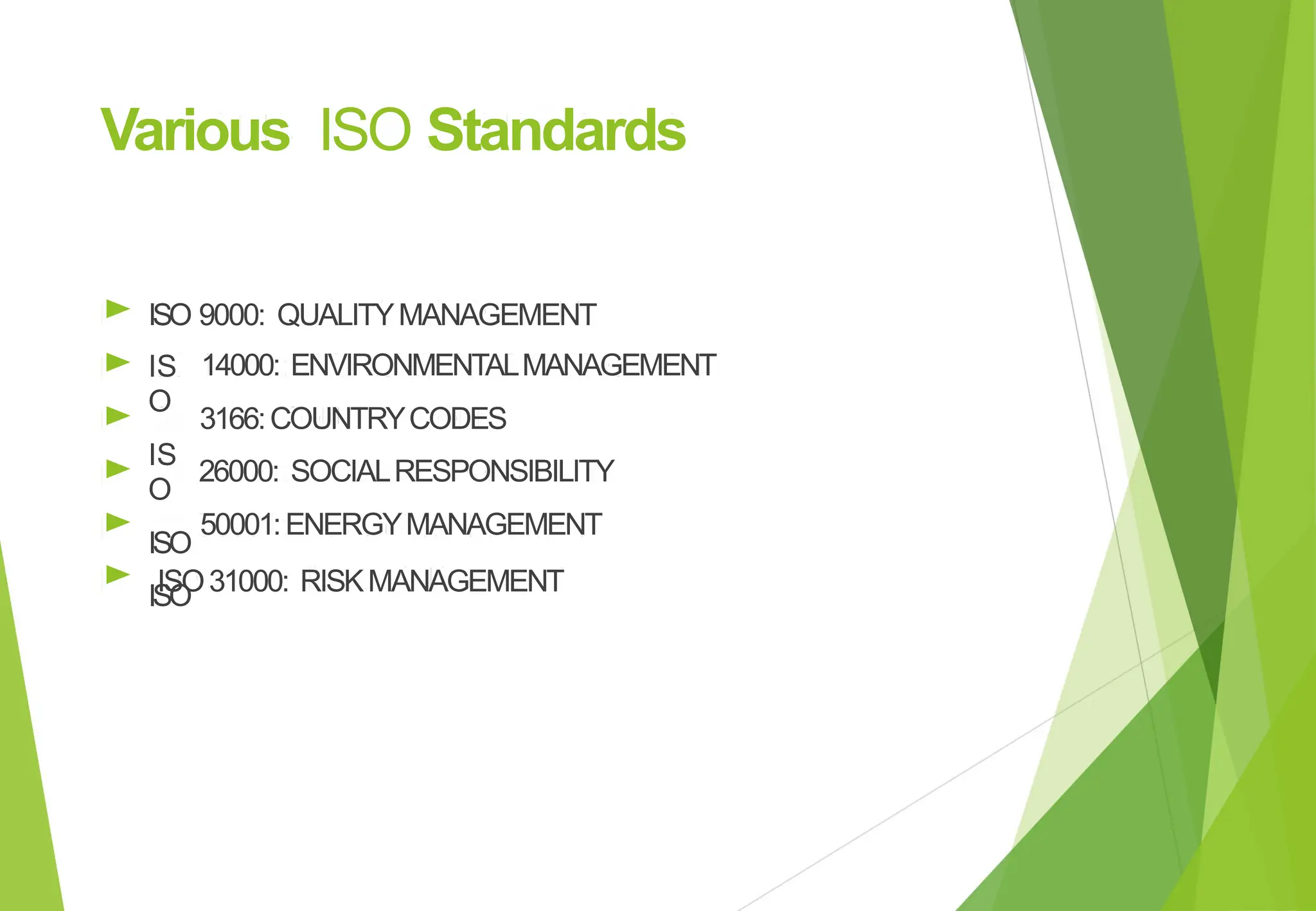
Various ISO Standards
►
►
►
►
►
►
ISO
IS
O
IS
O
ISO
ISO
9000: QUALITYMANAGEMENT
14000: ENVIRONMENTALMANAGEMENT
3166:COUNTRYCODES
26000: SOCIALRESPONSIBILITY
50001:ENERGYMANAGEMENT
ISO31000: RISKMANAGEMENT
CONT..
►
►
►
►
►
ISO
IS
O
IS
O
IS
O
IS
O
22000:
27001:
45001:
37001:
13485:
FOODSAFETYMANAGEMENT
INFORMATION SECURITY
MANAGEMENT
OCCUPATIONALHEALTH & SAFETY
ANTI BRIBERYMANAGEMENT SYSTEMS
MEDICALDEVICES
Benefits of ISO Standards
► International Standards are the backbone of our
society, ensuring the safety and quality of products and
services, facilitating international trade and
improving the environment in which we live in.
► By following International Standards helps reassuring
consumers that products, systems and organizations
are safe, reliable and
good
for the environment.
Economic Benefits of Standards
► Numerous studies have shown that standards boost busin
for a
standa
r
economies. In the UK, for example, standards account
annual growth in GDP
, while in Canada, the use of
injected over $91bn into the economy since 1981.
► International Standards are strategic tools and guidelines
companies tackle some of the most demanding challenges of mode
business.
possible,
markets.
They ensure that business operations are as efficient a
increase productivity and help companies access
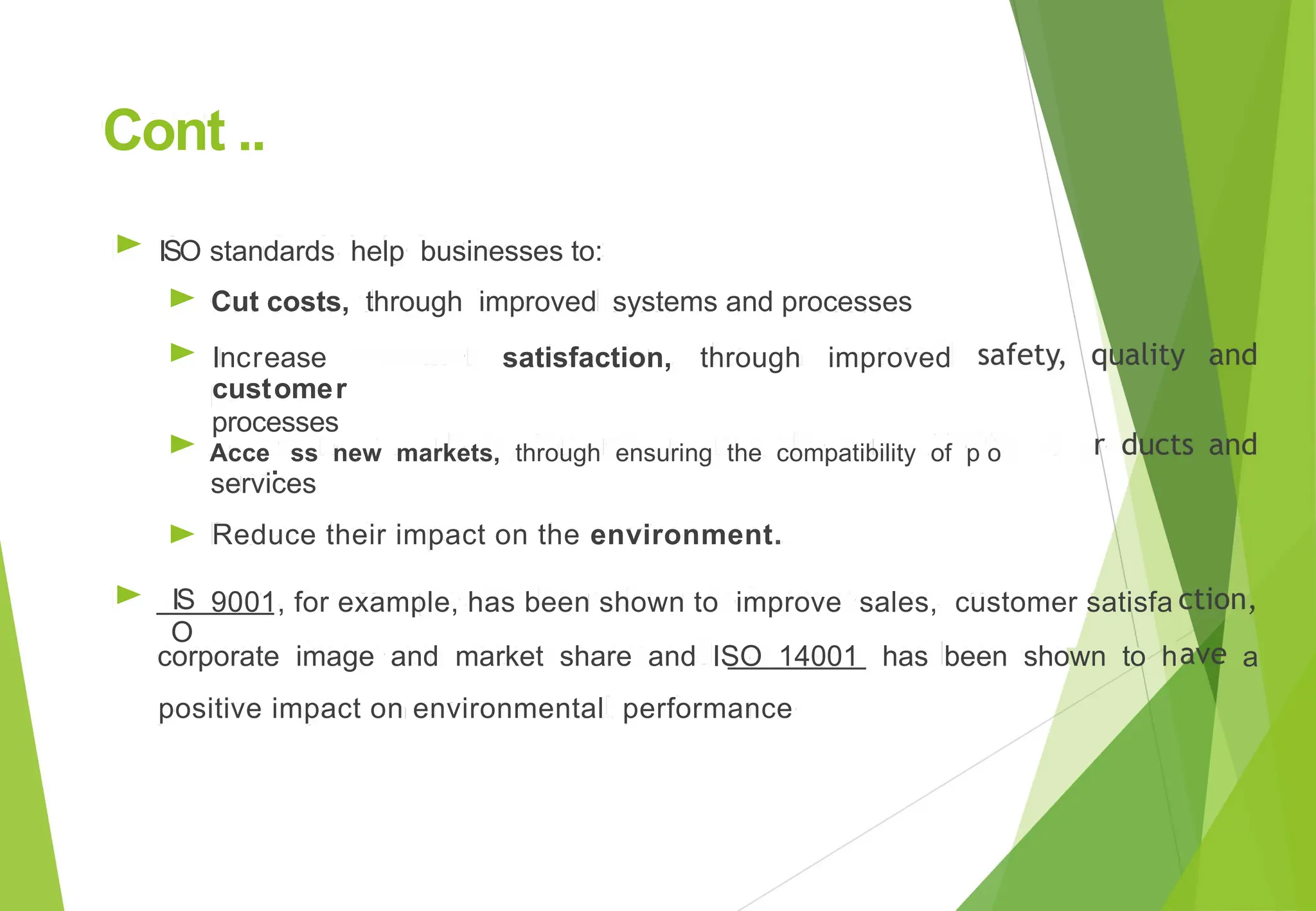
Cont ..
► ISO
►
►
►
►
IS
O
standards help businesses to:
Cut costs, through improved systems and processes
Increase
customer
processes
satisfaction, through improved
Acce
. ss new markets, through ensuring the compatibility of p o
services
Reduce their impact on the environment.
► 9001, for example, has been shown to improve sales, customer satisfa
corporate image and market share and ISO 14001
positive impact on environmental performance
has been shown to h a
ISO STANDARDS IN ACTION
Food
~
Sustainable Development
ISO International standards create confidence in the
Sustainable Development is "meeting the needs of
the present without compromising the ability of
fut ure generations to meet their own needs"
(W ED)
products we eat or drink by ensuring the world uses
the same recipe when it comes to quality, safety
and efficiency
Many of ISO's 21000 standards help businesses and
organizations do just that, for the environment
economy and society
ISO has more than 1000 standards dedicated to
food. covering everything from agricultural
machinery
to transportation. manufacturing and storage.
ISO
Water
STANDARDS IN ACTION
Services
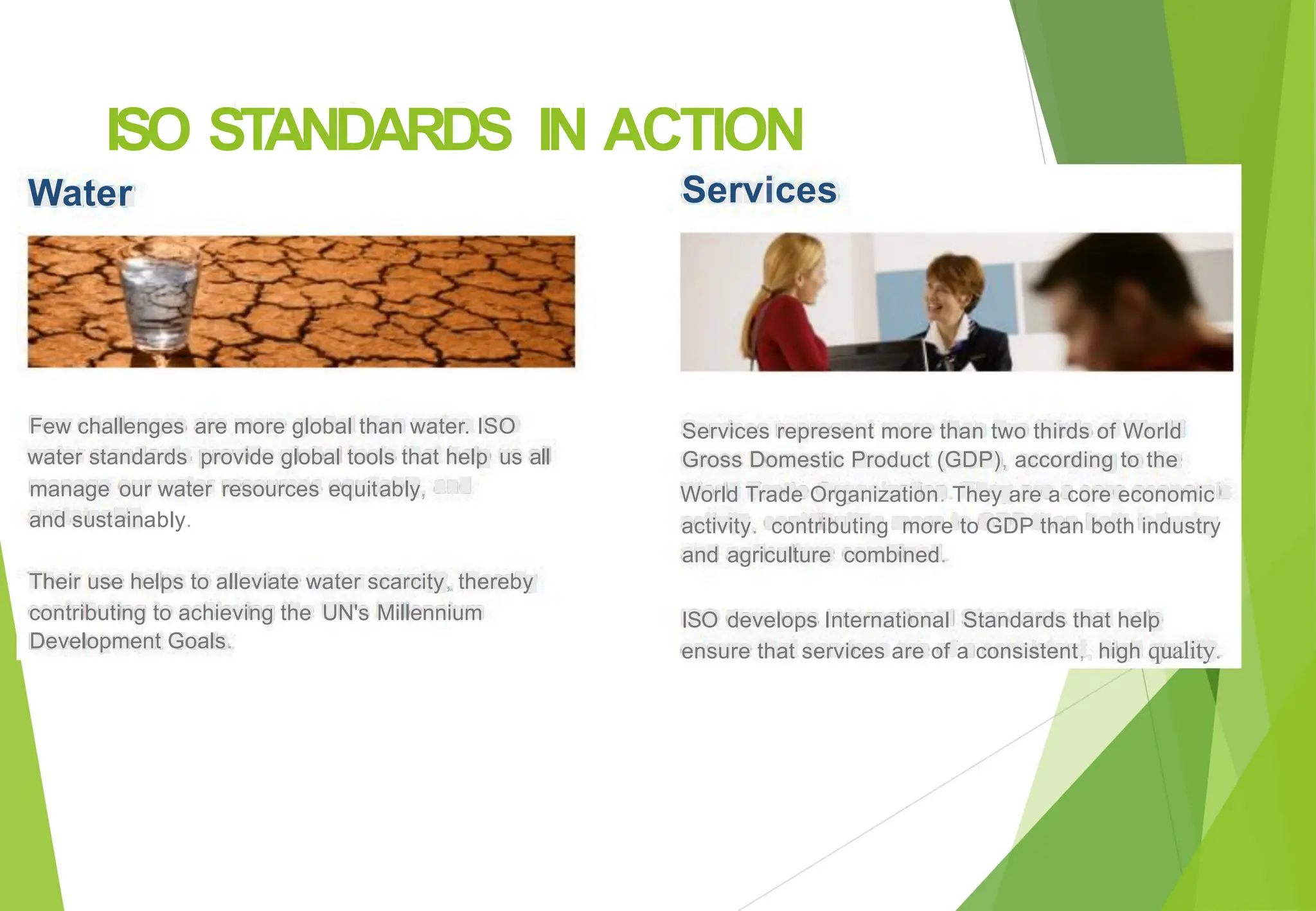
Few challenges are more global than water. ISO Services represent more than two thirds of World
Gross Domestic Product (GDP), according to the
World Trade Organization. They are a core economic
activity. contributing more to GDP than both industry
water standards provide global tools that help
manage our water resources equitably,
and sustainably.
us all
and agriculture combined.
Their use helps to alleviate water scarcity, thereby
contributing to achieving the
Development Goals.
UN's Millennium ISO develops International Standards that help
ensure that services are of a consistent, high quality.
ISO STANDARDS IN ACTION
Energy and renewables
Climate change
Climate change is the major environmental challenge
of our time. Reducing energy consumption and the dependency
on fossil fuels is a major challenge.
ISO standards help tackle climate change, with
requirements for measuring greenhouse gas
emissions and verifying claims made about them,
as
well as standards that focus on environmental and
energy management.
ISO International standards can help solve the
energy challenge by increasing energy efficiency,
and promoting the development of renewable
energy technolo gies
ISO
Transport
STANDARDS IN ACTION
Health and safety
} sL•
l
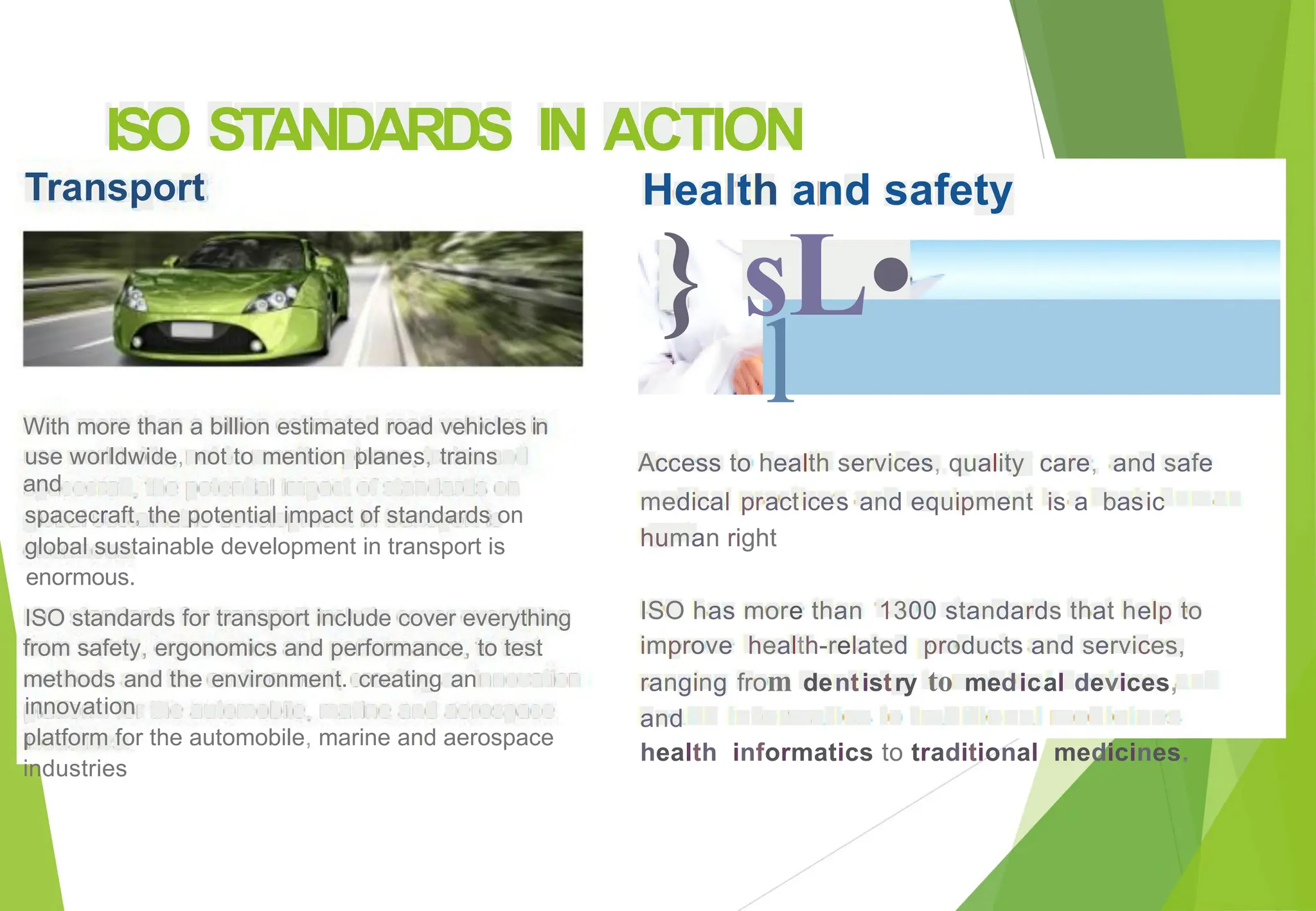
With more than a billion estimated road vehicles
use worldwide, not to mention planes, trains
and
spacecraft, the potential impact of standards on
global sustainable development in transport is
enormous.
in
Access to health services, quality care, and safe
medical practices and equipment is a basic
human right
ISO has more than 1300 standards that help to
improve health-related products and services,
ranging from dentistry to medical devices,
and
health informatics to traditional medicines.
ISO standards for transport include cover everything
from safety, ergonomics and performance, to test
methods and the environment. creating an
innovation
platform for the automobile, marine and aerospace
industries
Quality management
►
►
►
►
►
ISO 9001 is for quality management.
Quality refers to all those features of
(or service) which are required by the
a product
customer.
Quality management
organization does to
means what the
ensure that its products or services satisfy the
customer's quality requirements and
comply wit h any regulations applicable to
those
products or services.
Quality management (cont.)
►
►
►
Quality management also means what
to
the organization does
enhance customer satisfaction,
and
achieve continual improvement of its performance.
Environmental management
►
►
►
►
ISO 14001 is for environmental management. This means
what the organization does to:
minimize harmful effects on the environment caused by
its activities,
to conform to applicable regulatory requirements, and to
achieve continual improvement of its environmental
performance.
Generic standards
ISO 9001 and ISO 14001 are generic standards.
Generic means that the same standards can be applied:
to any organization, large or small, whatever its product
or service,
►
►
in any sector of activity, and
whether it is a business enterprise, a public
administration, or a government department .
Generic standards (cont.)
Generic also signifies that
►
►
►
no matter what the organization's scope of activity
if it wants to establish a quality management system,
9001 gives the essential features
ISO
or if it wants to establish an environmental management
system, ISO 14001 gives the essential features.
Management systems
►Management system means what the
organization does to manage its processes,
that
or
activities in
its products
order
►
►
►
►
or services meet the
organization's objectives, such as
satisfying the customer's quality
requirements,
complying to regulations, or
meeting environmental
objectives
Management systems
►To be really efficient and effective,
organization can manage it s way
of
things by systemizing it.
Nothing important is left out.
the
doing
►
►
►
Everyone is clear about who is responsible
for doing what, when, how, why and where.
Management
organization
system standards provide the
with an international, state-of•
the-art model to fallow.
Management systems (cont.)
►
►
►
Large organizations, or ones with complicated
processes, could not function well without management
systems.
Companies in such fields as aerospace,
automobiles, defence, or health care devices have
been operating management systems for years.
The ISO 9001 and ISO 14001 management
system standards
now make these successful practices available for all
organizations.
Processes, not products
►
►
►
►
►
Both ISO 9001 and ISO 14001 concern the way
about its work.
an
organization goes
They
They
They
They
are
are
are
can
not
not
product standards.
service standards.
process standards.
be used by product manufacturers
and
service
providers.
Processes, not products (cont.)
►
►
Processes affect final products or services.
ISO 9001 gives the requirements for what the organization
must do to manage processes affecting quality of its
products and services.
ISO 14001 gives the requirements for what the
organization
must do to manage processes affecting the impact of its
activities on the environment.
►
Certification and registration
►
►
Certification is known in some countries as registration.
It means that an independent, external body has audited
an
organization's management system and verified that it
conforms to the requirements specified in the standard (ISO
9001 or ISO 14001 ).
ISO does not carry out certification and does not issue or
approve certificates,
►
Accreditation
►
►
Accreditation is like certification of the certification
body.
It means the formal approval by a specialized body - an
is
accreditation body - that a
competent to carry out ISO
14001 :2004 certification in
certification body
9001 :2008 or ISO
specified business sectors.
bodies -
► Certificates issued by accredited certification
and known as accredited certificates - may be
perceived on the market as having increased
credibility.
ISO does not carry out or approve
accreditations.
►
Certification not a requirement
►
►
►
Certification is not a requirement of ISO 9001 or ISO
14001.
The organization can implement and benefit fram an ISO
9001 or ISO 14001 system without having it certified.
The organization can implement them for the
internal benefits without spending money on a
certification programme.
Certification
decision
is a business
►
►
►
►
►
Certification is a decision to be taken for business reasons:
if
If
it
if
it
it
is
it
is a contractual, regulatory, or market requirement,
meets customer preferences
part of a risk management programme, or
will motivate staff by setting a clear goal.
ISO does not certify
►
►
►
►
ISO
ISO
does not carry out ISO 9001 or ISO 14001 certification.
does not issue certificates.
ISO does not accredit, approve or control the certification
bodies.
ISO develops standards and guides to encourage
good practice in accreditation and certification.
9000 family
The ISO
►
►
►
►
ISO 9001 is the standard that gives the requirements for a
quality management
ISO 9001 :2008 is the
system.
latest, improved version.
It is the only standard in the ISO 9000 family that can be
used for certification.
There are 16 other standards in the family that can help
an organization on specific aspects such as performance
improvement , auditing, training...
The ISO 14000 family
►ISO 14001 is the standard that gives the
requirement s for an environmental
management
system.
ISO 14001:2004 is the latest , improved
version. It is the only standard in the ISO
14000 family
that can be used for certification.
The ISO 14000 family includes 21
other standards
that can help an organization specific
aspects such as audit ing, environment al
►
►
►
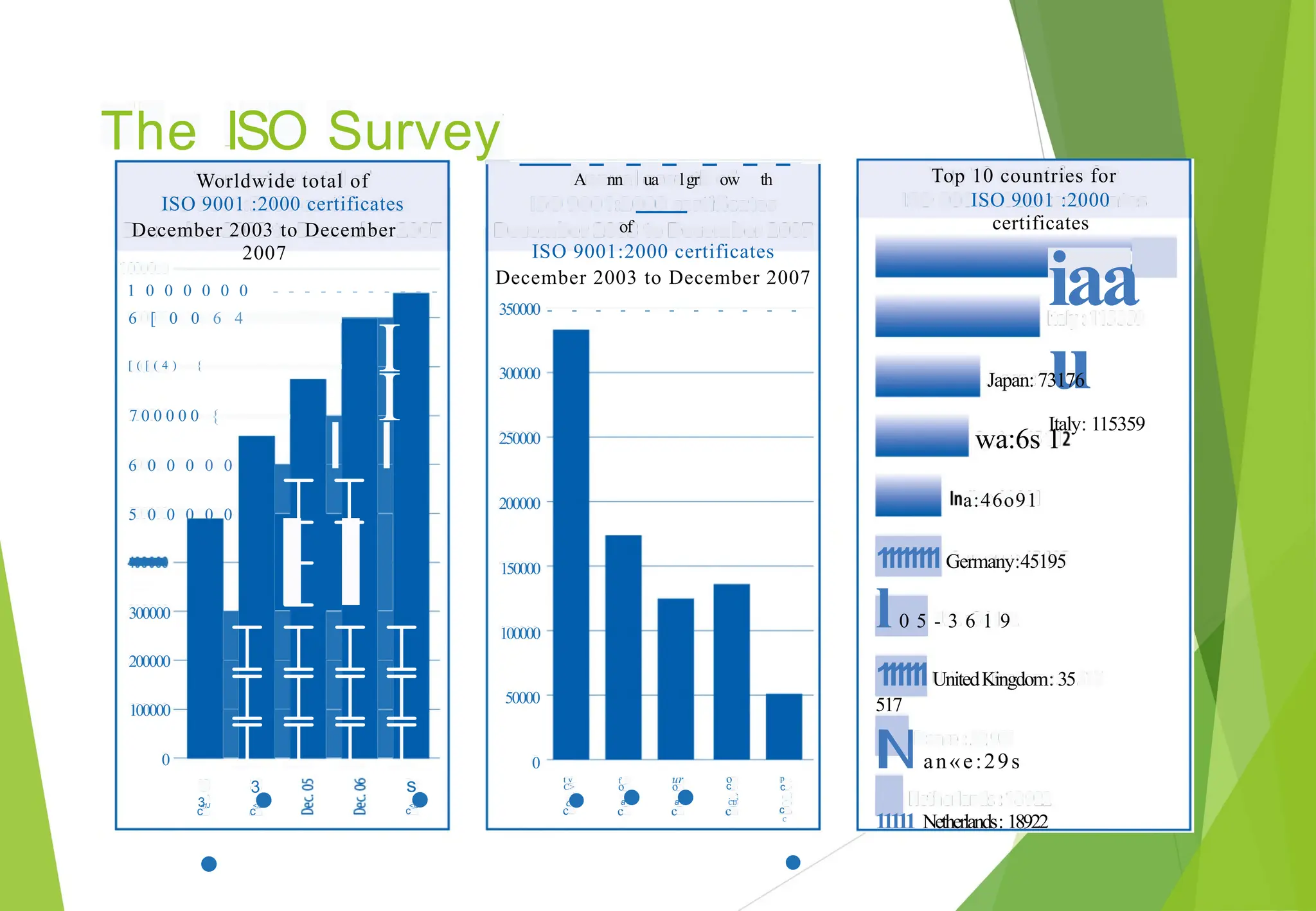
The ISO Survey -
-
-
-A
-nn
-ua
-lgr
-ow
-th
-
of
-
-
-
-
ISO 9001:2000 certificates
December 2003 to December 2007
Top 10 countries for
ISO 9001 :2000
certificates
iaa
u
Italy: 115359
Worldwide total of
ISO 9001 :2000 certificates
December 2003 to December
2007
1 0 0 0 0 0 0 - - - - - - - - - - -
350000 - - - - - - - - - - -
6 [ 0 0 6 4
I
I
[ ( [ ( 4 ) {
300000 Japan: 73176
7 0 0 0 0 0 {
I I wa:6s 1
250000
II
I
6 0 0 0 0 0
a:46o91
200000
I I
5 0 0 0 0 0
1
1
1
1
1
1
1
1Germany:45195
l0 5 - 3 6 1 9
1
1
1
1
1
1UnitedKingdom: 35
517
lNan«e:29s
11111 Netherlands: 18922
150000
=
300000
IIII 100000
IIII
200000
50000
IIII
100000
0 0
• •
3
•
• • • C
•
s ur o p
c
t v f
3 o o c
._;
ClJ
c
C>
c a
c
a
c
<1J <1J <1J
c
c c c
c
The ISO Survey (cont.)
►
►
►
The
end
This
of certificates to ISO 9001:2001 at the
486.
worldwide total
of 2007 was 951
was increase of 6 % over
2006
when the total was
896
929 certificates.
Certificates had been issued in 175
170 the previous year.
countries compared to
The ISO Survey (cont.)
Annual growth of
ISO 14001 :2004 certificates
December 2005 to
December 2007
Top 1 0 countries for
ISO 14001:2004
certificates
Worldwide total of
ISO 14001:2004 certificates
December 2005 to
December 2007
28000
160000
26000
24000
140000
22000
Spain: 13
852
120000
20000
ltaly:12057
18000
100000
16000
- United Kingdom : 7 323
14000
80000
11111111 Korea,Republicof:6392
l " 0 5 . 5 « 0
l 6way:4an7
l wen:3 aoo
.. France :3476
12000
60000 10000
8000
40000
6000
4000
20000
2000
0
0
•
o f
c
%
8
:i:
l
cLr
8
,._;
c"'
cf
:i:l
c
¥
c"' c
c c
c
The ISO Survey (cont.)
►
►
►
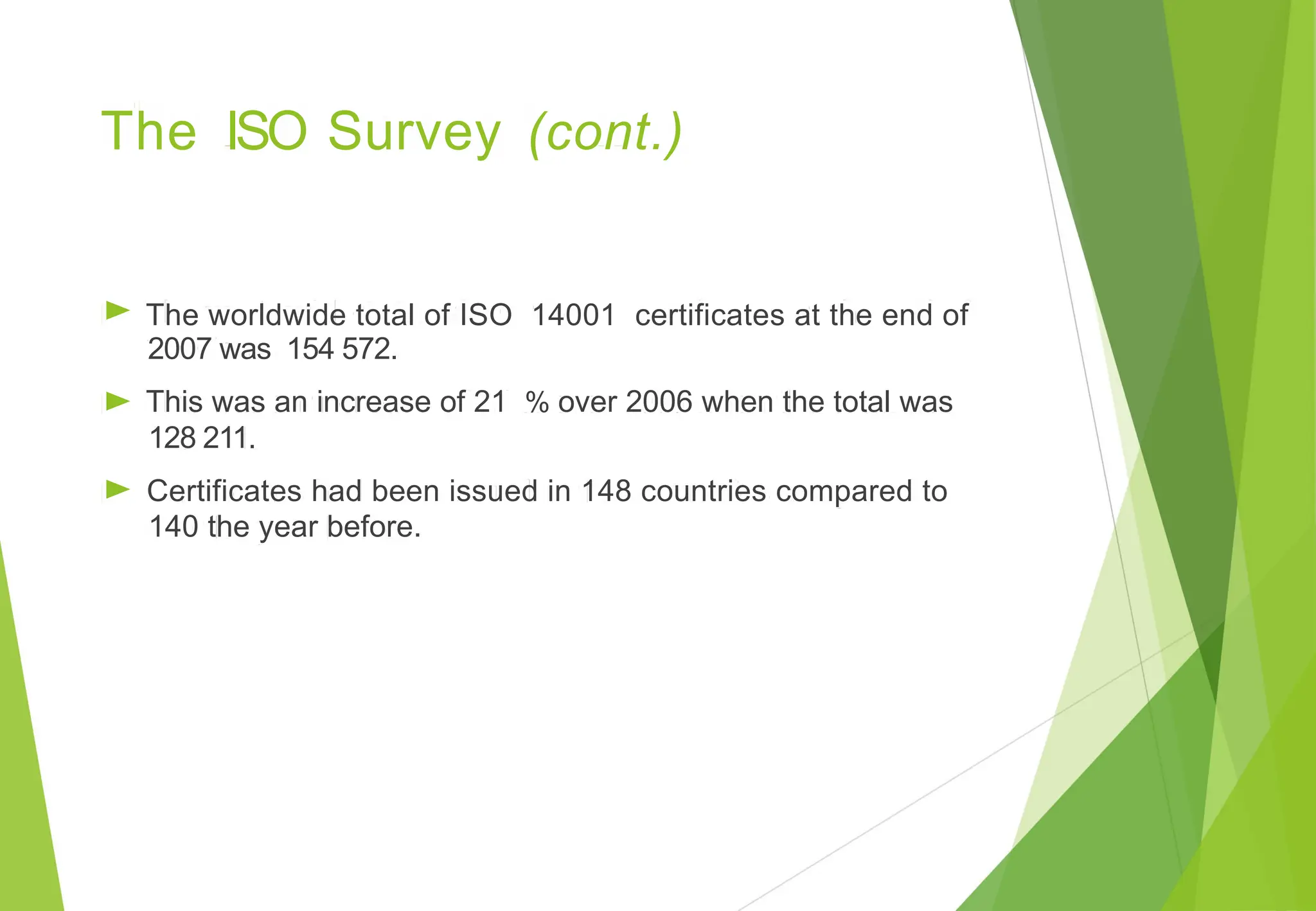
The worldwide total of ISO 14001 certificates at the end of
2007 was 154 572.
This was an increase of 21 % over 2006 when the total was
128 211.
Certificates had been issued in 148 countries compared to
140 the year before.
Benefits of
14001
ISO 9001 and ISO
►
►
►
►
International, expert consensus on state-of-the-art practices
for quality and environmental management.
Common language for dealing with customers and suppliers
worldwide in B2B.
Increase efficiency and effectiveness.
Model for continual improvement.
of ISO 9001 and ISO
Benefits
14001 (cont.)
►
►
►
►
Model for satisfying customers and other stakeholders.
Build quality into products and services from design
onwards. Address environmental concerns of customers
and public,
and comply with government regulations.
Integrate with global economy.
Benefits of ISO 9001 and ISO 14001 ( ont.)
►
►
►
►
Sustainable business
Unifying base for industry sectors
Qualify suppliers for global supply chains
Technical support for regulations
of ISO 9001 and ISO
Benefits
14001 (cont.)
► Transfer of good practice to developing countries
Tools for new economic players
Regional integration
Facilitate rise of services
►
►
►
More information
►
►
►
ISO 9000/ISO 14000 section on ISO Web site:
www.iso.org
ISO Management Systems magazine
www.iso.org/ims
IMS Alerts free electronic newsletter
www.iso.org/imsalerts
THANK YOU

iso standards and significance of iso 9000

  • 1.
    International Organization for Standardization Er.Vaibhav Agarwal Asst. Prof. BBD University, Lucknow
  • 2.
    Overview of ISO9 a d 1 S O 14001 By: Er. Vai bh av Ag arw al Asst. Prof. SOM, BBDU
  • 3.
    ISO 9001 andISO 14001 in brief ► ► ► ISO's most well ISO 9001 and ISO 14001 are among known standards ever. They are implemented by more than a million organizations in some 175 countries. ISO 9001 helps organizations to implement quality management. » ISO 14001 helps organizations to implement environmental management.
  • 4.
    Various ISO Standards ► ► ► ► ► ► ISO IS O IS O ISO ISO 9000:QUALITYMANAGEMENT 14000: ENVIRONMENTALMANAGEMENT 3166:COUNTRYCODES 26000: SOCIALRESPONSIBILITY 50001:ENERGYMANAGEMENT ISO31000: RISKMANAGEMENT
  • 5.
  • 6.
    Benefits of ISOStandards ► International Standards are the backbone of our society, ensuring the safety and quality of products and services, facilitating international trade and improving the environment in which we live in. ► By following International Standards helps reassuring consumers that products, systems and organizations are safe, reliable and good for the environment.
  • 7.
    Economic Benefits ofStandards ► Numerous studies have shown that standards boost busin for a standa r economies. In the UK, for example, standards account annual growth in GDP , while in Canada, the use of injected over $91bn into the economy since 1981. ► International Standards are strategic tools and guidelines companies tackle some of the most demanding challenges of mode business. possible, markets. They ensure that business operations are as efficient a increase productivity and help companies access
  • 8.
    Cont .. ► ISO ► ► ► ► IS O standardshelp businesses to: Cut costs, through improved systems and processes Increase customer processes satisfaction, through improved Acce . ss new markets, through ensuring the compatibility of p o services Reduce their impact on the environment. ► 9001, for example, has been shown to improve sales, customer satisfa corporate image and market share and ISO 14001 positive impact on environmental performance has been shown to h a
  • 9.
    ISO STANDARDS INACTION Food ~ Sustainable Development ISO International standards create confidence in the Sustainable Development is "meeting the needs of the present without compromising the ability of fut ure generations to meet their own needs" (W ED) products we eat or drink by ensuring the world uses the same recipe when it comes to quality, safety and efficiency Many of ISO's 21000 standards help businesses and organizations do just that, for the environment economy and society ISO has more than 1000 standards dedicated to food. covering everything from agricultural machinery to transportation. manufacturing and storage.
  • 10.
    ISO Water STANDARDS IN ACTION Services Fewchallenges are more global than water. ISO Services represent more than two thirds of World Gross Domestic Product (GDP), according to the World Trade Organization. They are a core economic activity. contributing more to GDP than both industry water standards provide global tools that help manage our water resources equitably, and sustainably. us all and agriculture combined. Their use helps to alleviate water scarcity, thereby contributing to achieving the Development Goals. UN's Millennium ISO develops International Standards that help ensure that services are of a consistent, high quality.
  • 11.
    ISO STANDARDS INACTION Energy and renewables Climate change Climate change is the major environmental challenge of our time. Reducing energy consumption and the dependency on fossil fuels is a major challenge. ISO standards help tackle climate change, with requirements for measuring greenhouse gas emissions and verifying claims made about them, as well as standards that focus on environmental and energy management. ISO International standards can help solve the energy challenge by increasing energy efficiency, and promoting the development of renewable energy technolo gies
  • 12.
    ISO Transport STANDARDS IN ACTION Healthand safety } sL• l With more than a billion estimated road vehicles use worldwide, not to mention planes, trains and spacecraft, the potential impact of standards on global sustainable development in transport is enormous. in Access to health services, quality care, and safe medical practices and equipment is a basic human right ISO has more than 1300 standards that help to improve health-related products and services, ranging from dentistry to medical devices, and health informatics to traditional medicines. ISO standards for transport include cover everything from safety, ergonomics and performance, to test methods and the environment. creating an innovation platform for the automobile, marine and aerospace industries
  • 13.
    Quality management ► ► ► ► ► ISO 9001is for quality management. Quality refers to all those features of (or service) which are required by the a product customer. Quality management organization does to means what the ensure that its products or services satisfy the customer's quality requirements and comply wit h any regulations applicable to those products or services.
  • 14.
    Quality management (cont.) ► ► ► Qualitymanagement also means what to the organization does enhance customer satisfaction, and achieve continual improvement of its performance.
  • 15.
    Environmental management ► ► ► ► ISO 14001is for environmental management. This means what the organization does to: minimize harmful effects on the environment caused by its activities, to conform to applicable regulatory requirements, and to achieve continual improvement of its environmental performance.
  • 16.
    Generic standards ISO 9001and ISO 14001 are generic standards. Generic means that the same standards can be applied: to any organization, large or small, whatever its product or service, ► ► in any sector of activity, and whether it is a business enterprise, a public administration, or a government department .
  • 17.
    Generic standards (cont.) Genericalso signifies that ► ► ► no matter what the organization's scope of activity if it wants to establish a quality management system, 9001 gives the essential features ISO or if it wants to establish an environmental management system, ISO 14001 gives the essential features.
  • 18.
    Management systems ►Management systemmeans what the organization does to manage its processes, that or activities in its products order ► ► ► ► or services meet the organization's objectives, such as satisfying the customer's quality requirements, complying to regulations, or meeting environmental objectives
  • 19.
    Management systems ►To bereally efficient and effective, organization can manage it s way of things by systemizing it. Nothing important is left out. the doing ► ► ► Everyone is clear about who is responsible for doing what, when, how, why and where. Management organization system standards provide the with an international, state-of• the-art model to fallow.
  • 20.
    Management systems (cont.) ► ► ► Largeorganizations, or ones with complicated processes, could not function well without management systems. Companies in such fields as aerospace, automobiles, defence, or health care devices have been operating management systems for years. The ISO 9001 and ISO 14001 management system standards now make these successful practices available for all organizations.
  • 21.
    Processes, not products ► ► ► ► ► BothISO 9001 and ISO 14001 concern the way about its work. an organization goes They They They They are are are can not not product standards. service standards. process standards. be used by product manufacturers and service providers.
  • 22.
    Processes, not products(cont.) ► ► Processes affect final products or services. ISO 9001 gives the requirements for what the organization must do to manage processes affecting quality of its products and services. ISO 14001 gives the requirements for what the organization must do to manage processes affecting the impact of its activities on the environment. ►
  • 23.
    Certification and registration ► ► Certificationis known in some countries as registration. It means that an independent, external body has audited an organization's management system and verified that it conforms to the requirements specified in the standard (ISO 9001 or ISO 14001 ). ISO does not carry out certification and does not issue or approve certificates, ►
  • 24.
    Accreditation ► ► Accreditation is likecertification of the certification body. It means the formal approval by a specialized body - an is accreditation body - that a competent to carry out ISO 14001 :2004 certification in certification body 9001 :2008 or ISO specified business sectors. bodies - ► Certificates issued by accredited certification and known as accredited certificates - may be perceived on the market as having increased credibility. ISO does not carry out or approve accreditations. ►
  • 25.
    Certification not arequirement ► ► ► Certification is not a requirement of ISO 9001 or ISO 14001. The organization can implement and benefit fram an ISO 9001 or ISO 14001 system without having it certified. The organization can implement them for the internal benefits without spending money on a certification programme.
  • 26.
    Certification decision is a business ► ► ► ► ► Certificationis a decision to be taken for business reasons: if If it if it it is it is a contractual, regulatory, or market requirement, meets customer preferences part of a risk management programme, or will motivate staff by setting a clear goal.
  • 27.
    ISO does notcertify ► ► ► ► ISO ISO does not carry out ISO 9001 or ISO 14001 certification. does not issue certificates. ISO does not accredit, approve or control the certification bodies. ISO develops standards and guides to encourage good practice in accreditation and certification.
  • 28.
    9000 family The ISO ► ► ► ► ISO9001 is the standard that gives the requirements for a quality management ISO 9001 :2008 is the system. latest, improved version. It is the only standard in the ISO 9000 family that can be used for certification. There are 16 other standards in the family that can help an organization on specific aspects such as performance improvement , auditing, training...
  • 29.
    The ISO 14000family ►ISO 14001 is the standard that gives the requirement s for an environmental management system. ISO 14001:2004 is the latest , improved version. It is the only standard in the ISO 14000 family that can be used for certification. The ISO 14000 family includes 21 other standards that can help an organization specific aspects such as audit ing, environment al ► ► ►
  • 30.
    The ISO Survey- - - -A -nn -ua -lgr -ow -th - of - - - - ISO 9001:2000 certificates December 2003 to December 2007 Top 10 countries for ISO 9001 :2000 certificates iaa u Italy: 115359 Worldwide total of ISO 9001 :2000 certificates December 2003 to December 2007 1 0 0 0 0 0 0 - - - - - - - - - - - 350000 - - - - - - - - - - - 6 [ 0 0 6 4 I I [ ( [ ( 4 ) { 300000 Japan: 73176 7 0 0 0 0 0 { I I wa:6s 1 250000 II I 6 0 0 0 0 0 a:46o91 200000 I I 5 0 0 0 0 0 1 1 1 1 1 1 1 1Germany:45195 l0 5 - 3 6 1 9 1 1 1 1 1 1UnitedKingdom: 35 517 lNan«e:29s 11111 Netherlands: 18922 150000 = 300000 IIII 100000 IIII 200000 50000 IIII 100000 0 0 • • 3 • • • • C • s ur o p c t v f 3 o o c ._; ClJ c C> c a c a c <1J <1J <1J c c c c c
  • 31.
    The ISO Survey(cont.) ► ► ► The end This of certificates to ISO 9001:2001 at the 486. worldwide total of 2007 was 951 was increase of 6 % over 2006 when the total was 896 929 certificates. Certificates had been issued in 175 170 the previous year. countries compared to
  • 32.
    The ISO Survey(cont.) Annual growth of ISO 14001 :2004 certificates December 2005 to December 2007 Top 1 0 countries for ISO 14001:2004 certificates Worldwide total of ISO 14001:2004 certificates December 2005 to December 2007 28000 160000 26000 24000 140000 22000 Spain: 13 852 120000 20000 ltaly:12057 18000 100000 16000 - United Kingdom : 7 323 14000 80000 11111111 Korea,Republicof:6392 l " 0 5 . 5 « 0 l 6way:4an7 l wen:3 aoo .. France :3476 12000 60000 10000 8000 40000 6000 4000 20000 2000 0 0 • o f c % 8 :i: l cLr 8 ,._; c"' cf :i:l c ¥ c"' c c c c
  • 33.
    The ISO Survey(cont.) ► ► ► The worldwide total of ISO 14001 certificates at the end of 2007 was 154 572. This was an increase of 21 % over 2006 when the total was 128 211. Certificates had been issued in 148 countries compared to 140 the year before.
  • 34.
    Benefits of 14001 ISO 9001and ISO ► ► ► ► International, expert consensus on state-of-the-art practices for quality and environmental management. Common language for dealing with customers and suppliers worldwide in B2B. Increase efficiency and effectiveness. Model for continual improvement.
  • 35.
    of ISO 9001and ISO Benefits 14001 (cont.) ► ► ► ► Model for satisfying customers and other stakeholders. Build quality into products and services from design onwards. Address environmental concerns of customers and public, and comply with government regulations. Integrate with global economy.
  • 36.
    Benefits of ISO9001 and ISO 14001 ( ont.) ► ► ► ► Sustainable business Unifying base for industry sectors Qualify suppliers for global supply chains Technical support for regulations
  • 37.
    of ISO 9001and ISO Benefits 14001 (cont.) ► Transfer of good practice to developing countries Tools for new economic players Regional integration Facilitate rise of services ► ► ►
  • 38.
    More information ► ► ► ISO 9000/ISO14000 section on ISO Web site: www.iso.org ISO Management Systems magazine www.iso.org/ims IMS Alerts free electronic newsletter www.iso.org/imsalerts
  • 39.