ENVIRONMENTAL
AYALA. CHONG. DOMINGO. SANCHEZ
MANAGEMENT
SYSTEM
Introduction
“An organization should implement an
effective environmental management
system in order to protect human health
and the environment from the potential
impacts of its activities, products, and
services and to assist in maintaining and
improving the quality of the environment.”
AWARENESS
ABOUT
WASTE
REDUCTION
COMPLIANCE
WITH
LEGISLATION
ENHANCEMENT
OF
ENVIRONMENTAL
AWARENESS
COST
SAVINGS
EMS
CERTIFICATION
COMPETITIVE
ADVANTAGE
ENVIRONMENTAL
COMMITMENT TO
STAKEHOLDERS
ENVIRONMENTAL
AWARDS
Benefits
Cause of Implementation
● Establish a uniform approach
● Minimum regulatory requirements are met
● Increase operational efficiency and minimize
wastage
● Demonstrate the organization’s commitment to
the environment to stakeholders
● Enhance relationship building with local
community
ISO 14000
● A series of international standards on
environmental management
● It provides a framework for the
development of an environmental
management system and the supporting
audit program
ISO 14001
● The cornerstone standard of the ISO
14000 series
● It specifies a framework of control for an
EMS against which an organization can
be certified by a third party
Standard Number Title
ISO 14001 Environmental management systems - Specification
with guidance for use
ISO 14004 Environmental management systems - General
guidelines on principles, systems, and supporting
techniques
ISO Family Standards
0 Introduction
0.1 Overview
0.2 Benefits of having an environmental management system
1 Scope
2 Normative references
3 Definitions
4 Environmental management system (EMS) principles and elements
4.1 Commitment and policy
4.2 Planning
4.3 Implementation
4.4 Measurement and evaluation
4.5 Review and improvement
Annex A: Examples of international environmental guiding principles
Annex B: Bibliography
Content of ISO 14004
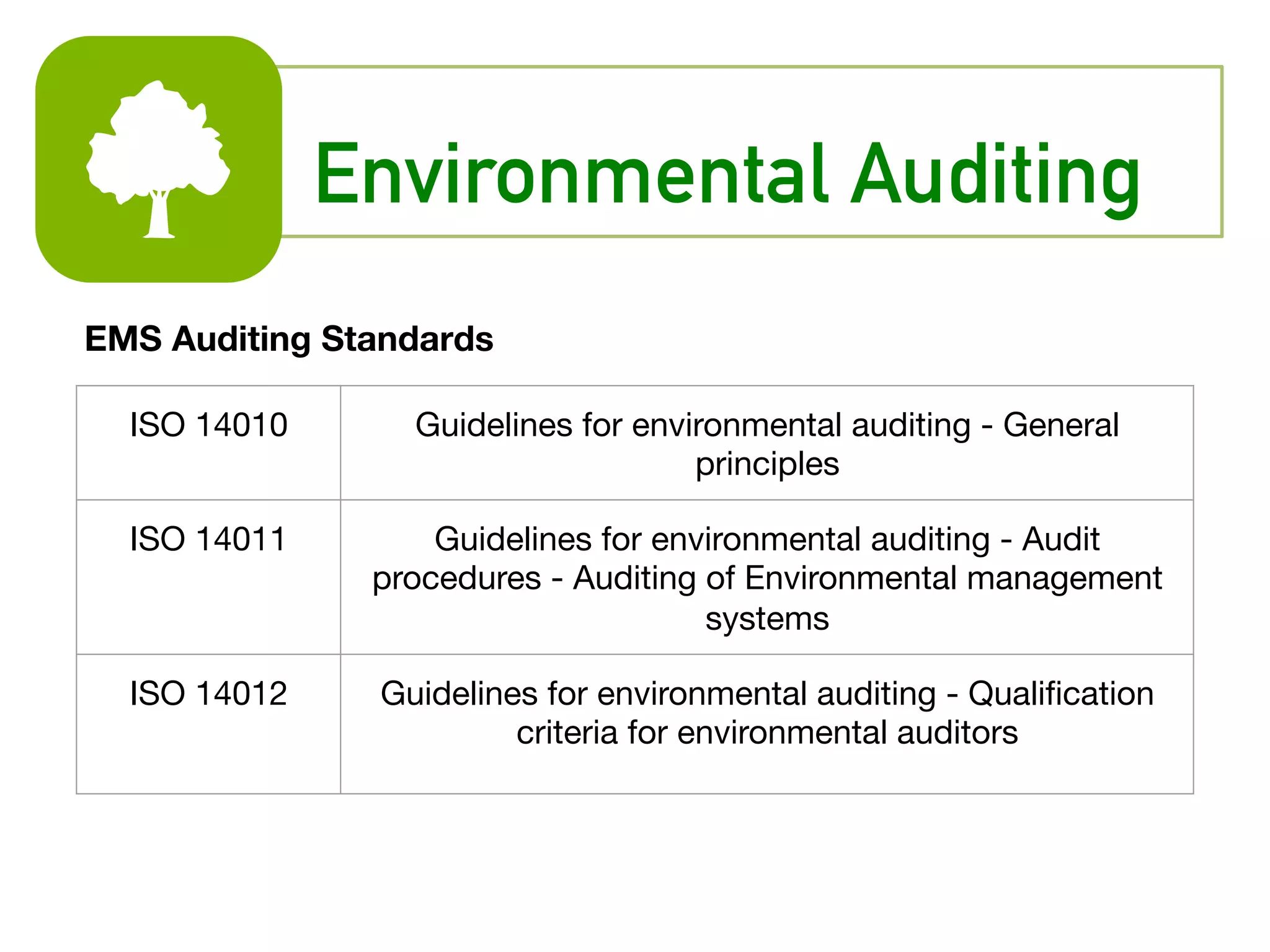
ISO 14010 Guidelines for environmental auditing - General
principles
ISO 14011 Guidelines for environmental auditing - Audit
procedures - Auditing of Environmental management
systems
ISO 14012 Guidelines for environmental auditing - Qualification
criteria for environmental auditors
EMS Auditing Standards
Environmental Auditing
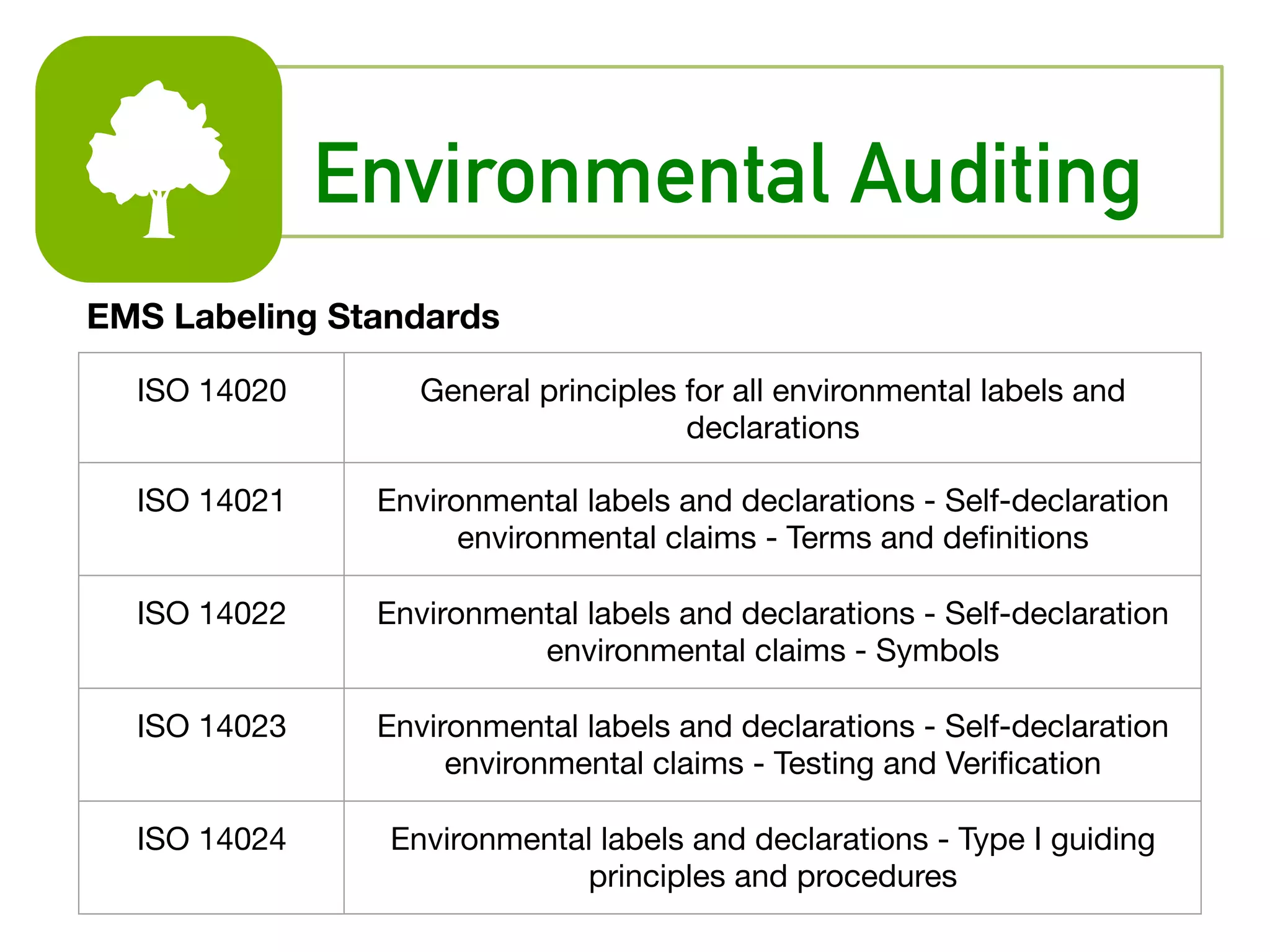
ISO 14020 General principles for all environmental labels and
declarations
ISO 14021 Environmental labels and declarations - Self-declaration
environmental claims - Terms and definitions
ISO 14022 Environmental labels and declarations - Self-declaration
environmental claims - Symbols
ISO 14023 Environmental labels and declarations - Self-declaration
environmental claims - Testing and Verification
ISO 14024 Environmental labels and declarations - Type I guiding
principles and procedures
EMS Labeling Standards
Environmental Auditing
ISO 14040 Life cycle assessment - Principles and framework
ISO 14041 Life cycle assessment - Inventory analysis
ISO 14042 Life cycle assessment - Impact assessment
ISO 14043 Life cycle assessment - Interpretation
ISO 14050 Terms and definition
ISO 14060 Guide for the inclusion of environmental aspects in
product standards
EMS Life Cycle Assessment Standards
Environmental Auditing
Requirements of EMS
Introduction
It provides the
importance of
EMS and
purpose of the
standard
Requirements
It starts at Clause
4
Annexure A
It provides the
guidance on the
use of the
standard
Introduction Clause
• Organizations want to achieve sound
environmental performance by controlling
the impact of their activities, products or
services on the environment
• To support environmental protection and
prevention of pollution in balance with
socio-economic needs
Clause Reference 1
• To enable an organization to formulate a
policy and objectives taking into account
legislative requirements and information
about significant environmental impacts
• This applies to what the organization can
control
Clause 1 – Scope
ENVIRONMENT
ENVIRONMENTAL
PERFORMANCE
ENVIRONMENTAL ASPECTS
ENVIRONMENTAL IMPACT
ENVIRONMENTAL
MANAGEMENT SYSTEM
ENVIRONMENTAL
OBJECTIVES
ENVIRONMENTAL POLICY
ENVIRONMENTAL TARGET
PREVENTION OF POLLUTION
Clause 1 – Scope
ENVIRONMENT
Surroundings in which an organization operates (land,
water, air, natural resources and etc.)
Element of an organization’s activities that can impact the
environment.
ENVIRONMENTAL ASPECTS
Clause 1 – Scope
ENVIRONMENTAL IMPACT
Any change to the environment, may it be adverse or
beneficial, that is a result of the organization’s activities.
A part of the overall system that includes the organizational
structure, planning activities, procedures for maintaining the
environmental policy.
ENVIRONMENTAL
MANAGEMENT SYSTEM
Clause 1 – Scope
ENVIRONMENTAL
OBJECTIVES
Overall environmental goal than an organization sets itself to
achieve
Measurable results of the environmental management
system based on its environmental objectives and targets.
ENVIRONMENTAL
PERFORMANCE
Clause 1 – Scope
ENVIRONMENTAL POLICY
The organization’s intentions in relation to overall
environmental performance; serves as a framework for
action.
The detailed performance requirement that arises from the
environmental objectives.
ENVIRONMENTAL TARGET
Clause 1 – Scope
PREVENTION OF POLLUTION
Use of processes, practices or products that avoid, reduce
or control pollution.
Clause 4
EMS Requirements
This international standard is based on the process
of “plan, implement, check and review.”
• Plan – Identifying environmental aspects and
establishing goals
• Implement – Training and operational controls
• Check – Monitoring and the corrective actions
needed
• Review – Progress reviews and acting to make
needed changes to the EMS.
Clause 4
EMS Requirements
General
The organization should
establish and maintain EMS
as per the requirements
given in clause 4
Environmental Policy
ü Appropriate to the nature, scale and
environmental impact
ü Commitment to prevention of
pollution
ü Comply with regulations and other
requirements
ü Establish and review the
environmental objectives and target
ü Documented, implemented,
maintained and be available to the
public
2
1
Clause 4
EMS Requirements
Planning
ü Environmental Aspects
ü Legal and Other
Requirements
ü Objectives and Target
ü Environmental
Management Programs
Implementation and
Operation
ü Structure and Responsibility
ü Training, Awareness and
Competence
ü Communications
ü EMS Documentation
ü Document Control
ü Operational Control
ü Emergency Preparedness and
Response
4
3
Clause 4
Planning
Environmental Aspects
• The organization must establish and maintain
environmental aspects in its activities which are duly
addressed in its objectives
Legal and Other Requirements
• The organization must establish procedure to have access
to legal and other requirements applicable to it
Clause 4
Planning
Objectives and Targets
• The organization should build an EMS based on the
applicable environmental aspects and policies used to
target and guide its EMS activities
Environmental Management Programs
• The programs implemented is aimed at achieving the
organization’s environmental objectives as well as tracking
its progress in achieving its established targets
Clause 4
Implementation and Operation
• It requires commitment of all employees
• It should begin at the top management,
establishing environmental policies and
systems for the organization
• The top management should ensure that
appropriate resources in maintaining
policies are provided
Clause 4
Implementation and Operation
Responsibility Person responsible
Overall direction CEO
Develop environmental policy CEO, MR
Monitor overall system performance MR
Assure regulatory compliance Senior environmental manager
Ensure internal compliance All managers, MR
Continual improvement All managers
Identify customer expectation for EMC Sales staff
Identify supplier expectation Purchase staff
Develop and maintain accounting procedures Finance
Comply with defined procedure All
Responsibility Matrix
Clause 4
Implementation and Operation
Training, Awareness and Competence
• The training programs focused on environmental
protection and those required for implementing EMS
should be organized and records maintained.
Communication
• Organizations should implement a procedure for receiving,
documenting, and responding to relevant information and
requests from interested parties.
Clause 4
Implementation and Operation
EMS Documentation
• Organizations would like to establish hierarchical structure
consisting of an EMS manual, EMS procedures, and
Environmental records, work instructions, standards,
forms, etc.
Document Control
• The guidance given for ISO 9000 more than satisfies this
requirement.
Clause 4
Implementation and Operation
Operational Control
• The organization should identify those operations and
activities that are associated with the identified
environmental aspects.
Emergency Preparedness and Response
• Emergency situations such as accidents should have been
anticipated and it should be tested periodically through
mock exercises to check for preparedness.
Clause 4
EMS Requirements
Checking and
Corrective Action
ü Monitoring and
Measurement
ü Non-conformance and
Corrective and Preventive
Action
ü Records
ü Environmental
Management System
Audit
5
Clause 4
Checking and Corrective Action
Records
Environmental records include:
ü Information on applicable environmental laws or other requirements
ü Complaint records
ü Training records
ü Process information
ü Product information
ü Inspection, maintenance, and calibration records
ü Pertinent, contractor and supplier information
ü Incident reports
ü Information on emergency preparedness and response
ü Records of significant environmental aspects
ü Audit results
ü Management review
Clause 4
Checking and Corrective Action
EMS Audit
The audit program and procedures should cover:
• The activities and areas to be considered in audits
• The frequency of audits
• The responsibilities with managing and
conducting audits
• The communication of audit results
• Auditor competence
• How audits will be conducted
Clause 4
EMS Requirements
Management Review
The essential purpose is to
confirm that the EMS is
implemented as a planned
and to determine the extent
to which objectives and
targets have been met
6
Clause 4
EMS in a Nutshell
PLAN
ACT
DO
CHECK
ü Environmental policy
ü Environmental aspects
ü Objectives and targets
ü Management
programs
ü Management
Review
ü Organization structure
ü Training
ü Communication
ü EMS documentation
ü Operational control
ü Emergency response
ü Records
ü Measuring and
monitoring
ü Checking corrective
and prevention
action audit
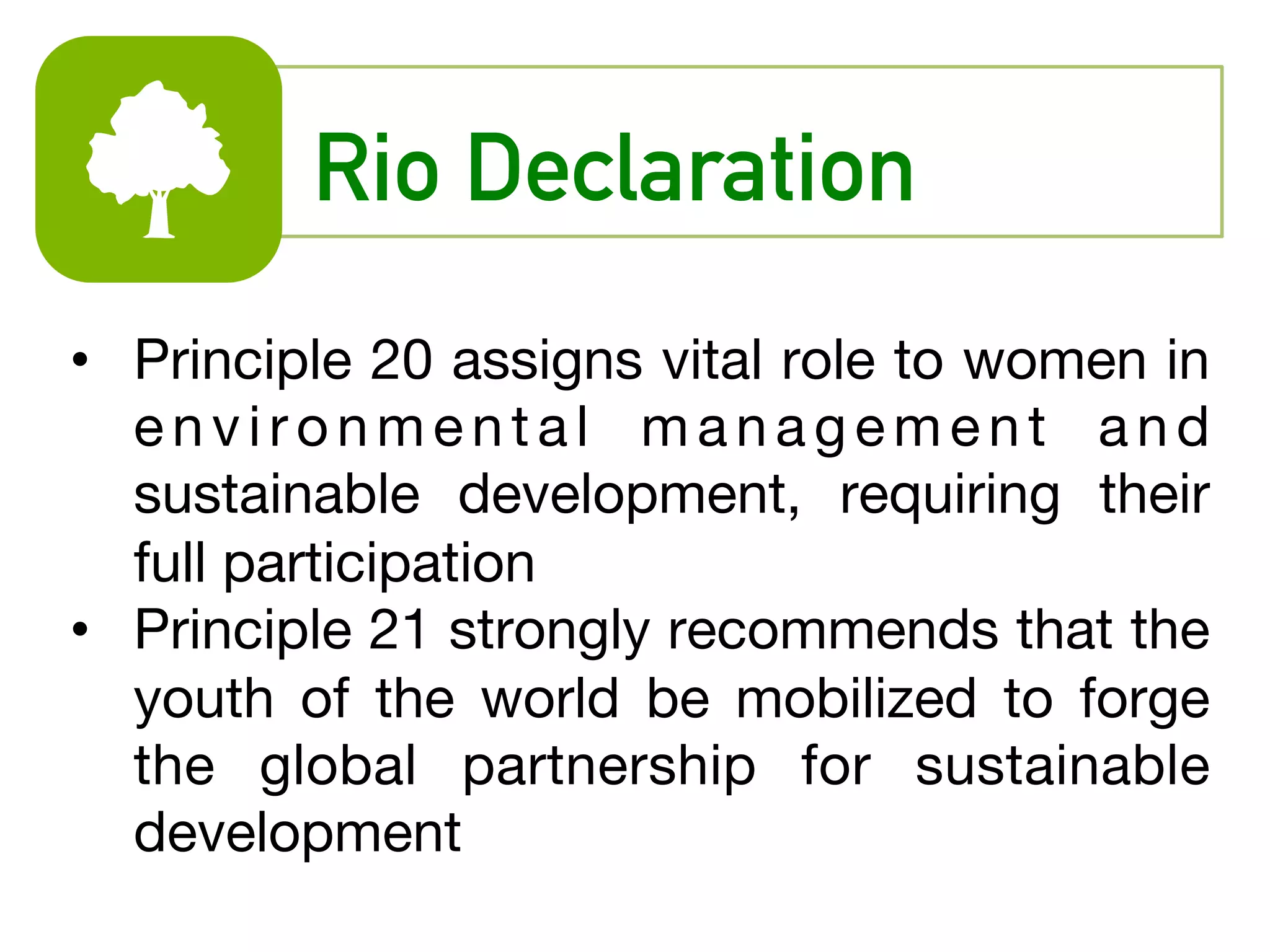
Rio Declaration
• Principle 20 assigns vital role to women in
environmental management and
sustainable development, requiring their
full participation
• Principle 21 strongly recommends that the
youth of the world be mobilized to forge
the global partnership for sustainable
development
Rio Declaration
Sovereign Rights to Sustainable Development
Sovereign Rights to Sustainable
Development
• States have the right to exploit their own
resources according to their own environmental
and developmental policies as long as they
ensure that activities within their jurisdiction do
not cause damage to the environment of other
areas beyond their limit
Rio Declaration
Global Partnership for Sustainable Development
Global Partnership for Sustainable
Development
• States shall cooperate in a spirit of global
partnership to conserve, protect and restore the
health and integrity of the earth’s ecosystem.
• States have common but differentiated
responsibilities
Rio Declaration
Equitable Environmental Legislation
• States shall enact effective environmental
legislation
• Environmental standards, management
objectives and priorities should reflect the
environmental and developmental context to
which they apply
Rio Declaration
Internal Environmental Impact Assessment
Internal Environmental Impact
Assessment
• A national instrument undertaken for activities
that are likely to have a significant adverse
impact on the environment
Integrating with ISO
• The organization may choose to integrate the
systems for both QMS meeting ISO 9001
standards and EMS meeting ISO 14001
standards
• The registration for EMS is similar to ISO 9000
• It may be integrated to reduce efforts and cost
and get the cooperation of the employees

270889687-Environmental-Management-System.pdf

  • 1.
    ENVIRONMENTAL AYALA. CHONG. DOMINGO.SANCHEZ MANAGEMENT SYSTEM
  • 2.
    Introduction “An organization shouldimplement an effective environmental management system in order to protect human health and the environment from the potential impacts of its activities, products, and services and to assist in maintaining and improving the quality of the environment.”
  • 3.
  • 4.
    Cause of Implementation ●Establish a uniform approach ● Minimum regulatory requirements are met ● Increase operational efficiency and minimize wastage ● Demonstrate the organization’s commitment to the environment to stakeholders ● Enhance relationship building with local community
  • 5.
    ISO 14000 ● Aseries of international standards on environmental management ● It provides a framework for the development of an environmental management system and the supporting audit program
  • 6.
    ISO 14001 ● Thecornerstone standard of the ISO 14000 series ● It specifies a framework of control for an EMS against which an organization can be certified by a third party
  • 7.
    Standard Number Title ISO14001 Environmental management systems - Specification with guidance for use ISO 14004 Environmental management systems - General guidelines on principles, systems, and supporting techniques ISO Family Standards
  • 8.
    0 Introduction 0.1 Overview 0.2Benefits of having an environmental management system 1 Scope 2 Normative references 3 Definitions 4 Environmental management system (EMS) principles and elements 4.1 Commitment and policy 4.2 Planning 4.3 Implementation 4.4 Measurement and evaluation 4.5 Review and improvement Annex A: Examples of international environmental guiding principles Annex B: Bibliography Content of ISO 14004
  • 9.
    ISO 14010 Guidelinesfor environmental auditing - General principles ISO 14011 Guidelines for environmental auditing - Audit procedures - Auditing of Environmental management systems ISO 14012 Guidelines for environmental auditing - Qualification criteria for environmental auditors EMS Auditing Standards Environmental Auditing
  • 10.
    ISO 14020 Generalprinciples for all environmental labels and declarations ISO 14021 Environmental labels and declarations - Self-declaration environmental claims - Terms and definitions ISO 14022 Environmental labels and declarations - Self-declaration environmental claims - Symbols ISO 14023 Environmental labels and declarations - Self-declaration environmental claims - Testing and Verification ISO 14024 Environmental labels and declarations - Type I guiding principles and procedures EMS Labeling Standards Environmental Auditing
  • 11.
    ISO 14040 Lifecycle assessment - Principles and framework ISO 14041 Life cycle assessment - Inventory analysis ISO 14042 Life cycle assessment - Impact assessment ISO 14043 Life cycle assessment - Interpretation ISO 14050 Terms and definition ISO 14060 Guide for the inclusion of environmental aspects in product standards EMS Life Cycle Assessment Standards Environmental Auditing
  • 12.
    Requirements of EMS Introduction Itprovides the importance of EMS and purpose of the standard Requirements It starts at Clause 4 Annexure A It provides the guidance on the use of the standard
  • 13.
    Introduction Clause • Organizationswant to achieve sound environmental performance by controlling the impact of their activities, products or services on the environment • To support environmental protection and prevention of pollution in balance with socio-economic needs
  • 14.
    Clause Reference 1 •To enable an organization to formulate a policy and objectives taking into account legislative requirements and information about significant environmental impacts • This applies to what the organization can control
  • 15.
    Clause 1 –Scope ENVIRONMENT ENVIRONMENTAL PERFORMANCE ENVIRONMENTAL ASPECTS ENVIRONMENTAL IMPACT ENVIRONMENTAL MANAGEMENT SYSTEM ENVIRONMENTAL OBJECTIVES ENVIRONMENTAL POLICY ENVIRONMENTAL TARGET PREVENTION OF POLLUTION
  • 16.
    Clause 1 –Scope ENVIRONMENT Surroundings in which an organization operates (land, water, air, natural resources and etc.) Element of an organization’s activities that can impact the environment. ENVIRONMENTAL ASPECTS
  • 17.
    Clause 1 –Scope ENVIRONMENTAL IMPACT Any change to the environment, may it be adverse or beneficial, that is a result of the organization’s activities. A part of the overall system that includes the organizational structure, planning activities, procedures for maintaining the environmental policy. ENVIRONMENTAL MANAGEMENT SYSTEM
  • 18.
    Clause 1 –Scope ENVIRONMENTAL OBJECTIVES Overall environmental goal than an organization sets itself to achieve Measurable results of the environmental management system based on its environmental objectives and targets. ENVIRONMENTAL PERFORMANCE
  • 19.
    Clause 1 –Scope ENVIRONMENTAL POLICY The organization’s intentions in relation to overall environmental performance; serves as a framework for action. The detailed performance requirement that arises from the environmental objectives. ENVIRONMENTAL TARGET
  • 20.
    Clause 1 –Scope PREVENTION OF POLLUTION Use of processes, practices or products that avoid, reduce or control pollution.
  • 21.
    Clause 4 EMS Requirements Thisinternational standard is based on the process of “plan, implement, check and review.” • Plan – Identifying environmental aspects and establishing goals • Implement – Training and operational controls • Check – Monitoring and the corrective actions needed • Review – Progress reviews and acting to make needed changes to the EMS.
  • 22.
    Clause 4 EMS Requirements General Theorganization should establish and maintain EMS as per the requirements given in clause 4 Environmental Policy ü Appropriate to the nature, scale and environmental impact ü Commitment to prevention of pollution ü Comply with regulations and other requirements ü Establish and review the environmental objectives and target ü Documented, implemented, maintained and be available to the public 2 1
  • 23.
    Clause 4 EMS Requirements Planning üEnvironmental Aspects ü Legal and Other Requirements ü Objectives and Target ü Environmental Management Programs Implementation and Operation ü Structure and Responsibility ü Training, Awareness and Competence ü Communications ü EMS Documentation ü Document Control ü Operational Control ü Emergency Preparedness and Response 4 3
  • 24.
    Clause 4 Planning Environmental Aspects •The organization must establish and maintain environmental aspects in its activities which are duly addressed in its objectives Legal and Other Requirements • The organization must establish procedure to have access to legal and other requirements applicable to it
  • 25.
    Clause 4 Planning Objectives andTargets • The organization should build an EMS based on the applicable environmental aspects and policies used to target and guide its EMS activities Environmental Management Programs • The programs implemented is aimed at achieving the organization’s environmental objectives as well as tracking its progress in achieving its established targets
  • 26.
    Clause 4 Implementation andOperation • It requires commitment of all employees • It should begin at the top management, establishing environmental policies and systems for the organization • The top management should ensure that appropriate resources in maintaining policies are provided
  • 27.
    Clause 4 Implementation andOperation Responsibility Person responsible Overall direction CEO Develop environmental policy CEO, MR Monitor overall system performance MR Assure regulatory compliance Senior environmental manager Ensure internal compliance All managers, MR Continual improvement All managers Identify customer expectation for EMC Sales staff Identify supplier expectation Purchase staff Develop and maintain accounting procedures Finance Comply with defined procedure All Responsibility Matrix
  • 28.
    Clause 4 Implementation andOperation Training, Awareness and Competence • The training programs focused on environmental protection and those required for implementing EMS should be organized and records maintained. Communication • Organizations should implement a procedure for receiving, documenting, and responding to relevant information and requests from interested parties.
  • 29.
    Clause 4 Implementation andOperation EMS Documentation • Organizations would like to establish hierarchical structure consisting of an EMS manual, EMS procedures, and Environmental records, work instructions, standards, forms, etc. Document Control • The guidance given for ISO 9000 more than satisfies this requirement.
  • 30.
    Clause 4 Implementation andOperation Operational Control • The organization should identify those operations and activities that are associated with the identified environmental aspects. Emergency Preparedness and Response • Emergency situations such as accidents should have been anticipated and it should be tested periodically through mock exercises to check for preparedness.
  • 31.
    Clause 4 EMS Requirements Checkingand Corrective Action ü Monitoring and Measurement ü Non-conformance and Corrective and Preventive Action ü Records ü Environmental Management System Audit 5
  • 32.
    Clause 4 Checking andCorrective Action Records Environmental records include: ü Information on applicable environmental laws or other requirements ü Complaint records ü Training records ü Process information ü Product information ü Inspection, maintenance, and calibration records ü Pertinent, contractor and supplier information ü Incident reports ü Information on emergency preparedness and response ü Records of significant environmental aspects ü Audit results ü Management review
  • 33.
    Clause 4 Checking andCorrective Action EMS Audit The audit program and procedures should cover: • The activities and areas to be considered in audits • The frequency of audits • The responsibilities with managing and conducting audits • The communication of audit results • Auditor competence • How audits will be conducted
  • 34.
    Clause 4 EMS Requirements ManagementReview The essential purpose is to confirm that the EMS is implemented as a planned and to determine the extent to which objectives and targets have been met 6
  • 35.
    Clause 4 EMS ina Nutshell PLAN ACT DO CHECK ü Environmental policy ü Environmental aspects ü Objectives and targets ü Management programs ü Management Review ü Organization structure ü Training ü Communication ü EMS documentation ü Operational control ü Emergency response ü Records ü Measuring and monitoring ü Checking corrective and prevention action audit
  • 36.
    Rio Declaration • Principle20 assigns vital role to women in environmental management and sustainable development, requiring their full participation • Principle 21 strongly recommends that the youth of the world be mobilized to forge the global partnership for sustainable development
  • 37.
    Rio Declaration Sovereign Rightsto Sustainable Development Sovereign Rights to Sustainable Development • States have the right to exploit their own resources according to their own environmental and developmental policies as long as they ensure that activities within their jurisdiction do not cause damage to the environment of other areas beyond their limit
  • 38.
    Rio Declaration Global Partnershipfor Sustainable Development Global Partnership for Sustainable Development • States shall cooperate in a spirit of global partnership to conserve, protect and restore the health and integrity of the earth’s ecosystem. • States have common but differentiated responsibilities
  • 39.
    Rio Declaration Equitable EnvironmentalLegislation Equitable Environmental Legislation • States shall enact effective environmental legislation • Environmental standards, management objectives and priorities should reflect the environmental and developmental context to which they apply
  • 40.
    Rio Declaration Internal EnvironmentalImpact Assessment Internal Environmental Impact Assessment • A national instrument undertaken for activities that are likely to have a significant adverse impact on the environment
  • 41.
    Integrating with ISO •The organization may choose to integrate the systems for both QMS meeting ISO 9001 standards and EMS meeting ISO 14001 standards • The registration for EMS is similar to ISO 9000 • It may be integrated to reduce efforts and cost and get the cooperation of the employees