Welcome To The User Awareness Training Of ISMS ISO/IEC 27001:2005 Saroj Ku. Behera 9/16/2010 Saroj
What is Information? What is Information Security? What is RISK? An Introduction to ISO 27001-2:2005 ISMS @ Organization User Responsibilities 9/16/2010 Saroj
'Information is an asset which, like other important business assets, has value to  an organization and consequently needs  to be suitably protected’ BS ISO 27002:2005 9/16/2010 Saroj
Information can be Created Stored Destroyed Processed Transmitted Used – (For proper & improper purposes) Corrupted Lost Stolen 9/16/2010 Saroj
Printed or written on paper Stored electronically Transmitted by post or using electronics means Shown on corporate videos Displayed / published on web Verbal – spoken in conversations ‘… Whatever form the information takes, or means by which it is shared or stored, it should always be appropriately protected’ (BS ISO 27002:2005) 9/16/2010 Saroj
What Is Information Security The quality or state of being secure to be free from danger Security is achieved using several strategies Security is achieved using several strategies simultaneously or used in combination with one another Security is recognized as essential to protect vital processes and the systems that provide those processes Security is not something you buy, it is something you do 9/16/2010 Saroj
The architecture where an integrated combination of appliances, systems and solutions, software, alarms, and vulnerability scans working together What Is Information Security Security is for  PPT  and not only for appliances or devices Monitored 24x7 Having  P eople,  P rocesses,  T echnology, policies, procedures, 9/16/2010 Saroj
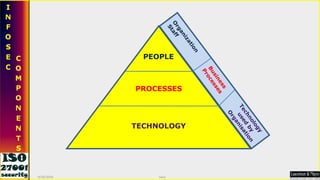
PEOPLE PROCESSES TECHNOLOGY Organization Staff Business Processes Technology used by Organisation 9/16/2010 Saroj
People “Who we are” People who use or interact with the Information include: Share Holders / Owners  Management Employees Business Partners Service providers Contractors Customers / Clients Regulators  etc… 9/16/2010 Saroj
Process “what we do” The processes refer to "work practices" or workflow. Processes are the repeatable steps to accomplish business objectives. Typical process in our IT Infrastructure could include: Helpdesk / Service management Incident Reporting and Management Change Requests process Request fulfillment Access management Identity management Service Level /  Third-party Services Management IT procurement process  etc ... 9/16/2010 Saroj
Technology “what we use to improve what we do” Network Infrastructure: Cabling, Data/Voice Networks and equipment Telecommunications services (PABX), including VoIP services , ISDN , Video Conferencing Server computers and associated storage devices Operating software for server computers Communications equipment and related hardware.  Intranet and Internet connections VPNs and Virtual environments Remote access services Wireless connectivity 9/16/2010 Saroj
Technology “what we use to improve what we do” Application software: Finance and assets systems, including Accounting packages, Inventory management, HR systems, Assessment and reporting systems Software as a service (Sass) - instead of software as a packaged or custom-made product . Etc.. Physical Security components: CCTV Cameras Clock in systems / Biometrics Environmental management Systems: Humidity Control, Ventilation , Air Conditioning, Fire Control systems Electricity / Power backup Access devices: Desktop computers Laptops, ultra-mobile laptops and PDAs Thin client computing. Digital cameras, Printers, Scanners, Photocopier etc.   9/16/2010 Saroj
Protects information from a range of threats Ensures business continuity Minimizes financial loss Optimizes return on investments Increases business opportunities Business survival depends on information security. INFORMATION SECURITY 9/16/2010 Saroj
ISO 27002:2005 defines Information Security as the preservation of: Confidentiality Ensuring that information is accessible only to those authorized to have access Integrity Safeguarding the accuracy and completeness of information and processing methods Availability Ensuring that authorized users have access to information and associated assets when required 9/16/2010 Saroj
Reputation loss Financial loss Intellectual property loss Legislative Breaches leading to legal actions (Cyber Law) Loss of customer confidence Business interruption costs  Security breaches leads to… LOSS OF GOODWILL 9/16/2010 Saroj
Information Security is “Organizational Problem”  rather than “IT Problem” More than 70% of Threats are Internal More than 60% culprits are First Time fraudsters Biggest Risk : People Biggest Asset : People  Social Engineering is major threat More than 2/3 rd  express their inability to determine  “Whether my systems are currently compromised?” 9/16/2010 Saroj
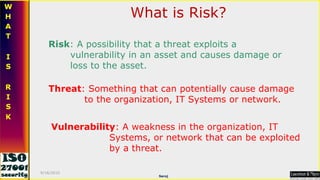
What is Risk? Risk : A possibility that a threat exploits a vulnerability in an asset and causes damage or loss to the asset. Threat : Something that can potentially cause damage to the organization, IT Systems or network. Vulnerability : A weakness in the organization, IT Systems, or network that can be exploited by a threat. 9/16/2010 Saroj
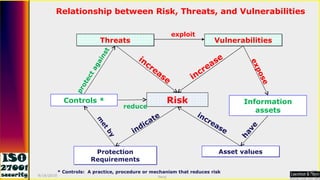
Relationship between Risk, Threats, and Vulnerabilities Threats Vulnerabilities exploit * Controls:  A practice, procedure or mechanism that reduces risk Risk Asset values Protection Requirements increase increase Information assets Controls * expose protect against reduce have increase indicate met by 9/16/2010 Saroj
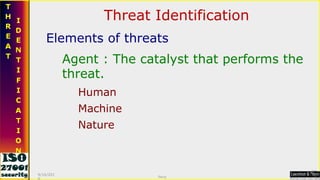
Threat Identification Elements of threats Agent : The catalyst that performs the threat.  Human Machine Nature 9/16/2010 Saroj
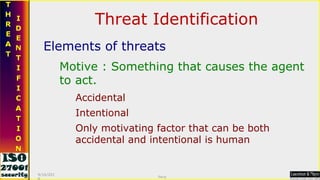
Threat Identification Elements of threats Motive : Something that causes the agent to act. Accidental Intentional Only motivating factor that can be both accidental and intentional is human 9/16/2010 Saroj
Threat Identification Elements of threats Results : The outcome of the applied threat. The results normally lead to the loss of CIA Confidentiality Integrity Availability 9/16/2010 Saroj
Threats Employees External Parties Low awareness of security issues Growth in networking and distributed computing Growth in complexity and effectiveness of hacking tools and viruses Natural Disasters eg. fire, flood, earthquake 9/16/2010 Saroj
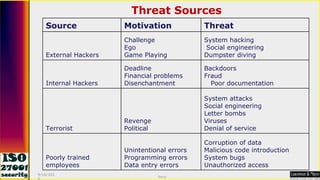
Threat Sources 9/16/2010 Saroj  Source Motivation Threat External Hackers Challenge  Ego  Game Playing System hacking  Social engineering  Dumpster diving Internal Hackers Deadline  Financial problems  Disenchantment Backdoors  Fraud  Poor documentation Terrorist Revenge  Political  System attacks  Social engineering  Letter bombs  Viruses  Denial of service Poorly trained employees Unintentional errors  Programming errors  Data entry errors Corruption of data  Malicious code introduction  System bugs  Unauthorized access
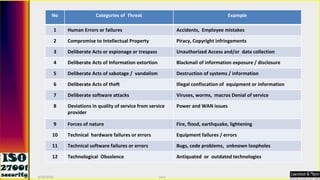
9/16/2010 Saroj  No Categories of  Threat Example 1 Human Errors or failures Accidents,  Employee mistakes 2 Compromise to Intellectual Property Piracy, Copyright infringements 3 Deliberate Acts or espionage or trespass Unauthorized Access and/or  data collection 4 Deliberate Acts of Information extortion Blackmail of information exposure / disclosure 5 Deliberate Acts of sabotage /  vandalism Destruction of systems / information 6 Deliberate Acts of theft Illegal confiscation of  equipment or information 7 Deliberate software attacks Viruses, worms,  macros Denial of service 8 Deviations in quality of service from service provider Power and WAN issues 9 Forces of nature Fire, flood, earthquake, lightening 10 Technical  hardware failures or errors Equipment failures / errors 11 Technical software failures or errors Bugs, code problems,  unknown loopholes 12 Technological  Obsolence Antiquated  or  outdated technologies
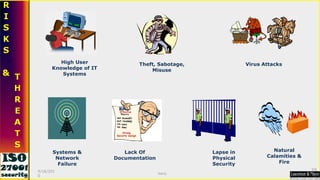
High User Knowledge of IT Systems Theft, Sabotage, Misuse Virus Attacks Systems & Network Failure Lack Of Documentation Lapse in Physical Security Natural Calamities & Fire 9/16/2010 Saroj
SO HOW DO WE OVERCOME THESE PROBLEMS? 9/16/2010 Saroj
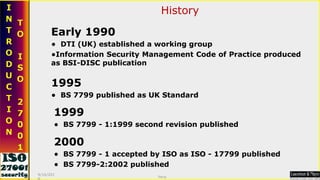
Early 1990 DTI (UK) established a working group Information Security Management Code of Practice produced as BSI-DISC publication 1995 BS 7799 published as UK Standard 1999 BS 7799 - 1:1999 second revision published 2000  BS 7799 - 1 accepted by ISO as ISO - 17799 published BS 7799-2:2002 published History 9/16/2010 Saroj
ISO 27001:2005 Information technology — Security techniques — Information security management systems — Requirements ISO 27002:2005 Information technology — Security techniques — Code of practice for information security management History 9/16/2010 Saroj
ISO 27001: This International Standard covers all types of organizations (e.g. commercial enterprises, government agencies, non-profit organizations). This  International Standard specifies the requirements for establishing; implementing, operating, monitoring, reviewing, maintaining and improving documented ISMS within the context of the organization’s overall business risks. It specifies requirements for the implementation of security controls customized to the needs of individual organizations or parts thereof.   The ISMS is designed to ensure the selection of adequate and proportionate security controls that protect information assets and give confidence to interested parties ISO 27001 9/16/2010 Saroj
Features of ISO 27001    • Plan, Do, Check, Act (PDCA) Process Model • Process Based Approach  • Stress on Continual Process Improvements • Scope covers Information Security not only IT Security • Covers People, Process and Technology • 5600 plus organizations worldwide have been certified • 11 Domains, 39 Control objectives, 133 controls   Features 9/16/2010 Saroj
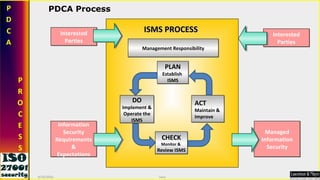
9/16/2010 Saroj  Interested Parties Information Security Requirements & Expectations PLAN Establish  ISMS CHECK Monitor &  Review ISMS ACT Maintain & Improve Management Responsibility ISMS PROCESS PDCA Process Interested Parties Managed Information Security DO Implement & Operate the ISMS
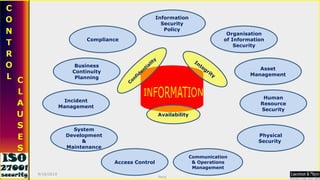
Information Security Policy Organisation of Information Security Asset Management Human Resource Security Physical Security  Communication & Operations Management Access Control System Development & Maintenance Incident Management Business Continuity Planning Compliance Confidentiality Integrity Availability 9/16/2010 Saroj
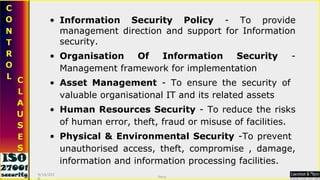
Information Security Policy  - To provide management direction and support for Information security. Organisation Of Information Security  - Management framework for implementation Asset Management  - T o ensure the security of  valuable organisational IT and its related assets  Human Resources Security  - To reduce the risks of human error, theft, fraud or misuse of facilities. Physical & Environmental Security  - To prevent  unauthorised access, theft, compromise , damage, information and information processing facilities. 9/16/2010 Saroj
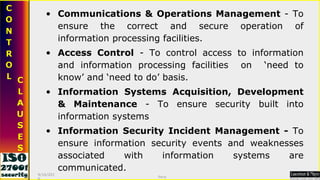
Communications & Operations Management  - To ensure the correct and secure operation of information processing facilities. Access Control  - To control access to information and information processing facilities  on  ‘need to know’ and ‘need to do’ basis.  Information Systems Acquisition, Development & Maintenance  - To ensure security built into information systems Information Security Incident Management -  To ensure information security events and weaknesses associated with information systems are communicated. 9/16/2010 Saroj
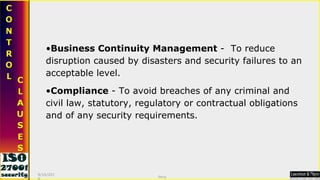
Business Continuity Management  -  To reduce disruption caused by disasters and security failures to an acceptable level. Compliance  - To avoid breaches of any criminal and civil law, statutory, regulatory or contractual obligations and of any security requirements. 9/16/2010 Saroj
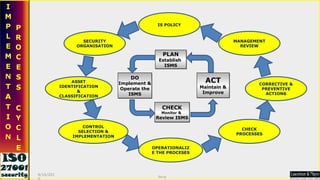
IS POLICY SECURITY ORGANISATION ASSET IDENTIFICATION & CLASSIFICATION CONTROL SELECTION & IMPLEMENTATION OPERATIONALIZE THE PROCESES MANAGEMENT REVIEW CORRECTIVE & PREVENTIVE ACTIONS CHECK PROCESSES 9/16/2010 Saroj  PLAN Establish  ISMS CHECK Monitor &  Review ISMS ACT Maintain & Improve DO Implement & Operate the ISMS
At the organizational level –  Commitment At the legal level –  Compliance At the operating level -  Risk management At the commercial level -  Credibility and confidence At the financial level -  Reduced costs At the human level -  Improved employee awareness 9/16/2010 Saroj
ISMS @ ORGANISATION Scope of ISMS Data Center DR site All Information, IT, Service and People Asset  9/16/2010 Saroj
ISMS @ ORGANISATION Documented ISMS Apex Security Policy Specific policies eg. Physical & Environment Policy, E-mail Policy, HR, Incident Management etc Procedures, Guidelines and Records 9/16/2010 Saroj
ISMS @ ORGANISATION Vision ORGANISATION would be a role model for having robust Information Security Management System Implementation with continual improvements, which assure and pervade very sphere of its activities and functional domains. Mission Empowerment of Information Security Management System through implementing best practices for People, Process and Technology.  Information Security is responsibility of everyone 9/16/2010 Saroj
ISMS @ ORGANISATION Security Organisation Apex Committee ISMS Forum ISMS Task Force Incident Response BCP Team DRP Team Audit Committee 9/16/2010 Saroj
Security Organization Apex Committee  :  CEO CTO/CISO ISMS Forum : Service Head Technology Head (CTO) Head HR IS Task Force  : Project Managers Administrators IS Team Member Audit Committee : Appointed by Apex Committee BCP Team : Appointed by Apex Committee /ISMS Forum DRP Team : Appointed by  Apex Committee /ISMS Forum ISMS @ ORGANISATION 9/16/2010 Saroj
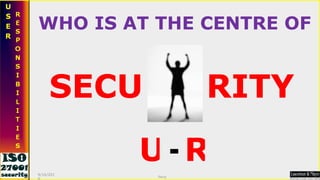
WHO IS AT THE CENTRE OF SECU RITY U - R 9/16/2010 Saroj
Information Security Policy IS Policy is approved by Top Management  Policy is released on Intranet at 9/16/2010 Saroj
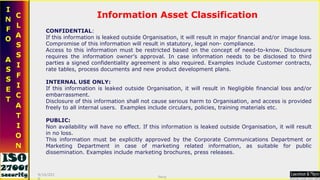
CONFIDENTIAL :  If this information is leaked outside Organisation, it will result in major financial and/or image loss. Compromise of this information will result in statutory, legal non- compliance. Access to this information must be restricted based on the concept of need-to-know. Disclosure requires the information owner’s approval. In case information needs to be disclosed to third parties a signed confidentiality agreement is also required. Examples include Customer contracts, rate tables, process documents and new product development plans.  INTERNAL USE ONLY:   If this information is leaked outside Organisation, it will result in Negligible financial loss and/or embarrassment. Disclosure of this information shall not cause serious harm to Organisation, and access is provided freely to all internal users.  Examples include circulars, policies, training materials etc.  PUBLIC:   Non availability will have no effect. If this information is leaked outside Organisation, it will result in no loss. This information must be explicitly approved by the Corporate Communications Department or Marketing Department in case of marketing related information, as suitable for public dissemination. Examples include marketing brochures, press releases. 9/16/2010 Saroj  Information Asset Classification
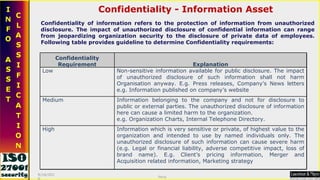
Confidentiality - Information Asset Confidentiality of information refers to the protection of information from unauthorized disclosure. The impact of unauthorized disclosure of confidential information can range from jeopardizing organization security to the disclosure of private data of employees. Following table provides guideline to determine Confidentiality requirements:  9/16/2010 Saroj  Confidentiality Requirement Explanation Low Non-sensitive information available for public disclosure. The impact of unauthorized disclosure of such information shall not harm Organisation anyway. E.g. Press releases, Company’s News letters e.g. Information published on company’s website Medium Information belonging to the company and not for disclosure to public or external parties. The unauthorized disclosure of information here can cause a limited harm to the organization.  e.g. Organization Charts, Internal Telephone Directory. High Information which is very sensitive or private, of highest value to the organization and intended to use by named individuals only. The unauthorized disclosure of such information can cause severe harm (e.g. Legal or financial liability, adverse competitive impact, loss of brand name). E.g. Client’s pricing information, Merger and Acquisition related information, Marketing strategy
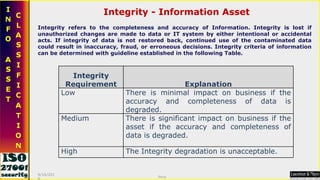
Integrity - Information Asset Integrity refers to the completeness and accuracy of Information. Integrity is lost if unauthorized changes are made to data or IT system by either intentional or accidental acts. If integrity of data is not restored back, continued use of the contaminated data could result in inaccuracy, fraud, or erroneous decisions. Integrity criteria of information can be determined with guideline established in the following Table. 9/16/2010 Saroj  Integrity Requirement Explanation Low There is minimal impact on business if the accuracy and completeness of data is degraded. Medium There is significant impact on business if the asset if the accuracy and completeness of data is degraded. High The Integrity degradation is unacceptable.
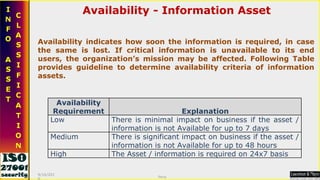
Availability - Information Asset Availability indicates how soon the information is required, in case the same is lost. If critical information is unavailable to its end users, the organization’s mission may be affected. Following Table provides guideline to determine availability criteria of information assets. 9/16/2010 Saroj  Availability Requirement Explanation Low There is minimal impact on business if the asset / information is not Available for up to 7 days Medium There is significant impact on business if the asset / information is not Available for up to 48 hours High The Asset / information is required on 24x7 basis
Non-information Assets [Physical] Information is processed with the help of technology. The assets, which are helpful in creating, processing, output generation and storage. Such assets need to be identified and valued for the purpose of their criticality in business process. Asset valuation of non information / physical Assets like software, Hardware, Services is carried out based on different criteria applicable to the specific group of physical assets involved in organization’s business processes. 9/16/2010 Saroj
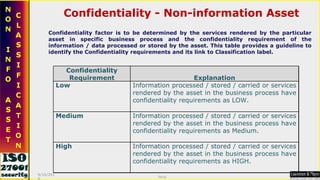
Confidentiality - Non-information Asset Confidentiality factor is to be determined by the services rendered by the particular asset in specific business process and the confidentiality requirement of the information / data processed or stored by the asset. This table provides a guideline to identify the Confidentiality requirements and its link to Classification label. 9/16/2010 Saroj  Confidentiality Requirement Explanation Low Information processed / stored / carried or services rendered by the asset in the business process have confidentiality requirements as LOW. Medium Information processed / stored / carried or services rendered by the asset in the business process have confidentiality requirements as Medium. High Information processed / stored / carried or services rendered by the asset in the business process have confidentiality requirements as HIGH.
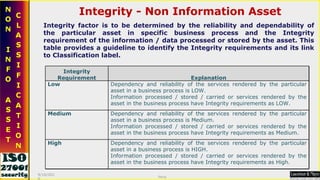
Integrity - Non Information Asset Integrity factor is to be determined by the reliability and dependability of the particular asset in specific business process and the Integrity requirement of the information / data processed or stored by the asset. This table provides a guideline to identify the Integrity requirements and its link to Classification label. 9/16/2010 Saroj  Integrity Requirement Explanation Low Dependency and reliability of the services rendered by the particular asset in a business process is LOW. Information processed / stored / carried or services rendered by the asset in the business process have Integrity requirements as LOW. Medium Dependency and reliability of the services rendered by the particular asset in a business process is Medium. Information processed / stored / carried or services rendered by the asset in the business process have Integrity requirements as Medium. High Dependency and reliability of the services rendered by the particular asset in a business process is HIGH. Information processed / stored / carried or services rendered by the asset in the business process have Integrity requirements as High.
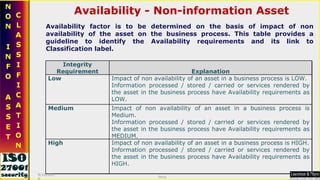
Availability - Non-information Asset Availability factor is to be determined on the basis of impact of non availability of the asset on the business process. This table provides a guideline to identify the Availability requirements and its link to Classification label.  9/16/2010 Saroj  Integrity Requirement Explanation Low Impact of non availability of an asset in a business process is LOW. Information processed / stored / carried or services rendered by the asset in the business process have Availability requirements as LOW. Medium Impact of non availability of an asset in a business process is Medium. Information processed / stored / carried or services rendered by the asset in the business process have Availability requirements as MEDIUM. High Impact of non availability of an asset in a business process is HIGH. Information processed / stored / carried or services rendered by the asset in the business process have Availability requirements as HIGH.
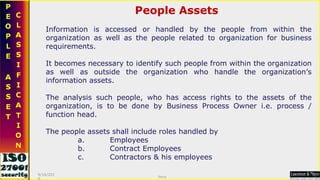
People Assets Information is accessed or handled by the people from within the organization as well as the people related to organization for business requirements.   It becomes necessary to identify such people from within the organization as well as outside the organization who handle the organization’s information assets.   The analysis such people, who has access rights to the assets of the organization, is to be done by Business Process Owner i.e. process / function head. The people assets shall include roles handled by a. Employees b. Contract Employees c. Contractors & his employees 9/16/2010 Saroj
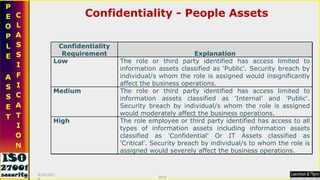
Confidentiality - People Assets 9/16/2010 Saroj  Confidentiality Requirement Explanation Low The role or third party identified has access limited to information assets classified as 'Public'. Security breach by individual/s whom the role is assigned would insignificantly affect the business operations. Medium The role or third party identified has access limited to information assets classified as 'Internal’ and 'Public'. Security breach by individual/s whom the role is assigned would moderately affect the business operations. High The role employee or third party identified has access to all types of information assets including information assets classified as 'Confidential' Or IT Assets classified as 'Critical'. Security breach by individual/s to whom the role is assigned would severely affect the business operations.
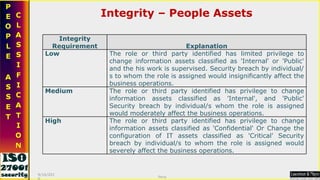
Integrity – People Assets 9/16/2010 Saroj  Integrity Requirement Explanation Low The role or third party identified has limited privilege to change information assets classified as 'Internal' or 'Public' and the his work is supervised. Security breach by individual/s to whom the role is assigned would insignificantly affect the business operations. Medium The role or third party identified has privilege to change information assets classified as 'Internal', and 'Public' Security breach by individual/s whom the role is assigned would moderately affect the business operations. High The role or third party identified has privilege to change information assets classified as 'Confidential' Or Change the configuration of IT assets classified as 'Critical' Security breach by individual/s to whom the role is assigned would severely affect the business operations.
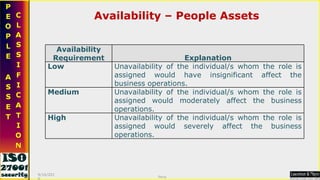
Availability – People Assets 9/16/2010 Saroj  Availability Requirement Explanation Low Unavailability of the individual/s whom the role is assigned would have insignificant affect the business operations. Medium Unavailability of the individual/s whom the role is assigned would moderately affect the business operations. High Unavailability of the individual/s whom the role is assigned would severely affect the business operations.
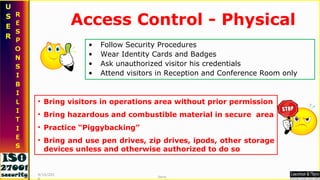
Access Control - Physical Follow Security Procedures Wear Identity Cards and Badges Ask unauthorized visitor his credentials Attend visitors in Reception and Conference Room only Bring visitors in operations area without prior permission Bring hazardous and combustible material in secure  area Practice “Piggybacking” Bring and use pen drives, zip drives, ipods, other storage devices unless and otherwise authorized to do so 9/16/2010 Saroj
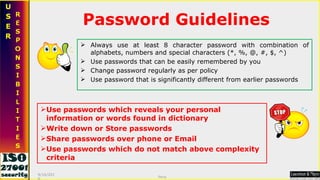
Password Guidelines Always use at least 8 character password with combination of alphabets, numbers and special characters (*, %, @, #, $, ^) Use passwords that can be easily remembered by you Change password regularly as per policy Use password that is significantly different from earlier passwords  Use passwords which reveals your personal information or words found in dictionary Write down or Store passwords Share passwords over phone or Email Use passwords which do not match above complexity criteria 9/16/2010 Saroj
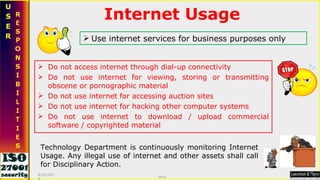
Technology Department is continuously monitoring Internet Usage. Any illegal use of internet and other assets shall call for Disciplinary Action. Do not access internet through dial-up connectivity Do not use internet for viewing, storing or transmitting obscene or pornographic material Do not use internet for accessing auction sites Do not use internet for hacking other computer systems  Do not use internet to download / upload commercial software / copyrighted material Use internet services for business purposes only Internet Usage 9/16/2010 Saroj
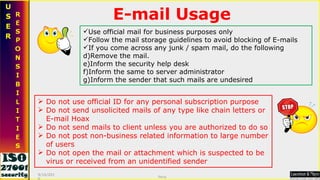
E-mail Usage Do not use official ID for any personal subscription purpose Do not send unsolicited mails of any type like chain letters or E-mail Hoax Do not send mails to client unless you are authorized to do so Do not post non-business related information to large number of users Do not open the mail or attachment which is suspected to be virus or received from an unidentified sender Use official mail for business purposes only Follow the mail storage guidelines to avoid blocking of E-mails If you come across any junk / spam mail, do the following Remove the mail. Inform the security help desk Inform the same to server administrator Inform the sender that such mails are undesired 9/16/2010 Saroj
Security Incidents Report Security Incidents (IT) to Helpdesk through E-mail to Telephone : e.g.:  IT Incidents: Mail Spamming, Virus attack, Hacking, etc.  Non-IT Incidents: Unsupervised visitor movement, Information leakage, Bringing unauthorized Media  Do not discuss security incidents with any one outside organization Do not attempt to interfere with, obstruct or prevent anyone from reporting incidents 9/16/2010 Saroj
Ensure your Desktops are having latest antivirus updates Ensure your system is locked when you are away Always store laptops/ media in a lockable place Be alert while working on laptops during travel Ensure sensitive business information is under lock and key when unattended Ensure back-up of sensitive and critical information assets Understand Compliance Issues such as  Cyber Law  IPR, Copyrights, IT act2000 etc Contractual Obligations with customer Verify credentials, if the message is received from unknown sender Always switch off your computer before leaving for the day Keep your self updated on information security aspects 9/16/2010 Saroj
Human Wall Is Always Better Than A Firewall  . . . LET US BUILD A HUMAN WALL ALONG WITH FIREWALL 9/16/2010 Saroj
Thanks [email_address] 9/16/2010 Saroj

Isms awareness training

  • 1.
    Welcome To TheUser Awareness Training Of ISMS ISO/IEC 27001:2005 Saroj Ku. Behera 9/16/2010 Saroj
  • 2.
    What is Information?What is Information Security? What is RISK? An Introduction to ISO 27001-2:2005 ISMS @ Organization User Responsibilities 9/16/2010 Saroj
  • 3.
    'Information is anasset which, like other important business assets, has value to an organization and consequently needs to be suitably protected’ BS ISO 27002:2005 9/16/2010 Saroj
  • 4.
    Information can beCreated Stored Destroyed Processed Transmitted Used – (For proper & improper purposes) Corrupted Lost Stolen 9/16/2010 Saroj
  • 5.
    Printed or writtenon paper Stored electronically Transmitted by post or using electronics means Shown on corporate videos Displayed / published on web Verbal – spoken in conversations ‘… Whatever form the information takes, or means by which it is shared or stored, it should always be appropriately protected’ (BS ISO 27002:2005) 9/16/2010 Saroj
  • 6.
    What Is InformationSecurity The quality or state of being secure to be free from danger Security is achieved using several strategies Security is achieved using several strategies simultaneously or used in combination with one another Security is recognized as essential to protect vital processes and the systems that provide those processes Security is not something you buy, it is something you do 9/16/2010 Saroj
  • 7.
    The architecture wherean integrated combination of appliances, systems and solutions, software, alarms, and vulnerability scans working together What Is Information Security Security is for PPT and not only for appliances or devices Monitored 24x7 Having P eople, P rocesses, T echnology, policies, procedures, 9/16/2010 Saroj
  • 8.
    PEOPLE PROCESSES TECHNOLOGYOrganization Staff Business Processes Technology used by Organisation 9/16/2010 Saroj
  • 9.
    People “Who weare” People who use or interact with the Information include: Share Holders / Owners Management Employees Business Partners Service providers Contractors Customers / Clients Regulators etc… 9/16/2010 Saroj
  • 10.
    Process “what wedo” The processes refer to "work practices" or workflow. Processes are the repeatable steps to accomplish business objectives. Typical process in our IT Infrastructure could include: Helpdesk / Service management Incident Reporting and Management Change Requests process Request fulfillment Access management Identity management Service Level / Third-party Services Management IT procurement process etc ... 9/16/2010 Saroj
  • 11.
    Technology “what weuse to improve what we do” Network Infrastructure: Cabling, Data/Voice Networks and equipment Telecommunications services (PABX), including VoIP services , ISDN , Video Conferencing Server computers and associated storage devices Operating software for server computers Communications equipment and related hardware. Intranet and Internet connections VPNs and Virtual environments Remote access services Wireless connectivity 9/16/2010 Saroj
  • 12.
    Technology “what weuse to improve what we do” Application software: Finance and assets systems, including Accounting packages, Inventory management, HR systems, Assessment and reporting systems Software as a service (Sass) - instead of software as a packaged or custom-made product . Etc.. Physical Security components: CCTV Cameras Clock in systems / Biometrics Environmental management Systems: Humidity Control, Ventilation , Air Conditioning, Fire Control systems Electricity / Power backup Access devices: Desktop computers Laptops, ultra-mobile laptops and PDAs Thin client computing. Digital cameras, Printers, Scanners, Photocopier etc. 9/16/2010 Saroj
  • 13.
    Protects information froma range of threats Ensures business continuity Minimizes financial loss Optimizes return on investments Increases business opportunities Business survival depends on information security. INFORMATION SECURITY 9/16/2010 Saroj
  • 14.
    ISO 27002:2005 definesInformation Security as the preservation of: Confidentiality Ensuring that information is accessible only to those authorized to have access Integrity Safeguarding the accuracy and completeness of information and processing methods Availability Ensuring that authorized users have access to information and associated assets when required 9/16/2010 Saroj
  • 15.
    Reputation loss Financialloss Intellectual property loss Legislative Breaches leading to legal actions (Cyber Law) Loss of customer confidence Business interruption costs Security breaches leads to… LOSS OF GOODWILL 9/16/2010 Saroj
  • 16.
    Information Security is“Organizational Problem” rather than “IT Problem” More than 70% of Threats are Internal More than 60% culprits are First Time fraudsters Biggest Risk : People Biggest Asset : People Social Engineering is major threat More than 2/3 rd express their inability to determine “Whether my systems are currently compromised?” 9/16/2010 Saroj
  • 17.
    What is Risk?Risk : A possibility that a threat exploits a vulnerability in an asset and causes damage or loss to the asset. Threat : Something that can potentially cause damage to the organization, IT Systems or network. Vulnerability : A weakness in the organization, IT Systems, or network that can be exploited by a threat. 9/16/2010 Saroj
  • 18.
    Relationship between Risk,Threats, and Vulnerabilities Threats Vulnerabilities exploit * Controls: A practice, procedure or mechanism that reduces risk Risk Asset values Protection Requirements increase increase Information assets Controls * expose protect against reduce have increase indicate met by 9/16/2010 Saroj
  • 19.
    Threat Identification Elementsof threats Agent : The catalyst that performs the threat. Human Machine Nature 9/16/2010 Saroj
  • 20.
    Threat Identification Elementsof threats Motive : Something that causes the agent to act. Accidental Intentional Only motivating factor that can be both accidental and intentional is human 9/16/2010 Saroj
  • 21.
    Threat Identification Elementsof threats Results : The outcome of the applied threat. The results normally lead to the loss of CIA Confidentiality Integrity Availability 9/16/2010 Saroj
  • 22.
    Threats Employees ExternalParties Low awareness of security issues Growth in networking and distributed computing Growth in complexity and effectiveness of hacking tools and viruses Natural Disasters eg. fire, flood, earthquake 9/16/2010 Saroj
  • 23.
    Threat Sources 9/16/2010Saroj Source Motivation Threat External Hackers Challenge Ego Game Playing System hacking Social engineering Dumpster diving Internal Hackers Deadline Financial problems Disenchantment Backdoors Fraud Poor documentation Terrorist Revenge Political System attacks Social engineering Letter bombs Viruses Denial of service Poorly trained employees Unintentional errors Programming errors Data entry errors Corruption of data Malicious code introduction System bugs Unauthorized access
  • 24.
    9/16/2010 Saroj No Categories of Threat Example 1 Human Errors or failures Accidents, Employee mistakes 2 Compromise to Intellectual Property Piracy, Copyright infringements 3 Deliberate Acts or espionage or trespass Unauthorized Access and/or data collection 4 Deliberate Acts of Information extortion Blackmail of information exposure / disclosure 5 Deliberate Acts of sabotage / vandalism Destruction of systems / information 6 Deliberate Acts of theft Illegal confiscation of equipment or information 7 Deliberate software attacks Viruses, worms, macros Denial of service 8 Deviations in quality of service from service provider Power and WAN issues 9 Forces of nature Fire, flood, earthquake, lightening 10 Technical hardware failures or errors Equipment failures / errors 11 Technical software failures or errors Bugs, code problems, unknown loopholes 12 Technological Obsolence Antiquated or outdated technologies
  • 25.
    High User Knowledgeof IT Systems Theft, Sabotage, Misuse Virus Attacks Systems & Network Failure Lack Of Documentation Lapse in Physical Security Natural Calamities & Fire 9/16/2010 Saroj
  • 26.
    SO HOW DOWE OVERCOME THESE PROBLEMS? 9/16/2010 Saroj
  • 27.
    Early 1990 DTI(UK) established a working group Information Security Management Code of Practice produced as BSI-DISC publication 1995 BS 7799 published as UK Standard 1999 BS 7799 - 1:1999 second revision published 2000 BS 7799 - 1 accepted by ISO as ISO - 17799 published BS 7799-2:2002 published History 9/16/2010 Saroj
  • 28.
    ISO 27001:2005 Informationtechnology — Security techniques — Information security management systems — Requirements ISO 27002:2005 Information technology — Security techniques — Code of practice for information security management History 9/16/2010 Saroj
  • 29.
    ISO 27001: ThisInternational Standard covers all types of organizations (e.g. commercial enterprises, government agencies, non-profit organizations). This International Standard specifies the requirements for establishing; implementing, operating, monitoring, reviewing, maintaining and improving documented ISMS within the context of the organization’s overall business risks. It specifies requirements for the implementation of security controls customized to the needs of individual organizations or parts thereof.   The ISMS is designed to ensure the selection of adequate and proportionate security controls that protect information assets and give confidence to interested parties ISO 27001 9/16/2010 Saroj
  • 30.
    Features of ISO27001   • Plan, Do, Check, Act (PDCA) Process Model • Process Based Approach • Stress on Continual Process Improvements • Scope covers Information Security not only IT Security • Covers People, Process and Technology • 5600 plus organizations worldwide have been certified • 11 Domains, 39 Control objectives, 133 controls Features 9/16/2010 Saroj
  • 31.
    9/16/2010 Saroj Interested Parties Information Security Requirements & Expectations PLAN Establish ISMS CHECK Monitor & Review ISMS ACT Maintain & Improve Management Responsibility ISMS PROCESS PDCA Process Interested Parties Managed Information Security DO Implement & Operate the ISMS
  • 32.
    Information Security PolicyOrganisation of Information Security Asset Management Human Resource Security Physical Security Communication & Operations Management Access Control System Development & Maintenance Incident Management Business Continuity Planning Compliance Confidentiality Integrity Availability 9/16/2010 Saroj
  • 33.
    Information Security Policy - To provide management direction and support for Information security. Organisation Of Information Security - Management framework for implementation Asset Management - T o ensure the security of valuable organisational IT and its related assets Human Resources Security - To reduce the risks of human error, theft, fraud or misuse of facilities. Physical & Environmental Security - To prevent unauthorised access, theft, compromise , damage, information and information processing facilities. 9/16/2010 Saroj
  • 34.
    Communications & OperationsManagement - To ensure the correct and secure operation of information processing facilities. Access Control - To control access to information and information processing facilities on ‘need to know’ and ‘need to do’ basis. Information Systems Acquisition, Development & Maintenance - To ensure security built into information systems Information Security Incident Management - To ensure information security events and weaknesses associated with information systems are communicated. 9/16/2010 Saroj
  • 35.
    Business Continuity Management - To reduce disruption caused by disasters and security failures to an acceptable level. Compliance - To avoid breaches of any criminal and civil law, statutory, regulatory or contractual obligations and of any security requirements. 9/16/2010 Saroj
  • 36.
    IS POLICY SECURITYORGANISATION ASSET IDENTIFICATION & CLASSIFICATION CONTROL SELECTION & IMPLEMENTATION OPERATIONALIZE THE PROCESES MANAGEMENT REVIEW CORRECTIVE & PREVENTIVE ACTIONS CHECK PROCESSES 9/16/2010 Saroj PLAN Establish ISMS CHECK Monitor & Review ISMS ACT Maintain & Improve DO Implement & Operate the ISMS
  • 37.
    At the organizationallevel – Commitment At the legal level – Compliance At the operating level - Risk management At the commercial level - Credibility and confidence At the financial level - Reduced costs At the human level - Improved employee awareness 9/16/2010 Saroj
  • 38.
    ISMS @ ORGANISATIONScope of ISMS Data Center DR site All Information, IT, Service and People Asset 9/16/2010 Saroj
  • 39.
    ISMS @ ORGANISATIONDocumented ISMS Apex Security Policy Specific policies eg. Physical & Environment Policy, E-mail Policy, HR, Incident Management etc Procedures, Guidelines and Records 9/16/2010 Saroj
  • 40.
    ISMS @ ORGANISATIONVision ORGANISATION would be a role model for having robust Information Security Management System Implementation with continual improvements, which assure and pervade very sphere of its activities and functional domains. Mission Empowerment of Information Security Management System through implementing best practices for People, Process and Technology. Information Security is responsibility of everyone 9/16/2010 Saroj
  • 41.
    ISMS @ ORGANISATIONSecurity Organisation Apex Committee ISMS Forum ISMS Task Force Incident Response BCP Team DRP Team Audit Committee 9/16/2010 Saroj
  • 42.
    Security Organization ApexCommittee : CEO CTO/CISO ISMS Forum : Service Head Technology Head (CTO) Head HR IS Task Force : Project Managers Administrators IS Team Member Audit Committee : Appointed by Apex Committee BCP Team : Appointed by Apex Committee /ISMS Forum DRP Team : Appointed by Apex Committee /ISMS Forum ISMS @ ORGANISATION 9/16/2010 Saroj
  • 43.
    WHO IS ATTHE CENTRE OF SECU RITY U - R 9/16/2010 Saroj
  • 44.
    Information Security PolicyIS Policy is approved by Top Management Policy is released on Intranet at 9/16/2010 Saroj
  • 45.
    CONFIDENTIAL : If this information is leaked outside Organisation, it will result in major financial and/or image loss. Compromise of this information will result in statutory, legal non- compliance. Access to this information must be restricted based on the concept of need-to-know. Disclosure requires the information owner’s approval. In case information needs to be disclosed to third parties a signed confidentiality agreement is also required. Examples include Customer contracts, rate tables, process documents and new product development plans. INTERNAL USE ONLY: If this information is leaked outside Organisation, it will result in Negligible financial loss and/or embarrassment. Disclosure of this information shall not cause serious harm to Organisation, and access is provided freely to all internal users. Examples include circulars, policies, training materials etc. PUBLIC: Non availability will have no effect. If this information is leaked outside Organisation, it will result in no loss. This information must be explicitly approved by the Corporate Communications Department or Marketing Department in case of marketing related information, as suitable for public dissemination. Examples include marketing brochures, press releases. 9/16/2010 Saroj Information Asset Classification
  • 46.
    Confidentiality - InformationAsset Confidentiality of information refers to the protection of information from unauthorized disclosure. The impact of unauthorized disclosure of confidential information can range from jeopardizing organization security to the disclosure of private data of employees. Following table provides guideline to determine Confidentiality requirements: 9/16/2010 Saroj Confidentiality Requirement Explanation Low Non-sensitive information available for public disclosure. The impact of unauthorized disclosure of such information shall not harm Organisation anyway. E.g. Press releases, Company’s News letters e.g. Information published on company’s website Medium Information belonging to the company and not for disclosure to public or external parties. The unauthorized disclosure of information here can cause a limited harm to the organization. e.g. Organization Charts, Internal Telephone Directory. High Information which is very sensitive or private, of highest value to the organization and intended to use by named individuals only. The unauthorized disclosure of such information can cause severe harm (e.g. Legal or financial liability, adverse competitive impact, loss of brand name). E.g. Client’s pricing information, Merger and Acquisition related information, Marketing strategy
  • 47.
    Integrity - InformationAsset Integrity refers to the completeness and accuracy of Information. Integrity is lost if unauthorized changes are made to data or IT system by either intentional or accidental acts. If integrity of data is not restored back, continued use of the contaminated data could result in inaccuracy, fraud, or erroneous decisions. Integrity criteria of information can be determined with guideline established in the following Table. 9/16/2010 Saroj Integrity Requirement Explanation Low There is minimal impact on business if the accuracy and completeness of data is degraded. Medium There is significant impact on business if the asset if the accuracy and completeness of data is degraded. High The Integrity degradation is unacceptable.
  • 48.
    Availability - InformationAsset Availability indicates how soon the information is required, in case the same is lost. If critical information is unavailable to its end users, the organization’s mission may be affected. Following Table provides guideline to determine availability criteria of information assets. 9/16/2010 Saroj Availability Requirement Explanation Low There is minimal impact on business if the asset / information is not Available for up to 7 days Medium There is significant impact on business if the asset / information is not Available for up to 48 hours High The Asset / information is required on 24x7 basis
  • 49.
    Non-information Assets [Physical]Information is processed with the help of technology. The assets, which are helpful in creating, processing, output generation and storage. Such assets need to be identified and valued for the purpose of their criticality in business process. Asset valuation of non information / physical Assets like software, Hardware, Services is carried out based on different criteria applicable to the specific group of physical assets involved in organization’s business processes. 9/16/2010 Saroj
  • 50.
    Confidentiality - Non-informationAsset Confidentiality factor is to be determined by the services rendered by the particular asset in specific business process and the confidentiality requirement of the information / data processed or stored by the asset. This table provides a guideline to identify the Confidentiality requirements and its link to Classification label. 9/16/2010 Saroj Confidentiality Requirement Explanation Low Information processed / stored / carried or services rendered by the asset in the business process have confidentiality requirements as LOW. Medium Information processed / stored / carried or services rendered by the asset in the business process have confidentiality requirements as Medium. High Information processed / stored / carried or services rendered by the asset in the business process have confidentiality requirements as HIGH.
  • 51.
    Integrity - NonInformation Asset Integrity factor is to be determined by the reliability and dependability of the particular asset in specific business process and the Integrity requirement of the information / data processed or stored by the asset. This table provides a guideline to identify the Integrity requirements and its link to Classification label. 9/16/2010 Saroj Integrity Requirement Explanation Low Dependency and reliability of the services rendered by the particular asset in a business process is LOW. Information processed / stored / carried or services rendered by the asset in the business process have Integrity requirements as LOW. Medium Dependency and reliability of the services rendered by the particular asset in a business process is Medium. Information processed / stored / carried or services rendered by the asset in the business process have Integrity requirements as Medium. High Dependency and reliability of the services rendered by the particular asset in a business process is HIGH. Information processed / stored / carried or services rendered by the asset in the business process have Integrity requirements as High.
  • 52.
    Availability - Non-informationAsset Availability factor is to be determined on the basis of impact of non availability of the asset on the business process. This table provides a guideline to identify the Availability requirements and its link to Classification label. 9/16/2010 Saroj Integrity Requirement Explanation Low Impact of non availability of an asset in a business process is LOW. Information processed / stored / carried or services rendered by the asset in the business process have Availability requirements as LOW. Medium Impact of non availability of an asset in a business process is Medium. Information processed / stored / carried or services rendered by the asset in the business process have Availability requirements as MEDIUM. High Impact of non availability of an asset in a business process is HIGH. Information processed / stored / carried or services rendered by the asset in the business process have Availability requirements as HIGH.
  • 53.
    People Assets Informationis accessed or handled by the people from within the organization as well as the people related to organization for business requirements.   It becomes necessary to identify such people from within the organization as well as outside the organization who handle the organization’s information assets.   The analysis such people, who has access rights to the assets of the organization, is to be done by Business Process Owner i.e. process / function head. The people assets shall include roles handled by a. Employees b. Contract Employees c. Contractors & his employees 9/16/2010 Saroj
  • 54.
    Confidentiality - PeopleAssets 9/16/2010 Saroj Confidentiality Requirement Explanation Low The role or third party identified has access limited to information assets classified as 'Public'. Security breach by individual/s whom the role is assigned would insignificantly affect the business operations. Medium The role or third party identified has access limited to information assets classified as 'Internal’ and 'Public'. Security breach by individual/s whom the role is assigned would moderately affect the business operations. High The role employee or third party identified has access to all types of information assets including information assets classified as 'Confidential' Or IT Assets classified as 'Critical'. Security breach by individual/s to whom the role is assigned would severely affect the business operations.
  • 55.
    Integrity – PeopleAssets 9/16/2010 Saroj Integrity Requirement Explanation Low The role or third party identified has limited privilege to change information assets classified as 'Internal' or 'Public' and the his work is supervised. Security breach by individual/s to whom the role is assigned would insignificantly affect the business operations. Medium The role or third party identified has privilege to change information assets classified as 'Internal', and 'Public' Security breach by individual/s whom the role is assigned would moderately affect the business operations. High The role or third party identified has privilege to change information assets classified as 'Confidential' Or Change the configuration of IT assets classified as 'Critical' Security breach by individual/s to whom the role is assigned would severely affect the business operations.
  • 56.
    Availability – PeopleAssets 9/16/2010 Saroj Availability Requirement Explanation Low Unavailability of the individual/s whom the role is assigned would have insignificant affect the business operations. Medium Unavailability of the individual/s whom the role is assigned would moderately affect the business operations. High Unavailability of the individual/s whom the role is assigned would severely affect the business operations.
  • 57.
    Access Control -Physical Follow Security Procedures Wear Identity Cards and Badges Ask unauthorized visitor his credentials Attend visitors in Reception and Conference Room only Bring visitors in operations area without prior permission Bring hazardous and combustible material in secure area Practice “Piggybacking” Bring and use pen drives, zip drives, ipods, other storage devices unless and otherwise authorized to do so 9/16/2010 Saroj
  • 58.
    Password Guidelines Alwaysuse at least 8 character password with combination of alphabets, numbers and special characters (*, %, @, #, $, ^) Use passwords that can be easily remembered by you Change password regularly as per policy Use password that is significantly different from earlier passwords Use passwords which reveals your personal information or words found in dictionary Write down or Store passwords Share passwords over phone or Email Use passwords which do not match above complexity criteria 9/16/2010 Saroj
  • 59.
    Technology Department iscontinuously monitoring Internet Usage. Any illegal use of internet and other assets shall call for Disciplinary Action. Do not access internet through dial-up connectivity Do not use internet for viewing, storing or transmitting obscene or pornographic material Do not use internet for accessing auction sites Do not use internet for hacking other computer systems Do not use internet to download / upload commercial software / copyrighted material Use internet services for business purposes only Internet Usage 9/16/2010 Saroj
  • 60.
    E-mail Usage Donot use official ID for any personal subscription purpose Do not send unsolicited mails of any type like chain letters or E-mail Hoax Do not send mails to client unless you are authorized to do so Do not post non-business related information to large number of users Do not open the mail or attachment which is suspected to be virus or received from an unidentified sender Use official mail for business purposes only Follow the mail storage guidelines to avoid blocking of E-mails If you come across any junk / spam mail, do the following Remove the mail. Inform the security help desk Inform the same to server administrator Inform the sender that such mails are undesired 9/16/2010 Saroj
  • 61.
    Security Incidents ReportSecurity Incidents (IT) to Helpdesk through E-mail to Telephone : e.g.: IT Incidents: Mail Spamming, Virus attack, Hacking, etc. Non-IT Incidents: Unsupervised visitor movement, Information leakage, Bringing unauthorized Media Do not discuss security incidents with any one outside organization Do not attempt to interfere with, obstruct or prevent anyone from reporting incidents 9/16/2010 Saroj
  • 62.
    Ensure your Desktopsare having latest antivirus updates Ensure your system is locked when you are away Always store laptops/ media in a lockable place Be alert while working on laptops during travel Ensure sensitive business information is under lock and key when unattended Ensure back-up of sensitive and critical information assets Understand Compliance Issues such as Cyber Law IPR, Copyrights, IT act2000 etc Contractual Obligations with customer Verify credentials, if the message is received from unknown sender Always switch off your computer before leaving for the day Keep your self updated on information security aspects 9/16/2010 Saroj
  • 63.
    Human Wall IsAlways Better Than A Firewall . . . LET US BUILD A HUMAN WALL ALONG WITH FIREWALL 9/16/2010 Saroj
  • 64.

Editor's Notes