In this article I will provide an Overview of A new Information Security Management System
Standard ISO/IEC 27001:2013 , The new standard just Published from a few Days Earlier .
ISO/IEC 27001:2013 Provides requirements for Establishing, Implementing, Maintaining
and Continually Improving an Information Security Management System.
The adoption of an information security management system is a strategic decision for
an organization. The establishment and implementation of an organization’s information
security management system is influenced by the organization’s needs and objectives,
The standard covers all types of organizations (e.g. commercial , government agencies,
non-profits), all sizes (from micro-businesses to huge multinationals), and all industries/
segments (e.g. retail, banking, defense, healthcare, education and government).
The Information Security Management System (ISMS) preserves the Confidentiality,
Integrity and Availability of information by applying a Risk Management process and
gives confidence to interested parties that Risks are adequately managed.
• Confidentiality - ensuring that access to information is appropriately authorized
• Integrity - safeguarding the accuracy and completeness of information and processing
methods
• Availability - ensuring that authorized users have access to information when they need it.
An Overview
ISO/IEC 27001:2013
www.bluekaizen.org
Securitykaizen Magazine
Best Practice 30
Securitykaizen Magazine
Best Practice31
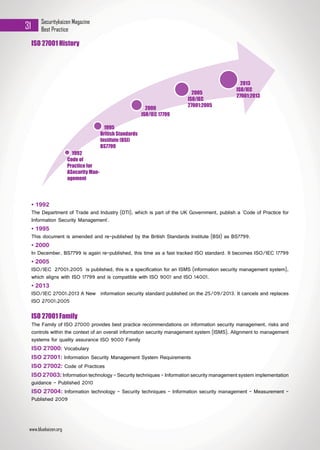
ISO 27001 History
• 1992
The Department of Trade and Industry (DTI), which is part of the UK Government, publish a 'Code of Practice for
Information Security Management'.
• 1995
This document is amended and re-published by the British Standards Institute (BSI) as BS7799.
• 2000
In December, BS7799 is again re-published, this time as a fast tracked ISO standard. It becomes ISO/IEC 17799
• 2005
ISO/IEC 27001:2005 is published, this is a specification for an ISMS (information security management system),
which aligns with ISO 17799 and is compatible with ISO 9001 and ISO 14001.
• 2013
ISO/IEC 27001:2013 A New information security standard published on the 25/09/2013. It cancels and replaces
ISO 27001:2005
ISO 27001 Family
The Family of ISO 27000 provides best practice recommendations on information security management, risks and
controls within the context of an overall information security management system (ISMS), Alignment to management
systems for quality assurance ISO 9000 Family
ISO 27000: Vocabulary
ISO 27001: Information Security Management System Requirements
ISO 27002: Code of Practices
ISO27003:Information technology - Security techniques - Information security management system implementation
guidance - Published 2010
ISO 27004: Information technology - Security techniques - Information security management - Measurement -
Published 2009
1992
Code of
Practice for
ASecurity Man-
agement
1995
British Standards
Institute (BSI)
BS7799
2013
ISO/IEC
27001:2013
2005
ISO/IEC
27001:2005
2000
ISO/IEC 17799
www.bluekaizen.org
Securitykaizen Magazine
Best Practice 32
ISO 27005: Information technology -- Security techniques -- Information security risk management - Published
2011
ISO 27006: Information technology -- Security techniques -- Requirements for bodies providing audit and
certification of information security management systems - Published 2011
ISO 27007-ISO 27008: Information technology -- Security techniques -- Guidelines for auditors on information
security controls - Published 2011
ISO 27011: Information technology -- Security techniques -- Information security management guidelines for
telecommunications organizations based on ISO/IEC 27002 - Published 2008
ISO 27799: Health informatics -- Information security management in health using ISO/IEC 27002
Published 2008
Benefits of ISO 27001
ISO/IEC 27001:2013 Implementation, Certification from a certification body demonstrates that the security of
organization information has been addressed, valuable data and information assets properly controlled.
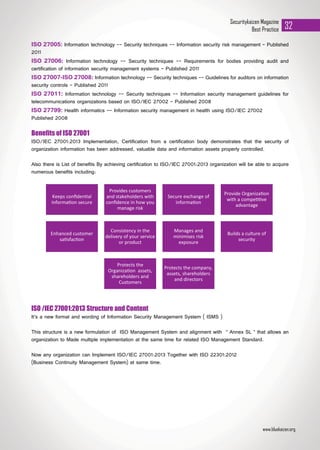
Also there is List of benefits By achieving certification to ISO/IEC 27001:2013 organization will be able to acquire
numerous benefits including:
ISO /IEC 27001:2013 Structure and Content
It’s a new format and wording of Information Security Management System ( ISMS )
This structure is a new formulation of ISO Management System and alignment with “ Annex SL “ that allows an
organization to Made multiple implementation at the same time for related ISO Management Standard.
Now any organization can Implement ISO/IEC 27001:2013 Together with ISO 22301:2012
(Business Continuity Management System) at same time.
www.bluekaizen.org
Securitykaizen Magazine
Best Practice33
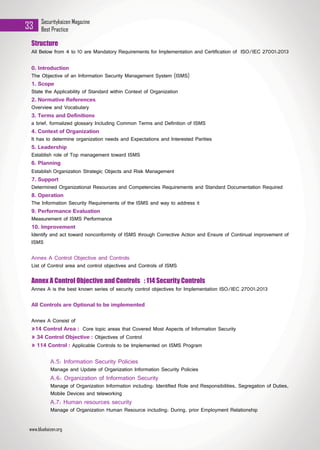
Structure
All Below from 4 to 10 are Mandatory Requirements for Implementation and Certification of ISO/IEC 27001:2013
0. Introduction
The Objective of an Information Security Management System (ISMS)
1. Scope
State the Applicability of Standard within Context of Organization
2. Normative References
Overview and Vocabulary
3. Terms and Definitions
a brief, formalized glossary Including Common Terms and Definition of ISMS
4. Context of Organization
It has to determine organization needs and Expectations and Interested Parities
5. Leadership
Establish role of Top management toward ISMS
6. Planning
Establish Organization Strategic Objects and Risk Management
7. Support
Determined Organizational Resources and Competencies Requirements and Standard Documentation Required
8. Operation
The Information Security Requirements of the ISMS and way to address it
9. Performance Evaluation
Measurement of ISMS Performance
10. Improvement
Identify and act toward nonconformity of ISMS through Corrective Action and Ensure of Continual improvement of
ISMS
Annex A Control Objective and Controls
List of Control area and control objectives and Controls of ISMS
Annex A Control Objective and Controls : 114 Security Controls
Annex A is the best known series of security control objectives for Implementation ISO/IEC 27001:2013
All Controls are Optional to be implemented
Annex A Consist of
»14 Control Area : Core topic areas that Covered Most Aspects of Information Security
» 34 Control Objective : Objectives of Control
» 114 Control : Applicable Controls to be Implemented on ISMS Program
	 A.5: Information Security Policies
	 Manage and Update of Organization Information Security Policies
	 A.6: Organization of Information Security
	 Manage of Organization Information including: Identified Role and Responsibilities, Segregation of Duties,
	 Mobile Devices and teleworking
	 A.7: Human resources security
	 Manage of Organization Human Resource including: During, prior Employment Relationship
www.bluekaizen.org
Securitykaizen Magazine
Best Practice 34
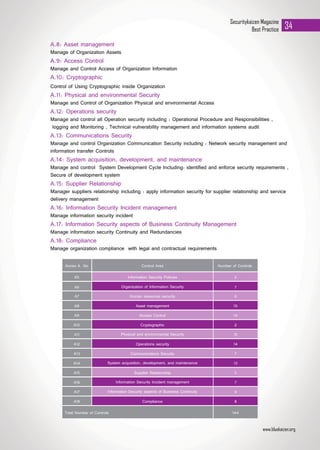
Control Area Number of ControlsAnnex A No
Operations security 14A12
Asset management 10A8
Information Security Incident management 7A16
Organization of Information Security 7A6
System acquisition, development, and maintenance 13A14
Cryptographic 2A10
Compliance 8A18
Information Security Policies 2A5
Communications Security 7A13
Access Control 14A9
Information Security aspects of Business Continuity 4A17
Human resources security 6A7
Supplier Relationship 5A15
Physical and environmental Security 15A11
144Total Number of Controls
	 A.8: Asset management
	 Manage of Organization Assets
	 A.9: Access Control
	 Manage and Control Access of Organization Information
	 A.10: Cryptographic
	 Control of Using Cryptographic inside Organization
	 A.11: Physical and environmental Security
	 Manage and Control of Organization Physical and environmental Access
	 A.12: Operations security
	 Manage and control all Operation security including : Operational Procedure and Responsibilities ,
	 logging and Monitoring , Technical vulnerability management and information systems audit
	 A.13: Communications Security
	 Manage and control Organization Communication Security including : Network security management and
	 information transfer Controls
	 A.14: System acquisition, development, and maintenance
	 Manage and control System Development Cycle Including: identified and enforce security requirements ,
	 Secure of development system
	 A.15: Supplier Relationship
	 Manager suppliers relationship including : apply information security for supplier relationship and service
	 delivery management
	 A.16: Information Security Incident management
	 Manage information security incident
	 A.17: Information Security aspects of Business Continuity Management
	 Manage information security Continuity and Redundancies
	 A.18: Compliance
	 Manage organization compliance with legal and contractual requirements
www.bluekaizen.org
Securitykaizen Magazine
Best Practice35
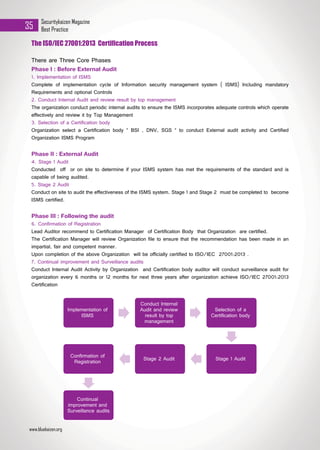
The ISO/IEC 27001:2013 Certification Process
There are Three Core Phases
Phase I : Before External Audit
1. Implementation of ISMS
Complete of implementation cycle of Information security management system ( ISMS) Including mandatory
Requirements and optional Controls
2. Conduct Internal Audit and review result by top management
The organization conduct periodic internal audits to ensure the ISMS incorporates adequate controls which operate
effectively and review it by Top Management
3. Selection of a Certification body
Organization select a Certification body “ BSI , DNV, SGS “ to conduct External audit activity and Certified
Organization ISMS Program
Phase II : External Audit
4. Stage 1 Audit
Conducted off or on site to determine if your ISMS system has met the requirements of the standard and is
capable of being audited.
5. Stage 2 Audit
Conduct on site to audit the effectiveness of the ISMS system. Stage 1 and Stage 2 must be completed to become
ISMS certified.
Phase III : Following the audit
6. Confirmation of Registration
Lead Auditor recommend to Certification Manager of Certification Body that Organization are certified.
The Certification Manager will review Organization file to ensure that the recommendation has been made in an
impartial, fair and competent manner.
Upon completion of the above Organization will be officially certified to ISO/IEC 27001:2013 .
7. Continual improvement and Surveillance audits
Conduct Internal Audit Activity by Organization and Certification body auditor will conduct surveillance audit for
organization every 6 months or 12 months for next three years after organization achieve ISO/IEC 27001:2013
Certification
www.bluekaizen.org
Securitykaizen Magazine
Best Practice 36
Estimated Time needed for Implementation and Certification ISO/IEC 27001:2013
Based on my Experience
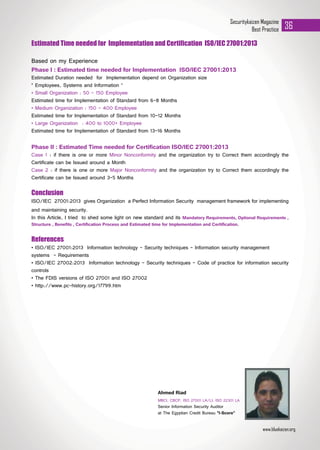
Phase I : Estimated time needed for Implementation ISO/IEC 27001:2013
Estimated Duration needed for Implementation depend on Organization size
“ Employees, Systems and Information “
• Small Organization : 50 - 150 Employee
Estimated time for Implementation of Standard from 6-8 Months
• Medium Organization : 150 – 400 Employee
Estimated time for Implementation of Standard from 10-12 Months
• Large Organization : 400 to 1000+ Employee
Estimated time for Implementation of Standard from 13-16 Months
Phase II : Estimated Time needed for Certification ISO/IEC 27001:2013
Case 1 : if there is one or more Minor Nonconformity and the organization try to Correct them accordingly the
Certificate can be Issued around a Month
Case 2 : if there is one or more Major Nonconformity and the organization try to Correct them accordingly the
Certificate can be Issued around 3-5 Months
Conclusion
ISO/IEC 27001:2013 gives Organization a Perfect Information Security management framework for implementing
and maintaining security.
In this Article, I tried to shed some light on new standard and its Mandatory Requirements, Optional Requirements ,
Structure , Benefits , Certification Process and Estimated time for Implementation and Certification.
References
• ISO/IEC 27001:2013 Information technology - Security techniques - Information security management
systems - Requirements
• ISO/IEC 27002:2013 Information technology - Security techniques - Code of practice for information security
controls
• The FDIS versions of ISO 27001 and ISO 27002
• http://www.pc-history.org/17799.htm
www.bluekaizen.org
MBCI, CBCP, ISO 27001 LA/LI, ISO 22301 LA
Senior Information Security Auditor
at The Egyptian Credit Bureau "I-Score”
Ahmed Riad

ISO/IEC 27001:2013 An Overview

  • 1.
    In this articleI will provide an Overview of A new Information Security Management System Standard ISO/IEC 27001:2013 , The new standard just Published from a few Days Earlier . ISO/IEC 27001:2013 Provides requirements for Establishing, Implementing, Maintaining and Continually Improving an Information Security Management System. The adoption of an information security management system is a strategic decision for an organization. The establishment and implementation of an organization’s information security management system is influenced by the organization’s needs and objectives, The standard covers all types of organizations (e.g. commercial , government agencies, non-profits), all sizes (from micro-businesses to huge multinationals), and all industries/ segments (e.g. retail, banking, defense, healthcare, education and government). The Information Security Management System (ISMS) preserves the Confidentiality, Integrity and Availability of information by applying a Risk Management process and gives confidence to interested parties that Risks are adequately managed. • Confidentiality - ensuring that access to information is appropriately authorized • Integrity - safeguarding the accuracy and completeness of information and processing methods • Availability - ensuring that authorized users have access to information when they need it. An Overview ISO/IEC 27001:2013 www.bluekaizen.org Securitykaizen Magazine Best Practice 30
  • 2.
    Securitykaizen Magazine Best Practice31 ISO27001 History • 1992 The Department of Trade and Industry (DTI), which is part of the UK Government, publish a 'Code of Practice for Information Security Management'. • 1995 This document is amended and re-published by the British Standards Institute (BSI) as BS7799. • 2000 In December, BS7799 is again re-published, this time as a fast tracked ISO standard. It becomes ISO/IEC 17799 • 2005 ISO/IEC 27001:2005 is published, this is a specification for an ISMS (information security management system), which aligns with ISO 17799 and is compatible with ISO 9001 and ISO 14001. • 2013 ISO/IEC 27001:2013 A New information security standard published on the 25/09/2013. It cancels and replaces ISO 27001:2005 ISO 27001 Family The Family of ISO 27000 provides best practice recommendations on information security management, risks and controls within the context of an overall information security management system (ISMS), Alignment to management systems for quality assurance ISO 9000 Family ISO 27000: Vocabulary ISO 27001: Information Security Management System Requirements ISO 27002: Code of Practices ISO27003:Information technology - Security techniques - Information security management system implementation guidance - Published 2010 ISO 27004: Information technology - Security techniques - Information security management - Measurement - Published 2009 1992 Code of Practice for ASecurity Man- agement 1995 British Standards Institute (BSI) BS7799 2013 ISO/IEC 27001:2013 2005 ISO/IEC 27001:2005 2000 ISO/IEC 17799 www.bluekaizen.org
  • 3.
    Securitykaizen Magazine Best Practice32 ISO 27005: Information technology -- Security techniques -- Information security risk management - Published 2011 ISO 27006: Information technology -- Security techniques -- Requirements for bodies providing audit and certification of information security management systems - Published 2011 ISO 27007-ISO 27008: Information technology -- Security techniques -- Guidelines for auditors on information security controls - Published 2011 ISO 27011: Information technology -- Security techniques -- Information security management guidelines for telecommunications organizations based on ISO/IEC 27002 - Published 2008 ISO 27799: Health informatics -- Information security management in health using ISO/IEC 27002 Published 2008 Benefits of ISO 27001 ISO/IEC 27001:2013 Implementation, Certification from a certification body demonstrates that the security of organization information has been addressed, valuable data and information assets properly controlled. Also there is List of benefits By achieving certification to ISO/IEC 27001:2013 organization will be able to acquire numerous benefits including: ISO /IEC 27001:2013 Structure and Content It’s a new format and wording of Information Security Management System ( ISMS ) This structure is a new formulation of ISO Management System and alignment with “ Annex SL “ that allows an organization to Made multiple implementation at the same time for related ISO Management Standard. Now any organization can Implement ISO/IEC 27001:2013 Together with ISO 22301:2012 (Business Continuity Management System) at same time. www.bluekaizen.org
  • 4.
    Securitykaizen Magazine Best Practice33 Structure AllBelow from 4 to 10 are Mandatory Requirements for Implementation and Certification of ISO/IEC 27001:2013 0. Introduction The Objective of an Information Security Management System (ISMS) 1. Scope State the Applicability of Standard within Context of Organization 2. Normative References Overview and Vocabulary 3. Terms and Definitions a brief, formalized glossary Including Common Terms and Definition of ISMS 4. Context of Organization It has to determine organization needs and Expectations and Interested Parities 5. Leadership Establish role of Top management toward ISMS 6. Planning Establish Organization Strategic Objects and Risk Management 7. Support Determined Organizational Resources and Competencies Requirements and Standard Documentation Required 8. Operation The Information Security Requirements of the ISMS and way to address it 9. Performance Evaluation Measurement of ISMS Performance 10. Improvement Identify and act toward nonconformity of ISMS through Corrective Action and Ensure of Continual improvement of ISMS Annex A Control Objective and Controls List of Control area and control objectives and Controls of ISMS Annex A Control Objective and Controls : 114 Security Controls Annex A is the best known series of security control objectives for Implementation ISO/IEC 27001:2013 All Controls are Optional to be implemented Annex A Consist of »14 Control Area : Core topic areas that Covered Most Aspects of Information Security » 34 Control Objective : Objectives of Control » 114 Control : Applicable Controls to be Implemented on ISMS Program A.5: Information Security Policies Manage and Update of Organization Information Security Policies A.6: Organization of Information Security Manage of Organization Information including: Identified Role and Responsibilities, Segregation of Duties, Mobile Devices and teleworking A.7: Human resources security Manage of Organization Human Resource including: During, prior Employment Relationship www.bluekaizen.org
  • 5.
    Securitykaizen Magazine Best Practice34 Control Area Number of ControlsAnnex A No Operations security 14A12 Asset management 10A8 Information Security Incident management 7A16 Organization of Information Security 7A6 System acquisition, development, and maintenance 13A14 Cryptographic 2A10 Compliance 8A18 Information Security Policies 2A5 Communications Security 7A13 Access Control 14A9 Information Security aspects of Business Continuity 4A17 Human resources security 6A7 Supplier Relationship 5A15 Physical and environmental Security 15A11 144Total Number of Controls A.8: Asset management Manage of Organization Assets A.9: Access Control Manage and Control Access of Organization Information A.10: Cryptographic Control of Using Cryptographic inside Organization A.11: Physical and environmental Security Manage and Control of Organization Physical and environmental Access A.12: Operations security Manage and control all Operation security including : Operational Procedure and Responsibilities , logging and Monitoring , Technical vulnerability management and information systems audit A.13: Communications Security Manage and control Organization Communication Security including : Network security management and information transfer Controls A.14: System acquisition, development, and maintenance Manage and control System Development Cycle Including: identified and enforce security requirements , Secure of development system A.15: Supplier Relationship Manager suppliers relationship including : apply information security for supplier relationship and service delivery management A.16: Information Security Incident management Manage information security incident A.17: Information Security aspects of Business Continuity Management Manage information security Continuity and Redundancies A.18: Compliance Manage organization compliance with legal and contractual requirements www.bluekaizen.org
  • 6.
    Securitykaizen Magazine Best Practice35 TheISO/IEC 27001:2013 Certification Process There are Three Core Phases Phase I : Before External Audit 1. Implementation of ISMS Complete of implementation cycle of Information security management system ( ISMS) Including mandatory Requirements and optional Controls 2. Conduct Internal Audit and review result by top management The organization conduct periodic internal audits to ensure the ISMS incorporates adequate controls which operate effectively and review it by Top Management 3. Selection of a Certification body Organization select a Certification body “ BSI , DNV, SGS “ to conduct External audit activity and Certified Organization ISMS Program Phase II : External Audit 4. Stage 1 Audit Conducted off or on site to determine if your ISMS system has met the requirements of the standard and is capable of being audited. 5. Stage 2 Audit Conduct on site to audit the effectiveness of the ISMS system. Stage 1 and Stage 2 must be completed to become ISMS certified. Phase III : Following the audit 6. Confirmation of Registration Lead Auditor recommend to Certification Manager of Certification Body that Organization are certified. The Certification Manager will review Organization file to ensure that the recommendation has been made in an impartial, fair and competent manner. Upon completion of the above Organization will be officially certified to ISO/IEC 27001:2013 . 7. Continual improvement and Surveillance audits Conduct Internal Audit Activity by Organization and Certification body auditor will conduct surveillance audit for organization every 6 months or 12 months for next three years after organization achieve ISO/IEC 27001:2013 Certification www.bluekaizen.org
  • 7.
    Securitykaizen Magazine Best Practice36 Estimated Time needed for Implementation and Certification ISO/IEC 27001:2013 Based on my Experience Phase I : Estimated time needed for Implementation ISO/IEC 27001:2013 Estimated Duration needed for Implementation depend on Organization size “ Employees, Systems and Information “ • Small Organization : 50 - 150 Employee Estimated time for Implementation of Standard from 6-8 Months • Medium Organization : 150 – 400 Employee Estimated time for Implementation of Standard from 10-12 Months • Large Organization : 400 to 1000+ Employee Estimated time for Implementation of Standard from 13-16 Months Phase II : Estimated Time needed for Certification ISO/IEC 27001:2013 Case 1 : if there is one or more Minor Nonconformity and the organization try to Correct them accordingly the Certificate can be Issued around a Month Case 2 : if there is one or more Major Nonconformity and the organization try to Correct them accordingly the Certificate can be Issued around 3-5 Months Conclusion ISO/IEC 27001:2013 gives Organization a Perfect Information Security management framework for implementing and maintaining security. In this Article, I tried to shed some light on new standard and its Mandatory Requirements, Optional Requirements , Structure , Benefits , Certification Process and Estimated time for Implementation and Certification. References • ISO/IEC 27001:2013 Information technology - Security techniques - Information security management systems - Requirements • ISO/IEC 27002:2013 Information technology - Security techniques - Code of practice for information security controls • The FDIS versions of ISO 27001 and ISO 27002 • http://www.pc-history.org/17799.htm www.bluekaizen.org MBCI, CBCP, ISO 27001 LA/LI, ISO 22301 LA Senior Information Security Auditor at The Egyptian Credit Bureau "I-Score” Ahmed Riad