 Problems with Governance:
◦ ‘box ticking’ v. thinking
◦ Structure v. behaviour
◦ Avoiding risks v. creating opportunities
◦ Developing policies, etc. v. implementation
 Evidence about link between ‘Governance’ and performance:
◦ Problem of ‘association’ v. ‘cause & effect’
◦ Is association because ‘effective’ boards and management teams endeavour
to follow ‘governance’, HRD, etc ‘best practice’?
 Importance of the chairman of the board
 Overview of presentation:
◦ Differing approaches of the best run and OK companies
◦ Creating a winning board and building a competitive company
◦ Developing winning people – enabling them to live the values
◦ Improving board effectiveness – Being World Class
 Why are some companies /people more successful?
 Identify apparent critical success factors
 Survey and interview practitioners
 Rank responses in order of results/benefits
 Compare the top and bottom quartiles
 Isolate the factors that make a difference
 Publish critical success factors reports/books/tools
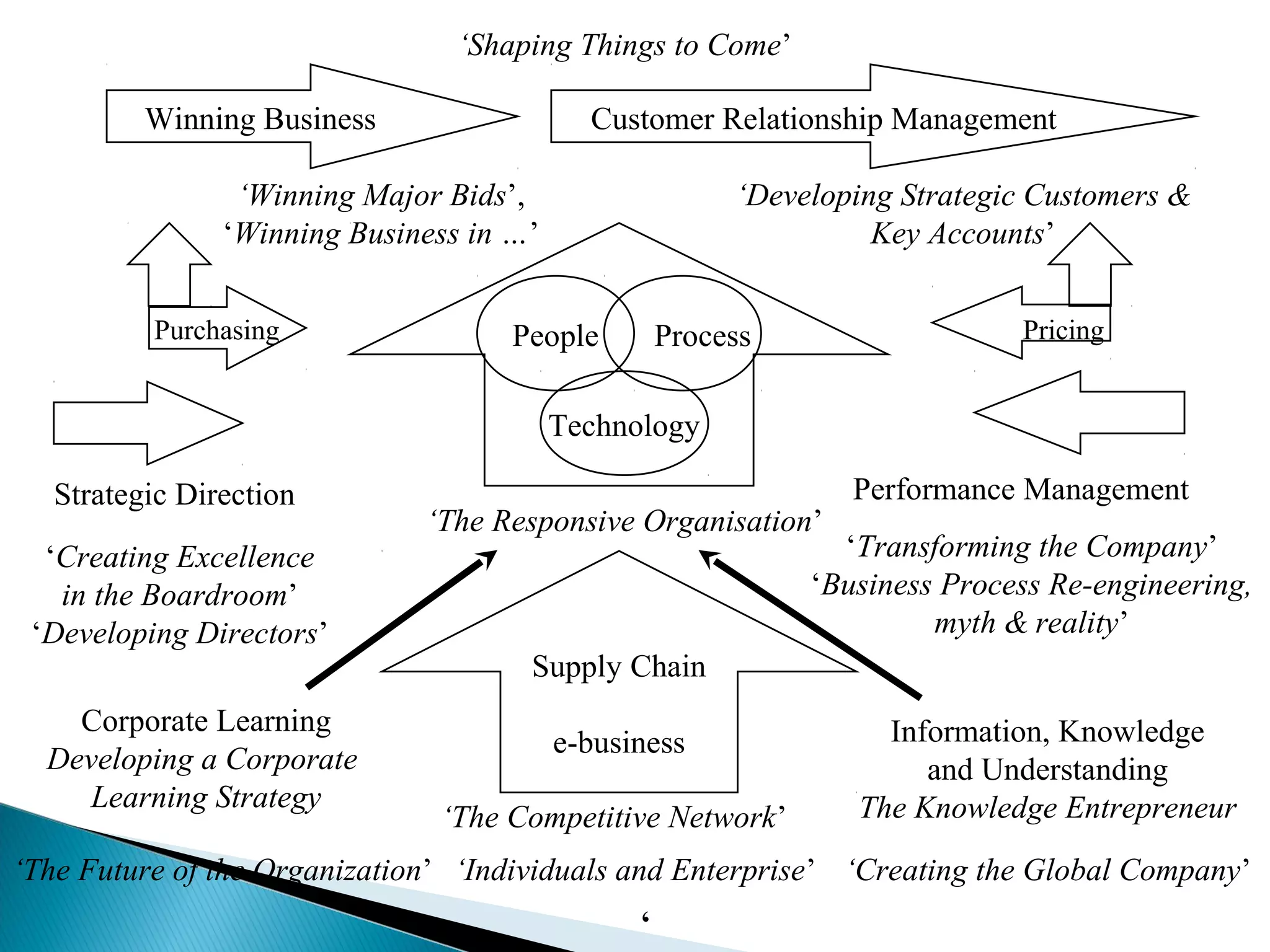
People Process
Technology
Supply Chain
e-business
Winning Business Customer Relationship Management
Purchasing Pricing
‘The Responsive Organisation’
‘The Competitive Network’
Information, Knowledge
and Understanding
The Knowledge Entrepreneur
Corporate Learning
Developing a Corporate
Learning Strategy
‘Winning Major Bids’,
‘Winning Business in …’
‘Developing Strategic Customers &
Key Accounts’
‘The Future of the Organization’ ‘Creating the Global Company’
‘
Strategic Direction Performance Management
‘Creating Excellence
in the Boardroom’
‘Developing Directors’
‘Transforming the Company’
‘Business Process Re-engineering,
myth & reality’
‘Individuals and Enterprise’
‘Shaping Things to Come’
 Clear distinction between winners and losers
 Critical success factors
◦ can be determined
◦ can be built into processes and support tools
 Success is directly related to the number of critical
success factors put in place
 Even the best companies could do much better
 Behavioural factors can be addressed:
◦ Workgroup productivity can be improved
◦ Board effectiveness can be improved
◦ Corporate performance can be transformed
 Need to understand winning approaches in key areas,
e.g. bidding, building relationships, differentiation,
pricing, communication, etc.
 Main differences between winners and losers are
attitudinal and behavioural
 With the same or similar processes, etc ….. winners do
it differently
 Ordinary people can be helped to understand, buy and
behave like superstars
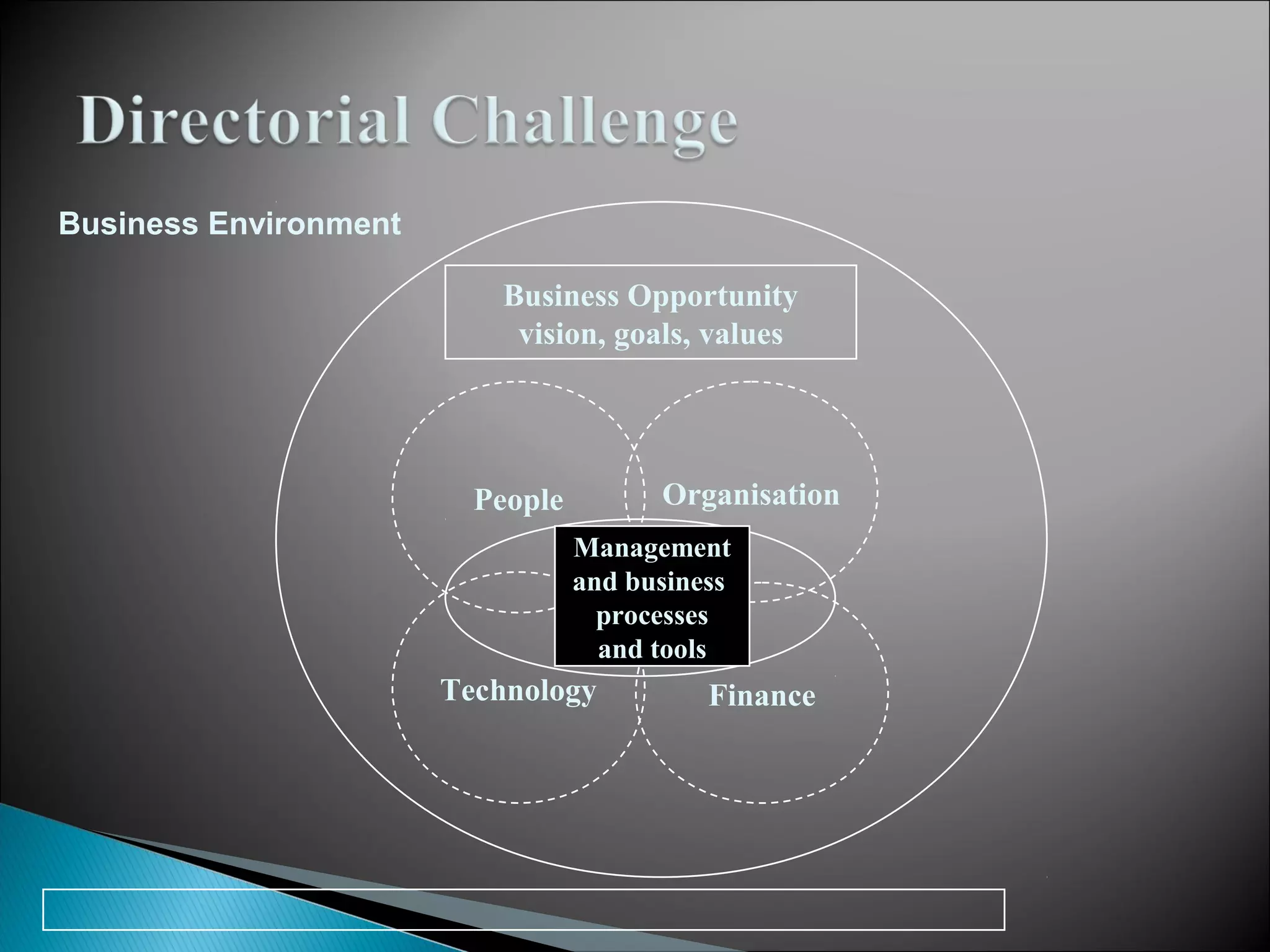
Organisation
Finance
People
Technology
Management
and business
processes
and tools
Business Opportunity
vision, goals, values
Business Environment
Determining what needs to be done
Deciding how to do what
needs to be done
Reporting to stakeholders
on what has been achieved
Ensuring what is done satisfies
legal and ethical requirements
Ensuring that what needs to be done
actually is done
Creating the capability to do what
needs to be done
Where do we want to be? (Visioning)
What are the gaps between where we are
and where we want to be? (Gap analysis)
Monitoring and reporting what has been
achieved (assessment and feedback)
Communicating plans and supporting
their implementation
What do we need to do to close the
gaps? (Action planning)
Where are we now? (Situation analysis)
INTERNAL
ENVIRONMENT
EXTERNAL
ENVIRONMENT
Market Place
Understanding
Listening to
the Customer
Technology
Resources
Organisational
Development
Products
& Services
CORE
PROCESS
Analysis
& Diagnosis
Corrective
Actions &
Improvements
Monitoring
QIP
PSP
BMK
ACTIONS LEARNING
Competitive
Intelligence
ENVIRONMENTAL
ASSESSMENT
•Economic / Social
•Political / Competitor
•Technological
SWOT
•Strengths
•Weaknesses
•Opportunities
•Threats
SITUATION
ANALYSIS
•Desired state
•Current state
•Barrier analysis
VISION
•Values
•Priorities
•Quality principles
MARKET MAP
•Case I High growth
•Case II Mid growth
•Case III Low Growth
•Implications
•Agreed direction
VITAL FEW
•Company
•Functional
 What are the major trends & developments in the
external business environment?
 How will they impact upon the company?
 How will they impact upon: Customers? Competitors?
 What needs to be done in response
◦ at local level?
◦ at operating unit level?
◦ at group/corporate level?
… to address problems and opportunities
… to help customers respond
 Stretching, distinctive and compelling vision that
paints a picture of a better future
 Desired and attainable state of affairs that can engage
and motivate
 A clear vision is of value internally and externally:
◦ Internally it motivates people to achieve and focus their
efforts
◦ Externally the vision should differentiate a company from
its competitors
 If the vision were an animal, a car or a person …
 Do you have a compelling reason for: … existing?
… charging a premium?
 What is unique, special or distinctive?
 Why should people buy from you?
 What would the world lose if you folded?
 Who would notice or care?
 Do customers, staff, business partners, etc.
understand your critical differentiators?
 Can they quickly communicate the essence of
what you are about?
Level of Margin or Return
0
Shared vision
Accepts challenges
New approaches
Flexibility
Innovation
Adds value
Shares risk
Business relevance
Level of Risk
Legalistic
Protective
Damage limitation
Safeguards
Caution
Avoids risk
Technical competence
Commodity supplier
Business partner
 Purpose: Vision, goals and values?
 Image and reputation?
 People: Skills? Understanding? Support?
 Processes: Way of working and learning?
 Products and services? Basis of charging?
 Approaches? Methodologies?
 Tools and techniques?
 Relationships: Partnering? Risk sharing?
 Will, Rationale, Purpose and Vision
 Goals, Values, Objectives and Strategy
 Resources, Capability and Processes
 Competent Management Team
 Framework of Policies and Values
 Agree & monitor plans & performance
 Safeguard assets & ethical standards
 Report performance to owners / interests
 Establishing vision, mission, values, objectives and
policies
 Setting business/financial direction/strategy
 Ensuring appropriate structure/capability
 Delegation to management and control
 Exercising responsibility to shareholders and other
interested parties
Board Responsibilities and Activities
Outward looking
Inward looking
Providing accountability
Providing direction
and
Formulating strategy
Monitoring performance
and
Supervising management
Establishing policies
Source: Hilmer and Tricker, 1991
Past and present oriented Future oriented
 Private Company:
◦ Entrepreneurial drive v. prudent control
◦ Be knowledgeable about and answerable for corporate
activities v. standing back and maintaining an objective
longer-term view
◦ Sensitivity to short-term pressures v. being informed about
market/broader trends
◦ Focus upon company’s commercial needs v. acting
responsibly towards various stakeholders
 Public Sector Board:
◦ Public accountability requirement for objective measures
◦ Quantitative targets v. needs
Positive and Negative Boards
High / right
Low / wrong
Talkers Invest
Irrelevant
Threat
Awareness
and
Strategy
Commitment and Drive
Low High
 Proactively creating a better future
 Exploring, pioneering and discovering
 Turning organisations into incubators of new enterprises
 Creating and launching new ventures
 Creating and exploiting knowledge/intellectual capital
 Generating new options and additional income streams
 Establishing new markets and winning new customers
 Building more intimate customer/partner/etc relationships
 Transforming performance with job support tools
 Change model of operation (network, virtual)
 Change relationships (partnering)
 Change processes (improvement, re-engineering)
 Change work patterns (outsourcing, teleworking)
 Change teamwork approach (activities, exercises)
 Change approaches to learning (e-learning, tools)
 Change approaches to management (democracy)
 Change assumptions and expectations (visioning)
 Change attitudes, skills & knowledge (enterprise)
 Change focus & allocation of time (vital few)
 Change support provided (tools with CSFs/winning ways)
 Lack of awareness of full range of options
 Focus on corporate not client requirements
 Failure to address greatest opportunities
 Excessive faith in single solutions
 Insufficient tailoring to particular culture, situation
and context
 Excessive emphasis upon ‘hard’ issues
 Inadequate balancing of interests
 Inadequate attention to people factors
 Restructuring disrupts relationships
 Downsizing causes loss of experience
 Re-engineering results in loss of specialists
 Outsourcing and the loss of key capabilities
 Regression when systems upgraded
 Standard solutions destroying diversity
 Assumption of linearity
 Activity and reflection
 Action and reaction
 Change and continuity
 Complexity and simplicity
 Surface and substance
 Fads and fundamentals
 Individuals and organisations
 Citizens and communities
 Performance today and capability tomorrow
 Understand what is happening in the business
environment and marketplace
 Anticipate events, address specifics and confront realities
 Develop additional income streams, new capabilities and
fresh intellectual capital
 Inspire, energize and motivate
 Are determined, pragmatic and positive
 Initiate, e.g. proactively approach those they would like
to do business with
 Focus upon areas that make a difference and critical
success factors for competing and winning
 Understand that change can disrupt valued relationships,
and only change what needs to be changed
 Trust reliable people and take calculated risks
 Delegate and encourage entrepreneurship
 Think for themselves and reflect before they act
 Adopt simple solutions and differentiate their
companies’ approaches, products and services
 Create bespoke offerings, additional choices and new
markets
 Are open and self-aware and monitor their own
performance
 Welcome questions, invite feedback and encourage
challenge
 Choose pragmatic colleagues and competent advisers
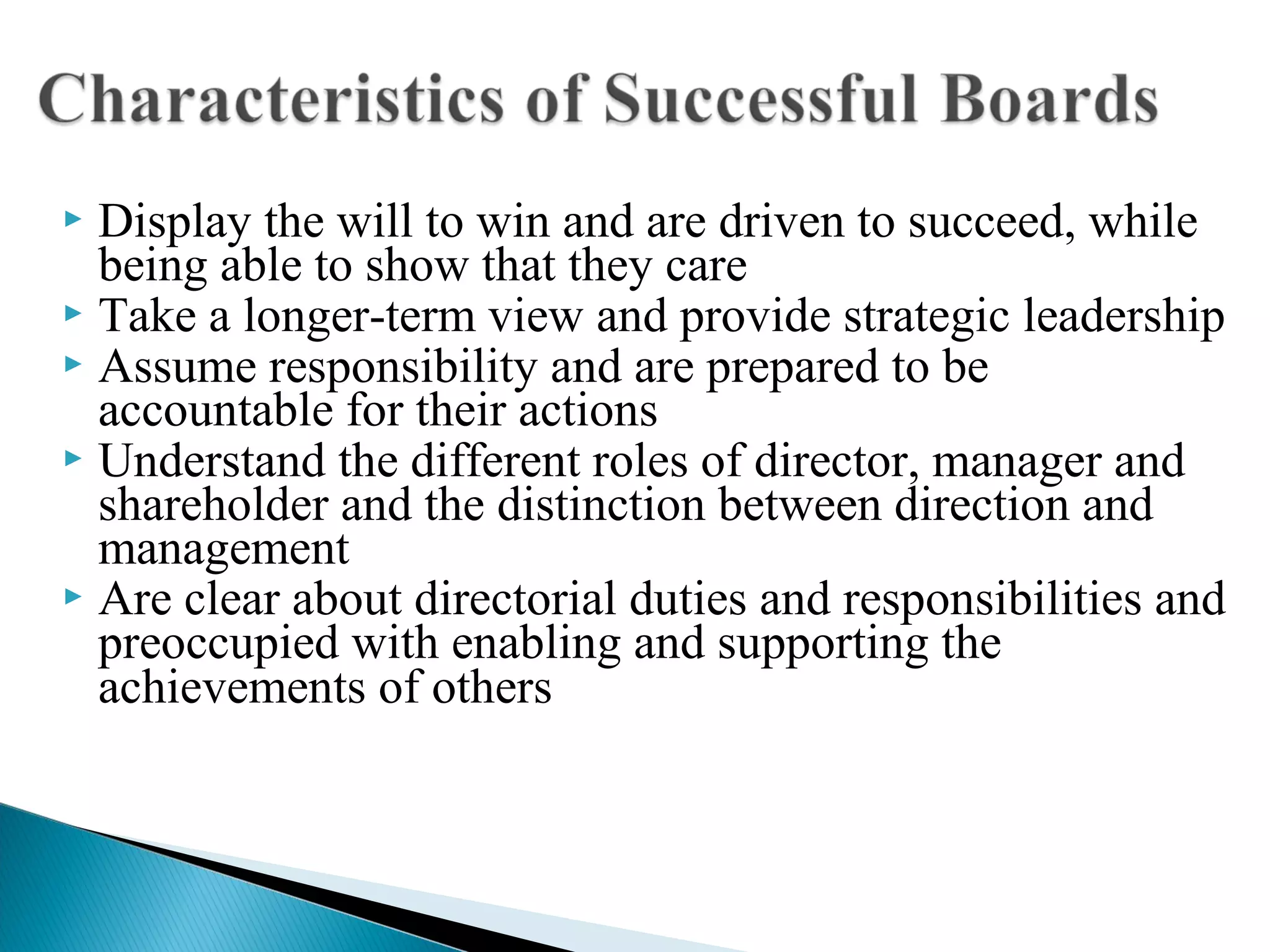
 Display the will to win and are driven to succeed, while
being able to show that they care
 Take a longer-term view and provide strategic leadership
 Assume responsibility and are prepared to be
accountable for their actions
 Understand the different roles of director, manager and
shareholder and the distinction between direction and
management
 Are clear about directorial duties and responsibilities and
preoccupied with enabling and supporting the
achievements of others
 Concentrate upon the external, strategic and business
development aspects of corporate governance
 Strive to ‘build the business’ and deliver additional
value for customers and shareholders
 Provide clear direction, a distinctive purpose, and
achievable goals that prove compelling to those working
towards their achievement
 Manage performance by means of an appropriate range
of indicators and develop new income streams,
capabilities and intellectual capital
 Invest in director/board development & the professional
selection, appointment and induction of new directors
 Determining the knowledge required
◦ ‘Shaping Things to Come’ / Differentiation
 Creating the knowledge required
◦ ‘Developing a Corporate Learning Strategy’
 Managing the knowledge created
◦ ‘Managing Intellectual Capital to Grow Shareholder
Value’ / K-frame
 Exploiting the knowledge created
◦ ‘The Knowledge Entrepreneur’
 Applying the knowledge created
◦ Developing knowledge based job support tools
 Information overload
 People need to be helped to understand & buy
 People need tools and relevant knowledge
 Opportunities for new knowledge-based services and
offerings (37 categories)
 Income opportunities (31 learning services)
 Superstar know-how can be captured / shared
 Need for knowledge entrepreneurs/support tools
 Make it easy for people to locate/understand what they need
 Help people to:
◦ understand technology/benefits for users/customers
◦ tackle more complex problems
 Help and enable your people to behave like winners
 Capture and share best practice & superstar approaches
 Build critical success factors into how work is done
 Provide simple, scalable and cost effective support tools
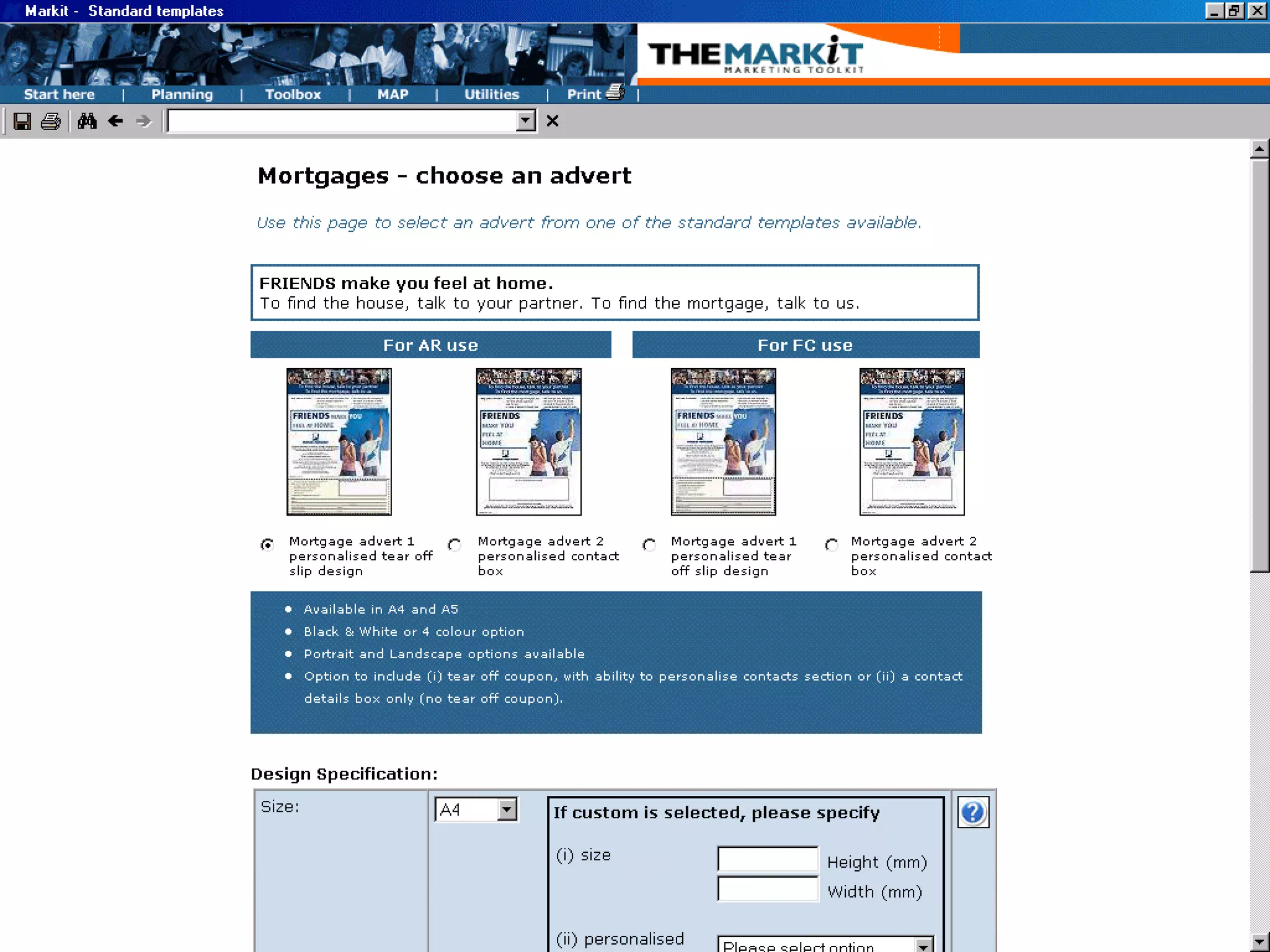
(e.g. Tools used by Avaya, B&Q, Cisco Systems, Dana, Eyretel,
Friends Provident, etc. see www.cotoco.com)
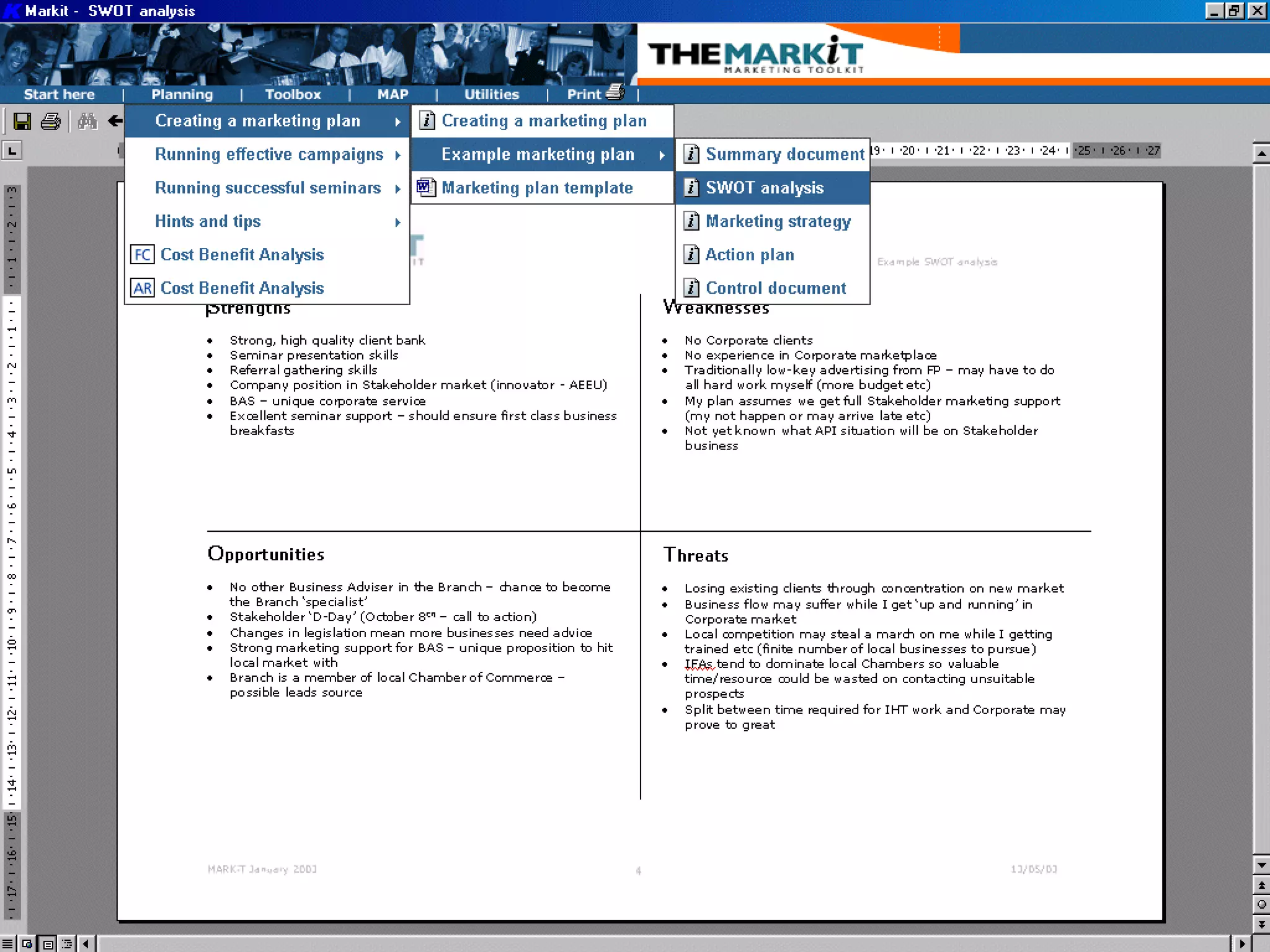
SWOT Analysis
Opportunities
Threats
Strengths Weaknesses
The importance of inter-relationships between SWOT elements
 Sales up 25% in 8 weeks
 £500k orders direct result of tool in first 8 wks.
 Sales cycle down from 12-16 to 8-12 weeks
 Sales technical support requirement down 66%
 Savings achieved of £2.5M per year
Eyretel submission to eBusiness Innovation Award
 £3M direct benefits in year one (£500k + £2.5M)
 Year one ROI 71.43 x project costs (£42k)
 “Before the sales accelerator came along not one
Account Manager wanted to sell SN [Storage
Networking]. … In 6 months since, we have closed deals
in Morocco, Saudi [Arabia], UAE and Pakistan worth
$2.5M. We have $10M in the pipeline.”
Systematic evaluation study compiled for Cisco Systems
 $4.4M (min) attributable to sales in 6 months
First few interviewees within a large global sales force
 Six month ROI min. of 38 x project cost ($116k)
 Traditional Approach:
◦ Checks and Reviews
◦ Delays and Higher Costs
◦ People focused on compliance rather than customers
◦ Bespoke responses discouraged as they create compliance
issues
 New Approach:
◦ Build checks and reviews into support tools
◦ People cannot produce proposals, etc that miss-sell etc.
◦ Faster responses and lower costs
◦ People free to deliver bespoke responses
◦ Also build CSFs and winning ways into support tools
◦ Large improvements in key work group performance
◦ High returns on investment: 20+X, 30+X, 70+X
 Provide the easiest way to accomplish a task
 Keep it simple: Use should improve understanding
 Improve processes, capture and share best practice
 Build critical success factors into practices/tools
 Most cost-effective with homogenous groups/tasks
 Enable bespoke responses to individual customers
 Focus on applications with the greatest impact
 Review, refine and maintain
 Limited and short-term vision
 Obsession with ratios and cost cutting
 Internal and win-lose orientation
 Protection of own interests
 Working harder and cutting corners
 Staying close to existing know-how
 Low margin commodity supplier
 Squeezed margins and falling profitability
 Broad and long-term vision
 Focus on the customer and opportunity generation
 External and win-win orientation
 Ensuring mutually beneficial outcomes
 Working smarter and building relationships
 Exploring, pioneering and discovering
 Sought after business partner
 Rising margins and profitability
 Distinction between direction and management /
Directorial qualities
 Multi-functional experience
 International / network perspective
 Entrepreneurial attitudes
 Complement qualities of colleagues
 The learning board and counselling
 Career evolution:
◦ Managerial progression
◦ First appointment to board
◦ Becomes managing director
◦ NED on another board
◦ Becomes CEO of quoted
company
◦ Becomes chairman of board
◦ Creates portfolio of NEDs
◦ Establishment of own
business
 Development needs:
◦ Management development
◦ Duties and responsibilities
◦ Role of the CEO
◦ Role of the NED
◦ Understand listing
requirements
◦ Role of the chairman
◦ Understand company
specific issues
◦ Business start-up and
financing
 Understanding of context
 Strategic awareness
 Holistic perspective
 Ability to ‘vision’ / look ahead
 Personal qualities
 IOD / Henley standards
 The Winning Board ‘Transforming the
Company’/’Winning Companies, Winning People’
 Strategic awareness and perception
 Analytical understanding/ thinking skills
 Decision making capability
 Communication and inter-personal skills
 Board skills: planning, delegating, appraising,
developing colleagues ….
 Achieving results: energy, drive, integrity ..
Ethics
Judgement
The Competent
Director
Legal
and
Financial
Strategy
Monitoring
Awareness
Knowledge
Skills
Sensitivity
Experience
 Chairman
 Chief Executive Officer
 Non-executive Director
 Functional v Process Owner Director
 Director of Learning / Transformation
 ‘Owner Director’
 Aspirant Director
 Business environment
 Company specific
 Specific to board
 Contribution to the board
 Evaluating individual and team performance
 Identifying obstacles & barriers
 ‘Cosy club’ versus ‘healthy debate’
 Outstanding individuals versus team effectiveness
 Interaction of particular personalities
 Creating an enterprise culture
 Stimulating entre/intrapreneurship
 Buy-outs and buy-ins
 The company as an enterprise colony
 Supporting enterprise development
 Create, package and exploit know-how
 From employee to business partner
 Freedom to dream, aspire, build and create
 Freedom to enter into mutually beneficial relationships
 Freedom to do what is necessary to deliver value and satisfaction to
customers
 Freedom as a customer to seek new sources of benefit and value
 Freedom to initiate debates, explore, question, challenge, innovate
and learn
 Freedom to understand one’s self, be true to one’s self, and develop
and build upon natural strengths
 Freedom to work at a time, location and mode that best contributes to
desired outputs
 Freedom to use the most relevant technology, tools and processes
depending upon what it is that needs to be done
 Freedom to confront reality, identify root causes and tackle obstacles
and barriers
 Freedom to learn according to one’s individual learning potential
 Are there compelling reasons for change?
 Why should anyone be interested or care?
 Are you clear about what you are seeking to do?
 What’s in it for those whose help you need?
 Do they understand why change is needed, what needs
to be done and how they can help?
 Are your aspirations expressed as clear objectives?
 Can these objectives be measured and monitored?
 Have they been agreed by your change partners?
 Are likely obstacles & barriers identified & addressed?
 Have the ‘vital few’ tasks been identified?
 Are people visibly committed to their achievement?
 Do rewards, communications and performance
management support what needs to be done?
 Does everyone understand the critical success factors for
competing and winning?
 Are individual roles, responsibilities and contributions
understood?
 Have people identified the knowledge, understanding
and support tools they will require?
 Are they motivated / equipped to communicate / act?
 Provide people with a distinctive and compelling vision
 Give them good reasons to follow you and/or change
 Enable your people to differentiate and make a difference
 Give them opportunities for personal growth
 Provide them with relevant support tools
 Enable them to communicate, share and live the vision
 Recognise their unique contributions
 Inspire trust and encourage innovation
 Back initiative and responsible risk taking
 Reconcile commercial success and personal fulfilment
 Providing Knowledge is not enough
 People may also require skills and tools to apply it
 Tools work best with homogenous groups and tasks
 Don’t use inflexible tools in rapidly changing areas
 Regular review, updating and maintenance extends life
 Improve rather than automate current practices
 Support tools enhance performance/understanding
 Superstar practice and expertise can be spread
 Behaviour can be changed through traffic lighting, etc.
 Returns on Investment (ROI) of over 20 x achieved
 Build an effective board (‘Developing Directors’)
 Build a Winning Team (‘Winning Companies; Winning People’)
 Attract, motivate, enable and support entrepreneurs
(‘Individuals & Enterprise’)
 Create new options, genuine choices and alternative
offerings (‘Shaping Things to Come’)
 Exploit know-how to create new offerings/services
(‘Knowledge Entrepreneur’)
 Transform business units into flexible networks for
managing change, competing and winning (‘Transforming
the Company’)
 Publications:
◦ Books,
◦ Reports and
◦ Briefings
 Presentations
 Benchmarking Reports
 Health Checks
 Course Modules
 Consultancy Support
 Support Tools

Transforming the Boardrooms "Boardroom Effectiveness "

  • 2.
     Problems withGovernance: ◦ ‘box ticking’ v. thinking ◦ Structure v. behaviour ◦ Avoiding risks v. creating opportunities ◦ Developing policies, etc. v. implementation  Evidence about link between ‘Governance’ and performance: ◦ Problem of ‘association’ v. ‘cause & effect’ ◦ Is association because ‘effective’ boards and management teams endeavour to follow ‘governance’, HRD, etc ‘best practice’?  Importance of the chairman of the board  Overview of presentation: ◦ Differing approaches of the best run and OK companies ◦ Creating a winning board and building a competitive company ◦ Developing winning people – enabling them to live the values ◦ Improving board effectiveness – Being World Class
  • 3.
     Why aresome companies /people more successful?  Identify apparent critical success factors  Survey and interview practitioners  Rank responses in order of results/benefits  Compare the top and bottom quartiles  Isolate the factors that make a difference  Publish critical success factors reports/books/tools
  • 4.
    People Process Technology Supply Chain e-business WinningBusiness Customer Relationship Management Purchasing Pricing ‘The Responsive Organisation’ ‘The Competitive Network’ Information, Knowledge and Understanding The Knowledge Entrepreneur Corporate Learning Developing a Corporate Learning Strategy ‘Winning Major Bids’, ‘Winning Business in …’ ‘Developing Strategic Customers & Key Accounts’ ‘The Future of the Organization’ ‘Creating the Global Company’ ‘ Strategic Direction Performance Management ‘Creating Excellence in the Boardroom’ ‘Developing Directors’ ‘Transforming the Company’ ‘Business Process Re-engineering, myth & reality’ ‘Individuals and Enterprise’ ‘Shaping Things to Come’
  • 5.
     Clear distinctionbetween winners and losers  Critical success factors ◦ can be determined ◦ can be built into processes and support tools  Success is directly related to the number of critical success factors put in place  Even the best companies could do much better  Behavioural factors can be addressed: ◦ Workgroup productivity can be improved ◦ Board effectiveness can be improved ◦ Corporate performance can be transformed
  • 6.
     Need tounderstand winning approaches in key areas, e.g. bidding, building relationships, differentiation, pricing, communication, etc.  Main differences between winners and losers are attitudinal and behavioural  With the same or similar processes, etc ….. winners do it differently  Ordinary people can be helped to understand, buy and behave like superstars
  • 7.
  • 8.
    Determining what needsto be done Deciding how to do what needs to be done Reporting to stakeholders on what has been achieved Ensuring what is done satisfies legal and ethical requirements Ensuring that what needs to be done actually is done Creating the capability to do what needs to be done
  • 9.
    Where do wewant to be? (Visioning) What are the gaps between where we are and where we want to be? (Gap analysis) Monitoring and reporting what has been achieved (assessment and feedback) Communicating plans and supporting their implementation What do we need to do to close the gaps? (Action planning) Where are we now? (Situation analysis)
  • 10.
    INTERNAL ENVIRONMENT EXTERNAL ENVIRONMENT Market Place Understanding Listening to theCustomer Technology Resources Organisational Development Products & Services CORE PROCESS Analysis & Diagnosis Corrective Actions & Improvements Monitoring QIP PSP BMK ACTIONS LEARNING Competitive Intelligence
  • 11.
    ENVIRONMENTAL ASSESSMENT •Economic / Social •Political/ Competitor •Technological SWOT •Strengths •Weaknesses •Opportunities •Threats SITUATION ANALYSIS •Desired state •Current state •Barrier analysis VISION •Values •Priorities •Quality principles MARKET MAP •Case I High growth •Case II Mid growth •Case III Low Growth •Implications •Agreed direction VITAL FEW •Company •Functional
  • 12.
     What arethe major trends & developments in the external business environment?  How will they impact upon the company?  How will they impact upon: Customers? Competitors?  What needs to be done in response ◦ at local level? ◦ at operating unit level? ◦ at group/corporate level? … to address problems and opportunities … to help customers respond
  • 13.
     Stretching, distinctiveand compelling vision that paints a picture of a better future  Desired and attainable state of affairs that can engage and motivate  A clear vision is of value internally and externally: ◦ Internally it motivates people to achieve and focus their efforts ◦ Externally the vision should differentiate a company from its competitors  If the vision were an animal, a car or a person …
  • 14.
     Do youhave a compelling reason for: … existing? … charging a premium?  What is unique, special or distinctive?  Why should people buy from you?  What would the world lose if you folded?  Who would notice or care?  Do customers, staff, business partners, etc. understand your critical differentiators?  Can they quickly communicate the essence of what you are about?
  • 15.
    Level of Marginor Return 0 Shared vision Accepts challenges New approaches Flexibility Innovation Adds value Shares risk Business relevance Level of Risk Legalistic Protective Damage limitation Safeguards Caution Avoids risk Technical competence Commodity supplier Business partner
  • 16.
     Purpose: Vision,goals and values?  Image and reputation?  People: Skills? Understanding? Support?  Processes: Way of working and learning?  Products and services? Basis of charging?  Approaches? Methodologies?  Tools and techniques?  Relationships: Partnering? Risk sharing?
  • 17.
     Will, Rationale,Purpose and Vision  Goals, Values, Objectives and Strategy  Resources, Capability and Processes  Competent Management Team  Framework of Policies and Values  Agree & monitor plans & performance  Safeguard assets & ethical standards  Report performance to owners / interests
  • 18.
     Establishing vision,mission, values, objectives and policies  Setting business/financial direction/strategy  Ensuring appropriate structure/capability  Delegation to management and control  Exercising responsibility to shareholders and other interested parties
  • 19.
    Board Responsibilities andActivities Outward looking Inward looking Providing accountability Providing direction and Formulating strategy Monitoring performance and Supervising management Establishing policies Source: Hilmer and Tricker, 1991 Past and present oriented Future oriented
  • 20.
     Private Company: ◦Entrepreneurial drive v. prudent control ◦ Be knowledgeable about and answerable for corporate activities v. standing back and maintaining an objective longer-term view ◦ Sensitivity to short-term pressures v. being informed about market/broader trends ◦ Focus upon company’s commercial needs v. acting responsibly towards various stakeholders  Public Sector Board: ◦ Public accountability requirement for objective measures ◦ Quantitative targets v. needs
  • 21.
    Positive and NegativeBoards High / right Low / wrong Talkers Invest Irrelevant Threat Awareness and Strategy Commitment and Drive Low High
  • 22.
     Proactively creatinga better future  Exploring, pioneering and discovering  Turning organisations into incubators of new enterprises  Creating and launching new ventures  Creating and exploiting knowledge/intellectual capital  Generating new options and additional income streams  Establishing new markets and winning new customers  Building more intimate customer/partner/etc relationships  Transforming performance with job support tools
  • 23.
     Change modelof operation (network, virtual)  Change relationships (partnering)  Change processes (improvement, re-engineering)  Change work patterns (outsourcing, teleworking)  Change teamwork approach (activities, exercises)  Change approaches to learning (e-learning, tools)  Change approaches to management (democracy)  Change assumptions and expectations (visioning)  Change attitudes, skills & knowledge (enterprise)  Change focus & allocation of time (vital few)  Change support provided (tools with CSFs/winning ways)
  • 24.
     Lack ofawareness of full range of options  Focus on corporate not client requirements  Failure to address greatest opportunities  Excessive faith in single solutions  Insufficient tailoring to particular culture, situation and context  Excessive emphasis upon ‘hard’ issues  Inadequate balancing of interests  Inadequate attention to people factors
  • 25.
     Restructuring disruptsrelationships  Downsizing causes loss of experience  Re-engineering results in loss of specialists  Outsourcing and the loss of key capabilities  Regression when systems upgraded  Standard solutions destroying diversity  Assumption of linearity
  • 26.
     Activity andreflection  Action and reaction  Change and continuity  Complexity and simplicity  Surface and substance  Fads and fundamentals  Individuals and organisations  Citizens and communities  Performance today and capability tomorrow
  • 27.
     Understand whatis happening in the business environment and marketplace  Anticipate events, address specifics and confront realities  Develop additional income streams, new capabilities and fresh intellectual capital  Inspire, energize and motivate  Are determined, pragmatic and positive  Initiate, e.g. proactively approach those they would like to do business with  Focus upon areas that make a difference and critical success factors for competing and winning  Understand that change can disrupt valued relationships, and only change what needs to be changed
  • 28.
     Trust reliablepeople and take calculated risks  Delegate and encourage entrepreneurship  Think for themselves and reflect before they act  Adopt simple solutions and differentiate their companies’ approaches, products and services  Create bespoke offerings, additional choices and new markets  Are open and self-aware and monitor their own performance  Welcome questions, invite feedback and encourage challenge  Choose pragmatic colleagues and competent advisers
  • 29.
     Display thewill to win and are driven to succeed, while being able to show that they care  Take a longer-term view and provide strategic leadership  Assume responsibility and are prepared to be accountable for their actions  Understand the different roles of director, manager and shareholder and the distinction between direction and management  Are clear about directorial duties and responsibilities and preoccupied with enabling and supporting the achievements of others
  • 30.
     Concentrate uponthe external, strategic and business development aspects of corporate governance  Strive to ‘build the business’ and deliver additional value for customers and shareholders  Provide clear direction, a distinctive purpose, and achievable goals that prove compelling to those working towards their achievement  Manage performance by means of an appropriate range of indicators and develop new income streams, capabilities and intellectual capital  Invest in director/board development & the professional selection, appointment and induction of new directors
  • 31.
     Determining theknowledge required ◦ ‘Shaping Things to Come’ / Differentiation  Creating the knowledge required ◦ ‘Developing a Corporate Learning Strategy’  Managing the knowledge created ◦ ‘Managing Intellectual Capital to Grow Shareholder Value’ / K-frame  Exploiting the knowledge created ◦ ‘The Knowledge Entrepreneur’  Applying the knowledge created ◦ Developing knowledge based job support tools
  • 32.
     Information overload People need to be helped to understand & buy  People need tools and relevant knowledge  Opportunities for new knowledge-based services and offerings (37 categories)  Income opportunities (31 learning services)  Superstar know-how can be captured / shared  Need for knowledge entrepreneurs/support tools
  • 33.
     Make iteasy for people to locate/understand what they need  Help people to: ◦ understand technology/benefits for users/customers ◦ tackle more complex problems  Help and enable your people to behave like winners  Capture and share best practice & superstar approaches  Build critical success factors into how work is done  Provide simple, scalable and cost effective support tools (e.g. Tools used by Avaya, B&Q, Cisco Systems, Dana, Eyretel, Friends Provident, etc. see www.cotoco.com)
  • 34.
    SWOT Analysis Opportunities Threats Strengths Weaknesses Theimportance of inter-relationships between SWOT elements
  • 39.
     Sales up25% in 8 weeks  £500k orders direct result of tool in first 8 wks.  Sales cycle down from 12-16 to 8-12 weeks  Sales technical support requirement down 66%  Savings achieved of £2.5M per year Eyretel submission to eBusiness Innovation Award  £3M direct benefits in year one (£500k + £2.5M)  Year one ROI 71.43 x project costs (£42k)
  • 42.
     “Before thesales accelerator came along not one Account Manager wanted to sell SN [Storage Networking]. … In 6 months since, we have closed deals in Morocco, Saudi [Arabia], UAE and Pakistan worth $2.5M. We have $10M in the pipeline.” Systematic evaluation study compiled for Cisco Systems  $4.4M (min) attributable to sales in 6 months First few interviewees within a large global sales force  Six month ROI min. of 38 x project cost ($116k)
  • 43.
     Traditional Approach: ◦Checks and Reviews ◦ Delays and Higher Costs ◦ People focused on compliance rather than customers ◦ Bespoke responses discouraged as they create compliance issues  New Approach: ◦ Build checks and reviews into support tools ◦ People cannot produce proposals, etc that miss-sell etc. ◦ Faster responses and lower costs ◦ People free to deliver bespoke responses ◦ Also build CSFs and winning ways into support tools ◦ Large improvements in key work group performance ◦ High returns on investment: 20+X, 30+X, 70+X
  • 46.
     Provide theeasiest way to accomplish a task  Keep it simple: Use should improve understanding  Improve processes, capture and share best practice  Build critical success factors into practices/tools  Most cost-effective with homogenous groups/tasks  Enable bespoke responses to individual customers  Focus on applications with the greatest impact  Review, refine and maintain
  • 47.
     Limited andshort-term vision  Obsession with ratios and cost cutting  Internal and win-lose orientation  Protection of own interests  Working harder and cutting corners  Staying close to existing know-how  Low margin commodity supplier  Squeezed margins and falling profitability
  • 48.
     Broad andlong-term vision  Focus on the customer and opportunity generation  External and win-win orientation  Ensuring mutually beneficial outcomes  Working smarter and building relationships  Exploring, pioneering and discovering  Sought after business partner  Rising margins and profitability
  • 49.
     Distinction betweendirection and management / Directorial qualities  Multi-functional experience  International / network perspective  Entrepreneurial attitudes  Complement qualities of colleagues  The learning board and counselling
  • 50.
     Career evolution: ◦Managerial progression ◦ First appointment to board ◦ Becomes managing director ◦ NED on another board ◦ Becomes CEO of quoted company ◦ Becomes chairman of board ◦ Creates portfolio of NEDs ◦ Establishment of own business  Development needs: ◦ Management development ◦ Duties and responsibilities ◦ Role of the CEO ◦ Role of the NED ◦ Understand listing requirements ◦ Role of the chairman ◦ Understand company specific issues ◦ Business start-up and financing
  • 51.
     Understanding ofcontext  Strategic awareness  Holistic perspective  Ability to ‘vision’ / look ahead  Personal qualities  IOD / Henley standards  The Winning Board ‘Transforming the Company’/’Winning Companies, Winning People’
  • 52.
     Strategic awarenessand perception  Analytical understanding/ thinking skills  Decision making capability  Communication and inter-personal skills  Board skills: planning, delegating, appraising, developing colleagues ….  Achieving results: energy, drive, integrity ..
  • 53.
  • 54.
     Chairman  ChiefExecutive Officer  Non-executive Director  Functional v Process Owner Director  Director of Learning / Transformation  ‘Owner Director’  Aspirant Director
  • 55.
     Business environment Company specific  Specific to board  Contribution to the board
  • 56.
     Evaluating individualand team performance  Identifying obstacles & barriers  ‘Cosy club’ versus ‘healthy debate’  Outstanding individuals versus team effectiveness  Interaction of particular personalities
  • 57.
     Creating anenterprise culture  Stimulating entre/intrapreneurship  Buy-outs and buy-ins  The company as an enterprise colony  Supporting enterprise development  Create, package and exploit know-how  From employee to business partner
  • 58.
     Freedom todream, aspire, build and create  Freedom to enter into mutually beneficial relationships  Freedom to do what is necessary to deliver value and satisfaction to customers  Freedom as a customer to seek new sources of benefit and value  Freedom to initiate debates, explore, question, challenge, innovate and learn  Freedom to understand one’s self, be true to one’s self, and develop and build upon natural strengths  Freedom to work at a time, location and mode that best contributes to desired outputs  Freedom to use the most relevant technology, tools and processes depending upon what it is that needs to be done  Freedom to confront reality, identify root causes and tackle obstacles and barriers  Freedom to learn according to one’s individual learning potential
  • 59.
     Are therecompelling reasons for change?  Why should anyone be interested or care?  Are you clear about what you are seeking to do?  What’s in it for those whose help you need?  Do they understand why change is needed, what needs to be done and how they can help?  Are your aspirations expressed as clear objectives?  Can these objectives be measured and monitored?  Have they been agreed by your change partners?  Are likely obstacles & barriers identified & addressed?
  • 60.
     Have the‘vital few’ tasks been identified?  Are people visibly committed to their achievement?  Do rewards, communications and performance management support what needs to be done?  Does everyone understand the critical success factors for competing and winning?  Are individual roles, responsibilities and contributions understood?  Have people identified the knowledge, understanding and support tools they will require?  Are they motivated / equipped to communicate / act?
  • 61.
     Provide peoplewith a distinctive and compelling vision  Give them good reasons to follow you and/or change  Enable your people to differentiate and make a difference  Give them opportunities for personal growth  Provide them with relevant support tools  Enable them to communicate, share and live the vision  Recognise their unique contributions  Inspire trust and encourage innovation  Back initiative and responsible risk taking  Reconcile commercial success and personal fulfilment
  • 62.
     Providing Knowledgeis not enough  People may also require skills and tools to apply it  Tools work best with homogenous groups and tasks  Don’t use inflexible tools in rapidly changing areas  Regular review, updating and maintenance extends life  Improve rather than automate current practices  Support tools enhance performance/understanding  Superstar practice and expertise can be spread  Behaviour can be changed through traffic lighting, etc.  Returns on Investment (ROI) of over 20 x achieved
  • 63.
     Build aneffective board (‘Developing Directors’)  Build a Winning Team (‘Winning Companies; Winning People’)  Attract, motivate, enable and support entrepreneurs (‘Individuals & Enterprise’)  Create new options, genuine choices and alternative offerings (‘Shaping Things to Come’)  Exploit know-how to create new offerings/services (‘Knowledge Entrepreneur’)  Transform business units into flexible networks for managing change, competing and winning (‘Transforming the Company’)
  • 64.
     Publications: ◦ Books, ◦Reports and ◦ Briefings  Presentations  Benchmarking Reports  Health Checks  Course Modules  Consultancy Support  Support Tools