Ghiath Alahmad
Main Points
 Clarification of the concept of Islamic Jurisprudence
 The purposes of the Jurisprudence
 Shariah & Jurisprudence
 Jurisprudence & the man made law
 The Categories of Action rules
 The historical stages of the growth of the
Jurisprudence
 The major schools of the Islamic Jurisprudence
‫الفقه‬
Jurisprudence
 ‫-الفقه‬Fiqh accurately means to understand deeply ‫.الفهم‬
 An example of this is found in the Qur’an in the Dua of
Prophet Moses (as) when he asked Allah to remove the
impediment from his speech so Pharaoh and his people
could understand him very well.
{‫لساني‬ ‫من‬ ‫عقدة‬ ‫واحلل‬‫يفقهوا‬‫قولي‬}.
“And loosen the knot from my tongue. That they may
understand my speech.”
‫الفقه‬
Jurisprudence
This usage is also found in the Hadith of the
Prophet (‫صلى‬‫هللا‬‫عليه‬‫وسلم‬) who said, “Whoever Allah
intends good for. He gives him understanding of
the Deen.” Narrated by Muslim.
”‫من‬‫به‬ ‫هللا‬ ‫يرد‬‫خ‬‫يرا‬‫يفقه‬‫ه‬‫الدين‬ ‫في‬“.
‫رواه‬‫البخاري‬‫و‬‫مسلم‬.
‫العلماء‬ ‫اصطالح‬ ‫يف‬ ‫الفقه‬
Jurisprudence According to the Scholars
Fiqh according to the scholars has the following meaning:
“The collection of rulings or laws, (taken from)
Shariah, dealing with actions, by which every Muslim
is required to live. It is important to know that these
rulings deal with the individual as well as the society.”
ّ‫ل‬‫أد‬ ‫من‬ ً‫ا‬َّ‫د‬َ‫م‬َ‫ت‬‫س‬ُ‫م‬ ‫ة‬ّ‫ي‬‫العمل‬ ‫ة‬ّ‫ي‬‫الشرع‬ ‫باألحكام‬ ‫العلم‬‫ة‬ّ‫ي‬‫التفصيل‬ ‫تها‬
‫الفقه‬ ‫مشولية‬
The Comprehensiveness of Jurisprudence
1. Worship – ‫العبادة‬ this aspect of Jurisprudence is
dealing with Prayer, Charity, Fasting, and Hajj.
2. Family Issues- ‫األسرة‬ this aspect of Jurisprudence is
dealing with the family from the beginning to the
end. Such as the conditions for a sound marriage
divorce and so forth.
3. Transactions- ‫المعامالت‬ this aspect of Jurisprudence is
related to how we cooperate with each other in
society. An example would be buying and selling
goods.
‫الفقه‬ ‫مشولية‬
The Comprehensiveness of Jurisprudence
4. Politics- ‫السياسة‬ this aspect of Jurisprudence
deals with the organization of government and
governmental organizations in regards to the
Muslim nation.
5. Punishment of criminals ‫العقوبات‬
‫الفقه‬ ‫مشولية‬
The Comprehensiveness of Jurisprudence
6. Peace and war- ‫السالم‬‫و‬‫الحرب‬ this aspect of
Jurisprudence deals with foreign relations with other
countries depending on the current condition that exist
between the Islamic state and those countries.
7. Ethics and virtue ‫الفضائل‬ ‫و‬ ‫األخالق‬
‫الشريعة‬
Al-Shariah in the Arabic Language
‫شريعة‬ “A watering place; a resort of drinkers (both men and
beast); a place to which men come to drink there-from and
draw water.”
‫االصطالح‬ ‫يف‬ ‫الشريعة‬
Al-Shariah in Islamic Terminology
“It refers to the sum total of Islamic Laws which were
revealed to the Prophet Muhammad {‫صلى‬‫هللا‬‫عل‬‫ي‬‫ه‬‫و‬‫سلم‬} which
are recorded in the Qur’an and the Sunnah).”
‫الشريعة‬:‫رة‬ّ‫ه‬‫المط‬ ‫ة‬ّ‫ن‬‫الس‬ ‫و‬ ‫القرآن‬ ‫نصوص‬ ‫هي‬
‫الشريعة‬ ‫و‬ ‫الفقه‬ ‫بني‬ ‫الفرق‬
The Differences Between Fiqh and Shariah
Fiqh.
1. A body of laws deduced from the
Shariah to cover specific situations
not covered in the Shariah.
‫الشريعة‬ ‫من‬ ‫ّة‬‫د‬‫المستم‬ ‫القوانين‬
Shariah
1. Shar’eah is the body of laws
found both in the Qur`an and
Sunnah.
ّ‫ن‬‫والس‬ ‫القرآن‬ ‫في‬ ‫الموجودة‬ ‫القوانين‬‫ة‬
‫الشريعة‬ ‫و‬ ‫الفقه‬ ‫بني‬ ‫الفرق‬
The Differences Between Fiqh and Shariah
Fiqh.
2. Fiqh changes according to the
circumstances surrounding it.
‫الظروف‬ ‫بتغير‬ ‫يتغير‬ ‫الفقه‬
‫المحيطة‬
Shariah
2. Shariah is fixed and
unchangeable.
‫تتغير‬ ‫ال‬ ‫و‬ ‫ثابتة‬ ‫الشريعة‬
‫الشريعة‬ ‫و‬ ‫الفقه‬ ‫بني‬ ‫الفرق‬
The Differences Between Fiqh and Shariah
Fiqh.
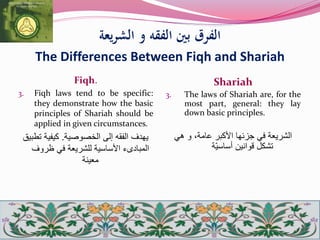
3. Fiqh laws tend to be specific:
they demonstrate how the basic
principles of Shariah should be
applied in given circumstances.
‫الخصوصية‬ ‫إلى‬ ‫الفقه‬ ‫يهدف‬.‫تطبي‬ ‫كيفية‬‫ق‬
‫ظروف‬ ‫في‬ ‫للشريعة‬ ‫األساسية‬ ‫المبادىء‬
‫معينة‬
Shariah
3. The laws of Shariah are, for the
most part, general: they lay
down basic principles.
‫هي‬ ‫و‬ ،‫عامة‬ ‫األكبر‬ ‫جزئها‬ ‫في‬ ‫الشريعة‬
‫ّة‬‫ي‬‫أساس‬ ‫قوانين‬ ‫تشكل‬
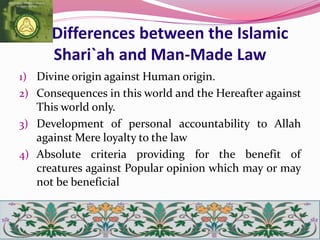
Differences between the Islamic
Shari`ah and Man-Made Law
1) Divine origin against Human origin.
2) Consequences in this world and the Hereafter against
This world only.
3) Development of personal accountability to Allah
against Mere loyalty to the law
4) Absolute criteria providing for the benefit of
creatures against Popular opinion which may or may
not be beneficial
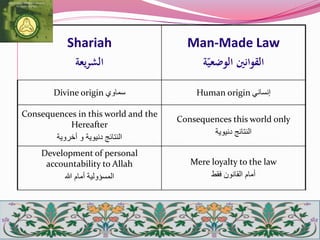
Shariah
‫يعة‬‫ر‬‫الش‬
Man-Made Law
‫ة‬ّ‫الوضعي‬ ‫القوانني‬
Divine origin ‫سماوي‬ Human origin ‫إنساني‬
Consequences in this world and the
Hereafter
‫أخروية‬ ‫و‬ ‫دنيوية‬ ‫النتائج‬
Consequences this world only
‫دنيوية‬ ‫النتائج‬
Development of personal
accountability to Allah
‫هللا‬ ‫أمام‬ ‫المسؤولية‬
Mere loyalty to the law
‫فقط‬ ‫القانون‬ ‫أمام‬
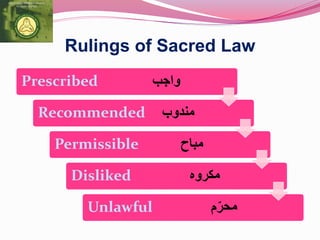
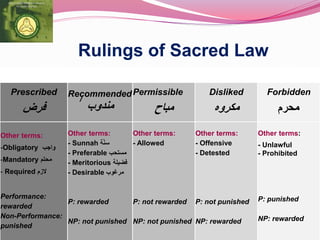
Rulings of Sacred Law
Prescribed ‫واجب‬
Recommended ‫مندوب‬
Permissible ‫مباح‬
Disliked ‫مكروه‬
Unlawful ‫م‬ّ‫ر‬‫مح‬
Rulings of Sacred Law
Prescribed
‫فرض‬
Recommended
/
‫مندوب‬
Permissible
‫مباح‬
Disliked
‫مكروه‬
Forbidden
‫محرم‬
Other terms:
-Obligatory ‫واجب‬
-Mandatory ‫محتم‬
- Required ‫الزم‬
Performance:
rewarded
Non-Performance:
punished
Other terms:
- Sunnah ‫ة‬ّ‫ن‬‫س‬
- Preferable ‫مستحب‬
- Meritorious ‫فضيلة‬
- Desirable ‫مرغوب‬
P: rewarded
NP: not punished
Other terms:
- Allowed
P: not rewarded
NP: not punished
Other terms:
- Offensive
- Detested
P: not punished
NP: rewarded
Other terms:
- Unlawful
- Prohibited
P: punished
NP: rewarded
The Six Historical Periods of
Islamic Jurisprudence
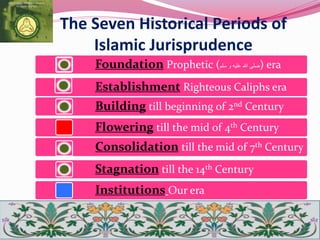
The Seven Historical Periods of
Islamic Jurisprudence
Foundation Prophetic ( ‫عليه‬ ‫هللا‬ ‫صلى‬‫و‬‫سلم‬ ) era
Establishment Righteous Caliphs era
Building till beginning of 2nd Century
Flowering till the mid of 4th Century
Consolidation till the mid of 7th Century
Stagnation till the 14th Century
Institutions Our era
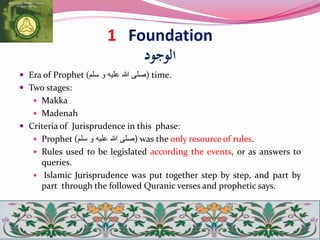
1 Foundation
‫الوجود‬
 Era of Prophet ( ‫صلى‬‫هللا‬‫عليه‬‫و‬‫سلم‬ ) time.
 Two stages:
 Makka
 Madenah
 Criteria of Jurisprudence in this phase:
 Prophet ( ‫صلى‬‫هللا‬‫عليه‬‫و‬‫سلم‬ ) was the only resource of rules.
 Rules used to be legislated according the events, or as answers to
queries.
 Islamic Jurisprudence was put together step by step, and part by
part through the followed Quranic verses and prophetic says.
1 Foundation
‫الوجود‬
 Differences existed but were limited.
 The ideological foundations of Islam were laid down.
 The evolution of Jurisprudence and the foundations of its
methodology were taught by the prophet ( ‫صلى‬‫هللا‬‫عليه‬‫و‬‫سلم‬ )
to his companions.
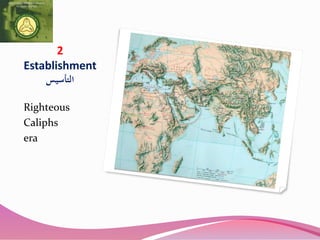
2
Establishment
‫التأسيس‬
Righteous
Caliphs
era
2 Establishment
‫التأسيس‬
 The basis of deductive Jurisprudent principles were
laid down during the time of the Righteous Caliphs.
 The sudden addition of vast new territories brought
Muslims into sudden contact with many different
cultures, and this produced a host of new issues which
were not specifically covered in the Qur`an And
Sunnah
2 Establishment
‫التأسيس‬
 Legal rulings became increasingly needed, and the
Righteous Caliphs developed certain procedures for
arriving at a juristic decision
 The companions, in general, followed decision making
procedures which helped them to avoid hard and fast
rulings
 The Presence of the Righteous Caliphs and the companions
provided a safe guard in legal rulings. This promoted unity
and there was no factionalism within the Islamic Nation
2 Establishment
 Criteria of Jurisprudence in this phase:
 Deliberation principle led to stop any conflict
 The consensus were easily available
 Not many account of Prophetic Says due to Omar's ban
 Not many events comparing with the events later
 Piety of the Companions to give Fatwa
3
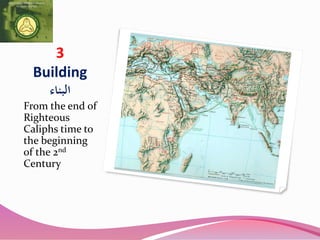
Building
‫البناء‬
From the end of
Righteous
Caliphs time to
the beginning
of the 2nd
Century
3 Building
‫البناء‬
 From the end of Righteous Caliphs time to the beginning
of the 2nd Century
 The Companions spread among different countries
 Scholars relied on frequent narration of Hadith and
compiled the legal rulings of the most prominent jurist
among the Companions (‫)الصحابة‬
3 Building
‫البناء‬
 Social unrest and confusion
 Fabrication of Hadith
3 Building
‫البناء‬
Ahl-Rai School)‫الرأي‬(
Ahl-Hadeth School)‫الحديث‬)
4
Flowering
‫االزدهار‬
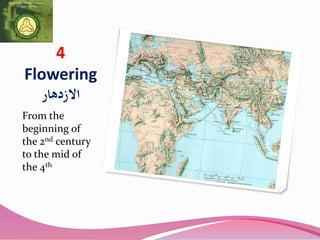
From the
beginning of
the 2nd century
to the mid of
the 4th
4 Flowering
‫االزدهار‬
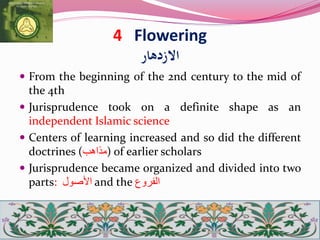
 From the beginning of the 2nd century to the mid of
the 4th
 Jurisprudence took on a definite shape as an
independent Islamic science
 Centers of learning increased and so did the different
doctrines (‫)مذاهب‬ of earlier scholars
 Jurisprudence became organized and divided into two
parts: ‫األصول‬ and the ‫الفروع‬
4 Flowering
‫االزدهار‬
 The entire Sunnah was collected and recorded in
books
 With regards to the issue of the Doctrines two distinct
periods took place during this time:
 Exchange of ideas and sharing of ideas/first half of this
period ‫تبادل‬‫و‬‫مشاركة‬
 Factionalism, intolerability, rigidity, and argumentation
/second half ‫ب‬ّ‫تحز‬‫و‬‫عدم‬‫ل‬ّ‫م‬‫تح‬‫و‬‫ب‬ّ‫ل‬‫تص‬
Imams
• Imam Abu Hanifa 80-150 (After Hijra)
• Imam Malik 93-179 (A.H.)
• Imam Shafi'i 150-204(A.H.)
• Imam Ahmad Ibn Hanbal 164-241 (A.H.)
• Others: Al-Thawri, Ibn Abu-Lail, Al Awza'i,
and Al-Laith
5
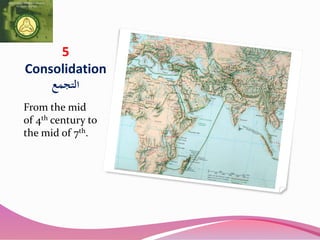
Consolidation
‫التجمع‬
From the mid
of 4th century to
the mid of 7th.
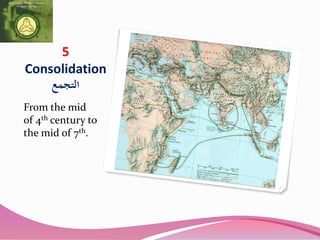
From the mid
of 4th century to
the mid of 7th.
5
Consolidation
‫التجمع‬
5 Consolidation
 From the mid of 4th century to the mid of 7th.
 Only FOUR jurisprudential doctrines were remained
 The jurisprudential doctrines reached their final form of
systemization and organization
 Ijtihaad beyond the structure of the different doctrines was
dropped and Ijtihaad within the only one doctrine took
over
 Justification of the jurisprudent choices developed
 Comparative jurisprudence was born
Hanifi Doctrine
 ‫الثامن‬ ‫القرن‬ ‫أوائل‬ ‫ت‬ ‫النسفي‬
 ‫سنة‬ ‫ت‬ ‫الزيلعي‬743
 ‫سنة‬ ‫ت‬ ‫الهمام‬ ‫بن‬ ‫الكمال‬861
 ‫ت‬ ‫العيني‬855
 ‫ت‬ ‫نجيم‬ ‫ابن‬969
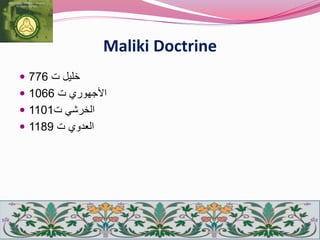
Maliki Doctrine
 ‫ت‬ ‫خليل‬776
 ‫ت‬ ‫األجهوري‬1066
 ‫ت‬ ‫الخرشي‬1101
 ‫ت‬ ‫العدوي‬1189
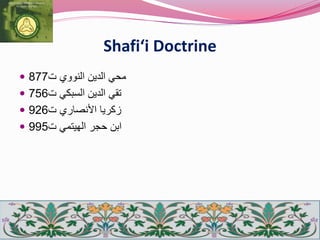
Shafi‘i Doctrine
 ‫ت‬ ‫النووي‬ ‫الدين‬ ‫محي‬877
 ‫ت‬ ‫السبكي‬ ‫الدين‬ ‫تقي‬756
 ‫ت‬ ‫األنصاري‬ ‫زكريا‬926
 ‫ت‬ ‫الهيتمي‬ ‫حجر‬ ‫ابن‬995
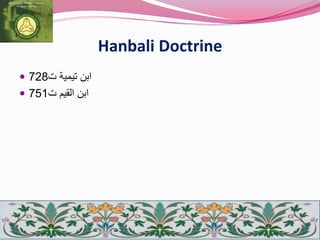
Hanbali Doctrine
 ‫ت‬ ‫تيمية‬ ‫ابن‬728
 ‫ت‬ ‫القيم‬ ‫ابن‬751
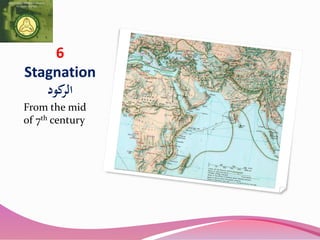
6
Stagnation
‫كود‬‫الر‬
From the mid
of 7th century
6 Stagnation
‫كود‬‫الر‬
 From the mid of 7th century
 It was divided into 2 periods
o Till the beginning of 10th century (Plenty of Scholars)
o From the 10th century
 Ijtihaad was put aside and the blind following of a doctrine
took over
 The four doctrines became more intolerable with each
other, and finally broke into four sects
6 Stagnation
‫كود‬‫الر‬
 Scholarly activity became polarized
 Revivers continued to work to bring the dynamics of
jurisprudence back
 The fanaticism of the doctrines lessened do to the Islamic
Movement and the teaching of comparative jurisprudence
7 Institutions
‫املؤسسات‬
 Lock of Ijtihad; ‫إغالق‬‫باب‬‫االجتهاد‬
 It means that it is not allowed -any more (after the end
of the fourth century)- to any scholar to contrive any
jurisprudential rule straight beginning from Qur`an
Sunnah and consensus, nevertheless it assumed to go
back to one of the four Islamic doctrines.
7 Institutions
‫املؤسسات‬
There are three developments facilitate for calling for this
closure:
 The jurists wanted to protect Sharia from some wiseacre
men. ‫حماية‬‫الشريعة‬‫من‬‫الناس‬‫غير‬‫المؤهلين‬
 Fanaticism of the followers of each doctrine ‫التعصب‬
 Juridical position: the governors used to choose the judges
from one doctrine, this push the student to study this
doctrine only ‫أصبح‬‫للدولة‬‫مذهب‬‫فقهي‬‫واحد‬
7 Institutions
‫املؤسسات‬
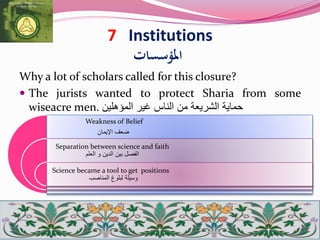
Why a lot of scholars called for this closure?
 The jurists wanted to protect Sharia from some
wiseacre men. ‫حماية‬‫الشريعة‬‫من‬‫الناس‬‫غير‬‫المؤهلين‬
Weakness of Belief
‫اإليمان‬ ‫ضعف‬
Separation between science and faith
‫العلم‬ ‫و‬ ‫الدين‬ ‫بين‬ ‫الفصل‬
Science became a tool to get positions
‫المناصب‬ ‫لبلوغ‬ ‫وسيلة‬
7 Institutions
‫املؤسسات‬
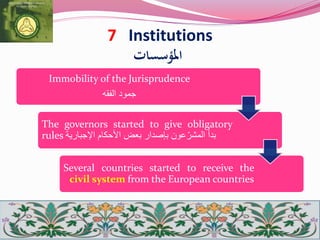
Immobility of the Jurisprudence
‫الفقه‬ ‫جمود‬
The governors started to give obligatory
rules ‫بدأ‬‫عون‬ّ‫المشر‬‫بإصدار‬‫بعض‬‫األحكام‬‫اإلجبارية‬
Several countries started to receive the
civil system from the European countries
7 Institutions
‫املؤسسات‬
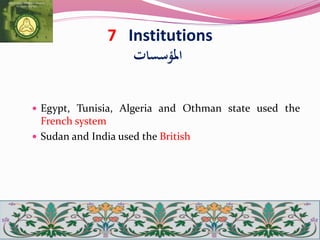
 Egypt, Tunisia, Algeria and Othman state used the
French system
 Sudan and India used the British
7 Institutions
‫املؤسسات‬
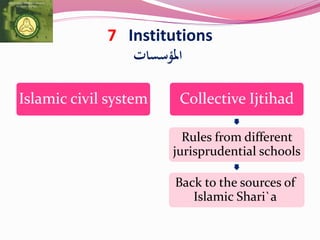
Islamic civil system Collective Ijtihad
Rules from different
jurisprudential schools
Back to the sources of
Islamic Shari`a
7 Institutions
‫املؤسسات‬
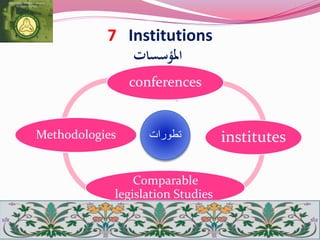
‫تطورات‬
conferences
institutes
Comparable
legislation Studies
Methodologies
7 Institutions
‫املؤسسات‬
Many conferences for Islamic Jurisprudence started to
be hold
 A week of Islamic Jurisprudence (Damascus Shawal 1380 –
April 1961)
 Conference of Islamic research institute in Al-Azhar (1961)
 Conference in Al-Byidah City in Libya, hold by Libyan
University
 Conference of Islamic Jurisprudence (Riyadh 1976)
7 Institutions
‫املؤسسات‬
Founding of many of the institutes of Jurisprudence
 Al Azhar's Islamic Research Academy 1961
 International Islamic Fiqh Academy Makah Safar 1405, November
1984
 Islamic Fiqh council, hold the first conference in Makah Shaban 1398,
1977
 The permanent Committee Fatwa in Kingdom of Saudi Arabia
 European Council for fatwa and research.
7 Institutions
‫املؤسسات‬
Examples of Fatwas:
 Organ transplantation
 Artificial Fertilization/ IVF

Islamic jurisprudence الفقه الإسلامي

  • 1.
  • 2.
    Main Points  Clarificationof the concept of Islamic Jurisprudence  The purposes of the Jurisprudence  Shariah & Jurisprudence  Jurisprudence & the man made law  The Categories of Action rules  The historical stages of the growth of the Jurisprudence  The major schools of the Islamic Jurisprudence
  • 3.
    ‫الفقه‬ Jurisprudence  ‫-الفقه‬Fiqh accuratelymeans to understand deeply ‫.الفهم‬  An example of this is found in the Qur’an in the Dua of Prophet Moses (as) when he asked Allah to remove the impediment from his speech so Pharaoh and his people could understand him very well. {‫لساني‬ ‫من‬ ‫عقدة‬ ‫واحلل‬‫يفقهوا‬‫قولي‬}. “And loosen the knot from my tongue. That they may understand my speech.”
  • 4.
    ‫الفقه‬ Jurisprudence This usage isalso found in the Hadith of the Prophet (‫صلى‬‫هللا‬‫عليه‬‫وسلم‬) who said, “Whoever Allah intends good for. He gives him understanding of the Deen.” Narrated by Muslim. ”‫من‬‫به‬ ‫هللا‬ ‫يرد‬‫خ‬‫يرا‬‫يفقه‬‫ه‬‫الدين‬ ‫في‬“. ‫رواه‬‫البخاري‬‫و‬‫مسلم‬.
  • 5.
    ‫العلماء‬ ‫اصطالح‬ ‫يف‬‫الفقه‬ Jurisprudence According to the Scholars Fiqh according to the scholars has the following meaning: “The collection of rulings or laws, (taken from) Shariah, dealing with actions, by which every Muslim is required to live. It is important to know that these rulings deal with the individual as well as the society.” ّ‫ل‬‫أد‬ ‫من‬ ً‫ا‬َّ‫د‬َ‫م‬َ‫ت‬‫س‬ُ‫م‬ ‫ة‬ّ‫ي‬‫العمل‬ ‫ة‬ّ‫ي‬‫الشرع‬ ‫باألحكام‬ ‫العلم‬‫ة‬ّ‫ي‬‫التفصيل‬ ‫تها‬
  • 6.
    ‫الفقه‬ ‫مشولية‬ The Comprehensivenessof Jurisprudence 1. Worship – ‫العبادة‬ this aspect of Jurisprudence is dealing with Prayer, Charity, Fasting, and Hajj. 2. Family Issues- ‫األسرة‬ this aspect of Jurisprudence is dealing with the family from the beginning to the end. Such as the conditions for a sound marriage divorce and so forth. 3. Transactions- ‫المعامالت‬ this aspect of Jurisprudence is related to how we cooperate with each other in society. An example would be buying and selling goods.
  • 7.
    ‫الفقه‬ ‫مشولية‬ The Comprehensivenessof Jurisprudence 4. Politics- ‫السياسة‬ this aspect of Jurisprudence deals with the organization of government and governmental organizations in regards to the Muslim nation. 5. Punishment of criminals ‫العقوبات‬
  • 8.
    ‫الفقه‬ ‫مشولية‬ The Comprehensivenessof Jurisprudence 6. Peace and war- ‫السالم‬‫و‬‫الحرب‬ this aspect of Jurisprudence deals with foreign relations with other countries depending on the current condition that exist between the Islamic state and those countries. 7. Ethics and virtue ‫الفضائل‬ ‫و‬ ‫األخالق‬
  • 9.
    ‫الشريعة‬ Al-Shariah in theArabic Language ‫شريعة‬ “A watering place; a resort of drinkers (both men and beast); a place to which men come to drink there-from and draw water.”
  • 10.
    ‫االصطالح‬ ‫يف‬ ‫الشريعة‬ Al-Shariahin Islamic Terminology “It refers to the sum total of Islamic Laws which were revealed to the Prophet Muhammad {‫صلى‬‫هللا‬‫عل‬‫ي‬‫ه‬‫و‬‫سلم‬} which are recorded in the Qur’an and the Sunnah).” ‫الشريعة‬:‫رة‬ّ‫ه‬‫المط‬ ‫ة‬ّ‫ن‬‫الس‬ ‫و‬ ‫القرآن‬ ‫نصوص‬ ‫هي‬
  • 11.
    ‫الشريعة‬ ‫و‬ ‫الفقه‬‫بني‬ ‫الفرق‬ The Differences Between Fiqh and Shariah Fiqh. 1. A body of laws deduced from the Shariah to cover specific situations not covered in the Shariah. ‫الشريعة‬ ‫من‬ ‫ّة‬‫د‬‫المستم‬ ‫القوانين‬ Shariah 1. Shar’eah is the body of laws found both in the Qur`an and Sunnah. ّ‫ن‬‫والس‬ ‫القرآن‬ ‫في‬ ‫الموجودة‬ ‫القوانين‬‫ة‬
  • 12.
    ‫الشريعة‬ ‫و‬ ‫الفقه‬‫بني‬ ‫الفرق‬ The Differences Between Fiqh and Shariah Fiqh. 2. Fiqh changes according to the circumstances surrounding it. ‫الظروف‬ ‫بتغير‬ ‫يتغير‬ ‫الفقه‬ ‫المحيطة‬ Shariah 2. Shariah is fixed and unchangeable. ‫تتغير‬ ‫ال‬ ‫و‬ ‫ثابتة‬ ‫الشريعة‬
  • 13.
    ‫الشريعة‬ ‫و‬ ‫الفقه‬‫بني‬ ‫الفرق‬ The Differences Between Fiqh and Shariah Fiqh. 3. Fiqh laws tend to be specific: they demonstrate how the basic principles of Shariah should be applied in given circumstances. ‫الخصوصية‬ ‫إلى‬ ‫الفقه‬ ‫يهدف‬.‫تطبي‬ ‫كيفية‬‫ق‬ ‫ظروف‬ ‫في‬ ‫للشريعة‬ ‫األساسية‬ ‫المبادىء‬ ‫معينة‬ Shariah 3. The laws of Shariah are, for the most part, general: they lay down basic principles. ‫هي‬ ‫و‬ ،‫عامة‬ ‫األكبر‬ ‫جزئها‬ ‫في‬ ‫الشريعة‬ ‫ّة‬‫ي‬‫أساس‬ ‫قوانين‬ ‫تشكل‬
  • 14.
    Differences between theIslamic Shari`ah and Man-Made Law 1) Divine origin against Human origin. 2) Consequences in this world and the Hereafter against This world only. 3) Development of personal accountability to Allah against Mere loyalty to the law 4) Absolute criteria providing for the benefit of creatures against Popular opinion which may or may not be beneficial
  • 15.
    Shariah ‫يعة‬‫ر‬‫الش‬ Man-Made Law ‫ة‬ّ‫الوضعي‬ ‫القوانني‬ Divineorigin ‫سماوي‬ Human origin ‫إنساني‬ Consequences in this world and the Hereafter ‫أخروية‬ ‫و‬ ‫دنيوية‬ ‫النتائج‬ Consequences this world only ‫دنيوية‬ ‫النتائج‬ Development of personal accountability to Allah ‫هللا‬ ‫أمام‬ ‫المسؤولية‬ Mere loyalty to the law ‫فقط‬ ‫القانون‬ ‫أمام‬
  • 16.
    Rulings of SacredLaw Prescribed ‫واجب‬ Recommended ‫مندوب‬ Permissible ‫مباح‬ Disliked ‫مكروه‬ Unlawful ‫م‬ّ‫ر‬‫مح‬
  • 17.
    Rulings of SacredLaw Prescribed ‫فرض‬ Recommended / ‫مندوب‬ Permissible ‫مباح‬ Disliked ‫مكروه‬ Forbidden ‫محرم‬ Other terms: -Obligatory ‫واجب‬ -Mandatory ‫محتم‬ - Required ‫الزم‬ Performance: rewarded Non-Performance: punished Other terms: - Sunnah ‫ة‬ّ‫ن‬‫س‬ - Preferable ‫مستحب‬ - Meritorious ‫فضيلة‬ - Desirable ‫مرغوب‬ P: rewarded NP: not punished Other terms: - Allowed P: not rewarded NP: not punished Other terms: - Offensive - Detested P: not punished NP: rewarded Other terms: - Unlawful - Prohibited P: punished NP: rewarded
  • 18.
    The Six HistoricalPeriods of Islamic Jurisprudence
  • 19.
    The Seven HistoricalPeriods of Islamic Jurisprudence Foundation Prophetic ( ‫عليه‬ ‫هللا‬ ‫صلى‬‫و‬‫سلم‬ ) era Establishment Righteous Caliphs era Building till beginning of 2nd Century Flowering till the mid of 4th Century Consolidation till the mid of 7th Century Stagnation till the 14th Century Institutions Our era
  • 20.
    1 Foundation ‫الوجود‬  Eraof Prophet ( ‫صلى‬‫هللا‬‫عليه‬‫و‬‫سلم‬ ) time.  Two stages:  Makka  Madenah  Criteria of Jurisprudence in this phase:  Prophet ( ‫صلى‬‫هللا‬‫عليه‬‫و‬‫سلم‬ ) was the only resource of rules.  Rules used to be legislated according the events, or as answers to queries.  Islamic Jurisprudence was put together step by step, and part by part through the followed Quranic verses and prophetic says.
  • 21.
    1 Foundation ‫الوجود‬  Differencesexisted but were limited.  The ideological foundations of Islam were laid down.  The evolution of Jurisprudence and the foundations of its methodology were taught by the prophet ( ‫صلى‬‫هللا‬‫عليه‬‫و‬‫سلم‬ ) to his companions.
  • 22.
  • 23.
    2 Establishment ‫التأسيس‬  Thebasis of deductive Jurisprudent principles were laid down during the time of the Righteous Caliphs.  The sudden addition of vast new territories brought Muslims into sudden contact with many different cultures, and this produced a host of new issues which were not specifically covered in the Qur`an And Sunnah
  • 24.
    2 Establishment ‫التأسيس‬  Legalrulings became increasingly needed, and the Righteous Caliphs developed certain procedures for arriving at a juristic decision  The companions, in general, followed decision making procedures which helped them to avoid hard and fast rulings  The Presence of the Righteous Caliphs and the companions provided a safe guard in legal rulings. This promoted unity and there was no factionalism within the Islamic Nation
  • 25.
    2 Establishment  Criteriaof Jurisprudence in this phase:  Deliberation principle led to stop any conflict  The consensus were easily available  Not many account of Prophetic Says due to Omar's ban  Not many events comparing with the events later  Piety of the Companions to give Fatwa
  • 26.
    3 Building ‫البناء‬ From the endof Righteous Caliphs time to the beginning of the 2nd Century
  • 27.
    3 Building ‫البناء‬  Fromthe end of Righteous Caliphs time to the beginning of the 2nd Century  The Companions spread among different countries  Scholars relied on frequent narration of Hadith and compiled the legal rulings of the most prominent jurist among the Companions (‫)الصحابة‬
  • 28.
    3 Building ‫البناء‬  Socialunrest and confusion  Fabrication of Hadith
  • 29.
  • 30.
  • 31.
    4 Flowering ‫االزدهار‬  Fromthe beginning of the 2nd century to the mid of the 4th  Jurisprudence took on a definite shape as an independent Islamic science  Centers of learning increased and so did the different doctrines (‫)مذاهب‬ of earlier scholars  Jurisprudence became organized and divided into two parts: ‫األصول‬ and the ‫الفروع‬
  • 32.
    4 Flowering ‫االزدهار‬  Theentire Sunnah was collected and recorded in books  With regards to the issue of the Doctrines two distinct periods took place during this time:  Exchange of ideas and sharing of ideas/first half of this period ‫تبادل‬‫و‬‫مشاركة‬  Factionalism, intolerability, rigidity, and argumentation /second half ‫ب‬ّ‫تحز‬‫و‬‫عدم‬‫ل‬ّ‫م‬‫تح‬‫و‬‫ب‬ّ‫ل‬‫تص‬
  • 33.
    Imams • Imam AbuHanifa 80-150 (After Hijra) • Imam Malik 93-179 (A.H.) • Imam Shafi'i 150-204(A.H.) • Imam Ahmad Ibn Hanbal 164-241 (A.H.) • Others: Al-Thawri, Ibn Abu-Lail, Al Awza'i, and Al-Laith
  • 34.
  • 35.
    From the mid of4th century to the mid of 7th. 5 Consolidation ‫التجمع‬
  • 36.
    5 Consolidation  Fromthe mid of 4th century to the mid of 7th.  Only FOUR jurisprudential doctrines were remained  The jurisprudential doctrines reached their final form of systemization and organization  Ijtihaad beyond the structure of the different doctrines was dropped and Ijtihaad within the only one doctrine took over  Justification of the jurisprudent choices developed  Comparative jurisprudence was born
  • 37.
    Hanifi Doctrine  ‫الثامن‬‫القرن‬ ‫أوائل‬ ‫ت‬ ‫النسفي‬  ‫سنة‬ ‫ت‬ ‫الزيلعي‬743  ‫سنة‬ ‫ت‬ ‫الهمام‬ ‫بن‬ ‫الكمال‬861  ‫ت‬ ‫العيني‬855  ‫ت‬ ‫نجيم‬ ‫ابن‬969
  • 38.
    Maliki Doctrine  ‫ت‬‫خليل‬776  ‫ت‬ ‫األجهوري‬1066  ‫ت‬ ‫الخرشي‬1101  ‫ت‬ ‫العدوي‬1189
  • 39.
    Shafi‘i Doctrine  ‫ت‬‫النووي‬ ‫الدين‬ ‫محي‬877  ‫ت‬ ‫السبكي‬ ‫الدين‬ ‫تقي‬756  ‫ت‬ ‫األنصاري‬ ‫زكريا‬926  ‫ت‬ ‫الهيتمي‬ ‫حجر‬ ‫ابن‬995
  • 40.
    Hanbali Doctrine  ‫ت‬‫تيمية‬ ‫ابن‬728  ‫ت‬ ‫القيم‬ ‫ابن‬751
  • 41.
  • 42.
    6 Stagnation ‫كود‬‫الر‬  Fromthe mid of 7th century  It was divided into 2 periods o Till the beginning of 10th century (Plenty of Scholars) o From the 10th century  Ijtihaad was put aside and the blind following of a doctrine took over  The four doctrines became more intolerable with each other, and finally broke into four sects
  • 43.
    6 Stagnation ‫كود‬‫الر‬  Scholarlyactivity became polarized  Revivers continued to work to bring the dynamics of jurisprudence back  The fanaticism of the doctrines lessened do to the Islamic Movement and the teaching of comparative jurisprudence
  • 44.
    7 Institutions ‫املؤسسات‬  Lockof Ijtihad; ‫إغالق‬‫باب‬‫االجتهاد‬  It means that it is not allowed -any more (after the end of the fourth century)- to any scholar to contrive any jurisprudential rule straight beginning from Qur`an Sunnah and consensus, nevertheless it assumed to go back to one of the four Islamic doctrines.
  • 45.
    7 Institutions ‫املؤسسات‬ There arethree developments facilitate for calling for this closure:  The jurists wanted to protect Sharia from some wiseacre men. ‫حماية‬‫الشريعة‬‫من‬‫الناس‬‫غير‬‫المؤهلين‬  Fanaticism of the followers of each doctrine ‫التعصب‬  Juridical position: the governors used to choose the judges from one doctrine, this push the student to study this doctrine only ‫أصبح‬‫للدولة‬‫مذهب‬‫فقهي‬‫واحد‬
  • 46.
    7 Institutions ‫املؤسسات‬ Why alot of scholars called for this closure?  The jurists wanted to protect Sharia from some wiseacre men. ‫حماية‬‫الشريعة‬‫من‬‫الناس‬‫غير‬‫المؤهلين‬ Weakness of Belief ‫اإليمان‬ ‫ضعف‬ Separation between science and faith ‫العلم‬ ‫و‬ ‫الدين‬ ‫بين‬ ‫الفصل‬ Science became a tool to get positions ‫المناصب‬ ‫لبلوغ‬ ‫وسيلة‬
  • 47.
    7 Institutions ‫املؤسسات‬ Immobility ofthe Jurisprudence ‫الفقه‬ ‫جمود‬ The governors started to give obligatory rules ‫بدأ‬‫عون‬ّ‫المشر‬‫بإصدار‬‫بعض‬‫األحكام‬‫اإلجبارية‬ Several countries started to receive the civil system from the European countries
  • 48.
    7 Institutions ‫املؤسسات‬  Egypt,Tunisia, Algeria and Othman state used the French system  Sudan and India used the British
  • 49.
    7 Institutions ‫املؤسسات‬ Islamic civilsystem Collective Ijtihad Rules from different jurisprudential schools Back to the sources of Islamic Shari`a
  • 50.
  • 51.
    7 Institutions ‫املؤسسات‬ Many conferencesfor Islamic Jurisprudence started to be hold  A week of Islamic Jurisprudence (Damascus Shawal 1380 – April 1961)  Conference of Islamic research institute in Al-Azhar (1961)  Conference in Al-Byidah City in Libya, hold by Libyan University  Conference of Islamic Jurisprudence (Riyadh 1976)
  • 52.
    7 Institutions ‫املؤسسات‬ Founding ofmany of the institutes of Jurisprudence  Al Azhar's Islamic Research Academy 1961  International Islamic Fiqh Academy Makah Safar 1405, November 1984  Islamic Fiqh council, hold the first conference in Makah Shaban 1398, 1977  The permanent Committee Fatwa in Kingdom of Saudi Arabia  European Council for fatwa and research.
  • 53.
    7 Institutions ‫املؤسسات‬ Examples ofFatwas:  Organ transplantation  Artificial Fertilization/ IVF

Editor's Notes

  • #11 الشريعة هي نصوص القرآن و السنّة المطهّرة
  • #17 prescribed, recommended, permissible, disliked and unlawful
  • #18 Rulings of the Shari`ah The rulings of shari`ah for all our daily actions are five : prescribed, recommended, permissible, disliked and unlawful . The distinctions between the five categories are in whether their performance (P) and nonperformance (NP) is rewarded, not rewarded, punished or not punished (see the table). The prescribed (fard) is also referred to as obligatory (wajib), mandatory (muhattam) and required (lazim). It is divided into two categories : personally obligatory (فرض عين), which is required from every individual Muslim (e.g. salah and zakah); and communally obligatory (فرض كفاية), which if performed by some Muslims is not required from others (e.g., funeral prayers). The recomended (mandub) is also referred to as sunnah, preferable (mustahabb), meritorious (fadila), and desirable (marghub fih). Examples are night vigil (tahajjud) prayers, and rememberance of Allah (zikr). The performance and nonperformance of the permissible/ allowed (mubah) is neither rewarded nor punished. Nonperformance of both the disliked (makruh) and the unlawful/prohibited (haram ) is rewarded. Performance of the unlawful is punished, but that of the disliked is not punished.