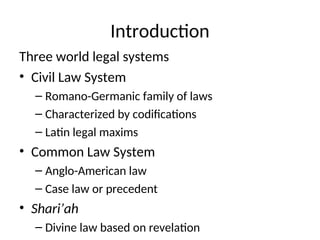
Introduction
Three world legalsystems
• Civil Law System
– Romano-Germanic family of laws
– Characterized by codifications
– Latin legal maxims
• Common Law System
– Anglo-American law
– Case law or precedent
• Shari’ah
– Divine law based on revelation
3.
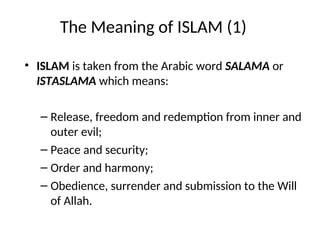
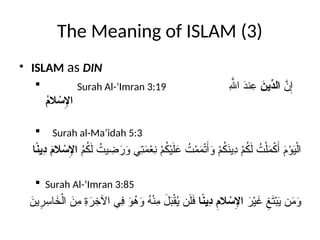
The Meaning ofISLAM (1)
• ISLAM is taken from the Arabic word SALAMA or
ISTASLAMA which means:
– Release, freedom and redemption from inner and
outer evil;
– Peace and security;
– Order and harmony;
– Obedience, surrender and submission to the Will
of Allah.
4.
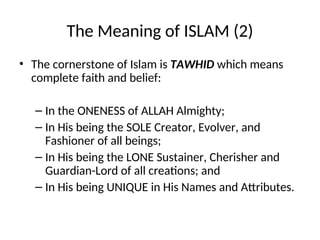
The Meaning ofISLAM (2)
• The cornerstone of Islam is TAWHID which means
complete faith and belief:
– In the ONENESS of ALLAH Almighty;
– In His being the SOLE Creator, Evolver, and
Fashioner of all beings;
– In His being the LONE Sustainer, Cherisher and
Guardian-Lord of all creations; and
– In His being UNIQUE in His Names and Attributes.
The Meaning ofISLAM (4)
• ISLAM as a DIN connotes:
– A complete way of life
– A distinct ideology
– A religious faith
– A mode of conduct
– A political system
– A code of law
– An economic theory
– An aesthetic value
7.
I – TheMeaning of ISLAM (5)
• ISLAM encompasses every sphere of human existence:
– Spiritual
– Intellectual
– Moral
– Social
– Political
– Economic
– Aesthetic
8.
I – TheMeaning of ISLAM (6)
• ISLAM governs all aspects of life:
– Individual
• Spiritual
• Physical
• Intellectual
– Family
– Societal/Communal
– Global/Universal
9.
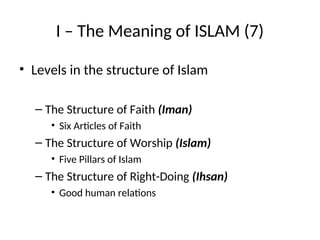
I – TheMeaning of ISLAM (7)
• Levels in the structure of Islam
– The Structure of Faith (Iman)
• Six Articles of Faith
– The Structure of Worship (Islam)
• Five Pillars of Islam
– The Structure of Right-Doing (Ihsan)
• Good human relations
10.
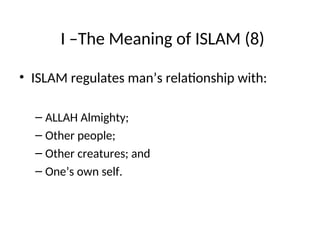
I –The Meaningof ISLAM (8)
• ISLAM regulates man’s relationship with:
– ALLAH Almighty;
– Other people;
– Other creatures; and
– One’s own self.
11.
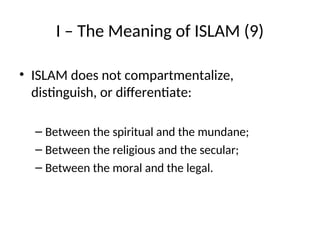
I – TheMeaning of ISLAM (9)
• ISLAM does not compartmentalize,
distinguish, or differentiate:
– Between the spiritual and the mundane;
– Between the religious and the secular;
– Between the moral and the legal.
12.
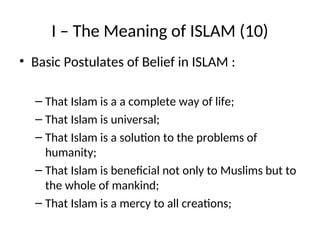
I – TheMeaning of ISLAM (10)
• Basic Postulates of Belief in ISLAM :
– That Islam is a a complete way of life;
– That Islam is universal;
– That Islam is a solution to the problems of
humanity;
– That Islam is beneficial not only to Muslims but to
the whole of mankind;
– That Islam is a mercy to all creations;
13.
I – TheMeaning of ISLAM (11)
• Basic Postulates of Belief in ISLAM:
– That Muslims are the best community evolved for
humanity;
– That Muslims are brothers and are merciful to one
another;
– That Muslims have no other choice but to obey,
follow, and uphold a law or rule that is set or
enjoined by Allah or His Messenger;
14.
I – TheMeaning of ISLAM (12)
• Basic Postulates of Belief in ISLAM:
– That Muslims are models for others;
– That Muslims are enjoined to convey the message
of Islam to other people and nations of the world
with wisdom and good preaching.
15.
Shari’āh and Fiqh(1)
Islamic Law: Between Shari’āh and Fiqh
• Shari’āh
– Refers to the totality of Allah’s commandments to
man
– Divine Law
– Perfect, eternal, unalterable
• Fiqh
– Refers to the human understanding of the law
– Human interpretation
– Imperfect, not eternal, alterable
16.
Shari’āh and Fiqh(2)
Coverage of Islamic Law
• Faith and Beliefs (‘Aqa’id)
• Religious worship (‘Ibadat)
– Shahadah, salat, zakat, sawm, hajj, jihad
• Human relations and commercial transactions
(Mu’amalat)
– Ahwal shakhsiyah
– ‘alaqat al-tijariyyah
– ‘ulum al-harbiyyah wa ‘alaqat al-dawliyyah
• Penal and criminal laws (Jinayat)
– Hudud
– Qisas
– Ta’zir
• Ethics and morality (Akhlaq)
17.
Shari’āh and Fiqh(3)
• ‘Aqeedah [System of Belief]
– The foundations of faith
Belief in Allah, in His angels, in His Revealed Books. in
His Messengers and Prophet, in life after death, and in
pre-determination
– The need for congruence among faith, action and
human relations
• Al-aqeedah al-salimah
• Al-ibadah al-sahihah
• Al-akhlaq al-hasanah
18.
Shari’āh and Fiqh(4)
• ‘Ibadat [Acts of Worship]
Physical Purification
Ablution
Ghusl
Tayammum
Purification of the Soul
Dhikr
Salat or Prayer
Zakat and Sadaqah
Sawm
Hajj and ‘Umrah
19.
Shari’āh and Fiqh(5)
• Mu’malat [Human/Social Relations]
Ahwal Shakhsiyah
Legal Capacity (Ahliyyah)
Receptive legal capacity (Ahliyyah al-wujub)
Capacity to act (Ahliyyah al-ada’)
Age of majority - puberty + mental maturity
Marriage
Purpose and requisites of marriage
Inter-religious marriages
Dealing with a Nushuz wife
Prohibited marriages
20.
Shari’āh and Fiqh(6)
• Mu’malat [Human/Social Relations]
Divorce
Kinds and conditions
Mubara’ah
Talaq
Tafwid
Khulu’
Ila’
Zihar
Li’an
Faskh
Iddah or waiting period
21.
Shari’āh and Fiqh(7)
• Mu’amalat [Human/Social Relations]
Inheritance
Reasons for inheritance
Nasab [family relations]
Nikah [marriage]
Wala’ [relation between a former slave and his manumitter]
Causes of disinheritance
Difference of religion
Causing the death of the decedent
Slavery
Fornication or adultery
Li’an
22.
Shari’āh and Fiqh(8)
• Mu’amalat [Human/Social Relations
• Trade or Business Deals
• Pillars: seller, buyer, valued merchandise,
manner of contract, mutual consent
• Riba (Usury and Interest)
• Partnership: profit-and-loss sharing;
working/corporal; speculative
(mudharabah)
• Mortgage
23.
Shari’āh and Fiqh(9)
• Jinayat [Crimes and Punishment]
• Hudud : zina, qadhf, shurb al-khamr, sariqah,
hirabah, irtidad
• Qisas
• Retaliation; blood money; pardoning
• Conditions: no injustice will be done; retaliation is
possible; the limb sought to be retaliated is the same
with the damaged limb of the victim; equality of the
two limbs
• Crime committed by a group: all will be subjected to
retaliation
• Ta’zir or discretionary punishment
24.
Shari’āh and Fiqh(10)
• Maqasid al-shari’ah
First Category
– Daruriyyah [the essential]
• Faith, life, intellect, lineage, property, honor
• These are absolute requirements for human survival
and spiritual well-being of individuals
• All laws are geared towards the protection of these
values
• Jihad has been validated to protect religion; qisas to
protect life; hudud for shurb al-khamr to protect
intellect; hudud for zina to protect lineage; hudud for
sirqa and hiraba to protect property; and hudud for
qadhf to protect honor
25.
Shari’āh and Fiqh(11)
• Maqasid al-shari’ah
Second Category
– Hajiyyah [the complimentary]
• Seek to promote the primary objectives and not by
themselves completely independent
• These are complimentary and beneficial acts that seek
to remove severity and hardship
• They include concessions granted to believers like the
shortening prayers, foregoing of fasting by the sick and
the traveler, suspension of penalty in case of doubt
26.
Shari’āh and Fiqh(12)
• Maqasid al-shari’ah
Third Category
– Tahsiniyyah [the desirable]
• Seek to refine and perfect the custom and conduct of
people like cleanliness, good attire for prayers, using
perfume when attending congregational prayer
• In the area of ‘ibadah, doing sunnah prayers, voluntary
fasting, giving voluntary charity or sadaqah
• In interpersonal relations, encouragement of
gentleness, pleasant speech and conduct, and fair
dealing
27.
Shari’āh and Fiqh(13)
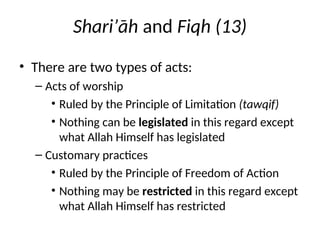
• There are two types of acts:
– Acts of worship
• Ruled by the Principle of Limitation (tawqif)
• Nothing can be legislated in this regard except
what Allah Himself has legislated
– Customary practices
• Ruled by the Principle of Freedom of Action
• Nothing may be restricted in this regard except
what Allah Himself has restricted
28.
Shari’āh and Fiqh(14)
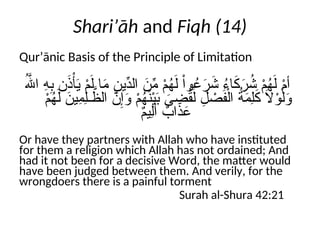
Qur’ānic Basis of the Principle of Limitation
ُهَّللا ِ
هِ
ب نَ
ذْأَ
ي ْ
مَل اَ
م ِ
ِّين
الد َ
نِّ
م ْ
مُ
هَل ْاوُ
عَ
رَ
ش ُ
ءاَ
كَ
رُ
ش ْ
مُ
هَل ْ
مأ
ْ
مُ
هَل َ
ِين
مِلـ َّ
الظ َّ
نِإَ
و ْ
مُ
هَ
نْيَ
ب َ
ى ِ
ضُ
قَل ِ
ل ْ
صَ
فْال ُ
ةَ
مِلَ
ك َ
الْ
وَلَ
و
ٌ
مِيلَأ ٌ
ابَ
ذَ
ع
Or have they partners with Allah who have instituted
for them a religion which Allah has not ordained; And
had it not been for a decisive Word, the matter would
have been judged between them. And verily, for the
wrongdoers there is a painful torment
Surah al-Shura 42:21
29.
Shari’āh and Fiqh(15)
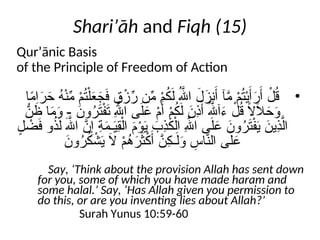
Qur’ānic Basis
of the Principle of Freedom of Action
•
اً
ماَ
رَ
ح ُ
هْنِّ
م ْ
مُ
تْلَ
عَ
جَ
ف ٍ
قْ
زِّ
ر نِّ
م ْ
مُ
كَل ُهَّللا َ
لَ
نزَأ آَّ
م ْ
مُ
تْيَأَ
رَأ ْ
لُ
ق
ُّ
ن َ
ظ اَ
مَ
و - َ
ونُ
رَ
تْفَ
ـ
ت ِهَّللا ىَلَ
ع ْ
مَأ ْ
مُ
كَل َ
ِن
ذَأ ُهَّللآَ
ء ْ
لُ
ق ً
الَ
الَ
حَ
و
ٍ
ل ْ
ضَ
ف وُ
ذَل َهَّللا َّ
نِإ ِ
ةَ
مـَ
يِ
قْال َ
مْ
وَ
ي َ
ِب
ذَ
كْال ِهَّللا ىَلَ
ع َ
ونُ
رَ
تْفَ
ي َ
ِين
ذَّال
َ
ونُ
رُ
ك ْ
شَ
ي َ
ال ْ
مُ
هَ
رَ
ثْ
كَأ َّ
ِن
كـَلَ
و ِ
اسَّ
الن ىَلَ
ع
Say, ‘Think about the provision Allah has sent down
for you, some of which you have made haram and
some halal.’ Say, ‘Has Allah given you permission to
do this, or are you inventing lies about Allah?’
Surah Yunus 10:59-60
Shari’āh and Fiqh(17)
Sources of the Shari’āh
– The Glorious Qur’ān
– The Sunnah of Prophet Muhammad [saw]
Sources of Fiqh
– The Glorious Qur’ān
– The Sunnah of Prophet Muhammad [saw]
– Ijtihād
• Ijmā’ (Consensus of Opinion)
• Qiyās (Analogy)
• Other Subsidiary Legal Principles
32.
The Glorious Qur’an(1)
Some Basic Facts about the Glorious Qur’an
• Revealed for a period of 23 years
• First revelation: Surah al-’Alaq 96:1-5
• Last revelation: Surah al-Ma’idah 5:3
Surah al-Baqarah 2:281
• 114 suwar [sing., surah] (chapters), 85
revealed in Makkah and 29 in Madinah
• 30 ajza’ [sing., juz] (parts), 19 revealed in
Makkah and 11 in Madinah
33.
The Glorious Qur’an(2)
Distinctions between Makki and Madani verses
• Makkan verses – devoted to matters of belief,
Tawhid, necessity of the prophethood of
Muhammad [saw], the hereafter, disputation
with unbelievers and inviting them to Islam
• Madani verses – comprised of legal rules and
regulated the political, legal, social and
economic life of the new community;
regulated war and peace, the status and rights
of conquered people, the organization of the
family
34.
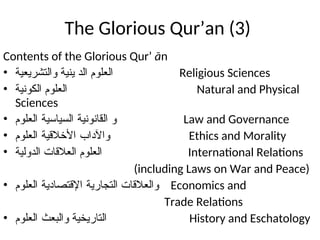
The Glorious Qur’an(3)
Contents of the Glorious Qur’ ān
• ﻮﺍﻠﺗﺷﺭﻳﻌﻳﺔ ﻴﻨﻴﺔ ﺍﻟﺩ ﺍﻟﻌﻠﻭﻢ Religious Sciences
• ﺍﻠﻛﻭﻨﻴﺔ ﺍﻟﻌﻠﻭﻢ Natural and Physical
Sciences
• ﺍﻠﻗﺎﻨﻭﻨﻴﺔ ﻭ
ﺍﻟﺴﻴﺎﺴﻴﺔ
ﺍﻟﻌﻠﻭﻢ Law and Governance
• ﻭﺍﻵﺩﺍﺏ
ﺍﻷﺧﻼﻗﻴﺔ
ﺍﻟﻌﻠﻭﻢ Ethics and Morality
• ﺍﻟﺩﻭﻠﻴﺔ ﺍﻟﻌﻼﻗﺎﺕ ﺍﻟﻌﻠﻭﻢ International Relations
(including Laws on War and Peace)
• ﺍﻠﺘﺠﺎﺭﻴﺔ ﻭﺍﻟﻌﻼﻗﺎﺕ
ﺍﻹﻗﺘﺼﺎﺪﻴﺔ
ﺍﻟﻌﻠﻭﻢ Economics and
Trade Relations
• ﻮﺍﻠﺑﻌﺙ ﺍﻠﺘﺎﺭﻴﺨﻴﺔ
ﺍﻟﻌﻠﻭﻢ History and Eschatology
35.
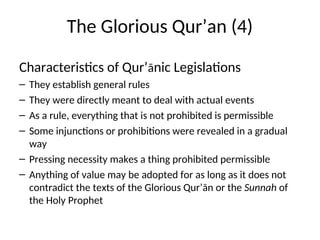
The Glorious Qur’an(4)
Characteristics of Qur’ānic Legislations
– They establish general rules
– They were directly meant to deal with actual events
– As a rule, everything that is not prohibited is permissible
– Some injunctions or prohibitions were revealed in a gradual
way
– Pressing necessity makes a thing prohibited permissible
– Anything of value may be adopted for as long as it does not
contradict the texts of the Glorious Qur’ān or the Sunnah of
the Holy Prophet
36.
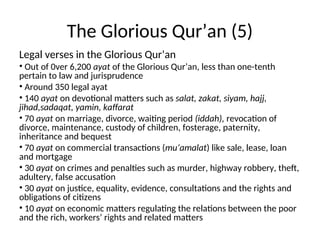
The Glorious Qur’an(5)
Legal verses in the Glorious Qur’an
• Out of 0ver 6,200 ayat of the Glorious Qur’an, less than one-tenth
pertain to law and jurisprudence
• Around 350 legal ayat
• 140 ayat on devotional matters such as salat, zakat, siyam, hajj,
jihad,sadaqat, yamin, kaffarat
• 70 ayat on marriage, divorce, waiting period (iddah), revocation of
divorce, maintenance, custody of children, fosterage, paternity,
inheritance and bequest
• 70 ayat on commercial transactions (mu’amalat) like sale, lease, loan
and mortgage
• 30 ayat on crimes and penalties such as murder, highway robbery, theft,
adultery, false accusation
• 30 ayat on justice, equality, evidence, consultations and the rights and
obligations of citizens
• 10 ayat on economic matters regulating the relations between the poor
and the rich, workers’ rights and related matters
37.
The Glorious Qur’an(6)
Basic Principles of Qur’anic Revelations
1.The removal of difficulty
2.The reduction of religious obligations
3.The realization of public welfare
4.The realization of universal justice
38.
Some Principles Pursued
bythe Glorious Qur’an (1)
• The principle of ﺍﻠﺘﻮﺣﻳﺪ (Tawhid) which is the cornerstone
of the Qur’anic Message. Tawhid means complete faith and
belief:
– In the ONENESS of ALLAH Almighty;
– In His being the SOLE Creator, Evolver, and Fashioner of
all beings;
– In His being the LONE Sustainer, Cherisher and
Guardian-Lord of all creations; and
– In His being UNIQUE in His Names and Attributes.
39.
Some Principles Pursued
bythe Glorious Qur’an (2)
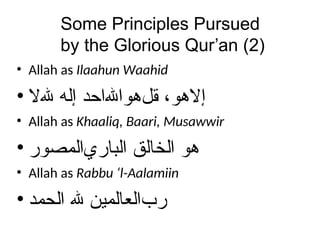
• Allah as Ilaahun Waahid
• ﻘﻞﻫﻭﺍﷲﺍﺤﺩ ،ﺇﻻﻫﻭ
ﺇﻟﻪ
ﷲﻻ
• Allah as Khaaliq, Baari, Musawwir
• ﺍﻠﺒﺎﺮﻱﺍﻟﻣﺻﻭﺮ ﺍﻠﺧﺎﻟﻖ ﻫﻮ
• Allah as Rabbu ‘l-Aalamiin
• ﺮﺐﺍﻠﻌﺎﻠﻣﻳﻥ
ﷲ
ﺍﻠﺣﻣﺩ
40.
Some Principles Pursued
bythe Glorious Qur’an (3)
• The principle of ﺍﻠﺗﻔﻛﺭ (Tafakkur) or constant
thinking of Allah and how He created, creates and
recreates.
– The Glorious Qur’an addresses the human mind
– Allah teaches also by His creations
– Every time the Qur’an mentions the power of Allah
and the mysteries of creation, it challenges the
human mind:
– ﺗﻌﻗﻠﻭﻦ
ﺃﻓﻼ Do you not think?
– ﺗﺫﻛﺭﻭﻦ
ﺃﻓﻼ Do you not reflect?
41.
Some Principles Pursued
bythe Glorious Qur’an (4)
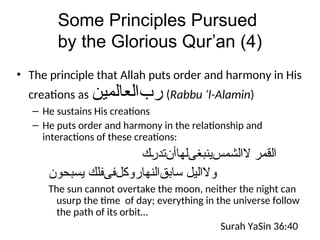
• The principle that Allah puts order and harmony in His
creations as ﺮﺐﺍﻠﻌﺎﻠﻣﻳﻥ (Rabbu ‘l-Alamin)
– He sustains His creations
– He puts order and harmony in the relationship and
interactions of these creations:
ﺍﻠﻗﻣﺭ
ﻻﺍﻠﺸﻤﺲﻴﻨﺑﻐﻰﻠﻬﺎﺃﻦﺗﺩﺭﻙ
ﻴﺳﺒﺤﻭﻥ ﺴﺎﺒﻖﺍﻠﻨﻬﺎﺭﻭﻛﻞﻔﻰﻔﻠﻙ ﻭﻻﺍﻠﻴﻞ
The sun cannot overtake the moon, neither the night can
usurp the time of day; everything in the universe follow
the path of its orbit…
Surah YaSin 36:40
42.
Some Principles Pursued
bythe Glorious Qur’an (5)
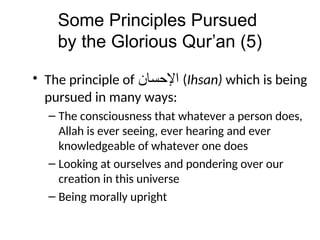
• The principle of ﺍﻹﺤﺴﺎﻦ (Ihsan) which is being
pursued in many ways:
– The consciousness that whatever a person does,
Allah is ever seeing, ever hearing and ever
knowledgeable of whatever one does
– Looking at ourselves and pondering over our
creation in this universe
– Being morally upright
43.
Some Principles Pursued
bythe Glorious Qur’an (6)
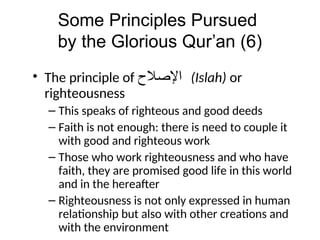
• The principle of ﺍﻹﺻﻼﺡ (Islah) or
righteousness
– This speaks of righteous and good deeds
– Faith is not enough: there is need to couple it
with good and righteous work
– Those who work righteousness and who have
faith, they are promised good life in this world
and in the hereafter
– Righteousness is not only expressed in human
relationship but also with other creations and
with the environment
44.
Some Principles Pursued
bythe Glorious Qur’an (7)
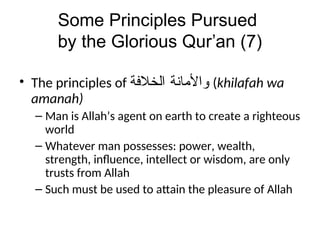
• The principles of ﻭﺍﻷﻣﺎﻨﺔ
ﺍﻠﺧﻼﻓﺔ (khilafah wa
amanah)
– Man is Allah’s agent on earth to create a righteous
world
– Whatever man possesses: power, wealth,
strength, influence, intellect or wisdom, are only
trusts from Allah
– Such must be used to attain the pleasure of Allah
45.
Some Principles Pursued
bythe Glorious Qur’an (8)
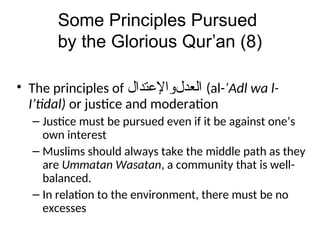
• The principles of ﺍﻠﻌﺪﻞﻮﺍﻹﻋﺗﺪﺍﻞ (al-‘Adl wa l-
I’tidal) or justice and moderation
– Justice must be pursued even if it be against one’s
own interest
– Muslims should always take the middle path as they
are Ummatan Wasatan, a community that is well-
balanced.
– In relation to the environment, there must be no
excesses
46.
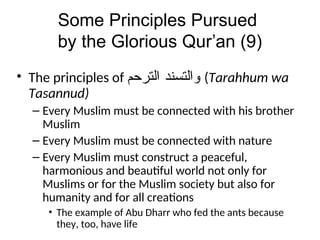
Some Principles Pursued
bythe Glorious Qur’an (9)
• The principles of ﻭﺍﻠﺗﺴﻨﺪ
ﺍﻠﺗﺭﺤﻢ (Tarahhum wa
Tasannud)
– Every Muslim must be connected with his brother
Muslim
– Every Muslim must be connected with nature
– Every Muslim must construct a peaceful,
harmonious and beautiful world not only for
Muslims or for the Muslim society but also for
humanity and for all creations
• The example of Abu Dharr who fed the ants because
they, too, have life
47.
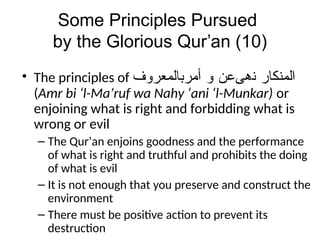
Some Principles Pursued
bythe Glorious Qur’an (10)
• The principles of ﺍﻠﻣﻨﻛﺎﺭ
ﻨﻫﻰﻋﻥ
ﻭ
ﺃﻣﺭﺒﺎﻠﻣﻌﺭﻭﻒ
(Amr bi ‘l-Ma’ruf wa Nahy ‘ani ‘l-Munkar) or
enjoining what is right and forbidding what is
wrong or evil
– The Qur’an enjoins goodness and the performance
of what is right and truthful and prohibits the doing
of what is evil
– It is not enough that you preserve and construct the
environment
– There must be positive action to prevent its
destruction
48.
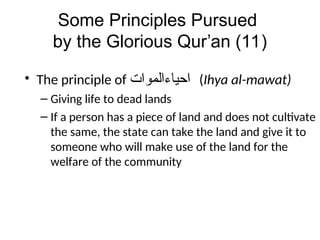
Some Principles Pursued
bythe Glorious Qur’an (11)
• The principle of ﺍﺤﻴﺎﺀﺍﻠﻣﻭﺍﺖ (Ihya al-mawat)
– Giving life to dead lands
– If a person has a piece of land and does not cultivate
the same, the state can take the land and give it to
someone who will make use of the land for the
welfare of the community
49.
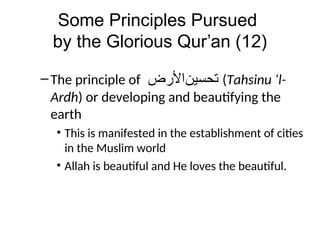
Some Principles Pursued
bythe Glorious Qur’an (12)
–The principle of ﺗﺤﺴﻴﻦﺍﻷﺭﺾ (Tahsinu ‘l-
Ardh) or developing and beautifying the
earth
• This is manifested in the establishment of cities
in the Muslim world
• Allah is beautiful and He loves the beautiful.
The Sunnah (2)
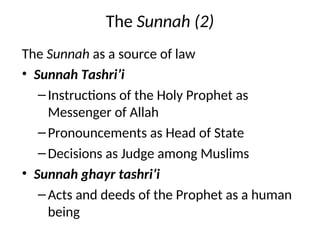
TheSunnah as a source of law
• Sunnah Tashri’i
–Instructions of the Holy Prophet as
Messenger of Allah
–Pronouncements as Head of State
–Decisions as Judge among Muslims
• Sunnah ghayr tashri’i
–Acts and deeds of the Prophet as a human
being
52.
The Sunnah (3)
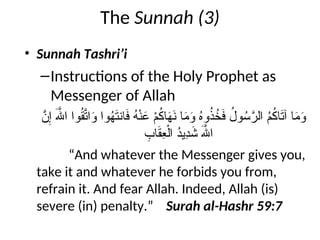
•Sunnah Tashri’i
–Instructions of the Holy Prophet as
Messenger of Allah
َّ
نِإ َهَّللا واُ
قَّ
اتَ
و واُ
هَ
تانَ
ف ُ
هْنَ
ع ْ
مُ
كاَ
هَ
ن اَ
مَ
و ُ
هوُ
ذُ
خَ
ف ُ
ولُ
سَّ
الر ُ
مُ
كاَ
تآ اَ
مَ
و
ِ
ابَ
قِ
عْال ُ
دِي
دَ
ش َهَّللا
“And whatever the Messenger gives you,
take it and whatever he forbids you from,
refrain it. And fear Allah. Indeed, Allah (is)
severe (in) penalty.” Surah al-Hashr 59:7
53.
The Sunnah (4)
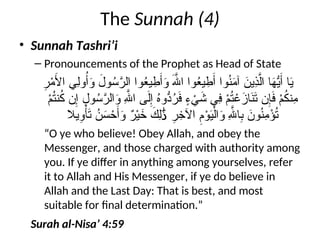
•Sunnah Tashri’i
– Pronouncements of the Prophet as Head of State
ِ
رْ
مَ
األ ِيلوُأَ
و َ
ولُ
سَّ
الر واُ
عي ِ
طَأَ
و َهَّللا واُ
عي ِ
طَأ واُ
نَ
مآ َ
ِين
ذَّال اَ
هُّ
يَأ اَ
ي
ْ
مُ
تنُ
ك نِإ ِ
ولُ
سَّ
الرَ
و ِهَّللا ىَلِإ ُ
هُّو
دُ
رَ
ف ٍ
ء ْ
يَ
ش ِي
ف ْ
مُ
ت ْ
عَ
ازَ
نَ
ت نِإَ
ف ْ
مُ
كِن
م
يالِ
وْأَ
ت ُ
نَ
س ْ
حَأَ
و ٌ
رْيَ
خ َ
ِكل ِ
رِ
اآلخ ِ
مْ
وَ
يْالَ
و ِهَّللاِ
ب َ
ونُ
نِ
مْ
ؤُ
ت
َٰذ
“O ye who believe! Obey Allah, and obey the
Messenger, and those charged with authority among
you. If ye differ in anything among yourselves, refer
it to Allah and His Messenger, if ye do believe in
Allah and the Last Day: That is best, and most
suitable for final determination.”
Surah al-Nisa’ 4:59
54.
The Sunnah (5)
•Sunnah Tashri’i
– Decisions of the Prophet as Judge among Muslims
ُوا
دِ
جَ
ي ال َّ
مُ
ث ْ
مُ
هَ
نْيَ
ب َ
ر َ
جَ
ش اَ
مِي
ف َ
وكُ
مِّ
كَ
حُ
ي َّ
تَ
ح َ
ونُ
نِ
مْ
ؤُ
ي ال َ
كِّ
بَ
رَ
و الَ
ف
ٰى
اً
مِيل ْ
سَ
ت واُ
مِّلَ
سُ
يَ
و َ
تْي َ
ضَ
ق اَّ
مِّ
م ا ً
جَ
ر َ
ح ْ
مِ
هِ
سُ
فنَأ ِي
ف
“But nay, by thy Sustainer! They do not [really]
believe unless they make thee [O Prophet] a judge of
all on which they disagree among themselves, and
then find in their hearts no bar to an acceptance of
thy decision and give themselves up [to it] in utter
self-surrender.”
Surah al-Nisa’ 5:65
55.
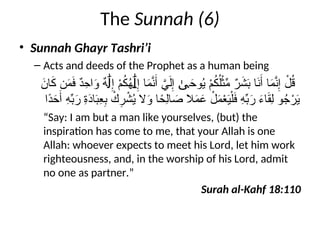
The Sunnah (6)
•Sunnah Ghayr Tashri’i
– Acts and deeds of the Prophet as a human being
َ
انَ
ك نَ
مَ
ف ٌ
دِ
احَ
و ٌ
ه ِإ ْ
مُ
كُ
ه ِإ اَ
مَّ
نَأ َّ
يَلِإ َ
وحُ
ي ْ
مُ
كُلْثِّ
م ٌ
رَ
شَ
ب اَ
نَأ اَ
مَّ
نِإ ْ
لُ
ق
َٰل َٰل ٰى
ًا
دَ
حَأ ِ
هِّ
بَ
ر ِ
ةَ
داَ
بِ
عِ
ب ْ
كِ
ر ْ
شُ
ي الَ
و اً
ِحلا َ
ص الَ
مَ
ع ْ
لَ
مْ
عَ
يْلَ
ف ِ
هِّ
بَ
ر َ
ءاَ
قِل وُ
جْ
رَ
ي
“Say: I am but a man like yourselves, (but) the
inspiration has come to me, that your Allah is one
Allah: whoever expects to meet his Lord, let him work
righteousness, and, in the worship of his Lord, admit
no one as partner.”
Surah al-Kahf 18:110
56.
The Sunnah (7)
TheSunnah as a source of law
• The aspects of Sunnah
–Sunnah qawli or statements of the Holy
Prophet (saw)
–Sunnah fi’li or his is acts and deeds
–Sunnah taqriri or the acts and deeds of his
companions which he approved or agreed
with
57.
The Sunnah (8)
TheSunnah as a source of law
• Two parts of a Hadith
– Sanad or the chain of narrators that traces the
origin of the statement, deed or approval from
the Holy Prophet himself. The study and
examination of the sanad is called riwayah. Out of
this developed the science of ‘asma’ al-rijal’
– Matn or the statement of the Holy Prophet or the
narration of his action or approval of an act done
by others. The study of the matn resulted into
dirayah
58.
The Sunnah (9)
Classificationof the Sunnah as to transmission:
• Muttasil [continuous]
– Mutawatir or one that is continuously recurrent and
reported by an indefinite number of people
– Mash’hur or one reported by one, two or more
Companions or from another companion and the diffusion
of the report must have taken place during the first or
second generation following the demise of the Prophet,
not later
– Ahad or one reported by one person
• Ghayr muttasil [discontinued]
– Mursal or munqati’ or one reported by one who had not
met the Prophet but attributed the statement to him
59.
The Sunnah (10)
Classificationof the Sunnah as to authenticity:
• Sahih or authentic and genuine
• Hasan or good
• Dha’if or weak
Basis of the degree of authenticity of a Hadith:
• The perfection [or imperfection] of the chain of narrators
• The freedom of the text from any concealed defects
• The acceptance [or rejection] of a Hadith by the Companions
of the Holy Prophet [peace be upon him]
60.
The Sunnah (11)
Asa source of law, the Sunnah enacts its rulings in
three capacities:
• Reiterate or corroborate a Qur’anic ruling
• Explain or interpret a Qur’anic injunction: clarify the
ambivalent [mujmal], qualify the absolute [mutlaq],
or specify the general [‘amm]
• Provide rulings where the Qur’an is silent: prohibition
of simultaneous marriage to the maternal or paternal
aunt of one’s wife; right of pre-emption;
grandmother’s entitlement to a share in inheritance
61.
The Sunnah (12)
SixAuthentic Collections of Hadith
• Sahih of Imam al-Bukhari [Abu ‘Abdullah ibn Muhammad ibn
Isma’il al-Bukhari, d.256 AH/870]
• Sahih of Imam Muslim [Abu ‘l-Husayn Muslim ibn Hajjaj al-
Nishapuri, d. 261 AH/875]
• Sunan of Ibn Majah [Muhammad ibn Yazid Abu ‘Abdullah ibn
Majah al-Qazwini, d. 273 AH/887]
• Sunan of Abu Dawud [Abu Dawud Azdi al-Sijistani, d. 275
AH/888]
• Jami’ of al-Tirmidhi [Muhammad ibn ‘Isa ibn Sawrah al-Sulami
al-Tirmidhi, d. 279 AH/892]
• Sunan of al-Nasa’i [Ahmad ibn Shu’ayb ibn ‘Ali ibn Sinan al-
Nasa’i, d.303 AH/915]
62.
Secondary Sources (1)
•Ijtihad
– Literally means intellectual striving or self-exertion which
entails a measure of hardship
– The intellectual exertion of a jurist in order to infer, with a
degree of probability, the rules of Shari’ah from their
detailed evidence from the sources
– The person who exercises ijtihad is called a mujtahid
• Types of Mujtahid
– Mujtahid fi ‘l-din
– Mujtahid fi ‘l-madh’hab
– Mujtahid fi ‘l-mas’alah
63.
Secondary Sources (2)
•Ijma’
– The unanimous agreement of the mujtahidin of the Muslim
community of any period following the death of the Holy
Prophet on any matter
– It applies to all juridical (shar’i), intellectual (‘aqli),
customary (‘urfi), and linguistic (lughawi) matters
– It is based from the nusus of the infallibility of the ummah
– It begins with the personal ijtihad of individual jurists and
culminates in the universal acceptance of a particular
opinion over a period of time
– Differences of opinion are tolerated until a consensus
emerges; there is no compulsion or imposition of ideas in
the process
64.
Secondary Sources (3)
•Essential requirements of Ijma’
1. Presence of a number of mujtahidin at a time an issue is
encountered
2. There is unanimity of opinion of the mujtahidin or jurists
3. The agreement of the mujtahidin must be shown in their
expressed opinion on a particular issue
4. Consensus must be by all the mujtahidin, not just a
majority [However, according to Ibn Jarir al-Tabari, Abu
Bakr al-Razi, Ahmad ibn Hanbal (in one of his two views),
and Shah Waliullah, ijma’ may be concluded by a
majority opinion]
– Once concluded, ijma’ cannot be repealed or modified
Secondary Sources (5)
•Bases of Ijma’ in the Sunnah
– “My community will not agree on error.”
– “I beseeched Almighty Allah not to bring my community to
the point of agreeing on dhalalah and He granted me this.”
– “The hand of Allah is with the community and (its safety) is
not endangered by isolated oppositions.”
– “Whoever leaves the community or separates himself from
it by the length of a span is breaking his bond with Islam.”
– “Whoever separates himself from the community and dies,
dies the death jahiliyyah.”
– “A group of my ummah shall continue to remain on the
right path. They will be dominant and will not be harmed by
the opposition of opponents.”
67.
Secondary Sources (6)
•Qiyas
– Literally means measuring or ascertaining the length,
weight or quality of something
– It also means comparison of two things suggesting their
equality or similarity
– Technically, qiyas means the extension of a shari’ah value
[hukm] from an original case [asl] to a new case [far’]
because the latter has the same effective cause [‘illah] as
the former
– The original case is regulated by a given text and qiyas
seeks to extend the same textual ruling to the new case
by virtue of the commonality of the effective cause
between the original case and the new case
68.
Secondary Sources (7)
•Essential Requirements of Qiyas
1. The original case or asl on which a ruling is given in the
text and which analogy seeks to extend to a new case
2. The new case or far’ on which a ruling is wanting or
needed
3. The effective cause or ‘illah which is an attribute of the
asl and is found to be present also in the new case
4. The ruling or hukm governing the original case which is
to be extended to the new case
69.
Secondary Sources (8)
•Examples of Qiyas
– The Glorious Qur’an (Surah al-Jumu’ah 62:9) forbids the
selling of goods after the last call for Friday prayer until the
end of the prayer. By analogy, the prohibition is extended to
all kinds of transactions because the effective cause, that is,
diversion from prayer is common to all
– The Prophet is reported to have said: “The killer shall not
inherit from his victim.” By analogy, the ruling is extended to
bequests, which would mean that the killer will not benefit
from the will of his victim
– According to a Hadith, a man cannot make an offer of
betrothal to a woman who is already betrothed to another
unless the latter gives his permission or has abandoned his
offer. This is extended to similar other transactions
70.
Subsidiary Legal Principles(1)
• Istihsan
– It is a method of exercising personal opinion in order to
avoid any rigidity and unfairness that might result from
the literal enforcement or execution of the law
– Literally means ‘to approve, or to deem something
preferable
– It is derived from hasuna which means ‘good’ or ‘beautiful’
– It can be translated as ‘juristic preference’
– It involves the setting aside of an established analogy in
favor of an alternative ruling which serves the ideals of
justice and public interest in a better way
71.
Subsidiary Legal Principles(2)
• Istihsan
– Hanafi definition [adopted from Abu ‘l-Hasan al-Karkhi]:
Istihsan is a principle which authorizes departure from an
established precedent in favor of a different ruling for a
reason stronger than the one which is obtained in that
precedent.
– Hanbali definition [adopted from Ibn Taymiyyah]: Istihsan
is the abandonment of one legal norm (hukm) to another
which is considered better on the basis of the Qur’an,
Sunnah or consensus.
– Maliki definition [adopted from Ibn ‘Arabi]: Istihsan is to
abandon exceptionally what is required by the law
because applying the existing law would lead to a
departure from some of its own objectives.
72.
Subsidiary Legal Principles(3)
• Istihsan
– Shafi’i view on istihsan: it is a form of pleasure-seeking and
arbitrary law-making in religion. It involves personal
opinion, discretion and the inclination of the individual
jurist, an exercise which is not in harmony with the
Qur’anic ayah: “Does man think that he will be left without
guidance?” ًى
د ُ
س َ
كَ
رْ
تُ
ي نَأ ُ
ان َ
نسِ
اإل ُ
ب َ
س ْ
حَ
يَأ[Surah al-
Qiyamah 75:35]
– Despite this denunciation, the Shafi’I jurist , al-Amidi,
stated that al-Shafi’i himself has resorted to istihsan as in
the ruling when he said: I approve [astahsinu] mut’ah (gift
of consolation) at the level of ‘30 dirhams’
73.
Subsidiary Legal Principles(4)
• Istihsan
– It consist of a departure from qiyas jali [obvious analogy]
to qiyas khafi [hidden analogy]
– Bases of the ruling of ‘Umar ibn al-Khattab not to enforce
hadd penalty on amputation for theft due to an acute
famine
– It is an expression of ra’y which gives preference to the
best of different choices as shown in the case when ‘Umar
was approached by Ibn Salamah’s neighbor who asked for
a permission to extend a water canal through Ibn
Salamah’s property, ‘Umar granted the request on the
ground that no harm was to accrue to Ibn Salamah and
extending the water canal would benefit his neighbor
74.
Subsidiary Legal Principles(5)
• Maslaha mursalah
– Refers to the unrestricted public interest
– Consists of considerations of securing benefit or
preventing harm and are harmonious with the
maqasid al-shari’ah which have to be protected
such as religion, life, intellect, lineage and
property
– Derives its validity from the norm that the basic
purpose of legislation is to secure the welfare of
the people by promoting their benefit or
protecting them from harm
75.
Subsidiary Legal Principles(6)
• Maslaha mursalah
– Conditions of Maslaha mursalah:
• The maslaha must be genuine [haqiqiyah]
• The maslaha must be general [kulliyah]
• The maslaha must not be in conflict with a
principle upheld by the nass and ijma’
• Imam Malik added: the maslaha must be
rational [ma’qulah] and must remove or
prevent hardship to the people
• Imam al-Ghazali added: the maslaha must be
essential [dharuriyah]
76.
Subsidiary Legal Principles(7)
• ‘Urf
– Refers to the collective practice of a large number
of people
– Defined as the recurring practices which are
acceptable to people of sound nature
– To be the valid basis of legal decisions, it must be
sound and reasonable
– Legal maxim recorded by the Shafi’i jurist al-
Suyuti: “What is proven by ‘urf is like that which
is proven by a shar’i proof”
77.
Subsidiary Legal Principles(8)
• ‘Urf
– Conditions of a valid ‘urf:
• Must represent a common and recurrent
phenomenon
• Must be in existence when a transaction is
concluded
• Must not contravene the clear stipulation of an
agreement
• Must not violate the nass
78.
Subsidiary Legal Principles(9)
• Istishab
– Denotes a rational proof which may be employed in
the absence of other indications
– Refers to the continuation of that which is proven
or the negation of that which had not existed
– Presumes the continuation of either the positive or
negative status of a thing until the contrary is
established by evidence
– Validated by the Shafi’i and Hanbali schools
– The Hanafi and Maliki schools do not consider it as
a proof in its own right
79.
Subsidiary Legal Principles(10)
• Istishab
– Varieties of Istishab:
• Presumption of original absence [istishab
al-’adam al-asli]
• Presumption of original presence [istishab al-
wujud al-asli]
• Presumption of the continuity of the general
rules and principles of law
• Presumption of continuity of attributes
[istishab al-wasf]
80.
Subsidiary Legal Principles(11)
• Sadd al-dhara’i
– Means blocking the means to an expected end
which is likely to materialize if the means towards
it is not obstructed
– Arises when a lawful means is expected to lead to
an unlawful result, or when a lawful means which
normally leads to a lawful result is used to procure
an unlawful end
– Founded on the idea of preventing evil before it
actually materializes
81.
Subsidiary Legal Principles(12)
• Sadd al-dhara’i
– Hanafi and Shafi’I schools do not recognize it as a
principle of jurisprudence
– Maliki and Hanbali jurists validated it as a proof of
Shari’ah in its own right
– Example: a man sent by the Prophet [saw] to
collect zakat and who took gifts from the people
– The Prophet prevented creditors to take gifts from
debtors which may lead to riba’ and the gift
becoming a substitute for riba’
82.
ISLAMIC LAW
AND ITSAPPLICATION
Part 2
STAGES IN THE DEVELOPMENT
OF ISLAMIC LAW
83.
I – TheFirst Stage: Foundation
• The Prophetic Period [13BH-10AH / 610-632]
– The only sources of law were the Qur’an and the
Sunnah
– A number of Qur’anic verses were direct answers to
queries by Muslims and non-Muslims [some of these
begin with the phrase: “They ask you about…”]
– Others were revealed due to particular incidents [Ex.,
ayat al-li’an (Surah al-Nur 24:6-9)]
– This is same with legislation found with the Sunnah:
they were either answer to questions or
pronouncements due to an incident
84.
I – TheFirst Stage: Foundation
• Justice was among the values the Holy Prophet most
profusely and exhaustively expounded.
• His sunnah is replete with statements and deeds that
would attest to this.
• Thus, when he migrated to Madínah and established
the first Islamic community in that city, he did not
only serve as the Messenger of Alláh and Head of
the budding Islamic state but also did the duty of a
qáḍí or judge to adjudicate with justice and fairness
all cases brought before him.
85.
I – TheFirst Stage: Foundation
• Early projects of the Holy Prophet after his
migration to Madinah:
1. Building the Masjid of the Prophet
2. Establishing brotherhood among the Ansar and
the Muhajirin
3. Writing of the Wathiqah or the Constitution of
Madinah that defined the relationship of the
Muslims among themselves and the Muslim
Community and the non-Muslim communities of
Madinah: the Jews, the Christians, and the
idolaters
86.
I – TheFirst Stage: Foundation
• Early projects of the Holy Prophet after
his migration to Madinah:
4. Establishing, strengthening and reforming
the market place
5. Sending expeditions in defense of the
budding Islamic state of Madinah
87.
I – TheFirst Stage: Foundation
• Illustrative Cases Decided by the Holy
Prophet:
– Once a woman complained to the Holy Prophet,
“O Messenger of Alláh, my womb was a resting
place of this son of mine, my breast a drinking
place for him, and my lap a soothing place for him,
but his father divorced me and wishes to snatch
him away from me.” The Holy Prophet decided,
“You have got a better right to take him till you
marry someone else.”
88.
I – TheFirst Stage: Foundation
• Illustrative Cases Decided by the Holy
Prophet:
– In another case, the Holy Prophet asked the boy,
who was the subject of controversy between his
parents, to pinpoint his preference between his
father and his mother. The boy chose his mother
and the Holy Prophet decided in her favor.
89.
I – TheFirst Stage: Foundation
• Illustrative Cases Decided by the Holy Prophet:
– Another example of a case decided by the Holy Prophet was
one relating to the daughter of Hamzah ibn ‘Abd al-Muttalíb,
his uncle. Zayd ibn Ḥárithah claimed custody over her on the
proposition that he was the one who took her from Makkah.
‘Alí ibn Abi Tálib claimed to take her on the reason that he
was Hamza’s nephew and his wife, Fatimah al-Zahrah, was the
Prophet’s daughter. Ja’far ibn Abi Tálib also sought custody of
her because he was Hamzah’s nephew and his wife was the
maternal aunt of the girl. Prophet Muhammad decided in
favor of Ja’far ibn Abi Tálib because the girl will be living with
her maternal aunt who is like a mother.
90.
I – TheFirst Stage: Foundation
• Delegation of Judicial Authority
One such case of delegation of judicial authority was the case of
Mu‘adh ibn Jabal who was sent to Yemen. On the day of his
departure, Mu‘adh ibn Jabal was asked by the Holy Prophet how
would he adjudicate cases brought before him. Mu‘adh ibn Jabal
replied, “According to the Book of Alláh.” “And if you do not find
bases therein?” asked the Prophet. Mu‘adh answered, “According
to the sunnah of the Messenger of Alláh.” “And if it is not also
there?” the Prophet inquired. Mu‘adh said, “Then I will exert my
best to exercise my personal judgment.” Thereupon, the Holy
Prophet said, “Praise be to Alláh who has guided the messenger
of the Messenger of Alláh to that which pleases his Messenger.
91.
I – TheFirst Stage: Foundation
• ‘Alí ibn Abi Tálib (raḍiya ‘Lláhu ‘anhu) was also sent as
a judge to Yemen. When he was designated to
perform that the task, he asked, “Messenger of Alláh,
you are sending me when I am young and have no
knowledge of the duties of a judge?” The Holy Prophet
replied, “Alláh will guide your heart and keep your
tongue true. When two litigants sit in front of you, do
not decide till you hear what the other has to say as
you heard what the first had to say; for it is best that
you should have a clear idea of the best decision.”
92.
I – TheFirst Stage: Foundation
• Aside from delegating judicial authority, the
Holy Prophet (saw) also served as an appellate
court hearing appeals on cases decided by his
appointed judges. An example of such is a
case decided by ‘Alí ibn Abi Tálib in Yemen
which, after it was appealed to the Holy
Prophet, the latter affirmed
93.
II – TheSecond Stage: Establishment
Era of al-Khulafa al-Rashidun [632-661]
•Abú Bakr al-Ṣiddíq [632-634] administered
justice according to the Glorious Qur’án and the
sunnah of the Holy Prophet
•He appointed ‘Umar ibn al-Khaṭṭáb as qáḍí but
no single case was ever reported to have been
brought before him
•Abu Bakr also acted as qadi and he adjudicated
cases brought before him with impartiality and
with a high sense of justice
94.
II – TheSecond Stage: Establishment
• Among such cases brought to the attention of Abú Bakr
was a dispute between ‘Umar ibn al-Khaṭṭáb and the
grandmother of ‘Umar’s son, ‘Asim. The latter was
‘Umar’s son with an Ansari woman whom he divorced.
When ‘Umar saw the young boy playing with other
children, he took him to his saddle. The child’s maternal
grandmother saw him and quarreled with him. When the
case was presented before Abú Bakr, ‘Umar pleaded that
he was the father of the boy. On the other hand, the old
woman argued that she claims preference over the
custody of the child as he was her grandson. Abú Bakr
decided in her favor
95.
II – TheSecond Stage: Establishment
• Another case decided by Abú Bakr was concerning a
man who pleaded to him, “My father desires to take
my property saying that he is in need of the whole of
it.” Abú Bakr told the father, “Take from the property
of your son which is sufficient for your sustenance.”
The man answered, “O Caliph of the Messenger of
Alláh, did not the Holy Prophet of Alláh said, “You
and your property belong to your father?” Abú Bakr
answered, “Yes, but what he meant by that is only
the necessary maintenance.”
96.
II – TheSecond Stage: Establishment
• When ‘Umar ibn al-Khaṭṭáb [634-644] assumed office, he
sent written instructions to his governors and to judges in
the different part of the Islamic state to administer justice
to the best of their ability, relying upon the Glorious
Qur’án, the sunnah of the Holy Prophet, the ijmá‘ or
consensus of opinion of the venerable companions, and
upon ijtihád
• It was during his time that judges were formally
appointed and the judiciary was treated as a separate
branch of the government, independent of and distinct
from the executive department
97.
II – TheSecond Stage: Establishment
• Among the judges appointed during the
caliphate of ‘Umar ibn al-Kattáb were:
– Zayd ibn Thábit ,‘Alí ibn Abi Tálib and Abú Dardá in
Madínah,
– Ka’b ibn Sur al-Azdi and Surayh in Basra
– ‘Abbádah ibn Sámit in Filastin
– Abú Músá al-Ash’ari, Abú Qurrah al-Kindi, Sulaymán
ibn Rabiah and ‘Abdu ‘Lláh ibn Mas‘úd in Kufa.
98.
II – TheSecond Stage: Establishment
• Umar also authorized ‘Amr ibn al-‘Ás, the
governor of Egypt, to appoint Ka’b ibn Yasar
as qáḍí in Egypt. Upon the refusal of the latter,
‘Amr appointed ‘Uthmán ibn Qa’is to assume
that position
• Thus, this new method of appointment of a
judge by a governor was introduced during
the khiláfah of ‘Umar ibn al-Khaṭṭáb
99.
II – TheSecond Stage: Establishment
• Instructions of Umar to Abu Musa upon the latter’s
appointment as a judge:
– Now, the office of judge is a definite religious duty and a
generally followed practice.
– Understand the depositions that are made before you, for it
is useless to consider a plea that is not valid.
– Consider the entire people equal before you in your court
and in your attention, so that the noble will not expect you to
be partial and the humble will not despair of justice from you.
100.
II – TheSecond Stage: Establishment
– The claimants must produce evidence; from the
defendant, an oath may be exacted.
– Compromise is permissible among Muslims, but not any
agreement through which something forbidden would
be permitted, or something permitted forbidden.
– If you give judgment yesterday, and today upon
reconsideration come to the correct opinion, you
should not feel prevented by your first judgment from
retracting; for justice is primeval, and it is better to
retract than to persist in worthlessness.
101.
II – TheSecond Stage: Establishment
– Use your brain about matters that perflex you and
to which neither (the) Qur’án nor (the) sunnah
seem to apply. Study similar cases and evaluate the
situation through analogy with those similar cases.
– If a person brings a claim, which he may or may not
be able to prove, set a time limit for him. If he
brings proof within the time limit, you should allow
his claim, otherwise, you are permitted to give
judgment against him. This is the better way to
forestall or clear up any possible doubt.
102.
II – TheSecond Stage: Establishment
– All Muslims are acceptable as witnesses against each
other, except as such as have received a punishment
provided for by the religious law, such as are proved to
have given false witness, and such as are suspected (of
parti’Alíty) on (the ground of) client status or relationship,
for Alláh , praised be He, forgives because of oaths and
postpones (punishments) in face of the evidence.
– Avoid fatigue and weariness and annoyance at the
litigants.
– For establishing justice in the courts of justice, Alláh will
grant you a rich reward and give you a good reputation.
103.
II – TheSecond Stage: Establishment
• When Uthman ibn ‘Affan [644-656] took over the
reins of power, he commissioned Zayd ibn Thábit,
‘Abdu ‘Lláh ibn Zubayr, Said ibn al-‘Ás and ‘Abdu ’l-
Raḥmán ibn Ḥárith ibn Hishám, to rewrite and
prepare several copies of the Holy Qur’án based on
the copy prepared during the time of Abu Bakr
These were sent to Muslims centers in the vast and
expanding Islamic empire to replace those in
circulation
A complete copy of one of this Mushaf was found in
Tashkent and is now kept in the Topkapi palace in
Istanbul
104.
II – TheSecond Stage: Establishment
• This action taken by ‘Uthmán in preparing
standard copies of the Holy Qur’án was not
only necessary in the preservation of the same
but it was equally important in the
dispensation and administration of justice, the
Holy Qur’án being the primary source of the
Sharí‘ah
105.
II – TheSecond Stage: Establishment
• ‘Alí ibn Abi Tálib [656-661] was the fourth
khalifah
• For ‘Ali, injustice is of three kinds:
– The first one is an injustice that would not be
forgiven. This pertains to an injustice done against
Alláh by ascribing partners with Him.
– The second one is an injustice that will be forgiven.
This concerns minor sins committed to oneself.
– The third is one that will not be left unquestioned.
This relates to an injustice done against other men.
106.
II – TheSecond Stage: Establishment
• For this reason, ‘Alí ibn Abi Tálib considered as
among the most detestable person a judge
who is ignorant of his task and yet continues
to perform his work as a judge.
• He declared: “Lost lives are crying against (a
judge with) unjust verdicts, and properties
(that have been wrongly disposed of) are
grumbling against him.”
107.
II – TheSecond Stage: Establishment
• He specified the qualifications of a person to be
appointed as a judge:
– He must not be excitable in himself, nor subject to
excitability by ruse of a party to a suit.
– He must not be one to persist in an error and must not be
reluctant to return to the correct way when he learns it.
– He must not be inclined to greed, nor must he deliver
premature judgment. If there is doubt, it should give him
pause; he should rely strongly on evidence and not on his
own inclined opinion.
108.
II – TheSecond Stage: Establishment
– He must be the most patient in seeking after the
truth of the matter, and when the case is clear, he
should give a strict judgment without hesitation.
– He must be immune to praise, and not subject to
temptation.
– His judgments should be checked on constantly;
he should be well-paid, so as not to fear the
temptation of bribery.
109.
II – TheSecond Stage: Establishment
–He should be given a high position inferior
to no other official, so that no one would
stand between him and the governor; thus
would he be secure from the slander of
those who would wish him ill.
110.
III – TheThird Stage: Building
• The Umayyad Dynasty (41-132 AH/661-750)
– How established
– Resistance against the Umayyad: Abdullah ibn Zubayr
– Principles of Islamic government abandoned by the
Umayyad:
• Shura or Consultation
• The dicta of the jurists were no longer respected as
these learned guardians of the Sharí‘ah were
subjected to varied ways of insults, torture and
oppression. Some of them, out of such inhuman
persecution and coercion, gave in to the desired
decisions of the Umayyad tyrants
111.
III – TheThird Stage: Building
• The court system took some significant
developments during the Umayyad era. The
qáḍí or judge at the Umayyad capital in
Damascus was appointed by the ruler while
the qudáh or judges in the other part of the
empire were appointed by the governors.
However, their decisions were subject for
review by the Umayyad monarch
112.
III – TheThird Stage: Building
• Reforms during the Reign of ‘Umar ibn ‘Abd
al-Aziz
– Institution of the Mazalim Court
– Independence of the Judiciary
– Revitalizing the Office of the Muhtasib
113.
III – TheThird Stage: Building
• Trends in Fiqh during this period:
– Increase in the number of ijtihad given by
scholars since ijma’ became more difficult to
attend due to dispersal of fuqaha’ to other
areas
– Increase in the tendency of fabricating and
forging ahadith [to support sectarian or
political groups]
– First attempts in the compilation of fiqh as a
means of preserving the ijtihad of the
shahabah
114.
III – TheThird Stage: Building
• Two groups of scholars during the period
– Ahl al-Hadith
• Limiting their deductions on available texts
• Avoided making legal rules if there are no available
texts of the Qur’an and hadith
• Centered in Madinah
– Ahl al-Ra’y
• Deduced legal rules through reason
• Problems were invented and imaginary solutions were
worked out
• Centered in Kufah
115.
IV – TheFourth Stage: Flowering
• The Abbasid Dynasty
(132-656 AH/750-1258)
– How established
– Developments during the Abbasid:
• Birth and development of the Madhahib or
Schools of Jurisprudence
• Compilation of Aḥádíth
116.
IV – TheFourth Stage: Flowering
Schools of Jurisprudence: The Hanafi Madh’hab
– Founded by Imam Nu’man ibn Thabit [703-767],
popularly known as Imam Abu Hanifah
– The school is characterized by being Ahl al-Ra’y
[people of opinion]
– Legal rules were deduced from the Glorious
Qur’an, the Sunnah, Ijma’ of the Companions,
individual opinion of the Shahabah, qiyas,
istihsan, and ‘urf
117.
IV – TheFourth Stage: Flowering
Schools of Jurisprudence: The Hanafi Madh’hab
– Most prominent students: Imam Abu Yusuf Ya’qub
ibn Ibrahim [735-795] and Imam Muhammad ibn
Hasan al-Shaybani [749-805]
– Followers of the school are mostly found in India,
Afganistan, Pakistan, Iraq, Syria, Turkey, Guyana,
Trinidad, Surinam, and Egypt
– Its spread was due to its adoption by the Ottoman
rulers
118.
IV – TheFourth Stage: Flowering
Schools of Jurisprudence: The Maliki Madh’hab
– Founded by Imam Malik ibn Anas [717-801]
– Being established in Madinah, it is basically
characterized as ahl al-hadith [people of tradition]
– Legal rules are deduced from the Glorious Qur’an,
the Sunnah, ‘amal ahl al-madinah [practice of the
people of Madinah], ijma’ of the Shahabah,
individual opinion of the Shahabah, qiyas,
maslahah mursalah, and ‘urf
119.
IV – TheFourth Stage: Flowering
Schools of Jurisprudence: The Maliki Madh’hab
– Imam Malik wrote al-Muwatta’ which Abbasid
caliphs requested to be the standard rule of
jurisprudence but which request Imam Malik
refused
– Prominent among the students of Imam Malik
were Imam Muhammad al-Shaybani and Imam ibn
Idris al-Shafi’i
– Followers of the school are mostly found in Upper
Egypt, Sudan, North Africa [Tunisia, Algeria and
Morocco
120.
IV – TheFourth Stage: Flowering
Schools of Jurisprudence: The Shafi’i Madh’hab
– Founded by Imam Muhammad Idris al-Shafi’I
[769-820]
– Imam Shafi’i was a student of Imam Malik and
Imam Muhammad al-Shaybani
– He tried to combine the legal approaches of ahl
al-ra’y and ahl al-hadith and systematized the
principles of fiqh through the science of usul al-
fiqh
121.
IV – TheFourth Stage: Flowering
Schools of Jurisprudence:The Shafi’i Madh’hab
– Legal rules were deduced from the Glorious
Qur’an, the Sunnah, ijma’ and qiyas
– Used istishab as a subsidiary legal principle
– Followers of the school are mostly found in Egypt,
Southern Arabia (Yemen, Hadramaut), Sri Lanka,
Southeast Asia (Indonesia, Malaysia, Thailand,
Singapore, Brunei, Philippines, East Africa (Kenya,
Tanzania), Surinam in South America
122.
IV – TheFourth Stage: Flowering
Schools of Jurisprudence: The Hanbali Madh’hab
– Founded by Imam Ahmad ibn Hanbal [778-855]
– Among his students were the great compilers of
Hadith, Imam Bukhari and Imam Muslim
– Legal rules were deduced from the Glorious
Qur’an, the Sunnah, ijma’ of the Shahabah,
individual opinion of the Shahabah, hadith dha’if
(weak hadith), qiyas
– Followers of the school are found in Palestine and
Saudi Arabia
123.
IV – TheFourth Stage: Flowering
Schools of Jurisprudence: Other Madha’hib
•Awza’i Madh’hab – founded by Abdu ‘l-Rahman
al-Awza’i [708-774]
•Zaydi Madh’hab – founded by Zayd ibn ‘Ali
[700-740]
•Laythi Madh’hab – founded by Imam Layth ibn
Sa’d [716- 791]
•Thawri Madh’hab – founded by Imam Sufyan al-
Thawri [719-777]
124.
IV – TheFourth Stage: Flowering
• Reform in the Judiciary
– Creation of the Office of Qáḍí al-Qudah
– Independence of the Judiciary
– The Maz’alím Court and the Muḥtasib
– Respect for Men of Learning
125.
IV – TheFourth Stage: Flowering
• The Umayyad Rule in Muslim Spain
– Originally part of the Umayyad Rule in Damascus
when it was conquered in 711 and 750
– Originally part of the governorship of the Maghrib
administered through Qayrawan in Tunisia
– When the Abbasid exterminated the Umayyad,
one of them, Abdul Rahman escaped to Andalus
and established in 756 the continuation of the
Umayyad Dynasty in Spain
126.
IV – TheFourth Stage: Flowering
• Judiciary in Muslim Spain
– Qadi al-jund
– Qadi al-jama’ah
– Qadi al-qudat
• The judge in a small town was called hakim. Although
the judge was appointed by the ruler, he was given
great authority and independence in the sense that
he could issue summons to the ruler which the latter
would readily and immediately comply with.
127.
IV – TheFourth Stage: Flowering
• He must be a man of great learning and familiar
with the Maliki school of law, of high moral
standards and integrity.
• His jurisdiction extended over awqaf or charitable
endowments and bayt al-mal lil-muslimin or
treasury of the Muslims, a fund which is distinct
and different from the bayt al-mal or state treasury.
These were aside from his exclusive jurisdiction on
cases pertaining to persons and family relations.
128.
IV – TheFourth Stage: Flowering
• The qáḍí also led the Friday prayer in
representation of the amir.
• He was assisted by a majlis al-shura or
consultative council which deliberated on
legal questions. Membership in this council
was limited to men learned in the mechanics
and intricacies of the Sharí‘ah.
129.
IV – TheFourth Stage: Flowering
• Other officials performing judiciary function:
1) The sahib al-mazalím or judge of appeal who took
cognizance of complaints against the abuses of those in
authority;
2) The sahib al-Madínah or prefect of the city who was
charged with the judicial authority of investigating and
punishing crimes against public morality.
3) The muḥtasib who was also known as sahib al-suq or
market inspector, who was either under the qáḍí or the
sahib al-Madínah but who acted independently of both.
130.
V – FifthStage: Consolidation
• From the Decline of the Abbasid to the Fall of
Bagdhad [960-1258]
– Only four of the madha’hib survived
– The scholars of each madh’hab analyzed the
rulings of their madh’hab, deduced the
fundamental principles behind the rulings and
codified them
– Ijtihad fi ‘l-madh’hab developed
131.
V – FifthStage: Consolidation
• From the Decline of the Abbasid to the Fall of
Bagdhad [960-1258]
– Books of fiqh were standardized with the order of
topics: taharah, salah, sawm, zakat, hajj; nikah and
talaq; ba’y and other commercial transactions;
adab
– Authors would mention the different proofs used by
the madha’hib and would end proving the
correctness of their school while refuting the views
of the other madha’hib
132.
VI – SixthStage: Stagnation and Decline
• From the Fall of Baghdad [1258] to the present
time
– Closure of the gate of ijtihad
– Overdependence on the work of earlier scholars
– The rise of power struggle and break-up of Islamic
empire into mini-states resulted into lack of state
support to scholarship
– There were attempts for reform but were only later
appreciated: Ahmad ibn Taymiyah [1263-1328],
Muhammad ibn Ali al-Shawkani [1757-1835]
133.
VI – SixthStage: Stagnation and Decline
• Decline of the Ottoman
– Waning of political power and influence and
defeat in war against western power
– Inroad of Western influence through conquest of
Muslim lands
– Creation of Nizamiyah courts and abolition of
Shari’ah courts
134.
VI – SixthStage: Stagnation and Decline
Muslim countries may now be divided into three
groups related to the Sharí‘ah courts and the
application of Islamic Law
First, those states that still follow the unified Islamic court
system which adjudicate all cases according to the
provisions and injunctions of the Divine law, the Sharí‘ah.
These are countries where even the hudud punishments
are enforced such as Saudi Arabia, the Gulf states,
Afghanistan (before the Russian invasion in 1979 and
hopefully, upon its current liberation), the Sudan and Iran.
Brunei has also announced to do this
135.
VI – SixthStage: Stagnation and Decline
• Second, those countries that continue the dual court
system, the Sharí‘ah courts and the secular nizamiyah
or civil tribunals initiated during the tanzimat. Syria,
Lebanon, Jordan, Iraq, Occupied Palestine belong to
this group. Other Muslim countries like Malaysia and
non-Muslim countries where there is a considerable
Muslim population like the Philippines and Thailand
followed suit by establishing special Sharí‘ah courts
having jurisdiction on cases concerning persons,
family and property relations
136.
VI – SixthStage: Stagnation and Decline
• The third group consists of states where a unified secular
court system is maintained which may be completely secular
and rejecting the provisions and injunctions of the Sharí‘ah
as in the case of Turkey or which may adjudicate with Islamic
law in matters of personal, family and property relations, and
with secular or man-made laws in other cases as in the case
of Egypt, Tunisia, Libya and Pakistan. However, there are
now new attempts among some of these Muslim countries
to re-adopt the provisions of the Sharí‘ah
137.
! جزيال شكرا
تعالىالله ورحمة عليكم والسالم
وبركاته
SHUKRAN JAZIILAN!
WA ‘S-SALAAMU ‘ALAYKUM
WA RAHMATU ‘LLAAHI TA’ALAA
WA BARAKAATUH!
#18 Purification
What purifies
pure water: rain, wells, springs, valleys, rivers, melted ice, ocean
pure earth: dust, sand, stone, salty earth deposits
Ablution
Elements:
intention, washing the face, washing the two arms, rubbing the head, washing the feet, doing them in sequence, continuity
Sunan Elements:
Saying Bismillah, washing the two hands, using siwak, rinsing one’s mouth, sniffing water, penetrating the berd with one’s wet hands, doing every act three times, wiping the outer and inner area of the ears, letting the water reach between the fingers and the toes, washing the right limbs first, while washing one should let the water reach more than the prescribed limits, in wiping the head it should be from the front to the nape, du’a or supplication
#21 The child who is walad al-firas does not inherit from his father, only from his mother
The child born out of li’an: the chid and the father neither inherit from each other as the father had denied him
#24 Maqasid al-shari’ah are principles that provide answers to the questions and similar questions about the Islamic law. Maqasid include the wisdoms behind rulings, such as enhancing social welfare, which is one of the wisdoms behind charity, and developing consciousness of God, which is one of the wisdoms behind fasting, Maqasid are also good ends that the laws aim to achieve by blocking, or opening, certain means. Thus, the maqasid of preserving people’s minds and souls explain the total and strict Islamic ban on alcohol and intoxicants. Maqasid are also the group of divine intents and moral concepts upon which the Islamic law is based, such as, justice, human dignity, free will, magnanimity, facilitation, and social cooperation.
#28 How can they believe in others who ordain for them things which Allah has not sanctioned in the practice of their faith?
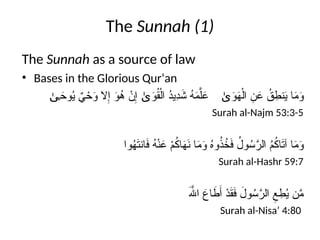
#65 4:59 -O ye who believe! Obey Allah, and obey the Messenger, and those charged with authority among you. If ye differ in anything among yourselves, refer it to Allah and His Messenger, if ye do believe in Allah and the Last Day: That is best, and most suitable for final determination.
4:83 -When there comes to them some matter touching (Public) safety or fear, they divulge it. If they had only referred it to the Messenger, or to those charged with authority among them, the proper investigators would have Tested it from them (direct). Were it not for the Grace and Mercy of Allah unto you, all but a few of you would have fallen into the clutches of Satan.
4:115-If anyone contends with the Messenger even after guidance has been plainly conveyed to him, and follows a path other than that becoming to men of Faith, We shall leave him in the path he has chosen, and land him in Hell,- what an evil refuge!
![ﺍﻟﺮﺣﻣﻦﺍﻟﺮﺣﻴﻢ
ﺑﺴﻢﺍﷲ
ISLAMIC LAW
AND ITS APPLICATION
[Part 1]](https://image.slidesharecdn.com/islamiclawanditsapplicationppt-250318041445-0210c4f5/85/ISLAMIC-LAW-AND-ITS-APPLICATION-powerpoint-ppt-ppt-1-320.jpg)
![ﺍﻟﺮﺣﻣﻦﺍﻟﺮﺣﻴﻢ
ﺑﺴﻢﺍﷲ
ISLAMIC LAW
AND ITS APPLICATION
[Part 1]](https://image.slidesharecdn.com/islamiclawanditsapplicationppt-250318041445-0210c4f5/75/ISLAMIC-LAW-AND-ITS-APPLICATION-powerpoint-ppt-ppt-1-2048.jpg)
![Shari’āh and Fiqh (3)
• ‘Aqeedah [System of Belief]
– The foundations of faith
Belief in Allah, in His angels, in His Revealed Books. in
His Messengers and Prophet, in life after death, and in
pre-determination
– The need for congruence among faith, action and
human relations
• Al-aqeedah al-salimah
• Al-ibadah al-sahihah
• Al-akhlaq al-hasanah](https://image.slidesharecdn.com/islamiclawanditsapplicationppt-250318041445-0210c4f5/85/ISLAMIC-LAW-AND-ITS-APPLICATION-powerpoint-ppt-ppt-17-320.jpg)
![Shari’āh and Fiqh (4)
• ‘Ibadat [Acts of Worship]
Physical Purification
Ablution
Ghusl
Tayammum
Purification of the Soul
Dhikr
Salat or Prayer
Zakat and Sadaqah
Sawm
Hajj and ‘Umrah](https://image.slidesharecdn.com/islamiclawanditsapplicationppt-250318041445-0210c4f5/85/ISLAMIC-LAW-AND-ITS-APPLICATION-powerpoint-ppt-ppt-18-320.jpg)
![Shari’āh and Fiqh (5)
• Mu’malat [Human/Social Relations]
Ahwal Shakhsiyah
Legal Capacity (Ahliyyah)
Receptive legal capacity (Ahliyyah al-wujub)
Capacity to act (Ahliyyah al-ada’)
Age of majority - puberty + mental maturity
Marriage
Purpose and requisites of marriage
Inter-religious marriages
Dealing with a Nushuz wife
Prohibited marriages](https://image.slidesharecdn.com/islamiclawanditsapplicationppt-250318041445-0210c4f5/85/ISLAMIC-LAW-AND-ITS-APPLICATION-powerpoint-ppt-ppt-19-320.jpg)
![Shari’āh and Fiqh (6)
• Mu’malat [Human/Social Relations]
Divorce
Kinds and conditions
Mubara’ah
Talaq
Tafwid
Khulu’
Ila’
Zihar
Li’an
Faskh
Iddah or waiting period](https://image.slidesharecdn.com/islamiclawanditsapplicationppt-250318041445-0210c4f5/85/ISLAMIC-LAW-AND-ITS-APPLICATION-powerpoint-ppt-ppt-20-320.jpg)
![Shari’āh and Fiqh (7)
• Mu’amalat [Human/Social Relations]
Inheritance
Reasons for inheritance
Nasab [family relations]
Nikah [marriage]
Wala’ [relation between a former slave and his manumitter]
Causes of disinheritance
Difference of religion
Causing the death of the decedent
Slavery
Fornication or adultery
Li’an](https://image.slidesharecdn.com/islamiclawanditsapplicationppt-250318041445-0210c4f5/85/ISLAMIC-LAW-AND-ITS-APPLICATION-powerpoint-ppt-ppt-21-320.jpg)

![Shari’āh and Fiqh (9)
• Jinayat [Crimes and Punishment]
• Hudud : zina, qadhf, shurb al-khamr, sariqah,
hirabah, irtidad
• Qisas
• Retaliation; blood money; pardoning
• Conditions: no injustice will be done; retaliation is
possible; the limb sought to be retaliated is the same
with the damaged limb of the victim; equality of the
two limbs
• Crime committed by a group: all will be subjected to
retaliation
• Ta’zir or discretionary punishment](https://image.slidesharecdn.com/islamiclawanditsapplicationppt-250318041445-0210c4f5/85/ISLAMIC-LAW-AND-ITS-APPLICATION-powerpoint-ppt-ppt-23-320.jpg)
![Shari’āh and Fiqh (10)
• Maqasid al-shari’ah
First Category
– Daruriyyah [the essential]
• Faith, life, intellect, lineage, property, honor
• These are absolute requirements for human survival
and spiritual well-being of individuals
• All laws are geared towards the protection of these
values
• Jihad has been validated to protect religion; qisas to
protect life; hudud for shurb al-khamr to protect
intellect; hudud for zina to protect lineage; hudud for
sirqa and hiraba to protect property; and hudud for
qadhf to protect honor](https://image.slidesharecdn.com/islamiclawanditsapplicationppt-250318041445-0210c4f5/85/ISLAMIC-LAW-AND-ITS-APPLICATION-powerpoint-ppt-ppt-24-320.jpg)
![Shari’āh and Fiqh (11)
• Maqasid al-shari’ah
Second Category
– Hajiyyah [the complimentary]
• Seek to promote the primary objectives and not by
themselves completely independent
• These are complimentary and beneficial acts that seek
to remove severity and hardship
• They include concessions granted to believers like the
shortening prayers, foregoing of fasting by the sick and
the traveler, suspension of penalty in case of doubt](https://image.slidesharecdn.com/islamiclawanditsapplicationppt-250318041445-0210c4f5/85/ISLAMIC-LAW-AND-ITS-APPLICATION-powerpoint-ppt-ppt-25-320.jpg)
![Shari’āh and Fiqh (12)
• Maqasid al-shari’ah
Third Category
– Tahsiniyyah [the desirable]
• Seek to refine and perfect the custom and conduct of
people like cleanliness, good attire for prayers, using
perfume when attending congregational prayer
• In the area of ‘ibadah, doing sunnah prayers, voluntary
fasting, giving voluntary charity or sadaqah
• In interpersonal relations, encouragement of
gentleness, pleasant speech and conduct, and fair
dealing](https://image.slidesharecdn.com/islamiclawanditsapplicationppt-250318041445-0210c4f5/85/ISLAMIC-LAW-AND-ITS-APPLICATION-powerpoint-ppt-ppt-26-320.jpg)
![Shari’āh and Fiqh (17)
Sources of the Shari’āh
– The Glorious Qur’ān
– The Sunnah of Prophet Muhammad [saw]
Sources of Fiqh
– The Glorious Qur’ān
– The Sunnah of Prophet Muhammad [saw]
– Ijtihād
• Ijmā’ (Consensus of Opinion)
• Qiyās (Analogy)
• Other Subsidiary Legal Principles](https://image.slidesharecdn.com/islamiclawanditsapplicationppt-250318041445-0210c4f5/85/ISLAMIC-LAW-AND-ITS-APPLICATION-powerpoint-ppt-ppt-31-320.jpg)
![The Glorious Qur’an (1)
Some Basic Facts about the Glorious Qur’an
• Revealed for a period of 23 years
• First revelation: Surah al-’Alaq 96:1-5
• Last revelation: Surah al-Ma’idah 5:3
Surah al-Baqarah 2:281
• 114 suwar [sing., surah] (chapters), 85
revealed in Makkah and 29 in Madinah
• 30 ajza’ [sing., juz] (parts), 19 revealed in
Makkah and 11 in Madinah](https://image.slidesharecdn.com/islamiclawanditsapplicationppt-250318041445-0210c4f5/85/ISLAMIC-LAW-AND-ITS-APPLICATION-powerpoint-ppt-ppt-32-320.jpg)
![The Glorious Qur’an (2)
Distinctions between Makki and Madani verses
• Makkan verses – devoted to matters of belief,
Tawhid, necessity of the prophethood of
Muhammad [saw], the hereafter, disputation
with unbelievers and inviting them to Islam
• Madani verses – comprised of legal rules and
regulated the political, legal, social and
economic life of the new community;
regulated war and peace, the status and rights
of conquered people, the organization of the
family](https://image.slidesharecdn.com/islamiclawanditsapplicationppt-250318041445-0210c4f5/85/ISLAMIC-LAW-AND-ITS-APPLICATION-powerpoint-ppt-ppt-33-320.jpg)
![The Sunnah (5)
• Sunnah Tashri’i
– Decisions of the Prophet as Judge among Muslims
ُوا
دِ
جَ
ي ال َّ
مُ
ث ْ
مُ
هَ
نْيَ
ب َ
ر َ
جَ
ش اَ
مِي
ف َ
وكُ
مِّ
كَ
حُ
ي َّ
تَ
ح َ
ونُ
نِ
مْ
ؤُ
ي ال َ
كِّ
بَ
رَ
و الَ
ف
ٰى
اً
مِيل ْ
سَ
ت واُ
مِّلَ
سُ
يَ
و َ
تْي َ
ضَ
ق اَّ
مِّ
م ا ً
جَ
ر َ
ح ْ
مِ
هِ
سُ
فنَأ ِي
ف
“But nay, by thy Sustainer! They do not [really]
believe unless they make thee [O Prophet] a judge of
all on which they disagree among themselves, and
then find in their hearts no bar to an acceptance of
thy decision and give themselves up [to it] in utter
self-surrender.”
Surah al-Nisa’ 5:65](https://image.slidesharecdn.com/islamiclawanditsapplicationppt-250318041445-0210c4f5/85/ISLAMIC-LAW-AND-ITS-APPLICATION-powerpoint-ppt-ppt-54-320.jpg)
![The Sunnah (9)
Classification of the Sunnah as to transmission:
• Muttasil [continuous]
– Mutawatir or one that is continuously recurrent and
reported by an indefinite number of people
– Mash’hur or one reported by one, two or more
Companions or from another companion and the diffusion
of the report must have taken place during the first or
second generation following the demise of the Prophet,
not later
– Ahad or one reported by one person
• Ghayr muttasil [discontinued]
– Mursal or munqati’ or one reported by one who had not
met the Prophet but attributed the statement to him](https://image.slidesharecdn.com/islamiclawanditsapplicationppt-250318041445-0210c4f5/85/ISLAMIC-LAW-AND-ITS-APPLICATION-powerpoint-ppt-ppt-58-320.jpg)
![The Sunnah (10)
Classification of the Sunnah as to authenticity:
• Sahih or authentic and genuine
• Hasan or good
• Dha’if or weak
Basis of the degree of authenticity of a Hadith:
• The perfection [or imperfection] of the chain of narrators
• The freedom of the text from any concealed defects
• The acceptance [or rejection] of a Hadith by the Companions
of the Holy Prophet [peace be upon him]](https://image.slidesharecdn.com/islamiclawanditsapplicationppt-250318041445-0210c4f5/85/ISLAMIC-LAW-AND-ITS-APPLICATION-powerpoint-ppt-ppt-59-320.jpg)
![The Sunnah (11)
As a source of law, the Sunnah enacts its rulings in
three capacities:
• Reiterate or corroborate a Qur’anic ruling
• Explain or interpret a Qur’anic injunction: clarify the
ambivalent [mujmal], qualify the absolute [mutlaq],
or specify the general [‘amm]
• Provide rulings where the Qur’an is silent: prohibition
of simultaneous marriage to the maternal or paternal
aunt of one’s wife; right of pre-emption;
grandmother’s entitlement to a share in inheritance](https://image.slidesharecdn.com/islamiclawanditsapplicationppt-250318041445-0210c4f5/85/ISLAMIC-LAW-AND-ITS-APPLICATION-powerpoint-ppt-ppt-60-320.jpg)
![The Sunnah (12)
Six Authentic Collections of Hadith
• Sahih of Imam al-Bukhari [Abu ‘Abdullah ibn Muhammad ibn
Isma’il al-Bukhari, d.256 AH/870]
• Sahih of Imam Muslim [Abu ‘l-Husayn Muslim ibn Hajjaj al-
Nishapuri, d. 261 AH/875]
• Sunan of Ibn Majah [Muhammad ibn Yazid Abu ‘Abdullah ibn
Majah al-Qazwini, d. 273 AH/887]
• Sunan of Abu Dawud [Abu Dawud Azdi al-Sijistani, d. 275
AH/888]
• Jami’ of al-Tirmidhi [Muhammad ibn ‘Isa ibn Sawrah al-Sulami
al-Tirmidhi, d. 279 AH/892]
• Sunan of al-Nasa’i [Ahmad ibn Shu’ayb ibn ‘Ali ibn Sinan al-
Nasa’i, d.303 AH/915]](https://image.slidesharecdn.com/islamiclawanditsapplicationppt-250318041445-0210c4f5/85/ISLAMIC-LAW-AND-ITS-APPLICATION-powerpoint-ppt-ppt-61-320.jpg)
![Secondary Sources (3)
• Essential requirements of Ijma’
1. Presence of a number of mujtahidin at a time an issue is
encountered
2. There is unanimity of opinion of the mujtahidin or jurists
3. The agreement of the mujtahidin must be shown in their
expressed opinion on a particular issue
4. Consensus must be by all the mujtahidin, not just a
majority [However, according to Ibn Jarir al-Tabari, Abu
Bakr al-Razi, Ahmad ibn Hanbal (in one of his two views),
and Shah Waliullah, ijma’ may be concluded by a
majority opinion]
– Once concluded, ijma’ cannot be repealed or modified](https://image.slidesharecdn.com/islamiclawanditsapplicationppt-250318041445-0210c4f5/85/ISLAMIC-LAW-AND-ITS-APPLICATION-powerpoint-ppt-ppt-64-320.jpg)
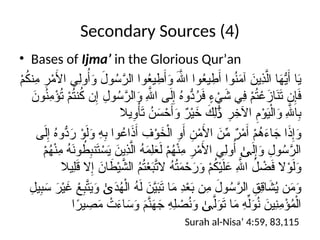
![Secondary Sources (6)
• Qiyas
– Literally means measuring or ascertaining the length,
weight or quality of something
– It also means comparison of two things suggesting their
equality or similarity
– Technically, qiyas means the extension of a shari’ah value
[hukm] from an original case [asl] to a new case [far’]
because the latter has the same effective cause [‘illah] as
the former
– The original case is regulated by a given text and qiyas
seeks to extend the same textual ruling to the new case
by virtue of the commonality of the effective cause
between the original case and the new case](https://image.slidesharecdn.com/islamiclawanditsapplicationppt-250318041445-0210c4f5/85/ISLAMIC-LAW-AND-ITS-APPLICATION-powerpoint-ppt-ppt-67-320.jpg)
![Subsidiary Legal Principles (2)
• Istihsan
– Hanafi definition [adopted from Abu ‘l-Hasan al-Karkhi]:
Istihsan is a principle which authorizes departure from an
established precedent in favor of a different ruling for a
reason stronger than the one which is obtained in that
precedent.
– Hanbali definition [adopted from Ibn Taymiyyah]: Istihsan
is the abandonment of one legal norm (hukm) to another
which is considered better on the basis of the Qur’an,
Sunnah or consensus.
– Maliki definition [adopted from Ibn ‘Arabi]: Istihsan is to
abandon exceptionally what is required by the law
because applying the existing law would lead to a
departure from some of its own objectives.](https://image.slidesharecdn.com/islamiclawanditsapplicationppt-250318041445-0210c4f5/85/ISLAMIC-LAW-AND-ITS-APPLICATION-powerpoint-ppt-ppt-71-320.jpg)
![Subsidiary Legal Principles (3)
• Istihsan
– Shafi’i view on istihsan: it is a form of pleasure-seeking and
arbitrary law-making in religion. It involves personal
opinion, discretion and the inclination of the individual
jurist, an exercise which is not in harmony with the
Qur’anic ayah: “Does man think that he will be left without
guidance?” ًى
د ُ
س َ
كَ
رْ
تُ
ي نَأ ُ
ان َ
نسِ
اإل ُ
ب َ
س ْ
حَ
يَأ[Surah al-
Qiyamah 75:35]
– Despite this denunciation, the Shafi’I jurist , al-Amidi,
stated that al-Shafi’i himself has resorted to istihsan as in
the ruling when he said: I approve [astahsinu] mut’ah (gift
of consolation) at the level of ‘30 dirhams’](https://image.slidesharecdn.com/islamiclawanditsapplicationppt-250318041445-0210c4f5/85/ISLAMIC-LAW-AND-ITS-APPLICATION-powerpoint-ppt-ppt-72-320.jpg)
![Subsidiary Legal Principles (4)
• Istihsan
– It consist of a departure from qiyas jali [obvious analogy]
to qiyas khafi [hidden analogy]
– Bases of the ruling of ‘Umar ibn al-Khattab not to enforce
hadd penalty on amputation for theft due to an acute
famine
– It is an expression of ra’y which gives preference to the
best of different choices as shown in the case when ‘Umar
was approached by Ibn Salamah’s neighbor who asked for
a permission to extend a water canal through Ibn
Salamah’s property, ‘Umar granted the request on the
ground that no harm was to accrue to Ibn Salamah and
extending the water canal would benefit his neighbor](https://image.slidesharecdn.com/islamiclawanditsapplicationppt-250318041445-0210c4f5/85/ISLAMIC-LAW-AND-ITS-APPLICATION-powerpoint-ppt-ppt-73-320.jpg)
![Subsidiary Legal Principles (6)
• Maslaha mursalah
– Conditions of Maslaha mursalah:
• The maslaha must be genuine [haqiqiyah]
• The maslaha must be general [kulliyah]
• The maslaha must not be in conflict with a
principle upheld by the nass and ijma’
• Imam Malik added: the maslaha must be
rational [ma’qulah] and must remove or
prevent hardship to the people
• Imam al-Ghazali added: the maslaha must be
essential [dharuriyah]](https://image.slidesharecdn.com/islamiclawanditsapplicationppt-250318041445-0210c4f5/85/ISLAMIC-LAW-AND-ITS-APPLICATION-powerpoint-ppt-ppt-75-320.jpg)
![Subsidiary Legal Principles (10)
• Istishab
– Varieties of Istishab:
• Presumption of original absence [istishab
al-’adam al-asli]
• Presumption of original presence [istishab al-
wujud al-asli]
• Presumption of the continuity of the general
rules and principles of law
• Presumption of continuity of attributes
[istishab al-wasf]](https://image.slidesharecdn.com/islamiclawanditsapplicationppt-250318041445-0210c4f5/85/ISLAMIC-LAW-AND-ITS-APPLICATION-powerpoint-ppt-ppt-79-320.jpg)
![Subsidiary Legal Principles (12)
• Sadd al-dhara’i
– Hanafi and Shafi’I schools do not recognize it as a
principle of jurisprudence
– Maliki and Hanbali jurists validated it as a proof of
Shari’ah in its own right
– Example: a man sent by the Prophet [saw] to
collect zakat and who took gifts from the people
– The Prophet prevented creditors to take gifts from
debtors which may lead to riba’ and the gift
becoming a substitute for riba’](https://image.slidesharecdn.com/islamiclawanditsapplicationppt-250318041445-0210c4f5/85/ISLAMIC-LAW-AND-ITS-APPLICATION-powerpoint-ppt-ppt-81-320.jpg)
![I – The First Stage: Foundation
• The Prophetic Period [13BH-10AH / 610-632]
– The only sources of law were the Qur’an and the
Sunnah
– A number of Qur’anic verses were direct answers to
queries by Muslims and non-Muslims [some of these
begin with the phrase: “They ask you about…”]
– Others were revealed due to particular incidents [Ex.,
ayat al-li’an (Surah al-Nur 24:6-9)]
– This is same with legislation found with the Sunnah:
they were either answer to questions or
pronouncements due to an incident](https://image.slidesharecdn.com/islamiclawanditsapplicationppt-250318041445-0210c4f5/85/ISLAMIC-LAW-AND-ITS-APPLICATION-powerpoint-ppt-ppt-83-320.jpg)
![II – The Second Stage: Establishment
Era of al-Khulafa al-Rashidun [632-661]
•Abú Bakr al-Ṣiddíq [632-634] administered
justice according to the Glorious Qur’án and the
sunnah of the Holy Prophet
•He appointed ‘Umar ibn al-Khaṭṭáb as qáḍí but
no single case was ever reported to have been
brought before him
•Abu Bakr also acted as qadi and he adjudicated
cases brought before him with impartiality and
with a high sense of justice](https://image.slidesharecdn.com/islamiclawanditsapplicationppt-250318041445-0210c4f5/85/ISLAMIC-LAW-AND-ITS-APPLICATION-powerpoint-ppt-ppt-93-320.jpg)
![II – The Second Stage: Establishment
• When ‘Umar ibn al-Khaṭṭáb [634-644] assumed office, he
sent written instructions to his governors and to judges in
the different part of the Islamic state to administer justice
to the best of their ability, relying upon the Glorious
Qur’án, the sunnah of the Holy Prophet, the ijmá‘ or
consensus of opinion of the venerable companions, and
upon ijtihád
• It was during his time that judges were formally
appointed and the judiciary was treated as a separate
branch of the government, independent of and distinct
from the executive department](https://image.slidesharecdn.com/islamiclawanditsapplicationppt-250318041445-0210c4f5/85/ISLAMIC-LAW-AND-ITS-APPLICATION-powerpoint-ppt-ppt-96-320.jpg)
![II – The Second Stage: Establishment
• When Uthman ibn ‘Affan [644-656] took over the
reins of power, he commissioned Zayd ibn Thábit,
‘Abdu ‘Lláh ibn Zubayr, Said ibn al-‘Ás and ‘Abdu ’l-
Raḥmán ibn Ḥárith ibn Hishám, to rewrite and
prepare several copies of the Holy Qur’án based on
the copy prepared during the time of Abu Bakr
These were sent to Muslims centers in the vast and
expanding Islamic empire to replace those in
circulation
A complete copy of one of this Mushaf was found in
Tashkent and is now kept in the Topkapi palace in
Istanbul](https://image.slidesharecdn.com/islamiclawanditsapplicationppt-250318041445-0210c4f5/85/ISLAMIC-LAW-AND-ITS-APPLICATION-powerpoint-ppt-ppt-103-320.jpg)
![II – The Second Stage: Establishment
• ‘Alí ibn Abi Tálib [656-661] was the fourth
khalifah
• For ‘Ali, injustice is of three kinds:
– The first one is an injustice that would not be
forgiven. This pertains to an injustice done against
Alláh by ascribing partners with Him.
– The second one is an injustice that will be forgiven.
This concerns minor sins committed to oneself.
– The third is one that will not be left unquestioned.
This relates to an injustice done against other men.](https://image.slidesharecdn.com/islamiclawanditsapplicationppt-250318041445-0210c4f5/85/ISLAMIC-LAW-AND-ITS-APPLICATION-powerpoint-ppt-ppt-105-320.jpg)
![III – The Third Stage: Building
• Trends in Fiqh during this period:
– Increase in the number of ijtihad given by
scholars since ijma’ became more difficult to
attend due to dispersal of fuqaha’ to other
areas
– Increase in the tendency of fabricating and
forging ahadith [to support sectarian or
political groups]
– First attempts in the compilation of fiqh as a
means of preserving the ijtihad of the
shahabah](https://image.slidesharecdn.com/islamiclawanditsapplicationppt-250318041445-0210c4f5/85/ISLAMIC-LAW-AND-ITS-APPLICATION-powerpoint-ppt-ppt-113-320.jpg)
![IV – The Fourth Stage: Flowering
Schools of Jurisprudence: The Hanafi Madh’hab
– Founded by Imam Nu’man ibn Thabit [703-767],
popularly known as Imam Abu Hanifah
– The school is characterized by being Ahl al-Ra’y
[people of opinion]
– Legal rules were deduced from the Glorious
Qur’an, the Sunnah, Ijma’ of the Companions,
individual opinion of the Shahabah, qiyas,
istihsan, and ‘urf](https://image.slidesharecdn.com/islamiclawanditsapplicationppt-250318041445-0210c4f5/85/ISLAMIC-LAW-AND-ITS-APPLICATION-powerpoint-ppt-ppt-116-320.jpg)
![IV – The Fourth Stage: Flowering
Schools of Jurisprudence: The Hanafi Madh’hab
– Most prominent students: Imam Abu Yusuf Ya’qub
ibn Ibrahim [735-795] and Imam Muhammad ibn
Hasan al-Shaybani [749-805]
– Followers of the school are mostly found in India,
Afganistan, Pakistan, Iraq, Syria, Turkey, Guyana,
Trinidad, Surinam, and Egypt
– Its spread was due to its adoption by the Ottoman
rulers](https://image.slidesharecdn.com/islamiclawanditsapplicationppt-250318041445-0210c4f5/85/ISLAMIC-LAW-AND-ITS-APPLICATION-powerpoint-ppt-ppt-117-320.jpg)
![IV – The Fourth Stage: Flowering
Schools of Jurisprudence: The Maliki Madh’hab
– Founded by Imam Malik ibn Anas [717-801]
– Being established in Madinah, it is basically
characterized as ahl al-hadith [people of tradition]
– Legal rules are deduced from the Glorious Qur’an,
the Sunnah, ‘amal ahl al-madinah [practice of the
people of Madinah], ijma’ of the Shahabah,
individual opinion of the Shahabah, qiyas,
maslahah mursalah, and ‘urf](https://image.slidesharecdn.com/islamiclawanditsapplicationppt-250318041445-0210c4f5/85/ISLAMIC-LAW-AND-ITS-APPLICATION-powerpoint-ppt-ppt-118-320.jpg)
![IV – The Fourth Stage: Flowering
Schools of Jurisprudence: The Shafi’i Madh’hab
– Founded by Imam Muhammad Idris al-Shafi’I
[769-820]
– Imam Shafi’i was a student of Imam Malik and
Imam Muhammad al-Shaybani
– He tried to combine the legal approaches of ahl
al-ra’y and ahl al-hadith and systematized the
principles of fiqh through the science of usul al-
fiqh](https://image.slidesharecdn.com/islamiclawanditsapplicationppt-250318041445-0210c4f5/85/ISLAMIC-LAW-AND-ITS-APPLICATION-powerpoint-ppt-ppt-120-320.jpg)
![IV – The Fourth Stage: Flowering
Schools of Jurisprudence: The Hanbali Madh’hab
– Founded by Imam Ahmad ibn Hanbal [778-855]
– Among his students were the great compilers of
Hadith, Imam Bukhari and Imam Muslim
– Legal rules were deduced from the Glorious
Qur’an, the Sunnah, ijma’ of the Shahabah,
individual opinion of the Shahabah, hadith dha’if
(weak hadith), qiyas
– Followers of the school are found in Palestine and
Saudi Arabia](https://image.slidesharecdn.com/islamiclawanditsapplicationppt-250318041445-0210c4f5/85/ISLAMIC-LAW-AND-ITS-APPLICATION-powerpoint-ppt-ppt-122-320.jpg)
![IV – The Fourth Stage: Flowering
Schools of Jurisprudence: Other Madha’hib
•Awza’i Madh’hab – founded by Abdu ‘l-Rahman
al-Awza’i [708-774]
•Zaydi Madh’hab – founded by Zayd ibn ‘Ali
[700-740]
•Laythi Madh’hab – founded by Imam Layth ibn
Sa’d [716- 791]
•Thawri Madh’hab – founded by Imam Sufyan al-
Thawri [719-777]](https://image.slidesharecdn.com/islamiclawanditsapplicationppt-250318041445-0210c4f5/85/ISLAMIC-LAW-AND-ITS-APPLICATION-powerpoint-ppt-ppt-123-320.jpg)
![V – Fifth Stage: Consolidation
• From the Decline of the Abbasid to the Fall of
Bagdhad [960-1258]
– Only four of the madha’hib survived
– The scholars of each madh’hab analyzed the
rulings of their madh’hab, deduced the
fundamental principles behind the rulings and
codified them
– Ijtihad fi ‘l-madh’hab developed](https://image.slidesharecdn.com/islamiclawanditsapplicationppt-250318041445-0210c4f5/85/ISLAMIC-LAW-AND-ITS-APPLICATION-powerpoint-ppt-ppt-130-320.jpg)
![V – Fifth Stage: Consolidation
• From the Decline of the Abbasid to the Fall of
Bagdhad [960-1258]
– Books of fiqh were standardized with the order of
topics: taharah, salah, sawm, zakat, hajj; nikah and
talaq; ba’y and other commercial transactions;
adab
– Authors would mention the different proofs used by
the madha’hib and would end proving the
correctness of their school while refuting the views
of the other madha’hib](https://image.slidesharecdn.com/islamiclawanditsapplicationppt-250318041445-0210c4f5/85/ISLAMIC-LAW-AND-ITS-APPLICATION-powerpoint-ppt-ppt-131-320.jpg)
![VI – Sixth Stage: Stagnation and Decline
• From the Fall of Baghdad [1258] to the present
time
– Closure of the gate of ijtihad
– Overdependence on the work of earlier scholars
– The rise of power struggle and break-up of Islamic
empire into mini-states resulted into lack of state
support to scholarship
– There were attempts for reform but were only later
appreciated: Ahmad ibn Taymiyah [1263-1328],
Muhammad ibn Ali al-Shawkani [1757-1835]](https://image.slidesharecdn.com/islamiclawanditsapplicationppt-250318041445-0210c4f5/85/ISLAMIC-LAW-AND-ITS-APPLICATION-powerpoint-ppt-ppt-132-320.jpg)