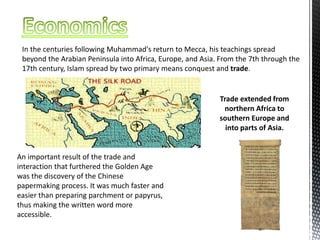
In the centuries following Muhammad's return to Mecca, his teachings spread
beyond the Arabian Peninsula into Africa, Europe, and Asia. From the 7th through the
17th century, Islam spread by two primary means conquest and trade.
An important result of the trade and
interaction that furthered the Golden Age
was the discovery of the Chinese
papermaking process. It was much faster and
easier than preparing parchment or papyrus,
thus making the written word more
accessible.
Trade extended from
northern Africa to
southern Europe and
into parts of Asia.
Sciences advanced in many directions during the Islamic Golden Age.
Arabic numerals, adapted from Hindu, and the idea of zero made algebra possible.
Al─Khwarizmi wrote an algebra textbook that was the standard for centuries.
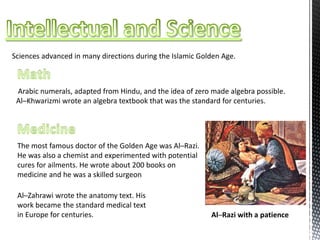
The most famous doctor of the Golden Age was Al─Razi.
He was also a chemist and experimented with potential
cures for ailments. He wrote about 200 books on
medicine and he was a skilled surgeon
Al─Zahrawi wrote the anatomy text. His
work became the standard medical text
in Europe for centuries. Al─Razi with a patience
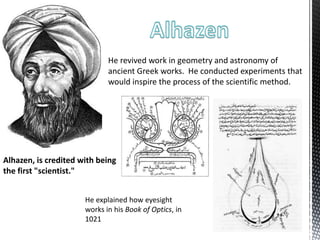
Alhazen, is credited with being
the first "scientist."
He revived work in geometry and astronomy of
ancient Greek works. He conducted experiments that
would inspire the process of the scientific method.
He explained how eyesight
works in his Book of Optics, in
1021
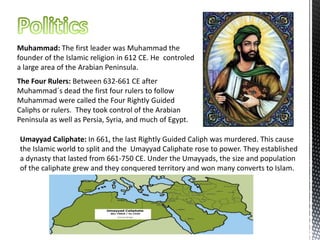
Muhammad: The first leader was Muhammad the
founder of the Islamic religion in 612 CE. He controled
a large area of the Arabian Peninsula.
The Four Rulers: Between 632-661 CE after
Muhammad´s dead the first four rulers to follow
Muhammad were called the Four Rightly Guided
Caliphs or rulers. They took control of the Arabian
Peninsula as well as Persia, Syria, and much of Egypt.
Umayyad Caliphate: In 661, the last Rightly Guided Caliph was murdered. This cause
the Islamic world to split and the Umayyad Caliphate rose to power. They established
a dynasty that lasted from 661-750 CE. Under the Umayyads, the size and population
of the caliphate grew and they conquered territory and won many converts to Islam.
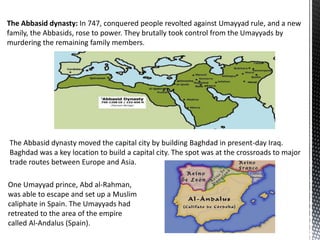
The Abbasid dynasty: In 747, conquered people revolted against Umayyad rule, and a new
family, the Abbasids, rose to power. They brutally took control from the Umayyads by
murdering the remaining family members.
One Umayyad prince, Abd al-Rahman,
was able to escape and set up a Muslim
caliphate in Spain. The Umayyads had
retreated to the area of the empire
called Al-Andalus (Spain).
The Abbasid dynasty moved the capital city by building Baghdad in present-day Iraq.
Baghdad was a key location to build a capital city. The spot was at the crossroads to major
trade routes between Europe and Asia.
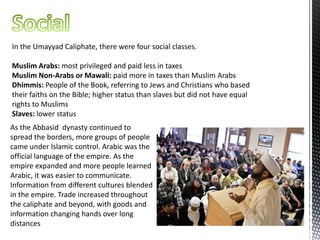
In the Umayyad Caliphate, there were four social classes.
Muslim Arabs: most privileged and paid less in taxes
Muslim Non-Arabs or Mawali: paid more in taxes than Muslim Arabs
Dhimmis: People of the Book, referring to Jews and Christians who based
their faiths on the Bible; higher status than slaves but did not have equal
rights to Muslims
Slaves: lower status
As the Abbasid dynasty continued to
spread the borders, more groups of people
came under Islamic control. Arabic was the
official language of the empire. As the
empire expanded and more people learned
Arabic, it was easier to communicate.
Information from different cultures blended
in the empire. Trade increased throughout
the caliphate and beyond, with goods and
information changing hands over long
distances
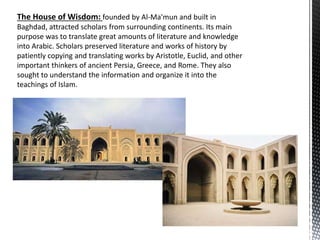
The House of Wisdom: founded by Al-Ma'mun and built in
Baghdad, attracted scholars from surrounding continents. Its main
purpose was to translate great amounts of literature and knowledge
into Arabic. Scholars preserved literature and works of history by
patiently copying and translating works by Aristotle, Euclid, and other
important thinkers of ancient Persia, Greece, and Rome. They also
sought to understand the information and organize it into the
teachings of Islam.
Important cities: Many cities in the Muslim empire became thriving places
of culture, learning, and the arts. These cities include Damascus, Cairo,
Baghdad, and, of course, Córdoba. These cultural centers kept scholarship
alive during the Dark Ages of Europe and played a major role in sparking the
European Renaissance.
By the 10th century, the city of Córdoba
in Spain was bustling. It had an
impressive population of nearly
200,000 people and served as an
impressive cultural center.
Baghdad
Córdoba

Islamic Empire: Evolution and Achievement

  • 2.
    In the centuriesfollowing Muhammad's return to Mecca, his teachings spread beyond the Arabian Peninsula into Africa, Europe, and Asia. From the 7th through the 17th century, Islam spread by two primary means conquest and trade. An important result of the trade and interaction that furthered the Golden Age was the discovery of the Chinese papermaking process. It was much faster and easier than preparing parchment or papyrus, thus making the written word more accessible. Trade extended from northern Africa to southern Europe and into parts of Asia.
  • 3.
    Sciences advanced inmany directions during the Islamic Golden Age. Arabic numerals, adapted from Hindu, and the idea of zero made algebra possible. Al─Khwarizmi wrote an algebra textbook that was the standard for centuries. The most famous doctor of the Golden Age was Al─Razi. He was also a chemist and experimented with potential cures for ailments. He wrote about 200 books on medicine and he was a skilled surgeon Al─Zahrawi wrote the anatomy text. His work became the standard medical text in Europe for centuries. Al─Razi with a patience
  • 4.
    Alhazen, is creditedwith being the first "scientist." He revived work in geometry and astronomy of ancient Greek works. He conducted experiments that would inspire the process of the scientific method. He explained how eyesight works in his Book of Optics, in 1021
  • 5.
    Muhammad: The firstleader was Muhammad the founder of the Islamic religion in 612 CE. He controled a large area of the Arabian Peninsula. The Four Rulers: Between 632-661 CE after Muhammad´s dead the first four rulers to follow Muhammad were called the Four Rightly Guided Caliphs or rulers. They took control of the Arabian Peninsula as well as Persia, Syria, and much of Egypt. Umayyad Caliphate: In 661, the last Rightly Guided Caliph was murdered. This cause the Islamic world to split and the Umayyad Caliphate rose to power. They established a dynasty that lasted from 661-750 CE. Under the Umayyads, the size and population of the caliphate grew and they conquered territory and won many converts to Islam.
  • 6.
    The Abbasid dynasty:In 747, conquered people revolted against Umayyad rule, and a new family, the Abbasids, rose to power. They brutally took control from the Umayyads by murdering the remaining family members. One Umayyad prince, Abd al-Rahman, was able to escape and set up a Muslim caliphate in Spain. The Umayyads had retreated to the area of the empire called Al-Andalus (Spain). The Abbasid dynasty moved the capital city by building Baghdad in present-day Iraq. Baghdad was a key location to build a capital city. The spot was at the crossroads to major trade routes between Europe and Asia.
  • 7.
    In the UmayyadCaliphate, there were four social classes. Muslim Arabs: most privileged and paid less in taxes Muslim Non-Arabs or Mawali: paid more in taxes than Muslim Arabs Dhimmis: People of the Book, referring to Jews and Christians who based their faiths on the Bible; higher status than slaves but did not have equal rights to Muslims Slaves: lower status As the Abbasid dynasty continued to spread the borders, more groups of people came under Islamic control. Arabic was the official language of the empire. As the empire expanded and more people learned Arabic, it was easier to communicate. Information from different cultures blended in the empire. Trade increased throughout the caliphate and beyond, with goods and information changing hands over long distances
  • 8.
    The House ofWisdom: founded by Al-Ma'mun and built in Baghdad, attracted scholars from surrounding continents. Its main purpose was to translate great amounts of literature and knowledge into Arabic. Scholars preserved literature and works of history by patiently copying and translating works by Aristotle, Euclid, and other important thinkers of ancient Persia, Greece, and Rome. They also sought to understand the information and organize it into the teachings of Islam.
  • 9.
    Important cities: Manycities in the Muslim empire became thriving places of culture, learning, and the arts. These cities include Damascus, Cairo, Baghdad, and, of course, Córdoba. These cultural centers kept scholarship alive during the Dark Ages of Europe and played a major role in sparking the European Renaissance. By the 10th century, the city of Córdoba in Spain was bustling. It had an impressive population of nearly 200,000 people and served as an impressive cultural center. Baghdad Córdoba