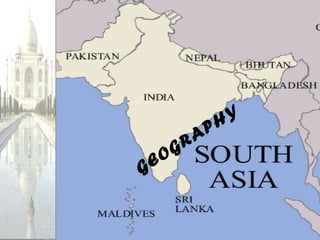
GEOGRAPHY
Physical Features South Asia consists of 7 countries – Bangladesh, Bhutan, India, Maldives, Nepal, Pakistan, and Sri Lanka The landforms include, mountains, rivers, deserts, fertile plains, and plateaus South Asia is located  on a  subcontinent  – a large landmass that rests on its own tectonic plate yet is smaller than a continent
Physical Features Scientists believe that over 60 million years ago the South Asian subcontinent was a part of Africa It broke away, and began to drift north until it “hit” Asia When the tectonic plates collided, mountains were formed  South Asia is divided into three regions: Northern Mountains, Northern Plains, & Southern Region
Physical REgions
Northern Mountains Three mountain systems create the northern border of the Indian subcontinent :  Hindu Kush, Himalaya, and Karakoram The Himalaya Mountains are the highest mountain system in the world and effectively kept South Asia isolated from the East Asia People from Central Asia (Afghanistan and Pakistan) were able to enter South Asia via the  Khyber Pass  of the Hindu Kush Mountains
Mt. Everest Karakoran Mts . Hindu Kush Khyber Pass Northern Mountains ▲ ▲ Himalayas
Hindu Kush
The Khyber Pass Kyber Pass
“ him” [snow] “ aalaya” [home] Mt. Everest is   29,035 feet. It    is the highest    mt. peak in the   world. The Himalayas
Northern Plain Wide fertile plains lie south of the mountains and are fed by three rivers The  Indus River  begins in the Himalayas and flows southwest through Pakistan into the Arabian Sea  The  Ganges River  begins in the Himalayas and flows southeast through Bangladesh and eventually connects with the  Brahmaputra River The Ganges Plain has India’s richest soil and is home to about 40% of India’s population
Indus R. Ganges R. Brahmaputra R. Arabian Sea Indian Ocean Bay of Bengal Northern Plain Rivers
Southern Region At the base of the sub-continent are two mountain chains – the  Eastern Ghats  and the  Western Ghats Between the mountains is a highland area known as the  Deccan Plateau   The Western Ghats block seasonal rains and area is extremely dry South of the Deccan Plateau is the  Karnataka Plateau  – this area receives seasonal rains and has fertile soil
Deserts / Plateaus Thar Desert Deccan Plateau Tibetan Plateau Deserts & Plateaus
The Deccan Plateau 31,800 square miles in size. Elevation range:  2,000 – 8,000 feet high. From the Sanskrit word, “dakshina” [“the south”].
The Tibetan Plateau The “Roof of the World.” average elevation is 16,400 feet.
The Thar Desert The Great Indian Desert 200  - 1500 feet in elevation. up to 127ºF in July.
Climate Much of the subcontinent has 3 seasons: dry, wet, and cool – the seasons are influenced by the rainfall Dry season  – the land heats up, ground becomes hard, vegetation shrivels (M, A, M) Wet season  – (monsoon season) southwest wind brings heavy rain (J, J, A) One of the wettest places on earth is Cherrapunji with 450 in. a year Cool season  – winds reverse blow from the northeast cooling the land down (S – F)
Climate Regions of South Asia

Sageography 091002130315-phpapp01

  • 1.
  • 2.
    Physical Features SouthAsia consists of 7 countries – Bangladesh, Bhutan, India, Maldives, Nepal, Pakistan, and Sri Lanka The landforms include, mountains, rivers, deserts, fertile plains, and plateaus South Asia is located on a subcontinent – a large landmass that rests on its own tectonic plate yet is smaller than a continent
  • 3.
    Physical Features Scientistsbelieve that over 60 million years ago the South Asian subcontinent was a part of Africa It broke away, and began to drift north until it “hit” Asia When the tectonic plates collided, mountains were formed South Asia is divided into three regions: Northern Mountains, Northern Plains, & Southern Region
  • 4.
  • 5.
    Northern Mountains Threemountain systems create the northern border of the Indian subcontinent : Hindu Kush, Himalaya, and Karakoram The Himalaya Mountains are the highest mountain system in the world and effectively kept South Asia isolated from the East Asia People from Central Asia (Afghanistan and Pakistan) were able to enter South Asia via the Khyber Pass of the Hindu Kush Mountains
  • 6.
    Mt. Everest KarakoranMts . Hindu Kush Khyber Pass Northern Mountains ▲ ▲ Himalayas
  • 7.
  • 8.
    The Khyber PassKyber Pass
  • 9.
    “ him” [snow]“ aalaya” [home] Mt. Everest is 29,035 feet. It is the highest mt. peak in the world. The Himalayas
  • 10.
    Northern Plain Widefertile plains lie south of the mountains and are fed by three rivers The Indus River begins in the Himalayas and flows southwest through Pakistan into the Arabian Sea The Ganges River begins in the Himalayas and flows southeast through Bangladesh and eventually connects with the Brahmaputra River The Ganges Plain has India’s richest soil and is home to about 40% of India’s population
  • 11.
    Indus R. GangesR. Brahmaputra R. Arabian Sea Indian Ocean Bay of Bengal Northern Plain Rivers
  • 12.
    Southern Region Atthe base of the sub-continent are two mountain chains – the Eastern Ghats and the Western Ghats Between the mountains is a highland area known as the Deccan Plateau The Western Ghats block seasonal rains and area is extremely dry South of the Deccan Plateau is the Karnataka Plateau – this area receives seasonal rains and has fertile soil
  • 13.
    Deserts / PlateausThar Desert Deccan Plateau Tibetan Plateau Deserts & Plateaus
  • 14.
    The Deccan Plateau31,800 square miles in size. Elevation range: 2,000 – 8,000 feet high. From the Sanskrit word, “dakshina” [“the south”].
  • 15.
    The Tibetan PlateauThe “Roof of the World.” average elevation is 16,400 feet.
  • 16.
    The Thar DesertThe Great Indian Desert 200 - 1500 feet in elevation. up to 127ºF in July.
  • 17.
    Climate Much ofthe subcontinent has 3 seasons: dry, wet, and cool – the seasons are influenced by the rainfall Dry season – the land heats up, ground becomes hard, vegetation shrivels (M, A, M) Wet season – (monsoon season) southwest wind brings heavy rain (J, J, A) One of the wettest places on earth is Cherrapunji with 450 in. a year Cool season – winds reverse blow from the northeast cooling the land down (S – F)
  • 18.