Arabic
Literature
 ‫العربي‬ ‫الدب‬
Arabic Literature
• Produced by writersin the Arabic
language.
• Adab istheArabic word for literature.
• Includesworksof Turks, Persians,
Syrians, Egyptians, Indians, Jewsand
other Africansand Asians, aswell as
theArabsthemselves.
Arabic Literature
• Not from literary motivesbut religiousand
practical needs.
Quran
* Finest literaturework in Arabic Language.
History and Culture
• Under theAbbasids(750-1258)
* Hellenic, Syrian, Pahlari, and
Sanskrit worksbecameavailablein
translation.
* Arabic Languagedeveloped as
vehicleof scienceand philosophy.
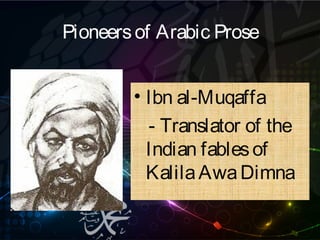
Pioneersof Arabic Prose
• Ibn al-Muqaffa
- Translator of the
Indian fablesof
KalilaAwaDimna
Pioneersof Arabic Prose
• Al-Jahiz
- Influential
Arab in the
establishment
of thebelles-
lettres
compedia.
(adab)
Riseof thenew Arabic-Persian
Cultureof Baghdaol
• Philosophy, mathematics, law,
Qur’anic interpretation and
criticism, history, and science
werecultivated.
• Collectionsof early Arabic poetry
werecompiled during thisperiod.
4th
to 7th
Century
(Golden Ageof Lyric Poetry)
• Poems are strongly personal
qasidaor odes.
• The themes are love, fighting,
courageand chase.
• Poet speaks directly not
romantically, of nature and power
of God.
• Quran
- Primary document of Islamic.
• Poetry gained prestigeunder the
Umayyadsbecauseof Al-Alchtal
and Al-Farazdaq.
At theEnd of the8th
Century
• Abu Nuwas
- prominent court poet
• Omar Ibn al-Faridh
- greatest mystic poet
• Influenceof Indiaand Persiaseen
in Arabic proseromance.
• Thegreatest collection isthe
Thousand and OneNights.
Major Writers
• Bukhari
• Tabari
• Masudi
• Ibn Khaldun*
• Ibn al-Athir
• Ibn Batuta
• Spanish Arabsproduced fine
poetsand scholars.
• Their worksbecameknown in
Europe.
During the19th
Century
• Printing in Arabic began in
earnest.
• Newspapers, encyclopedia, and
bookswerepublished.
• Interest in modern Arabic
Literatureincreased becauseof
Naguib Mahfouz.
20th
and 21st
Century
• Famouswritersinclude:
Abdelrahman Munit, Sonallah
Dorahim, YahyaHakki, Uhassan
Kanati, AlaaAl Aswany, Elias
Khoury, and Mahmoud Saeed.
• International Prizefor Arabic
Fiction stimulated theinterest of
Arabic Fiction.
Characteristics& Significance
Characteristics
• Thestructureof theArabic
Language.
• Thetypical poem of thisperiod is
theqasidah.
* Abu Al-Farat Al-Isfahani
* Kitab al-Hayawan
* Kitab al-Bayan waal-Tabyin
* Kitab al-Bukhala
Significance
• Quran, theprimary document.
• It has114 suraswhich contain
6,236 ayat.
• It containsinjunctions, narratives,
homilies, and parables,
• TheQuran istheholy book of
Islam.
RepresentativeWriters
Naguib Mahfouz
• Wasborn in
December 11, 1911
and died in August
30, 2006.
• An Egyptian writer.
• Heisregarded as
oneof thefirst
contemporary
writersof Arabic
Literature.
Hepublished
• 50 novels
• 350 short stories
• 12 of moviescripts
• 5 playsover a70 yearscareer
Nizar Tawfiq Qabbani
(21 March 1923 – 30
April 1998)
- WasaSyrian
diplomat, poet and
publisher.
- Born in theSyrian
Capital of
Damascus.
- Studied at theNat’l
Scientific College
School.
• Helater studied law at the
DamascusUniversity.
• After graduating from law school,
heworked for theSyrian Foreign
Ministry.
Khalil Gibaran
January 6, 1883 – April 10,
1931
- Lebaneseartist, poet and
writer
- Born in thetown of
Bsharri in thenorth of
modern-day Lebanon.
- Immigrated with his
family to theU.S.
- Literary and political rebel.
- Third best-selling poet of all time.
- Died in New York City (48 years
old)
“I am not politician, nor do I wish
to becomeone.” and “Spareme
thepolitical eventsand power
struggles, asthewholeearth is
my homeland and all men aremy
fellow countrymen.”
•Prepared by:
Teresa Mae J. Garcia

Arabic Literature